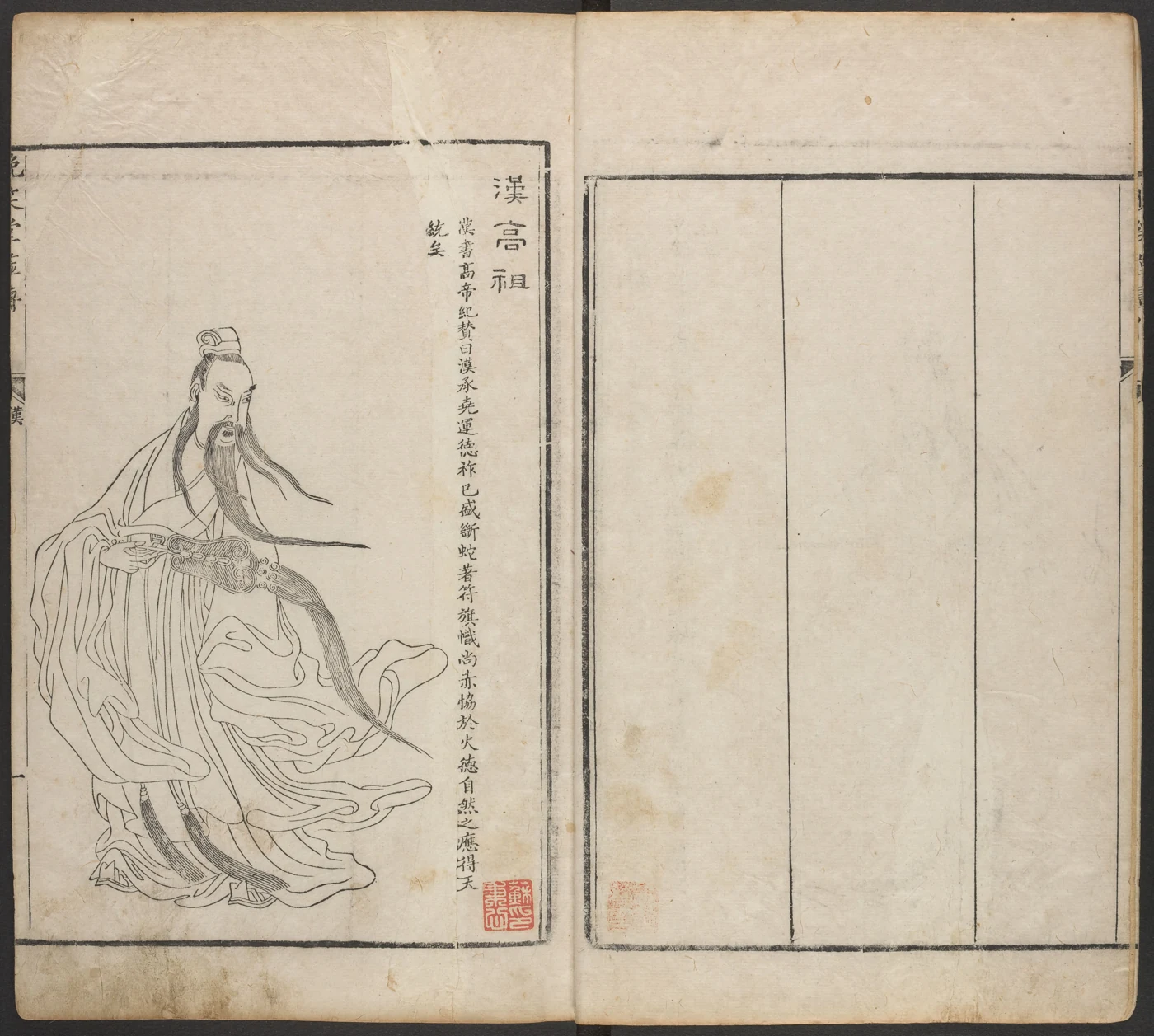
Biography
Family Background and Early Years
Official histories record little about Liu Bang's ancestry. The *Records of the Grand Historian* refers to his father simply as “Liu Taigong” and his mother as “Liu Ao,” without definite personal names. The *Book of Han: Annals of Emperor Gao* cites the Spring and Autumn-era Jin historian Cai Mo in tracing the Liu lineage back to the legendary Yao of Taotang, with Liu Lei in the Xia and the Fan lineage in Zhou. Later genealogical traditions claimed that Liu Bang's great-grandfather Liu Qing moved to Pei County and that his grandfather Liu Ren moved to Fengyi and served as a local headman. These accounts appear in the *New Book of Tang* genealogies and Gu Yanwu's *Record of Daily Knowledge*, but the source notes that they are not clearly supported by the standard histories and should be treated as genealogical tradition.
Two birth dates for Liu Bang are preserved: 256 BCE and 247 BCE. The *Records of the Grand Historian* describes him as having a prominent nose, a “dragon-like face,” fine whiskers and beard, and seventy-two dark marks on his left thigh. It also depicts him as benevolent, generous, open-minded, and unconcerned with petty details, but as disliking agricultural work, for which his father often scolded him as an idler.
As a youth Liu Bang studied basic literacy with Lu Wan and became his close friend. He grew up in the cultural borderland of former Wei and Chu, was familiar with Chu songs, and admired the reputation of Lord Xinling, Wei Wuji. He later traveled west to the former state of Wei, but Lord Xinling had long since died. Liu Bang therefore associated with Zhang Er, a former retainer of Lord Xinling, living for several months as a guest in Waihuang County. After Qin destroyed Wei around 225 BCE, Zhang Er became a wanted man and his followers scattered. Liu Bang returned to his home in Pei.
Adulthood and the Beginning of Rebellion
After Qin conquered Chu around 223 BCE, Liu Bang entered Qin service through probationary recruitment and became pavilion chief of Sishui. He was familiar and jocular with county officials and enjoyed wine and women. On one occasion he performed corvée service in Xianyang and saw Qin Shi Huang on procession, exclaiming, “Ah, a true man should be like this!”
Lü Gong of Shanfu moved to Pei County while fleeing enemies and became friendly with the county magistrate. Local notables and officials went to congratulate him, with Xiao He managing reception and assigning lower seating to those giving less than one thousand cash. Liu Bang, then a pavilion chief, falsely announced a gift of ten thousand cash even though he had brought nothing. Lü Gong, skilled in physiognomy, was greatly impressed by his appearance and seated him prominently. After the banquet he told Liu Bang that he had never seen a face equal to Ji's and offered his daughter Lü Zhi in marriage despite his wife's objections. Lü Zhi later bore Emperor Hui Liu Ying and Princess Luyuan.
As pavilion chief, Liu Bang was ordered to escort laborers to Mount Li. Many escaped on the journey, and he concluded that nearly all would be gone before reaching the destination. At a marsh west of Fengyi he stopped to drink and released the remaining laborers at night, telling them all to leave because he too would disappear. More than ten strong men chose to follow him into the Mangdang marshes. Legends later developed around Liu Bang killing a serpent while drunk and being identified as the “son of the Red Emperor.” After these stories spread, young men from Pei increasingly joined him and his following grew into the hundreds.
Uprising at Pei and the War against Qin
In July 209 BCE, Chen Sheng and Wu Guang rose at Dazexiang and established the “Zhang Chu” regime. The magistrate of Pei considered joining the rebellion. Xiao He and Cao Can urged him to recall Liu Bang and other fugitives to strengthen his forces. The magistrate sent Fan Kuai to summon Liu Bang but then changed his mind, closed the city, and planned to kill Xiao He and Cao Can. They escaped and joined Liu Bang outside the walls. Liu Bang shot a silk letter into the city calling on the inhabitants to kill the magistrate. The elders of Pei did so, opened the gates, and admitted him. Xiao He and Cao Can, both civil clerks who feared collective punishment if the rebellion failed, strongly supported Liu Bang as leader. He was made magistrate of Pei and, following Chu practice, styled Duke of Pei. An altar was erected and red banners raised; his force soon grew to about three thousand men.
After rising, Liu Bang attacked Huling and Fangyu and then returned to defend Fengyi. The Qin supervisor of Sishui Commandery besieged Feng but was defeated by Liu Bang's forces. Liu Bang left Yong Chi to defend Feng and personally attacked Xue. Zhou Shi, a minister of Wei, later attacked Fangyu, and Yong Chi surrendered Fengyi to Wei. Liu Bang failed to retake it. At this time Qin Jia and Ningjun of Dongyang had installed Jing Ju as King of Chu. Liu Bang set out to join him and met Zhang Liang on the way. He then fought Qin forces repeatedly and captured Dang Commandery, gaining five to six thousand troops.
Joining Xiang Liang and Entering Guanzhong
When Xiang Liang was encamped at Xue, Liu Bang joined him with more than one hundred cavalry. Xiang Liang gave him five thousand soldiers and ten officers of the rank of Fifth Grandee. Liu Bang then retook Fengyi, forcing Yong Chi to flee to Wei. After learning that Chen Sheng was definitely dead, Xiang Liang gathered the commanders and installed Xiong Xin, a grandson of the former King Huai of Chu, as King Huai of Chu, while Xiang Liang styled himself Lord Wuxin. Liu Bang accompanied Xiang Liang in campaigns to assist Tian Rong, pursued Qin forces with Xiang Yu to Chengyang, defeated Zhang Han east of Puyang, and fought further around Dingtao and Yongqiu.
In September 208 BCE, Zhang Han defeated and killed Xiang Liang at Dingtao. King Huai moved his headquarters to Pengcheng, brought Xiang Yu's and Lü Chen's forces under his own authority, and stationed Liu Bang at Dang. In 207 BCE King Huai made the famous agreement that whoever first entered and pacified Guanzhong would rule there. Liu Bang was sent west against Qin. He incorporated scattered forces, recruited men such as Chen Hui and Li Yiji, and entered Guanzhong through Wuguan. In October 207 BCE, the Qin ruler Ziying came in a plain carriage with white horses and a cord around his neck to surrender. Liu Bang entered Xianyang and made the Pact of Three Articles with the elders of Guanzhong: murder would be punished by death, and injury and theft would be punished according to the offense. The rest of the Qin laws were set aside.
Feast at Hong Gate and the Han Kingship
After Xiang Yu entered the passes, he encamped at Hong Gate opposite Liu Bang's forces. Through the mediation of Zhang Liang and Xiang Bo, Liu Bang personally attended the Feast at Hong Gate, narrowly avoiding assassination before escaping. In February 206 BCE, Xiang Yu divided the former Qin territories among regional rulers and enfeoffed Liu Bang as King of Han, giving him Ba, Shu, and Hanzhong with his capital at Nanzheng. In Hanzhong, Liu Bang appointed Han Xin as General-in-Chief. The source recounts the traditional stratagem summarized as “openly repairing the plank roads while secretly crossing at Chencang.” In May 206 BCE he returned east, recovered the Three Qin, and established his capital at Yueyang. A four-year war with Xiang Yu followed.
The Chu–Han Contention and Accession as Emperor
During the Chu–Han Contention, Liu Bang became known for appointing capable men, listening to advice, and allowing subordinates to use their strengths. He integrated forces opposed to Xiang Yu and allied with Peng Yue, Ying Bu, Han Xin, and others. At the Battle of Gaixia, Xiang Yu was defeated and eventually killed himself. In February 202 BCE, Liu Bang proclaimed himself emperor north of the Si River at Dingtao, founded the Han dynasty, and initially established his capital at Luoyang. In the fifth month he held a banquet in the Southern Palace of Luoyang to distribute rewards and discuss merit. He later accepted the advice of Lou Jing and Zhang Liang to establish the capital in Guanzhong. In 200 BCE, after Changle Palace was completed, Chang'an became the formal capital.
After becoming emperor, Liu Bang eliminated or reduced the power of non-Liu regional kings, including Zang Tu, Han Xin, Peng Yue, and Ying Bu, while enfeoffing members of the Liu clan. In 195 BCE he was wounded while suppressing Ying Bu's rebellion. On the twenty-fifth day of the fourth month, according to one account the bingchen day, he died at Changle Palace and was buried at Changling.
The Descent of the Liu Clan and the Move to Fengyi
The Qianfu lun, in the chapter on clans and surnames, quotes the encomium of the Han shu's annals of Gaozu to cite the words of Cai Mo, historian of Jin in the Spring and Autumn period: after the decline of the Taotang clan there was Liu Lei, who learned to tame dragons and served Kong Jia, and the Fan clan descended from him. The Jin minister Fan Xuanzi likewise described his own line: above Yu the ancestor was of the Taotang clan, in Xia of the Yulong clan, in Shang of the Shiwei clan, in Zhou of the Tangdu clan, and when the lords of Jin held the covenant of Xia they were the Fan clan. The Fan were hereditary masters of the Jin and in the time of Duke Wen of Lu fled to Qin; afterwards they returned to Jin, and those of them who remained in Qin became the Liu clan. Liu Xiang says that in the Warring States period the Liu clan was taken from Qin by Wei. When Qin destroyed Wei it moved the people of Daliang and made its capital at Feng, which is why Zhou Shi told Yong Chi that Feng was a colony of Liang; and so the Han sang of Gaozu that the Han emperor's line came from the Tang emperor, that in Zhou it was Liu in Qin, and that passing through Wei eastward it became the Dukes of Feng. Liu Bang's ancestral home was Daliang, and his family moved east to Fengyi with the fall of Wei, so that his native place was Zhongyang village in Fengyi of Pei, and the origin of his forebears can still be traced in the accounts of the men of Han.
His Early Years and the Office of Pavilion Chief at Sishui
When Liu Bang was a pavilion chief he wore a cap of green bamboo skin, which he had made for him at Xue by the thief-catcher. Ying Shao says that the cap was made of the first green skin of the bamboo, and is the cap known today as the magpie-tail cap; that in the old system a pavilion had two soldiers, one the pavilion father, who kept the gate and swept, and the other the thief-catcher, who hunted robbers; and that Xue was a county of Lu which had a craftsman for caps, so that he went there to have it made. Cai Yong's Duan du says that the long cap was a Chu institution, that Gaozu made his of bamboo skin, and that it was called the Liu cap. The lowliness of such a badge shows how he rose from the lanes of a country town. He often took leave to go to his fields, and once when Empress Lü and her two children were weeding in the field an old man passed and asked for a drink, and she gave him food. The old man read Empress Lü's face and said that she would be honoured by the world; asked to read the two children, he said of Xiaohui that it was this boy who would make his mother great, and found the Princess of Luyuan likewise noble. When the old man had gone, Liu Bang came from a neighbouring hut, and Empress Lü told him that a stranger had read the faces of mother and children and found them all greatly noble. He asked where the man was, was told that he was not yet far off, and overtook him and questioned him; the old man said that the lady and the children all resembled him, and that his own face was noble beyond words. Liu Bang thanked him and said that if it were as he said he would not forget his kindness, and when he came to greatness no one knew where the old man had gone.
Liu Bang also used to drink on credit at the taverns of old dame Wang and old dame Wu, and when drunk would lie down to sleep there, and the two women saw a dragon's shape above him and were astonished; whenever he stayed and drank, they sold several times as much wine as usual. At the year's end, when the accounts were settled, the two houses often broke his tallies and cancelled what he owed. Afterwards, when he was sent with conscripts to Mount Li, many of them ran away on the road, and reckoning that all would have gone before he reached the place, he released them by night, saying that they might all go and that he too would take himself off from that time; of the conscripts, more than ten of the strong men chose to follow him. Being drunk, he went by a footpath through the marsh by night and sent one man ahead, who came back to say that a great snake lay across the way and begged them to turn back; Liu Bang, drunk, said that a brave man's going was nothing to fear, and went on, drew his sword and cut the snake in two, so that the way was opened; after several li he was very drunk and lay down to sleep. Later men came to the place of the snake and saw an old woman weeping in the night, and when they asked her why, she said that her son was the son of the White Emperor, that he had taken the form of a snake lying across the way, and that the son of the Red Emperor had now cut him in two, and that she wept for this. Because the snake he killed was the son of the White Emperor and the killer the son of the Red Emperor, his banners were afterwards all red. His followers then hid in the marshes and hills of Mang and Dang and gathered to several tens or hundreds.
The Rising at Pei and His Establishment as Duke of Pei
After Chen Sheng rose, the prefectures and counties killed their chief officials in great numbers to respond to him, and the magistrate of Pei, in fear, wished to answer Chen She with Pei. Xiao He and Cao Can, the clerk and the chief of staff, said that he was an official of Qin, and that if he now turned against it and led the sons of Pei, they would probably not obey; he should summon those who had fled abroad, some hundreds of men, and use them to compel the rest, who would not dare to disobey. Fan Kuai was therefore sent to summon Liu Ji, who already had several tens or hundreds of men, and Fan Kuai came back with him; but the magistrate repented, and fearing a change shut the city and guarded it, and wished to kill Xiao He and Cao Can, who in fear climbed over the wall and took refuge with Liu Ji. Liu Ji then wrote on silk and shot it over the wall into the city, telling the elders of Pei that the world had long suffered under Qin, that although the elders were now guarding the city for the magistrate, the lords were rising together and would put Pei to the sword, that they should join to kill the magistrate and choose one of their sons to be set up, so as to answer the lords and keep their families whole, and that otherwise father and son would be slaughtered together to no purpose. The elders accordingly led their sons in killing the magistrate and opened the gate to receive Liu Ji, wishing to make him magistrate of Pei. Liu Ji said that the world was in disorder and the lords rising together, and that if the wrong man were set over them they would be ruined in one defeat; that he did not presume to spare himself, but feared his ability was small and he could not preserve the fathers and elder brothers and their sons; and that this was a great matter, and they should choose among themselves a fitter man. Xiao He and Cao Can and the others, being clerks who valued themselves, feared that the affair would fail and that Qin would afterwards exterminate their families, and all yielded to Liu Ji. The elders all said that of the strange things they had heard of Liu Ji in their lives he was surely destined to be honoured, and that when they divined by shell and stalk none was so auspicious as Liu Ji. Liu Ji declined several times, but none dared to take it, and he was set up as Duke of Pei. He sacrificed to the Yellow Emperor, offered to Chi You in the courtyard at Pei, smeared the drums and banners with blood, and his banners were all red. The young men and the bold clerks, such as Xiao, Cao and Fan Kuai, then gathered two or three thousand sons of Pei for him, and his enterprise began here.
The Meeting with Li Yiji and the Grain of Chenliu
As Liu Bang advanced westward he passed through Gaoyang, where Li Yiji was a village gatekeeper and said that many generals had passed that way, but that he judged the Duke of Pei a great and generous man, and asked to see and persuade him. The Duke of Pei was sitting sprawling on his couch while two women washed his feet; Li Yiji entered and made a long bow without kneeling, saying that if the lord meant to put the wicked Qin to death he should not sit sprawling before his elders. The Duke of Pei then rose, smoothed his clothes, thanked him and gave him the seat of honour. Li Yiji spoke of the days of the vertical and horizontal alliances of the six states; the Duke of Pei was pleased, had food given him and asked what plan he had. Li Yiji said that the lord had raised a rabble and gathered scattered troops, not ten thousand in all, and meant to march straight into a strong Qin, which was what was called feeling for the tiger's mouth; that Chenliu was the crossroads of the empire, a place of four roads and five thoroughfares, and its city had much stored grain; that he knew its magistrate and asked to be sent to bring him over to the lord, and that if he would not hear reason the lord should attack the city and he would be his man within. Li Yiji was therefore sent, the Duke of Pei followed with his troops, Chenliu was taken, and Li Yiji was styled Lord of Guangye; he also spoke of his younger brother Li Shang, who was given several thousand men to reduce the land southwest of the Duke of Pei, while Li Yiji himself was always the envoy, riding on missions to the lords. A horseman under the Duke of Pei happened to be a son of Li Yiji's village, and since the Duke of Pei was always asking after the worthy men and braves of the district, the horseman told him, and Li Yiji sought an audience on the strength of it; such were the ways by which he gathered men. Afterwards the Duke of Pei fought the Qin general Yang Xiong at Baima and again east of Quyu, destroying him; Yang Xiong fled to Xingyang, and the Second Emperor sent an envoy to behead him and parade his head.
The Terms at Wancheng and the Entry into the Pass
The Duke of Pei then led his troops back by night by another road, changed his banners, and at dawn surrounded Wancheng threefold, and the governor of Nanyang meant to cut his own throat. His retainer Chen Hui said that it was not yet too late to die, and climbing over the wall he saw the Duke of Pei and said that he had heard the lord's agreement, that whoever entered Xianyang first should be king there; that the lord was now staying to besiege Wancheng, which was the chief city of a great commandery with dozens of linked towns, many people and much store, and whose officials thought surrender meant death and therefore held the walls; that if the lord spent the whole day attacking, his soldiers would suffer heavy losses, and if he led his troops away, Wancheng would surely follow at his back, so that he would both forfeit the agreement on Xianyang and have the trouble of a strong Wancheng behind him; and that in the lord's interest it was better to agree to its surrender, enfeoff its governor, have him stay and hold it, and take its armed men west with him, when the towns not yet taken would open their gates at the news and wait for him, so that his road would be free of encumbrance. The Duke of Pei agreed, made the governor of Wan the Marquis of Yin and gave Chen Hui a thousand households. Thereafter, as he went west, the towns submitted at the news. At that time Xiang Yu and Song Yi were going north to relieve Zhao, and when Xiang Yu killed Song Yi and took his place as supreme general, with the generals and Qing Bu all under him, he broke the Qin army under Wang Li and received the surrender of Zhang Han, and all the lords attached themselves to him; and when Zhao Gao had killed the Second Emperor and sent someone to agree on dividing the passes and ruling them as kings, the Duke of Pei thought it a trick and used Zhang Liang's plan, sending Li Yiji and Lu Jia to persuade the Qin generals and entice them with profit, and then attacking Wuguan by surprise and breaking it. He fought the Qin army again south of Lantian, displaying yet more dummy banners and forbidding all plundering on the march, so that the men of Qin were pleased and their army slackened, and he broke them utterly, fought again north of the city and broke them again, and pressing his advantage destroyed them. In the tenth month of the first year of Han the Duke of Pei's army was first among the lords to reach Bashang, and the Qin king Ziying, in a plain carriage with white horses and a cord about his neck, sealed the imperial seal and credentials and surrendered beside the Zhidao road.
Entering Xianyang and Withdrawing to Bashang
Some of the generals wished to put the Qin king to death; the Duke of Pei said that King Huai had sent him precisely because he could be lenient, and that since the man had already submitted it was inauspicious to kill him. He handed the Qin king over to the officials and entered Xianyang. Wishing to stay in the palace and rest there, he was remonstrated with by Fan Kuai and Zhang Liang, and so sealed the treasuries of precious goods and returned with his army to Bashang. He summoned the elders and notables of the counties and said that they had long suffered under the harsh laws of Qin, under which slander was punished with the extermination of the family and private speech with execution in the market; that he had agreed with the lords that whoever entered the pass first should be king there, and that he was to be king of the passes; that he made a covenant with the elders in three articles only, that a murderer should die and that wounding and robbery should be punished accordingly, and that all other Qin laws were abolished; that the officials were all to remain at their posts; and that he had come to rid the elders of harm and not to commit outrages, so that they should not be afraid; and that he had withdrawn to Bashang to await the arrival of the lords and settle the terms with them. Envoys were sent with the Qin officials through the counties and villages to proclaim this, and the men of Qin were greatly pleased and vied in bringing cattle, sheep and wine to feast the soldiers; the Duke of Pei declined them, saying that the granaries were full and there was no want, and that he did not wish to put the people to expense. The people rejoiced the more and were afraid only that he might not be king of Qin. This hope of the men of Qin became the foundation of his later recovery of the three Qin regions.
Before Hongmen and the Message through Xiang Bo
At that time Xiang Yu reached the passes, killed the Qin king Ziying, put Xianyang to the sword and burned it, divided the empire and set up the lords, and breaking the agreement divided the passes into four states. The Duke of Pei, having entered the pass, was advised by someone to hold it against the lords, for then the land of Qin could be ruled by him alone, and he listened. When Xiang Yu came and was angry and wished to attack him, Zhang Liang asked who had made this plan for the king, and the Duke of Pei said that a shallow fellow had told him to hold the pass and admit no lord, since then the land of Qin could be ruled by him alone, and that he had listened. Zhang Liang asked whether the king's troops could withstand Xiang Yu's; the Duke of Pei was silent and said that they could not, and asked what was to be done. Zhang Liang said that he would go and tell Xiang Bo that the Duke of Pei did not dare to turn against Xiang Yu. The Duke of Pei asked how he and Xiang Bo knew each other, and Zhang Liang said that they had been friends in Qin times, that Xiang Bo had killed a man and he had saved him, and that in the present danger he had been kind enough to come and tell him. Asked which of them was the elder, Zhang Liang said that Xiang Bo was, and the Duke of Pei said to call him in, and promised to treat him as an elder brother. Zhang Liang went out and invited Xiang Bo, who came in to see the Duke of Pei, and the Duke of Pei pledged him a cup of wine and wished him long life, and they agreed to a marriage between their houses, saying that since entering the pass he had not dared to come near the least thing, that he had registered the officials and people and sealed the treasuries to await the general, that guards had been set at the pass only against bandits and emergencies, and that he looked for the general's coming day and night, how then should he dare rebel; and he begged Xiang Bo to tell the whole of his own unwillingness to be ungrateful. Xiang Bo agreed, and told the Duke of Pei that he must come early the next day to thank Xiang Yu in person, and the Duke of Pei said he would. Xiang Bo then went back by night to the camp and reported the Duke of Pei's words to Xiang Yu in full, adding that if the Duke of Pei had not first broken through the passes, would the lord have dared to enter at all; that it was unjust to attack a man who had done such service, and better to treat him well. Xiang Yu agreed.
The Defeat at Pengcheng and the Children Thrown from the Chariot
When Liu Bang marched east to contend with Xiang Yu he suffered a great defeat near Pengcheng. The Shi ji, in the Basic Annals of Xiang Yu, records that a great wind rose from the northwest, breaking trees and tearing off roofs and raising sand and stones so that the day grew dark, and met the Chu army head on; the Chu army fell into utter confusion and broke up, and the King of Han escaped with a few dozen horsemen. He wished to pass by Pei and gather his household to go west, but Chu also sent men to Pei to take the King of Han's family, and the whole household had fled and could not be found. On the road he met Xiaohui and the Princess of Luyuan and took them into his carriage; when the Chu horse pursued and the King of Han was hard pressed, he pushed Xiaohui and the Princess out of the carriage, and the Duke of Teng repeatedly got down and took them back in, three times over. The Duke of Teng said that however urgent it was, one could not drive the horses to death, and how could one abandon them; and so they escaped. Later ages have mostly read this as proof of Liu Bang's hardness, yet amid headlong flight the struggle between saving the army and the love of father for son makes this one of the scenes in which his nature is most plainly seen in the long standoff between Chu and Han.
The Defeat at Chenggao and the Stand at Guangwu
As Chu and Han stood off against each other, the ground between Chenggao and Guangwu was what both sides had to hold. The Shi ji, in the Basic Annals of Gaozu, records that in the fourth year Xiang Yu told Cao Jiu, grand commandant and Marquis of Haichun, to guard Chenggao carefully, and if the Han challenged, to beware of fighting, only to prevent them going east; that within fifteen days he would settle the land of Liang and rejoin him; and he then attacked Chenliu, Waihuang and Suiyang and took them. The Han indeed challenged the Chu army several times, the Chu army did not come out, and for five or six days they sent men to insult them; the grand commandant in his anger took his troops across the Fan River, and when half had crossed the Han attacked and destroyed the Chu army, taking all their gold, jade and goods, and Cao Jiu and the chief secretary Xin both cut their throats on the Fan. Having lost Chenggao, Xiang Yu brought his army back from Liang and encamped facing the Han at Guangwu, and there they held each other for several months. At that time Peng Yue repeatedly rose in the land of Liang and cut off the Chu supply, which troubled Xiang Yu, and he therefore made a high chopping block, set the Old Man, Liu Bang's father, upon it, and told the King of Han that if he did not come down quickly he would boil his father. The King of Han said that he and Xiang Yu had both received the mandate of King Huai facing north and were sworn as brothers, so that his father was Xiang Yu's father, and if he must boil his father he hoped for a cup of the broth. Xiang Yu in anger wished to kill him, but Xiang Bo said that the affairs of the empire were not yet settled and that a man who would rule the empire did not care for his family, and that killing him would do no good but only add trouble, and Xiang Yu followed him and the Old Man was spared. That he was not moved at such a pass is what those who later discussed the Han victory over Chu most often cite.
The Decisive Battle at Gaixia and the End of Chu
In the fifth year Liu Bang and the armies of the lords joined to attack Chu and fought the decisive battle with Xiang Yu at Gaixia. The Marquis of Huaiyin, Han Xin, with three hundred thousand men faced him, General Kong was on the left and General Fei on the right, the emperor was behind Han Xin, and the Marquis of Jiang and General Chai behind the emperor. Xiang Yu's soldiers were about a hundred thousand. The Marquis of Huaiyin engaged first, was worsted and drew back; Generals Kong and Fei loosed their troops and the Chu army was worsted, and the Marquis of Huaiyin, attacking again, destroyed them utterly at Gaixia. Xiang Yu's men heard the Han army singing the songs of Chu on every side and thought that Han had taken all the land of Chu, and Xiang Yu fled in defeat, so that his army was utterly broken. Liu Bang sent the cavalry commander Guan Ying in pursuit and killed Xiang Yu at Dongcheng, cutting off eighty thousand heads, and the land of Chu was reduced. The land of Lu held out for Chu and would not submit, and Liu Bang led the lords' armies north and showed the elders of Lu Xiang Yu's head, whereupon Lu submitted, and Xiang Yu was buried at Gucheng under the title of Duke of Lu. Returning to Dingtao, he galloped into the walled camp of the King of Qi, Han Xin, and took his army from him. On the point of defeat Xiang Yu had reached the Wu River, where the pavilion chief of Wu had a boat waiting and told him that although Jiangdong was small, it was a thousand li square with several hundred thousand people and enough to be king there, and that he begged the king to cross at once. Xiang Yu laughed and said that Heaven was destroying him and what use was crossing; that he had brought eight thousand sons of Jiangdong across the river westward and now not one had returned, and though the elders of Jiangdong might pity and make him king, with what face could he see them. He gave the horse he rode to the pavilion chief and cut his own throat, Wang Yi took his head, and Yang Xi, Lü Matong, Lü Sheng and Yang Wu each got a part of the body, the five joining the parts together. The contest between Chu and Han ended here.
Accession at the Fan River and the Discussion of Merit at Luoyang
In the first month the lords and the generals and ministers together asked to honour the King of Han as emperor. The King of Han said that he had heard that the title of emperor belonged to the worthy, that empty words were not what should be preserved, and that he did not dare to assume the imperial seat. The ministers all said that the king had risen from obscurity, put the violent and rebellious to death and pacified the four seas, and that those who had merit were at once given land and enfeoffed as kings and marquises, and that if the king did not take the honour all would doubt and be unquiet, and that they would maintain it at the cost of their lives. The King of Han declined three times and, unable to refuse, said that since they all thought it right, it was for the good of the state. On the jiawu day he ascended the imperial throne north of the Fan River. In the same year Liu Bang held a victory banquet in the Southern Palace at Luoyang and asked his ministers to speak freely. Gaozu, having set out wine in the Southern Palace, said that the marquises and generals should not conceal anything from him but should all speak their minds, and asked why he had won the empire and why the Xiang house had lost it. Gao Qi and Wang Ling answered that the emperor was rude and insulting while Xiang Yu was kind and loved men; yet the emperor, when he sent men to attack cities and take land, gave them what was taken, sharing the profit with the world, whereas Xiang Yu was jealous of the worthy, harmed those who had merit and suspected those who were able, gave no credit for victory and no profit for land taken, and that this was why he lost the empire. Gaozu said that they knew one thing but not the other: that in devising plans within the tent and deciding victory a thousand li away he was not Zhang Liang's equal; in settling the state, comforting the people, supplying provisions and keeping the road of grain unbroken he was not Xiao He's equal; and in commanding a million troops, winning every battle and taking every city he was not Han Xin's equal; that these three were men of genius, and that he could use them, which was how he won the empire; while Xiang Yu had one Fan Zeng and could not use him, which was why he was taken by him. This single passage of self-description has been the basis of all later discussion of the use of men.
Fixing the Capital in the Passes and Moving the Great Families
The choice of a capital in the early Han bore on the safety of a whole age. The Shi ji, in the life of Liu Jing and Shusun Tong, records that Liu Jing, coming back from the Xiongnu, reported that the White Sheep and Loufan kings of the Xiongnu on the south of the Yellow River were at the nearest seven hundred li from Chang'an, so that light horse could reach the middle of Qin in a day and a night; that the middle of Qin had lately been broken and had few people, though its soil was rich and it could be filled; that when the lords first rose none could make a name without the Tian of Qi and the Zhao, Qu and Jing of Chu; that although the emperor had his capital in the passes there were in fact few people there, that he was close to the Hu raiders in the north and had the old clans of the six states in the east, whose kinsmen were strong, so that if there were a sudden change he could not sleep easy; and that he begged the emperor to move the Tian of Qi, the Zhao, Qu and Jing of Chu, and the descendants of Yan, Zhao, Han and Wei together with the notable and powerful families to live in the passes, so that in peace they could guard against the Hu and in disorder lead east to attack, which was the art of strengthening the root and weakening the branches. The emperor agreed and had Liu Jing move the more than a hundred thousand persons he had named into the passes. At the same time Zhang Liang argued that Luoyang could not be the capital: that although it had its defences it was small, not more than a few hundred li, its fields poor and open to attack on four sides, and no country for the use of arms; that the passes had the Yao and Han mountains on the left and Long and Shu on the right, with a thousand li of rich plain, the wealth of Ba and Shu to the south and the profit of the Hu pastures to the north, so that one could hold three sides and control the lords with a single face to the east; that when the lords were at peace the grain of the Yellow River and the Wei could be transported to supply the capital, and when there was trouble in the lordships it could come down with the current to supply the army; and that this was what was meant by a citadel of a thousand li and a land of heaven, and that Liu Jing was right. Thereupon Liu Bang set out that very day and made his capital in the passes. To move the great families to strengthen the root and hold the passes to control the empire, on these two counsels the two hundred years of the Han house were founded.
The Honouring of the Old Man as Retired Emperor and the Building of Xinfeng
After ascending the throne Liu Bang still served his father with the courtesy of a family. The Shi ji, in the Basic Annals of Gaozu, records that in the sixth year he waited on the Old Man once every five days in the manner of family courtesy. The Old Man's household steward told him that there were not two suns in the sky nor two kings on earth, that though Gaozu was his son he was the lord of men, and though the Old Man was his father he was a subject, and that it was not right to make the lord of men bow to a subject, for then his majesty would not be felt. After that, when Gaozu came to wait on him, the Old Man swept the way with a broom and walked backward to meet him at the gate; Gaozu was greatly startled, came down and supported him, and the Old Man said that the emperor was the lord of men and it was not right to disorder the law of the empire for his sake. Gaozu therefore honoured the Old Man as Retired Emperor, and being pleased with the steward's words gave him five hundred jin of gold. Yet the Retired Emperor, living deep in the palace, was silent and unhappy. The Xijing zaji records that when the Retired Emperor moved to Chang'an and lived in the deep palace he was sorrowful and displeased; Gaozu privately asked his attendants why, and they said that all his life he had loved the young butchers and pedlars, the wine sellers and cake sellers, cockfighting and football, and had taken his pleasure in these, and that now none of them were there, and so he was unhappy. Gaozu therefore built Xinfeng and moved his old acquaintances there to fill it, and the Retired Emperor was pleased. The lanes, houses and looks of the new town were exactly as of old; the young and old, men and women, walked hand in hand at the street corners and each knew his own house, and dogs, sheep, fowl and ducks let loose in the thoroughfare likewise knew their homes; it was built by the craftsman Hu Kuan, and those who were moved, delighted with the likeness, vied in rewarding him, so that in a month he had amassed a hundred jin of gold. Gaozu had also sacrificed at the altar of the elm in his youth, and when Xinfeng was built the old altar was set up there again. This passage of father and son is the most human of the palace stories of the early Han.
Returning to Pei and the Song of the Great Wind
After putting down the rebellion of Qing Bu, Gaozu returned by way of Pei and stayed there, setting out wine in the palace of Pei, summoning all his old friends, the elders, fathers and younger brothers to drink freely, and taking a hundred and twenty boys of Pei and teaching them to sing. When the wine was deep Gaozu struck the zither and made a song: "The great wind rises, the clouds fly and scatter; my majesty reaches the four seas and I return to my old home; where shall I find brave men to guard the four quarters?" He had the boys all learn and sing it with him, then rose and danced, moved and sorrowful, and tears ran down in several streams. He told the elders and brothers of Pei that a traveller grieves for his old home; that though he had his capital in the passes, for ten thousand years his soul would still delight to think of Pei; and that since from being Duke of Pei he had put the violent and rebellious to death and so obtained the empire, Pei should be his bath fief and its people be exempted for ever from taxes and service. The elders, mothers and old friends of Pei drank and rejoiced daily, talking of old times and laughing. After more than ten days Gaozu wished to leave, and the elders and brothers of Pei pressed him to stay; Gaozu said that his following was numerous and the elders and brothers could not provide for it, and departed, whereupon the whole county of Pei went out to the west of the town to present offerings. Gaozu stayed again and held a drinking bout of three days, and the elders of Pei all bowed and said that Pei had been fortunate enough to be exempted but Feng had not, and begged the emperor to pity it. Gaozu said that Feng was where he had grown up and he could never forget it, but that its people had turned to Wei because of Yong Chi; the elders pressed him and he exempted Feng as well, on the same terms as Pei. The words about the traveller grieving for his old home have passed down with the Song of the Great Wind.
His Last Campaigns and Death on the Way
In his last years Liu Bang campaigned in person year after year. In the eleventh year the King of Huainan, Qing Bu, rebelled and Gaozu went east against him in person, taking an arrow in the fighting; on the way back he passed through Pei and set out wine in the palace of Pei and sang the Song of the Great Wind, and it was at this time. His illness grew worse and he returned to Chang'an, wishing the more to change the heir; Zhang Liang's remonstrance was not heard, and Shusun Tong contended with his life, so that the matter was dropped. In the fourth month of the summer of the twelfth year Liu Bang died in the Changle Palace at sixty-two, and was buried at Changling with the posthumous name Emperor Gao, and the crown prince Liu Ying took the throne as Emperor Xiaohui. Two accounts of his birth year are current: one that he was born in the fifty-ninth year of King Nan of Zhou, that is 256 BC, and the other in the fifty-first year of King Zhao of Qin, that is 247 BC; the two differ by nine years, and the historians of later ages have differed in their reckonings, so that the two accounts are here given side by side without deciding between them. From his rising in the first year of the Second Emperor of Qin to his death was sixteen years, and he was emperor for eight. To rise from a commoner in Feng and Pei and, in an age of contending heroes, in the end leave a united realm to his descendants was a situation without precedent in the history of China before him, so that the men of Han praised him saying that in eight years the empire was brought to peace, and held that since high antiquity, in all the books had recorded, there had never been such a thing.
The Gradual Reduction of the Non-Imperial Kings
After Liu Bang took the throne some seven or eight kings not of the imperial house were put to death on charges of treason or fled within a few years. Jia Yi, in his New Book, in the chapter on the strength of the fiefs, traced the matter and said that in general the strongest rebelled first: that the King of Huaiyin ruled Chu, was the strongest, and rebelled first; that the King of Han relied on the Hu and rebelled again; that Guan Gao, using the resources of Zhao, rebelled again; that Chen Xi had fine and strong troops and rebelled again; that Peng Yue used Liang and rebelled again; that Qing Bu used Huainan and rebelled again; and that Lu Wan's kingdom in the north was the weakest and he rebelled last. Changsha had only twenty-five thousand households and its strength was not enough for rebellion, and so its merit was small but it was the most complete, its position distant and itself the most loyal, keeping the flesh and bone whole. He added that had Fan, Li, Jiang and Guan held dozens of cities and been made kings they too would by now have been destroyed, and that had men like Han Xin, Qing Bu and Peng Yue been made marquises only and kept there they would still exist to this day. The King of Yan, Zang Tu, was the first executed for rebellion; the King of Han surrendered to the Xiongnu; Guan Gao, chancellor of Zhao, was thrown into prison for plotting to murder Gaozu; Chen Xi rebelled in Dai; Peng Yue and Qing Bu were executed in turn for rebellion; and Lu Wan fled to the Xiongnu, so that only the Wu line of the kings of Changsha survived by reason of its small kingdom and distant position. With the fiefs not of the imperial house exhausted, those made kings in their place were all sons and brothers of the Liu house, and the feudal order of the early Han was changed by this.
His Later Years and the Succession of the Han House
After Liu Bang's death Emperor Xiaohui was mild and weak, and Empress Lü ruled in his name, wishing to make the Lü princes kings, while the right chancellor Wang Ling contended with her on the ground that Gaozu had sworn on a white horse that whoever was made king not of the Liu house should be attacked by the whole empire; the Lü family afterwards usurped power, and it was only by the efforts of Zhou Bo and Chen Ping and the members of the imperial clan that the succession of the Liu house was preserved. The early institutions of Han, such as the statutes of Xiao He, the court ceremonial of Shusun Tong and the regulations of Zhang Cang, were established in Liu Bang's own time or continued from his intention; while the parallel system of commanderies and kingdoms, the moving of the powerful families into the passes, the repression of merchants and the exaltation of agriculture, and the policy of marriage alliance to soften the Xiongnu, all became settled institutions of the age and endured for decades before being altered. Historians therefore, in discussing the four hundred years of the Han house, always take the reign of Gaozu as its foundation, whose scale was simple yet which later ages could not go beyond.
Frontier Troubles and the Four Neighbours in the Early Han
In Liu Bang's lifetime there were notable matters on all four frontiers of the Han. In the north the Xiongnu under Modu were then strong, with bowmen said to number three hundred thousand, and they once besieged Gaozu at Baideng near Pingcheng, the siege being raised only after seven days; this was the greatest frontier danger of the early Han, and it was from it that the policy of marriage alliance was settled. In the southeast the rulers of Min Yue and Dong'ou were enfeoffed for their help to the Han, the old land of Minzhong being ruled by Wuzhu, King of Min Yue, and Dong'ou being the capital of Yao, King of Donghai. In the south the Nanyue commander Zhao Tuo held Lingnan and made himself king, and the early Han too treated him as a vassal and exchanged envoys without sending armies. In the southwest the Cong people of Ba and Shu took part in the settling of the three Qin, and Fan Mu of Langzhong was made a marquis for his merit, the Ba-Yu dance entering the music of the Han court. All these affairs of the four quarters ran together with the founding of the state, and since the Han made the nourishing of the people its policy they mostly inclined to loose rein and marriage alliance on the four frontiers and did not lightly begin hostilities.
The Horseman of Gaoyang and the Road into the Pass
The ways by which Liu Bang gathered men were wide indeed, for even a horseman from a lane might speak to him. A horseman under the Duke of Pei happened to be a son of Li Yiji's village, and since the Duke of Pei was always asking after the worthy men and braves of the district, the horseman told him on his return and Li Yiji was thus able to obtain an audience; his diligence in seeking the worthy did not cease even in the camp. From Gaoyang he took Chenliu, from Wancheng he settled the towns of Nanyang, and by way of Wuguan and Lantian he entered Xianyang, and from Bashang, receiving the surrender, he made the covenant in three articles; along that whole road into the pass he did three things together, gathering men of wisdom, bringing the commanderies to submission by terms, and winning the hearts of the people. When Xiang Yu entered the passes, put Xianyang to the sword and to the flames, divided the empire and set up the lords, Liu Bang took the title of King of Han and went to his kingdom at Nanzheng; within a few years he recovered the three Qin and came east to contend with Chu, and in the end achieved the imperial enterprise. From his rising to his accession was no more than eight years, and though the road was crooked his advance could not be withstood.