Birth | Born in Suide Army, Yan'an Prefecture, in present-day Suide, Shaanxi
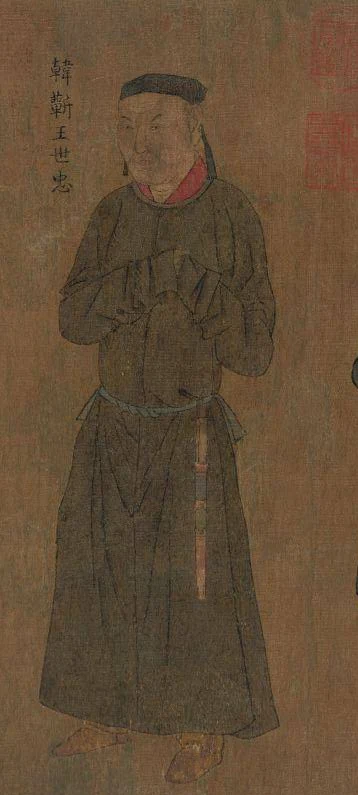
1090 CE–1151 CE
General
Han Shizhong
韩世忠
Han Shizhong (January 26, 1090–September 15, 1151), courtesy name Liangchen and self-styled Qingliang Jushi, was a native of Suide Army in Yan'an Prefecture (present-day Suide County, Yulin, Shaanxi). A renowned general and lyric poet active across the transition from the Northern to the Southern Song, he was grouped with Yue Fei, Zhang Jun, and Liu Guangshi as the “Four Generals of the Restoration.” Born into poverty, Han…
1090 CE–1151 CESouthern Song
PROFILE
Han Shizhong (January 26, 1090–September 15, 1151), courtesy name Liangchen and self-styled Qingliang Jushi, was a native of Suide Army in Yan'an Prefecture (present-day Suide County, Yulin, Shaanxi). A renowned general and lyric poet active across the transition from the Northern to the Southern Song, he was grouped with Yue Fei, Zhang Jun, and Liu Guangshi as the “Four Generals of the Restoration.” Born into poverty, Han enlisted while still young. Rough and forthright in temperament, he was able to draw a powerful bow and became known for exceptional bravery, winning repeated merit in campaigns against the Western Xia. He later served under Wang Bing in the suppression of the Fang La Rebellion. After the outbreak of war between Song and Jin, he campaigned across several regions and repeatedly fought larger enemy forces with smaller formations. After Emperor Gaozong of Song ascended the throne, Han became commander of the Left Army of the Imperial Camp and participated in suppressing the Miao–Liu Rebellion. When the Jin commander Wanyan Zongbi invaded south, Han withdrew from Zhenjiang toward the mouth of the Yangtze. As the Jin army tried to return north, Han used a naval force of eight thousand men to force it into Huangtiandang and then pursued it toward Jiankang, fighting for dozens of days and achieving substantial results. In 1134, the fourth year of the Shaoxing era, he defeated invading Jin and puppet Qi forces at the Battle of Dayi Town. He later moved his base to Chuzhou, expanded his army, and with fewer than thirty thousand men turned Huaidong into an important defensive barrier for the southeast. During these years he repeatedly memorialized against peace negotiations. In 1140, while Yue Fei was conducting his northern campaign, Han captured Haizhou and other places; in the following year he was ordered to reinforce Huaixi, after which he was stripped of field command and brought to court as Military Affairs Commissioner.
- Alternative Names
- Courtesy name Liangchen; Prince of Qi
- Courtesy Name
- Liangchen
- Period
- Southern Song
- Date of Birth
- January 26 1090
- Date of Death
- September 15 1151
- Dynasty/Regime
- Southern Song
- Identity
- General
- Ethnicity/People
- Not recorded in historical sources
- Ancestral Home
- Suide Army, Yan'an Prefecture (present-day Suide County, Yulin, Shaanxi)
- Place of Birth
- Not recorded in historical sources
- Major Achievements
- One of the Four Generals of the Restoration; inflicted heavy losses on Jin forces at the Battle of Huangtiandang; later spent generously from his family wealth, asked to relinquish military command, and held banquets to avoid suspicion.
LIFE TIMELINE
Age sixteen | Enlisted locally for his courage and entered the Yan'an military establishment to resist Western Xia
Age eighteen | Joined the assault on Yinzhou, broke through the defenses and killed an enemy commander, gaining a reputation for exceptional courage
Age twenty-eight | Followed Liu Yanqing against Western Xia, scaled a city wall at night and took two heads; promoted to Deputy Commandant of Jinyi
Age twenty-nine | Followed Liu Yanqing in building a stronghold at Tianjiang Mountain, repelled Western Xia troops, and was promoted to Deputy Commandant of Jinwu
Age thirty-two | Campaigned against Fang La with Liu Yanqing and captured Fang La alive; Xin Xingzong took credit for the achievement, and Han was later promoted to Chengjielang
Age thirty-two | With a little over fifty cavalrymen encountered two thousand Jin cavalry at the Hutuo River and defeated them by stratagem
Age thirty-six | Followed Wang Yuan and Liang Fangping in suppressing armed groups in Shandong and Hebei and was promoted through accumulated merit
Age thirty-seven | Defended the Yellow River bridge at Xunzhou and fought his way out after the line collapsed; later defended Zhaozhou and raided the Jin camp during a snowstorm, earning promotion to a defense commission
Age thirty-eight | Led his troops to Jizhou and joined those supporting Prince Kang Zhao Gou; after Gaozong became emperor, Han was appointed Surveillance Commissioner of Guangzhou, granted court arms-bearing privileges, and made commander of the Left Army of the Imperial Camp
Age thirty-nine | Promoted to Commissioner of Pacification of the Dingguo Army; followed the emperor to Yangzhou and entered Zhang Yu's camp alone to explain the consequences of loyalty and rebellion
Age forty | Helped suppress the Miao–Liu Rebellion and rescue the emperor; appointed Military Commissioner of the Wusheng Army and commander-in-chief of the Left Army of the Imperial Camp
Age forty-one | At the Battle of Huangtiandang, used eight thousand men to confine a Jin army said to number one hundred thousand; his wife Lady Liang personally beat the war drum, and the standoff lasted forty-eight days
Age forty-two | Appointed deputy pacification commissioner for Fujian, Jiangxi, Hunan, and Hubei and sent against Fan Ruwei
Age forty-three | Captured Jianzhou; Fan Ruwei committed suicide; promoted to Grand Commandant
Age forty-five | Defeated the Jin–puppet Qi allied force at the Battle of Dayi Town
Age forty-six | Appointed Junior Guardian and summoned to court
Age forty-seven | Appointed pacification and disposition commissioner for Jingdong and Huaidong, with headquarters in Chuzhou; also held three military commissions
Age fifty-one | Captured Haizhou and other places and was promoted to Grand Guardian and Duke of Ying
Age fifty-two | Appointed Military Affairs Commissioner and stripped of field command; after Yue Fei was imprisoned, challenged Qin Gui over the phrase “perhaps there is” and asked how such words could convince the empire; requested retirement and shut his doors to visitors
Age fifty-three | Re-enfeoffed as Duke of Tan and accompanied Emperor Gaozong when he received Empress Dowager Wei
Age fifty-four | Enfeoffed as Prince of Xian'an Commandery
Age sixty-three | Appointed Grand Preceptor and retired from office; died the same day at his granted residence in Lin'an and was posthumously made Prince of Tongyi Commandery
Posthumous | Posthumously enfeoffed as Prince of Qi
Posthumous | Received the posthumous title Zhongwu
Posthumous | Enshrined in Emperor Gaozong's ancestral temple
BIOGRAPHY
Biography
Family Background and Early Life
Han Shizhong was born into an ordinary farming family in Suide Army, Yan'an Prefecture, in present-day Suide, Shaanxi. His family was poor. From an early age he practiced martial skills and was described as extraordinarily fierce and brave. He drank heavily, valued loyalty and honor, and did not concern himself with minor conventions. Once, when someone predicted that he would one day rise to one of the highest offices, the young Han thought the remark was mockery and beat the speaker. The History of Song, juan 364, describes him as imposing in build, with eyes “flashing like lightning,” exceptionally fierce and courageous in youth, able to ride an unbroken foal, and poor enough to possess no property, while being fond of drink and spirited conduct and difficult to restrain by ordinary rules.
In 1105, the fourth year of the Chongning era, Han enlisted in the local forces before reaching adulthood and entered the military establishment of Yan'an Prefecture to resist Western Xia. His skill with powerful bows and mounted archery quickly distinguished him. Soon after joining the army he entered combat and was promoted from ordinary soldier to leader of a small squad of a little more than ten men. Although the post was minor and many of the men under him were older, his courage in battle, fairness in handling affairs, and plain speaking won their obedience.
Northwestern Campaigns and the Suppression of Fang La
On one occasion Song forces attacked Yinzhou but could not break the defenses. Han forced his way through the gate, killed an enemy commander, and threw the commander's head outside the walls. Encouraged by this, the Song troops surged forward and captured the city. Western Xia troops later massed at Haoping Ridge; Han led picked troops in hard fighting and drove them back. When Western Xia forces came again by another route, he organized volunteers for a desperate engagement and forced them to give ground. Seeing an especially formidable mounted warrior among the Western Xia troops, Han questioned a captive and learned that the man was an imperial son-in-law serving as army supervisor. Han then charged the formation and beheaded him, causing the Western Xia troops to collapse and flee. The regional military command reported the exploit and requested exceptional promotion, but Tong Guan, then directing frontier affairs, doubted the report and allowed Han to rise only one grade, to the dissatisfaction of the troops.
In 1117, the seventh year of Zhenghe, Han followed Liu Yanqing, commander of the Fuyan circuit, on campaign against Western Xia forces at the Chengde Army fortification in Fokou Valley of the Huanqing circuit. He climbed the walls by night, took two heads, and cut away protective felt from the defenses as proof of his exploit. In 1118, he followed Liu to build a new fort at Tianjiang Mountain, beat back Western Xia troops trying to interfere with the work, and took several heads. Later, when Zhong Shidao commanded forces from seven circuits in Shaanxi and Hedong against Zangdihe City, Liu Yanqing's Fuyan army participated, and Han took three more heads. These successes brought successive promotions to Deputy Commandant of Jinyi and Deputy Commandant of Jinwu.
In 1120, the second year of Xuanhe, Fang La, a lacquer-garden owner from Qingxi in Muzhou, launched an uprising, styled himself “Shenggong,” captured dozens of prefectures and counties, and gathered a following said to approach one million, alarming the southeast. Emperor Huizong mobilized troops from several regions. In 1121 Han joined the campaign under Liu Yanqing as a subordinate commander. After reaching Hangzhou, he used an ambush to defeat a much larger rebel force. Vanguard commander Wang Yuan praised him as “a match for ten thousand men,” gave him personal property, and became his friend. Han then pursued the rebels to the Qingxi caves in Muzhou, learned a shortcut from local people, crossed difficult terrain for several li, reached the rebel camp directly, killed several dozen men, and captured Fang La alive. Xin Xingzong took the credit for this achievement. Only after Right Army commander Yang Weizhong returned to court and reported what had happened was Han promoted to Chengjielang.
Fighting the Jin in Hebei and Supporting Emperor Gaozong
In 1121, the third year of Xuanhe, Song and Jin concluded the Alliance Conducted at Sea to destroy the Liao jointly. The Song court decided to recover Yanshan and mobilized troops from several circuits, but the forces that reached the region were defeated. Han, leading just over fifty cavalrymen near the Hutuo River, encountered two thousand Jin cavalry. He told his men that panic meant death and ordered them to remain steady. A squad leader named Su Ge took part of the force to occupy high ground and formed a stationary line. Han also collected several hundred defeated Song soldiers retreating from Yanshan, formed them into ranks, and ordered them to beat drums and shout. He then led a handful of volunteers directly into the Jin formation and killed the enemy standard-bearer. Su Ge's cavalry charged downhill while the soldiers by the river raised a great din. The Jin formation broke and withdrew north; Han pursued and took significant spoils.
In the late reign of Emperor Huizong, armed bands proliferated in Shandong and Hebei. In 1125, the seventh year of Xuanhe, Han followed Wang Yuan in suppression operations, destroyed river bandits in Daming Prefecture, defeated other armed groups at Tangcun, and earned repeated merit. He then served as a subordinate commander under Liang Fangping, who had been assigned specifically to suppress disturbances in Shandong. At Weishi he defeated several thousand followers of Yang Tianwang and Toushouhua; at Hanwangdian he defeated tens of thousands under Wu Hu of Linyi; and he also participated in defeating the forces of Xu Jin of Yizhou, Zhang Xian of Qingzhou, Liu Dalang of Shuigu, Gao Tuoshan of Wangxian, Jia Jin of Jilu, Xu Dalang of Ju County, and Zhang Kui of Donghai. The source states that “the bandits of Shandong were thereby all pacified.” Through accumulated merit Han rose again in military rank.
In the first month of 1126, the first year of Jingkang, Han followed Liang Fangping in defending the Yellow River bridge at Xunzhou, in present-day Xun County, Henan, against Jin troops. When Liang's force collapsed, Han fought his way out, burned the bridge, and withdrew toward Kaifeng. During the Jin siege of Kaifeng, Han was promoted to a command post and participated in the defense. After the Jin lifted the siege in the second month, Han served as a vanguard commander under Hebei commander Wang Yuan. In the sixth month, when Li Gang, pacification commissioner for Hedong and Hebei, went to relieve Taiyuan, Han was stationed at Daming and was ordered by Li Gang to suppress rebel forces. He earned promotion to Acting Training Commissioner of Shanzhou and camped along the Hutuo River. When Wang Yuan was defending Zhaozhou, present-day Zhao County in Hebei, Han went to reinforce him but was driven into the city by tens of thousands of Jin troops. The city was surrounded several layers deep, provisions were scarce, and morale was unstable. Some proposed abandoning the city, but Han refused. That night heavy snow fell. Han selected three hundred strong soldiers, left the city, and raided the Jin camp. The attackers disrupted the enemy so severely that the Jin forces withdrew. Han was promoted to a defense commission for the victory. After returning with his troops to Daming, he was appointed commander of the Front Army by general administrator Zhao Ye. He continued anti-Jin operations in Hebei for several years and acquired a formidable reputation.
In 1127, the second year of Jingkang, the Jingkang Incident culminated in the fall of Kaifeng and the capture of Emperor Huizong and Emperor Qinzong of Song by the Jin. Zhao Gou, Prince Kang and ninth son of Huizong, reached Jizhou, in present-day Juye, Shandong. Officials accompanying him urged him to reestablish the Song government. Han brought his troops to Jizhou and joined those supporting Zhao Gou's accession. In the fourth month, Han's subordinate Yang Jin defeated Jin forces attacking Nanjing's Yingtian Prefecture, present-day Shangqiu, Henan, and Han escorted Zhao Gou to Nanjing. Zhao Gou then ascended the throne there as Emperor Gaozong of Song. Gaozong appointed Han Surveillance Commissioner of Guangzhou and granted him the privilege of bearing arms in the imperial presence. Han requested that the capital be moved to Chang'an and that armies be sent to recover the two northern regions, but the proposal was not adopted. When the Imperial Camp was reorganized, he became commander of its Left Army. He was then independently ordered to recover Yutai, defeated rebels in Shanzhou, and assisted Liu Guangshi in defeating rebels at Liyi. After these groups were pacified, he entered the capital to serve in the imperial guard.
Suppression of the Miao–Liu Rebellion and the Battle of Huangtiandang
In 1128, the second year of Jianyan, Han was promoted to Commissioner of Pacification of the Dingguo Army and followed Emperor Gaozong south to Yangzhou. Zhang Yu, who had submitted to the court, arrived outside the city but kept his men in armor, alarming the population. Han entered Zhang Yu's camp alone, explained the consequences of loyalty and rebellion, and calmed the force. Another group of one hundred thousand under Li Min came to surrender but showed signs of mutiny on the way. Han was sent to proclaim the imperial instructions, killed Liu Yan, who appeared ready to rebel, expelled Li Min, and sent twenty-nine junior officers to his superior Wang Yuan for execution. After settling this affair, Han was assigned to suppress internal and external banditry in Jingxi and other circuits.
In 1129, the third year of Jianyan, Emperor Gaozong convened his generals to discuss a route of retreat from the Jin advance. Zhang Jun and Xin Qizong proposed moving the court to Hunan. Han opposed the plan. He argued that the Huai and Zhejiang regions were the prosperous core of the state, that popular morale was already unstable, and that there could be no guarantee against trouble during a further flight to Hunan. Even if the emperor departed, troops would still have to defend the Huai and Yangtze. Of one hundred thousand troops, if half were left to guard those regions, the remaining fifty thousand would not ensure the emperor's safety. Han later gathered several thousand routed soldiers at Yangcheng. On learning that Gaozong had fled south to Qiantang, he traveled by sea to the temporary imperial residence.
In the third month, officers Miao Fu and Liu Zhengyan, dissatisfied with the government, launched the Miao–Liu Rebellion. They killed Wang Yuan and the eunuch Kang Lü and forced Emperor Gaozong to yield the throne to his three-year-old son Zhao Fu. Lü Yihao, pacification commissioner of Jiangnan East and prefect of Jiangning, coordinated with Zhang Jun of the Imperial Camp headquarters and with Han Shizhong, Zhang Jun, and other senior generals to suppress the rebellion and rescue Gaozong. When Han received Zhang Jun's letter, he wept, poured a libation, and swore that he would not live under the same sky as the rebels. His soldiers were stirred to action. He led his force from Pingjiang, with armored troops carried in boats stretching for thirty li. At Xiuzhou he pretended illness and halted while building scaling ladders and preparing equipment, causing Miao Fu and his allies to become fearful. At the time Han's wife, Lady Liang, and their son Han Liang were being held as hostages by Miao Fu under tight guard. Zhu Shengfei deceived Miao Fu by proposing that the empress dowager dispatch them to reassure Han, thereby calming the men at Pingjiang. Lady Liang was therefore summoned in, granted the title Lady of Anguo, and permitted to visit Han. Once outside the city, she rode directly to Han's position and reached him within a day and a night. With his family safe, Han immediately raised troops to restore the emperor. At Linping he met the forces of Miao Fu and Liu Zhengyan and defeated them decisively. The two rebel leaders fled. Han asked permission to pursue them personally and was appointed military commissioner for Jiang and Zhe. In the fifth month he fought the rebels at Yuliang Station in Pucheng, defeated them, and captured Liu Zhengyan; Miao Fu was later captured as well. Emperor Gaozong held Han's hand and wept, personally wrote the two characters “loyal and brave” for him, and appointed him Acting Junior Guardian, Military Commissioner of both the Wusheng and Zhaoqing Armies, and commander-in-chief of the Imperial Left Army.
In 1130, the fourth year of Jianyan, the Jin commander Wanyan Zongbi led a southern invasion. Han withdrew from Zhenjiang to a position near the mouth of the Yangtze. When the Jin army attempted to return north, Han used a naval force of eight thousand to force it into Huangtiandang and then pursued it toward Jiankang, engaging it for dozens of days. His wife Lady Liang was said to have personally beaten the battle drum to encourage the troops, a story later widely celebrated. The Jin eventually dug a channel to escape north. Wanyan Zongbi himself barely escaped, while casualties and captures were said to be numerous. Great quantities of baggage were abandoned, many captives taken by the Jin were freed, and more than ten vessels belonging to “Longhu Dawang” were seized. According to the source, Han's eight thousand men confined a Jin army of one hundred thousand. Although he did not annihilate the enemy, the Battle of Huangtiandang badly damaged Jin momentum and made its troops more cautious about crossing the Yangtze, becoming an important turning point in the Song–Jin war.
Defense of Huaidong and Later Years
In the eleventh month of 1131, the first year of Shaoxing, after the forces of Fan Ruwei captured several prefectures and counties in succession, Han was appointed deputy pacification commissioner for Fujian, Jiangxi, Hunan, and Hubei and sent against him. On the fourth day of the first month of 1132, Han surrounded Jianzhou, in present-day Jian'ou, Fujian, using fire towers, large stones, scaling ladders, and other siege equipment. Five days later the city was recovered and Fan Ruwei committed suicide. An imperial edict praised the victory and awarded Han gold vessels. In the third month he turned west to campaign against Cao Cheng, Ma You, Li Hong, Liu Zhong, and other armed groups in Jinghu South. In the intercalary fourth month he camped along the river at Hongzhou, with camps extending for dozens of li, and sent an officer of the Left Divine Martial Army named Dong to persuade Cao Cheng to surrender. In the sixth month he was ordered to return. For his role in pacifying these groups he was promoted to Grand Commandant. In the ninth month he became pacification commissioner of Jiangnan East, with headquarters in Jiankang Prefecture.
In 1134, the fourth year of Shaoxing, Han defeated invading Jin and puppet Qi forces at the Battle of Dayi Town. He later transferred his base to Chuzhou, expanded his military strength, and with fewer than thirty thousand troops turned Huaidong into an important barrier protecting the southeast. During this period he repeatedly memorialized against peace negotiations. In the third month of 1136 he became pacification and disposition commissioner for Jingdong and Huaidong and concurrently held the military commissions of the Zhenwu and Anhua Armies, with headquarters in Chuzhou. In the fourth month he added a third military commission, Henghai and Wuning, and received the honorific “Yangwu Yiyun Merit Official.”
In 1140, the tenth year of Shaoxing, while Yue Fei was undertaking his northern campaign, Han captured Haizhou and other places. The following year he was ordered to reinforce Huaixi. In 1141 Qin Gui began purging the Southern Song's anti-Jin military leadership, and Han was initially a principal target. Qin arrested Han's subordinate commander Hu Fang and pressured him to accuse Han of treason. Because Han had previously rescued Emperor Gaozong during the Miao–Liu Rebellion, however, Gaozong protected him, and Qin's attention turned to Yue Fei, leading to Yue's prosecution. In the fourth month Han was stripped of military command and brought to court as Military Affairs Commissioner. In the eleventh month, after Yue Fei was imprisoned and Han learned that Yue Yun and Zhang Xian had been executed, Han went directly to Qin Gui's residence and challenged him. Qin replied that although the alleged letter between Yue Yun and Zhang Xian was unclear, the matter “perhaps existed.” Han retorted: “With the three words ‘perhaps there is,’ how can you convince the empire?”
In the eleventh month of 1141, Han requested release from office. He was made Grand Tutor, retained military commissions in the Henghai, Wuning, and Anhua Armies, and was appointed commissioner of Liquan Abbey. He then closed his doors to visitors and never again spoke of military affairs. In the tenth month of 1142 he was re-enfeoffed as Duke of Tan. In the eighth month, Empress Dowager Wei returned from the Jin to Lin'an, and Han accompanied Gaozong in receiving her at Linping. She had already heard of Han's fame while in Jin territory and specially summoned him before her curtain, asking, “Is this Lord Han?” and speaking with him for a long time. In the second month of 1143 he was promoted to Prince of Xian'an Commandery. In the third month of 1147 he was transferred to hold military commissions in the Zhennan, Wu'an, and Ningguo Armies. Gaozong repeatedly invited Han and his family into the palace for banquets and treated him with sustained favor, frequently presenting him with fine horses, precious swords, and other gifts.
In the autumn of 1151, the twenty-first year of Shaoxing, Han became seriously ill and submitted a memorial asking to retire. On September 16, 1151, the fifth day of the eighth month, he was appointed Grand Preceptor and formally retired. He died the same day at his granted residence in Lin'an Prefecture, aged sixty-three. He was posthumously created Prince of Tongyi Commandery. The court supplied ceremonial dress, a sable cap, mercury and borneol for the burial, granted three thousand units of silver and silk from the palace treasury for funeral expenses, and appointed nine of his relatives to office. In the tenth month he was buried at the foot of Lingyan Mountain in Xutai Township, Wu County, Pingjiang Prefecture. In the fifth month of 1168 he was posthumously created Prince of Qi, hence the later title “Prince Han of Qi.” In the second month of 1176 he received the posthumous title Zhongwu. In the third month of 1178 he was enshrined in Emperor Gaozong's ancestral temple together with Lü Yihao, Zhao Ding, and Zhang Jun.
His Early Service in the Northwest and the Campaign against Fang La
The Song History describes him as "of noble frame and bearing, with eyes that flashed like lightning; in his early years fierce and brave beyond other men, able to ride an unbroken colt; poor, without property, fond of wine and given to temper, beyond the restraint of rules," and records that when a fortune-teller told him he would rise to the three excellencies, Han Shizhong beat him for the insult. Before he came of age he enlisted in his prefecture for his daring, was enrolled in the registers, and "drew a strong bow and galloped shooting, first among the whole army in courage"; stationed in the northwest, he saw action soon after enlisting and was raised from common soldier to section leader with a dozen men under him — few, but he carried out his duty and his men, all older than he, obeyed him for his courage, his fair dealing and his straight sense in speaking. When the Song army besieged Yinzhou without success he broke into the city by force, killed its defending general and flung his head outside the wall, so that the army took heart and carried the city; at Haoping ridge he led picked troops in a hard fight and beat the Western Xia off; when they came again by a side road he posted a death-or-glory force to fight them to a standstill, and learning from prisoners that the rider pressing hardest was the Xia supervising commissioner and imperial son-in-law, he spurred into the line and cut him down, at which the enemy broke. The military commissioner reported his merit, but Tong Guan, who directed frontier affairs, "suspected the report of exaggeration, and gave him only one grade," which the army thought unjust.
When Fang La rose in 1120 and Jiangsu and Zhejiang were shaken, the court levied troops far and wide, and Han Shizhong went as a subordinate general under Wang Yuan. Reaching Hangzhou he broke the large rebel force by an ambush: Wang Yuan had told him that "the rebels think us come from afar and will despise us; tomorrow you fight them and feign flight, while I lay crossbowmen in ambush a few hundred paces off," and so it was done, the crossbows loosing as the rebels pursued, so that "they fell to the twang of the string," and the pursuit went on to Chun'an and the rebel stronghold of Bangyuan was invested and reduced. Han Shizhong then chased the remains to the Qingxi cave at Muzhou, where the rebels held rocky chambers in three chambers and the generals coming up could find no way in; he "crept through the ravines and asked a countrywoman for a path," then advanced spear in hand, crossed several li of dangerous ground, stormed the lair, killed dozens and brought Fang La out alive. But Xin Xingzong, commanding troops, blocked the mouth of the cave and took the captive as his own merit, so that Han Shizhong received no reward, until another commander, Yang Weizhong, returned to court and "set the matter straight," and he was transferred to a minor rank. In 1121, when the court resolved to recover Yanshan and the armies sent there were all broken, Han Shizhong with Su Ge and fifty horsemen reached the Hutuo river and met more than two thousand Khitan cavalry; Su Ge lost his head, but Han Shizhong calmly had him form on a high ridge and forbade movement, gathered the fugitives from Yanshan on the river bank to beat drums and shout, and himself spurred at the enemy, killing the standard-bearer, while Su Ge charged down from the height and the boatmen raised their clamour, so that the enemy broke and was cut down in numbers. When banditry swarmed in Shandong and Hebei in the last years of Huizong, he followed Wang Yuan in 1125 against them, destroying river pirates at Damingfu and breaking bandits at Tangcun, and was then sent against Shandong alone, defeating Yang Tianwang and Tou Shouhua with several thousand men, Wu Hu with tens of thousands at Hanwangdian, and the bands of Xu Jin, Zhang Xian, Liu Dalang, Gao Tuoshan, Jia Jin, Xu Dalang and Zhang Kui, "and so all the banditry of Shandong was put down."
Major Activities
Military Contributions
Han Shizhong was one of the most important anti-Jin generals of the early Southern Song. The source summarizes his military achievements in six areas.
First, warfare against Western Xia in the northwest: from 1105 through the Zhenghe era, Han repeatedly earned merit in fighting Western Xia. During the assault on Yinzhou he broke through the defenses and killed an enemy commander, and at Haoping Ridge he killed a Western Xia army supervisor who was an imperial son-in-law, causing the opposing force to collapse.
Second, suppression of internal rebellions: in 1121 he captured Fang La alive; in 1125 he followed Wang Yuan and Liang Fangping in suppressing armed groups in Shandong and Hebei; and in 1131–1132 he fought Fan Ruwei, Cao Cheng, and other insurgent groups.
Third, fighting the Jin in Hebei: in 1126 he defended the Yellow River bridge at Xunzhou and fought his way out after the line broke. At Zhaozhou he launched a night raid in heavy snow, using three hundred picked soldiers to drive away a besieging Jin force said to number in the tens of thousands.
Fourth, the Battle of Huangtiandang: in 1130 Han used a naval force of eight thousand to confine the army of Jin Wuzhu, said in the source to number one hundred thousand, at Huangtiandang for forty-eight days. Although he did not destroy the Jin army completely, he badly damaged its momentum and discouraged easy crossings of the Yangtze.
Fifth, the Battle of Dayi Town: in 1134 he defeated invading Jin and puppet Qi allied troops in what the source calls the “victory at Dayizhen.”
Sixth, defense of Huaidong: in 1136 he moved his headquarters to Chuzhou and, with fewer than thirty thousand men, made Huaidong a major defensive barrier for the southeast. In 1140 he captured Haizhou and other places.
Political Activities
Han's most important political action was his participation in suppressing the Miao–Liu Rebellion. In 1129 Miao Fu and Liu Zhengyan launched a mutiny and forced Emperor Gaozong to abdicate. Han coordinated with Zhang Jun, Lü Yihao, and others, raised troops to restore the emperor, and ultimately suppressed the rebellion. In recognition, Gaozong personally wrote the words “loyal and brave” for him.
Han firmly opposed peace negotiations with the Jin. During the first peace negotiations of 1138 he repeatedly memorialized in favor of a northern campaign and even considered killing the Jin envoys. In 1141 Qin Gui began purging the anti-Jin leadership, but Han survived because of his earlier role in rescuing Gaozong. After Yue Fei was imprisoned, Han confronted Qin Gui at his residence and challenged the accusation with the famous question: how could the words “perhaps there is” convince the empire?
Travels and Places of Activity
Han's career took him across northern and southern China. He was born in the Yan'an region of Shaanxi and spent his early military career on the northwestern frontier. During the Xuanhe era he followed the army south to suppress Fang La. After the Jingkang Incident he fought in Hebei and Henan. During the Jianyan era he followed Gaozong south and was stationed around Zhenjiang and Jiangyin. In the Shaoxing era he served as deputy pacification commissioner in Fujian, Jiangxi, Hunan, and Hubei and campaigned against insurgent forces. He later spent many years defending Chuzhou in Huaidong. After relinquishing military power in his later years, he lived in Lin'an and withdrew from public life.
Literary Works
Han was illiterate in his early years and began teaching himself after leaving active command. He left relatively few poems and prose pieces, but the surviving works are marked by a strong and forthright tone. Two well-known ci lyrics attributed to him are “Linjiangxian” and “Nanxiangzi.”
“Linjiangxian” reads in the source, in meaning: “In winter the green hills are free and still; with spring the mountains warm and flowers grow thick. Youth and decline pass like blossoms. Guests in this world chase fame and gain, whether rich or poor. Splendor is no elixir of long life, and leisure is no gate to death. I urge you to recognize the master within. There is only one ingredient in the prescription, and it lies in what words cannot express.”
“Nanxiangzi” reads in the source, in meaning: “How many forms can a human life take? Wealth, honor, and glory are all ultimately idle. Heroes from ancient times are like dreams; office itself binds one to worldly obligations of treasure, spouse, and children. In old age the body declines, hair turns pale and bones grow dry. Yet people do not see the good in mountains and forests, where hunger is answered by a meal; perhaps it is only that such leisure cannot be found at court.”
The Miao-Liu Rising and the Battle of Huangtiandang
When Miao Fu and Liu Zhengyan rose in 1129 and forced Gaozong to abdicate, Han Shizhong, with few troops, gathered stragglers about Yancheng, formed a small force and came by sea to Changshu, agreeing with Zhang Jun and others to move on Xiuzhou and then pretending to rest his troops while secretly preparing to storm the city. His wife Lady Liang and his son Han Liang were held as hostages by Miao and Liu under close guard, and Zhu Shengfei tricked Miao Fu by saying that if the empress dowager were asked to send the two to comfort Han Shizhong, the men at Pingjiang would be the more reassured; so Lady Liang was summoned to the palace, made lady of Anguo, and sent out to receive her husband and hasten his loyalist rising, and she rode out of the city at speed and "joined Han Shizhong at Xiuzhou within a day and a night." When the envoy came with her Han Shizhong burned the edict and beheaded the messenger, ordered the advance on Hangzhou, and said, "I know of Jianyan, and I know nothing of Mingzhao." At Linping the rebel generals Miao Yi and Ma Rouji formed with their backs to the hills and the river, planting stakes in mid-stream to block the boats; Han Shizhong left his boat and fought on foot, Zhang Jun and Liu Guangshi following in support, and when the line gave a little he "left his horse and came on with his spear," ordering, "Today we repay the state with our deaths; any man with fewer than several arrows in his face shall be beheaded." The men gave their all, the rebels broke, and Miao and Liu fled with two thousand picked troops by the Yongjin gate. He was made military governor of Wusheng and commander of the left army of the imperial camp, asked leave to pursue, and as commissioner of Zhejiang and Jiangsu chased them by way of Qu and Xin to Yuliang post station, where "Han Shizhong came on foot with his spear, and the rebels, seeing him, cried out, 'This is General Han!' and broke in panic," and in the end Liu Zhengyan and Miao Fu's brother Miao Yi were taken and Miao Fu caught in flight, all being executed. The emperor wrote the two words "loyal and brave" in his own hand on a banner for him. After the rising was put down the emperor told him that Wu Zhan, commander of the central army in the palace, was of one party with Miao and Liu and that the palace could not be safe while he lived; and when Wu Zhan came with troops to welcome him and put out his hand to take Han Shizhong's, Han Shizhong, who was very strong, broke his middle finger in the grip, had him seized and beheaded in the market, and took the rebel counsellor Wang Shixiu and others as well.
The battle of Huangtiandang is the most famous action of his life. When Wanyan Zongbi (Wuzhu) invaded, crossing the Yangtze at Majiadu, the emperor asked his generals where to move, and when Zhang Jun and Xin Qizong urged flight to Changsha, Han Shizhong said: "The state has already lost Hebei and Shandong; if we give up the Huai and the Yangtze too, what ground is left?" and was made commissioner of western Zhejiang, to hold Zhenjiang. The Jin took Jiankang and Lin'an and the emperor fled to eastern Zhejiang, while the Jin, after plundering in the south, withdrew in succession. Han Shizhong "posted his forward army at Qinglong town, his centre at Jiangwan and his rear at the sea mouth, waiting to strike the enemy on his return," memorializing the court that he meant "to stay on the river and cut off the Jin retreat, and fight to the death." Wanyan Zongbi sent him a challenge and a day was fixed for battle on the river; the Jin, unused to river fighting, were beaten several times by Han Shizhong, who sealed the Yangtze and took Wuzhu's son-in-law, the prince of Longhu, alive, after which Wuzhu dared not fight again. On the size of the Jin force the sources differ greatly: the Song accounts say a hundred thousand, while the History of Jin gives four thousand, a gap so wide that later scholars have generally held that the Song exaggerated their victory and the Jin concealed their defeat, so that neither figure should be taken as decisive. However that may be, the action held the Jin long on the river and unable to cross north, and was one of the few cases in the early years of the Southern Song of a deliberate offensive that inflicted a serious check on the Jin.
Personal Relations
- First wife: Lady Bai, died early
- Wife: Lady Liang, popularly known in later accounts as Liang Hongyu; said to have personally beaten the battle drum at Huangtiandang and was granted the title Lady of Anguo
- Son: Han Liang, held as a hostage with Lady Liang during the Miao–Liu Rebellion
- Son: Han Yanzhi, Southern Song official
- Son: Han Yanpu
- Son: Han Yanzhi (different written name in the Chinese source)
- Wang Yuan: vanguard commander who praised Han as “a match for ten thousand men” and became his friend; later killed by Miao Fu
- Zhang Jun: principal coordinator in suppressing the Miao–Liu Rebellion and closely associated with Han
- Liu Yanqing: commander of the Fuyan circuit and Han's early superior
- Yang Weizhong: Right Army commander-in-chief who testified to Han's achievement in capturing Fang La
- Yue Fei: fellow member of the Four Generals of the Restoration; Han protested the injustice of Yue's prosecution
- Zhang Jun: fellow member of the Four Generals of the Restoration and participant in suppressing the Miao–Liu Rebellion
- Liu Guangshi: fellow member of the Four Generals of the Restoration
- Zhao Gou, Emperor Gaozong of Song: Han earned great credit in rescuing him; Gaozong personally wrote the words “loyal and brave” for Han and treated him with sustained favor in later life, repeatedly inviting him to palace banquets
- Empress Dowager Wei: had heard of Han's reputation while in Jin territory and specially summoned him for an extended audience after returning to Song territory
- Tong Guan: doubted Han's military achievement while directing frontier affairs and allowed him only a single-grade promotion
- Xin Xingzong: took credit for Han's capture of Fang La
- Qin Gui: advocated peace with the Jin and purged anti-Jin forces; attempted to implicate Han and later targeted Yue Fei. Han challenged Qin with the question of how the words “perhaps there is” could convince the empire
- Miao Fu and Liu Zhengyan: leaders of the rebellion that Han helped suppress
Historical Assessment
Song Dynasty and Contemporary Views
- Emperor Gaozong of Song personally wrote the words “loyal and brave” for Han in recognition of his role in restoring the emperor. In Han's later years Gaozong continued to favor him deeply and repeatedly granted him fine horses and precious swords.
- Empress Dowager Wei had heard of Han's fame while in Jin territory and summoned him for a prolonged audience after her return.
- Wang Yuan exclaimed, “Truly a match for ten thousand men,” according to the History of Song, juan 364, “Biography of Han Shizhong.”
- Zhang Jun coordinated with Han in suppressing the rebellion, and the two congratulated and reassured one another after success.
Song and Yuan Periods
- The History of Song, juan 364, describes Han as imposing in build, with eyes flashing like lightning; as extraordinarily fierce and brave in youth; and as poor, fond of drink, spirited, and difficult to restrain. It also says he was blunt and straightforward, brave, loyal, and righteous, and that whenever matters concerned the ancestral temples and the state he would speak to the utmost with tears in his eyes.
- His posthumous elevation to Prince of Qi in 1168, the posthumous title Zhongwu in 1176, and his enshrinement in Emperor Gaozong's ancestral temple in 1178 demonstrate the high official assessment of his achievements.
- Later generations called him “Prince Han of Qi” and counted him among the Four Generals of the Restoration alongside Yue Fei.
Ming and Qing Periods
- The Ming scholar Wang Shizhen, in discussing Southern Song generals, placed Han Shizhong together with Yue Fei among the foremost figures of the restoration period.
- The Qing scholar Bi Yuan gave detailed accounts of Han's campaigns in the Continuation of the Comprehensive Mirror in Aid of Governance and described his loyalty and courage as surpassing his age.
- Ming and Qing popular narratives and drama widely celebrated the story of Han Shizhong and Lady Liang beating the drum against the Jin at Huangtiandang, turning them into popular symbols of loyalty and courage.
Modern Scholarship
- Modern historian Deng Guangming repeatedly discussed Han in his Biography of Yue Fei, regarding him as one of the most outstanding anti-Jin generals of the early Southern Song and as firmly opposed to peace negotiations.
- Scholar Wang Zengyu, in A New Biography of Yue Fei, describes Han as a soldier of humble origins whose exceptional loyalty and courage brought repeated success in the war against Jin, and treats his challenge to Qin Gui over the words “perhaps there is” as one of his most enduring statements.
- Han's tomb is located at Lingyan Mountain in Mudu, Suzhou, Jiangsu. In 1982 it was listed as a protected cultural site of Jiangsu Province, reflecting later recognition of his historical status.
FIGURES ASSOCIATED WITH THIS DYNASTY
Bibliography
Bibliographic information is not yet available for this entry.