Age one | Born in the imperial palace in the Eastern Capital as Emperor Huizong's ninth son.
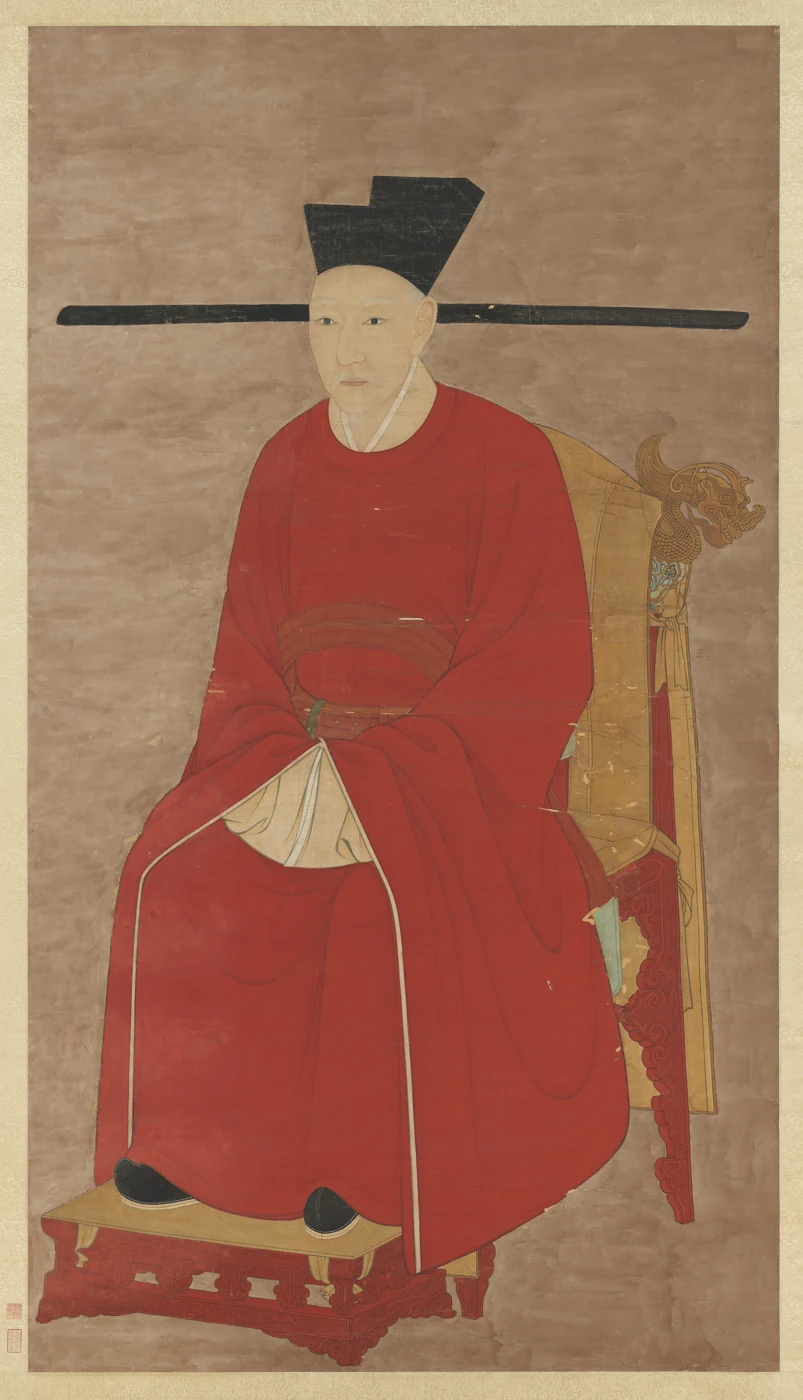
1107 CE–1187 CE
Emperor
Zhao Gou
赵构
Emperor Gaozong of Song, Zhao Gou (June 13, 1107, the twenty-first day of the fifth month in the first year of Daguan – November 9, 1187, the yihai day of the tenth month in the fourteenth year of Chunxi), courtesy name Deji and art name Sunzhai, was the tenth emperor of the Song dynasty and the founding emperor of the Southern Song. He reigned from 1127, the first year of Jianyan, to 1162, the thirty-second year of Shaoxing.…
1107 CE–1187 CESouthern Song
PROFILE
Emperor Gaozong of Song, Zhao Gou (June 13, 1107, the twenty-first day of the fifth month in the first year of Daguan – November 9, 1187, the yihai day of the tenth month in the fourteenth year of Chunxi), courtesy name Deji and art name Sunzhai, was the tenth emperor of the Song dynasty and the founding emperor of the Southern Song. He reigned from 1127, the first year of Jianyan, to 1162, the thirty-second year of Shaoxing. He was the ninth son of Emperor Huizong of Song, Zhao Ji, the younger brother of Emperor Qinzong of Song, Zhao Huan, and the son of Empress Xianren, Lady Wei. During the Jingkang Incident, the Northern Song fell. As the only surviving close male member of the imperial house, Zhao Gou ascended the throne at Yingtian Prefecture in the Southern Capital, present-day Shangqiu in Henan, and established the Southern Song. During his reign he employed generals including Yue Fei and Han Shizhong to resist Jin forces while also relying heavily on peace advocates such as Qin Gui to promote a settlement with the Jin. The Treaty of Shaoxing was concluded in 1141, the eleventh year of Shaoxing, at the price of accepting vassal status, paying tribute, and abandoning former territories. It established a north-south standoff between the Southern Song and Jin along the Huai River–Dashan Pass line. In 1162, the thirty-second year of Shaoxing, Zhao Gou abdicated in favor of his adopted son Zhao Shen, Emperor Xiaozong of Song, and retired to Deshou Palace as Retired Emperor. He died in 1187, the fourteenth year of Chunxi, at the age of eighty-one, making him one of the longest-lived retired emperors in Chinese history.
- Other names
- Prince Kang; Emperor Gaozong of Song; Gaozong; Ninth Brother
- Courtesy name
- Deji
- Art name
- Sunzhai
- Period
- Southern Song
- Dynasty/Polity
- Southern Song
- Identity
- Emperor
- Ethnicity/People
- Not recorded in historical sources
- Native place
- Not recorded in historical sources
- Date of birth
- June 13, 1107
- Place of birth
- Not recorded in historical sources
- Date of death
- November 9, 1187
- Reign
- 1127–1162
- Predecessor
- Emperor Qinzong of Song (Zhao Huan)
- Successor
- Emperor Xiaozong of Song (Zhao Shen)
- Posthumous name
- Not recorded in historical sources
- Major achievements
- Founding emperor of the Southern Song; after the Jingkang southward flight he proclaimed himself emperor under the Jianyan era name; relied heavily on Qin Gui to seek peace with the Jin and contributed to the wrongful execution of Yue Fei
LIFE TIMELINE
Age one | Given the name Gou, appointed Military Commissioner of Dingwu Army and Acting Grand Commandant, and enfeoffed as Duke of Shu.
Age two | Advanced to Prince of Guangping Commandery.
Age fifteen | Advanced to Prince Kang.
Age sixteen | Underwent the capping ceremony and moved to a residence outside the palace.
Age twenty | During the first Jin siege of Bianjing, entered the Jin camp as a hostage in his capacity as a prince.
Age twenty | Released because the Jin doubted his identity; promoted to Grand Tutor.
Age twenty | Ordered to travel to the Jin camp to seek peace; stopped at Cizhou by Zong Ze's remonstrance and turned back to Xiangzhou.
Age twenty | Appointed Grand Marshal of the Armies of Hebei and established the Grand Marshal's headquarters at Xiangzhou.
Age twenty-one | Withdrew to Jizhou and learned that his father and elder brother had been captured and that Zhang Bangchang had usurped the throne.
Age twenty-one | Ascended the throne at Yingtian Prefecture in the Southern Capital, adopted the era name Jianyan, and established the Southern Song.
Age twenty-one | Moved south to Yangzhou.
Age twenty-three | As Jin troops advanced south, fled across the Yangtze, passing through Zhenjiang and Pingjiang before reaching Hangzhou.
Age twenty-three | During the Miao–Liu Rebellion, forced to abdicate in favor of his son Zhao Fu; soon restored to the throne.
Age twenty-three | Moved the court to Jiangning (Jiankang), and later made Lin'an (Hangzhou) the capital.
Age thirty-one | News of Huizong's death reached the Southern Song; Zhao Gou honored his mother Lady Wei from afar as Empress Dowager.
Age thirty-two | Formally established the capital at Lin'an, designated as the imperial residence.
Age thirty-four | Jin forces broke the agreement and invaded south; Yue Fei and other commanders defeated Jin forces at Yancheng and Yingchang, but Yue was recalled by twelve gold plaques.
Age thirty-five | Removed Yue Fei, Han Shizhong, and other leading generals from military command; Yue Fei was executed on New Year's Eve of the twelfth month, January 27, 1142; the Treaty of Shaoxing was concluded.
Age thirty-six | Welcomed back his mother, Empress Dowager Wei, together with Huizong's coffin.
Age fifty-five | The Jin ruler Wanyan Liang invaded south; Song forces won the Battle of Caishi.
Age fifty-six | Abdicated in favor of his adopted son Zhao Shen, Emperor Xiaozong of Song, and was honored as Retired Emperor.
November 9, 1187 CE(yihai day of the tenth month, fourteenth year of Chunxi) | Age eighty-one | Died at Deshou Palace.
BIOGRAPHY
Biography
Family background and early years
Zhao Gou was born on June 13, 1107, the twenty-first day of the fifth month in the first year of Daguan, in the imperial palace of the Eastern Capital. His father, Emperor Huizong of Song, Zhao Ji, was the eighth emperor of the Northern Song. He was renowned for painting and calligraphy but was politically incompetent, placing trust in Cai Jing, Tong Guan, Wang Fu, and other corrupt officials as government increasingly deteriorated. Zhao Gou's mother, Lady Wei, came from a humble background. She entered the palace with the rank of Lady of Pingchang Commandery, was promoted to jieyu after giving birth to Zhao Gou, and later to xiurong; she bore no more children. Because of his mother's low status, Zhao Gou attracted little attention among Huizong's many sons.
Zhao Gou was intelligent and studious from childhood. Historical accounts describe him as "bright and perceptive by nature, broadly learned with a strong memory, reciting more than a thousand words of text each day." He was accomplished in calligraphy, music, chess, painting, and other arts, and was especially known for calligraphy. He first modeled his hand on Huang Tingjian and later developed his own style; works such as the Imperial Handwritten Edict Bestowed on Yue Fei are attributed to him. He also practiced martial arts and was able to draw a bow rated at one shi and five dou, stronger than the one-shi-three-dou standard for advanced students at the military academy. This was unusual for a prince raised within the palace and later contributed to the Jin doubting his identity during his time in their camp.
In the twelfth month of 1121, the third year of Xuanhe, Zhao Gou was advanced to Prince Kang. In 1122 he underwent the capping ceremony and moved to a residence outside the palace. By then the Northern Song and Jin had concluded the Alliance Conducted at Sea to destroy the Liao jointly. The Liao fell in 1125, but Jin armies immediately advanced south against the Song in two columns, placing the Northern Song in grave danger.
Mission to the Jin camp and organization of relief forces
In the first month of 1126, the first year of Jingkang, the eastern Jin army under Wanyan Zongwang, also known as Wo Libu, crossed the Yellow River and reached the walls of Kaifeng Prefecture in the Eastern Capital. Emperor Huizong panicked, hastily abdicated in favor of Crown Prince Zhao Huan, Emperor Qinzong of Song, and fled south. After taking the throne, Qinzong, supported by pro-war officials such as Li Gang, defended the Eastern Capital. Unable to take the city, the Jin proposed peace terms requiring the Song to cede Taiyuan, Zhongshan, and Hejian and send a prince and a grand councilor to the Jin camp as hostages. Qinzong summoned the princes and asked who would go. Zhao Gou stepped forward out of turn and volunteered.
Zhao Gou entered the Jin camp as a princely hostage. His companion, Vice Grand Councilor Zhang Bangchang, was so frightened that he "wept in fear," while Zhao Gou remained calm and told him, "This is a matter for men; Your Excellency should not behave like this." In the Jin camp Zhao Gou shot arrows together with members of the Jin imperial clan and reportedly struck the target with three consecutive shots. Seeing his skill in horsemanship and archery and his unusual composure, the Jin suspected that he was not truly a palace-raised prince but a military-family youth sent in disguise, and demanded another hostage. Prince Su, Zhao Shu, was therefore sent to replace him, allowing Zhao Gou to return to Song territory. The episode not only spared him from later captivity in the north but also gave him a reputation for exceptional martial ability.
In the eighth month of 1126, the Jin invaded south again on the grounds that the Song had not carried out the territorial cessions. Qinzong demoted Li Gang in an attempt to placate the Jin and in the tenth month again sent Zhao Gou to the Jin camp to seek peace. When Zhao Gou reached Cizhou, Prefect Zong Ze strongly urged him not to proceed, saying, "Prince Su went and never returned. Now enemy cavalry is already pressing in; Your Highness's going will bring no benefit." The people of Cizhou also gathered around the Cui Fujun Temple, crying out in remonstrance, and even killed deputy envoy Wang Yun, who had strongly urged continuing north. Zhao Gou therefore turned back to Xiangzhou. Wang Boyan, the prefect of Xiangzhou, led troops to meet him by the Yellow River and thereafter became one of Zhao Gou's trusted followers.
In the intercalary eleventh month, the Jin broke into the Eastern Capital and took control of Huizong, Qinzong, and the court. Qinzong sent a secret wax-sealed edict to Xiangzhou appointing Zhao Gou Grand Marshal of the Armies of Hebei and ordering him to mobilize all available Hebei troops for the capital's defense. On the first day of the twelfth month, Zhao Gou opened the Grand Marshal's headquarters at Xiangzhou and recruited troops, quickly gathering more than ten thousand men. Under the influence of peace advocates Wang Boyan, Huang Qianshan, and others, however, he did not actively advance to relieve Kaifeng. Instead he moved east to Daming Prefecture and then withdrew into Shandong. Zong Ze proposed marching directly to Chanyuan to cut the Jin line of retreat and relieve the capital, but Zhao Gou rejected the proposal and instead ordered Zong Ze to garrison Chanyuan, thereby pushing him out of the central decision-making circle.
Accession and the southward flight
In the third month of 1127, the second year of Jingkang, the Jin carried Huizong, Qinzong, and members of the imperial family north as prisoners. Zhao Gou's mother Lady Wei, his wife Xing Bingyi, and his daughters were among the captives. The Jin installed Zhang Bangchang as emperor and established the puppet Chu regime. Among close members of the Song imperial clan who had not been taken north, only Zhao Gou and Lady Meng, the deposed empress of Emperor Zhezong, remained. After the Jin withdrew, Zhang Bangchang located Lady Meng, honored her as Empress Yuanyou, and sent messengers to find Zhao Gou with the intention of supporting his accession. Huizong, while being taken north, also sent a secret instruction to Zhao Gou saying that he should "immediately assume the rightful position and come save your parents."
On June 12, 1127, the first day of the fifth month in the second year of Jingkang, Zhao Gou ascended the throne at Yingtian Prefecture in the Southern Capital, present-day Shangqiu in Henan. He adopted the era name Jianyan and became Emperor Gaozong of Song, thereby establishing the Southern Song. He honored his captive mother Lady Wei from afar as Empress Xuanhe and repeatedly sent envoys to the Jin seeking peace and asking that she be allowed to return south.
The establishment of the Southern Song did not halt Jin attacks. In the tenth month of 1127, the first year of Jianyan, Zhao Gou moved south to Yangzhou. In the second month of 1129, the third year of Jianyan, several hundred Jin cavalry approached Tianchang Army northwest of Yangzhou. When Zhao Gou received the report, he fled in haste, crossed the Yangtze to Jingkou, passed through Zhenjiang and Pingjiang Prefecture, present-day Suzhou, and finally reached Hangzhou. The escape was so abrupt that even grand councilors and other senior officials were not informed.
In the third month of 1129, dissatisfaction among Imperial Guard commanders over personnel appointments led to the Miao–Liu Rebellion. Zhao Gou was forced to abdicate in favor of his three-year-old son Zhao Fu. In the fourth month, as loyalist forces under Han Shizhong, Liu Guangshi, and others advanced, the revolt was suppressed and Zhao Gou was restored. He continued moving through the Jiangnan region and at one point even remained at sea to evade pursuing Jin forces. Only after the Jin withdrew north in 1130, the fourth year of Jianyan, could he stay temporarily in Yuezhou, present-day Shaoxing, before later moving the court to Lin'an, present-day Hangzhou. In 1138, the eighth year of Shaoxing, Lin'an was formally established as the capital and called the imperial residence, marking the completion of the Jianyan southward migration.
Treaty of Shaoxing and the execution of Yue Fei
In 1137, the seventh year of Shaoxing, news reached the Southern Song that Emperor Huizong had died at Wuguocheng. Zhao Gou wept loudly and told his officials: "Empress Xuanhe is advanced in years. I think of her and cannot rest in peace. I humble myself and seek peace precisely for this reason." He thus explicitly presented the recovery of his mother as a major motive for seeking peace with the Jin.
In 1138, the eighth year of Shaoxing, diplomatic efforts by Song envoy Wang Lun led the Jin temporarily to return Henan and Shaanxi to the Southern Song, but Empress Dowager Wei had still not returned. In 1140, the tenth year of Shaoxing, the Jin broke the agreement and reoccupied Shaanxi and Henan. Jin commander Wanyan Zongbi, also known as Wuzhu, was first defeated by Liu Qi's Eight-Character Army and then twice defeated by Yue Fei's Yue Family Army at Yancheng and Yingchang. Yet just as Yue Fei's army was approaching an opportunity to recover Kaifeng, Zhao Gou, urged by Qin Gui, sent twelve gold plaques ordering Yue to return, causing the northern campaign to collapse.
In the fourth month of 1141, the eleventh year of Shaoxing, Zhao Gou removed Yue Fei, Han Shizhong, Liu Qi, Yang Yizhong, Zhang Jun, and other leading commanders from military command. In the tenth month the Southern Song sent Wei Liangchen to the Jin to propose peace. In the eleventh month, Jin envoys Xiao Yi and Xing Juzhan arrived with peace terms. At this time Empress Dowager Wei arranged for a letter to reach Zhao Gou. Zhao Gou was delighted and said, "Sending a hundred envoys is not as useful as a single letter." He also stated explicitly: "I possess the realm, yet cannot care for my parent. Huizong can no longer be reached. Now, in making this sworn agreement, it must be stated plainly that my Empress Dowager is to be returned to me. I am not ashamed of peace. Otherwise, I do not fear using arms!"
On New Year's Eve of the twelfth month, January 27, 1142, Zhao Gou had Yue Fei, Yue Fei's son Yue Yun, and his subordinate Zhang Xian executed in Lin'an on the charge commonly summarized as "perhaps there is" or "possibly guilty." The Treaty of Shaoxing was then concluded. The Southern Song accepted vassal status and tribute obligations to the Jin, recognized the Huai River–Dashan Pass line as the border, and ceded Tangzhou, Dengzhou, and most of Shangzhou and Qinzhou. In the eighth month of 1142, the twelfth year of Shaoxing, Empress Dowager Wei finally returned south to Lin'an, while Huizong's coffin was returned at the same time.
Abdication and later years
In 1161, the thirty-first year of Shaoxing, the Jin ruler Wanyan Liang repudiated the Treaty of Shaoxing and led a major invasion south. At the Battle of Caishi, Song forces defeated a larger Jin force and repelled the invasion. In the sixth month of 1162, the thirty-second year of Shaoxing, Zhao Gou cited weariness with government and abdicated in favor of his adopted son Zhao Shen, Emperor Xiaozong of Song. He styled himself Retired Emperor, and the officials bestowed on him the honorific "Guangyao Shousheng Retired Emperor." After abdication, Zhao Gou lived at Deshou Palace and enjoyed a comfortable old age while continuing to exercise some influence over government. He died there on November 9, 1187, the yihai day of the tenth month in the fourteenth year of Chunxi, at the age of eighty-one. His temple name was Gaozong, and he was buried at Yongsi Mausoleum.
Title, Birthday and Palace Education
The Song hui yao ji gao (Assembled Drafts of the Song Administrative Statutes), section Li 49, records the sequence of Zhao Gou's titles and the date of his birth: he was born in the fifth month of the first year of Daguan inside the palace at Dongjing, was first enfeoffed as Duke of Shu, then promoted to Commandery Prince of Guangping, and only in the twelfth month of the third year of Xuanhe was he raised to Prince of Kang. After the court established itself in the south, his birthday was made the Tianshen Festival, on which every prefecture and county held vegetarian offerings and the emperor feasted his ministers; together with the Tianning Festival of Huizong and the Qianlong Festival of Qinzong it formed the three great imperial festivals of the Song house.
His mother, née Wei, entered the palace as a palace woman, was promoted to commandery lady of Pingchang, and after bearing the emperor rose in turn to jieyu and xiurong; she bore no further children, so her rank remained modest throughout Huizong's reign. Carried north with Huizong and Qinzong in the Jingkang catastrophe, she was remotely honoured in the south as Empress Xuanhe and returned only after the Shaoxing peace. Zhao Gou was the ninth son of Huizong; because his mother's position was low, palace protocol toward him was thin, and it is recorded that as a boy he disliked play, studied the classics and history daily, practised calligraphy and ink painting, and also trained in archery and horsemanship, so that among the princes he was distinguished for his accomplishments.
The Grand Marshal's Office and the Move to Dongping
The Song shi, chapter 24, records that in the intercalary eleventh month of the first year of Jingkang, as the siege of Dongjing tightened, Qinzong sent a man down the city wall with a wax-sealed edict that appointed Zhao Gou Grand Marshal of the Hebei armies, with Chen Hengbo as Marshal and Zong Ze and Wang Boyan as Vice Marshals, ordering him to muster all the troops of Hebei to defend the capital. On the first day of the twelfth month Zhao Gou opened the Grand Marshal's Office at Xiangzhou and raised troops widely, assembling ten thousand men within ten days, formed into five armies under Chen Cui as overall commander. Zong Ze arrived first with two thousand men; Liang Yangzu followed with three thousand, and Zhang Jun, Miao Fu, Yang Yizhong and Tian Shizhong all served under his banner. Wang Boyan advised moving the army to Dongping, and Zhao Gou followed him, crossing the Yellow River from Damingfu eastward and then moving on to Jizhou.
When the Jin learned that the Grand Marshal's Office had been established, they sent Zhang Cheng with an edict to summon him; Zong Ze ordered brave men to shoot at Zhang Cheng, who fled in confusion. Thereafter the government troops and the various armed bands of Hebei who came over were said to number a million, but Zhao Gou remained cautious and would not advance directly on the capital, so the plan to relieve it was never carried out. Zong Ze once asked to march straight to Chanyuan to cut off the Jin retreat; Zhao Gou refused, and instead ordered Zong Ze forward to Chanyuan with the claim that the emperor was with the army, after which Zong Ze no longer took part in the deliberations of the office. In the third month the Jin set up Zhang Bangchang as emperor under the style Chu; when Huang Shanqian reported it, Zhao Gou wept aloud. Wanyan Zongwang withdrew his army, Huizong and the imperial clan were taken north, and the prefectures of Hebei surrendered at the news, while the host raised by the Grand Marshal's Office gradually dispersed.
The Imperial Robe, the Autograph Letter, and the Empress Dowager's Summons
Chapter 4 of Li Xinchuan's Jianyan yilai xinian yaolu records that after the Jin withdrew north, Cao Xun, a palace usher, escaped from the Jin camp in Hebei and reached Jizhou, where he presented Huizong's imperial robe and an autograph letter whose gist was: "You may at once assume the throne, and come to save your father and mother." Huizong, at Yanjing, had also dreamed that four suns rose together, had written the character "ling" on his neckcloth, and, holding a letter sent by Consort Wei, ordered Cao Xun to travel by side roads to the Prince of Kang. On the dingmao day of the fourth month of the second year of Jingkang, Xie Kejia brought the "Talisman of the Song Mandate" to Jizhou; Zhao Gou wept and received it kneeling, and ordered Wang Boyan to take charge of it. On the gengwu day Empress Dowager Yuanyou, née Meng, took the throne behind the curtain in regency, and Zhang Bangchang retired as grand chancellor to Zishan Hall; on the jiaxu day the Empress Dowager issued a proclamation to the empire recounting the perils of the state and the absence of a sovereign and declaring that a worthy prince of the near line should be chosen to settle the succession. On the dingchou day the civil and military officials three times submitted memorials urging him to ascend; Zhao Gou answered that he would wait until he entered the capital and personally visited the ancestral temple, and that if the imperial carriage did not return he would pacify the people and provisionally attend to state affairs. On the guiwei day he reached Yingtianfu, the Southern Capital; on the jiashen day Zhang Bangchang came from Bianjing to Yingtian to await punishment, and Zhao Gou comforted him and did not inquire into his usurpation. In the same month he honoured née Meng as Empress Dowager Yuanyou and served her as a mother, and great matters of court were mostly reported to her before action.
Accession at Yingtian and the Jianyan Era
On the first day of the fifth month of the first year of Jianyan, Zhao Gou ascended the throne in the main hall of the government office of Yingtianfu, the Southern Capital, and changed the era name to Jianyan, which was the beginning of the Southern Song. That day he mounted the altar, received the Mandate at the hour of the tiger, and after the reading of the patent wept facing south, so that none of the ministers could keep from tears. That same day he appointed Huang Shanqian as vice minister of the Secretariat and Wang Boyan as associate commissioner of the Bureau of Military Affairs, and all the old men of the Grand Marshal's Office were advanced. On the following day he honoured the Jingkang emperor as Emperor Xiaoci Yuansheng and the Empress Dowager Yuanyou as Empress Dowager Yuanyou; Wang Boyan's Zhongxing rili records her as Empress Dowager Longyou, and later official compilations mostly followed that form. He also ordered Huang Shanqian to hold concurrently the post of commissioner of the Imperial Camp and Wang Boyan that of deputy commissioner. Because the state was in peril, he issued an edict inviting officials and commoners alike to point out defects in government, and another announcing his accession to Heaven, Earth, the ancestral temple and the altars of soil and grain. In the seventh month he issued an edict saying that he would follow the ancient practice of a royal progress and take up position in the vicinity of the capital, intending to choose ground from which to avoid the Jin edge; already the court harboured a veiled intention of moving south. The Jin sent envoys to the frontier at this time, hoping to use negotiations to blunt their advance, and the emperor and his two chief ministers schemed to use the name of exchanging envoys to slow the enemy; the repeated memorials of Zong Ze asking for a return to the capital were all held back and never issued.
The Miao-Fu Mutiny and the Restoration
In the third month of the third year of Jianyan, Miao Fu, commander of the escort, and Liu Zhengyan, deputy commander of the right army of the Imperial Camp, mutinied on the grounds of unequal rewards and the employment of palace eunuchs. On the fifth day they ambushed and killed Wang Yuan, commander of the Imperial Camp Office, and members of the household of the eunuch Kang Lü outside the travelling palace, then brought their troops to the north gate of the palace and killed all they met who were beardless, more than a hundred men. Zhao Gou mounted the gate tower and faced them; Miao Fu reproached him to his face for trusting eunuchs and failing to reward military merit, and demanded the execution of Kang Lü, Lan Gui and Zeng Ze together with the abdication of the emperor in favour of the crown prince and the regency of the Empress Dowager Longyou behind the curtain. Zhao Gou had no choice but to surrender Kang Lü and was forced to abdicate, taking up residence in Xianzhong Temple with the honorific "Emperor Ruisheng Renxiao"; his son Zhao Fu, then three years old, was set up as emperor, with the Empress Dowager Longyou as regent. Two months later the armies of Han Shizhong, Liu Guangshi and Zhang Jun rose one after another to relieve the throne; Lü Yihao led the loyal troops into the city, the mutineers were heavily defeated, and Miao Fu and Liu Zhengyan fled to Hangzhou with two thousand men. Zhao Gou was restored, grasped Han Shizhong's hand and wept, and directed that the whole faction of rebels be destroyed. In the rewards that followed, Lü Yihao became right chancellor and commissioner of the Imperial Camp, Liu Guangshi was advanced to grand commandant, Han Shizhong was made military commissioner of Wushengjun, and Zhang Jun of Zhenxijun. On the twentieth day of the fourth month Zhao Gou left Hangzhou northward, and on the eighth day of the fifth month reached Jiangningfu, renamed the next day Jiankangfu as the temporary capital. That month Liu Zhengyan and Miao Fu were captured at Pucheng and Jianyang and sent to Jiankang, where they were executed in the seventh month. After this mutiny Zhao Gou relied the more on the generals while somewhat curbing the power of the palace eunuchs.
The Dismissal of Qin Gui and the Shifting Balance of War and Peace
In the eighth month of the second year of Shaoxing, Qin Gui was dismissed from the post of academician of the Hall of the Observation of Letters and made superintendent of the Taiping Temple of Jiangzhou. Earlier Huang Guinian had impeached him for advocating peace at the cost of the state, and Qi Chongli, when received in audience, produced the two policies Qin Gui had earlier offered, namely that southerners should return to the south and northerners to the north. Hearing this, Zhao Gou said, "I am a northerner; where am I to return?" and ordered a patent of censure setting out his offences, which was proclaimed at home and abroad. Qin Gui had been chancellor only one year when dismissed, and then lived in retirement for several years. In the eleventh month of the third year of Shaoxing the Jin envoys Li Yongshou and Wang Yi came, proposing the return of the northern population and a border on the Yangzi; this was the first time the Jin sent envoys to the Southern Song, and opinion at court was divided, so Zhao Gou ordered the chief ministers and the censors to deliberate together on the form of reception. Later the Jin appointed Xiao Zhe as commissioner for the pacification of Jiangnan, styling the Southern Song "Jiangnan" in its edict and using the word "summons", intending that Zhao Gou should become a vassal emperor in place of Liu Yu. Although Zhao Gou declared that he had received the two-hundred-year heritage of his ancestors and would never accept such a patent of enfeoffment, he still insisted on peace and demoted the bellicose Zhao Ding as a sign of his intent. In the eighth year of Shaoxing the Jin restored to the Southern Song the territory of Henan and Shaanxi, yet the return of Huizong's coffin and the Empress Dowager Wei was still not achieved. In the ninth year of Shaoxing the Jin fell into internal strife and Wanyan Zongbi took command; the following year he tore up the agreement and retook Shaanxi and Henan, and the peace was broken.
The Shaoxing Peace and the Tribute of a Vassal
The Jin shi, chapter 77, records that in the second month of the second year of Huangtong the Song ruler sent He Zhu to present the oath tablet, whose full text ran in substance: "Your servant Gou states that the boundary is now to be drawn along the middle course of the Huai River, and that the prefectures of Tang and Deng to the west are ceded to the superior state," and further that the annual tribute of silver and silk should be two hundred and fifty thousand taels and bolts, beginning with the year renxu. This was the written form of the Shaoxing peace. In the eleventh month of the eleventh year of Shaoxing the Jin envoys Xiao Yi and Xing Juzhan brought the terms to the Southern Song, and Zhao Gou made the return of the Empress Dowager Wei the first article of the oath, saying plainly: "I possess the empire but cannot support my mother; Huizong is beyond reach. Now that the oath is to be sworn, let it be stated explicitly that my mother is to be returned to me; I am not ashamed to make peace. Otherwise I would not shrink from war." On the last night of that year Yue Fei was killed at Lin'an and the peace was concluded immediately. In the eighth month of the twelfth year of Shaoxing the Empress Dowager Wei returned south to Lin'an and Huizong's coffin came back at the same time; Zhao Gou received them by the roadside, and mother and son met while rulers and ministers alike wept. With the peace concluded there was no great war between Song and Jin for twenty years and the people of north and south had rest, yet the tribute and the forms of vassalage were never altered throughout Zhao Gou's lifetime.
News and Foreboding in the Last Shaoxing Years
The Song shi, chapter 172, records an edict of the third month of the twenty-sixth year of Shaoxing: "I hold that to lay down arms and give the people rest is the great virtue of a sovereign," adding that the late chancellor Qin Gui had merely been able to assist him, and warning his ministers that anyone who dared to speak recklessly would be punished with the full severity of the law; Shen Gai proposed that a special edict be issued to make this intent widely known, and it was proclaimed at home and abroad. In the fourth month of the twenty-ninth year of Shaoxing Huang Zhong returned from congratulating the Jin ruler on his birthday and reported that the Jin ruler Wanyan Liang was rebuilding Bianjing with designs on the south; Zhao Gou started and said, "I fear it is a detached palace." Shen Gai and Tang Situi rebuked Huang Zhong for reckless speech. In the ninth month of the same year Wang Lun and Cao Xun returned to court and reported that the neighbouring state was respectful and friendly and meant nothing else; Zhao Gou said, "Since the return of Wang Lun and the others I have thought about it in the middle of the night and tremble with cold," while Tang Situi said it was all due to the emperor's awe-inspiring virtue; yet Wanyan Liang had already fixed his plan to invade the river. In the thirty-first year of Shaoxing Wanyan Liang led a great army south, Yu Yunwen won the battle of Caishi and broke the Jin army, and Wanyan Liang was killed in a mutiny among his own troops. On the eve of his abdication Zhao Gou abolished three commissions as recruiting commissioners and entrusted military affairs largely to the chief ministers and the generals.
Abdication to the Deyang Palace and the Life of a Retired Emperor
The first chapter of the second collection of Li Xinchuan's Jianyan yilai chaoye zaji records that in his later years Zhao Gou grew ever more weary of affairs, and that Zhu Kangbo secretly supported the great deliberation and drafted the autograph edict establishing a crown prince. On the jiazi day of the fifth month of the thirty-second year of Shaoxing an edict was issued from within appointing the prince as crown prince and changing his name to Ye; Zhou Bida observed that the character "Ye" had the same sound as the name of Emperor Zhaozong of Tang, and so the name Shen was bestowed instead. The Song shi, chapter 33, records that on the yihai day of the sixth month of the thirty-second year of Shaoxing an autograph tablet was issued from within saying that the crown prince should at once ascend the throne, that the emperor would style himself Retired Emperor and withdraw to the Deyang Palace. On the following day Zhao Gou announced his decision in person, appeared in the Zichen Hall, and the new emperor was led by attendants to the side of the imperial couch where he stood rather than sat, and was supported and pressed seven or eight times before he would sit at all, saying with a troubled countenance that the command of his lord and father came from a sole decision, but that he feared he could not bear so great a position. The Retired Emperor then departed for the Deyang Palace while the new emperor, in robe and shoes, walked out of the gate of the Xiangxi Hall and, in the rain, held the carriage and walked beside it, not stopping even at the palace gate; the Retired Emperor waved him back repeatedly and, turning, said, "I have entrusted it to the right man; I have no regrets." A general amnesty followed, the accession was announced to Heaven, Earth, the ancestral temple and the altars, and the new emperor began holding court in the rear hall; an edict invited officials and commoners to point out defects in government, and the honorific Guangyao Shousheng Retired Emperor was conferred. Zhao Gou lived in the Deyang Palace for twenty-five years and died on the yihai day of the tenth month of the fourteenth year of Chunxi at the age of eighty-one, buried at the Yongsi Mausoleum. The Deyang Palace was for a time the most splendid of residences, with ponds, terraces and halls. Zhou Bida's Wenzhong ji, chapter 174, in a Duanwu verse, records that the Retired Emperor once walked to Chuanfa Temple and saw a tower which he named Juyuan, and had Su Shi's poems written large on a screen; he also had a great pool dug in the palace, fed by bamboo pipes carrying water from West Lake over several li, and piled stones into a mountain in imitation of Feilai Peak, so that the provision made for him was such as few retired emperors in any age enjoyed.
The Two Missions to the Jin Camp in the Jingkang Siege
In the first month of the first year of Jingkang the eastern army of the Jin under Wanyan Zongwang crossed the Yellow River and came up to the walls of Dongjing; Huizong hastily abdicated in favour of the crown prince Zhao Huan and fled south to Zhenjiang with his confidants. Qinzong made Li Gang commander of the personal expedition and had him direct the defence from the wall, while Zhong Shidao and Yao Pingzhong successively brought relieving troops into the capital, so that Dongjing held for a time. Unable to take the city, the Jin proposed peace, demanding the cession of the three garrison towns of Taiyuan, Zhongshan and Hejian and the sending of a prince and a chancellor into their camp as hostages. Qinzong assembled the princes in the hall and asked who would go; Zhao Gou stepped forward out of turn and volunteered, and went with the junior chancellor Zhang Bangchang. Zhang Bangchang wept with fear while Zhao Gou remained composed, telling him that this was a man's business and that a chancellor should not behave so. In the Jin camp Zhao Gou shot arrows in company with members of the Jin imperial clan and hit the target three times in succession; the Jin, seeing his skill in archery and horsemanship and his composure, suspected that he was a general's son passed off as a prince and asked for another hostage, so that Prince Su, Zhao Shu, was sent in and Zhao Gou was able to return. The Jin withdrew once the three garrison towns had been promised, but the Song court delayed the cession, and in the eighth month the Jin came south again on the pretext of breach of faith, Zongwang and Zonghan advancing by two routes; Taiyuan fell in the ninth month and the situation of the Northern Song had become irrecoverable.
In the tenth month Qinzong again sent Zhao Gou to negotiate, with Wang Yun as his deputy. Reaching Cizhou, the prefect Zong Ze strongly dissuaded him, saying that Prince Su had gone and never returned, that the enemy horse was already near, and that there was no profit in the prince's going. The people of Cizhou gathered before the temple of Lord Cui and cried out to hold him back and to keep the Prince of Kang to bind the hearts of the people, going so far as to kill Wang Yun, who insisted on going north. Zhao Gou then turned back to Xiangzhou, where Wang Boyan, the prefect, came with troops to meet him on the bank of the Yellow River, and from this time Zhao Gou was bound to Wang Boyan and treated him as his confidant. In the intercalary eleventh month of that year the Jin broke into Dongjing and Qinzong went in person to their camp to sue for peace and was detained, so that Huizong and Qinzong, the empresses and consorts, the imperial clan and the officials were all in the hands of the Jin. In the second month of the second year of Jingkang the Jin deposed the two emperors as commoners; in the third month they set up Zhang Bangchang as emperor under the style Chu; in the fourth month they took Huizong and Qinzong and more than three thousand members of the imperial clan north. Zhao Gou's mother née Wei, his wife Xing Bingyi and his daughters were among the captives, and of the near line of the imperial clan the only one not carried off besides Zhao Gou himself was the deposed empress of Zhezong, née Meng.
The Crossing South and the Months at Sea
In the autumn of the third year of Jianyan the Jin advanced south in several columns; Wanyan Zongbi crossed the river, took Jiankangfu in the eleventh month and then Hangzhou. Zhao Gou fled from Hangzhou to Yuezhou and then to Mingzhou, the chief ministers and the whole administration following in confusion and many being lost on the way. In the first month of the fourth year of Jianyan the Jin took Mingzhou, and Zhao Gou thereupon boarded a ship and put to sea, sheltering in the region of Taizhou and Wenzhou; the travelling court drifted on the sea for several months, and when the Jin pursued with a river fleet they were held off by the Song naval forces. At that season the south was hot and damp and the Jin were unaccustomed to the climate, and with Han Shizhong, commanding eight thousand men, blocking Wanyan Zongbi's hundred thousand at Jiaoshan and Huangtiandang near Zhenjiang for more than forty days, while Yue Fei and Zhang Jun took the opportunity to recover Jiankang, the Jin withdrew north that year. Zhao Gou returned from the sea to Yuezhou, which in the first year of Shaoxing was raised to be Shaoxingfu; in the second year of Shaoxing he returned to Lin'anfu, and in the eighth year he formally made Lin'an the capital, styling it the travelling residence; the pattern of the crossing south was thus fixed. After the crossing the Huai region and Jiang-Zhe became the source of the court's revenue, and although Lin'an was nominally only a travelling residence, its palaces, offices, schools and markets were rebuilt in order.
The Menace of the Puppet Qi and the Plot of Assassination
Since Zhang Bangchang could not last, in the ninth month of the fourth year of Jianyan the Jin set up Liu Yu as emperor of the great Qi at Daming, moving him to Bianjing in the second year of Shaoxing and giving him the territory of Henan and Shaanxi as a buffer on the Chinese side. Liu Yu's son Liu Lin and others repeatedly led troops south, mounting great invasions of the Huai in the third and sixth years of Shaoxing, which were held off by Han Shizhong, Liu Guangshi and Zhang Jun. Historical sources record that the puppet Qi once plotted the assassination of Zhao Gou: Liu Lin, hearing that Zhao Gou was passionately fond of Huang Tingjian's calligraphy, sent Wang Kaidao to imitate Huang's script deliberately and infiltrate the Song territory, and ordered Kuai Ting to seize an opportunity to assassinate him, though the plot never succeeded. In the seventh year of Shaoxing the Jin, finding Liu Yu useless, deposed him as Prince of Shu and the puppet Qi came to an end, easing the pressure on the eastern front. In the same year, however, Liu Guangshi was stripped of his command and his subordinate Li Qiong crossed the Huai with his troops to surrender to the Qi, shaking the Huai region for a time, and Zhao Gou dealt severely with the affair, from which came the later design to reclaim the military power of the great generals.
Illness in Later Years and the Choice of an Heir
Zhao Gou was much afflicted by illness in his later years. Historical sources record that while Wang Boyan and Huang Shanqian were in power, the sudden arrival of Zhang Jun's report of mutiny so startled and alarmed him that he contracted a withering ailment, and that after the early death of the prince Zhao Fu the palace saw no further births. Zhao Fu had been set up in the third month of the third year of Jianyan during the mutiny, with the era name Mingzhao, and after the mutiny was put down he was still made crown prince, but died soon afterwards at the age of three. Zhao Gou was thus left without a son of his own, and in the second year of Shaoxing he selected Zhao Bocong, a descendant of Taizu, to be raised in the palace; in the fifth year of Shaoxing he was enfeoffed as Commandery Prince of Pu'an; in the thirtieth year he was made an imperial son and given the name Wei and the title Prince of Jian; in the thirty-second year he was made crown prince and took the name Shen, becoming the later Emperor Xiaozong. Zhao Gou, himself bearing the temple name Gaozong and descended from the Taizong line, thus saw the imperial succession return to the descendants of Taizu, the matter of greatest consequence for the ancestral temple in his later years. In the sixth month of the thirty-second year of Shaoxing Zhao Gou abdicated on the ground of weariness, withdrew to the Deyang Palace and was Retired Emperor for twenty-five years; he died there in the tenth month of the fourteenth year of Chunxi at the age of eighty-one, with the temple name Gaozong, and was buried at the Yongsi Mausoleum.
The Changing Chief Ministers in the Jianyan Years
In the fifth month of the first year of Jianyan, at the beginning of his reign, Zhao Gou made Li Gang vice director of the Secretariat and concurrently vice minister of the Secretariat and summoned him to the travelling court, relying on him as chancellor. Li Gang arrived and presented ten articles, asking that the capital be moved back to Bianjing, that the peace negotiations be abandoned, that armaments be reorganised and the city walls repaired, which ran directly counter to the views of Huang Shanqian and Wang Boyan. In the eighth month of that year Li Gang was dismissed as academician of the Hall of the Observation of Letters and superintendent of the Dongxiao Temple, so swift an advance and retreat that officials and people alike were astonished. The student Chen Dong and the commoner Ouyang Che submitted memorials setting out the offences of Huang Shanqian and Wang Boyan and asking that Li Gang be retained and the capital restored, and were put to death, so that opinion among the scholars grew more angry still. Thereafter Huang Shanqian and Wang Boyan were in power and devoted themselves to moving south to avoid the enemy, so that reports from the prefectures grew daily more urgent while the response of the central court grew daily more slack; in the second month of the third year of Jianyan, after the rout at Yangzhou, the two men were dismissed in turn. Lü Yihao, Zhu Shengfei and others then held office one after another, the chief ministers changing like pieces on a board while no settled policy was reached at court. After the era name was changed to Shaoxing, Lü Yihao and Qin Gui were chancellors together but could not tolerate each other, and Qin Gui was dismissed in the eighth month of the second year of Shaoxing. After the fourth year of Shaoxing, Zhao Ding and Zhang Jun became chancellors in turn and the party in favour of war gained a little ground; in the eighth year of Shaoxing Zhao Ding was dismissed and Qin Gui was chancellor alone, and for the next seventeen years the authority of the chief ministers was wholly gathered into the hands of Qin Gui, so that the politics of Zhao Gou's court were settled upon the policy of peace.
War and Defence, and the Northern Expeditions of the Shaoxing Years
In the tenth month of the fourth year of Shaoxing the Jin and the puppet Qi advanced together, and Han Shizhong heavily defeated them at Dazhen near Yangzhou; Zhao Gou personally issued an autograph commendation, one of the few victories since the founding of the Southern Song. In the sixth year of Shaoxing Zhang Jun, as right chancellor, inspected the armies on the Huai and ordered the generals to advance by separate routes; Yue Fei recovered the territory of Shang and Guo, and the defence of the Huai was somewhat strengthened, though the armies withdrew before long for want of provisions. In the fifth month of the tenth year of Shaoxing the Jin broke the agreement and retook Henan and Shaanxi; Liu Qi with the Eight-Character Army heavily defeated Wanyan Zongbi at Shunchang, and Yue Fei's army won repeated victories at Yancheng and Yingchang, driving toward Kaifeng, while the elders of the central plain brought cattle and wine to welcome them. Zhao Gou and Qin Gui, however, did not wish a great campaign, and in a single day sent twelve gold-lettered tablets ordering Yue Fei to withdraw; the prefectures north of the Yangzi were then abandoned again and the northern expedition was cut short. In the spring of the eleventh year of Shaoxing the Song won another victory at Zhegao but suffered a reverse at Haozhou, and the two armies accordingly laid down their arms, the peace being concluded. For the next twenty years Zhao Gou made the defence of the river his business, adding garrisons and repairing fortifications between the Huai and the Yangzi, and the armies of Yue Fei and Han Shizhong were reorganised into the imperial-front armies, the pattern of Southern Song defence being broadly fixed along these lines.
The Reception of the Coffin and the Ancestral Temple
In the eighth month of the twelfth year of Shaoxing the Jin returned Huizong's coffin and the Empress Dowager Wei as agreed; Zhao Gou sent envoys to receive them beyond the frontier, and when the coffin reached Lin'an he mourned and put on the mourning garments, the coffin being provisionally interred at Kuaiji, which was the beginning of the six mausoleums of the Southern Song. In the same year Xing Bingyi was posthumously created Empress Xianjie, and her tablet was placed in the ancestral temple, Zhao Gou attending the sacrifice in person and unable to restrain his tears. Since the crossing south the ancestral temple and tombs of the Zhao house had all lain in the north, and Zhao Gou ordered an ancestral temple built at Lin'an with the seasonal offerings as of old; he also built the Jingling Palace to receive the portraits of the successive reigns, going there in person on the first and fifteenth of the month and at the festivals. For the imperial clansmen in the south he established the Southern and Western Courts of the Imperial Clan to govern them, those scattered in Quanzhou and Fuzhou being given stipends, so that although the court was displaced, the rites of the ancestral temple were not once neglected. All these matters touched the foundations of the state, and Zhao Gou gave them considerable attention, so that although the Southern Song held only a corner of the realm, its ritual system remained largely complete and preserved the old regulations of the Northern Song.
Internal Government, Revenue, the Land Survey and the Paper Currency
After the crossing south the land of the Huai and the Jing-Xiang regions had repeatedly suffered fire and sword and much of it lay waste. Zhao Gou repeatedly ordered the gathering of refugees and the remission of taxes, instructing the prefectures to give out waste land and lend seed grain, and he carried out military and official farming so that soldiers and people cultivated side by side on the frontier, while the taxes of Jiangnan were several times reduced. After the twelfth year of Shaoxing, the offices concerned, finding the registers of land lost and the taxes unequal, asked to carry out a survey of boundaries, measuring the fields and making new registers of holdings, in order to set the boundaries right and equalise the taxes; this was carried out in the circuits of the southeast one after another and the people found it in many ways convenient. In the thirtieth year of Shaoxing, following the method of the Sichuan paper notes, Zhao Gou ordered the Ministry of Revenue to establish the Office of Paper Currency at the travelling court and to issue notes of one hundred, two hundred, three hundred, five hundred and one thousand cash to circulate alongside copper coin and facilitate the movement of goods in the southeast; this was the beginning of Southern Song paper money, and the later guanzi, Sichuan notes and Huai notes all derived from it.
Internal Disorder and Its Suppression in the Jianyan Years
Between the Jianyan and Shaoxing periods the Southern Song faced the pressure of the Jin and the puppet Qi from without and the disorder of scattered soldiers and bandits within. In the Jianyan years, once the troops of Hebei and Jingdong had dissolved, Zhang Yu, Li Cheng, Cao Cheng, Ma You, Liu Zhong, Shao Qing and Qi Fang each held tens of thousands of men and raided back and forth between the Huai and the Yangzi, the Jing-Hu and Jiangxi, leaving prefectures and counties in ruins. In the first year of Shaoxing Zhang Jun and Yue Fei attacked Li Cheng at Hongzhou and Jiangzhou, defeated him in successive battles, and he fled north to surrender to Liu Yu. The Qianzhou region of Jiangxi and Fan Ruwei in Fujian also rose in turn, and in the second year of Shaoxing Han Shizhong sailed from Taizhou to Fuzhou and put down the revolt in a single battle. In Lake Dongting Yang Yao gathered hundreds of thousands and held a fortified base on the water against the government armies; in the fifth year of Shaoxing Yue Fei was sent against him, first offering terms and then attacking, broke his water fort and Yang Yao drowned himself, his fleet passing wholly into Yue Fei's army, and the disorder of Hunan was settled. Throughout these years the court was resisting a strong enemy abroad and putting down bandits at home, its forces and revenue alike exhausted, and it was thanks to the generals that Jiangnan was gradually pacified.
The Defence of Sichuan and Shaanxi and the Passes into Shu
In the fourth year of Jianyan Zhao Gou made Zhang Jun commissioner for the pacification of Sichuan and Shaanxi, commanding the armies there so as to strike at the Jin rear. In the ninth month of that year Zhang Jun joined the forces of the five routes and fought the Jin at Fuping, was heavily defeated, and withdrew to hold the passes into Shu, most of the region of the passes being lost. In the tenth month of the first year of Shaoxing Wu Jie, holding Heshangyuan, defeated a far larger Jin force and broke it, and the Jin commanders fled in confusion; in the fourth year of Shaoxing Wu Jie and Wu Lin won another great victory at Xianrenguan, and from that time the Jin did not dare to spy out Shu. With Sichuan and Shaanxi secured the connection between the southeast and the southwest was kept unbroken, and the revenue, horses, tea and salt of Shu could be sent to the travelling court, so that the Southern Song had, as it were, two arms. Zhao Gou treated the commanders of Sichuan and Shaanxi with marked favour; the brothers Wu Jie and Wu Lin both received the staff of command, and their troops guarded the passes into Shu from generation to generation, standing with the generals of the southeast as the pillars of the state.
Rites and Books After the Crossing South
At the beginning of the crossing south, the sacrificial vessels, instruments and ceremonial regalia had mostly been lost in the north. Zhao Gou ordered the offices concerned to gather them in time, and the rites of the suburban sacrifice, the Bright Hall and the ancestral temple were gradually restored, the altars and temples being built one after another, the ritual officials examining the old regulations and the ceremonial texts and movements of music being newly compiled. He also ordered searches for the maps, registers, veritable records and administrative compilations of the Northern Song and had the scholars of the palace libraries copy and preserve them, so that after the crossing the collections of the Secretariat became once more considerable and the official histories of the successive reigns with the records of the various offices were saved from complete loss. He ordered the recompilation of the Veritable Records of the reigns of Shenzong and Zhezong under Fan Chong as diarist of the History Office, and later had the histories of the succeeding reigns continued, and the flourishing of historical writing in the Southern Song began here.
The Honorifics of a Retired Emperor and Xiaozong's Devotion
Once the abdication of the sixth month of the thirty-second year of Shaoxing had been accomplished, the ministers asked to confer on the Retired Emperor the honorific Guangyao Shousheng Retired Emperor, which was later accumulated into the full form Guangyao Shousheng Xiantian Tidao Xingren Chengde Jingwu Weiwen Shaoye Xingtong Mingmo Shenglie Retired Emperor, his merits while on the throne being set out at length in the patent, an elaboration of ritual rarely seen among retired emperors of earlier ages. After his accession Emperor Xiaozong went four times a month to the Deyang Palace to inquire after his health, personally attending to every matter of his daily life, food and drink, medicine and clothing, never once relaxing in twenty-six years; at every birthday of the Retired Emperor and at every seasonal festival he would lay out great banquets and music and make generous grants to the ministers to delight him. The ponds, gardens, flowers, calligraphy, paintings and vessels of the Deyang Palace were presented by Xiaozong at the proper times, and whatever the Retired Emperor wished was at once provided. Zhao Gou in turn constantly instructed Xiaozong in the way of governing, and the harmony between father and son was unbroken, so that the scholar-officials of the Southern Song regarded it as a great matter; it was for this that Xiaozong's temple name was Xiao, "the filial". On the yihai day of the tenth month of the fourteenth year of Chunxi Zhao Gou died in the Deyang Palace at the age of eighty-one; Xiaozong, hearing the news, mourned bitterly and wished to observe the three years of mourning, ordering the offices concerned to examine the ancient regulations, and though his ministers repeatedly asked that days be taken for months he wore the mourning garments according to the rites, so that in his conduct toward the Retired Emperor from first to last he could not have done more.
The Rites After Death, the Mausoleum and the Temple
When Zhao Gou died his testamentary edict ordered that the rites of burial be kept simple and the people not troubled. The offices concerned submitted the posthumous name Shouming Zhongxing Quangong Zhide Shensheng Wenwu Zhaoren Xianxiao Emperor, with the temple name Gaozong, and he was buried at the Yongsi Mausoleum at Kuaiji, not far from Huizong's Yongyou Mausoleum, and the system of the six mausoleums of the Southern Song was thereby established. His tablet was placed in the ancestral temple and the sacrifices of joint offering were performed at the proper times, the emperors from Xiaozong onward making offerings in season, so that although the court held only a corner of the realm the order of the ancestral temple was never confused. Historians have compared Zhao Gou's work of restoration with that of Shao Kang of Xia, King Xuan of Zhou, Guangwu of Han and Emperor Yuan of Jin, and those who speak of the founding of the Southern Song must begin with Gaozong; such has been the judgement of later ages, and though praise and blame have differed, the succession of the dynasty was in fact settled by his hand.
Relations Between Song and Jin After the Peace
Once the peace was settled the two states sent envoys each year to congratulate one another on the New Year and on birthdays, the Southern Song acknowledging vassalage to the Jin and paying annual tribute, while the line of the Huai River and Dasanguan became the boundary between north and south. Zhao Gou gave careful attention to the forms of intercourse between the two states, and the reception of envoys, the size of gifts and the pomp of ceremony all had their regulations, his aim being to end war and give the people rest. After the twenty-fifth year of Shaoxing the Jin repeatedly gave notice of rebuilding Bianjing and building a river fleet, and though Zhao Gou lay awake at midnight he never once lightly began hostilities in his lifetime.
Major Activities
Establishment of the Southern Song
After the Jingkang Incident destroyed the Northern Song, Zhao Gou, as the only surviving close male member of the imperial house, ascended the throne at Yingtian Prefecture in the Southern Capital and established the Southern Song. The new regime preserved the Song dynastic line for another 151 years and allowed the Zhao imperial house to continue in Jiangnan. The establishment of the Southern Song was not only a dynastic continuation but also marked the completion of the southward shift of China's political, economic, and cultural center.
War and peace with the Jin
During the early years of his reign, Zhao Gou faced powerful Jin offensives. He employed generals including Yue Fei, Han Shizhong, and Liu Qi to resist them, while also appointing peace advocates such as Wang Boyan, Huang Qianshan, and Qin Gui to pursue negotiations. In 1140, the tenth year of Shaoxing, Yue Fei inflicted major defeats on the Jin at Yancheng and Yingchang, but Zhao Gou, encouraged by Qin Gui, recalled him with twelve gold plaques. The Treaty of Shaoxing was concluded in 1141 at the price of vassal submission, tribute, and abandonment of former territory, in exchange for roughly two decades of peace between Song and Jin. After the agreement Zhao Gou regained his mother, Empress Dowager Wei, but the Southern Song thereafter lost the possibility of recovering the Central Plains under his rule.
Execution of Yue Fei
On New Year's Eve of the twelfth month in the eleventh year of Shaoxing, January 27, 1142, Zhao Gou had Yue Fei, Yue Fei's son Yue Yun, and the general Zhang Xian executed on the accusation commonly expressed as "perhaps there is" or "possibly guilty." Yue Fei was one of the Southern Song's most outstanding commanders against the Jin. His Yue Family Army was highly disciplined and effective and formed a major pillar of resistance. Yue Fei's death became one of the most criticized decisions of Zhao Gou's reign and one of the best-known wrongful convictions in Chinese history. Zhao Gou's decision reflected both an effort to satisfy Jin conditions for peace and a deeper desire to prevent powerful generals from becoming too independent and threatening imperial authority.
Establishing the capital at Lin'an
After moving south, Zhao Gou shifted among Yangzhou, Jiankang, Hangzhou, Yuezhou, and other places. In 1138, the eighth year of Shaoxing, he formally established the capital at Lin'an, present-day Hangzhou, while calling it the imperial residence. Lin'an thereafter became the political, economic, and cultural center of the Southern Song. After more than a century of development under the dynasty, it became one of the most prosperous cities in the world. Zhao Gou's establishment of the capital there marked the consolidation of the Southern Song regime in Jiangnan.
Calligraphy
Zhao Gou was a noted Song calligrapher. He initially studied the style of Huang Tingjian, then turned to Mi Fei and Wang Xizhi before eventually developing a distinctive style of his own. He excelled particularly in running and cursive scripts, with mature brushwork and lively rhythm. Surviving works attributed to him include the Imperial Handwritten Edict Bestowed on Yue Fei and Thousand-Character Classic in Standard and Cursive Scripts. He also wrote Hanmo Zhi, a treatise on calligraphy theory that influenced later calligraphic practice.
Establishment of the Imperial Camp Office
At the founding of the Southern Song military power lay scattered among the generals and the court had no unified military organ. On the dingyou day of the fifth month of the first year of Jianyan, Zhao Gou established the Imperial Camp Office to bring the government orders of the army under one head; taking the five armies of the Grand Marshal's Office as its basis, he made Wang Yuan commander of the office, with Han Shizhong, Zhang Jun and Miao Fu as controllers and Liu Guangshi in charge of its general affairs, while Huang Shanqian and Wang Boyan held the posts of commissioner and deputy commissioner of the Imperial Camp. The creation of the office allowed the troops scattered in the crossing south to be gathered under the central court, and the generals thereby received formal titles and offices; the rise of men such as Han Shizhong and Zhang Jun dates from this. When the military power of the three great generals was reclaimed in the Shaoxing period the office was abolished and its authority merged into the Bureau of Military Affairs and the Three Commands, and the military system of the Southern Song took its final shape.
The Debate on a Progress to the Southeast
In the seventh month of the first year of Jianyan the emperor's autograph edict spoke of following the ancient practice of a royal progress and taking up position near the capital, intending to choose a place in the metropolitan region. Opinion at court was divided: Liu Jue said that Nanyang was poor ground and unsuitable, while Jinling, protected by natural defences, could be held and should be the place of residence, whereas Wang Boyan and Huang Shanqian both urged a progress to the southeast to avoid the Jin edge. On the yisi day the emperor issued an autograph edict saying that the capital could not yet be entered and that he would make a progress to the southeast as a measure against the enemy, returning to the palace in the spring; the plan to move south was thus settled. In the tenth month he left Yingtian for Yangzhou in the south with the whole central administration, and the defences of Hebei and Hedong became daily more empty. When the Jin came south again the following year Yangzhou too could not be held; the emperor crossed the river at Jingkou and went by way of Zhenjiang and Pingjiangfu to Hangzhou, and in the course of this flight even chief ministers did not all know where he had gone, a confusion of movement unmatched since the court first crossed to the south.
Institutions of the New State and the Southeastern Base
On ascending the throne at Yingtian, Zhao Gou at once set about rebuilding the central administration, making Yingtianfu the Southern Capital and Bianjing the old capital, and summoning the loyal troops of the empire to its defence. After the move to Yangzhou the court gradually reorganised the taxes and grain transport of the Huai and Jiang-Zhe regions, treating the southeast as its base. Although the administration was repeatedly displaced in the Jianyan period, the systems of the central offices, the examinations and the schools mostly followed the old regulations of the Northern Song, so that even when orders reached only a few prefectures the institutional framework survived. The Jin set up Liu Yu in Henan as the state of Qi, hoping to use Chinese against Chinese; the Southern Song took the Huai and the Yangzi as its screen, appointing military commissioners and pacification commissioners in the border regions and drawing in the refugees of the north, so that for a time soldiers and civilians mingled in the Huai plain and garrison duty went on side by side with cultivation, laying the foundation for the defence of the river in the Shaoxing period.
The Reclamation of the Three Great Generals' Military Power
In the seventh year of Shaoxing Zhao Gou dismissed Liu Guangshi as junior preceptor and commissioner of the Longevity Temple; his subordinate Li Qiong refused to accept the change and crossed the Huai with tens of thousands of men to surrender to the puppet Qi, causing the Li Qiong affair, which shook the Southern Song. On the xinmao day of the fourth month of the eleventh year of Shaoxing Fan Tong proposed to Qin Gui that the great generals be removed from the Bureau of Military Affairs and stripped of their troops; taking advantage of the victory at Zhegao, they summoned Han Shizhong, Zhang Jun and Yue Fei to the imperial residence. Qin Gui and Wang Ciweng, fearing that Yue Fei would arrive last, arranged to feast the three generals by the lake on the following day and put off the date until six or seven days had passed, when Yue Fei at last came. On the renchen day Han Shizhong and Zhang Jun were both made commissioners of military affairs and Yue Fei deputy commissioner; that same day an edict abolished all the military commissions, ordered the controllers and officers of each command to include the words "imperial front" in their titles, had seals cast and issued to them by the appropriate office, and required the controllers to be received in audience in turn according to seniority. From this time the military power of the Southern Song was wholly gathered into the court, the armies formerly commanded by the generals were transferred to the imperial front, and the system of central military control was established.
The Academy and the Revival of Letters
In the sixth month of the third year of Shaoxing an edict established the Directorate of Education at Lin'an with the thirty-six students who had followed the court as its pupils and two erudites, borrowing the buildings of the Jijiaqiao Temple for the purpose. In the first month of the thirteenth year of Shaoxing an edict established the Directorate of Education and the Academy at the former residence of Yue Fei west of Qiantang county, with one erudite and one recorder each and a quota of eighty students, later increased to two thousand; the buildings were completed in the seventh month of that year and rivalled in scale the examination hall of the Ministry of Rites and the Secretariat. In the same year nearly six thousand candidates sat the academy examination. In the eleventh month Zhao Gou personally wrote out the Six Classics together with the Analects and the Mencius and had them cut in stone at the Directorate, the work known to later ages as the Stone Classics of the Southern Song Academy, of which more than eighty slabs still stand in the great hall of the Confucian temple at Hangzhou. Zhao Gou and Empress Wu also wrote out the classical texts together as copybooks, the empress continuing the brushwork when the emperor tired, and had them engraved in great stone for permanence. When the court crossed the river the books had been scattered and lost, and the rebuilding of the Directorate and the Academy restored southern education to something like the condition of the Northern Song.
Maritime Trade and Revenue
At the beginning of the crossing south the court merged the maritime trade offices of Liangzhe and Fujian into the transport offices and abolished that of Guangnan to reduce expense. Later, as the profits of the sea-going ships came to be valued, the offices were gradually restored in the several circuits and new offices were added at Wenzhou and Jiangyinj un to attract trade. In the intercalary tenth month of the seventh year of Shaoxing Zhao Gou told his ministers that the profit of maritime trade was the greatest of all, and that if properly managed it would amount to millions and was surely better than taking it from the people; from this time the administration of maritime trade was more carefully studied, with fixed rules for the taking of duties and for official purchase, and ships from the southern seas, Japan and Koryo came and went without cease, the receipts of the ports of Quanzhou, Guangzhou, Mingzhou and Hangzhou becoming a major source of Southern Song revenue.
Horse Administration and Military Supply
The Southern Song had always a narrow supply of horses, and Zhao Gou established markets for them in the Sichuan and Guangnan circuits, the Sichuan horses coming from the southwestern prefectures and the Guangnan horses from Lingnan, all bought with tea, salt, brocade and silk, yielding several thousand head a year. In the fifth month of the thirteenth year of Shaoxing Zhao Gou spoke to his ministers of horse-breeding, saying that within two or three years several hundred foals had been obtained and that thereafter he did not fear a shortage, and ordered the offices concerned to establish pastures widely and choose well-watered and grassy ground; but the Huai and Yangzi regions were hot and damp and many horses sickened and died, so that the supply was never sufficient. In the Qiandao period the horse-breeding establishments were all closed, and the horse administration of the Southern Song then fell into ruin, the cavalry of the army declining year by year.
Restrictions on Buddhism and Daoism
After the twelfth year of Shaoxing Zhao Gou reduced religious activity and limited the building and endowment of monasteries, so that in more than twenty years only six monasteries were added in Lin'an prefecture. He once told his ministers that he had never given his attention to the books of Buddhism and Daoism, since they were of no benefit to the way of government, and accordingly he curtailed the numbers of monks and priests and the endowments of temples. Yet the tombs of former emperors, the sacrifices of the ancestral temple and the offerings at famous mountains and great rivers were never neglected, officials being sent at the proper seasons to perform the rites as before, to comfort the minds of the people.
The Compilation of History and Learned Controversy
At a birthday banquet, the Empress Dowager Longyou spoke with Zhao Gou of former dynasties, saying that she had once served the Empress Dowager Xuanren Shengli, and asked that the Veritable Records of the reigns of Shenzong and Zhezong be recompiled; Zhao Gou agreed and summoned Fan Chong as vice minister of the Court of the Imperial Clan and concurrent diarist of the History Office, telling him that the great compilations of those two reigns had all been damaged by treacherous ministers and were therefore entrusted to him. In the eighth month of the fourth year of Shaoxing Fan Chong was received in audience, and Zhao Gou said that he had been summoned for the sake of history and that the great compilations of the two reigns had all been damaged by treacherous ministers; Fan Chong discussed the innovations of the Xining period, the restoration of the Yuanyou period and the inconsistent measures from Shaosheng onward, and spoke at length of the errors of Wang Anshi's reforms and the crimes of Cai Jing, whereupon Zhao Gou said, "Exactly so; I love the Yuanyou period best." At that time Wang Juzheng, vice minister of the Ministry of War, presented his forty-three chapters of Bianxue, and Zhao Gou observed that Wang Anshi's learning was mixed with the doctrine of the hegemon and took from Shang Yang the art of enriching the state and strengthening the army; that in the disasters of the day men knew only the crimes of Cai Jing and Wang Fu and did not know that the disorder of the empire had sprung from Wang Anshi, and he added with a changed countenance that this surely harmed the teaching of names, ordering Wang Juzheng to place his words at the head of the Bianxue and circulate it among scholars.
Brushwork and the Inner Palace
In his residence at the Deyang Palace Zhao Gou personally supervised the laying out of every pond, terrace, flower and spring. In the eleventh month of the twenty-eighth year of Shaoxing he issued the stone text of his autograph Record of the Studio of Diminishment (Sunzhai ji) to his ministers, in which he described his own rejection of idle amusements and single-minded devotion to learning. He also had a great pool dug in the palace, fed by bamboo pipes carrying West Lake water over several li, and piled stones into a mountain in imitation of Feilai Peak, so that the Deyang Palace became the finest of all the gardens of Lin'an. Among the women of the inner palace were Consort Pan, Consort Zhang, Consort Liu and Consort Zhang, together with the elder and younger ladies Liu, and more than ten consorts kept in the Deyang Palace had no rank at all, the regulations of the palace being notably modest compared with the splendour of earlier dynasties.
Serving the Great with the Small, and Relations Between the Two States
On the question of the respective status of Song and Jin, Zhao Gou consistently held that the small state should serve the great, saying that he was not ashamed to serve the great with the small. In the ninth year of Shaoxing, after the Jin had returned the territory of Henan and Shaanxi, Zhao Gou sent the chief of the Court of the Imperial Clan and others as envoys to Henan to repair and maintain the tombs of the former emperors and to comfort the spirits of his ancestors. After the peace of the eleventh year of Shaoxing the two states sent envoys at the proper seasons to congratulate each other on the New Year and on birthdays, with fixed forms of ceremony, the Southern Song acknowledging vassalage to the Jin and paying annual tribute, while the Jin could not lightly begin hostilities again, and north and south had rest for twenty years. Qin Gui died in the tenth month of the twenty-fifth year of Shaoxing, and in the following year Zhao Gou issued an edict declaring his intention to lay down arms and give the people rest and warning his ministers not to speak recklessly about war and peace, at the same time somewhat restoring to office those earlier dismissed, and the political situation changed accordingly. In the twenty-ninth and thirtieth years of Shaoxing, as the Jin ruler Wanyan Liang greatly expanded Bianjing and built a river fleet, Zhao Gou received the reports and, thinking of them in the middle of the night, trembled with cold, knowing that the friendship could not long be relied on; on the eve of his abdication he abolished the posts of recruiting commissioners and other commissions for war, entrusting military matters largely to the chief ministers and the generals in order to secure peace within and without.
Residence at the Deyang Palace and the Rites of Abdication
After his abdication Zhao Gou lived for twenty-five years at the Deyang Palace, personally supervising the laying out of every pond, terrace, hall, flower and spring. Zhou Bida's Wenzhong ji, in the fourth collection, records that he once happened to walk to Chuanfa Temple, saw a tower and named it Juyuan, and had Su Shi's poems written large on a screen; he also had a great pool dug in the palace, fed by bamboo pipes carrying West Lake water over several li, and piled stones into a mountain in imitation of Feilai Peak, so that the Deyang Palace became the finest of all the gardens of Lin'an. Tian Rucheng's Xihu youlan zhiyu, chapter 2, records an old story of the Deyang Palace: the Retired Emperor once visited Lingyin and saw a wandering monk at the Cold Spring Pavilion, and having asked and learned the circumstances, after a long while flew into a rage and actually ordered his former office restored to him and a large prefecture assigned to him, which became a byword of the time among rulers and their sons. In the eleventh month of the twenty-eighth year of Shaoxing Zhao Gou issued the stone text of his autograph Record of the Studio of Diminishment to his ministers, in which he described his own rejection of idle amusements and single-minded devotion to learning, and the scholars who received it counted it a great event.
Restrictions on Buddhism and Daoism, and the Sacrifices
After the twelfth year of Shaoxing Zhao Gou reduced religious activity and limited the building and endowment of monasteries, so that in more than twenty years only six monasteries were added in Lin'an prefecture. He once told his ministers that he had never given his attention to the books of Buddhism and Daoism, since they were of no benefit to the way of government, and accordingly he curtailed the numbers of monks and priests and the endowments of temples, abolishing unregistered endowments and forbidding private building. Yet the tombs of former emperors, the sacrifices of the ancestral temple and the offerings at famous mountains and great rivers were never neglected; officials were sent at the proper seasons to perform the rites as before, the tombs and temples were repaired by the offices concerned and their lands exempted from taxes and labour service, to comfort the minds of the people. In this alternation of relaxation and restraint the temper of his government may be seen.
Calligraphy, Collecting and the Arts
Zhao Gou applied himself most deeply to calligraphy, first studying Huang Tingjian and later Mi Fu and Wang Xizhi, until he formed a style of his own, being especially skilled in running and cursive script; his surviving ink includes the autograph edict to Yue Fei and the Thousand-Character Text in regular and cursive, and he wrote the Record of Ink (Hanmo zhi) discussing the sources of the art. He was passionately fond of the ink of earlier masters, and historical sources record that Liu Lin of the puppet Qi, knowing of his love for Huang Tingjian's calligraphy, sent a man to imitate Huang's style as part of an assassination plot, so that his fame as a collector and connoisseur was exploited even by an enemy state. After the crossing south the palace treasures had mostly been lost in the north, yet Zhao Gou still sought out famous works widely and the imperial collection gradually returned to its former state; he also personally wrote out the Six Classics together with the Analects and the Mencius and had them cut in stone at the Academy as a model for scholars, so that for a time the splendour of ink and brush rivalled that of the Xuanhe period of the Northern Song.
Gathering the Refugees and Settling the Huai Region
After the Jianyan period the scholars and common people of the north who fled the fighting came south in unbroken succession. Zhao Gou ordered the settling of these people in the circuits of Jiang-Zhe, Fujian and Jing-Hu: those willing to return to farming were given land, seed and oxen, those willing to serve were enrolled in the armies, and those wishing to live in the towns were allowed to establish their own prefectures and counties in exile, so that many places in Jiangnan took the names of northern prefectures. Rewards were offered to encourage the breaking of waste ground and taxes were remitted in varying degrees, so that the refugees had somewhere to go. In the Huai region military and pacification commissioners were appointed to draw in the northern leaders and the scattered soldiers, so that for a time soldiers and civilians mingled in the Huai plain and garrison duty went on side by side with cultivation; though the central plain could not be recovered, the foundation of the river defence was laid thereby, and the century of security the Southern Song enjoyed began here.
Revenue and the Management of Grain Transport
The Southern Song, established in the southeast, relied for its revenue entirely on the grain transport of Jiang-Zhe and Jing-Hu, and Zhao Gou ordered the offices concerned to reorganise the transport and repair the locks of the canal so as to secure the supply of the travelling court. The profits of maritime trade, the monopoly of salt and tea and the quotas of official purchase were all fixed in regulations, and there were repeated edicts to cut redundant expenditure and abolish unregistered taxes, the salt levy and the commutation of cloth in Liangzhe and Jiangdong being several times adjusted. In the Shaoxing years the court often increased the taxes on the people because the compulsory purchases and levies fell short, and Zhao Gou also warned the offices concerned not to take too much, saying that the strength of the people was already exhausted and that thought must be given to nourishing it. Throughout his lifetime the revenue of the Southern Song was not abundant, yet the costs of the army, the officials and the ancestral sacrifices were still roughly met, and the effects of his management of the southeast may be seen in this.
Imperial Calligraphy and the Spread of Learning
Zhao Gou gave considerable attention to learning and education. In the Shaoxing years the Directorate of Education and the Academy were restored one after another, the prefectures and counties were ordered to repair their schools, and the quotas of the examinations were enlarged. He personally wrote out the Six Classics together with the Analects and the Mencius and had them cut in stone at the Academy, ordering the schools of the empire to use them as their standard; he also wrote out the Record of the Studio of Diminishment and presented it to his ministers to show his diligence in study. Many southern scholars who fled the troubles came south, and the fashion of lecturing and study flourished between Lin'an, Wuzhou and Mingzhou, while the collections of the palace libraries were gradually gathered again, so that although the splendour of the Northern Song was not equalled, the culture of the educated class was preserved. Zhao Gou said of himself that he had put aside idle amusements and given his mind wholly to learning; his diligence in imperial calligraphy was rarely matched among the emperors of the Song, and the esteem in which the scholars of the Southern Song held ink and brush owed something to the taste of the sovereign.
The Generals of the Restoration and the Imperial-Front Armies
The Southern Song relied on the armies of Zhang Jun, Han Shizhong, Liu Guangshi and Yue Fei, whom contemporaries called the four generals of the restoration, while Liu Qi, Yang Yizhong, Wu Jie, Wu Lin, Wang De and Tian Shizhong were also famous for their victories. Zhao Gou both relied on the generals as his screen and feared that they might long hold great armies and become uncontrollable. In the eleventh year of Shaoxing Han Shizhong and Zhang Jun were both made commissioners of military affairs and Yue Fei deputy commissioner, the military commissions were all abolished, the controllers and officers of each command were ordered to include the words "imperial front" in their titles, seals were cast and issued to them by the offices concerned, and the controllers were required to be received in audience in turn according to seniority. The troops of the generals thus became wholly imperial-front armies, garrisoned at Zhenjiang, Jiankang, Chizhou, Ezhou, Jiangzhou, Jiangling and at Xingzhou, Xingyuan, Jinzhou and Lizhou in Sichuan and Shaanxi, each under a commander-in-chief, their promotion, pay and equipment all coming from the court. The military system of the Southern Song was thereby fixed; the generals no longer had private armies, and the court no longer suffered the danger of commanders holding troops on their own authority.
The Courtesy Shown to the Generals and the Rites of Mourning
Zhao Gou treated the generals with marked favour, granting the staff of command and advancing their ranks and titles for every victory, and conferring posthumous offices, honourable names and appointments on the sons of those who fell. Although the death of Yue Fei came of the settlement for peace, within a few years Zhao Gou issued an edict seeking out his family and restoring his lands and house, and in his later years allowed his grandson to enter office; under Xiaozong he was at last cleared and granted the posthumous name Wumu. After Han Shizhong was stripped of military command he shut his door and refused visitors, never speaking of war, and Zhao Gou treated him always with courtesy and made him continual gifts. The sons of many generals were brought to attend at the travelling court, and the court also chose their sons to enter the Academy and be given civil appointments so that they might associate with the scholar-officials, a means at once of honour and of restraint. For the families of the fallen there were repeated edicts to the prefectures to provide relief, giving them land and exempting them from taxes and labour service, and temples were built between the Huai and the Yangzi to sacrifice to those who had died in the service of the state, officials being sent at the proper seasons to make offerings to comfort their spirits.
The Employment of Scholars Both Northern and Southern
After the crossing south the court at the travelling residence employed scholars from both north and south. Those who came from the north mostly knew the strategic geography of the central plain and were versed in military affairs, while the southern scholars were skilled in revenue, litigation and letters, and Zhao Gou employed both, so that among the chief ministers and censors of the Shaoxing years northerners and southerners sat together; although factional strife arose from time to time, talent was never wanting. The examination system continued as before, and the scholars of Jiang-Zhe and Fujian took degrees in unbroken succession, while the men of letters of the central plain who had taken refuge in Jiangnan were often given posts in the libraries or as school officials. Zhao Gou also issued edicts to seek out men of worth in retirement and to recommend the able, ordering the circuit supervisors and prefects each to recommend those they knew, so that men such as Zhao Ding, Zhang Jun, Hu Yin, Lü Benzhong, Wang Zao and Qi Chongli were employed for their literary talent and administrative ability, and the fashion of discussion in the palace libraries was preserved.
The Imperial Writings and the Transmission of His Calligraphy
Zhao Gou's brushwork was not confined to the palace. His autograph Six Classics together with the Analects and the Mencius were cut in stone at the Academy and used by the school officials of later ages as the standard text; his single chapter Record of Ink discusses the sources of the various scripts past and present and weighs the merits and faults of the calligraphers of the successive dynasties, and the calligraphic theory of the Song often cites it, the work surviving to this day. He also issued the stone text of his autograph Record of the Studio of Diminishment to his ministers, who counted it an honour to receive a single sheet. After the crossing south the paintings and calligraphy of the palace collection were gradually gathered again, works of the old Xuanhe collection scattered among the people being sought out by edict and returned to the treasury, so that although the Southern Song palace collection did not equal the splendour of Xuanhe, many famous works of the successive reigns survived. His diligence in calligraphy and his refinement as a connoisseur drew the scholars of the Southern Song to the study of ink and brush, and the fashion for calligraphy flourished greatly between Lin'an and Wuzhou; this, apart from his government of the state, has been most admired by later ages.
Personal Decisions by Autograph and the Conduct of Edicts
Zhao Gou personally decided most matters of government, and where the chief ministers reported or the censors argued, he often issued his decision directly by autograph. In the Shaoxing years the repeated changes of policy on war and peace, the advancement and dismissal of the generals and the tenure of the chief ministers were mostly settled by a single autograph, and though the chief ministers and censors disagreed they could seldom overturn it. He also gave attention to the wording of edicts, personally reviewing many of those of amnesty, remission and relief so that the imperial grace should reach the people; after his abdication in his later years he still indicated his views to Xiaozong from time to time by autograph, so that for twenty-five years at the Deyang Palace he remained informed of the great affairs of court. This habit of personal decision was never once altered from Jianyan to Chunxi, and the sovereign's authority in the Southern Song was thereby increased while that of the chancellors and censors was lighter than in the Northern Song, an influence visible throughout the Southern Song.
Intercourse and the Government of the Frontier
With Song and Jin at peace, the land south of the Huai River and east of Dasanguan belonged to the Southern Song, and customs houses were established along the frontier to allow trade, so that goods moved between north and south. Zhao Gou ordered the frontier officials to keep strictly to the boundary and not to stir up trouble, to punish those who crossed the border according to law and to hand over fugitives to the offices concerned. Envoys passed between the two states with fixed forms of reception, and although the terms were humiliating in name, the people on the frontier were able to live in peace, which was the effect of the settlement.
Personal Relations
- Emperor Huizong of Song, Zhao Ji: father.
- Empress Xianren, Lady Wei: mother.
- Emperor Qinzong of Song, Zhao Huan: elder brother.
- Xing Bingyi: wife, captured by Jin forces and taken north.
- Lady Pan: consort and mother of Prince Zhao Fu.
- Zhao Fu: son, died young.
- Zhao Shen: adopted son, Emperor Xiaozong of Song.
- Wang Boyan: trusted official and advocate of peace.
- Huang Qianshan: trusted official and advocate of peace.
- Qin Gui: Grand Councilor, advocate of peace, and dominant political figure for fifteen years.
- Zong Ze: senior anti-Jin official and advocate of northern campaigning who had urged Zhao Gou not to enter the Jin camp.
- Li Gang: pro-war Grand Councilor who briefly led the government early in the Jianyan era.
- Zhang Jun: pro-war Grand Councilor who directed military affairs in Sichuan and Shaanxi.
- Yue Fei: leading anti-Jin general, executed by Zhao Gou.
- Han Shizhong: leading anti-Jin general whose military command was removed.
- Liu Qi: anti-Jin general associated with the victory at Shunchang.
- Zhang Jun: general who later supported Qin Gui.
- Yang Yizhong: general who distinguished himself at the Battle of Zhegao.
- Wanyan Zongwang, also known as Wo Libu: commander of the eastern Jin army.
- Wanyan Zongbi, also known as Wuzhu: Jin commander and counterpart in the Shaoxing peace settlement.
- Wanyan Liang: Jin ruler who invaded the south in the thirty-first year of Shaoxing.
Historical Assessment
Song / contemporary period
- Zhu Xi compared Zhao Gou by saying: "Gaozong's breadth of character surpassed Emperor Gaozu of Han, but his ability fell short of Emperor Guangwu." (Classified Conversations of Master Zhu)
- Emperor Xiaozong of Song, Zhao Shen, praised his adoptive father: "The Retired Emperor's sacred virtue is vast; benevolence and filial devotion are innate in him." (History of Song, "Annals of Xiaozong")
- Jin sources regarded Zhao Gou as "the ruler of Jiangnan." Emperor Xizong of Jin is recorded as saying: "Although Zhao Gou calls himself a vassal, his intentions cannot yet be known." (History of Jin, "Annals of Xizong")
Song and Yuan periods
- Yuan historian Toghto, in the History of Song, judged: "Gaozong was respectful, frugal, benevolent, and generous. These qualities were more than sufficient for succeeding to an established line and preserving its institutions, but insufficient for restoring order from chaos." (History of Song, "Annals of Gaozong")
- Yuan scholar Hu Sansheng commented: "Gaozong's failure to restore the north was not solely Qin Gui's fault; Gaozong himself had no intention of restoration." (Annotated Comprehensive Mirror in Aid of Governance)
- Historian Ma Duanlin of the late Song and early Yuan wrote: "Gaozong's southward flight, though called a restoration, was in fact like founding a new state." (Wenxian Tongkao)
Ming and Qing periods
- Ming thinker Li Zhi wrote: "Gaozong's killing of Yue Fei was not Qin Gui's crime; it was Gaozong's own crime." (Cangshu)
- Wang Fuzhi of the late Ming and early Qing argued: "In Gaozong's age there were opportunities to act and generals capable of acting, yet in the end he chose not to act; his intention was only to preserve a partial peace." (Song Lun)
- Qing historian Zhao Yi wrote: "Gaozong's seeking security east of the Yangtze arose from the lesson of the Jingkang disaster; he feared the Jin as if they were a tiger." (Notes on the Twenty-Two Histories)
Modern period
- Modern historian Qian Mu wrote: "Gaozong's southward flight was a turning point in the fortunes of the Song. The resulting partial peace preserved the dynasty but also lost the Central Plains." (Outline of National History)
- Modern historian Deng Guangming described Zhao Gou as "an extremely self-interested emperor" who, in order to preserve his throne, was willing to execute Yue Fei and accept vassal status under the Jin. (Biography of Yue Fei)
- Modern historian Wang Zengyu regarded Emperor Gaozong as a central figure in the political order of the early Southern Song and argued that his decisions between war and peace deeply shaped more than a century of subsequent Southern Song history. (The Dissolute and Unprincipled Emperor Gaozong of Song)
FIGURES ASSOCIATED WITH THIS DYNASTY
Bibliography
- History of Song, vol. 24, "Basic Annals of Gaozong"
- History of Song, vol. 473, "Biography of Qin Gui"