Birth or birth year | Birth or birth year; no inference is made where reliable sources provide no further detail.
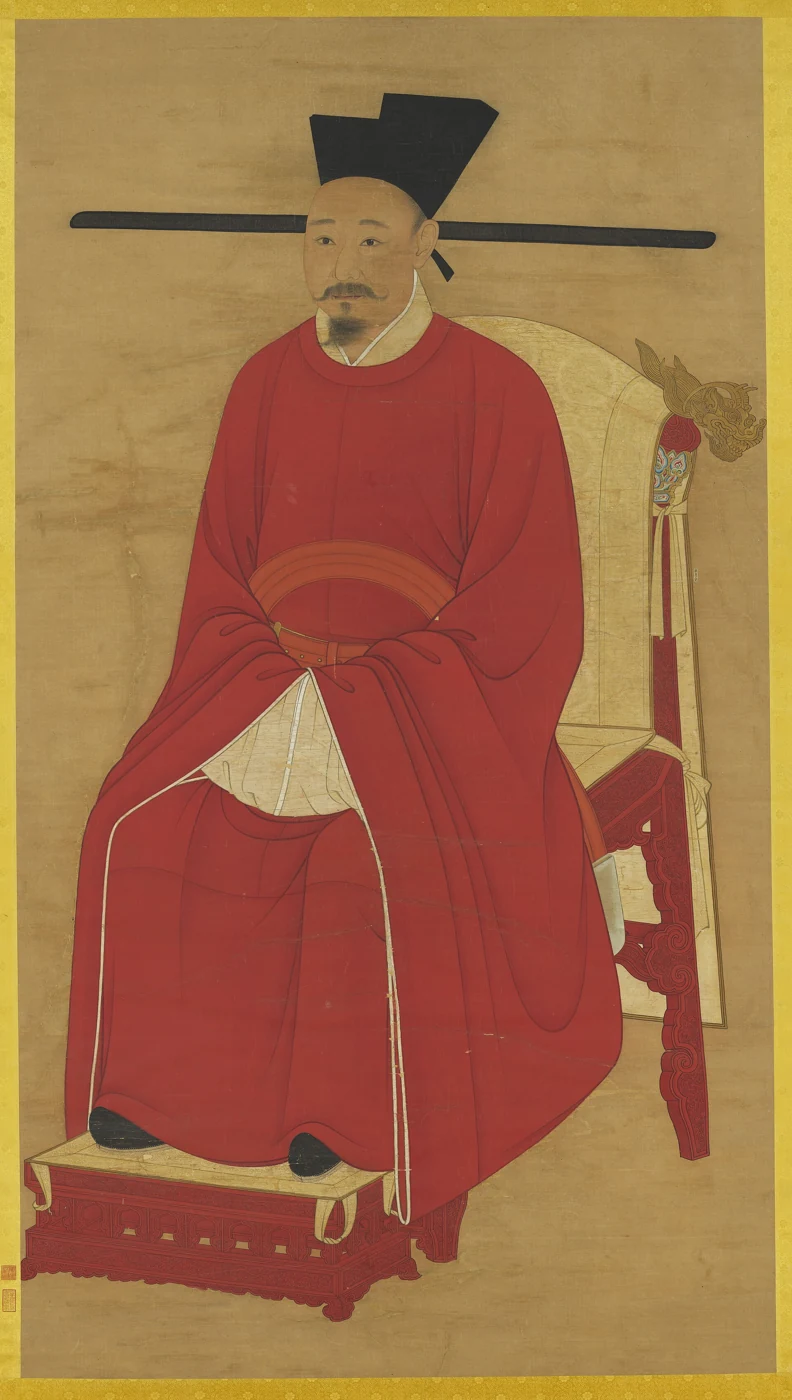
1127 CE–1194 CE
Emperor of the Southern Song
Zhao Shen
赵昚
Emperor Xiaozong of Song, Zhao Shen (27 November 1127 – 28 June 1194), courtesy name Yuanyong, was the eleventh emperor of the Song dynasty and the second of the Southern Song, reigning from 20 July 1162 to 18 February 1189. Originally named Bocong, he was a seventh-generation descendant of the dynasty's founder Zhao Kuangyin and a son of Zhao Zicheng, Prince of Xiu. He was raised in the palace by Emperor Gaozong from 1132,…
1127 CE–1194 CESouthern Song
PROFILE
Emperor Xiaozong of Song, Zhao Shen (27 November 1127 – 28 June 1194), courtesy name Yuanyong, was the eleventh emperor of the Song dynasty and the second of the Southern Song, reigning from 20 July 1162 to 18 February 1189. Originally named Bocong, he was a seventh-generation descendant of the dynasty's founder Zhao Kuangyin and a son of Zhao Zicheng, Prince of Xiu. He was raised in the palace by Emperor Gaozong from 1132, made an imperial son in 1160 and crown prince in 1162, and took the throne by Gaozong's abdication in the same year, returning the succession to the line of the founding emperor. He rehabilitated Yue Fei, employed the veteran Zhang Jun and launched the Longxing northern campaign, which failed at Fuliji and was followed by the Longxing peace with the Jin. He then reformed the bureaucracy, cut supernumerary offices, reorganised finances, relieved famine and held three great military reviews, a period known as the Qianchun governance. He abdicated in favour of his son Zhao Dun in 1189 with the title Retired Emperor Shouhuang and died at the Chonghua Palace in 1194.
- Other names
- Shouhuang; Emperor Xiaozong of Song, Zhao Shen
- Courtesy name
- Yuanyong
- Era
- Southern Song
- Dynasty/Regime
- Southern Song
- Identity
- Emperor of the Southern Song
- Date of Birth
- November 27 1127
- Date of Death
- June 28, 1194 CE(5th year of the Shaoxi era)
- Ancestral home
- Not recorded in historical sources
- Place of birth
- Qingshan Sluice, Xiuzhou (present-day Jiaxing, Zhejiang Province)
- Place of death
- Not recorded in historical sources
- Reign
- July 20, 1162–February 18, 1189
- Predecessor
- Emperor Gaozong of Song (Zhao Gou)
- Successor
- Emperor Guangzong of Song (Zhao Dun)
- Era names
- Longxing, Qiandao, Chunxi
- Highest office
- See Biography and Major Deeds
- Major achievement
- Regarded as the most capable emperor of the Southern Song; after the failure of the Longxing Northern Expedition, he continued to pursue recovery while promoting Neo-Confucian culture.
LIFE TIMELINE
Death or year of death | Death or year of death; no inference is made where reliable sources provide no further detail.
BIOGRAPHY
Biography
Descent and Entry into the Palace
Zhao Shen was born on the wuchen day of the tenth month of the first year of Jianyan (27 November 1127) at the official residence by the Qingshan Gate in Xiuzhou, in present-day Jiaxing, Zhejiang. His father was Zhao Zicheng, Prince of Xiu, a descendant of Zhao Defang, Prince of Qin, the youngest son of the dynasty's founder; his mother was a lady of the Zhang clan. According to the genealogy given in the History of Song, the line ran from the founding emperor through Prince Defang of Qin, Duke Weixian of Yingguo, Marquis Congyu of Xinxing, Marquis Shijiang of Huayin and Duke Lingtan of Qingguo to Zicheng, which made Zhao Shen a seventh-generation descendant of Zhao Kuangyin. This descent had special significance for the Southern Song succession: since the accession of Taizong, Zhao Guangyi, the imperial title had passed among Taizong's descendants, and the accession of Zhao Shen returned it to the line of the founding emperor after a hundred and eighty-six years. Later historical commentary repeatedly stresses this point about the legitimacy of his line. His boyhood name was Bocong, and he also had the childhood name "Yang".
In 1132 the officials charged with seeking out members of the imperial clan selected ten boys under the age of seven from among the "Bo" generation of the founder's descendants, one generation below Emperor Gaozong; Zhao Bocong was among them. Of the ten, only two were finally presented for Gaozong's decision, one fat and one thin: the fat boy was named Zhao Bohao and the thin one was Zhao Bocong. Gaozong at first decided after a cursory look to keep the fat boy and send Bocong home with three hundred taels of silver, then changed his mind, saying that he had not examined them carefully and wished to look again, and had the two stand with hands folded while he observed them closely. Just then a cat passed beneath their feet: Zhao Bocong did not move, but Zhao Bohao kicked it. Gaozong frowned and observed that the cat had merely chanced by and there was no reason to kick it, and that such frivolity in a child hardly fitted him to bear the weight of the state; he therefore decided to keep Zhao Bocong and raise him in the palace. The story is recorded both in the History of Song and in later notebooks such as Wang Mingqing's Huizhu lu yuhua, which adds that the fat boy, Zhao Bohao, ended his career as inspector of Wenzhou.
In the second month of 1133 Zhao Bocong was appointed defence commissioner of Hezhou and given the name Yuan, and was then transferred to Guizhou. In the fifth month of 1135, on the advice of Zhao Ding, the left vice director of the Secretariat, a school was established in the palace to teach him, and when it was completed it was made the Zishan Hall. The histories say that he read widely and had an exceptional natural capacity. In the same year he was appointed military commissioner of Baoqing and enfeoffed as Duke of Jianguo, with Fan Chong, edict attendant of the Huiyou Pavilion, and Zhu Zhen, diarist, appointed his tutors; Gaozong instructed him to bow to both men. Because it was rumoured that the Jin intended to install Zhao Chen, the crown prince of Emperor Qinzong, as a puppet emperor at the old capital Kaifeng in order to challenge Gaozong's legitimacy, the general Yue Fei secretly asked Gaozong to name Zhao Yuan crown prince early so that the Jin scheme would come to nothing; Gaozong also arranged for Yue Fei to meet Zhao Yuan, and Yue Fei remarked that Zhao Yuan was the kind of ruler who could restore the Song house.
Prince of Pu'an and the Contest over the Succession
In the first month of 1142 Zhao Yuan was given the additional title of junior guardian and enfeoffed as Prince of Pu'an Commandery; in the third month he left the palace for his own residence. In the ninth month of 1143 his father, Zhao Zicheng, Prince of Xiu, died at Xiuzhou; in the first month of the following year the court, on the advice of its ministers, permitted him to lay down office and go into mourning, and in the fourth month of 1146, when the mourning ended, he returned to his former office. In the sixth month of 1147 he was transferred to be military commissioner of Changde. In the meantime Gaozong's other adopted son, Zhao Qu, was enfeoffed as Prince of Enping Commandery and made military commissioner of Wukang, with the same staff and ceremonial status as Zhao Yuan; the two were known as the Eastern and Western establishments. The position of crown prince remained unfilled for many years and both inside and outside the court there was doubt about the succession.
Several details bearing on Gaozong's final choice survive in Song sources. The Baozheng Siming zhi records the episode of the copies of the Lanting xu: Gaozong gave one copy each to the two princes with the instruction to submit five hundred further copies in that style; when he later asked first the Prince of Pu'an, seven hundred copies had been submitted, while the Prince of Enping said he had had no time. The same source records that Gaozong gave each prince ten palace women, and that the Prince of Pu'an treated them according to the proprieties due to women who had formerly served the late emperor, while the Prince of Enping became intimate with all of his. Gaozong accordingly thought the Prince of Pu'an the more worthy and made him an imperial son with the title Prince of Jian. These details come from later gazetteers and notebooks and may be read alongside the selection process recorded in the standard history rather than taken as verbatim contemporary minutes.
In the second month of 1160 Zhao Yuan was made an imperial son with the name Wei and appointed military commissioner of Ningguo, opening office with the same honours as the three excellencies, and enfeoffed as Prince of Jian; in the third month Zhao Qu was appointed with the same honours, made superintendent of the imperial clan and given an office at Shaoxingfu, thereafter being styled "imperial nephew", which settled the status of the two. In the fourth month Zhao Wei was given the courtesy name Yuanhuan. Li Xinchuan's Collected Documents from the Years since Jianyan records the proceedings: the chief councillor Tang Situi and others asked that an imperial son be named and that he be given a new name in accordance with precedent, whereupon an imperial autograph note to the Three Departments read that Yuan might be made an imperial son with the name Wei, and a decree appointed the imperial son military commissioner of Ningguo and opening office with the same honours as the three excellencies and enfeoffed him as Prince of Jian; when the decree was issued, the court officials were stirred and rejoicing was general inside and outside the court. At the same time Zhao Qu, Prince of Enping Commandery, was made superintendent of the imperial clan with an office at Shaoxingfu and styled imperial nephew.
In the course of this process relations between Zhao Wei and the powerful chief councillor Qin Hui became strained. In 1154, when bandits rose at Quzhou, Qin Hui sent the officer Xin Li of the Palace Front Command with a thousand men to suppress them and did not report the matter. When Zhao Wei attended the emperor he mentioned it, to Gaozong's great alarm; the next day Gaozong asked Qin Hui about it, and Qin Hui replied that the disturbance was not worth troubling the imperial mind, that he had therefore not reported it and had meant to memorialise once it was suppressed. On leaving the presence Qin Hui understood that Zhao Wei had spoken of it and bore him a grudge. When Qin Hui later lay gravely ill, his household concealed the fact and plotted to have his son Qin Xi succeed him as chief councillor; Zhao Wei again secretly informed Gaozong and defeated the scheme.
The Wanyan Liang Invasion and the Request to Lead Troops
In the ninth month of 1161 the Jin ruler Wanyan Liang invaded in force and on the first day of the tenth month an edict announced a personal campaign. With both Huai regions lost, the court debated withdrawal, and the Prince of Jian, Zhao Wei, could not contain his indignation and memorialised asking to lead the troops as the vanguard; this at once aroused Gaozong's suspicion and anger. According to Li Xinchuan's Miscellaneous Records from the Court and Countryside since Jianyan, Shi Hao, who lectured at the prince's establishment and had been absent ill for several days, on hearing of it at once used the examples of Shen Sheng, heir of the Duke of Jin, and of Emperor Hui of Han to argue that a crown prince must not command troops, observing that in a time of crisis father and son could not for a single step be parted, and that the precedent of Emperor Suzong of Tang proclaiming himself at Lingwu had brought him a few years of early emperorship at the cost of never being able to be a loyal subject or a filial son for the rest of his life. The prince was greatly stirred and asked what was to be done; Shi Hao then drafted a memorial for him, in which he bitterly acknowledged his fault and asked instead to escort the imperial progress and so fulfil his duty as a son, and had it submitted through the palace. Gaozong, who had been suspicious and angry, was at once appeased on reading it, and on learning that the memorial came from Shi Hao, said to the ministers the next morning, "Shi Hao is truly an official for a prince's establishment", and approved the prince's accompanying him to Jiankang to review the generals. In the tenth month of the same year the Prince of Jian was transferred to be military commissioner of Zhennan by the grace of the Bright Hall sacrifice; in the twelfth month he escorted the imperial progress to Jiankang.
The Abdication and Accession
In the fifth month of 1162 Gaozong made Zhao Wei crown prince and changed his name to Shen. According to the Miscellaneous Records, Gaozong was weary of government and the chief councillor Chen Kangbo secretly supported the great decision, arguing that if the name were not settled the ministers might harbour doubts and that, with the generals quartered along the river, they must be made to know the imperial will clearly. The edict issued from within observed that he had held the throne for thirty-six years and that, the prince being of ripened virtue, the succession had a worthy holder. The choice of name involved an episode: the name first chosen was homophonous with that of the last ruler of the Tang, and after a minister raised the point a new name, Shen, was obtained by imperial decision, with the courtesy name Yuanyong given ten days later.
On the tenth day of the sixth month Gaozong issued an autograph note declaring that the crown prince might ascend the throne and that he himself would be known as retired emperor and retire to the Palace of Longevity. In the same month the abdication ceremony was held: the officials were drawn up below the Zichen Hall, five hundred bearers of the yellow standards and a hundred musicians of the imperial offering were provided but stood silent. Gaozong had earlier conveyed his intention to the prince, who had wept and firmly declined; on the day itself he was summoned by an inner messenger and told again, but he still refused, went quickly to the side door of the hall and wished to return to the Eastern Palace, and was stopped only by Gaozong's repeated encouragement. Gaozong then took his seat in the Zichen Hall, and after the officials had paid their respects the left vice director Chen Kangbo and others came up and offered their congratulations, saying that the sovereign had raised himself above the common and performed an act worthy of Yao and Shun; Gaozong answered that he had reigned thirty-six years, was now old and ill and had long wished for retirement, and that the matter lay wholly in his own decision and not in the urging of ministers, and told them to exert themselves in supporting his successor.
The record of Zhao Shen's conduct at the ceremony was noted at the time: wearing the robe and shoes of his rank he was assisted to the front of the throne by the eunuchs, where he stood with hands folded and would not sit; as the attending officials congratulated him in turn he was assisted seven or eight times before he sat briefly at the side, and when the chief councillor led the hundred officials in congratulation he rose at once, saying that he feared he could not bear so great a position. After the ceremony the retired emperor left that day for the Palace of Longevity, and Zhao Shen, in red-brown robe and jade belt, walked out of the gate of the Xiangxi Hall and supported his carriage through the rain, refusing to stop even at the gate of the palace; the retired emperor waved him back repeatedly and had him assisted back, saying that he had entrusted the realm to the right man and had no regrets. This account is preserved in Li Xinchuan's Miscellaneous Records and is among the few detailed records of a Southern Song abdication.
The Longxing Northern Campaign and the Defeat at Fuliji
At the beginning of his reign Zhao Shen was determined on restoration. He first rehabilitated Yue Fei, granting him posthumously the title Duke of Egou, cleared out the remaining partisans of Qin Hui and employed the veteran general Zhang Jun to direct military affairs. His treatment of Zhang Jun was remarked on: he sent him his own exposition of the restoration policy and placed Zhang Jun's tablet among the tablets in the palace shrine, so that whenever he had a doubt he would first pay respects there and then summon Zhang Jun to ask for details, so as to show that he did not presume to interrogate him directly. Some ministers who admired Zhang Jun thought this went beyond the proper relation between ruler and minister, but Zhao Shen was unmoved and announced that he relied on the Duke of Wei as on the Great Wall and would not be swayed by idle talk.
For the campaign he reorganised the army and trained in arms himself. Yue Ke's Ting shi records that in the early Longxing years, bent on restoring the north, he took to the saddle himself to accustom himself to hardship, in the spirit of Tao Kan carrying bricks, and often summoned the generals to play polo in the palace, spreading sand and erecting awnings even in wind and rain; the ministers memorialised that the weight of the ancestral temple made it improper to take such risks, and he paid no attention. He also hoped for the support of the retired emperor, and at the beginning of his reign would talk animatedly of restoration plans at each visit to the Palace of Longevity, but Gaozong showed impatience and once said, "Elder brother, discuss this after my hundred years have passed"; Zhao Shen fell silent, and thereafter never raised the subject in his presence again.
In the fourth month of 1163, on Zhang Jun's advice, Zhao Shen sent the armies north. Zhang Jun directed the forces from Yangzhou and on the fourth day of the fifth month the two generals Li Xianzhong and Shao Hongyuan marched in succession. Li Xianzhong crossed the Huai and reached Dougou, where he met the Jin general Xiao Qi; the Song troops fought with high spirits, defeated the Jin heavily and went on to recover Lingbi. Shao Hongyuan's attack on Hongxian went badly: several tens of thousands of Song troops besieged a town held by a few thousand and were repulsed for days, and only entered after Li Xianzhong sent surrendered troops from Lingbi to persuade the Jin commanders to give up a hopeless defence, which left Shao Hongyuan jealous. Li Xianzhong then advanced north to the walls of Suzhou, proposing a joint attack, but Shao Hongyuan was non-committal and Li Xianzhong took the city in a bloody assault on his own. Zhao Shen was delighted at the news, promoted Li Xianzhong to recruiting commissioner of the three routes of Huainan, Jingdong and Hebei and Shao Hongyuan to deputy, and prepared to take the field himself.
The Jin forces then steadied, counter-attacked in strength, and the Song armies, with their two commanders at odds, were deep in enemy country with insufficient troops. Zhang Jun saw the danger and prepared to order a withdrawal, but the Song army collapsed at Fuliji and most of the recovered ground could not be held, ending the campaign in failure. The feud between Li Xianzhong and Shao Hongyuan and the collapse of coordination were the immediate causes of the defeat. The debate before the campaign also left a record: when Li Xianzhong and Shao Hongyuan asked leave to advance, Shi Hao memorialised that the two generals were seeking battle on their own initiative and asked whether the orders of the command were being disobeyed; Zhang Jun asked to be received and for an edict that the emperor would come to Jiankang the same day, whereupon Shi Hao set out three reasons against it and later argued with Zhang Jun that the campaigns of emperors must be undertaken with complete certainty and not attempted in hope of luck. Zhang Jun replied that the Central Plain had long been lost and that if it were not taken now the bold men of the region would rise and take it themselves; Shi Hao answered that there were no such bold men, for if there were they would have risen and destroyed the Jin. When a dispatch from Shao Hongyuan calling out the troops was found in the secretariat, showing that the advance had been ordered without the Three Departments being informed, Shi Hao said to Chen Kangbo that they all held office in the right bureau and yet knew nothing of the campaign, asking what use they were as councillors, and warned that if Zhang Jun, bent on war, once failed, the emperor might never again hope to see the Central Plain. After the censor Wang Shipeng criticised him, Shi Hao was sent out to govern Shaoxing.
The Longxing Peace and the Struggle between War and Peace Parties
After the failure of the campaign Zhao Shen employed the peace party around Tang Situi and the court became split between those who wanted peace and those who wanted war. The Jin demanded the terms of the Shaoxing settlement on pain of invasion, and Zhao Shen, over Zhang Jun's objection, sent Lu Zhongxian to the Jin camp at Suzhou. The Jin put four demands: that Song troops withdraw from the four prefectures of Hai, Si, Tang and Deng; that the annual tribute be paid in full and on time; that the Song emperor acknowledge the Jin ruler as his sovereign; and that the disloyal be handed over; in substance a repetition of the Shaoxing terms. Zhao Shen wished for peace but thought the terms too harsh, and before Lu Zhongxian set out warned him not to agree to the return of the border lands and to seek a reduction of the annual tribute and silk; Tang Situi, afraid that no agreement would be reached, privately told him to accept everything. Lu Zhongxian, timid and afraid of death, did not argue, saying only that he would report the terms to the court. Pusan Zhongyi then handed him a document which, apart from changing the relation between the two states from sovereign and subject to uncle and nephew, repeated the earlier terms and fixed the twentieth day of the eleventh month as the deadline for a reply. When Lu Zhongxian brought the document back, Zhao Shen stripped him of office, imprisoned him and sent him into exile.
Tang Situi then asked that his associate Wang Zhiwang be sent as the formal envoy to negotiate at the Jin court, ostensibly to reopen the terms but privately instructed to concede everything; the retired emperor Gaozong also pressed Zhao Shen to reach a settlement quickly and said he intended to prepare his own gift for the Jin emperor when Wang Zhiwang went. Zhao Shen reluctantly agreed; later, on the objection of the war party Chen Lianghan and Yu Yunwen, he ordered Wang Zhiwang's mission to halt at the frontier, and sent Hu Fang as an informal envoy to state that the four prefectures would never be returned. Hu Fang was at once detained by Pusan Zhongyi on the ground that the Song had exceeded the deadline, and the Jin sent word that unless the four prefectures were returned there was nothing to discuss. Unable to endure the arrogance, Zhao Shen angrily broke off the talks, recalled Wang Zhiwang's mission to Lin'an and ordered the frontier to prepare for war; Zhang Jun took the occasion to raise again the question of the emperor moving to Jiankang, and Zhao Shen agreed and fixed the fourth month of 1164 for the journey.
His breaking off the negotiations was, however, largely the product of a moment's anger, and he had no great confidence in reopening the war. When Hu Fang was released and the Jin emperor signalled a willingness to talk, the resolve he had just regained was much reduced, and with Tang Situi and others pressing him in turn he changed his mind again, cancelling the journey to Jiankang and returning to negotiation. In the third month of 1164 he ordered the armies along the Huai frontier to withdraw to their garrisons stage by stage and sent Tang Situi and Wang Zhiwang to supervise the withdrawal as commissioners for the eastern and western Huai; in the fourth month he abolished the Jiankang-Huai supervisory headquarters and accepted Zhang Jun's resignation; in the fifth month he disbanded the "effective" troops and forbade frontier commanders to receive ministers from the north; in the sixth month he ordered Yu Yunwen to give up Tang and Deng, and when Yu Yunwen refused he was dismissed; in the seventh month the defence line along the Huai was withdrawn and Hai and Si were abandoned; in the eighth month Wei Qi and Wang Pu were sent respectively to the Jin court and to the camp of Pusan Zhongyi to discuss terms; in the ninth month Tang Situi was appointed commander of the armies of the eastern and western Huai routes, Jiankang, Zhenjiang and Jiangyin and the prefectures of Jiang and Chi, putting the military power of the middle and lower Yangtze in his hands, and in the same month Wang Zhiwang became assistant administrator of state and concurrently in charge of the Bureau of Military Affairs. By this point the military and political power of the court lay wholly with the peace party.
The four principles Zhao Shen laid down before Wei Qi's departure — correct titles, withdrawal of troops, reduction of tribute and refusal to return disloyal subjects — had in effect ceased to touch the essential questions. Wei Qi was detained on the way by Pusan Zhongyi, who demanded to inspect the letter of Zhao Shen to the Jin emperor and then demanded the further cession of the Shang and Qin prefectures of the Sichuan-Shaanxi frontier on pain of invasion. Zhao Shen had to have the letter replaced, agreeing to return the four prefectures of Hai, Si, Deng and Tang and to maintain the old tribute. Pusan Zhongyi was still unsatisfied, declared that the Song was insincere and led his armies forward; the Song forces collapsed, and with the Jin breaking through the Huai defence line the prefectures of Hao, Chu and Chu fell in succession by the beginning of the eleventh month, Yangzhou was in danger and the front was pushed to the north bank of the Yangtze.
Before the Jin attack began in earnest Zhao Shen had already received Wei Qi's report, learned that the Jin was pressing its advantage and felt regret at having listened to Tang Situi and the rest, saying that he would rather the state perish than comply; he ordered the armies back to the front, told Wei Qi to stop negotiating and to use the gifts and money in his charge to reward the troops. Wei Qi, instructed by Tang Situi, refused to obey and withdrew only as far as Zhenjiang, waiting for the Jin pressure to force Zhao Shen to submit, which deepened Zhao Shen's dissatisfaction. Once the Jin broke through on the Huai and reached the north bank of the Yangtze, Zhao Shen brought Chen Kangbo back as chief councillor and Yu Yunwen as assistant with concurrent office in the Bureau of Military Affairs. On the tenth day of the eleventh month he dismissed Tang Situi from all office, stripped him of the title Duke of Guo and sent him under escort to Yongzhou, where he died on the way. The two states then returned to negotiation and concluded the Longxing peace of 1164, which changed the relation from sovereign and subject to uncle and nephew and somewhat reduced the annual tribute; the era name was changed to Qiandao the following year.
Domestic Government and Frontier Affairs in the Qiandao Years
After the peace Zhao Shen both strengthened the frontier and turned to domestic government. He first sought to change the humiliating ceremony for receiving Jin documents: under the Shaoxing settlement the Song emperor had to leave his seat and descend the steps to receive the letter, displaying the relation of subject to sovereign, and in the early years of his reign, with Chen Kangbo as chief councillor, this was altered so that an attendant received the letter and presented it, implying that the two rulers were of equal standing; when the peace party returned to power the old ceremony was restored and Zhao Shen accepted it under pressure. The Longxing settlement changed the relation from sovereign and subject to uncle and nephew but left the ceremony unchanged, and Zhao Shen, who felt the humiliation keenly, looked for an opportunity to alter it. In 1170 he appointed the diarist Fan Chengda as envoy; Fan Chengda raised the demand in person, and the Jin emperor Renzong was furious and his ministers asked that he be detained, but the emperor, impressed by his willingness to die rather than disgrace his ruler's commission, overruled them and let him return. The Jin emperor flatly refused to change any clause of the treaty and agreed only to move the tombs of the Northern Song emperors south, thereby closing the question of the return of Henan. Two months after Fan Chengda's return Zhao Shen sent the secretariat drafter Zhao Xiong to demand the change of ceremony again, on the occasion of congratulations on the Jin emperor's birthday; the Jin emperor asked why, if the Song would not receive the coffin of Emperor Qinzong, it persisted in demanding the return of the Henan tombs, and said that he would bury Qinzong himself if the Song did not wish him returned, and that after years without objection the sudden demand for a change of ceremony showed what fidelity; there was nothing to discuss, and Zhao Xiong came back empty-handed. In the Chunxi years Zhao Shen's ambition for the north gradually faded and relations with the Jin settled into more than thirty years without incident.
In domestic government he concentrated on reforming the bureaucracy, cutting supernumerary offices and managing finance. In the first month of 1172 he followed the Han model of renaming the left and right vice directors of the Secretariat as left and right chief councillors, abolishing the offices of director of the Chancellery, director of the Secretariat and director of the Department of State Affairs, and transferring the business of the Three Departments to the two chief councillors; this ended the Northern Song arrangement by which the deputy head of the Department of State Affairs held the chancellorship on a temporary basis and increased both the authority and the rank of the chief councillor, raising it from the first rank with a difference to the first rank proper. The change was in fact connected with his wish to strengthen Yu Yunwen's authority for a further northern campaign. In the tenth month of 1168 he appointed Chen Junqing right chief councillor and concurrently commissioner of military affairs, soon promoting him to the left; in the sixth month of the following year he brought Yu Yunwen back as commissioner of military affairs and in the eighth month promoted him to right chief councillor while he retained the military post. Both were of the war party. Yu Yunwen as chief councillor urged the revision of the Longxing treaty, proposing an embassy to demand the return of Henan, where the tombs of the Northern Song emperors lay, and the alteration of the humiliating forms of exchange, while Chen Junqing firmly opposed the move as futile and likely only to arouse Jin suspicion. Zhao Shen adopted Yu Yunwen's proposal and Chen Junqing resigned; in the ninth month of 1172 Zhao Shen approved Yu Yunwen's resignation as chief councillor and appointed him commissioner for the pacification of Sichuan with the titles of junior guardian and military commissioner of Wu'an and the enfeoffment Duke of Yong, intending that Yu Yunwen should command the Sichuan-Shaanxi front while he directed the Huai and Yangtze fronts himself, with the two to rise together and meet in Henan; within two years Yu Yunwen died in office.
The choice of chief councillors was also repeatedly changed. Wei Qi was consistently for peace, and after entering the chancellorship opposed Zhao Shen's talk of restoration with various arguments, much to his disappointment; a year later Zhao Shen dismissed Ye Yong and Wei Qi on the pretext of thunder in the winter solstice. In the second month of the following year he promoted Jiang Fu to right chief councillor with sole authority, but Jiang Fu, though known as an advocate of war, urged the maintenance of the existing peace on the ground that the time and circumstances were not ripe and refused outright to command a campaign, whereupon Zhao Shen, visibly angry, dismissed him after five months. In the early Qiandao years he had also employed the minister Jiang Fu to manage finance, appointing him chief councillor because he was thought relatively skilled in such matters, but he achieved nothing and greatly disappointed the emperor.
On finance, the extravagance and waste that had prevailed since the Northern Song remained serious. As soon as he came to the throne Zhao Shen declared the need for economy and freedom from burdensome expenditure and began with himself and the court: by custom the prefectures sent quantities of gold and silver as birthday gifts on the emperor's birthday, many officials profiting in the process, and on the day after his accession he suspended the birthday offerings and three months later cancelled the celebration of the Huiqing festival, his own birthday. To make up the shortfall the Southern Song had issued paper money, with the result that its value fell sharply: a thousand units of the Qianyan, fixed officially at 1,280 cash in iron coin, was worth only 700 in private transactions; a thousand of the eastern Huizi, originally worth one string of copper cash, fell to 750, and the Hubei Huizi to 500 or 600 cash, a depreciation of half. In the late 1167 he ordered two million taels of silver and two million strings of cash to be brought out to retire most of the eastern Huizi, fixing the remainder at a little over five million as the basic quota and providing for regular replacement. He also adjusted certain taxes so as to stabilise revenue, fixing the annual receipts of the monopoly offices and tea markets at Lin'an, Jiankang and Zhenjiang at 24 million strings, with 12 million for Jiankang, 8 million for Lin'an and 4 million for Zhenjiang, and rewards for exceeding the quota and penalties for falling short, and fixing the Lin'an wine tax at 1.6 million strings a year and later at 2.1 million. These measures touched the fundamental problems of the finances, but with the chief councillors also responsible for the whole civil and military administration, and with finance regarded as beneath the dignity of the scholar-officials, the practical results were limited.
For the hardships of the people Zhao Shen had shown sympathy even before his accession. The day after he came to the throne he ordered officials everywhere to seek out and report in detail any matters causing distress among the people, so that irregular levies might be removed as far as possible, and he remitted the arrears of land tax in Sichuan; in the eighth month he issued eighteen measures for the relief and comfort of the people; in the eleventh month he remitted 400,000 strings of arrears from the wine shops, and in the twelfth month the burdensome tax levies of Sichuan; soon afterwards he remitted the arrears of the poor households of Xiuzhou and elsewhere. Natural disasters had been frequent since the end of the Shaoxing period, and in the Liangzhe region two successive years of flood left crowds of refugees. In 1163 he remitted that year's land tax for the flood-stricken people of Liangzhe, and in 1164 brought out 400,000 taels of silver from the privy treasury together with purchased grain for the victims and distributed 200,000 piculs of the Jiangxi charitable granaries. He required the ministers and the censors to supervise the distribution of relief and to impeach and punish any who withheld or misappropriated it. When a minister proposed sending officials to pray to the gods of the mountains and rivers of the stricken districts to avert heaven's anger, he replied that heaven should be answered with substance and that rather than look to spirits for help he would act, cutting palace expenditure and observing reduced meals and withdrawal from the main hall, devoting the savings to relief.
In relief administration he both tried to repair the charitable and ever-normal granaries and explored new methods. In the fifth month of 1168, with famine in Fujian, a community granary was set up at Chong'an in Jianningfu, which borrowed 600 piculs of millet from the government to distribute to the hungry, to be repaid with interest after the harvest; the prefect Wang Huai ordered a separate granary to be established in the countryside, managed by a chosen steward, for relief in famine and storage in good years. Because the community granary stood at the level of the village and was run by representatives of the participants, it was easier to supervise and less liable to abuse, and after some years it had not only repaid the 600 piculs but accumulated 3,100 more, so that even in bad years the people did not go short. In the Chunxi years Zhao Shen issued an edict extending the community granary system to the whole country, with households grouped in tens under a head and in fifties under a community head, the grain contributed by the wealthy together with the community head, the neighbourhood head and local scholars managing the affairs; the poor, except for deserters, vagrants and the well-to-do, could join voluntarily, with one picul lent to an adult, five pecks to a minor and nothing to children under five, interest at first twenty per cent and, once the interest paid reached ten times the principal, at only three per cent for wastage, and heavy penalties for refusing repayment. In practice the system was soon turned to the people's harm by the abuses of wealthy local families, but in its trial years it did help the poor through famine.
In the discipline of officials, he issued an edict in the eleventh month of the year of his accession increasing the penalties for corruption, providing that officials convicted of accepting bribes be dismissed and never again employed and that those already reappointed be dealt with on the same principle; to prevent concealment of a corrupt record or impersonation, the authorities were ordered to keep a full register of every such case for checking at appointment. He soon further provided that officials guilty of serious corruption should forfeit their property and, like common criminals, be tattooed and exiled to the frontier. Some at first took this for the enthusiasm of a new ruler, and the official Shi Xiangyi continued to take bribes until, on discovery, Zhao Shen in great anger ordered his property confiscated and his exile with the tattoo, at which the officials understood his determination. He also stressed the assessment of officials, holding that promotion must rest on actual achievement and ability, and limiting the number of promotions to encourage competition. In 1163, after wide consultation, he fixed the annual promotions of principal local officials at eighty, each to be supported by at least nine assessments and the recommendation of two ministers, with no promotion at all if fewer than that number qualified and no limit for exceptional merit. What was assessed varied with the region: in Hunan, land reclaimed and the state of agriculture; on the frontiers of Huainan and Sichuan-Shaanxi, the ability to settle refugees and encourage farming. Those who failed might face more assessments, a longer probation, demotion or immediate dismissal, and the principal officials of each route had to report regularly on their subordinates. He later fixed standards for central officials as well, so that a vice minister could be promoted to head of a ministry only after serving in a local post and passing assessment, and punished for falling short. Against factionalism he took the eight characters "speak without concealment, and let every word be reasonable" as the standard for ministers, and especially for the censors, including it in their instructions and repeatedly warning them to attend to public business and to establish rules and correct the law. When the censors Liu Du, Hu Yi and others opposed the exceptional appointment of his former establishment officials Long Dayuan and Zeng Di, he wrongly supposed that they were acting in concert in the manner of a faction, angrily dismissed them and declared that he would break up factions, later restoring them when he learned the truth.
In military affairs he held three great reviews of the troops in 1166, 1168 and 1170, within a span of less than five years, in order to show his refusal to accept a humiliating peace, to raise morale and to reform and assess the army. Reviews on such a scale had not been seen since the founding of the Southern Song and, at a time when a mood of accommodation prevailed, they raised morale among the people. Besides reviewing the troops in person he required the garrisons to hold exercises every spring and autumn so that weaknesses in training could be found and corrected, with exceptional commanders promoted out of turn and soldiers of outstanding skill rewarded: good archers received an extra three to five pecks of military grain a month and crossbowmen five to eight pecks, and those outstanding in all skills could rise two grades. He told Yu Yunwen that with rewards in the army every man would strive to master his craft and there would be no need to fear that military administration would go unreformed. The rewards at the reviews were generous, that at the second costing forty yi of gold and more than 100,000 strings of cash. He practised arms himself as well, riding and shooting with his sons and attendant officers in the palace or at the Yujin Garden, and though the ministers objected that it was beneath the imperial dignity he persisted.
On horse supply, the Southern Song continued the policy of breeding its own horses, establishing the Yangzhou stud in Huainan and the Longjushan and Yingcheng studs in Jingxiang, but the horses obtained were few and poor, and in 1173 all the studs were closed, including the Nandang stud at Lin'an which Gaozong had fostered, after which warhorses came wholly from the Sichuan and Guang horses bought from the Tibetans and the Dali kingdom. In Sichuan and Shaanxi, the three routes of Qinfeng, Xihe and Yongxing, thirteen prefectures and three armies in all, which had been recovered since the end of the Shaoxing period, were lost again to the Jin through faulty handling; when Yu Yunwen returned from the front to report the facts and argue strongly against the policy, Zhao Shen realised that he had been misled by Shi Hao's one-sided account, cried out that Shi Hao had ruined him and hastily ordered Wu Lin to decide for himself whether to advance or withdraw, but the position could no longer be saved.
Abdication and Last Years
After Gaozong's death in 1187 Zhao Shen announced that he would observe three years of mourning for him. On the twentieth day of the first month of 1189 he formally told the chief councillors that he would abdicate in favour of the crown prince and retire to keep the mourning; on the twenty-eighth day he renamed the Palace of Longevity the Chonghua Palace as his own residence, and on the second day of the second month the abdication ceremony was held in the Zichen Hall, Zhao Shen becoming retired emperor with the title Most Honoured Retired Emperor Shouhuang. He had already begun to devolve power: the crown prince had first been brought into the making of policy, on the second day of the eleventh month he was formally given a share in government with a hall in which to discuss affairs with the chief councillors, and in the first month of the following year the arrangement was extended so that apart from the principal appointments of court academicians, local supervisors and military commissioners above a certain rank, which remained in the emperor's own hands, all promotions, demotions and transfers were left to the crown prince, subject only to report; soon the crown prince attended the court directly and all state business was decided after consultation with him.
Zhao Dun, the new emperor, was, however, far less filial to his own father than Zhao Shen had been to his adoptive one, attending court irregularly and sometimes pleading illness for months, while his empress Li Fengniang repeatedly stirred up trouble over the naming of a crown prince and encouraged him to stay away from the Chonghua Palace. Zhao Shen was unhappy and fell ill with grief and anger. By the fourth month of 1194 his illness was grave, yet Zhao Dun refused to visit him and went instead with the empress to the Yujin Garden; in the fifth month, feeling his end near and wishing to see his son once more, Zhao Shen asked several times a day whether he had come, and Zhao Dun and the empress remained unmoved. The chief councillor Liu Zheng and the other ministers repeatedly begged Zhao Dun to satisfy the retired emperor's last wish, but he rose and left, and when they held his robe and warned that a last meeting would be impossible once the end came, he ignored them and went back into the palace, tearing his robe; two days later he ordered Liu Zheng and the others to stand down pending punishment. When this reached the Chonghua Palace, Zhao Shen, wholly disappointed in his son, declined, and died on the ninth day of the sixth month (28 June 1194) in the Chonghua Hall of Lin'an at the age of sixty-seven. In the tenth month he was given the posthumous title Zhewenshenwuchengxiao and the temple name Xiaozong, with the dynastic music called the Dance of the Great Bonds, and in the eleventh month he was buried in the Yongfu Mausoleum; in the sixth month of 1197 his title was extended with the additional words Shaotongtongdaoguandezhaogong.
Zhao Shen was a seventh-generation descendant of Emperor Taizu. Taizu's youngest son, the Prince of Qin, De Fang, begot the Duke of Yingguo, Weixian; Weixian begot the Marquis of Xinxing, Congyu; Congyu begot the Marquis of Huayin, Shijiang; Shijiang begot the Duke of Qingguo, Lingtan; and Lingtan begot Zicheng, the Prince of Xiu. The prince's wife, Lady Zhang, dreamed that someone brought her a sheep with the words "take this as the sign," conceived, and gave birth to Zhao Shen on the wuyin day of the tenth month of 1127 at the official lodging at Qingshan lock in Xiuzhou, the room said to have been filled with red light as if the sun stood at noon. He was named Bocong as he grew.
Because he had no son, Gaozong sought a boy of the imperial clan, choosing ten children under seven of the "Bo" generation, one step below his own, from among Taizu's descendants; Zhao Bocong was among them. After scrutiny only two remained for the emperor to decide between, one fat and one thin, the fat one Zhao Bohao and the thin one Zhao Bocong. Having glanced at them Gaozong resolved to keep the fat and send away the thin with three hundred ounces of silver, then changed his mind and said he had not looked closely, ordering them to stand with hands folded for a careful inspection. At that moment a cat passed under their feet; Zhao Bocong did not move while Zhao Bohao kicked it, and Gaozong, frowning, asked why he kicked a cat that merely chanced by and whether such levity could bear the weight of the state, whereupon he kept Zhao Bocong and raised him in the palace. In the second month of 1133 he was made defense commissioner of Hezhou and given the name Yuan; in the fifth month of 1135, on the advice of the left chancellor Zhao Ding, a school was set up in the palace for his education, afterward called the Zishan Hall; he read with a strong memory and uncommon gifts, and Gaozong had him greet his tutors Fan Chong and Zhu Zhen with the full ceremony. He was afterward made junior guardian, Prince of Pu'an and then commissioner of Changdejun.
In 1154, when bandits rose in Quzhou and Qin Hui sent a thousand men under Xin Li without informing the emperor, Zhao Shen mentioned it while attending on Gaozong, who was much alarmed; and when Qin Hui lay dying and his household concealed it, plotting to have his son Xi succeed him as chancellor, Zhao Shen secretly informed Gaozong and the scheme was exposed. In the comparison with the Prince of Enping, Zhao Ju, his tutor Shi Hao taught him in many ways: when Gaozong had the two princes copy the Lanting Preface, Zhao Shen submitted seven hundred copies while Zhao Ju submitted none; and when the emperor gave each ten palace women, Zhao Shen treated them with the respect due his father's consorts while Zhao Ju took liberties with them. Gaozong therefore thought the more highly of him and in 1160 made him an imperial son with the title Prince of Jian.
In 1161, when the Jin invaded and the court proclaimed a personal campaign in the tenth month, with the two Huai lost and ministers arguing for retreat, Zhao Shen indignantly offered to lead the vanguard. Shi Hao warned him with the cases of Shen Sheng of Jin and the Han heir Hui, insisting a heir apparent must not command troops and citing the Tang Suzong's accession at Lingwu as a caution — that Suzong, though emperor a few years early, was forever barred from being counted a loyal son. Greatly moved, Zhao Shen had Shi Hao draft a memorial bitterly repenting and asking to accompany the emperor, submitted through the empress; Gaozong, then angry and suspicious, was appeased on reading it, and learning it came from Shi Hao exclaimed that he was truly a prince's officer, and allowed Zhao Shen to accompany him to Jiankang to meet the generals. In the twelfth month Zhao Shen went with the imperial progress to Jiankang.
On the jiazi day of the fifth month of 1162 Gaozong's hand edict made Zhao Shen heir apparent, the name first to be "Yu" but changed to "Shen" because of its sound with the last Tang ruler's, with the courtesy name Yongyong. On the tenth day of the sixth month Gaozong abdicated, and on the eleventh the ceremony was held in the Zichen Hall: Zhao Shen declined repeatedly, withdrawing to the side door to return to the Eastern Palace, and only after repeated urgings consented in tears; at the accession he stood aside from the throne and would not sit until the eunuchs had several times conveyed the retired emperor's order and lifted him seven or eight times, and when the officials offered congratulations he sprang up again, unwilling to receive them. He then escorted Gaozong through the rain to the Deshou Palace, refusing to halt at the gate, and Gaozong waved him back again and again, saying that he had entrusted the realm to the right man and had no regrets.
After taking the throne Zhao Shen sought to recover the central plains, in 1163 ordering Zhang Jun to lead a northern campaign, which ended in heavy defeat at Fuli through discord among the commanders and inadequate preparation. The next year the Song and Jin concluded the Longxing treaty, and peace held for more than forty years. He then devoted himself to domestic government: reforming the bureaucracy, cutting supernumerary posts, attending to farming and waterworks and repeatedly reducing taxes, so that the economy and society of the Southern Song were comparatively settled in the Qiandao and Chunxi years, known as the government of Qian-Chun. In 1189 he abdicated in favor of his son Zhao Dun, Emperor Guangzong, taking up residence as retired emperor in the Chonghua Palace; he died in 1194 at sixty-eight with the temple name Xiaozong and was buried at Yongfuling.
Another feature of Xiaozong's reign was the closer interaction between emperor and scholar-officials. He valued the classics colloquium, summoned ministers repeatedly to discuss government, and the chief councillors of the Qiandao and Chunxi years — Chen Junqing, Yu Yunwen, Zhou Bida, Wang Huai and others — were generally effective; he also had contact with the Neo-Confucian figures, Zhu Xi and Zhang Shi holding office or receiving his courtesy in his reign. His era therefore matters in both the political and the intellectual history of the Southern Song: the ambition to recover the north went unrealized, while much was accomplished in domestic government and culture.
His filial care of Gaozong is another point later ages praise: after Gaozong retired to the Deshou Palace he inquired after him regularly and joined him in excursions, and when Gaozong died he insisted on mourning to the point of disrupting the government. That reputation as a filial son matches his temple name Xiaozong and the political culture of the Southern Song, with its stress on legitimacy and ethics.
The failure of the Longxing campaign affected Southern Song foreign policy greatly. Xiaozong still wished to recover the north, but the court grew cautious in military matters and peace with the Jin lasted a long time; meanwhile the internal debate over war and peace continued, the opposition of the two camps recurring through the reigns of Xiaozong, Guangzong and Ningzong. His own position was thus in a sense contradictory: he wished to recover the north and had to accept the settlement, a contradiction basic to Southern Song politics.
The abdication between him and Gaozong was regarded by Southern Song historians as the model of a peaceful transfer within the dynasty.
He reigned twenty-seven years and lived five years more as retired emperor in the Chonghua Palace, one of the longer-reigning Southern Song sovereigns.
In the Chunxi years he discussed recovery with his ministers repeatedly and as often deferred it, the back-and-forth itself showing the limits of Southern Song strength and consensus.
Major Activities
Foreign Relations: the Ceremony for Receiving Documents and the Longxing Treaty
The main thrust of Zhao Shen's foreign policy was to maintain the peace while chipping away at the humiliating clauses of the Longxing treaty. In 1170 he sent Fan Chengda to demand the return of the Henan burial lands and a change in the ceremony for receiving Jin documents; the Jin emperor refused to alter the treaty and agreed only to move the tombs of the Northern Song emperors south, closing the question of Henan. Two months after Fan Chengda's return Zhao Shen sent Zhao Xiong to press the change of ceremony again, and was again refused on the grounds of fidelity to the treaty as it stood. With these missions unavailing, relations between Song and Jin remained without incident for more than thirty years, and the terms "changing the form of address from subject to nephew and reducing the annual tribute" became the principal claim for the diplomatic gains of his reign. In the south, his reign saw a settled arrangement for the investiture of Jiaozhi: when Li Tianzuo of Jiaozhi died in the Chunxi years, the Song court, following precedent by which the ruler of Jiaozhi was first made prince of Jiaozhi Commandery, later Prince of Nanping and posthumously granted the titles of attendant of the palace and King of Nanyue, resolved to honour him particularly generously, granting him posthumously the title attendant of the palace and King of Nanyue, and in 1176 invested his son Li Longgan as military commissioner and observation and disposal commissioner of the Jinghai army with the titles of specially advanced, junior commandant of the guard and concurrent censor, and the enfeoffment King of Annan with three thousand households and one thousand households in actual revenue, granting him the style of loyal and compliant servant. The patent observed that the charge had passed through seven generations since the Li family received the enfeoffment, and the court repeatedly praised the minute and barely legible characters of the Jiaozhi memorials, showing how formalised the investiture and correspondence with the southern dependencies had become.
Finance and Economic Institutions
Besides reforming the paper currency and fixing tax quotas, Zhao Shen tried to address the structural problems of the finances by establishing the Bureau of State Expenditure to supervise the financial agencies, headed personally by the chief councillors and assistant administrators of state, with great authority and high status; but with the chief councillors responsible for the whole civil and military administration and also for the details of finance, the arrangement exceeded any man's capacity, and since finance was regarded by scholar-officials as beneath their dignity and few chief councillors understood it, the design, thorough as it was, produced limited results.
Army Reform and the Military Reviews
The three great reviews of 1166, 1168 and 1170 were the most conspicuous expression of his army policy, unmatched since the founding of the Southern Song and intended both to inspect the army and to show that he would not settle for humiliation. They were accompanied by semi-annual exercises, by promotion out of turn for officers of achievement and rewards for soldiers of skill, and by his own long practice of riding and archery. The attempt to breed horses at home failed, and with the closure of the studs in 1173 the army depended entirely on Sichuan and Guang horses bought from outside.
Famine Relief and Community Granaries
Famine relief in his reign moved from emergency measures towards permanent institutions: the remission of arrears in Sichuan and of wine-shop taxes, the eighteen measures for the people's relief and repeated grants from the privy treasury were followed after the success of the Chong'an community granary in 1168 by an edict of the Chunxi years extending the system throughout the country, with its heads, quotas, rates of interest and penalties. The community granary became an important landmark in the history of Chinese famine administration.
The Palace, Court Anecdotes and the Use of Officials
Zhao Shen's long reign was noted for the absence of any conspicuous imperial favourite. His palace included Consort Cai, Consort Li Xianfei, Consort Zhang and Consort Chen Shufei; the histories record his reply to Li Tao's remonstrance about palace luxury that he was old and that only the burial of Consort Li had cost thirty thousand strings, with nothing else spent. In the use of officials he showed the same independence: in the Chunxi years the favourite Zhang Yue, then keeper of the seals, asked leave to entertain the attendants and, when the minister Chen Lianghan alone failed to attend, complained twice; that night Chen Lianghan was appointed remonstrating official by imperial note while the guests were still at their cups. The same independence appeared in his treatment of the censors: he made "speak without concealment, and let every word be reasonable" their standard, dismissed Liu Du and Hu Yi when he thought they acted in concert, and restored them when he learned the facts. In the choice of chief councillors he employed in turn the war party Yu Yunwen and Chen Junqing and the peace party Wei Qi and Tang Situi, the balance of power shifting with the state of the war and peace debate.
Personal Relations
- Relationships recorded in reliable sources are listed under Related Entries.
Historical Assessment
Assessment of this figure should be based on verifiable offices, activities, writings, and contemporary records.
FIGURES ASSOCIATED WITH THIS DYNASTY
Bibliography
Bibliographic information is not yet available for this entry.