Noble Birth
Born in Kaifeng into the illustrious lineage of Tang loyalist Guo Ziyi; relocated south to Lin'an after dynastic upheaval.
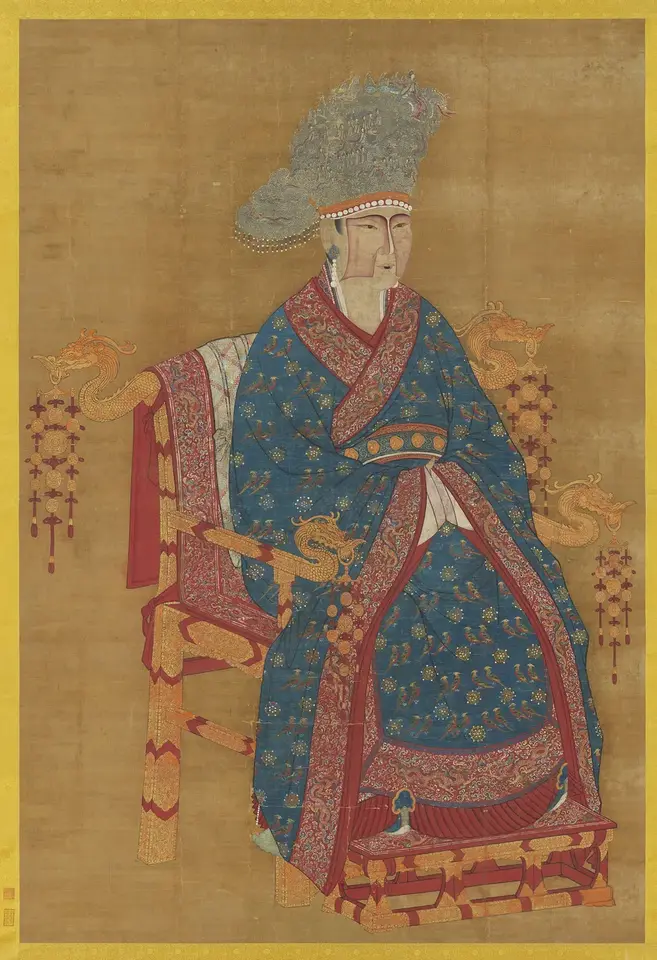
1126 CE–1156 CE
郭氏(宋孝宗皇后)
Lady Guo (郭氏, 1126–1156), formally honored posthumously as Empress Chengmu (成穆皇后), was a native of Kaifeng who settled in Lin'an following the southward flight of the Song court. A direct descendant of the renowned Tang dynasty loyalist Guo Ziyi, Prince of Fenyang, and daughter of Guo Jian, Military Commissioner of Zhaoqing, she was the primary consort of Emperor Xiaozong of Southern Song (Zhao Shen) and the birth mother of…
Lady Guo (郭氏, 1126–1156), formally honored posthumously as Empress Chengmu (成穆皇后), was a native of Kaifeng who settled in Lin'an following the southward flight of the Song court. A direct descendant of the renowned Tang dynasty loyalist Guo Ziyi, Prince of Fenyang, and daughter of Guo Jian, Military Commissioner of Zhaoqing, she was the primary consort of Emperor Xiaozong of Southern Song (Zhao Shen) and the birth mother of Emperor Guangzong (Zhao Dun). Raised in an illustrious military and bureaucratic lineage, Lady Guo was celebrated from childhood for her moral rectitude, modesty, and deep understanding of classical propriety. In 1144, during the rigorous selection of a principal consort for Prince of Pu'an Zhao Shen, she was chosen by Emperor Gaozong and Empress Wu, receiving the aristocratic rank of Lady of Chuyu State and later Lady of Shu State. Throughout their twelve years together in the princely mansion, she managed household affairs with rigorous frugality, restrained family ambition, offered prudent counsel amidst dangerous succession rivalries, and gave birth to four healthy princes—Crown Prince Zhao Qi, Prince Zhao Kai, Emperor Guangzong Zhao Dun, and Prince Zhao Ke—securing Zhao Shen's standing as the rightful heir to the Song throne. Exhausted by childbirth and domestic strain, she passed away in 1156 at the age of thirty-one. Following Zhao Shen's accession as Emperor Xiaozong in 1162, she was posthumously consecrated as empress, initially styled Empress Gongshu and later amended to Empress Chengmu, with her spirit tablet formally enshrined in the Imperial Ancestral Temple upon the accession of her son, Emperor Guangzong.
Born in Kaifeng into the illustrious lineage of Tang loyalist Guo Ziyi; relocated south to Lin'an after dynastic upheaval.
Selected as primary consort for Prince of Pu'an Zhao Shen; created Lady of Chuyu State by imperial decree.
Gave birth to Zhao Qi, the future Crown Prince Zhuangwen, solidifying princely status.
Gave birth to her third son, Zhao Dun, who would later ascend the throne as Emperor Guangzong.
Succumbed to chronic illness in the princely mansion aged thirty-one; posthumously honored as Empress Chengmu and enshrined in the Imperial Ancestral Temple.
Empress Chengmu was born into one of the most distinguished aristocratic families of the Song empire in 1126. Her family traced direct paternal descent from the legendary Tang general Guo Ziyi, Prince of Fenyang, whose military genius had crushed the An Lushan Rebellion. Following the fall of the Northern Song capital in the Jingkang incident of 1127, her household joined the mass southward migration of imperial elites, establishing permanent residence in the Southern Song capital of Lin'an.
From early childhood, Lady Guo was instructed in classical family precepts, the Book of Songs, and the Admonitions for Women. She was renowned among the gentry of Lin'an for her composed demeanor, refined needlework, and complete disinterest in personal luxury. When Emperor Gaozong, devoid of direct male heirs, established independent households for his adopted imperial heirs, Prince of Pu'an Zhao Shen required an exemplary primary consort capable of managing a royal household under close imperial scrutiny.
In 1144, following extensive evaluations by court ladies and ritual officials, Lady Guo was selected by Emperor Gaozong and Empress Wu as the primary consort for Prince of Pu'an Zhao Shen. The court conferred upon her the aristocratic title Lady of Chuyu State, conducting the traditional Six Rites of marriage with full imperial honors. Entering the prince's residence, the young consort exhibited unfailing deference toward royal elders and compassionate firmness toward household staff.
During the prolonged and precarious competition between Zhao Shen and his rival Prince Zhao Zhuo for the imperial succession, the princely household operated under constant administrative surveillance. Lady Guo recognized the delicate nature of their position, advising her husband to cultivate personal frugality, attend diligently to morning filial audiences with the emperor, and avoid any contact with contentious court factions, providing essential moral and emotional anchoring.
Within the Prince of Pu'an's mansion, Lady Guo established an orderly domestic regime that was praised throughout the capital. She instituted strict accounting procedures for all monthly household expenditures, eliminated wasteful banquets, and wore simple garments woven from common silk, which she mended and re-wore rather than discarding. Courtiers sent by Emperor Gaozong to observe the mansion consistently reported that the residence was governed with exceptional dignity and moderation.
Gratified by her domestic discipline, the imperial throne rewarded Lady Guo with progressive honors, elevating her to the higher status of Lady of Shu State. Beyond her administrative contributions, she performed monumental service to the imperial lineage by bearing four healthy sons in rapid succession: Eldest Son Zhao Qi in 1144, Second Son Zhao Kai in 1145, Third Son Zhao Dun in 1147, and Fourth Son Zhao Ke in 1149.
The presence of four healthy, well-educated male heirs effectively settled the imperial succession question in Zhao Shen's favor. Emperor Gaozong, observing Zhao Shen's expanding lineage, resolved to confirm his adoption as heir apparent. As a mother, Lady Guo oversaw the rigorous moral tutelage of her sons, engaging learned scholars to instruct them in the Classic of Filial Piety while warning them against the arrogance typical of royal scions.
The physical strain of bearing four sons within five years, combined with the relentless psychological stress of navigating treacherous court politics during the ascendancy of Chancellor Qin Hui, severely compromised Lady Guo's health. By the mid-1150s, she suffered from chronic pulmonary weakness and physical exhaustion, spending extended periods confined to her bedchambers despite constant medical attention arranged by her devoted husband.
In the summer of 1156, Lady of Shu State Guo passed away at the age of thirty-one, never living to witness her husband's ascension to the supreme throne. Prince Zhao Shen was devastated by the loss of his beloved companion, weeping inconsolably and composing poignant elegies mourning her unfulfilled life. Emperor Gaozong and Empress Wu issued decrees expressing deep condolences, arranging an elaborate funeral and interring her remains near the scenic precincts of West Lake.
Lady Guo's historical significance lies prominently in her steadfast adherence to personal frugality and her rigorous restraint of her maternal relatives. Recognizing that the elevation of royal in-laws had historically destabilized earlier dynasties, she established strict boundaries for her father, Guo Jian, and her brothers, forbidding them from exploiting their royal connection to solicit office, meddle in court politics, or acquire private agricultural estates illegally.
Under her firm ethical direction, the Guo family maintained an unblemished reputation for modest civic service. Her relatives adhered scrupulously to administrative regulations, precluding any criticism from imperial censors and shielding Prince Zhao Shen from factional attacks during his vulnerable years as presumptive heir.
In 1160, when Emperor Gaozong formally confirmed Zhao Shen as heir apparent under the title Prince of Jian, an imperial decree posthumously elevated Lady Guo to the status of Consort of Prince Jian. Two years later, upon Emperor Gaozong's abdication and Zhao Shen's accession as Emperor Xiaozong, the newly enthroned sovereign moved swiftly to honor his late wife, posthumously investing her as Empress Gongshu.
In 1167, concluding that the original posthumous designation did not fully reflect her foundational contributions in nurturing the imperial house, Emperor Xiaozong officially revised her posthumous title to Empress Chengmu. Concurrently, he bestowed posthumous peerages upon her father, creating him Grand Preceptor and Prince of Rong, while appointing her brother Guo Shiyu to high garrison commands in the capital guards.
In 1189, following Emperor Xiaozong's abdication, Lady Guo's third son ascended the imperial throne as Emperor Guangzong. Driven by deep filial gratitude toward the mother who had guided his formative years, Emperor Guangzong presided over grand state ceremonies to formally install Empress Chengmu's spirit tablet into the Imperial Ancestral Temple, ensuring her permanent enshrinement alongside the dynastic sovereigns.
Empress Chengmu's memory was commemorated throughout the Southern Song as the ideal paradigm of royal womanhood. In 1198, during the reign of her grandson Emperor Ningzong, the court bestowed additional honorific characters upon her title, finalizing her designation as Empress Chengmu Ruishun Zhuangyi.
Her selfless devotion to household stability, unblemished integrity, and pivotal role in providing four healthy heirs established the foundation for the prosperous Southern Song renaissance known as the Reign of Qianchun. Her legacy demonstrated that behind the triumphs of enlightened monarchs lay the indispensable moral contributions of dedicated consorts who quietly anchored the altars of state.
FIGURES ASSOCIATED WITH THIS DYNASTY