Birth in Shanyin
Born in Shanyin as a descendant of Zhao Dechao, raised in modest rural circumstances.
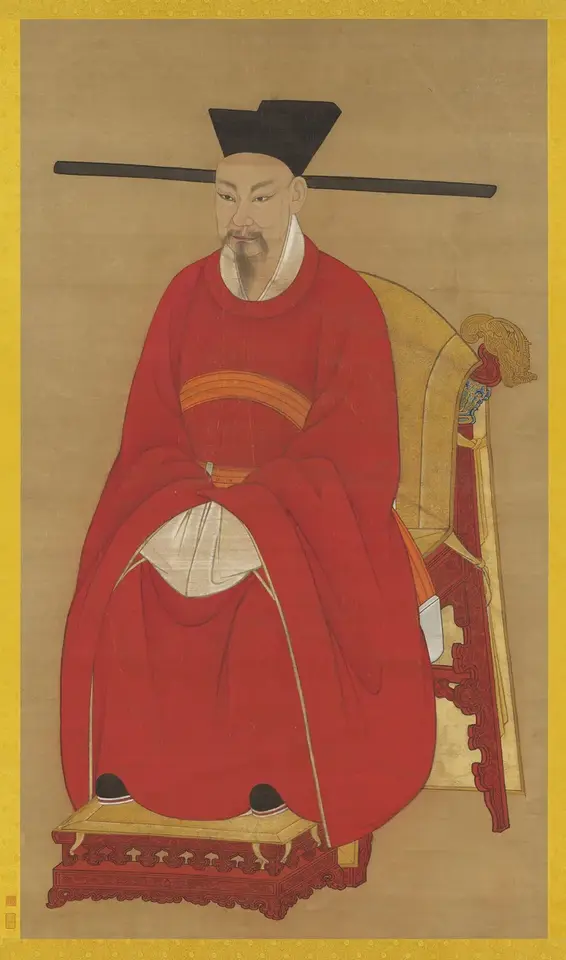
1205 CE–1264 CE
赵昀
Zhao Yun (January 26, 1205 – November 16, 1264), originally named Zhao Yuju and later renamed Zhao Guicheng, was the fifth emperor of the Southern Song dynasty. A tenth-generation descendant of Emperor Taizu (Zhao Kuangyin) through Prince of Yan Zhao Dechao, he was raised among commoners in rural Shaoxing. In 1221, powerful chancellor Shi Miyuan arranged his adoption as heir to the Prince of Yi. Following Emperor Ningzong's…
Zhao Yun (January 26, 1205 – November 16, 1264), originally named Zhao Yuju and later renamed Zhao Guicheng, was the fifth emperor of the Southern Song dynasty. A tenth-generation descendant of Emperor Taizu (Zhao Kuangyin) through Prince of Yan Zhao Dechao, he was raised among commoners in rural Shaoxing. In 1221, powerful chancellor Shi Miyuan arranged his adoption as heir to the Prince of Yi. Following Emperor Ningzong's death in 1224, Shi Miyuan forged an imperial edict deposing Crown Prince Zhao Hong and enthroning Zhao Yun as Emperor Lizong. For the first decade of his reign, Lizong remained a figurehead, dedicating himself to Neo-Confucian studies while Shi Miyuan monopolized executive power. Following Shi Miyuan's death in 1233, Lizong assumed personal rule and launched the Duanping Restoration, revitalizing the bureaucracy, patronizing Neo-Confucian scholars like Zhen Dexiu, and establishing the Bureau of Infant Welfare as the world's earliest state-funded orphan relief network. In 1234, he dispatched Meng Gong to ally with the Mongols and crush the Jin dynasty at Caizhou, avenging the century-old Jingkang Incident. However, his subsequent Advance into Luoyang met disastrous defeat, precipitating a forty-year war with the Mongols. In response, he promoted Meng Gong and Yu Jie to build three defensive theaters, including the mountain fortresses of Sichuan. He also canonized Cheng-Zhu Neo-Confucianism as state orthodoxy. In his later years, he neglected governance, indulging in palace pleasures while empowering Jia Sidao. He died in 1264 at age sixty and was buried at Yongmuling.
Born in Shanyin as a descendant of Zhao Dechao, raised in modest rural circumstances.
Selected by Shi Miyuan to inherit the Prince of Yi estate, renamed Zhao Guicheng.
Enthroned by Shi Miyuan upon Ningzong's death, renaming himself Zhao Yun as Emperor Lizong.
Maintained quiet seclusion while Shi Miyuan directed the execution of deposed heir Zhao Hong.
Assumed direct personal rule following Shi Miyuan's death, planning sweeping administrative reforms.
Purged corrupt factions, appointed scholar Zhen Dexiu, and established the Bureau of Infant Welfare.
Dispatched Meng Gong to conquer Caizhou alongside Mongols, avenging the Jingkang humiliation.
Launched an ill-fated campaign to recover northern capitals, suffering catastrophic defeat by Mongols.
Enshrined Zhu Xi in the Confucian Temple, establishing Neo-Confucianism as state doctrine.
Commissioned Meng Gong and Yu Jie to build mountain fortress networks across Sichuan and the Yangtze.
Elevated Jia Sidao to Grand Chancellor after the minister concealed an unauthorized truce at Ezhou.
Passed away at age sixty in Funing Palace; interred at Yongmuling in Shaoxing.
Zhao Yun, originally named Zhao Yuju, was born on January 26, 1205, in Hongqiaoli, Shanyin County, Shaoxing Prefecture, Zhejiang. He was a ninth-generation descendant of Prince of Yan Zhao Dechao, the second son of Emperor Taizu of Song. Following the Jingkang Incident and the southward migration of the dynasty, his distant branch drifted away from direct court stipends. His father, Zhao Xihuan, served only as a minor ninth-rank county registrar, leaving the family in modest circumstances.
When Zhao Yun was young, his father passed away. His impoverished mother, Lady Quan, took Zhao Yun and his younger brother Zhao Yurui back to her native village in Shaoxing, residing with her brother Quan Baojiu, a village headman. Zhao Yun lived as a commoner, laboring in the fields and experiencing the hardships of peasant life. Under his mother's guidance, he attended local private schools, studying the Confucian classics and developing a disciplined, reserved temperament.
During the Jiading era, Emperor Ningzong's biological sons died in infancy. Ningzong adopted Zhao Hong, the son of the Prince of Yi, as crown prince, leaving the Prince of Yi lineage vacant. Powerful Grand Chancellor Shi Miyuan, alarmed by Crown Prince Zhao Hong's open resentment of his monopoly of power, feared future banishment if Zhao Hong took the throne. To safeguard his position, Shi Miyuan secretly dispatched his retainer Yu Tianxi into the countryside to find a suitable imperial descendant.
Seeking shelter from a storm, Yu Tianxi stayed at Quan Baojiu's residence in Shanyin, where he was impressed by the dignified demeanor of Zhao Yuju. Returning to the capital, Yu informed Shi Miyuan, who brought the young man to his residence for observation. In 1221, Emperor Ningzong decreed Zhao Yuju adopted as heir to the Prince of Yi, renaming him Zhao Guicheng and investing him as General of the Right Gate Guards. In this role, he maintained a humble and obedient demeanor toward Shi Miyuan.
In autumn 1224, Emperor Ningzong fell critically ill. Shi Miyuan orchestrated a palace coup, fabricating an imperial testament demoting Crown Prince Zhao Hong to Prince of Jiyang and exiling him to Huzhou. Collaborating with Empress Dowager Yang, Shi Miyuan enthroned twenty-year-old Zhao Guicheng as Emperor Lizong, renaming him Zhao Yun and styling the era Baoqing. This propelled a rural imperial descendant onto the imperial throne, inaugurating a forty-year reign.
Due to the irregular succession and public outrage over Zhao Hong's deposition, Lizong adopted a cautious survival strategy. When Shi Miyuan had Zhao Hong murdered in 1225, provoking vehement protests from court censors, Lizong recognized that his political base was fragile. Throughout the Baoqing and Shaoding eras, he delegated state affairs entirely to Shi Miyuan, remaining in the inner palace studying Neo-Confucian philosophy while awaiting his opportunity.
In October 1233, Grand Chancellor Shi Miyuan died after dominating court affairs for twenty-six years, allowing twenty-nine-year-old Emperor Lizong to assume direct personal rule. Eager to revitalize the dynasty, Lizong proclaimed 1234 as the first year of Duanping, initiating comprehensive institutional reforms known as the Duanping Restoration. He purged corrupt partisans of the Shi faction, cleansing the administration of decades of bureaucratic malpractice.
In civil appointments, Lizong demonstrated an open and meritocratic approach. He posthumously rehabilitated Zhao Hong, restoring his princely honors. Reopening avenues for candid remonstrance, he recruited esteemed Neo-Confucian scholars including Zhen Dexiu, Wei Liaoweng, and Cui Yuzhi to key positions in the Secretariat and Censorate, revitalizing the spirit of the Southern Song court.
Economically, Lizong reformed bureaucratic evaluations to eliminate redundant personnel and curb magistrate extortion. He founded the Bureau of Infant Welfare (Ciyouju) to rescue abandoned infants and orphans, providing state-funded sustenance, medical care, and education until adulthood. Lizong subsequently ordered the establishment of these bureaus across all circuits, creating the world's earliest state-funded national orphan relief system.
In the early years of Lizong's reign, the geopolitical landscape in the north underwent dramatic upheaval. The rising Mongol Empire routed Jin armies at Yehuling and Sanfengshan, compelling the Jin court to relocate from Kaifeng to Caizhou in Henan. Mongol Khan Ogodei dispatched ambassadors to Lin'an proposing a joint military campaign to eradicate the Jin dynasty, offering to return former Song territories south of the Yellow River.
The proposal provoked intense debate at the Song court. Senior statesmen, mindful of how Northern Song's alliance with Jin to destroy Liao had precipitated the disastrous Jingkang Incident, advised retaining Jin as a buffer against Mongol cavalry. However, Lizong felt an intense desire to avenge the national humiliation of Jingkang, especially as desperate Jin forces continued raiding Song borderlands in Sichuan and Huainan for food. Lizong rejected peace overtures from Jin and committed to the alliance with the Mongols.
In early 1234, Lizong dispatched general Meng Gong with twenty thousand elite infantry and cavalry, alongside 300,000 piculs of grain, to join Mongol commander Tachao'er in besieging Caizhou. Song soldiers breached the southern gates, prompting Emperor Aizong of Jin to commit suicide and his successor to fall in battle. The joint Song-Mongol campaign annihilated the Jin dynasty, concluding 108 years of rivalry and avenging the Jingkang humiliation.
The destruction of Jin fueled Lizong's ambition to recover the northern ancestral lands. Following Jin's fall, central Henan became a power vacuum as main Mongol forces withdrew north to escape summer heat. Encouraged by Grand Chancellor Zheng Qingzhi and disregarding the warnings of Zhen Dexiu, Lizong ordered an expedition into central China to recover the Three Capitals: Kaifeng, Luoyang, and Shangqiu.
In summer 1234, Song general Quan Zicai led ten thousand troops from Huainan to occupy Kaifeng, followed by Zhao Kui advancing with fifty thousand men into Luoyang in the military campaign known as the Advance into Luoyang. Although Song forces initially entered the ruined capitals without major resistance, supply lines collapsed across the war-ravaged landscape of Henan, leaving forward units starving and isolated.
Anticipating the move, Mongol armies breached the Yellow River dikes at Cunxiang, flooding Song encampments and cutting off retreat from Luoyang. Trapped by famine and floodwaters, Song forces were routed at Longmen outside Luoyang, abandoning armaments and suffering thousands of casualties. The expedition ended in catastrophe, infuriating the Mongols and initiating over forty years of full-scale war.
The collapse in Henan exposed the Southern Song frontier to invasion as Ogodei dispatched three armies into Sichuan, Jingxiang, and Jianghuai. Facing an existential crisis, Lizong demonstrated defensive resolve, promoting commanders Meng Gong, Yu Jie, Du Gao, and Li Tingzhi, dividing the defense along the Yangtze into three operational theaters: Sichuan, Jingxiang, and Lianghuai.
In Jingxiang, Meng Gong recaptured Xiangyang and Fancheng, constructing formidable fortifications to repel Mongol incursions. In Lianghuai, Du Gao utilized artillery and stone fortifications to shatter Mongol cavalry in western Huai. In Sichuan, Lizong promoted the humble commoner Yu Jie to direct regional defense. Adopting the strategy of the Ran brothers, Yu Jie constructed dozens of interlocking mountain fortresses, including Diaoyu Fortress in Hezhou.
This defensive network demonstrated remarkable strategic resilience, enabling the Southern Song to withstand decades of assaults by the most formidable cavalry forces of Eurasia. Crucially, Diaoyu Fortress repelled numerous sieges and resulted in the death of Mongol Great Khan Mongke in 1259, altering the course of world history.
In intellectual history, Lizong's most enduring legacy was institutionalizing Cheng-Zhu Neo-Confucianism as imperial state orthodoxy. Having studied Neo-Confucianism since youth, he revered the teachings of Zhou Dunyi, Zhang Zai, the Cheng brothers, and Zhu Xi. In 1235, Lizong issued edicts posthumously honoring Zhu Xi as Duke of Hui, alongside honors for Zhou Dunyi and the Cheng brothers, ordering their ancestral tablets installed in the Confucian Temple.
Lizong decreed Zhu Xi's Collected Commentaries on the Four Books as the mandatory curriculum for state schools and the sole authoritative standard for imperial civil service examinations. He patronized academies such as the Bailudong and Yuelu academies, personally inscribing calligraphy plaques and donating classical texts. This imperial patronage established Neo-Confucianism as the dominant ideology of late imperial China for over seven centuries.
Lizong embedded Neo-Confucian moral principles into statutory jurisprudence, overseeing compilations like the Chunyou Laws and emphasizing judicial clemency and legal education. Under this intellectual climate, the late Southern Song produced principled scholar-officials like Wen Tianxiang and Lu Xiufu, who demonstrated unwavering moral loyalty during the final fall of the dynasty.
As frontier warfare stabilized into a defensive stalemate, Lizong succumbed to personal complacency. In his later years, he withdrew into the inner palace, surrounding himself with courtesans and indulging Noble Consort Yan. He exhausted state revenues constructing lavish palaces and gardens along West Lake, creating substantial fiscal deficits.
To escape administrative burdens, Lizong surrendered executive power to sycophantic chancellors Ding Daquan and Jia Sidao. When Mongol armies besieged Ezhou, Jia Sidao secretly concluded a peace treaty agreeing to pay annual tributes, yet returned to Lin'an fabricating reports of a magnificent victory. Deceived by these falsehoods, Lizong elevated Jia Sidao to Grand Chancellor, surrendering court administration to his faction.
Jia Sidao implemented the controversial Public Land Law (Gongtianfa), forcibly purchasing private estates from Jiangnan landholders below market rates to generate military grain supplies. This policy alienated gentry elites, disrupted agriculture, and persecuted veteran commanders like Xiang Shibi, dismantling defensive cohesion.
Lizong committed another fatal error regarding dynastic succession. Lacking biological sons, he selected his frail and mentally challenged nephew Zhao Qi, the son of Prince Rong Zhao Yurui. Despite earnest warnings from senior ministers that the prince was unfit to govern, Lizong, pressured by Consort Yan and Jia Sidao, designated Zhao Qi as crown prince (later Emperor Duzong), leaving the empire vulnerable to Mongol conquest.
In autumn 1264, sixty-year-old Emperor Lizong fell gravely ill from prolonged indulgence and systemic edema. On November 16, 1264, Lizong passed away in the Funing Palace, concluding a forty-year reign. The court honored him with the posthumous title Emperor Jiandao Beide and the temple name Lizong, burying him at Yongmuling in the Song Six Mausoleums in Shaoxing.
Tragically, only two decades after Lizong's death, the Southern Song collapsed. In 1285, the Tangut Tibetan monk Yanglian Zhenjia, appointed by the Yuan dynasty as superintendent of Buddhist clergy in Jiangnan, looted the Song Six Mausoleums. Lizong's tomb was ransacked; because his body had been preserved in mercury, the looters suspended his corpse upside down from a tree to extract the mercury, eventually severing his skull to craft a jewel-encrusted drinking bowl, marking one of the most gruesome desecrations in Chinese imperial history.
Ascending to personal rule, Emperor Lizong made the strategic decision to reject Jin entreaties and ally with the Mongols to extinguish the Jin dynasty. Dispatching Meng Gong with twenty thousand elite troops and substantial grain reserves to besiege Caizhou, Song forces breached the city, leading to Emperor Aizong's suicide and the end of Jin. This victory avenged the century-old national humiliation of the Jingkang Incident and concluded 108 years of northern confrontation.
The Duanping Restoration launched by Lizong following Shi Miyuan's death represented the most significant political renewal of the late Southern Song. Lizong purged corrupt officials, rehabilitated disgraced loyalists, and appointed upright Neo-Confucian scholars like Zhen Dexiu to lead the government. Furthermore, his establishment of the Bureau of Infant Welfare across the empire created the earliest state-funded national orphan relief system in human history.
Lizong's most consequential intellectual contribution was establishing Cheng-Zhu Neo-Confucianism as the exclusive ideological orthodoxy of the Chinese state. By enshrining Zhu Xi and the Cheng brothers in the Confucian Temple, mandating the Four Books for imperial examinations, and patronizing major academies, he elevated Neo-Confucianism to a preeminent status that defined Chinese educational and political culture for over seven hundred years.
Confronting continental war following the Advance into Luoyang, Lizong promoted capable commanders including Meng Gong, Yu Jie, and Du Gao to establish defensive theaters across Sichuan, Jingxiang, and Lianghuai. His support for Yu Jie's network of mountain fortresses, notably Diaoyu Fortress, created a formidable defensive shield that resisted Mongol cavalry for decades and directly led to the death of Mongol Great Khan Mongke.
Lizong's reign ended in administrative neglect and autocratic delegation. In his later years, he indulged in palace pleasures, surrendering power to Jia Sidao, whose extortionate Public Land Law and covert peace deals alienated the gentry and destroyed military readiness. His selection of the incompetent Zhao Qi as crown prince doomed the dynasty to administrative paralysis during the final Mongol invasions.
Emperor Lizong of Song was a consequential late Southern Song monarch whose forty-year reign exhibited sharp contrasts between enlightened institutional achievement and catastrophic administrative neglect.
In the History of Song, the Yuan historian Tuotuo evaluated him: "Emerging from common obscurity to inherit the imperial throne after Shi Miyuan's hegemony, Lizong's early Duanping governance welcomed virtuous scholars, invited candid remonstrance, and canonized Neo-Confucian sages. His victory at Caizhou avenged the century-old national humiliation of his ancestors. Yet his rash advance into Luoyang provoked relentless Mongol assaults. In his twilight years, he neglected state affairs, ceding power to corrupt ministers like Jia Sidao while indulging in palace luxuries, nurturing the seeds of dynastic ruin."
Ming philosopher Li Zhi observed: "Emperor Lizong was a sovereign of balanced merits and flaws; his Duanping reforms and institutionalization of Neo-Confucianism benefited the realm of letters, yet his blind trust in Jia Sidao ultimately doomed the dynasty."
Modern historians recognize that Lizong's establishment of the Bureau of Infant Welfare and canonization of Cheng-Zhu Neo-Confucianism left enduring marks on Chinese social welfare and intellectual history. Furthermore, his promotion of commanders Meng Gong and Yu Jie created a mountain fortress network that prolonged Southern Song's survival for decades and led to the death of Mongke Khan. However, his strategic recklessness at Luoyang and abdication of responsibility to Jia Sidao accelerated the collapse of the dynasty.
FIGURES ASSOCIATED WITH THIS DYNASTY