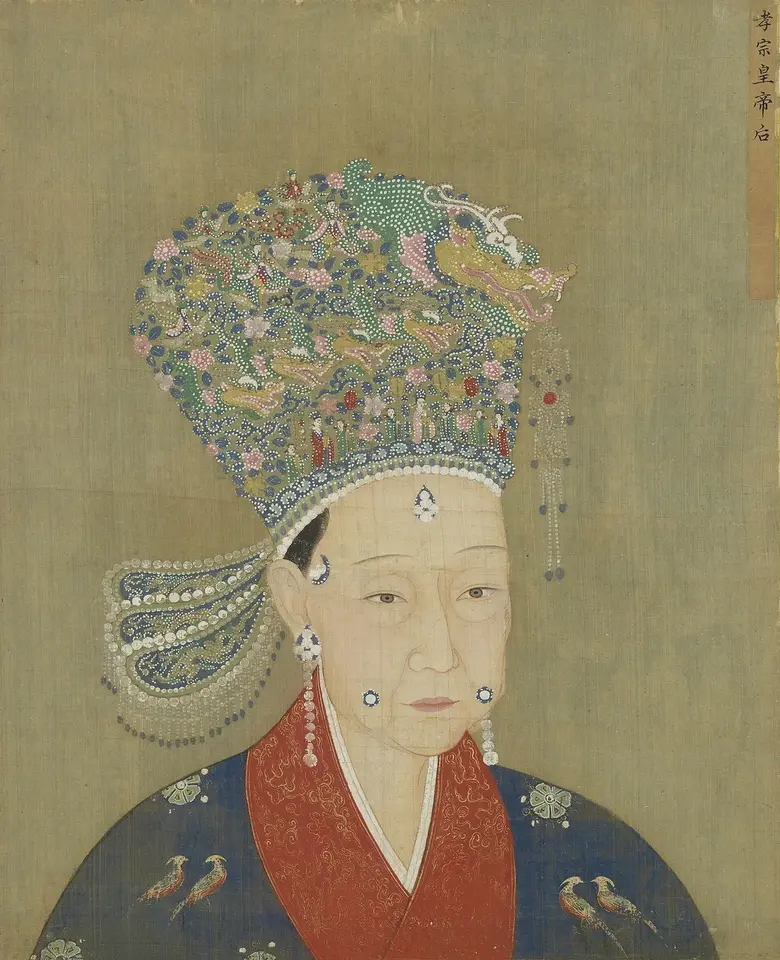
Life Story
Early Misfortune and Demeanour in Palace Service
Empress Xie was born in the second year of Shaoxing (1132) into a commoner household in Danyang County, Runzhou. Both of her parents passed away during her early childhood, leaving her an orphan dependent upon extended relatives. Experiencing the privations of ordinary rural life in her youth, she developed an enduringly modest, tranquil, and resilient disposition.
During the Shaoxing era, when imperial court commissioners traveled through the southern circuits to select daughters of respectable households for court service, Lady Xie was selected and entered the Southern Song imperial palace at Lin'an. She was assigned to the Deshou Palace to wait upon Empress Wu, the primary consort of Emperor Gaozong. In this role, her unwavering prudence, respectful demeanor, and meticulous attention to protocol earned her the deep trust and favor of the senior empress.
On the twentieth day of the second month in the thirty-first year of Shaoxing (1161), Emperor Gaozong and Empress Wu, seeking capable and virtuous companions for their adopted heir Zhao Shen (Prince of Jian), bestowed Lady Xie upon him. By imperial decree, she was invested as Lady of Xian'an Commandery.
Rise to Noble Consort and Regent of the Inner Chambers
Following her entry into the princely residence of Prince of Jian, Lady Xie maintained an exemplary standard of domestic harmony and modest deportment. In the sixth month of 1162, Emperor Gaozong abdicated the throne to Zhao Shen, who ascended as Emperor Xiaozong. On the twenty-eighth day of the eighth month of that year, Xiaozong elevated Lady Xie to Lady of Grace, an honorable rank within the second imperial echelon.
On the eleventh day of the second month in the second year of Longxing (1164), Lady Xie was further elevated to first-rank Noble Consort, standing second only to Empress Xia in the palace hierarchy. Noble Consort Xie remained exceptionally frugal, habitually wearing plain garments without ornate jewelry and treating all attendants and lesser concubines with kindness and equity.
In the sixth month of the third year of Qiandao (1167), Empress Xia passed away. Rather than rushing to enthrone a new empress, Emperor Xiaozong entrusted Noble Consort Xie with the comprehensive administration of the inner palace. For nine years, she managed the imperial household with scrupulous fairness and economy, maintaining domestic harmony and reducing court expenses.
On the fourteenth day of the eighth month in the third year of Chunxi (1176), Emperor Xiaozong, acting upon the imperial authorization of retired Emperor Gaozong and Empress Wu, formally proclaimed Noble Consort Xie as empress of the Song empire, celebrating the grand enthronement rites on the fifth day of the tenth month.
Partnering in the Rule of Qianchun and Relocation to Chonghua
Following her official investiture as empress, Lady Xie intensified her personal commitment to frugality. When Emperor Xiaozong extended official ranks to her maternal relatives, including her elder brother Xie Shenfu, Empress Xie placed strict boundaries on their conduct, sternly warning them never to abuse imperial favor or interfere in civil administration.
Throughout Emperor Xiaozong's twenty-seven-year reign, the Southern Song experienced political stability, economic prosperity, and the rehabilitation of patriotic commanders such as Yue Fei, an era celebrated in Chinese history as the Rule of Qianchun. Empress Xie provided indispensable support in the private quarters, reinforcing the sovereign's frugal policies through personal example and enjoying mutual respect with Xiaozong for over two decades.
In the second month of 1189, Emperor Xiaozong abdicated the throne in favor of his son Zhao Dun (Emperor Guangzong), retiring as retired emperor to the Chonghua Palace. Empress Xie was accordingly honored as Grand Empress Shoucheng. Living quietly in the Chonghua Palace, she devoted herself to attending upon the retired emperor.
Rebuking the Insolent Empress and Stabilizing Dynastic Rule
Following Emperor Guangzong's accession, his principal consort Empress Li Fengniang exhibited extreme jealousy, paranoia, and arrogance. Empress Li terrorized the imperial concubines and drove a wedge between Emperor Guangzong and his father Xiaozong, convincing the reigning emperor to cease paying formal filial visits to the Chonghua Palace.
Distressed by Empress Li's unfilial behavior, Grand Empress Shoucheng gently admonished her to observe filial piety and consort decorum. Instead of heeding the counsel, Empress Li insolently retorted that she and Guangzong were lawfully wedded from their youth and that her son Zhao Kuo was of pure bloodline, sarcastically mocking the fact that Xiaozong was an adopted heir and that Empress Xie was not Xiaozong's original primary wife. Deeply outraged by the insult, Empress Xie reported the treasonous insolence to Xiaozong. Although Xiaozong initially resolved to depose Empress Li, the plan was abandoned due to political caution urged by ministers like Shi Hao.
In the sixth month of 1194, Emperor Xiaozong passed away in deep sorrow. With Guangzong incapacitated by mental instability and refusing to preside over the imperial funeral, the dynasty faced an unprecedented succession crisis. Minister of War Zhao Ruyu and Han Tuozhou coordinated with the inner palace. Demonstrating decisive moral authority, Grand Empress Shoucheng and Grand Empress Dowager Wu promulgated the imperial decree that formalized Guangzong's abdication and installed Crown Prince Zhao Kuo as Emperor Ningzong, successfully averting dynastic collapse.
Longevity, Honors, and Mausoleum Enshrinement
Following Emperor Ningzong's ascension, the new sovereign honored Grand Empress Shoucheng as Empress Dowager. In the tenth month of 1196, Ningzong conferred upon her the honorific title Empress Dowager Shoucheng Huici.
In 1197, senior matriarch Empress Wu died at the age of eighty-three. In the eighth month of 1200, Emperor Ningzong officially elevated Empress Dowager Xie to Grand Empress Dowager, titling her Grand Empress Dowager Shoucheng Huici, and in 1202 supplemented her title to Grand Empress Dowager Shousheng Ciyou.
Grand Empress Dowager Xie spent her final decade in serene retirement at the Shousi Palace, receiving the continuous filial devotion of the imperial family. On the sixteenth day of the fifth month in the third year of Kaixi (1207), she passed away peacefully at the age of seventy-six. Emperor Ningzong suspended court audiences and bestowed upon her the posthumous name Empress Xie (Xiaozong). In the eighth month of 1207, she was interred alongside Emperor Xiaozong in the Yongfu Mausoleum and enshrined in the imperial ancestral temple.
Major Achievements
Frugal Matron of the Qianchun Golden Era
Originating from an indigent background, Empress Xie never succumbed to ostentatious luxury despite attaining the pinnacle of female majesty. Her garments remained plain and devoid of precious jewels. During the nine years she presided over the inner chambers prior to her formal coronation, she enforced rigorous institutional economy, significantly curbing palace expenditure.
Her personal frugality established a model for the entire court, complementing Emperor Xiaozong's statecraft and helping forge the frugal and disciplined domestic environment that underpinned the prosperity of the Qianchun era.
Decisive Role in Resolving Dynastic Crisis
When Empress Li Fengniang's reckless malice fractured imperial family relations and threatened court stability, Empress Xie stood as a pillar of dynastic righteousness. She fearlessly admonished the unfilial consort and defended the institutional dignity of the retired emperor.
During the grave succession paralysis of 1194 following Xiaozong's demise, Empress Xie collaborated with Grand Empress Dowager Wu to validate the forced abdication of Emperor Guangzong and the enthronement of Emperor Ningzong. Her decisive decree extinguished consort factionalism and restored administrative stability without bloodshed.
Historical Evaluation
In the History of Song (Song Shi, Biographies of Empresses and Consorts), the imperial chroniclers recorded: "Empress Chengsuxie was from Danyang. Orphaned early, she entered the palace to serve Empress Wu, advancing from Lady of Xian'an to Lady of Grace and Noble Consort. Following the death of Empress Xia, she solely managed the inner palace before ascending to the central seat. The empress was prudent, sincere, and moved strictly according to ritual law. During the reign of Guangzong, when Empress Li was arrogant and insolent, the empress repeatedly instructed her with propriety. When Xiaozong passed away and Guangzong was unable to conduct the mourning rites, she joined Empress Wu in establishing the grand succession plan, enthralling Ningzong and preserving the altars. Living to seventy-six years and buried in Yongfu, she served as a matriarch across two reigns. How truly virtuous she was!"
In the Qing dynasty Gazetteer of Danyang County, local scholars recorded: "During the dynastic restoration south of the river, female virtue was exalted. Empress Chengsu arose from humble origins in Danyang, leading the palace with frugality and harmonizing the six chambers. Amid the Chonghua abdication and the Shaoxi transition, she decided matters with supreme righteousness, ensuring lasting tranquility for the royal house. Living to great longevity and recording immense merit, she stands as a true model of southern womanhood."