Born | at Fenning in Hongzhou, now Xiushui, Jiangxi
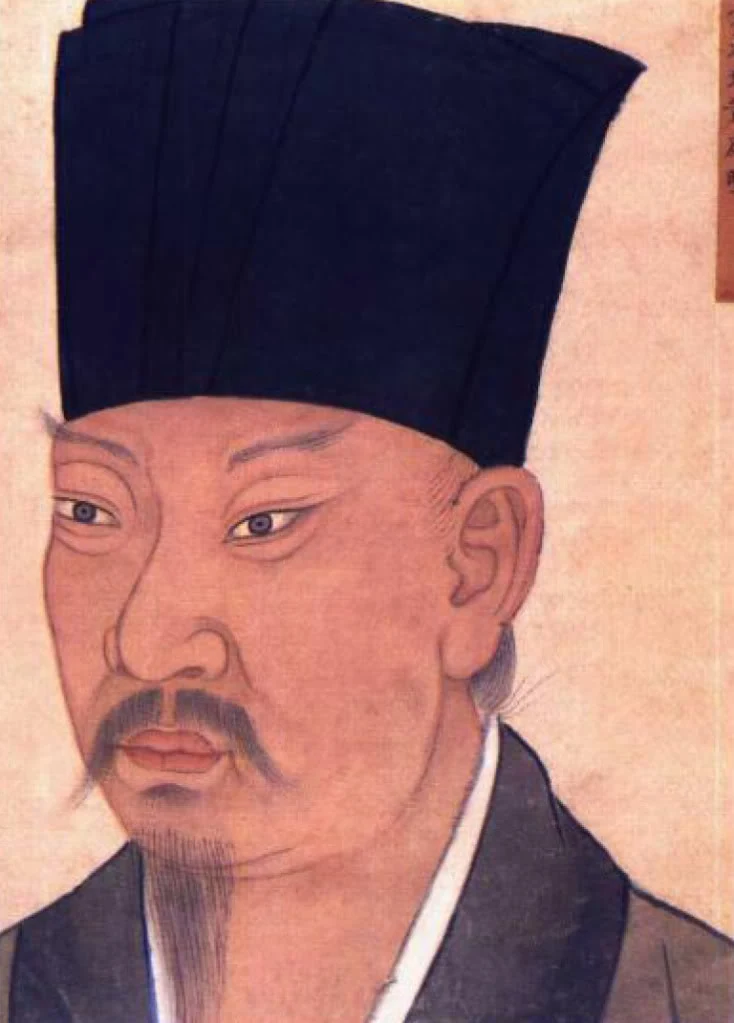
1045 CE–1105 CE
Writercalligrapherand official
Huang Tingjian
黄庭坚
Huang Tingjian (twelfth day of the sixth lunar month, Qingli 5, July 28, 1045–thirtieth day of the ninth lunar month, Chongning 4, November 8, 1105), courtesy name Luzhi and childhood name Shengquan, used the art names Shangu Daoren, Fu Weng, and Qian'an Jushi, among others. He was commonly known as Huang Shangu, Historian Huang, and Huang Wenjie. A native of Fenning in Hongzhou Prefecture, Jiangnan West Circuit, now Xiushui…
1045 CE–1105 CENorthern Song
PROFILE
Huang Tingjian (twelfth day of the sixth lunar month, Qingli 5, July 28, 1045–thirtieth day of the ninth lunar month, Chongning 4, November 8, 1105), courtesy name Luzhi and childhood name Shengquan, used the art names Shangu Daoren, Fu Weng, and Qian'an Jushi, among others. He was commonly known as Huang Shangu, Historian Huang, and Huang Wenjie. A native of Fenning in Hongzhou Prefecture, Jiangnan West Circuit, now Xiushui County, Jiujiang, Jiangxi, he was a Northern Song official, writer, calligrapher, and founder of the Jiangxi School of Poetry. After passing the civil service examinations in 1067, he served as county commandant of Ye, professor at the Directorate of Education in the Northern Capital, magistrate of Taihe, supervisor of Deping Market, proofreader in the Palace Library, compiling official of the Veritable Records of Emperor Shenzong, and diarist of imperial activity. His poetry was ranked with Su Shi’s under the name “Su and Huang,” while his calligraphy made him one of the Four Masters of the Song. In his final years he was caught in factional conflict, exiled to Yizhou, and died there in 1105. Early in the Shaoxing reign, Emperor Gaozong posthumously appointed him grand preceptor and attendant academician of the Dragon Diagram Pavilion and gave him the posthumous name Wenjie.
- Other Names
- Huang Luzhi, Shangu Daoren
- Courtesy Name
- Luzhi
- Art Name
- Qingfengke
- Era
- Northern Song
- Dynasty/Regime
- Northern Song
- Identity
- Writer, calligrapher, and official
- Date of Birth
- July 28 1045
- Date of Death
- November 8 1105
- Ethnicity/Group
- Not reliably established in historical sources
- Ancestral Home
- Fenning, Hongzhou (present-day Xiushui County, Jiujiang, Jiangxi)
- Place of Birth
- Fenning, Hongzhou (present-day Xiushui, Jiangxi)
- Place of Death
- Unknown
- Highest Office
- See Biography and Major Activities
- Major Achievements
- Northern Song poet and calligrapher; founder of the Jiangxi School of Poetry; advocated “turning iron into gold”; also wrote elegant ci poetry.
- Lifespan
- 61 years
LIFE TIMELINE
At seven | wrote “The Shepherd Boy”
At fourteen | his father Huang Shu died while prefect of Kangzhou
At fifteen | traveled and studied in Huainan with his maternal uncle Li Chang
At nineteen | placed first in the provincial examination
At twenty | first sat the metropolitan examination and failed
At twenty-two | again placed first in the provincial examination
At twenty-three | passed the metropolitan examination, first in the third class; appointed county commandant of Ye; his wife Lady Sun died
At twenty-eight | appointed professor at the Directorate of Education in the Northern Capital and married Lady Xie
At thirty-four | wrote to Su Shi, beginning their friendship at a distance
At thirty-six | became magistrate of Taihe County, Jizhou
At forty | became supervisor of Deping Market in Dezhou and wrote “Sent to Huang Jifu”
At forty-one | summoned as proofreader in the Palace Library; his son Huang Xiang was born
At forty-two | met Su Shi for the first time and became a reviewing official for the Veritable Records of Emperor Shenzong
At forty-three | promoted to assistant author and concurrently collator of the Jixian Institute
At forty-seven | after completing the Veritable Records, promoted to diarist; entered mourning for his mother
At fifty | returned as assistant director of the Palace Library; attacked by the New Policies faction, demoted to nominal vice prefect of Fuzhou and placed under supervision at Qianzhou
At fifty-four | moved to Rongzhou to avoid serving in the same jurisdiction as a relative
At fifty-six | after Emperor Huizong’s accession restored as Gentleman for Court Discussion and made supervisor of the Ezhou salt tax
At fifty-seven | named prefect of Shuzhou and summoned as vice director of the Ministry of Personnel, but declined
At fifty-eight | placed in charge of Taiping Prefecture but dismissed after nine days; lived in Ezhou
At fifty-nine | falsely accused of slander in his “Record of Chengtian Cloister at Jingnan” and exiled to Yizhou
At sixty-one | died of illness in the garrison tower at Yizhou on the thirtieth day of the ninth month
Event | Reburied west of the ancestral grave at Shuangjing, Xiushui
BIOGRAPHY
Biography
Family Background and Early Life Huang came from the Shuangjing Huang family of Xiushui, Jiangxi, a scholarly lineage extending over ten generations. The family traced its remote ancestry to the Western Han chancellor Huang Ba, known as a good administrator. Huang Han, ten generations before Huang Tingjian, passed the examinations in the mid-Tang, and Huang Rong, eight generations before him, became right vice director of the Department of State Affairs. Under the Song, his great-grandfather Huang Zhongli passed the provincial examination, founded Zhitai and Yingtao academies, and was a noted Yuzhang educator. His grandfather Huang Shi passed the metropolitan examination; ten of thirteen brothers did likewise and were called the “Ten Dragons.” His father Huang Shu, an early innovator of Song poetry, became prefect of Kangzhou. Before Huang Tingjian’s success, the Shuangjing family had produced twenty-two metropolitan graduates and afterward another twenty-five—forty-eight in the Song alone—giving Shuangjing the title “foremost village of examination graduates in China.” The family’s strict rules made reading the basis of sincere self-cultivation and the principal means of honoring the ancestors. They required eminent teachers for the young, mastery of canonical texts, and moral discipline. Born in the sixth lunar month of 1045, Huang displayed unusual intelligence. At his first-birthday selection ceremony, he chose a writing brush from among a bow, arrows, paper, and other objects and would not release it. His father commemorated the episode in “Written While Teaching Shengquan Calligraphy,” including the line “Bound to letters, he once played with ink.” At five Huang could recite the Five Classics. When a teacher omitted the Spring and Autumn Annals as not worth reading, he asked: “Since it is called a classic, how can it be left unread?” He memorized it in ten days without missing a character. His personal name Tingjian came from one of the ancient Eight Kai, Gaoyao’s courtesy name; Gaoyao was a worthy assistant of Shun and traditional ancestor of judicial administration. His courtesy name Luzhi honored the forthright Northern Song minister Lu Zongdao, whom Emperor Zhenzong praised by writing “Lu the Upright” on a palace wall. At seven Huang wrote “The Shepherd Boy”: “Riding an ox far past the village ahead, / his flute is heard slantwise across the river wind. / How many seekers of profit and fame in Chang'an / exhaust every scheme yet cannot equal you.” The next year, in a poem sending someone to the examinations, he wrote: “If you ask of the Huang Tingjian of old, / he has been banished to the human world for eight years,” showing precocious confidence. ### Study in Huainan and the Examinations Huang Shu died in the tenth month of 1058 while prefect of Kangzhou. Huang’s mother, née Li, was the sister of the bibliophile and Dragon Diagram Pavilion academician Li Chang and herself wrote poetry. In 1059 she sent the fifteen-year-old Huang to travel and study with Li. As he departed Shuangjing’s Mingyue Bay, she placed her own lyric to the tune “Silk-Washing Stream” in his luggage: “Too weak, the rose bends low with rain; / affectionate butterflies chase flying blossoms. / Fragrance drifts on running water as young swallows cry. / At Nanpu my soul breaks, but spring pays no heed; / in Dongyang my clothes grow loose, as the mirror knows. / Tonight the moon lingers over the little tower.” During three years with Li Chang, Huang read broadly through the classics and philosophers and studied ancient and contemporary poetry and prose, establishing a deep scholarly foundation. Through Li he met the writer Sun Jue in Yangzhou; Sun valued his talent and married his daughter to him. Huang later wrote: “The one who nurtured and taught me was truly my maternal uncle.” Huang placed first in the provincial examination in 1063. After failing his first metropolitan attempt in 1064, he calmly returned to Shuangjing and continued at Zhitai and Yingtao academies. He again placed first provincially in 1066. Examiner Li Xun praised his writing: “This man not only surpasses all in literary principle; one day his poetry will make his name supreme throughout the four seas.” In 1067, Huang passed the metropolitan examination as the first name in its third class, thirty-first overall. ### First Offices: Ye County and the Northern Capital Huang began official life as county commandant of Ye in Ruzhou in 1067. On arriving, he wrote “On First Arriving in Ye County”: “The white crane has gone to seek Prince Wang Zijin; / the true dragon wins the admiration of Shen Zhuliang. / A thousand years of past events are like birds in flight; / in a single day I pour out my sorrow before the setting sun.” During four years there he wrote more than one hundred poems, his first major creative flowering. Soon after arrival, an earthquake in Hebei was followed by severe flooding and refugees poured into Ye. Huang organized relief and, ashamed to draw salary while people wandered homeless, wrote “Lament of the Refugees” to record their suffering: “Toppled walls and shattered beams crush the old and weak; / their cries of anguish have scarcely ceased before the flood sweeps them away. / The earth is split and gashed as the waters boil and surge; / in eight or nine households out of ten, fish heads appear.” His first wife, Lady Sun, died during this appointment. After placing first in an examination for instructors in the four capitals in 1072, he became professor at the Directorate of Education in the Northern Capital, Daming Prefecture. The regent Wen Yanbo admired him and retained him for further service. During eight years as an instructor, Huang married Lady Xie, daughter of the poet Xie Jingchu, and had a daughter Huang Mu. He concentrated on literature. Su Shi read his work and found him “transcendent and free from dust, standing independently among countless poems and essays.” Huang wrote to Su in 1078, beginning their friendship at a distance. Wen Yanbo rated his performance “outstanding” and recommended him for appointment through the Ministry of Personnel. ### Magistrate of Taihe and Supervisor at Deping In 1080, the thirty-six-year-old Huang became magistrate of Taihe in Jizhou and married Lady Shi. He governed plainly, disciplined clerks, opposed the salt quota, and investigated local conditions. Other counties competed to assume larger salt allotments, but Taihe did not; the clerks resented him while the people rejoiced. He insisted that officials not evade affairs, keep clear consciences, and never treat the people as a ladder for advancement. He copied out an official admonition on stone to warn himself and became known as “Huang the Clear Sky.” From Kuaige Pavilion he wrote the famous lines: “Fallen leaves over a thousand mountains, the sky vast and far; / one clear river, the moon shining bright.” Roads and schools in Taihe still bear the name Shangu. In the first month of 1084, Huang was demoted to supervise the market, taxes, and public order at Deping in Dezhou. Assistant prefect Zhao Tingzhi sought favor by imposing the Market Exchange Law there. Huang argued that Deping was small and poor and that the policy would scatter its market population, and firmly resisted it. Though his official career suffered, his writing flourished. At Deping he wrote “Sending Off Young Wang” and the celebrated “Sent to Huang Jifu”: “I dwell by the North Sea and you by the South; / I would entrust letters to geese, but they cannot. / One cup of wine in peach and plum blossom spring; / ten years of lamps in river-and-lake night rain...” ### Years in the Capital Institutions After Emperor Zhezong’s accession in 1085, Huang was summoned as proofreader in the Palace Library, and his son Huang Xiang was born that fifth month. Recommended by Sima Guang, he helped collate the Comprehensive Mirror in Aid of Governance in 1086 and soon became a reviewing official for the Veritable Records of Emperor Shenzong. That spring, Huang and Su Shi finally met in the capital and began their happiest lifelong friendship in literature and calligraphy. Huang became assistant author and Jixian collator in 1087. When Su presided over the examinations in 1088, Huang, Li Gonglin, and others assisted him. Their poetic exchanges in the Historiography Institute became a celebrated cultural event. On completion of the Veritable Records in the third month of 1091, Huang became a diarist of imperial activity. His mother died that tenth month. During her yearlong illness, the deeply filial Huang watched her constantly without undressing for sleep. He built Everlasting Remembrance Hall beside her grave during mourning, and grief made him so ill that he nearly died. ### Factional Exile and Final Years After mourning ended in 1094, Huang became assistant director of the Palace Library, superintendent of Mingdao Palace, and historiographer. The New Policies leaders Zhang Dun and Cai Bian accused the Veritable Records of many falsehoods. Huang answered each charge. Cai personally inspected the text and collected more than a thousand passages concerning Wang Anshi and Emperor Shenzong, alleging that the compilers had slandered the emperor. In the twelfth month, Huang, Fan Zuyu, and Zhao Yanruo were demoted; Huang became nominal vice prefect of Fuzhou and was placed under supervision at Qianzhou. He arrived at Qianzhou in the fourth month of 1095 and lived in Mowei Pavilion at Kaiyuan Monastery. In 1098, because his cousin Zhang Xiang was serving as granary official of Kuizhou Circuit, Huang was moved to Rongzhou to avoid a conflict of kinship. After Huizong’s accession in 1100, he was restored as Gentleman for Court Discussion and supervisor of the Ezhou salt tax. In the tenth month he became Gentleman for Court Service and administrative assistant to the Ningguo military governor. In 1101 he was named prefect of Shuzhou, then summoned while traveling through Jingnan as vice director of the Ministry of Personnel. Recently recovered from serious illness, he declined and requested Taiping Prefecture. He took charge there in 1102 but was dismissed after nine days, then made superintendent of Yulong Temple and lived in Ezhou. Huang had earlier quarreled with Zhao Tingzhi over the Market Exchange Law. Now in power, Zhao allowed his subordinate Chen Ju to accuse Huang’s “Record of Chengtian Cloister at Jingnan” of slander. Huang was banished to Yizhou in present-day Yishan, Guangxi. In 1104, after a long journey through Tanzhou, Hengzhou, Yongzhou, and Guizhou, he reached Yizhou between the fifth and sixth months; his family remained at Yongzhou. Officials harassed him first in rented housing and then in a monastery, finally forcing him into a ruined garrison tower on the wall. Others could not have endured such distress, but Huang calmly read, wrote poetry, drank, and sang. The people admired his openness and integrity and sought his poems and calligraphy, which he provided whenever possible. He died in the tower on the thirtieth day of the ninth month in 1105, aged sixty-one. Su Bogu and Jiang Wei escorted his coffin home for burial west of the family graves at Shuangjing in spring 1109.
His Family and the Household Tradition of Learning
Huang Tingjian was a man of Fenning in Hongzhou of Jiangnan West circuit in the Northern Song, his ancestral home being Jinhua in Zhejiang. The Huang of Fenning had produced scholars and officials for generations: his eighth-generation ancestor Huang Rong had been a vice-chancellor of the Tang, his fourth-generation ancestor founded the Zhitai and Yingtao academies and was a great scholar famed through Yuzhang, and his father Huang Shu was a presented scholar of the Song and governor of Kangzhou and a noted poet. Of the thirteen brothers of Huang Shi, ten passed as presented scholars and were called the ten dragons. Before Huang Tingjian's generation at Shuangjing the Huang of Xiushui had already produced eighteen presented scholars, and before his own success twenty-two; after his success the family produced twenty-five more in the Song, so that in the Song alone the Huang of Shuangjing counted forty-eight presented scholars. Among the family rules his great-grandfather laid down was one on reading, to this effect, that reading is the root of sincere conduct and the chief means of bringing honour to the ancestors; that after the genealogy was revised the family must each year engage famous teachers to instruct the young, aiming at a thorough mastery of the classics and clear writing, and at the same time discipline of conduct so as to make great vessels of them; and that the fees and courtesy due the teachers must not be stinted, for if one engages village schools at random for convenience and aims only at literacy, the young will grow low and coarse and disgrace their forebears. Posterity praised the household, saying that the brothers of one house studied together at the Zhitai academy by the waters of Xiushui, whetting one another in principle and vying in talent. Fenning had the custom of the first-birthday test, and Huang Shu, following it, set the choice before his second son Shengquan; and among bows, arrows, paper and brushes the little Tingjian took up a brush and would not let it go, and all praised him, saying that the Huang had got another scholar. Huang Shu wrote a poem recalling it, that by fate with letters he had once handled ink, and that he rejoiced to hand on the family trade of brush and inkstone and not lose the house of poetry and books. He named his second son Tingjian, for Tingjian was one of the eight able men of antiquity, a good helper of the sages and by repute the ancestor of Chinese justice, upright and wise, showing the great hopes he placed in him. After Huang Tingjian passed as a presented scholar the Huang of Shuangjing produced twenty-five more scholars of the Song, so that in the Song alone the family counted forty-eight.
His Boyhood Studies and His Wanderings
Huang Tingjian was unusually clever from childhood and could recite a text after reading it a few times. His maternal uncle Li Chang came to his house and, taking books from the shelf, questioned him, and there was nothing he did not know, at which Li Chang marvelled greatly and judged that his learning advanced a thousand li a day and that he was a talent of a thousand li. At five he had already recited the Five Classics; and one day asking his teacher about the saying that a certain classic was not worth reading, he said that if it was called a classic, how could it not be read, and in ten days he had it by heart without one word missing; and his father, pleased at his quickness, wished to have him try the examinations for the gods, at which Huang Tingjian laughed and asked what sort of a business that was. In the fourth year of Huangyou he wrote a poem for a man going up to the examination, telling him that on the long road of ten thousand li he should whip up his ancestor's steed, and bidding him farewell before the jade steps, and saying that if anyone asked after the Huang Tingjian of old, he had been banished to the world of men for eight years now. His mother, the lady Li, was a lady of a great house, famed in the district for her beauty, able to read and write and skilled in poetry and song; and she resolved to send Huang Tingjian to study in the train of his uncle Li Chang and to have that uncle oversee his learning. From the fourth year of Jiayou he began his wanderings with Li Chang, and at their parting his mother copied out a lyric of her own and put it in his bag, a lyric of most beautiful writing of weak roses bowed with rain and amorous butterflies sporting with the flowers, of drifting water and the fragrance of milk-fed swallows, of the south bank where the soul melts while spring heeds it not. Reading with his uncle he also ranged widely through the poems and writings of earlier and contemporary men, laying a deep scholarly foundation. Through Li Chang's introduction he came to know at Yangzhou the famous poet Sun Jue; and in a dispute on poetry between Sun Jue and Wang Pingfu, Wang Anshi discovered Huang Tingjian's talent and thought much of the youth, and afterwards Sun Jue gave him his daughter Sun Lanxi in marriage. With the help of Li Chang, Sun Jue and others his learning advanced greatly, and he recalled later that it was his uncle who had brought him up and taught him. In the eighth year of Jiayou he sat the provincial examination and took first place; in the first year of Zhiping he went to the capital for the metropolitan examination, and his name was not on the list, his first failure, which he bore with firmness and calm, returning to Shuangjing to read again at the Zhitai and Yingtao academies; in the third year of Zhiping he took first place in the provincial examination again. In the fourth year of Zhiping he sat again and succeeded, becoming a presented scholar.
Yexian, the Northern Capital, Taihe and Deping
From the fourth year of Zhiping to the fourth year of Xining Huang Tingjian was a junior officer of Yexian, which was the starting point of his official career, and his first wife, the lady Sun, died there. On reaching Yexian he wrote a poem with the lines about the white crane going to seek Wang Ziqiao and the true dragon longing for Shen Zhuliang. At Yexian came the first height of his poetry, for in his four years there he wrote more than a hundred poems; and shortly after he took up his post there was an earthquake in Hebei followed by a great flood, and refugees poured into Yexian, where Huang Tingjian organized relief and directed the succour, and with the self-reproach that as magistrate he was ashamed of his salary while people wandered, he wrote poems recording the misery of the homeless. Afterwards he sat the examination for the schools of the four capitals and, his paper being the best, became professor of the imperial college at the northern capital in charge of education, and Wen Yanbo, thinking him able, kept him on to teach. During his professorship at the northern capital he married as his second wife the lady Xie, daughter of the Northern Song poet Xie Shihou, and had a daughter, Huang Mu. In eight years as an education officer he worked diligently in letters and studied deeply; and Su Shi, once seeing his poems, thought them transcendent and standing alone above thousands, such as the world had not seen for long, and from this his fame began to shake the four quarters. Su Shi's assessment of his eight years of teaching was outstanding, and he recommended him for the examination. From the third to the sixth year of Yuanfeng, at thirty-six, Huang Tingjian was magistrate of Taihe, writing that he was taking thirty mouths with him to dream of Jiangnan; and at Taihe he married as his third wife the lady Shi. He governed Taihe with mildness: when the salt policy was being pushed, and other counties vied to take the greater share, Taihe alone did not, and though the clerks were displeased the people were pleased. He straightened the administration, resisted the salt tax and enquired into the people's hardships, and was called by them the blue-sky Huang; and in his leisure he climbed the Kuai pavilion and left the famous lines about the fallen leaves of a thousand hills and the vast sky, and the clear river with one line of moonlight. Afterwards he was inexplicably demoted to be a town supervisor, his chief business being to oversee the markets, the taxes and the peace. The assistant of the prefecture, Zhao Tingzhi, to please his superiors, wished to carry out the law of market exchange at Deping, and Huang Tingjian, as its supervisor, held that Deping was small and its people poor and its market too small, and that if the law were carried out the people gathered in the market would scatter and go away. Baffled in office, he turned to letters, and though he held his public post only a short time, less than half a year, he wrote several fine pieces, the most famous among them the poem about living north of the sea while you are south of the sea, and about a cup of wine in the spring breeze of peaches and plums and a lamp ten years in the night rain of rivers and lakes. Later, when a canal was dug and a river dredged at Duoshi town, a carved stone written by Huang Tingjian was found, the epitaph of the gentleman Liu in the office of court service, which he had written at Deping and which the continued gazetteer of Deping preserved.
The Capital, the History Office and His Friendship with Su Shi
In the eighth year of Yuanfeng of Emperor Shenzong Huang Tingjian was summoned to the capital as collator of the palace library. In the first year of Yuanyou, when Zhezong came to the throne, he collated the Comprehensive Mirror for Aid in Government on Sima Guang's recommendation, and was presently made reviser of the Veritable Record of Shenzong and given a place in the Hall of Assembled Worthies; and when the record was finished he was promoted to palace attendant on the left. He was by nature most filial: when his mother lay ill for a year he watched her countenance day and night and did not loosen his belt, and when she died he built a hut by her grave to mourn, and grief brought on illness that nearly killed him. In the fifth month of the first year of Shaosheng, when his mourning ended, he became assistant of the secretariat and supervisor of the Mingdao temple, holding also the office of compiler of the national history, and posterity honoured him as the grand scribe Huang. In the first year of Yuanfeng, at thirty-four, he wrote two old-style poems and sent them to Su Shi in token of his admiration, and Su Shi at once answered with a letter and poems greatly praising him, and from then the exchanges between Su and Huang began. Because the two were not in one place and often changed their posts, they could not yet exchange often; and in the second year of Yuanfeng Su Shi suffered the case of the Crow Terrace poems, and Huang Tingjian, of small office and light words, could do nothing for him and had himself to be questioned, and though the two had never yet met and he might well have said that he was not of Su Shi's party and so escaped, he insisted that Su Shi was the greatest man of letters of the age and loyal to his lord, and for this he was fined. In the spring of the first year of Yuanyou the two friends, stars of poetry that they were, at last found the time to meet, and met for the first time in the capital, entering the happiest stretch of friendship in either life. For more than three years in the capital together they gathered in leisure, discoursing on the Way and on art, matching poems and answering one another, discussing letters, appraising books and painting, freely giving rein to all the feeling of teacher and friend; and by an incomplete count of the surviving notes to the poems of Su and Huang, their exchanges in those years came to nearly a hundred pieces. Men of the time began to compare and name them together as Su and Huang, but Huang Tingjian kept to his first admiration for Su Shi and insisted on the courtesy of a disciple, and while Su Shi was in exile and even after his death he never left him and never departed from the rites of a disciple. It is recorded that when his own fame was high Huang Tingjian still honoured his teacher, and though the teacher was exiled to Hainan he hung Su Shi's portrait in his house and each morning rose, dressed and set his cap straight, burnt incense and bowed to it with great reverence; and when someone said that the fame of Su and Huang was in fact about equal, Huang Tingjian started from his seat and said that as to Dongpo he was no more than a pupil, and how dared he confuse the order of teacher and pupil.
His Exile in the Ba-Shu and Qian-Rong Regions
From the second year of Shaosheng to the third year of Yuanfu, six years away from the capital, Huang Tingjian was exiled in the Ba, Shu, Qian and Rong regions. Zhang Dun and his party held that the Veritable Record of Shenzong contained many false accusations, and had the former historians of the record lodged in various places near the capital to be questioned, extracting more than a thousand passages and showing them to them, saying these were unverified; but when examined by the office they were all found to have grounds in fact. And because the record contained the words that the iron dragon claw was used to govern the river as if it were child's play, he was questioned on this first; and Huang Tingjian answered that when he was an officer at the northern capital he had seen the matter with his own eyes and that it had indeed been like child's play. Whatever he was asked he answered plainly, without scruple, and those who heard praised him for his boldness. For the case of the iron dragon claw he was demoted to be master of horse of Fuzhou; and his attackers held even that he went to a good place, and falsely accused him of breaking the law, and on the ground of avoiding kinship he was moved to Rongzhou. Huang Tingjian took it as nothing and did not mind his exile at all. Baffled a second time in office, he did not sink into gloom but turned crisis to chance and worked eagerly at letters, spending his days teaching students to read, writing poems and lyrics, practising calligraphy, judging his friends' poems and writing inscriptions at their request. At Pengshui he built a thatched house, commonly called the valley cottage, and founded a private school, called the Mowei school, to teach his nephews and the local youths; and in his letter to the seventh elder brother he said that in the school he lectured each day on one great classic and one small classic and discoursed on poetry at night. His Mowei school was the earliest private school in the region's history, and he was its teacher of the highest attainments, so that the people of the Ba and Shu sent their sons and grandsons to it; and he was often invited to lecture to the gentry at Yushan, and the place where he lectured he named the hall of ten thousand volumes. The scholars of the Ba and Shu all admired him and drew gently near him, coming in crowds to hear and question him, and he taught without weariness, so that whatever writing passed through his hands had something worth seeing. At Rongzhou he also collected the poems and writings Du Fu had made in the Ba and Shu and wrote out all three hundred odd poems of the collection, and with the help of friends had them all carved as steles of poems; and when the great hall that housed them was finished in the third year of Yuanfu Huang Tingjian gladly named it the hall of great elegance and wrote the preface to the poems of Du Zimei in the Ba and Shu.
His Late Recall and His Death at Yizhou
In the third year of Yuanfu, when Huizong came to the throne, Huang Tingjian was called to be supervisor of the Yezhou tax and returned from the Ba and Shu to Jiangnan; in the tenth month he was reinstated as gentleman of the court of consultation and signatory of the Ningguo army. The court summoned him several times but he declined and asked to be an officer of a commandery. In the eleventh month of the second year of Chongning he was struck from the rolls for rejoicing at calamity and slandering the state, and put under guard at Yizhou. He had been somewhat at odds with Zhao Tingzhi in Hebei, and Zhao Tingzhi being in power, the transport judge Chen Ju, taking his intent, presented the record of the Chengtian monastery of Jingnan that Huang Tingjian had written, accusing him of rejoicing at disaster, and he was struck from the rolls again and sent under guard to Yizhou. In the eighth month of the fourth year of Chongning a decree moved him to Yongzhou, but before he heard the decree he died at Yizhou in the ninth month at sixty-one; and in the twelfth month the ban on the Yuanyou partisans was repealed and a decree restored him to office. In the last stretch of his life he read by incense opposite the butcher's block on which oxen were cut, wrote postscripts for his friends with a chicken-feather brush bought for three coppers, and counted standing in the rain on the city wall one of the great pleasures of his life. Afterwards his kin and friends buried him in the ancestral graveyard of the Huang at Shuangjing, and in time the court conferred on him the posthumous name Wenjie, and posterity honoured him as Duke Huang Wenjie.
Major Activities
Literature: Founder of the Jiangxi School of Poetry Huang’s poetic fame rivaled Su Shi’s, producing the pairing “Su and Huang.” Zhu Bian’s Old Reports from Quwei says: “After Dongpo’s writings at Huangzhou, no one could equal him; only Huang Luzhi’s poetry could sometimes stand against him.” Huang founded the Jiangxi School and left the Collected Writings of Master Huang of Yuzhang and Outer Collection of Shangu’s Delights of the Lute. His disciple Ren Yuan compiled the twenty-volume Annotations to Shangu’s Poetry. Huang advocated “turning iron into gold” and “seizing the embryo and changing the bones.” The former transformed earlier writing through altered words, omissions, additions, and syntax. His line about asking geese to carry a letter combines the tales of Su Wu’s goose-foot message and geese stopping at Hengyang. “Seizing the embryo” used an earlier form with new phrasing, as when he condensed Wang Xizhi’s “between a downward and upward glance, all have already become traces” in the Orchid Pavilion Preface. “Changing the bones” recast an earlier poetic idea in other language, as in his transformation of Wang Anshi’s lines about autumn insects urging the loom in a poor household. These methods deeply influenced later poets but were also criticized as overly allusive and bookish. Huang also wrote elegant, free-flowing ci, collected in Outer Collection of Shangu’s Delights of the Lute. “Pure Serene Music: Where Has Spring Gone?” is among his best-known lyrics. ### Calligraphy: One of the Four Masters of the Song Huang created a distinctive style in running and cursive scripts and especially excelled in cursive. Works include Letter to the Eminent Monks, Li Bai’s Poem on Recalling an Old Journey, Poem on the Fragrance of Flowers, Poem Written at Pine Wind Pavilion, Poems of Hanshan and Layman Pang, and the colophon to Scroll Presented to Zhang Datong. Later critics described his writing as “untrammeled and extraordinary, with mature surging force.” Its freely controlled expansion and contraction broke through square, even conventions. With Su Shi, Mi Fu, and Cai Xiang, he is one of the Four Masters of the Song. All four excelled in running script, but Huang’s cursive dominated his age. Open-minded and indifferent to materials, he wrote whenever he found paper until it was exhausted, without letting old rules constrain him. He is considered the most important Song cursive master after Huaisu and Zhang Xu; Shen Zhou of the Ming called him a “sage of cursive script.” His Inscription for the Mainstay sold at Poly’s spring 2010 auction for RMB 436.8 million, then a world auction record for Chinese art. ### Travels Huang’s travels spanned north and south. He studied in Huainan and met Sun Jue at Yangzhou, then served in Ye County, the Northern Capital at Daming, Taihe, Deping in Dezhou, and the capital Kaifeng. In later life he was exiled to Qianzhou, now Pengshui in Chongqing; Rongzhou, now Yibin in Sichuan; and finally Yizhou in Guangxi. Everywhere he left poetry, calligraphy, and administrative achievements. Roads and schools in Taihe bear the name Shangu; an inscribed stone attributed to him was found in Jiyang; and people in Yizhou eagerly sought his writing. ### Friendship with Su Shi Huang and Su’s relationship is one of the most admired friendships in Northern Song literature. In 1078, Huang sent Su two old-style poems expressing admiration; Su replied with a letter and matching poems and praised him highly. In 1072 (Xining 5), Su had said of Huang that “he is like refined gold and beautiful jade; he does not seek others, but others seek him, and even if he fled fame he could not escape it.” When Su was imprisoned in the Crow Terrace Poetry Case in 1079, his exchanges with Huang were used against him. Though Huang, a minor official, could have denied the relationship, he insisted that Su Zizhan was the greatest writer and loyal to ruler and country, and was fined. The two finally met in the capital in spring 1086. For more than three years they gathered in leisure, discussed the Way and the arts, exchanged poems, and tested each other with difficult rhyme schemes. Their friendship became a celebrated episode of Chinese cultural history.
The Jiangxi School of Poetry and His Views on the Art
Huang Tingjian took Du Fu as his model and urged that poetry should have in it the marrow of writing without intent yet with the intent arriving of itself, together with the methods of turning iron into gold and taking the embryo and changing the bones. His poetic manner was rugged and strange; and Lü Benzhong made the chart of the sects of the Jiangxi poetry society with Huang Tingjian as its head, whereby the Jiangxi school formally entered the history of our letters. It was the first school of writing in our literary history to bear a formal name, a school of poetry formed about Huang Tingjian's theory of poetic creation. In technique Huang Tingjian held that every word must have its source, and men of the time judged that in his poetry each word and line had been hammered and refined over months and seasons and never lightly let go. He also put forward the eye within the line, which later men called the eye of the poem, setting weight on the refining of the key word, so that to place one word was like shutting a gate with its bar. On phrasing he held simplicity supreme, and in the second letter to Wang Guanfu he wrote that one need only read Du Fu's regulated poems from the Kui prefecture onward to find the phrasing simple and great skill emerging from it, plain and yet high as mountains and deep as water; and that in a finished piece of writing, when there is no longer any trace of the axe and chisel, it is good. He said much on structure and intent, likening structure to the weaver's loom, and saying that writing a poem is like putting on a variety show, which must be set out at the beginning and must have its comic turn at the end before it can leave the stage; and taken together, his structure is the seeking of turns and changes in the structure of the poem, which are found by studying the works of earlier men. He taught the methods of poetry but did not hold to them, requiring at last that one pass beyond method to the state where without chiselling or planing it fits of itself. As one of the great poets of the Song, his influence on Song poetry was greater even than that of the great Su Shi: for Su Shi wrote poetry with his breath, letting the brush go free, sweeping and changing beyond tracing, so that few could follow him and no school formed; whereas Huang Tingjian's lines of thought can be traced and he set much store by method and was easy to learn, so that his followers were many.
His Calligraphy
Under the influence of his family Huang Tingjian loved calligraphy from childhood. He excelled in running and cursive script, and his regular script also formed a school of its own, and in study he esteemed above all the Orchid Pavilion preface and the Crane Mausoleum inscription. In going back to the Jin and Tang and studying the classic calligraphy of earlier men, the greatest influence on him was none other than Su Shi, and it may be said that Huang Tingjian's small running hand in letters was to a great extent learned from Su Shi; and in his writings on calligraphy he speaks much of Dongpo's writing, mostly in the highest praise, as when he said that he and Dongpo had both studied Yan Zhenqing but that his own hand was clumsy and never came near. The formation of Huang Tingjian's large running-and-regular manner came after he saw at Jingkou the broken cliff of the Crane Mausoleum inscription, which he then kept imitating and fostering until he formed a school of his own; and he took that inscription to be the writing of the General of the Right and believed it firmly, and so threw all his strength into imitating it, which by a happy accident also furthered his manner of long spears and great halberds, of drawn sinew and halting dryness. In his letter to Su Mai he says of himself that he had studied cursive for more than thirty years, first with Zhou Yue as his teacher, so that for twenty years he could not shake off the commonplace; that late he saw the writing of Su Caiweng and Zi Mei and got the ancients' brush intent, and afterwards the ink traces of Zhang the grand scribe and the monk Huaisu and Gao Xian, and so spied out the wonder of the brush method; and that on a boat in the Bo road, watching the boatmen pulling at the oars and the crew plying the sweeps, he felt he had advanced a little, and was glad of what he had got and used it in the brush. In his postscript to the poem of This Lord's Pavilion he says that scholars of recent times seldom get the ancient method but only twist the brush left and right and call it cursive, not knowing that the tadpole, seal and clerk scripts have the same method and intent; and that in several hundred years only Zhang the grand scribe, the mad monk Huaisu of Yongzhou and himself had understood this method. The maturing of his cursive also owed to his realization of things beyond calligraphy, as when he wrote that living at the Xiyi hall of the Kaiyuan temple he looked out on rivers and mountains, and that writing cursive there he seemed to be helped by the rivers and mountains; that Zhang the mad scribe and the mad monk had both relied on this and reached the spirit, whereas he drank no wine and it was fifty years now, so that though he wished to do the thing well his instrument was not keen and his brush halted and stumbled, and he could not write as in drunkenness. Zhang Xu and Huaisu wrote their cursive in the drunken, self-forgetful frenzy, but Huang Tingjian drank no wine and wrote wholly from inner awakening, wielding the brush with intent, and though largely rational, he could open and close greatly, gather and let go, and his brush was the more composed and elegant, so that though it rose and fell it could stay where it moved and move where it stayed, and so he opened a new realm of Chinese cursive.
His Filial Piety, Family Precepts and Method of Reading
Huang Tingjian was most filial by nature. Though he held high office, the histories record that he served his mother with the utmost filial duty, washing her night vessel with his own hands every evening and never for a day forgetting a son's duty; and when she lay ill for more than a year he went on washing her bedpan. Someone reproached him, asking how, being now an officer of the court with many servants, he need wash it himself and shame the court; and Huang Tingjian shook his head and said that to serve one's parents was his own proper business, and that whether or not he was an official he was willing to serve her for her comfort, and how could that shame the court. At forty he got a son, on whom he set great hopes, and taught him himself to read and write, and in the eighth month of the first year of Shaosheng wrote the family precepts for his son, containing the four nothing of ordering a house—no argument of mine and thine, no grudging of more and less, no quarrel over small wealth, no enmity over small matters—and the four nothing of self-culture—no thought of covetous desire, no wealth spent at random, no heart of suspicion, no mind of possession. He set great store by the reading of his sons and nephews, saying that ten thousand volumes of books may teach a son while a full basket of left gold is often a disaster, and that a day without reading and the dust grows in one, two days without reading and speech grows insipid, three days without reading and the face grows hateful; and again that he ever thought of the unmatched ancestor of the world and would read books unseen among men. He loved reading all his life and set much store by method, holding that one must guard against reading and letting go and must use the method of careful reading, for only when one has dwelt on a text for long does one see where the ancients put their minds, and that having done so with one or two books the rest are like split bamboo, meeting the blade everywhere. After his first failure in the metropolitan examination he got at the Xiangguo temple a draft copy and, going home, studied it together with the fair copy, comparing and pondering them again and again, and from that time his power in the examination essays grew daily, and this was nothing but the fruit of his self-teaching by comparing draft and fair copy.
His Memory and What Survives
The Huang Tingjian memorial hall at Xiushui stands south of the county town and is one of the ten great memorial halls of Jiangxi and a provincial site under protection, opened in 1985; inside is the nine-turn gallery, thirty-one point eight nine metres long and two point seven six wide, set with twenty-nine carved tablets of his calligraphy. In 2009 the county greatly rebuilt and repaired the hall, the new one covering forty-five point two nine mu. His former dwelling, once bearing a tablet of the hall of central harmony written by the crown prince Xian of the Southern Song in 1210 and hence also called by that name, stands at Hangkou town in Xiushui county of Jiujiang in Jiangxi, where he was born, grew up and was buried; the rebuilt house shows his daily life and his care of his parents and meetings with friends, and the origins of the Huang, his parents and wives, his chronology, the family rules and tales of his boyhood. His tomb, also called the valley tomb of Shuangjing, lies southwest of Shuangjing village and has been repaired many times since the Song; in 1982 it was thoroughly repaired and enlarged into the valley garden, the restored cemetery covering six hundred square metres with a memorial gateway, a screen wall of carved stones within, his own portrait in the middle and the couplet about delight in the yellow and laughter at white hair on either side; and the tomb faces south with a mound one point nine two metres high and two point seven six in diameter, with four pillars and three tablets before it, the middle reading the tomb of the posthumously honoured Duke Huang Wenjie of Song and the sides his life. It was listed as a provincial site under protection in 1959. Besides this, at Yushan in Pengshui of Sichuan there is a shrine to three worthies and the old mound, and in the winter of the sixth year of Daoguang the inspector of Yushan, Xu Chengzhi, bricked up the old grave and set up a stone reading the tomb of the grand scribe Duke Huang Wenjie of Song; and the people of Yizhou too built a shrine to him after his death, rebuilt by later ages, with the couplet that loyalty and filial piety uphold the moral order, that his name is written in the proscription rolls, that his integrity was like that of the Eastern Han, and that his writing hangs over the universe, that the house of poetry branching out opened a separate gate in the West River. And a fossil of the Chinese Sinoceras that Huang Tingjian once kept still bears on its left side his own hand, four lines of verse carved in it about the new wife stone of the southern cliff, the thunderbolt pressing the bamboo shoots out, a spoonful of water moistening its root, and when the bamboo would be made—signed Tingjian—an early work of his, the fossil having likely come to him in the third year of Yuanfeng while he was dismissed from the magistracy of Taihe, and it is held to be the first fossil specimen ever collected by man.
Personal Relations
- Mother: Lady Li, Li Chang’s sister and a poet.
- Maternal uncle: Li Chang, bibliophile and Dragon Diagram Pavilion academician.
- Elder brother: Huang Dalin, courtesy name Dalin, metropolitan graduate.
- Wives: Lady Sun, daughter of Sun Jue; Lady Xie, daughter of Xie Jingchu; and Lady Shi.
- Son: Huang Xiang, later grand master for court consultation and head of Zhitai Academy under the Southern Song.
- Remote ancestors: Huang Ba, Western Han chancellor; Huang Rong, Tang vice chief councillor. ### Teachers and Friends - Su Shi: Close friend; paired with Huang as “Su and Huang”; Huang was one of the Four Scholars of Su’s school.
- Zhang Lei, Chao Buzhi, and Qin Guan: The other Four Scholars of Su’s school.
- Li Chang: Maternal uncle and teacher.
- Sun Jue: Father-in-law and patron.
- Ren Yuan: Disciple and author of Annotations to Shangu’s Poetry.
- Hong Jufu: Nephew whom Huang repeatedly urged to stop drinking. ### Rulers - Emperor Shenzong: Huang was accused of slandering him in the Veritable Records.
- Emperor Zhezong: Summoned Huang to capital office during Yuanyou.
- Emperor Huizong: Restored Huang after accession.
- Emperor Gaozong: Early in Shaoxing posthumously appointed him grand preceptor and attendant academician of the Dragon Diagram Pavilion and named him Wenjie. ### Conflicts - Zhao Tingzhi: Quarreled with Huang over the Market Exchange Law at Dezhou and later tolerated a subordinate’s false accusation.
- Zhang Dun and Cai Bian: New Policies leaders who alleged falsehoods in the Veritable Records and directed Huang’s demotion.
- Chen Ju: Zhao Tingzhi’s subordinate who accused the “Record of Chengtian Cloister at Jingnan” of slander.
Historical Assessment
Northern Song and Contemporary Views - Su Shi praised Huang’s writing as “transcendent and free from dust, standing independently among countless poems and essays; the world has long lacked such fine work.”
- Su described him as “refined gold and beautiful jade; he does not seek others, but others seek him, and even if he fled fame he could not escape it.”
- Li Xun said: “This man not only surpasses all in literary principle; one day his poetry will make his name supreme throughout the four seas.”
- Wen Yanbo rated his official performance “outstanding” and recommended him to the Ministry of Personnel. ### Southern Song and Yuan Periods - Zhu Bian wrote: “After Dongpo’s writings at Huangzhou, no one could equal him; only Huang Luzhi’s poetry could sometimes stand against him.”
- Yuan Xie praised the Huang family’s learning: “The brothers of one gate studied together at Zhitai Academy by the Xiushui. They polished one another in righteousness and competed in brilliance.”
- Southern Song poets honored Huang as a founder; Lü Benzhong placed him first in his Chart of the Lineages of the Jiangxi Poetry Society.
- Fang Hui early in the Yuan proposed “one ancestor and three patriarchs”: Du Fu as ancestor and Huang Tingjian, Chen Shidao, and Chen Yuyi as the three patriarchs. ### Ming and Qing Periods - Shen Zhou called Huang a “sage of cursive script.”
- Wang Shizhen wrote in Goblet Discourses on Art: “The poetry of Huang of Yuzhang is the one great achievement after Old Du.”
- Weng Fanggang’s “texture theory” admired Huang’s poetic method, viewing it as grounded in ancient masters and substantial learning.
- Zhao Yi’s Remarks on Poetry from Oubei criticized him for making the selection and arrangement of source material his special skill, beginning a line of later criticism. ### Modern Period - Qian Zhongshu supplied forty corrections and additions to Ren Yuan’s Annotations to Shangu’s Poetry in Record of Talks on Art, showing his sustained attention to Huang.
- Modern scholars generally regard Huang as a founder of distinctive Song poetry; his theories of “turning iron into gold” and “seizing the embryo and changing the bones” decisively shaped Song poetic style.
- Calligraphers commonly regard him as the foremost Song master of cursive. Inscription for the Mainstay set a Chinese-art auction record in 2010 at RMB 436.8 million.
- Shuangjing in Xiushui, celebrated as China’s foremost village of examination graduates, preserves Huang’s native place as an important cultural heritage site.
FIGURES ASSOCIATED WITH THIS DYNASTY
Bibliography
- History of Song*, “Biography of Huang Tingjian”