Birth
Born at Jiama Camp in Luoyang (modern Henan Province).
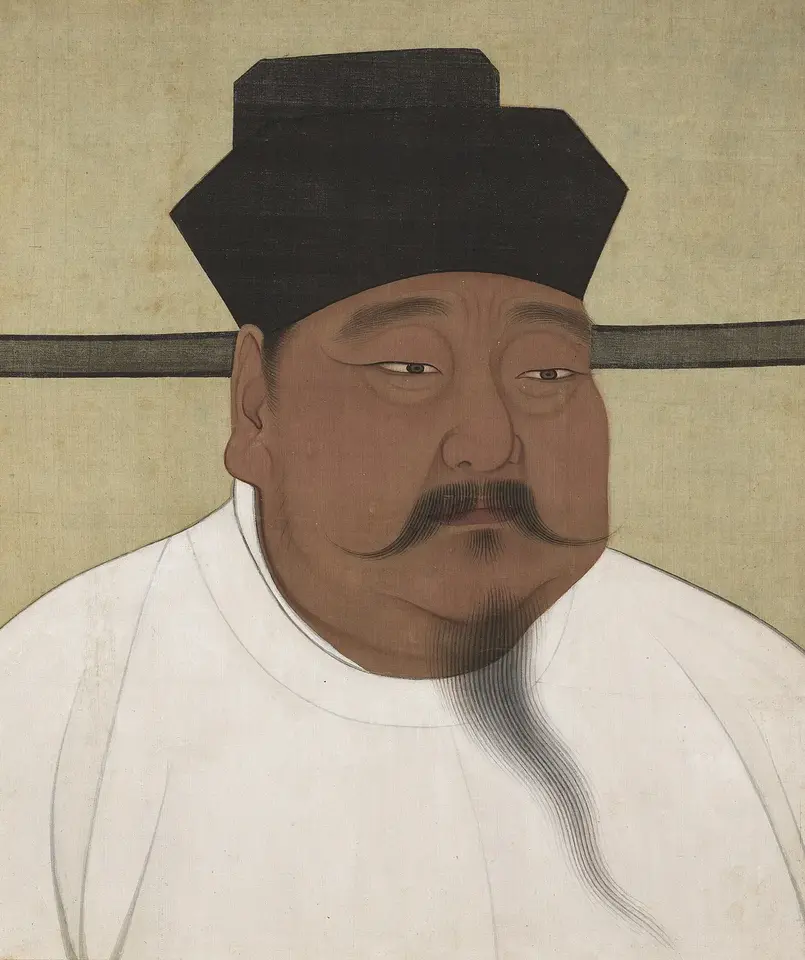
927 CE–976 CE
赵匡胤
Emperor Taizu of Song (宋太祖; March 21, 927 – November 14, 976 CE), personal name Zhao Kuangyin (赵匡胤), courtesy name Yuanlang (元朗), was the founding emperor of the Song dynasty, reigning from February 4, 960 until his death in 976 CE. Born into a military family in Luoyang, he rose through the ranks of the Later Han and Later Zhou armies, distinguishing himself under Emperor Shizong of Later Zhou (Chai Rong). At the…
Emperor Taizu of Song (宋太祖; March 21, 927 – November 14, 976 CE), personal name Zhao Kuangyin (赵匡胤), courtesy name Yuanlang (元朗), was the founding emperor of the Song dynasty, reigning from February 4, 960 until his death in 976 CE. Born into a military family in Luoyang, he rose through the ranks of the Later Han and Later Zhou armies, distinguishing himself under Emperor Shizong of Later Zhou (Chai Rong). At the pivotal Battle of Gaoping in 954 CE, Zhao executed a daring countercharge that rescued imperial forces and routed the Northern Han-Khitan coalition, subsequently serving as a frontline commander in victorious campaigns against Later Shu and Southern Tang. By 959 CE, he had been elevated to Palace Command Inspector-in-Chief (*Dianqian Duduojian*), the supreme commander of the imperial palace guards. Following Shizong's untimely death and the succession of the child-emperor Chai Zongxun, Zhao was dispatched in early 960 CE to repel an alleged northern incursion; at the Chenqiao Outpost, mutinous troops draped him in imperial yellow robes, staging a near-bloodless coup that forced the Later Zhou abdication and inaugurated the Song dynasty. Upon ascending the throne, Emperor Taizu confronted the centrifugal legacy of warlord separatism (fanzhen) and military praetorianism that had precipitated over half a century of political chaos during the Five Dynasties and Ten Kingdoms period. In close consultation with his strategist Zhao Pu, Taizu formulated the overarching national strategy to "subdue the south first and the north later" (xian nan hou bei), methodically extinguishing the southern regional kingdoms of Jingnan, Wuping, Later Shu, Southern Han, and Southern Tang to reconstitute imperial unity across China proper. Domestically, Taizu engineered a profound institutional revolution: through the famed episode of "relieving generals of command over a cup of wine" (beijiu shi bingquan), he peacefully stripped imperial guard generals and regional military commissioners of their commands, replacing them with rotating garrisons and civil officials. By centralizing elite troops in the capital (shou jingbing), severing administrative ties between regional military governors and subordinate prefectures (xue zhijun), and rerouting regional tax revenues to the central court (zhi qiangu), Taizu permanently dismantled military feudalism and anchored the foundational Song policy of "elevating civil governance and curbing military dominance" (chongwen yiwu). His sudden death on November 14, 976 CE, amidst the mysterious "riddle of the candle shadows and axe sound" (zhuying fusheng), concluded a transformational reign that laid the institutional and cultural bedrock for China's high medieval civilization.
Born at Jiama Camp in Luoyang (modern Henan Province).
Enlists under Military Affairs Commissioner Guo Wei; serves in the campaign suppressing rebel warlord Li Shouzhen at Hezhong.
Decisive bravery at the Battle of Gaoping saves Later Zhou army; wounded by an arrow at the siege of Taiyuan; promoted to Palace Command Inspector and appointed Prefect of Yanzhou.
Campaigns with Chai Rong against Southern Tang; crushes enemy armies at Huokou, captures Chuzhou at Qingliu Pass, and triumphs at Luhe; promoted to Palace Command Commander-in-Chief and Military Commissioner of Dingguo Army.
Serves as Supreme Naval and Land Commander during the northern offensive against the Khitans, taking Wahe Pass; elevated to Palace Command Inspector-in-Chief as Chai Rong falls critically ill; seven-year-old Chai Zongxun ascends the throne.
On February 3, stages the Chenqiao Mutiny; enters Kaifeng on February 4, accepts the abdication of Emperor Gong of Later Zhou, and proclaims the founding of the Song dynasty; suppresses the rebellions of Li Yun at Luzhou and Li Chongjin at Yangzhou.
Executes the first "Relieving Military Command over Wine," peacefully retiring imperial guard commanders Shi Shouxin and Wang Shenqi to local sinecures.
Dispatches Murong Yanzhao and Li Chuyun to conquer the Hunan and Hubei corridors, subjugating Jingnan and Wuping.
Issues an imperial decree ordering local prefectures to submit fiscal revenues to the central treasury; institutes Fiscal Commissioners (Zhuanyunshi) and Controllers-General (Tongpan).
Directs Wang Quanbin and Cao Bin to invade the Shu kingdom, rapidly conquering Later Shu.
Executes the second "Relieving Military Command over Wine," retiring veteran regional military commissioners; leads an expedition against Northern Han without decisive result.
Dispatches Pan Mei on a southern expedition, defeating the elephant corps and annexing Southern Han.
Directs Cao Bin and Pan Mei to conquer Southern Tang; captures Jinling and takes King Li Yu prisoner.
Mounts a third expedition against Northern Han; dies suddenly on November 14 in the Wansui Palace amidst the "riddle of candle shadows and axe sound"; succeeded by younger brother Zhao Guangyi.
Zhao Kuangyin traced his ancestral roots to Zhuo Commandery (modern Zhuozhou, Hebei Province), and was born on March 21, 927 CE, at Jiama Camp in the eastern suburbs of Luoyang. He hailed from a lineage of hereditary military and administrative servitors: his fifth-generation ancestor Zhao Tiao served as Magistrate of Youdu (modern Beijing) during the Tang dynasty; his great-grandfather Zhao Ting served as Vice Censor-in-Chief; his grandfather Zhao Jing held successive governorships over Ying, Ji, and Zhuo prefectures. His father, Zhao Hongyin (posthumously honored as Emperor Xuanzu), was a veteran cavalry officer commanding the Guarding and Holy Guards (Husheng Jun) under the Later Tang, Later Jin, and Later Zhou regimes. His mother, Lady Du (posthumously Empress Dowager Zhaoxian), was a woman of high domestic discipline and cultural cultivation.
Though classical dynastic historiography records that fragrant vapors enveloped the chamber during his birth—giving rise to his childhood moniker "Fragrant Child" (Xianghai'er)—Zhao received a conventional dual aristocratic education. His father valued civil literature and collected classical texts, enrolling young Kuangyin under private tutors Chen and Zhao at Jiama Camp, and later placing him under the renowned Confucian scholar Xin Wenyue to master the Five Classics. Concurrently, Zhao developed extraordinary martial proficiencies, displaying an instinctive mastery of equestrian archery and battlefield tactics, often leading neighborhood youths in military drilling and training with a heavy solid-iron staff.
In 944 CE, at age eighteen, Zhao married Lady He, the daughter of his father's colleague He Jingsi in the imperial guard.
During the chaotic transition from the Later Jin to the Later Han dynasty (947–948 CE), Zhao left home to seek independent political advancement. Traveling south to Fuzhou (modern Tianmen, Hubei), he called upon Wang Yanchao, Defense Commissioner of Fuzhou and former associate of his father, but was politely turned away with a modest cash disbursement. He then traveled to Suizhou to serve Prefect Dong Zongben, but soon departed after clashing with the prefect's haughty son, Dong Zunhui. While lodging at a Buddhist monastery in Xiangyang, an elderly monk skilled in prognostication observed his extraordinary bearing, gifted him travel funds, and advised him to travel north.
Proceeding northward to the frontlines of the rebellion of warlord Li Shouzhen at Hezhong in 948 CE, Zhao enlisted under Guo Wei, Military Affairs Commissioner (Shumishi) of Later Han. After briefly serving Liu Chong (founder of Northern Han) in Taiyuan, Zhao recognized Guo Wei's burgeoning military ascendancy and formally entered Guo's private headquarters at Yedu.
When Guo Wei overthrew the Later Han and founded the Later Zhou dynasty in 951 CE, Zhao was appointed Senior Officer of the Eastern and Western Shifts (Dongxi Ban Hangshou) within the Palace Guards. In 953 CE, Chai Rong (Guo Wei's adopted son and Prince of Jin), serving as Prefect of Kaifeng, recognized Zhao's exceptional tactical talents and recruited him as Commander of the Metropolitan Guard Cavalry (Mazhi Junshi).
The Crucible of Gaoping (954 CE)
In early 954 CE, Chai Rong ascended the throne as Emperor Shizong. Taking advantage of the dynastic transition, Emperor Liu Chong of Northern Han and allied Khitan cavalry invaded Later Zhou. Chai Rong led an imperial army north, encountering the enemy host at Bagongyuan, south of Gaoping. As the battle commenced, Later Zhou right-wing commanders Fan Ainneng and He Hui retreated in panic without engaging, precipitating the surrender of over a thousand infantry and plunging the imperial center into mortal peril.
In this catastrophic moment, Zhao Kuangyin rallied his comrades, crying out: "The sovereign faces mortal peril; we must fight to the death!" Coordinating with fellow palace guard commander Zhang Yongde, Zhao directed archers to secure the high ground on the left flank while leading two thousand elite cavalry in a ferocious, suicidal assault against the Northern Han front lines. Inspired by Shizong's personal courage in the field, Zhao's countercharge smashed the enemy formations, transforming imminent collapse into a complete triumph. Pursuing the routed enemy to Taiyuan, Zhao sustained a severe arrow wound to his left arm while attempting to set fire to the city gates. In the aftermath of Gaoping, Shizong promoted Zhao to Palace Command Inspector (*Dianqian Duyuhou*) with nominal title as Prefect of Yanzhou.
Reorganization of the Imperial Guards
Deeply shaken by the cowardice of the old guard at Gaoping, Emperor Shizong commissioned Zhao to execute a sweeping reform of the palace armies. Zhao conducted rigorous screening of the Metropolitan Cavalry and Infantry Command, discharging the infirm and corrupt while enrolling veteran warriors from across the empire into a newly reconstituted Palace Command (Dianqian Si). This process birthed elite corps such as the Dragon-Surging (Longjie), Tiger-Pouncing (Hujie), Iron Cavalry (Tieqi), and Crane- Controlling (Konghe) guards, establishing an imperial vanguard unmatched in military readiness. Crucially, Zhao utilized this reorganization to form the "Fraternity of Ten Brothers" (Yishe Shixiongdi)—a sworn military brotherhood that included Shi Shouxin, Wang Shenqi, Yang Guangyi, and Li Jixun—while cultivating dedicated lieutenants like Yang Xin, Cui Han, and Zhang Qiong, thereby forging an unshakable power base at the core of the state military apparatus.
Frontline Campaigns against Shu and Southern Tang (955–958 CE)
In 955 CE, dispatched by Shizong to inspect stalled operations in western Shanxi, Zhao advised perseverance, enabling Later Zhou to wrest Qin, Jie, Cheng, and Feng prefectures from Later Shu.
In early 956 CE, Zhao accompanied Shizong in the invasion of Huainan against Southern Tang. At Huokou, Zhao routed over ten thousand enemy troops. Advancing on Chuzhou, he confronted a reported Southern Tang host of one hundred fifty thousand under Huangfu Hui and Yao Feng entrenched at Qingliu Pass. Zhao outmaneuvered the enemy, chasing them to the city walls. When Huangfu requested an honorable set-piece engagement, Zhao charged into the enemy ranks on horseback, personally striking down Huangfu Hui and capturing both enemy commanders. At Luhe, Zhao routed a major counterattack led by Li Jingda, executing ten thousand enemy soldiers. In recognition of these victories, he was elevated to Palace Command Commander-in-Chief (Dianqian Duzhihuishi) and Military Commissioner of Dingguo Army.
During the campaigns of 957–958 CE at Shouchun, Haozhou, and Sizhou, Zhao spearheaded amphibious operations across the Huai River, personally swimming his warhorse across eighteen-mile sandbars to storm fortified river redoubts. When the King of Southern Tang attempted to bribe him with three thousand ounces of silver in an effort to sow discord between Zhao and Shizong, Zhao immediately surrendered the treasure to the imperial exchequer, thwarting the plot.
Elevation to Palace Command Inspector-in-Chief (959 CE)
In the summer of 959 CE, Zhao served as Supreme Naval and Land Commander in Shizong's northern offensive against the Khitans, securing the strategic surrender of Wahe Pass. However, Shizong fell gravely ill during the expedition. En route back to Kaifeng, Shizong examined intelligence documents and discovered a wooden plaque inscribed: "The Inspector-in-Chief shall become Son of Heaven." Suspicious of his brother-in-law Zhang Yongde, who then held the post, Shizong relieved Zhang and appointed Zhao Kuangyin as Palace Command Inspector-in-Chief (Dianqian Duduojian)—inadvertently placing the supreme keys of metropolitan armed power into the hands of the very man destined to fulfill the omen. Days later, Shizong died, leaving the throne to his seven-year-old son, Chai Zongxun (Emperor Gong).
On the first day of the Lunar New Year in 960 CE (January 31), urgent intelligence reports arrived in Kaifeng claiming that the allied armies of Northern Han and the Khitan Empire were advancing south. Panicked chancellors Fan Zhi and Wang Pu hurriedly ordered Zhao Kuangyin to lead the imperial guard north to repel the invaders.
On February 2, the imperial army marched out through the Aijing Gate and encamped twenty kilometers northeast of Kaifeng at the Chenqiao Outpost (Chenqiao Yi). That evening, Zhao's inner circle—directed by his younger brother Zhao Guangyi, military secretary Zhao Pu, and lieutenant Li Chuyun—actively orchestrated a military coup among the troops, spreading word that: "The emperor is young and fragile; fighting for the state will go unrewarded. It is better to proclaim our Inspector-in-Chief as Son of Heaven before marching north!"
At dawn on February 3, 960 CE, mutinous officers brandishing weapons surrounded the command tent. Zhao emerged, feigning grogginess from wine. Before he could speak, the officers draped a pre-sewn imperial yellow robe (huangpao) over his shoulders, prostrating themselves and chanting "Ten Thousand Years!" Zhao feigned reluctance, mounting his horse and declaring to the assembly: "You seek wealth and honor by making me emperor; if so, you must obey my commands. Otherwise, I will not be your master!" The soldiers swore unconditional obedience. Zhao immediately commanded: "The Empress Dowager and the young sovereign must not be harmed; the ministers of court must not be humiliated; the state treasuries and private citizens must not be looted. Violators shall be executed along with their clans."
Entering Kaifeng through the Renhe Gate without armed resistance, Zhao returned to the Palace Command bureau and removed the yellow robe. Leading chancellors Fan Zhi, Wang Pu, and Wei Renpu were brought before him. Overwhelmed by Zhao's display of emotional reluctance and confronted by armed officers threatening violence, the chancellors bowed in submission. That afternoon, Hanlin Academician Tao Gu produced a pre-drafted edict of abdication from his sleeve. In the Chongyuan Hall, the seven-year-old Chai Zongxun formally abdicated. Zhao Kuangyin ascended the throne, naming his new dynasty Song (derived from Songzhou, the administrative seat of his former Guide Army command) and proclaiming the era title Jianlong. The transition of power was achieved with unprecedented decorum and virtually no bloodshed in the capital.
Shortly after the founding of Song, veteran regional warlords raised revolts to challenge the new regime:
The rapid elimination of these two prominent Later Zhou military grandees stabilized the fledgling dynasty, proving the superior cohesion of the reorganized central guard.
Recognizing that the chronic instability of the late Tang and Five Dynasties stemmed from the excessive military and fiscal independence of regional warlords (fanzhen), Taizu consulted his chancellor Zhao Pu. Zhao Pu diagnosed the crisis with succinct clarity: "The only remedy is to curtail their power, seize control of their revenues, and confiscate their elite troops." Taizu systematically implemented this grand design through three institutional pillars:
*1. "Relieving Military Command over a Cup of Wine" (Beijiu Shi Bingquan)*
In the autumn of 961 CE, Taizu invited his former military comrades—Shi Shouxin, Wang Shenqi, Gao Huaide, and Zhang Lingduo—to an intimate banquet in the palace. When wine had circulated freely, Taizu dismissed the attendants and confessed: "I could not have attained this position without your aid. Yet being Son of Heaven is full of sorrow; I have not slept peacefully for a single night." The terrified generals prostrated themselves, professing absolute fidelity. Taizu responded: "I do not doubt your loyalty. But if your subordinates, coveting wealth and glory, should one day drape a yellow robe over your shoulders, could you refuse?" The weeping generals begged for a path to survival. Taizu gently advised: "Human life is brief as a white colt passing a crevice. Why not lay down your military commands, accept comfortable provincial governorships, buy fine estates, and spend your days enjoying wine and women? I shall bind our families through matrimonial alliances, so that sovereign and subject live in mutual peace." The following morning, all the generals submitted memorials citing ill health and requesting retirement from imperial guard command. Taizu rewarded them lavishly, appointing them to lucrative provincial sinecures and replacing them with junior, politically pliant officers. In 969 CE, Taizu repeated this bloodless maneuver with the veteran military commissioners of the provinces, permanently neutralizing the threat of military coups.
*2. Confiscation of Elite Troops (Shou Jingbing)*
Taizu reorganized the imperial military system into the Metropolitan Guard (Jinjing Jun) and Prefectural Guard (Xiangjun). Veteran combatants from across China were selected and transferred directly into the central Imperial Guards (Shuwei), while the old and feeble remained in the provinces as auxiliary labor troops. The guard was stationed in equal halves between the capital and strategic circuits (neiwai xiangwei), rotating commands every three years so that "generals did not know their soldiers, and soldiers did not recognize their generals" (bing bu zhi jiang, jiang bu zhi bing), rendering mutinies mechanically impossible.
*3. Fiscal Recentralization and Administrative Restraint (Zhi Qiangu, Xue Zhijun)*
To destroy regional autonomy, Taizu established Fiscal Commissioners (Zhuanyunshi) across the circuits, decreeing in 964 CE that all local taxes beyond essential operating expenses must be remitted directly to the central court. In the prefectures, he instituted Controllers-General (Tongpan), civil officials appointed directly by the emperor who possessed co-signing authority over all official documents issued by prefects and military commissioners. He systematically eliminated subordinate prefectures (zhijun), placing all regional subdivisions under direct central supervision. To curb military arbitrary power, he elevated the civil bureaucracy, reserving top regional posts for civil scholar-officials (wenren zhi zhou) and initiating the enduring dynastic doctrine of "elevating civil governance and curbing military dominance" (chongwen yiwu).
Following Zhao Pu's strategic doctrine of "subduing the vulnerable south before addressing the resilient Khitans and Northern Han in the north," Taizu mounted systematic military campaigns:
With the south subdued, Taizu turned his attention to the north. In 969 CE and 976 CE, he personally led expeditions against Northern Han at Taiyuan, but operations were stymied by formidable fortifications, dysentery among the troops, and Khitan relief columns. To resolve the lost Sixteen Prefectures of Yanyun, Taizu accumulated imperial surpluses within the Special Reserve Treasury (Fengzhuang Ku), intending to purchase the territories from the Khitans or, failing that, to finance a massive mercenary campaign.
On the evening of November 14, 976 CE (the 19th day of the 10th lunar month), Taizu summoned his younger brother Zhao Guangyi to drink wine in the Wansui Palace. According to later accounts in Wen Ying's Xiangshan Yelu, palace attendants observed the flickering shadows of candles behind the screens and heard the dull thud of an axe striking the ground, followed by Taizu's exclamation: "Do it well! Do it well!" The next morning at dawn, Emperor Taizu was found dead at age forty-nine. Zhao Guangyi immediately ascended the throne as Emperor Taizong, bypassing Taizu's mature sons Zhao Dezhao and Zhao Defang. This episode, famously known as the "riddle of the candle shadows and axe sound" (zhuying fusheng), remains one of the greatest unsolved successional mysteries in imperial Chinese historiography. Taizu was interred at the Yongchang Mausoleum in Gongyi, Henan.
The peaceful disarming of the military elite (beijiu shi bingquan) was Taizu's defining political masterstroke. Overcoming the violent cycle of the Five Dynasties—where monarchs were routinely murdered or deposed by their own praetorian commanders—Taizu used psychological persuasion and material compensation rather than purges to strip commands from his imperial guard comrades (Shi Shouxin, Wang Shenqi) in 961 CE and from provincial military commissioners in 969 CE. By granting lavish pensions, prestigious sinecures, and imperial matrimonial ties, he achieved a bloodless structural transformation that eliminated warlordism without provoking mutiny.
Taizu constructed a durable triadic formula to prevent regional rebellion:
Taizu systematically elevated scholar-bureaucrats over military aristocrats:
Formulated with chancellor Zhao Pu, this geopolitical strategy guided Song unification:
To address the profound strategic loss of the Sixteen Prefectures of Yanyun (ceded to the Khitans by Later Jin in 936 CE), Taizu created the Special Reserve Treasury in the inner palace. Dedicating annual budgetary surpluses to this fund, Taizu formulated a visionary diplomatic plan: once the reserves reached three to five million strings of coin, he intended to ransom the Sixteen Prefectures from the Khitan Liao; if the Khitans refused, the accumulated wealth would finance a colossal expedition to retake the northern borderlands by force. Though his unexpected death terminated the scheme, the treasury testified to his extraordinary strategic foresight.
FIGURES ASSOCIATED WITH THIS DYNASTY