Zhao Xu was born at the residence of the Prince of Pu. | Zhao Xu was born at the residence of the Prince of Pu.
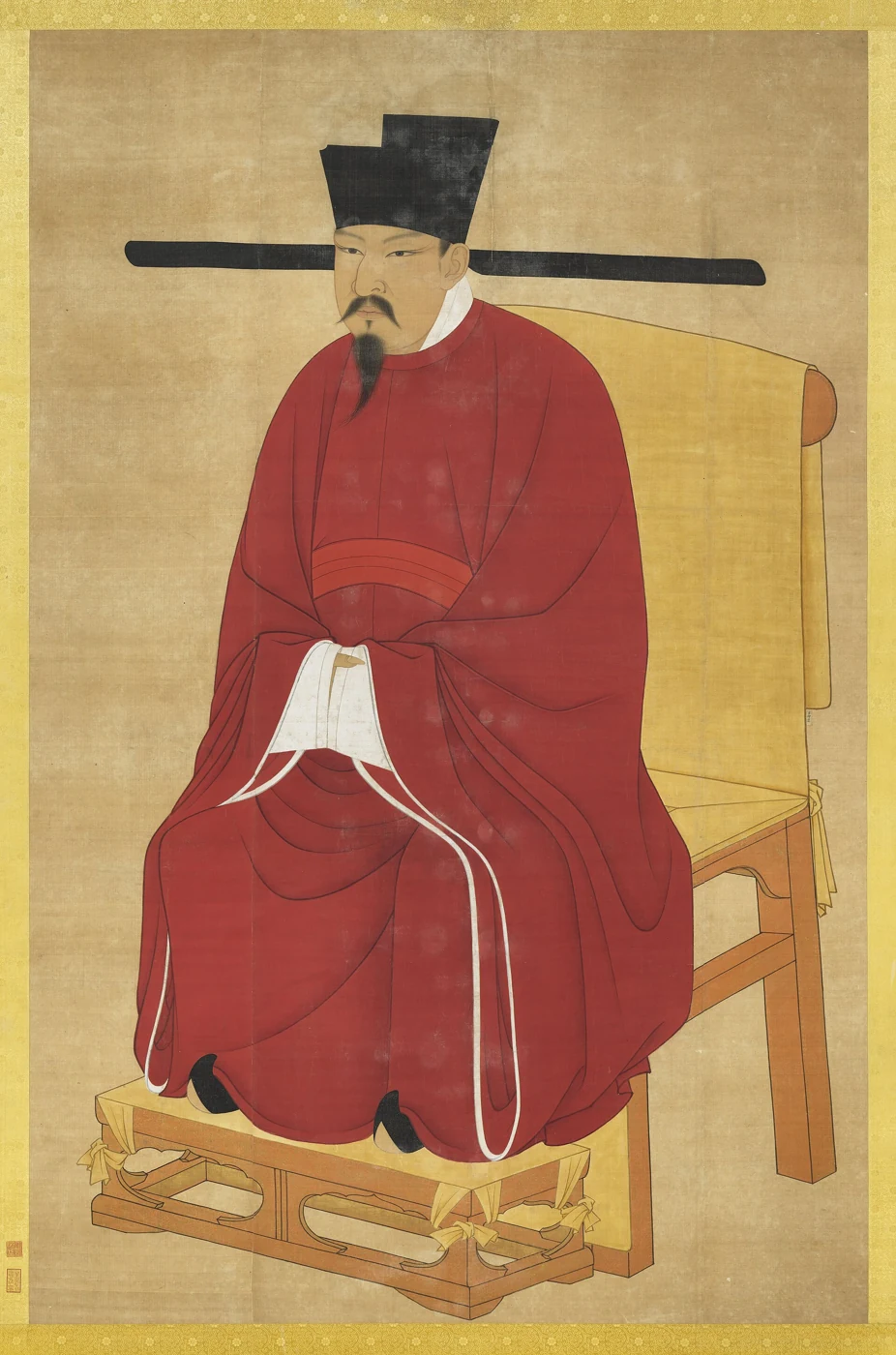
1048 CE–1085 CE
Historical figure
Zhao Xu
赵顼
Zhao Xu, originally named Zhongzhen, was the eldest son of Zhao Shu, Emperor Yingzong of Song, and Lady Gao, and the sixth emperor of Northern Song. After succeeding his father in 1067 (fourth year of Zhiping), he faced fiscal, military, and frontier pressures. He recalled Wang Anshi and backed a series of New Policies, including the Green Shoots Policy, service substitution, and the baojia militia system. After Wang left…
1048 CE–1085 CENorthern Song
PROFILE
Zhao Xu, originally named Zhongzhen, was the eldest son of Zhao Shu, Emperor Yingzong of Song, and Lady Gao, and the sixth emperor of Northern Song. After succeeding his father in 1067 (fourth year of Zhiping), he faced fiscal, military, and frontier pressures. He recalled Wang Anshi and backed a series of New Policies, including the Green Shoots Policy, service substitution, and the baojia militia system. After Wang left office, Zhao continued the reforms, beginning to reorganize the bureaucracy in 1080 (third year of Yuanfeng) and promulgating a new arrangement of the Three Departments, Privy Council, and Six Ministries in 1082 (fifth year of Yuanfeng). Song forces expanded their position in the Xi–He region but suffered reverses against Western Xia at Lingzhou and Yongle. The war with Jiaozhi ended in negotiations. Zhao died in 1085 (eighth year of Yuanfeng) and was succeeded by his son Zhao Xu. The benefits and social costs of the New Policies, together with the mixed results of frontier warfare, remain central to assessments of his reign.
- Dynasty / polity
- Northern Song
- Period
- Northern Song
- Date of Birth
- May 25, 1048 CE(8th year of the Qingli era, Song, 4th month)
- Date of Death
- April 1, 1085 CE(8th year of the Yuanfeng era, Song, 3rd month)
- Early name
- Zhao Zhongzhen
- Period and state
- Northern Song
- Position
- Emperor of Northern Song, known as Emperor Shenzong
- Reign
- 25 January 1067 (first month of the fourth year of Zhiping) to 1 April 1085 (wu-xu day of the third month, eighth year of Yuanfeng)
- Era names
- Xining; Yuanfeng
- Temple name
- Shenzong
- Posthumous name
- Shaotian Fagu Yunde Jiangong Yingwen Liewu Qinren Shengxiao Huangdi; the longer form resulted from later additions
- Burial place
- Yongyu Mausoleum
- Predecessor
- Zhao Shu, Emperor Yingzong of Song
- Successor
- Zhao Xu's son Zhao Xu, Emperor Zhezong of Song
- Principal activities
- Backed the New Policies of Wang Anshi; directed the Yuanfeng Reforms; supported campaigns in the Xi–He region and wars with Western Xia; supported the compilation of the Comprehensive Mirror in Aid of Governance
LIFE TIMELINE
After his father's accession | After his father's accession, Zhao was made Duke of Guangguo and later Prince of Huaiyang; his personal name was changed to Xu.
He was named crown prince. | He was named crown prince.
Zhao succeeded to the throne. | Zhao succeeded to the throne.
He appointed Wang Anshi vice councillor and advanced the New Policies. | He appointed Wang Anshi vice councillor and advanced the New Policies.
Wang became chief councillor as the reforms expanded. | Wang became chief councillor as the reforms expanded.
Wang Shao's campaign in the Xi–He region took Wusheng and established Xizhou. | Wang Shao's campaign in the Xi–He region took Wusheng and established Xizhou.
Wang Anshi left the chief councillorship for the second time | Wang Anshi left the chief councillorship for the second time, while Zhao retained major elements of the New Policies.
Su Shi was jailed over his writing and later exiled to Huangzhou in the Crow Terrace Poetr | Su Shi was jailed over his writing and later exiled to Huangzhou in the Crow Terrace Poetry Trial.
Zhao began reorganizing the central bureaucracy. | Zhao began reorganizing the central bureaucracy.
Song armies attacked Western Xia along five routes but failed to take Lingzhou. | Song armies attacked Western Xia along five routes but failed to take Lingzhou.
The new official system was promulgated | The new official system was promulgated; Yongle fell to Western Xia forces.
Zhao died | Zhao died, and Zhao Xu succeeded him.
BIOGRAPHY
Biography
Education and accession
The History of Song records Zhao Xu as Emperor Yingzong's eldest son and describes his early instruction at court. After Yingzong's accession in 1063 (eighth year of Jiayou), he received the title Duke of Guangguo, later became Prince of Huaiyang, and changed his personal name from Zhongzhen to Xu. He was made Prince of Ying in 1064 (first year of Zhiping) and crown prince in 1066 (third year of Zhiping). Both encyclopedias say he read the Han Feizi and Wang Anshi's memorials, a useful context for his later interest in fiscal and military reform. Stories of auspicious signs or prophetic dreams belong to historical narrative and are not treated as verifiable events. Zhao became emperor when Yingzong died in 1067 (fourth year of Zhiping).
The Xining New Policies
Zhao summoned Wang Anshi soon after accession. In 1069 (second year of Xining), he named Wang vice councillor and established an office to frame reforms of the fiscal administration. The Green Shoots Policy, equitable transport, agricultural waterworks, Service Exemption Law, State Trade Policy, Mutual Security (baojia) Policy, and land survey and tax equalization measures followed. Wang became chief councillor in 1070 (third year of Xining). The reforms touched revenue, labor obligations, markets, military organization, and examinations. Sima Guang, Han Qi, and others opposed various measures. Zhao supported the program while changing appointments and some provisions amid controversy and implementation problems. Wang left the chief councillorship for a second time in 1076 (ninth year of Xining), but Zhao retained most of the major measures. Describing everything thereafter simply as the “failure” of reform would miss its continuation and revision.
Yuanfeng administration and frontier war
After Wang's departure, Zhao focused on the bureaucracy. From 1080 (third year of Yuanfeng), the court addressed the mismatch between official titles and actual assignments. In 1082 (fifth year of Yuanfeng), it promulgated a new structure centered on the Three Departments, Six Ministries, and Privy Council, revising responsibilities and ranks. On the frontier, Zhao supported Wang Shao's operations in the Xi–He region, and Song forces gained Xizhou, Hezhou, and nearby territory. Song and Jiaozhi fought from 1075 to 1077 (eighth to tenth years of Xining); Song forces recovered lost positions, and the two sides negotiated. The five route offensive against Western Xia in 1081 (fourth year of Yuanfeng) did not take Lingzhou; in 1082 (fifth year of Yuanfeng), Western Xia captured Yongle with heavy Song losses. These outcomes cannot all be described as frontier victories.
Death and succession
Zhao became gravely ill in 1085 (eighth year of Yuanfeng). He named his son Zhao Yong crown prince and changed the boy's name to Zhao Xu. The emperor died in Funing Hall on 1 April 1085 (wu-xu day of the third month, eighth year of Yuanfeng). His son succeeded as Emperor Zhezong. The temple name Shenzong and his lengthy posthumous title developed through later rites and additions. The information panel here follows the long form listed by other accounts; the successive versions noted in another account are retained in the source comparison record. He was buried at Yongyu Mausoleum.
His Birth, His Early Love of Learning, and His Study of the Classics
On the day wuyin of the fourth month of the eighth year of Qingli, 25 May 1048, Zhao Xu was born in the Mucin residence of the palace of the prince of Pu'an, and it is recorded that "auspicious light filled the chamber and a swarm of mice breathed five-coloured vapour that formed clouds." His original name was Zhao Zhongzhen, which was given him in the eighth month, and he was made a vice commander of the guards and three times promoted to be general of the right thousand-ox guard. In 1063 he entered the Qingning palace with his father Zhao Shu, having once dreamed that a spirit bore him up to heaven; and in the third month of that year, when Emperor Renzong died and his father came to the throne, Zhao Xu was made an observation commissioner of Anzhou and enfeoffed duke of Guang. In the fifth month he received the classics in the eastern palace; and he is recorded as of "a high nose and a dragon countenance, with every movement in its proper measure," and of a nature fond of learning, "questioning until late in the day and forgetting to eat," so that Emperor Yingzong often sent attendants to stop him. His propriety in settling his dress and joining his hands was such that "though it were the greatest heat he never used a fan"; and when the lecturer Wang Tao came in to serve, Zhao Xu led his younger brother Zhao Hao to bow to him, which shows his reverence for his teachers. In the ninth month he was given the posts of military commissioner of Zhongwu and joint manager of state affairs, enfeoffed prince of Huaiyang commandery and given his present name. In the sixth month of the first year of Zhiping, 1064, he was advanced to be prince of Ying; in the third month of the third year he married a granddaughter of the late chancellor Xiang Minzhong; in the tenth month, Emperor Yingzong falling ill, Zhao Xu, relying on the precedent of Emperor Renzong's time, asked that lectures be held in the Yingying pavilion every other day to set the minds of the officers of the court at rest; and on the day renyin of the twelfth month he was made heir apparent.
The Formation of His Thought and His Accession
As a boy Shenzong "knew that his ancestors had meant to swallow You and Ji and Lingwu and had several times been beaten," and resolved to wipe out the shame of several generations; and by his teens he "was stirred to great designs and wished to call the two northwestern states to account." While reading in the eastern palace he greatly admired the Legalist school, and among the Legalists he especially liked Han Feizi, being much taken with their art of enriching the state and strengthening the army; he had also read Wang Anshi's memorial to Emperor Renzong and thought very highly of his ideas on managing the finances and governing the state. The Legalist teaching had indeed a great effect on him: in later discussions of the art of government he would often bring up the ancient Legalists who had carried through reforms, saying that among those who had established fame in antiquity, Guan Zhong in Qi, Shang Yang in Qin and Wu Qi in Chu had all made their orders certainly carried out; and the reforming spirit of the Legalist teaching together with the idea of strengthening the ruler's autocracy by joining law, method and circumstance made a deep impression on his whole life. In the first month of the fourth year of Zhiping, 1067, Emperor Yingzong died and the heir Zhao Xu came to the throne, changing the era name the next year to Xining. At his accession the Northern Song faced a series of crises: military expenditure was enormous, the bureaucracy was swollen and its costs many, and the great annual payments to Liao and Xia left the finances in deficit year after year, the History of Song recording that in 1065 the deficit had reached more than seventeen million five hundred thousand; and the peasants, ground down by the seizure of land by the powerful, by usury and by heavier taxes and labour service, rose again and again. In such straits at home and abroad, with the finances exhausted, the young Zhao Xu was convinced that reform was the only way out of the crisis.
The Carrying Out of the Xining Reforms and His Appointments
Wang Anshi having been summoned to the capital, Zhao Xu was overjoyed at the news and at once received him; and after hearing his plans for reform in politics, finance, the economy and the army, he felt that Wang Anshi was the man to accomplish the great work with him, while Wang Anshi in turn was won by Zhao Xu's determination to govern well and enrich and strengthen the state, so that sovereign and minister came together for a common ideal and faith. In the second month of the second year of Xining, 1069, Zhao Xu made Wang Anshi assistant in the government with chief charge of the reforms, and at the same time rearranged the personnel and formed a new governing team; the measures fell roughly into three parts, the means of enriching the state, of strengthening the army and of selecting scholars. No sooner were the new laws issued than they drew a storm of reproach and abuse from court and country, attacking them not only in their content and effects but decrying them in terms of thought and morals, saying that Wang Anshi "changed the laws of the ancestors," that "by the art of enriching the state and strengthening the army he misled the imperial mind, seeking quick results and forgetting the old learning," and that "in exalting law and ordinance he praised Shang Yang, in despising the seasoned he counted forbearance a fault, and in casting off public opinion he counted custom a vulgarity"; but Wang Anshi was unmoved and cried out that "heaven's changes are not to be feared, men's words are not to be heeded, and the laws of the ancestors are not to be kept." Zhao Xu supported him, saying that a subject who could speak only of morality and gave no substance of merit was of no use to the business, and holding that morality and merit should both be valued; and against the old party he dismissed a number of officials who opposed the reforms: the censor-in-chief Lü Gongzhu "went out to Yingzhou for asking the abolition of the new laws"; the censors Liu Shu, Liu Qi, Qian Luo and Sun Changling and others "were all refused a hearing and left one after another"; the Hanlin academician Fan Zhen was stripped of office and retired for three memorials on the green-sprouts law; Ouyang Xiu asked to retire "and was allowed"; Fu Bi "was relieved of his office as commissioner for obstructing the green-sprouts law"; and Wen Yanbo, having said that the market-exchange law competed with the people for profit, "was sent out to hold Wei." Afterwards Wang Anshi became joint manager of the department of state affairs, ranking with a chancellor and holding greater power, so that the green-sprouts, baojia, equal-supply, market-exchange and water-conservancy laws were promulgated throughout the realm one after another and the reform reached its height. To frame and carry out the new laws promptly and effectively Zhao Xu created a special bureau for the regulations of the three departments, presided over by Wang Anshi with the privy councillor Chen Shengzhi, and on Wang Anshi's recommendation employed Lü Huiqing and others in it. In the third year of Xining, 1070, he made Wang Anshi joint manager of state affairs in charge of the government; in the fourth year he abolished the subjects of poetry and rhapsody and the illumination of the classics and took scholars in the meaning of the classics, in discourse and in policy; in the fifth year he set up the county of Anhua and the next year the bureau for the meaning of the classics with Wang Anshi at its head; and in the eighth year, the new books on the meaning of the classics being finished, he decreed that the meanings of the Odes, the Documents and the Rites of Zhou be published in the schools.
The Resistance to the Reforms, Wang Anshi's Two Dismissals, and the Later Reform
Though the Xining laws had Zhao Xu's full support they advanced with the greatest difficulty: offending in many ways the interests of the privileged great officials, great landowners and great merchants, the reform met fierce opposition from the first, and this opposition had the support of the grand empress dowager, the empress dowager and the emperor's own empress; and since the new laws had many faults of their own, they were opposed by some upright ministers besides. The emperor's own mind began to waver: the conservative ministers' opposition Wang Anshi had been prepared for, but the split within the reforming party dealt him a heavier blow, and the emperor was no longer so obedient to him as in earlier years, sometimes paying no attention to his views at all, so that Wang Anshi sighed to him that the affairs of the realm were like boiling soup, with one handful of fire put in and then a ladle of water thrown after it, and how should it ever come to the boil. In the spring of the ninth year of Xining, 1076, Wang Anshi, being ill, asked repeatedly to resign; and in the sixth month his son dying in his prime, Wang Anshi was so overcome with grief that he could no longer give his mind to the government, and the emperor had to let him resign the chancellorship and go out as governor of Jiangningfu; the next year Wang Anshi gave up even that title, and never returned to court before his death in 1086. Both of Wang Anshi's dismissals were the result of Zhao Xu's compromise with the old forces, his purpose being to secure his own throne and the support of the ministers and the consort kin, but his aim of enriching and strengthening the state through reform did not change: while soothing the old party and restoring to use such dismissed and demoted old figures as Lü Gongzhu, Feng Jing and Sun Gu, he held to the reform so as to balance the new and old parties. Politically he still did his utmost to maintain the new order: when after Wang Anshi's first dismissal the old party thought the times were about to change, the emperor issued an edict stating plainly that the new laws "where they are not yet at rest shall be examined and perfected until they reach what is right, and that the officials should apply themselves to carrying them out to answer his mind, and that no man should cling to the old ways to thwart his law, and that whoever did not obey would be punished without pardon"; and after Wang Anshi's second dismissal, throughout Shenzong's reign, apart from the abolition of the square-field law and some slight adjustments of clauses, the new laws were in the main carried out. He also showed consideration for Wang Anshi in his provincial post, making him commissioner of the Jixi temple in 1077, president of the left of the secretariat, duke of Shu and commissioner of the Jixi temple in 1078, and on the reorganization of 1080 specially advanced with the fief of duke of Jing. In the year after Wang Anshi's second dismissal Zhao Xu changed the era name to Yuanfeng and came forward from behind the scenes to conduct the reforms himself; but the reforms were still attended by opposition, and having lost Wang Anshi, and having besides to face great pressure alone, he grew somewhat angry and resolved to use stronger means to carry the new laws through and to punish severely those who opposed them. He did not stop the process of reform, and through his unceasing efforts the Song court established a centralized autocracy more favourable to the ruler, its basic institutions remaining in force to the end of the Song without great change.
The Yuanfeng Reorganization
The superfluity of offices and of their cost came of the early Song practice, to strengthen the throne, of granting office widely so as to divide the powers of chancellor, ministries, courts and tribunals, the system being complex with its separation of rank, function and commission, so that offices were duplicated and idle officials costly. In the eighth month of the third year of Yuanfeng, 1080, the emperor formally began the reorganization of the offices, starting where the abuses were deepest: he decreed the abolition of titles that carried only a name, so that the courts, ministries, tribunals and offices formerly held as empty titles should have real business; and he took the old titles of the dispersed officials and formed them into grades, to serve as the standard of salary and of promotion and demotion, so that "the officers of the censors, the secretariats, the governors and the tribunals should actually conduct business, and all who held only a name should be dismissed and their places filled by grades, with salaries fixed accordingly." He also merged offices and reduced officials so that names and realities matched and office carried power. He set up the three secretariats of the central, the chancellery and the department of state affairs to conduct the central government: the central secretariat issued the emperor's commands, answered the memorials of officials and decided the appointment and dismissal of the chief officers, with eight bureaux such as the bureau of personnel beneath it; the chancellery examined what the central secretariat had decided; and the department of state affairs was the executive, with chancellors of the left and right exercising real power, though the ministry of war had charge only of the baojia and militia, real military power remaining with the emperor and the privy council. Thus the early Song abuse of many empty and few real posts in the central government was reversed. Second, he unified the salaries of officials throughout the realm, so that officials who had held only a salary were given corresponding grades and paid by grade, which made for their assessment and employment. The reorganization of the Yuanfeng years, though of limited scope, showed his wish to maintain the new policy and continue the reform, changed to some degree the confused bureaucracy inherited from the early Song and laid the basic framework of the central government for the later Northern and the Southern Song.
The Northwest, the South, and Learning
Zhao Xu had the ambition of uniting Liao and Xia. In the eighth month of the fourth year of Xining, 1071, he set up the Taohé pacification office with Wang Shao at its head; in the fifth month of the next year the Tongyuan army, with Wang Shao as its governor in charge of the Taohé region, which had Wang Anshi's full support; in the eighth month Wusheng was taken and renamed Zhentao, in the tenth month raised to be Xizhou with a commissioner for the Xihe circuit, and thereafter He, Min and Tao were taken, "the whole territory of the Xihe circuit being held at last, which served to check the Western Xia." With Xia he "fought again and again, suffering great defeats at Lingzhou and Yongle city": in the seventh month of the fourth year of Yuanfeng, 1081, seizing the occasion of Xia's internal disorder, he sent five armies against it, and at the end of the eleventh month the Song troops reached the wall of Lingzhou and were about to enter when the commander, jealous of the merit, sent a rider to stop them, so that the moment was lost and the city untaken while the Xia let the river flood them, forcing the Song to withdraw; and in 1082 the emperor built Yongle city on the border of Yin and Xia to pen in the Xia of Xingzhou, but the Xia brought out more than three hundred thousand men to besiege it, the city fell, more than two hundred Song officers and men being killed and more than two hundred thousand labourers and craftsmen lost, and when the report reached Bianjing the emperor wept in open court and from that time lost his fighting spirit. In the south, in the intercalary seventh month of the fifth year of Xining, 1072, Wang Anshi sent his chief reformer Zhang Dun, under the name of inspecting the Hengping affairs of the Jinghu circuits, to open up the Two Rivers region; in the eleventh month of that year the Meishan region of the Jinghu south circuit was opened and the county of Xinhua set up, and the next year Anhua; in the seventh year the southern river was opened and Yuanzhou and Luyang county set up, and later Qianyang; and in the ninth year the northern river too was opened, so that western Hunan was gradually developed. Against Jiaozhi, in the ninth month of the eighth year of Xining, 1075, the Jiaozhi army took the Guwan stockade, and in the eleventh month attacked on a great scale by water, taking Lianzhou and Qinzhou by sea; the next year Guo Kui and others were appointed and the lost ground recovered; in the twelfth month the Song entered Jiaozhi territory, broke its elephant formation and took Menzhou, coming within thirty li of its capital, where the Jiaozhi gathered all their ships on the south bank so that the Song could not cross; and the Song then laid an ambush and decoyed them, and the Jiaozhi crossing to attack were broken, its heir apparent Hongzhen dying in the fight, so that on the twenty-first day of the twelfth month the king of Jiaozhi, Li Qiande, submitted and asked for peace, and Guo Kui, his men having died in great numbers of the heat and the miasma, accepted the surrender and led his troops north. In education his reforms met with little objection: primary schools were set up in the prefectures and counties, the court took the grand college directly in hand, and the students were divided into the outer, inner and upper houses chosen by periodical examination, two thousand in the outer house, the best rising to the inner house of three hundred, and the best of these to the upper house of a hundred, from which the best might be chosen directly for office. In letters he supported Sima Guang in compiling the Comprehensive Mirror: when the bureau moved to Luoyang the emperor gave Sima Guang his old library of the palace of Ying, two thousand four hundred scrolls, and wrote a preface for the Mirror.
His Handling of the Case of Su Shi and the Slander of Ouyang Xiu
In the case of Su Shi the joint manager of state affairs Wang Gui cited the lines in his poem on the juniper, that "the root reaches to the nine springs and has no crooked place, and in the world only the hidden dragon knows it," as showing a disloyal mind and deserving heavy punishment; and the emperor said that he had always treated Su Shi well and that though Su Shi had erred he had not gone so far as treason, asking how the minister knew that Su Shi meant to rebel. And he told Wang Gui that a poet writing a poem wrote it for the juniper and what had it to do with himself, and asked them to cease their far-fetched readings. Afterwards, when men falsely accused Sima Guang, Zhang Fangping, Fan Zhen, Chen Xiang and Liu Zhi of similar conduct and of secret dealings and demanded severe punishment, Shenzong would not allow it, and in the end Su Shi was only banished as assistant commander of the Huangzhou militia without criminal proceedings. At his accession, also, the censor Jiang Zhiqi impeached the left assistant of the secretariat Ouyang Xiu for improper conduct and an incestuous scandal with his niece; and the emperor turned to the former minister Sun Sigong, who said it was quite impossible and that the matter touched a great minister's reputation and should be handled with care. The emperor then decreed that Jiang Zhiqi produce his evidence, and Jiang Zhiqi, whose charge was mere hearsay, had none, and in confusion said he had heard it from the vice censor-in-chief Peng Siyong; and Peng Siyong, asked, said he too had heard it and had no proof. On further inquiry the emperor at last established that the tale of Ouyang Xiu's incest was wholly false: Ouyang Xiu's brother-in-law Xue Zongru, being at odds with him, had invented the slander, which somehow reached the vice censor Peng Siyong and was by him told to Jiang Zhiqi, who without distinguishing true from false had used it to impeach. Having established this, Shenzong in anger rebuked Jiang Zhiqi for false accusation and banished him with Peng Siyong out of the capital, so that "the court was shaken and the realm acknowledged his clear judgement."
His Last Years and Death
In the first month of the eighth year of Yuanfeng, 1085, Zhao Xu, whose ambitions were great, was dealt a heavy blow by the disasters of the war with Xia and his illness grew worse. The ministers were in confusion, and he, having a presentiment of evil, nodded in helpless assent to their request: his sixth son Zhao Yong, renamed Xu, was made heir apparent, and affairs of state were provisionally left to the empress dowager. Zhao Xu had sought his ideal all his life, hoping to rebuild a strong and flourishing state, and when these dreams were broken he too came to the end of his road. On the day wuxu of the third month he died in the Funing hall at the age of thirty-eight, with the posthumous name of the emperor who continued heaven, followed antiquity, carried virtue, established merit, was accomplished in letters, fiercely martial, reverent and benevolent, sage and filial, and the temple name Shenzong, and was buried at the Yongling. His son Zhao Xu succeeded as Emperor Zhezong; and the new laws to which he had given the toil of a lifetime were provisionally abolished soon after his death by his mother the grand empress dowager Gao, though after Zhezong took the government himself they were restored one after another, many of the measures continuing in force into the Southern Song.
Major Activities
Finance, education, and institutions
Zhao Xu and Wang Anshi advanced the Xining New Policies to improve public finance and military capacity. Measures such as the Green Shoots Policy, Service Exemption Law, and State Trade Policy altered how the state raised funds and organized obligations, while prompting debate over burdens on households, uneven enforcement, and concentrated power. The court also shifted civil examinations toward interpretation of the classics, policy argument, and written proposals, and established an office to prepare new interpretations of the classics. The Yuanfeng Reforms sought to bring central office names and actual functions closer together. Their institutional influence lasted beyond Zhao's reign, although historians differ on their effectiveness and costs.
Scholarship and the frontier
Zhao supported Sima Guang's compilation of the Comprehensive Mirror in Aid of Governance, supplying books and writing a preface. The Xi–He campaigns enlarged Song positions in the northwest, while the failed attack on Lingzhou and the loss of Yongle exposed military problems. In the Crow Terrace Poetry Trial of 1079 (second year of Yuanfeng), Su Shi was arrested over his writings and later sent to Huangzhou, illustrating the harsh side of court politics during the reform era. These events are described in the full texts of both encyclopedias. Aggregate fiscal claims alone cannot establish that every policy produced the same social result.
The Judgements of Later Ages, the Gains and Losses of the Xifeng Reforms, and Their Historical Significance
The eulogy in the History of Song says that from youth he "loved learning and questioned others until late in the day, forgetting to eat," and that "the emperor was by nature filial and fraternal, and in serving the two palaces would stand all day without change in cold or heat… and on his accession he was careful and modest, reverencing his ministers, seeking plain speech, looking into the people's hidden hardships, pitying the orphaned and alone, supporting the aged and relieving the destitute; he did not build palaces nor go on excursions, but strove to govern well and was about to accomplish much," so high is its estimate of his character and his will to govern; yet the same eulogy says that "before long Wang Anshi entered the chancellorship… and when the laws of green sprouts, baojia, equal supply, market exchange and water conservancy were set up, the realm was in an uproar and men came one after another weeping and wailing; the emperor never came to see it, but resolutely dismissed the old ministers and pushed aside the remonstrants, carrying it through without doubt, so that in the end the good laws and fair intentions of the ancestors were almost all destroyed" — its censure of his employment of men and conduct of the law being equally heavy. It is also recorded that he was "of Heaven-granted sagely wisdom and versed besides in letters," and the mourning poems he gave on the death of the grand princess of Qin were praised in their day. Later opinion differs even more widely: one holds that "Shenzong was extremely intelligent and understood everything under heaven, a sovereign not to be met with in a generation, only that when it came to the point he failed to keep time"; another that the Xining reform was "a self-rescue movement of the landlord class, fundamentally opposed to the peasants' class struggle, yet under the influence and pressure of that struggle it adapted to some degree to the prospects of economic development and the demands of the working people"; another that it "took the removal of hardships, the checking of annexation and the convenience of farming as urgent"; another that he "cherished the thought of enriching the state and strengthening the army and sought to bestir himself, employed Wang Anshi as chancellor, carried out measures of political reform of every kind and actively created favourable conditions for campaigns abroad"; and yet another criticises him for "a spirit not grand enough, thought not deep enough and character not firm enough," and holds that "in checking annexation he was not as firm as Wang Anshi: wishing both to increase the state's revenue and not to injure the interests of the upper classes, he made the burden fall after all on the lower people." As to the actual effects of the reforms: the new laws greatly increased the state's revenue, social production developed greatly, the cultivated area grew sharply to seven hundred million mu in the realm, yields per unit rose generally, the output of many minerals was several to several tens of times that of Han and the middle Tang, town commerce developed as never before, and the army's fighting quality plainly improved; while the reorganization of the Yuanfeng years, though "of some positive effect, had also its historical limits," and under the conditions of the time he "neither did nor could carry out a thorough reform of the institutional structure and reduce the number of officials," so that "he had a good will but could not achieve his aim of securing the fruits of the reform." The Xining reform he conducted, also called the Xifeng reform, showed his reforming enterprise most plainly in the reorganization of the offices, known to history as the "Yuanfeng reorganization."
Personal Relations
- Zhao Shu and Lady Gao: His parents; Zhao Shu was his predecessor, Emperor Yingzong.
- Lady Xiang: His empress. The encyclopedias differ on her exact generation of descent from Xiang Minzhong.
- Zhao Xu: His son and successor, Emperor Zhezong. Another son, Zhao Ji, later became Emperor Huizong.
- Wang Anshi: The statesman whom Zhao appointed to lead the New Policies; the two also differed on appointments and implementation.
- Sima Guang: A leading critic of the reforms and the compiler of the Comprehensive Mirror in Aid of Governance, which Zhao supported.
- Wang Shao: The commander associated with Xi–He expansion; Su Shi was involved in the Crow Terrace Poetry Trial.
Historical Assessment
The History of Song praises Zhao's drive for orderly government but strongly criticizes the disputes and disturbances it associated with the New Policies. Zhu Xi described Zhao as intelligent while faulting his handling of warfare in the west; Wang Fuzhi traced later Song political troubles to his reign. These are judgments from different historians. The documented record shows that Zhao sustained major institutional changes and expanded Song positions in the northwest, while also bearing the consequences of defeats at Lingzhou and Yongle and increasingly bitter court divisions. Neither simple success nor simple failure captures the whole eighteen year reign.
FIGURES ASSOCIATED WITH THIS DYNASTY
Bibliography
- History of Song*, juan 14–16, annals of Emperor Shenzong; full text held locally by the project.