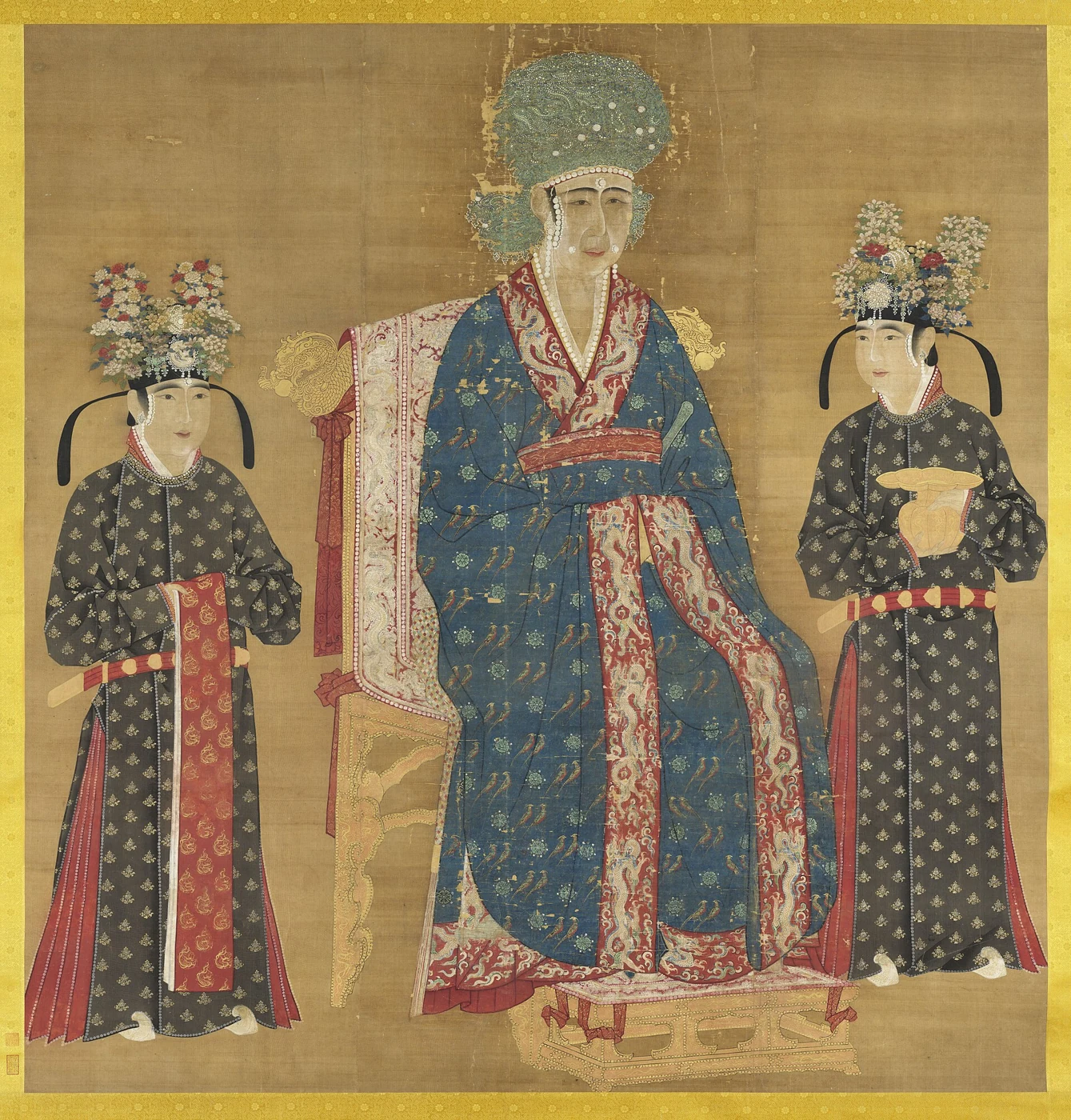
Seated portrait of the empress of Song Renzong; the National Palace Museum identifies the central figure as probably Empress Cao.

1016 CE–1079 CE

Empressempress dowagergrand empress dowager and regent behind the curtainHan

Empress Cao (Consort of Emperor Renzong)

曹氏(宋仁宗皇后)

Empress Cao (1016–1079), native of Lingshou, Zhending (modern Hebei), was the second empress consort of Emperor Renzong of Song, the adoptive mother of Emperor Yingzong, and Grand Empress Dowager during the reign of Emperor Shenzong, posthumously honored as Empress Cisheng Guangxian. Descending from one of the most prominent military-aristocratic lineages of the early Northern Song, she was the granddaughter of founding…

1016 CE–1079 CENorthern Song

PROFILE

Empress Cao (1016–1079), native of Lingshou, Zhending (modern Hebei), was the second empress consort of Emperor Renzong of Song, the adoptive mother of Emperor Yingzong, and Grand Empress Dowager during the reign of Emperor Shenzong, posthumously honored as Empress Cisheng Guangxian. Descending from one of the most prominent military-aristocratic lineages of the early Northern Song, she was the granddaughter of founding chancellor and supreme general Cao Bin. Formally invested as empress in 1034 (Jingyou 1), she was renowned for benevolent frugality, scholarly elegance, agrarian industry, and mastery of the rare "flying-white" (*feibai*) calligraphy. During the dangerous palace mutiny of 1048, she demonstrated heroic composure, barring the chambers, deploying water brigades to extinguish fires, and clipping the hair of couriers to guarantee fair rewards, swiftly extinguishing the insurrection. Following Emperor Renzong's sudden death in 1063, she sealed the imperial citadels, impounded the palace keys, and summoned grand councilors to peacefully enthrone Emperor Yingzong. When Yingzong fell incapacitated by mental illness, she presided over state affairs from behind the lowered screen, relinquishing power immediately upon his recovery. In her twilight years as Grand Empress Dowager, she restrained the harsh excesses of Wang Anshi's New Policies and famously intervened on her deathbed to rescue literary titan Su Shi from execution during the "Crow Terrace Poetry Trial." Spanning three pivotal imperial reigns with untarnished maternal grace and statesmanship, she passed away at age sixty-four, celebrated throughout Chinese history as an immortal model of sovereign virtue.

Era
Ancient times;Ancient times
Identity
Empress, empress dowager, grand empress dowager and regent behind the curtain; Han
Ancestral Home
Lingshou, Zhending (present-day Lingshou County, Shijiazhuang, Hebei);Unknown
Place of Birth
Lingshou, Zhending (present-day Lingshou County, Shijiazhuang, Hebei)
Place of Death
Unknown;64; a separate passage quoted from the History of Song in the source gives 62 (both accounts retained)
Highest Office
See the Biography section;See the Biography section
Peerage
Duke of Lu;Empress Cisheng Guangxian
Posthumous Honors
Prince of Wu

LIFE TIMELINE

Born into preeminent founding lineage | Born in Lingshou, Zhending; grOpen

Born into preeminent founding lineage | Born in Lingshou, Zhending; granddaughter of founding Grand Marshal Cao Bin and daughter of Cao Qi

Formally consecrated as Empress Consort | Promoted by Empress Dowager Open

Formally consecrated as Empress Consort | Promoted by Empress Dowager Yang following the deposition of Empress Guo; uncle Cao Cong arranged the wedding

Heroically suppresses nocturnal palace mutiny | Mutinous imperial guarOpen

Heroically suppresses nocturnal palace mutiny | Mutinous imperial guards raided the palace; Empress Cao barred the gates, quenched fire, and crushed the plot

Fosters imperial nephew Zhao Shu as crown prince | Personally nurturedOpen

Fosters imperial nephew Zhao Shu as crown prince | Personally nurtured Prince Zhao Shu (later Emperor Yingzong) in the inner court, urging Renzong to designate him heir

Locks palace gates to safely enthrone Yingzong | Renzong passed away sOpen

Locks palace gates to safely enthrone Yingzong | Renzong passed away suddenly; Empress Cao impounded palace keys and summoned Han Qi to ensure peaceful succession

Presides behind lowered screen during emperor's illness | Ruled as regOpen

Presides behind lowered screen during emperor's illness | Ruled as regent behind the screen due to Yingzong's severe mental affliction, foiling eunuch conspiracies

Resigns regency immediately upon Yingzong's recovery | Yielded imperiaOpen

Resigns regency immediately upon Yingzong's recovery | Yielded imperial seals and withdrew behind the screen as soon as Yingzong resumed audience, refusing power

Elevated to Grand Empress Dowager by Shenzong | Honored by her grandsoOpen

Elevated to Grand Empress Dowager by Shenzong | Honored by her grandson Emperor Shenzong in Qingshou Palace, receiving unprecedented filial reverence

Intervenes on deathbed to rescue Su Shi from execution | Invoked EmperOpen

Intervenes on deathbed to rescue Su Shi from execution | Invoked Emperor Renzong's past praise to convince Shenzong to spare Su Shi during the Crow Terrace Poetry Trial

Passes away peacefully and interred at Yongzhao | Passed away in winteOpen

Passes away peacefully and interred at Yongzhao | Passed away in winter 1079 at age sixty-four; posthumously titled Empress Cisheng Guangxian and buried at Yongzhao

She gently advised Shenzong: "The statutes of our imperial ancestors sOpen

She gently advised Shenzong: "The statutes of our imperial ancestors should not be overtur | She gently advised Shenzong: "The statutes of our imperial ancestors should not be overturned rashly; one must beware of alienating the hearts of the common folk." In the autumn of 1079 (Yuanfeng 2), the infamous "Crow Terrace Poetry Trial" (*Wutai Shian*) erupted.

Empress Cao (1016–1079) | Empress Cao (1016–1079), native of Lingshou,Open

Empress Cao (1016–1079) | Empress Cao (1016–1079), native of Lingshou, Zhending (modern Hebei), was the second empress consort of Emperor Renzong of Song, the adoptive mother of Emperor Yingzong, and Grand Empress Dowager during the reign of Emperor Shenzong, posthumously honored as Empress Cisheng Guangxian.

BIOGRAPHY

Biography

Illustrious Heritage and Elevation to the Throne Empress Cao originated from one of the most distinguished military-aristocratic clans of the Northern Song—the Zhending Cao clan. Tracing their lineage back to Cao Hong, Governor of Qinghe during the Jin Dynasty, the clan rose to prominence in the Five Dynasties and flourished into a supreme Northern Song aristocratic house, rivaling the Lyu clan of Donglai and the Han clan of Zhending. Her grandfather, Cao Bin (Prince of Wuhui), was the preeminent founding general of the Song empire, serving as Bureau of Military Affairs Commissioner and posthumously honored in the ancestral shrine of Emperor Taizu. Celebrated for subduing Later Shu, Southern Tang, and Northern Han without indiscriminate slaughter, Cao Bin established an enduring family tradition of chivalric restraint and humaneness. Renowned statesman Ouyang Xiu lauded his achievements as "peerless among founding heroes," while Emperor Zhenzong praised him as a rare titan whose moral fiber elevated his house across generations. Empress Cao's father, Cao Qi, was Cao Bin's fourth son, serving as Vice Director in the Ministry of Works before his premature death, posthumously created Prince of Wu. Reared within this rigorous tradition, Lady Cao was endowed with deep moral integrity, keen intelligence, and modesty. She was widely read in classical history and mastered the exquisite "flying-white" (*feibai*) calligraphic script. In 1033 (Mingdao 2), following the passing of Empress Dowager Liu, the newly emancipated Emperor Renzong deposed his first consort, Empress Guo. When rival concubines Consort Shang and Consort Yang brought disorder to the inner chambers, they were subsequently expelled. Seeking a noble and virtuous matron to anchor the court, Emperor Renzong's adoptive mother, Empress Dowager Yang (Zhanghui), strongly recommended Lady Cao. In September 1034 (Jingyou 1), Emperor Renzong formally issued an imperial edict consecrating Lady Cao as Empress Consort, extolling her illustrious descent, gentle virtue, and erudition. During the grand ceremony, her uncle, Palace Gate Commissioner Cao Cong, took charge of organizing her matrimonial dowry and ritual apparatus. Because imperial marriage protocols were lavish and the emperor granted no compensatory disbursements from the inner vaults, Cao Cong incurred immense private debts to fulfill dynastic dignity. This historical episode was recalled decades later in 1092 by Grand Empress Dowager Gao and Chancellor Lyu Dafang as a classic precedent illustrating the heavy financial burdens borne by imperial affines. ### Frugal Living and the Suppression of Nocturnal Mutiny Following her enthronement, Empress Cao steadfastly refused to indulge in palatial extravagance. Although Emperor Renzong was passionately enamored of the dazzling Consort Zhang (posthumously titled Empress Wencheng), Empress Cao treated her rival with graceful deference, showing neither jealousy nor resentment. Empress Cao harbored a natural reverence for agriculture and sericulture. Within the forbidden imperial enclosures, she personally cleared several plots of arable soil, planting wheat and millet alongside palace maidservants and diligently performing the classical rites of silkworm rearing. When autumn crops were harvested, she presented the grain to Emperor Renzong for imperial ancestral offerings, subtly reminding the court of the hardships endured by common peasants. In the intercalary first month of 1048 (Qingli 8), the palace was convulsed by a perilous insurrection. Emperor Renzong had intended to re-stage the extravagant Lantern Festival on the fifteenth night, but Empress Cao successfully dissuaded him out of consideration for fiscal restraint. Three nights later, on the eighteenth, four imperial guards from the Chongzheng Palace—Yan Xiu, Guo Kui, Wang Sheng, and Sun Lu—conspired with inner accomplices to stage an armed insurrection. Scaling the ramparts with drawn sabers, the assassins surged directly toward Emperor Renzong's sleeping chambers at the Yanhe Palace. Screams and the clashing of steel echoed through the midnight dark. Terrified and bewildered, Emperor Renzong leaped from his couch and attempted to flee into the open courtyards. Displaying the heroic courage of her martial lineage, Empress Cao grabbed the emperor's robes and bolted the massive doors from within, shouting: "The situation outside is unknown, and rebels are at hand; the Son of Heaven must never expose himself to blades!" She immediately dispatched a trusted eunuch through a concealed passage to summon Palace Commissioner Wang Shouzhong to bring armored shock troops into the palace. As the mutineers butchered palace attendants outside the doors, panic-stricken eunuchs falsely reported that wet nurses were merely chastising younger maidservants. Empress Cao rebuked them fiercely: "Rebels are butchering men at our doorstep; how dare you speak falsehoods!" Anticipating that the assassins would set fire to the halls to flush out the sovereign, she calmly ordered palace maids to carry leather water bags and bronze basins filled with well water to conceal themselves in shadowed corridors. Moments later, the rebels cast torches onto the palace hangings. Fanned by night winds, flames leapt toward the eaves. The maids immediately doused the blazes with water, preventing the fire from spreading. Throughout the life-and-death ordeal, whenever Empress Cao dispatched a courier or guard on a dangerous errand, she personally sheared a lock of hair from their crown with silver scissors, declaring: "Tonight all is darkness and blood; tomorrow at dawn, rewards for valor shall be reckoned solely by these severed locks!" Galvanized by her majestic composure, every palace defender fought with unyielding ferocity until Wang Shouzhong's armored legion arrived, systematically wiping out the conspirators. Following the suppression, investigators discovered that a palace maidservant in Empress Cao's own chambers had secretly aided the assassins. By dynastic law, high treason demanded immediate beheading. The maidservant pleaded desperately with Emperor Renzong's favorite concubine, who successfully extracted an imperial promise of pardon from the emperor. Hearing this, Empress Cao donned her ceremonial robes, presented herself before Renzong, and sternly petitioned: "Treason strikes at the heart of the state. If a maidservant who abetted murderous rebels is spared, how shall the sovereign govern the army or maintain discipline within the court!" When Renzong offered excuses and invited her to sit, Empress Cao stood resolute before the dais, refusing to yield. Awed by her moral rectitude, Renzong rescinded his pardon and ordered the traitor executed, establishing immaculate order throughout the palace. ### Securing Succession and Enacting the Dynastic Transition Although Renzong fathered numerous daughters, his three biological sons died in infancy, leaving the throne without a designated successor for decades. Early in the Baoyuan era, Empress Cao and Emperor Renzong welcomed Prince Zhao Zongshi (later Emperor Yingzong), the thirteenth son of Prince Pu Zhao Yunrang, to be reared within the palace. Empress Cao loved the boy as her own son. Concurrently, she fostered her niece, Lady Gao (later Empress Xuanren), within the palace, subsequently arranging their marriage to forge an auspicious imperial match. In August 1062 (Jiayou 7), guided by the impassioned memorials of loyal ministers Han Qi, Ouyang Xiu, and Sima Guang, and backed wholeheartedly by Empress Cao, Emperor Renzong formally decreed the thirty-one-year-old Zhao Zongshi as Crown Prince, renaming him Zhao Shu. On the night of April 30, 1063 (Jiayou 8), Emperor Renzong was stricken by sudden heart failure in the Funing Palace and expired without speaking a word. In the ensuing pandemonium, inner eunuchs clamored to throw open the palace gates and summon officials. Recognizing that midnight confusion had historically spawned bloody usurpations, Empress Cao acted with decisive firmness: "In midnight mourning, palace gates must remain sealed!" She impounded all bronze keys, tally tokens, and imperial seals, forbidding any exit, and secretly dispatched couriers to the grand councilors to instruct them to enter the palace at dawn. At daybreak, Chancellor Han Qi and his colleagues entered the inner court. Empress Cao lowered the curtain and announced Renzong's passing, issuing an imperial decree commanding Crown Prince Zhao Shu to assume the throne. Stunned by the awesome burden, Yingzong initially hesitated, but Han Qi draped the dragon robes over him. With the transition seamlessly executed, Yingzong ascended the throne and invested Empress Cao as Empress Dowager. ### Regency Behind the Screen and Prudent Abdication Within ten days of his accession, Emperor Yingzong was overwhelmed by grief and fell critically ill with mental delirium, shouting erratically during funeral rituals. As border crises flared and the central bureaucracy stalled, Han Qi and Ouyang Xiu repeatedly implored Empress Dowager Cao to preside over the government from behind the lowered screen. In May 1064 (Zhiping 1), Empress Dowager Cao complied, conducting audiences behind the screen in the side hall. Her decisions were celebrated for piercing clarity and fairness. When powerful eunuch Ren Shouzhong attempted to exploit Yingzong's delirium by slandering the emperor and sowing discord between mother and son, Empress Dowager Cao demonstrated extraordinary magnanimity. When she showed Han Qi erratic verses penned by Yingzong during his madness, Han Qi burned them before the messenger, reminding her that maternal tolerance must prevail over illness. Embracing Han's counsel, Empress Dowager Cao banished the treacherous Ren Shouzhong to Lingnan, unifying the court. In 1065 (Zhiping 2), upon Emperor Yingzong's complete recovery, Empress Dowager Cao voluntarily relinquished her regency. She surrendered all state seals and retired entirely to her private apartments, never interfering in external politics. Her selfless devotion won the boundless admiration of the realm. ### Grand Empress Dowager and the Salvation of Su Shi In 1067 (Zhiping 4), Emperor Yingzong passed away, and his eldest son Emperor Shenzong mounted the throne, elevating Empress Dowager Cao to Grand Empress Dowager residing in the Qingshou Palace. Emperor Shenzong venerated her with immense filial devotion, granting her household unlimited disbursements and breaking ancient taboos to allow her brother Cao Yi to visit her inner apartments for intimate family gatherings. When Emperor Shenzong enacted Wang Anshi's sweeping New Policies, Grand Empress Dowager Cao observed the severe hardships inflicted upon rural peasants by the Green Sprouts and labor service levies. She gently advised Shenzong: "The statutes of our imperial ancestors should not be overturned rashly; one must beware of alienating the hearts of the common folk." In the autumn of 1079 (Yuanfeng 2), the infamous "Crow Terrace Poetry Trial" (*Wutai Shian*) erupted. Censors Li Ding and Shu Dan extracted satirical couplets from Su Shi's writings, accusing him of sedition and demanding his execution. Imprisoned in the Censorate dungeons, Su Shi faced imminent death, and no court minister dared speak in his defense. At that time, Grand Empress Dowager Cao lay gravely ill in her bedchambers. When Emperor Shenzong came to pay his respects, she noticed his troubled countenance and inquired about state affairs. When Shenzong confessed Su Shi's predicament, the dying empress rallied her failing strength, declaring solemnly: "In former years, Emperor Renzong passed Su Shi and his brother Su Zhe in the imperial decree examinations, returning to the palace overjoyed to tell me: 'Today I have secured two grand chancellors for my descendants!' Now Su Shi is jailed for writing poetry; this can only be the work of jealous enemies concocting slander to murder a loyal subject! Poets throughout history have employed subtle irony to express grief; how could this warrant death? In my dying hour, we must not execute a preeminent scholar and disrupt the harmonious blessings bestowed by our ancestors!" Struck with awe and remorse by his grandmother's invoking of Emperor Renzong's sacred legacy, Emperor Shenzong wept and yielded. Within days, he commuted Su Shi's sentence, exiling him to Huangzhou. Su Shi was saved from the scaffold, and whenever he recalled the late empress's salvation, he wept tears of eternal gratitude. ### Passing and Immortal Renown On November 16, 1079 (Yuanfeng 2), Grand Empress Dowager Cao passed away peacefully in Qingshou Palace at the age of sixty-four. Emperor Shenzong was submerged in profound grief, canceling court audiences and leading the bureaucracy in mourning. In February 1080, the court conferred upon her the posthumous title Empress Cisheng Guangxian, interring her alongside Emperor Renzong at the Yongzhao Mausoleum. Eminent literary giants of the era—including Zeng Gong, Su Song, Wang Anshi, and Chen Xiang—composed poignant elegies honoring her life. Su Song celebrated her as an immortal paragon whose virtue matched the ancient sage-queens, while Wang Anshi lauded her agrarian maternal benevolence. the source’s main narrative gives an age at death of sixty-four, while another passage it quotes from the History of Song gives sixty-two. Both accounts are retained without calculating an age from the birth and death years.

Major Activities

Virtuous Governance of the Inner Court Maintained immaculate modesty and peace within the imperial harem from 1034 onward; practiced sericulture and cultivated cereals in the palace gardens to promote peasant thrift, practicing the rare "flying-white" calligraphy. ### Heroic Defense During the Nocturnal Mutiny Heroically protected Emperor Renzong during the 1048 palace guard mutiny; barred the palace gates, directed water squads to quench fire attacks, and sheared couriers' locks to ensure exact battlefield rewards. ### Impounding Palace Keys for Peaceful Succession Took swift control upon Emperor Renzong's sudden death in 1063, sealing the gates and impounding the tallies to orchestrate Emperor Yingzong's accession without bloodshed. ### Prudent Regency and Immediate Abdication Exercised supreme authority from behind the screen in 1064 during Yingzong's mental incapacitation, banishing treacherous eunuch Ren Shouzhong and abdicating the regency the very moment the sovereign recovered. ### Saving Literary Master Su Shi from the Scaffold Intervened from her deathbed in 1079 during the Crow Terrace Poetry Trial, invoking Emperor Renzong's memory to compel Emperor Shenzong to spare the life of cultural titan Su Shi.

Personal Relations

  • Father: Cao Qi, Vice Director in the Ministry of Works, posthumously created Prince of Wu.
  • Mother: Lady Feng, Duchess of Chu.
  • Uncle: Cao Cong, Palace Gate Commissioner and Prefect of Weizhou, who financed and directed her wedding rites.
  • Brothers: - Cao Chuan: Elder brother, died prematurely. - Cao Yi: Younger brother, Prince of Jiyang and Chief Chancellor, historical inspiration for the Daoist immortal Royal Uncle Cao. - Cao Yi: Younger brother, Palace Guard Commander.
  • Former Betrothed: Li Zhi, an ascetic who abandoned the wedding chamber to pursue Daoist immortality, leading to a peaceful divorce.
  • Husband: Emperor Renzong of Song (Zhao Zhen), fourth sovereign of the Northern Song.
  • Adoptive Son: Emperor Yingzong of Song (Zhao Shu), fostered by Empress Cao from childhood.
  • Niece and Daughter-in-law: Empress Xuanren Gaotao, raised alongside Zhao Shu and married to him under Empress Cao's auspices.
  • Adoptive Grandson: Emperor Shenzong of Song (Zhao Xu), sixth sovereign of the Northern Song. ### Grand Councilors and Statesmen - Han Qi: Duke of Wei and Chief Chancellor; core operational partner in designating the heir, securing Yingzong's accession, and managing the regency.
  • Ouyang Xiu: Associate Grand Councilor; staunch supporter during the regency crisis.
  • Lyu Dafang: Chancellor who frequently cited the exemplary fiscal sacrifices of Empress Cao's clan.
  • Su Shi: Celebrated literary master whose life she saved during the Crow Terrace Poetry Trial.

Historical Assessment

Classical Dynastic Historians - Emperor Renzong's Investiture Edict: "Granddaughter of the late Prince of Ji Cao Bin, born of noble blood and schooled in civic virtues. Gentle and humane, she reads history to illuminate her mind. Fit to anchor the central palace and inspire the realm."

  • **Toqto'a (*History of Song*)**: "Compassionate and frugal, she honored agriculture, cultivating grain and silkworms within the palace enclosures, gifted in flying-white calligraphy. When Yingzong fell ill, she handled state affairs behind the screen with immaculate order; the moment he recovered, she abdicated without the slightest cling to power. In Shenzong's reign, she preserved scholars from death. In maternal virtue, she was truly the Yao and Shun among women."
  • **Su Song (*Elegies for Empress Cisheng Guangxian*)**: "From Jingyou to Yuanfeng, she matched the sovereign altar for four decades. Aloft in deep silence, her monumental virtue knew no equal. Her deeds filled the mortal realm, an eternal consort matching Renzong's benevolence."
  • **Wang Anshi (*Elegies for Empress Cisheng Guangxian*)**: "The state relied upon her virtue like the ancient queens Jiang and Ren. Her maternal benevolence leaves an eternal blessing across ten thousand lands." ### Modern Historiographical Evaluation Empress Cao stands as one of the most capable and principled female rulers in Chinese imperial history. Combining the refinement of high aristocracy, the fearlessness of military heritage, and the sharp acumen of an experienced statesman, she repeatedly rescued the dynastic house from catastrophe. In suppressing the 1048 mutiny and securing the throne in 1063, she acted with unhesitating decisiveness; in assuming and relinquishing regency, she exhibited absolute respect for dynastic law; and in saving Su Shi, she displayed transcendent moral courage. Her legacy defines the Northern Song ideal of the virtuous empress who protects the state without subverting it.

LOCAL NETWORK

Cao Bin↗Linked from this entry

Original note (Chinese): 曹彬孙女,宋仁宗皇后,被誉“圣后”

Empress Gao↗Linked from this entry

Original note (Chinese): 宋仁宗曹皇后(慈圣光献皇后),高太后姨母兼婆婆。高氏幼年因曹皇后入宫,后与英宗成婚。

Cao Bin↗Related entry

Original note (Chinese): 曹皇后祖父,北宋开国名将,济阳郡王

Zhao Xu↗Related entry

Original note (Chinese): 宋神宗,曹后之孙辈,尊为太皇太后

Han Qi↗Related entry

Original note (Chinese): 北宋宰相,与曹后共同定策立英宗

Wang Anshi↗Related entry

Original note (Chinese): 变法派,曹后反对其新政

Su Shi↗Related entry

Original note (Chinese): 曹后病中进言救苏轼(有争议)

Northern Song↗Era association

Original note (Chinese): 宋·北宋;宋·北宋

曹玘 · No matching entry available

曹皇后之父,尚书虞部员外郎

赵祯 · No matching entry available

宋仁宗,曹皇后之夫

赵曙 · No matching entry available

宋英宗,曹后定策所立,视如己出

曹佾 · No matching entry available

曹皇后从弟(族弟),官至同中书门下平章事

张贵妃 · No matching entry available

仁宗宠妃,与曹后有争宠关系

文彦博 · No matching entry available

北宋宰相,庆历宫变后劝仁宗赏罚公允

CONTEMPORARIES

Bibliography

  • History of Song*, Volume 242: Biographies 1: Empresses and Consorts I: Biography of Empress Cisheng Guangxian Cao
  • Dongdu Shilüe*, Volume 13: Biographies of Empresses and Consorts