Birth in Guangshan
Born on the 18th day of the 10th lunar month at the official residence of Guangshan County, named Guang after the prefecture.
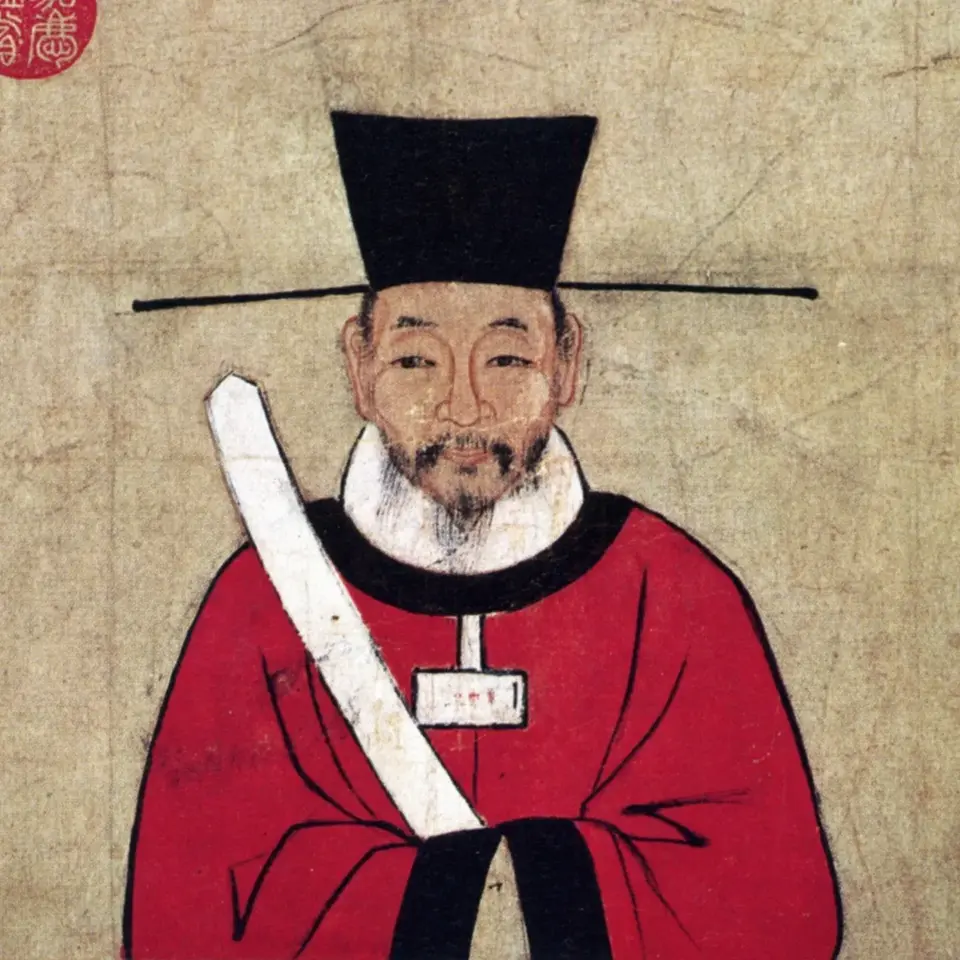
1019 CE–1086 CE
司马光
Sima Guang (司马光, November 17, 1019 – October 11, 1086), styled Junshi and known by his literary sobriquet Yusou and scholarly name Master Shushui, was a native of Xia County in modern Shanxi Province. He was one of the most prominent historiographers, conservative statesmen, and classical scholars of the Northern Song Dynasty. Serving across four imperial reigns—Renzong, Yingzong, Shenzong, and Zhezong—he rose to become Left…
Sima Guang (司马光, November 17, 1019 – October 11, 1086), styled Junshi and known by his literary sobriquet Yusou and scholarly name Master Shushui, was a native of Xia County in modern Shanxi Province. He was one of the most prominent historiographers, conservative statesmen, and classical scholars of the Northern Song Dynasty. Serving across four imperial reigns—Renzong, Yingzong, Shenzong, and Zhezong—he rose to become Left Grand Councilor and Vice Director of the Chancellery, holding the highest ministerial authority in the imperial government. Upon his death, he was posthumously honored with the exalted title Grand Preceptor, created Duke of Wen, and conferred the preeminent civil posthumous title Wenzheng. Endowed with exceptional intellect from childhood, Sima Guang attained widespread renown throughout the capital region for the celebrated episode of breaking a water vat with a stone to rescue a drowning child. He passed the highest imperial examinations in 1038, securing the prestigious jinshi degree at the age of twenty. Entering civil service, he held various local administrative posts and pivotal metropolitan remonstrance assignments, distinguishing himself through fearless remonstrance, firm defense of Confucian ritual order, and vocal leadership during the controversial Pu Ritual Debates. During the reign of Emperor Shenzong, Sima Guang emerged as the foremost conservative opponent of Wang Anshi's radical Xining Reforms. Unwilling to compromise his administrative principles, he withdrew to Luoyang for fifteen years, completely abstaining from everyday political controversies to dedicate his entire energy to compiling the monumental chronological universal history Zizhi Tongjian. Following Shenzong's death, Empress Dowager Gao assumed the regency and summoned Sima Guang back to lead the imperial administration, inaugurating the Yuanyou Era Restoration during which all reform legislation was repealed. Sima Guang's crowning scholarly legacy is the two-hundred-and-ninety-four-volume Zizhi Tongjian, covering a sweeping timeline of 1,362 years from 403 BCE to 959 CE. Compiled over nineteen rigorous years through an innovative three-stage workflow and accompanied by a groundbreaking critical commentary volume, the masterpiece established an enduring standard for chronological historiography in East Asia, exercising an immense influence on Chinese political thought and historical methodology.
Born on the 18th day of the 10th lunar month at the official residence of Guangshan County, named Guang after the prefecture.
Passed the metropolitan examination with the highest honors, appointed Prefectural Judge of Hua Prefecture, married Lady Zhang.
Lost both parents in succession, retreated to Xia County for three years of strict ritual mourning, composing foundational political treatises.
Entered the military secretariat of veteran minister Pang Ji in Yanzhou, appointed Staff Supervisor of the Wucheng Army.
Appointed Director of the Bureau of Remonstrance, submitted over one hundred and seventy memorials urging the formal appointment of an imperial heir.
Promoted to Academician of the Longtu Pavilion, steadfastly defended imperial lineage protocol by arguing the emperor's biological father be styled Imperial Uncle.
Presented the Tongzhi to Emperor Yingzong, who ordered the creation of a specialized editorial bureau at Chongwen Academy and authorized selected editorial assistants.
Emperor Shenzong bestowed the title Zizhi Tongjian with an imperial preface; Sima Guang became Censor-in-Chief and voiced early misgivings over aggressive fiscal restructuring.
Following principled resistance against the Green Sprouts Act and defending dismissed colleague Fan Zhen, took up a secondary sinecure in Luoyang to compile the chronicle.
Submitted the completed 294 volumes of the Zizhi Tongjian alongside its critical apparatus and table of contents, receiving high imperial commendation.
Upon Shenzong's death, Empress Dowager Gao recalled Sima Guang to head the ministry, spearheading the comprehensive dismantling of the New Policies.
Elevated to Left Grand Councilor and Prime Minister, abolished service-exemption cash taxes, and passed away from physical exhaustion on the first day of the ninth month.
Sima Guang was born on November 17, 1019, in the official residence of Guangshan County, Guang Prefecture (in present-day Xinyang City, Henan Province). His father, Sima Chi, who was serving as county magistrate of Guangshan at the time, bestowed upon his newborn son the personal name Guang, commemorating his birthplace. The Sima family was an illustrious Northern lineage from Shushui Village in Xia County, Shan Prefecture, celebrated for its long-standing tradition of civil service, scholarly erudition, and moral discipline. From early childhood, Sima Guang exhibited extraordinary intellectual precocity and solemnity of temper. When he was six years old, his father began instructing him in foundational classical texts. By the age of seven, upon hearing lectures on the Zuozhuan, he comprehended its profound thematic architecture and retold its complex moral narratives to his family members with remarkable lucidity. He read with unflagging fervor, holding books constantly in his hands and becoming entirely oblivious to physical cold, heat, hunger, or thirst.
During his boyhood years, Sima Guang performed a celebrated act of bravery and presence of mind that reverberated throughout the twin capitals of Kaifeng and Luoyang. While a group of children was playing in a courtyard, one careless youngster clambered onto the rim of an immense ceramic water storage vat, slipped, and plunged into the deep water within, facing immediate drowning. The other children were paralyzed with panic and scattered in terror. Alone among his peers, Sima Guang retained absolute composure. Lifting a massive paving stone from the courtyard ground, he hurled it with all his strength against the base of the vat. The heavy ceramic shattered, and torrents of water rushed out, enabling the trapped child to survive unharmed. The episode quickly spread through popular legend, and artists across the capital region produced vivid illustrations depicting the scene. As his father held administrative appointments across Henan, Shaanxi, and Sichuan, he consistently brought Sima Guang along with him, allowing the boy to observe local customs, government affairs, and geographic landscapes, an exposure that endowed him with mature wisdom far beyond his years. His father carefully instilled in him the principles of classical history and personal honesty, warning him never to engage in deceptive ostentation.
In 1038, at the age of twenty, Sima Guang sat for the metropolitan examinations and successfully earned the prestigious jinshi degree with top honors. His initial official assignment was as Prefectural Judge of Hua Prefecture. Because his father was concurrently administering nearby Tong Prefecture, Sima Guang frequently traveled between the two districts to attend to his parents, forming a close intellectual friendship with fellow scholar Shi Changyan. In the same year, he married the daughter of Zhang Cun, a senior judicial official in the Court of Judicature. In 1040, desiring to remain near his aging father who had been transferred to Suzhou, Sima Guang secured an appointment as Staff Supervisor of Suzhou.
In 1041, the Tangut chieftain Yuanhao proclaimed himself emperor and founded the Western Xia state, triggering widespread warfare on the northwestern frontier. As imperial armies suffered repeated reverses, the court ordered local authorities in southeastern Liangzhe to conscript large numbers of peasant bowmen and commission military commanders. Observing the hardships of local households, Sima Chi and Sima Guang analyzed the strategic reality and determined that drafting untrained peasants would disrupt agrarian livelihoods without adding genuine combat power. Sima Guang drafted a formal memorial on his father's behalf, carefully enumerating the grave defects of the policy. In the same year, Sima Guang resigned his office following the death of his mother, returning to Xia County to observe ritual mourning. In December, his father Sima Chi passed away in his official residence at Jin Prefecture. Having lost both parents within a single year, Sima Guang was plunged into profound grief. However, he channeled his sorrow into disciplined scholarship, spending the three-year mourning period in seclusion, perusing classical histories and reflecting deeply on statecraft. During this seclusion, he penned numerous foundational essays, including On the Ten Philosophers, On the Four Heroes, and Eighteen Historical Critiques, In these mourning essays, Sima Guang systematically compared the governing successes and failures of ancient thinkers and dynasties. In On Ability and Virtue, he articulated his famous doctrine that talent is the resource of virtue, while virtue is the commander of talent, insisting that administrative recruitment must prioritize moral integrity over mere technical skill. In his historical evaluations, he analyzed the harsh legalism of Shang Yang, warning that utilitarian expediency must never supplant benevolence and ritual order, laying the foundational philosophical tenets that would animate his historical appraisals in the Zizhi Tongjian.
Upon completing his mourning obligations in 1044, Sima Guang gained the high patronage of veteran statesman Pang Ji, an intimate colleague of his late father who was then serving as governor of Yanzhou on the frontier. Pang Ji invited Sima Guang to join his regional headquarters, recommending him for appointment as Staff Supervisor of the Wucheng Army. In the spring of 1045, catastrophic flooding along the Yellow River breached dikes and inundated the regional capital at Huazhou. Sima Guang personally supervised levee reconstruction and disaster relief operations along the riverfront, exhibiting remarkable administrative competence. By 1046, he was summoned to the capital to lecture on Confucian canons at the Directorate of Education. When the religious rebellion led by Wang Ze erupted in Beizhou in 1047, Sima Guang submitted a tactical proposal to Pang Ji, advocating a policy of political subversion and military isolation that pardoned coerced insurgents while focusing punishment solely on the ringleaders, a strategy that led to the swift collapse of the uprising. On Pang Ji's repeated recommendations, Sima Guang was elevated in 1048 to Collator in the Imperial Archives.
In 1051, Sima Guang was appointed Administrator of the Court of Imperial Sacrifices. In this capacity, he demonstrated steadfast adherence to ritual propriety, adamantly opposing the imperial court's decision to grant military procession honors to the deceased eunuch Mai Yunyan and vigorously challenging the granting of the supreme posthumous title Wenzheng to the opportunistic grandee Xia Song. In 1053, when Pang Ji was relieved of his ministerial rank and assigned to govern Yunzhou, Sima Guang answered his mentor's call to serve as his Assistant Prefect. Two years later, when Pang Ji was transferred to Bingzhou as Military Commissioner of Hedong, Sima Guang once again accompanied him as Assistant Prefect.
During their tenure along the frontier of Hedong, Sima Guang remained vigilant despite a lull in hostilities with the Western Xia state. He proposed establishing fortified defensive redoubts and curbing illicit border contraband to consolidate imperial authority. However, imperial commander Guo En conducted a reckless drunken sortie deep into Western Xia territory, suffering a disastrous defeat and committing suicide to escape punishment. When an imperial investigator arrived to ascertain culpability, Pang Ji took complete responsibility upon himself and was stripped of his military commission. Deeply distressed that his superior had suffered for implementing his strategic advice, Sima Guang submitted three urgent memorials confessing that the border policy originated entirely with him, pleading with the emperor to inflict punishment upon him alone. Pang Ji, upon learning of his protege's actions, stubbornly reaffirmed his sole accountability. The selfless fidelity demonstrated by both men became widely celebrated across the empire, and Sima Guang supported Pang Ji's family with filial devotion for the remainder of his life.
In 1058, Sima Guang returned to the imperial capital, holding posts as Judge of the Kaifeng Metropolitan Prefecture and Assistant Director in the Tax Transport Bureau. In 1061, Emperor Renzong appointed him Gentleman of the Interior and Administrator of the Bureau of Remonstrance. During his five-year tenure as chief remonstrator, Sima Guang presented more than one hundred and seventy formal memorials to Emperors Renzong and Yingzong, touching upon institutional protocol, fiscal prudence, military reorganization, and local administrative probity.
Because Emperor Renzong had reached advanced age without surviving male issue, the question of imperial succession had become the gravest threat to political stability, yet most high ministers shrank from broaching the sensitive topic. Defying court taboos, Sima Guang submitted three consecutive sealed memorials urging the throne to select an heir from among the descendants of the imperial house. Collaborating with his close friend Fan Zhen, who reinforced the appeal in imperial audience, Sima Guang relentlessly pressed the issue. Swayed by their principled persistence, Renzong formally designated Zhao Shu, the son of Prince Zhao Yunrang, as imperial heir.
Following Renzong's death in 1063, Zhao Shu ascended the throne as Emperor Yingzong. Remembering Sima Guang's instrumental role in the succession, the new monarch promoted him to Drafter in the Secretariat and Academician of the Tianzhang Pavilion, retaining him as head of the Remonstrance Bureau. Sima Guang continued to speak boldly, strongly criticizing an imperial decree that sought to conscript peasant labor in Shaanxi into military units, arguing passionately that security depended on capable generalship rather than coercing farmers into unready militias.
In 1065, the imperial court was convulsed by the Pu Ritual Debates. Desiring to honor his biological father, Emperor Yingzong sought to confer upon Prince Zhao Yunrang the exalted title Imperial Father, creating a major conflict over ritual legitimacy. Senior grand councilors Han Qi and Ouyang Xiu supported the imperial wish. When the court scholars assembled to deliberate the protocol, most ministers hesitated to speak out, but Sima Guang took up his brush and wrote unequivocally: When one is adopted as an heir, one is bound as that parent's son and cannot harbor private kinship attachments. Sima Guang argued that the prince should be styled Imperial Uncle, adhering strictly to established precedent for collaterals. When six imperial censors were dismissed from court for opposing the emperor, Sima Guang submitted memorials requesting that he be banished alongside them. Although Yingzong declined to punish him, Sima Guang felt that his admonitions were no longer effective and voluntarily resigned from his remonstrance duties to become Academician of the Longtu Pavilion.
Alongside his contentious political engagements, Sima Guang poured his greatest intellectual devotion into the study of history. In 1066, he presented to Emperor Yingzong his Chronological Chart in five volumes and his Chronicle in eight volumes, which chronicled the period from the tripartite division of Jin in 403 BCE to the fall of the Qin Dynasty in 207 BCE. Deeply impressed by the utility of this work as a mirror for imperial statecraft, Yingzong decreed the establishment of a dedicated editorial bureau at the Chongwen Academy. Sima Guang was commissioned to compile a comprehensive chronological history of the empire, and he was granted full autonomy to select his editorial colleagues. He chose scholars Liu Ban, renowned for his command of Han Dynasty sources, and Liu Shu, an authority on the historical records of the Three Kingdoms, Jin, and Southern and Northern Dynasties.
In early 1067, Emperor Yingzong passed away and was succeeded by Emperor Shenzong. Recognizing Sima Guang's moral gravity and erudition, Shenzong appointed him Censor-in-Chief and Hanlin Academician. In October of that year, Sima Guang presented the completed early sections of the chronicle, prompting Shenzong to bestow upon the work the illustrious title Zizhi Tongjian, composing an imperial preface and gifting over two thousand volumes of rare books from his personal residence. However, Shenzong was an energetic and ambitious young ruler determined to restore northern territories and enrich the state treasury. He embraced the radical socioeconomic proposals of Wang Anshi, appointing him Vice Grand Councilor in 1069 to inaugurate the Xining Reforms.
In political philosophy and fiscal methodology, Wang Anshi and Sima Guang occupied irreconcilable positions. Wang Anshi contended that the state could generate unprecedented revenue through bureaucratic intervention in commerce and agricultural credit without increasing direct taxes on the populace. Sima Guang vehemently counterargued that the wealth of Heaven and Earth exists in a fixed quantity: what is appropriated by the state treasury is inexorably extracted from the ordinary people. He maintained that governmental lending under the Green Sprouts Act amounted to usurious state exploitation that corrupted magistrate morals and impoverished peasants. In formal imperial audiences, the two former friends clashed repeatedly over the direction of the empire. Sima Guang emphasized that sound fiscal management resided in curbing extravagance and fostering private prosperity rather than extracting revenues through state monopolistic mechanisms.
In 1070, Emperor Shenzong sought to bridge the bureaucratic rift by appointing Sima Guang Vice Commissioner of Military Affairs. Sima Guang adamantly refused the high office, submitting five memorials stating that his political convictions were incompatible with current governance, and requested permission to depart the capital. In 1071, when his friend Fan Zhen was dismissed from office for denouncing the reforms, Sima Guang submitted a fierce protest on his behalf and petitioned to be assigned to the Western Capital at Luoyang. For the next fifteen years, Sima Guang lived in self-imposed political retirement in Luoyang. Abstaining entirely from daily administrative disputes, he turned his modest home, the Garden of Solitary Joy, into a bustling scholarly workshop. Accompanied by Liu Ban, Liu Shu, Fan Zuyu, and his son Sima Kang, he devoted himself completely to the arduous compilation of the Zizhi Tongjian. During his stay in Luoyang, he joined retired grandees Fu Bi and Wen Yanbo in the Luoyang Elders Society, observing strict personal decorum and abstaining from partisan intrigue.
In the winter of 1084, after nineteen continuous years of exhaustive archival research and redaction, the monumental 294-volume Zizhi Tongjian, accompanied by thirty volumes of critical apparatus and thirty volumes of detailed indexes, was finally brought to completion. Sima Guang formally submitted the manuscript to the imperial court. Emperor Shenzong was immensely delighted, affixing the imperial seal of the Ruisis Hall to each volume, praising Sima Guang for creating an enduring masterwork for the ages, and promoting him to Academician of the Zizheng Hall.
In March 1085, Emperor Shenzong died, and the ten-year-old Emperor Zhezong mounted the throne, with Empress Dowager Gao assuming the regency. Having long opposed the disruptions caused by the Xining and Yuanfeng initiatives, the Empress Dowager immediately sent couriers to solicit Sima Guang's guidance. Sima Guang submitted memorials calling for the restoration of open remonstrance and the complete repeal of harmful New Policies, arguing that statecraft must return to the Confucian ideal of benevolence toward the agrarian base.
In May 1085, Empress Dowager Gao appointed Sima Guang Vice Director of the Chancellery. When he arrived in Kaifeng, thousands of citizens thronged the streets, bowing and cheering his return as the savior of the people. In April 1086, Sima Guang was elevated to Left Grand Councilor and Prime Minister. Assuming supreme leadership over the imperial bureaucracy, he oversaw the comprehensive dismantling of the New Policies, terminating the Green Sprouts Act, the Service Exemption Tax, the State Trade System, and the Baojia collective militia system. He recalled prominent conservative luminaries, including Fan Chunren, Su Shi, Su Zhe, and Huang Tingjian, to high office, inaugurating the political epoch known as the Yuanyou Era Restoration. He also compiled the concise chronicle Jigu Lu, offering a panoramic retrospective on imperial statecraft.
By this time, however, Sima Guang was nearly seventy years old, suffering from severe pulmonary illness and physical exhaustion. Fully aware of his imminent demise, he continued to work tirelessly at his desk, utilizing a round wooden block as a wakeful headrest to prevent himself from slipping into idle slumber. On October 11, 1086, Sima Guang passed away in his official residence in Kaifeng at the age of sixty-eight.
Upon news of his death, the markets of Kaifeng closed in mourning, and ordinary citizens wept openly in the streets, selling their clothes to buy incense and sacrificial offerings for his funeral. Emperor Zhezong and the Empress Dowager visited his bier in person, suspending court audiences for three days. Sima Guang was posthumously elevated to Grand Preceptor and created Duke of Wen, granted the supreme posthumous title Wenzheng, and commemorated with an imperial tomb inscription reading Loyal, Pure, and Unblemished Virtue. When his cortege was conveyed to Xia County for burial, commoners along the entire route lined the roads in veneration, hanging portraits of him in their households.
In subsequent political swings, Sima Guang's reputation suffered severe reversals: during the Shaosheng era under Emperor Zhezong's personal rule, prime minister Zhang Dun restored the reforms and revoked Sima Guang's posthumous honors, destroying his imperial stele; under Emperor Huizong, Cai Jing erected the Stele of Yuanyou Partisans, listing Sima Guang as the foremost political traitor. However, in 1126, Emperor Qinzong fully exonerated the Yuanyou scholars, reinstating Sima Guang's honors. In the Southern Song, he was enshrined in the imperial ancestral temple of Emperor Zhezong, commemorated among the twenty-four supreme statesmen in the Zhaoxun Pavilion, and granted sacrifice in the temple of Confucius, cementing his status as an immortal sage-minister of Chinese civilization.
Sima Guang's most enduring monument is the compilation of the Zizhi Tongjian, which revolutionized Chinese historiography. Before its publication, Chinese historical literature was dominated by the biographical annalistic format established by the Shiji and Hanshu. While the biographical structure was effective for detailing individual genealogies, it fragmented chronological continuity, making it exceedingly difficult for rulers and administrators to grasp the long-term patterns of institutional evolution, administrative failure, and political rise and fall. Sima Guang resolved to forge a comprehensive chronological narrative that combined rigorous factual accuracy with unbroken temporal progression.
Beginning with the official establishment of the editorial bureau in 1066 and concluding in 1084, Sima Guang directed the nineteen-year enterprise with unwavering precision. Spanning 1,362 years from 403 BCE to 959 CE, the completed work comprised 294 fascicles containing over three million Chinese characters. Sima Guang recruited a team of premier scholars: Liu Ban oversaw the Han Dynasty materials; Liu Shu gathered records from the Three Kingdoms through the Southern and Northern Dynasties; Fan Zuyu redacted the vast documentation of the Sui, Tang, and Five Dynasties; and Sima Guang's son Sima Kang supervised textual verification and clerical collation.
Sima Guang established an innovative, three-stage editorial methodology that redefined historical compilation: The first stage was the Collection of Draft Items. The compilers extracted chronological notices from two hundred and twenty-two historical sources—including dynastic histories, private chronicles, local gazetteers, epitaphs, and literary anthologies—arranging every related fact in strict temporal order. The second stage was the Assembly of the Long Compilation. Discrepancies and contradictory records were gathered into an expansive intermediate draft under the explicit operating rule: Prefer excessive inclusion over omission. The third stage was the Final Redaction. Sima Guang reserved this responsibility entirely to himself. Working through the mountainous drafts, he pruned extraneous details, resolved textual contradictions, refined prose style, and harmonized the historical narrative into a unified, elegant whole. Through this relentless synthesis, the Zizhi Tongjian emerged as a peerless masterpiece of world historiography.
Concurrently with his editorial labors, Sima Guang pioneered the discipline of historical source criticism in East Asia by compiling the thirty-volume Tongjian Kaoyi. The Kaoyi represents the earliest systematic monograph of textual collation and source validation ever paired with a universal chronicle in Chinese historiographical tradition.
When confronted with conflicting dates, differing accounts of battlefield casualties, or contradictory biographical details across centuries of scribal transmission, Sima Guang refused to select a preferred version arbitrarily. Instead, he formulated a transparent methodology: wherever sources disagreed, he appended a critical note documenting the divergent readings, tracing their bibliographic origins, and demonstrating why a particular text was judged authentic while another was rejected. He prioritized accounts written contemporaneously by eyewitnesses over romanticized later lore, checked official decrees and administrative records against personal memoirs, and systematically excised supernatural omens, ghosts, and improbable miracles in accordance with the rationalist Confucian tenet of not discussing unnatural spirits.
This critical apparatus not only secured the factual integrity of the Zizhi Tongjian, but also established a methodological foundation for the evidential scholarship of later centuries. Qing dynasty scholars such as Qian Daxin and Wang Mingsheng celebrated Sima Guang's collation methods as the pinnacle of historical objectivity. In addition to the Kaoyi, Sima Guang authored the Jigu Lu in twenty volumes, summarizing political lessons from ancient emperors to Emperor Yingzong, and the Sushui Jiwen, which provided detailed firsthand documentation of early Song court debates, institutional reforms, and northwestern military defenses. In adjudicating the chaotic records of the late Tang and Five Dynasties periods, where official court chronicles were fragmented and private narratives proliferated, Sima Guang collated the Old and New Histories of the Five Dynasties against dozens of private memoirs, rectifying conflicting chronological cycles and establishing an objective standard of empirical verification for later generations of historians.
Sima Guang was not merely a premier historian, but also the principal intellectual architect of conservative political theory during the mid-Northern Song Dynasty. In contrast to Wang Anshi's activist program of state-driven economic restructuring and fiscal expansion, Sima Guang's philosophy was anchored in classical Confucian humanism, the preservation of ancestral statutes, and the economic principle of keeping wealth distributed among the people.
Sima Guang posited that the governance of an empire rested upon three foundational virtues: benevolence to succor the people, discernment to recognize moral character, and firmness to uphold just laws. In economic matters, he adhered to a strict doctrine of fiscal restraint. In his famous debate with Wang Anshi before the imperial throne, he declared: The wealth and goods produced by Heaven and Earth exist in a finite quantity; what does not remain with the common people is merely concentrated in the hands of the state. He warned that governmental lending institutions, such as the Green Sprouts system, were usurious operations in disguise, functioning to enrich venal clerks while dispossessing smallholders. He argued that true state wealth could only be preserved by curbing imperial extravagance, abolishing redundant offices, and leaving resources within the private agrarian economy. On the relationship between Heaven and humankind, Sima Guang formulated a profound doctrine of mutual assistance between nature and humanity, observing: What celestial power cannot achieve is accomplished by humans, hence there is plowing, weeding, and harvesting; what human labor cannot control belongs to Heaven, hence there are floods, droughts, and locust plagues. Sowing and reaping depend on human effort, while bounty and scarcity depend on Heaven. He maintained that dynastic order depended upon conscientious human administration that respected agrarian cycles, cautioning that rulers must never deplete popular resources through oppressive bureaucratic exactions.
At the institutional level, Sima Guang revered the ancestral statutes established by the early Song emperors, which favored administrative stability, checks and balances through the censorial organs, and cooperative governance with the scholar-official elite. He believed that sudden, sweeping legal experiments invariably fostered opportunism and factional strife. Although his total dismantling of the New Policies during the Yuanyou era was criticized by later observers for lacking nuance, his motives were grounded in an unshakeable moral conviction to alleviate agrarian suffering.
In his later years, Sima Guang achieved significant breakthroughs in cosmological theory and classical philosophy. He disdained superficial literary ornamentation, insisting that classical learning must illuminate practical morality and institutional statecraft. His major philosophical treatise, Qian Xu, modeled upon Yang Xiong's Taixuan, represented a major effort to construct an integrated cosmological framework.
Sima Guang posited the Void as the ultimate, unconditioned origin of the cosmos. From the invisible Void emerged generative Qi, which solidified into material Form, from which evolved the specific natures, designations, and destinies of all living beings. Addressing the relationship between abstract principle and worldly phenomena, he formulated the objective proposition: Where there is an actual event, there is an inherent principle; without an inherent principle, no event can come into being.
In ethical cultivation, Sima Guang interpreted the Great Learning's doctrine of investigating things as the capacity to resist and ward off external desires. He taught that human nature is fundamentally decent, but vulnerable to corruption by worldly temptation; only through sincere introspection and unyielding vigilance can one master moral rectitude. His personal life was marked by absolute sincerity, unpretentious frugality, and deep reverence. His insistence on inner rectitude and ethical sincerity exerted a profound formative influence on the Cheng brothers and the subsequent synthesis of Neo-Confucianism under Zhu Xi.
In personal morality and administrative incorruptibility, Sima Guang stood as an exemplar for the scholar-official class throughout imperial Chinese history. Despite holding the highest offices in the realm and receiving lavish imperial remunerations, he lived in ascetic simplicity, dressing in coarse fabrics, taking simple meals, and residing in dwellings that barely shielded him from wind and rain. His modest home in Luoyang, the Garden of Solitary Joy, featured a tiny study equipped with only a wooden desk, a simple sleeping cot, and bookshelves, earning widespread acclaim as the dwelling of a true sage who embraced honorable poverty.
Sima Guang treated material wealth with complete detachment. When his wife Lady Zhang passed away, his household was so devoid of spare funds that he lacked the means to purchase a proper coffin for her burial. He was compelled to pawn three mou of his land in Luoyang to finance a modest and ritually appropriate funeral. Because Lady Zhang had borne no male heir, his elder brother Sima Dan once secretly purchased a concubine for him to continue the family line; Sima Guang immediately declined the arrangement, maintaining absolute marital fidelity and refusing to keep secondary wives or concubines throughout his life. To instruct his adopted heir Sima Kang, he composed the renowned treatise Family Precepts on Frugality, cautioning future generations that shifting from thrift to extravagance is easy, but returning from extravagance to frugality is exceedingly arduous. Sima Kang strictly observed his father's admonitions, becoming equally famous for his moral discipline and integrity. Sima Guang's unwavering consistency between word and deed established him as a timeless model of Confucian virtue.
| Relationship Type | Name | Historical Facts and Nature of Interaction |
|---|---|---|
| Elder Brother | Sima Dan | Earned his jinshi degree earlier; maintained lifelong fraternal affection and collaborated with Sima Guang in familial memorial rites. |
| Patron and Mentor | Pang Ji | Grand Councilor and close friend of Sima Chi; patronized Sima Guang's early career, taking sole blame during the Yanzhou military setback. |
| Political Opponent and Friend | Wang Anshi | Intimate intellectual friend who held polar-opposite governing philosophies; clashed fiercely over state reforms while retaining mutual moral respect. |
| Historiographical Colleague | Liu Ban | Erudite scholar possessing encyclopedic mastery of Han dynasty sources; compiled the foundational drafts for the Han sections of the Zizhi Tongjian. |
| Historiographical Colleague | Liu Shu | Expert on the fragmented records of the Three Kingdoms, Jin, and Northern and Southern Dynasties; contributed crucial chronological drafts. |
| Historiographical Colleague | Fan Zuyu | Master of Tang institutions who compiled over six hundred fascicles of raw Tang history drafts for the chronicle; authored the Tangjian. |
| Close Colleague | Fan Zhen | Hanlin Academician and lifelong ally; jointly petitioned for the imperial succession and was dismissed for opposing the New Policies. |
| Disciple and Admirer | Su Shi | Literary giant deeply revered by Sima Guang; favored a moderate path during the Yuanyou era and composed Sima Guang's official biographical account. |
FIGURES ASSOCIATED WITH THIS DYNASTY