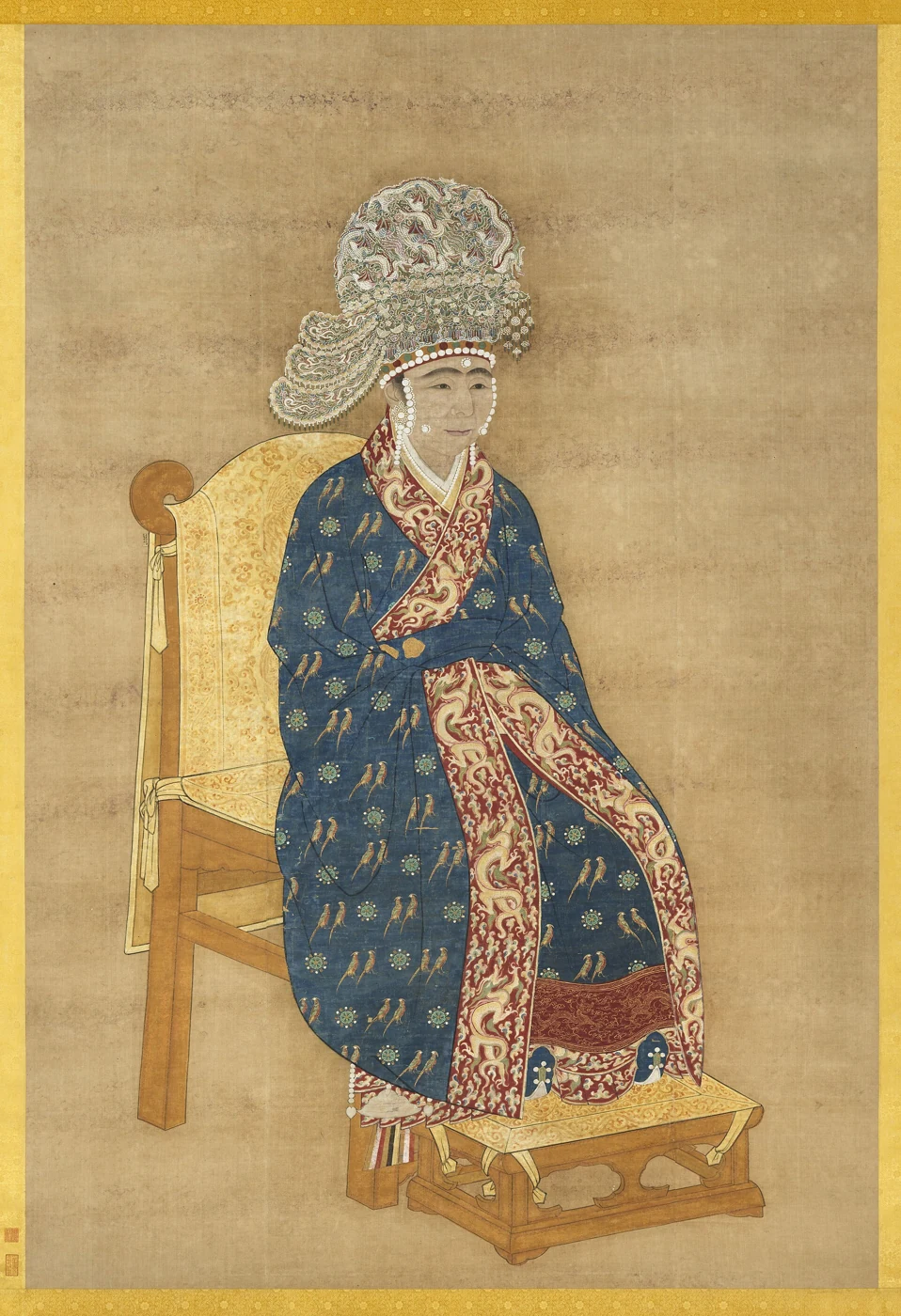
Biography
Family Background and Early Life Gao came from a prominent military family. Her great-grandfather Gao Qiong, courtesy name Baochen, served Emperors Taizong and Zhenzong and rose to Commander-in-Chief of the Palace Command and Military Commissioner of Zhongwu Army, making him an important general of Taizong's reign. Her grandfather Gao Jixun, courtesy name Shaoxian, became Military Commissioner of Jianxiong Army and was likewise known for military service. Her father Gao Zunfu rose to Deputy Commissioner of the Northern Workshops, while her mother Lady Cao was the elder sister of Empress Cao of Emperor Renzong. These close ties to the imperial house laid the foundation for Gao's upbringing in the palace and later marriage to Yingzong. As a child, Gao was brought into the palace and raised there because of her aunt Empress Cao. Zhao Zongshi, the future Emperor Yingzong, was also being raised in the palace because Renzong then had no surviving son and was the same age as Gao. The two grew up together. Renzong once told Empress Cao that they should eventually be married. In the third month of 1047, Gao married Zhao Zongshi and was titled Lady of Jingzhao Commandery. Although Renzong had by then fathered a son and Zhao had moved out of the palace, Renzong and Empress Cao still arranged the marriage. Contemporaries described it as “the emperor taking a daughter-in-law and the empress marrying off a daughter,” and it became a celebrated event. ### From Princely Household to Empress After marriage, Gao and Zhao Zongshi were close. In 1048 she gave birth to their eldest son Zhao Xu, later Emperor Shenzong. She subsequently bore three more sons and four daughters; all four sons and four daughters of Emperor Yingzong were Gao's children. In 1062, after Renzong's biological sons had died young, Zhao Zongshi was designated imperial son and renamed Zhao Shu. In the third month of 1063 Emperor Renzong died and Zhao Shu succeeded as Emperor Yingzong. Gao was made empress in the fourth month and formally invested in the eleventh month of 1065. During Yingzong's reign, Empress Gao was the only woman in his inner palace and there were no other consorts. Empress Dowager Cao once had a confidant urge Gao to select consorts for Yingzong. Gao replied that she had married the “Thirteenth Training Commissioner,” referring to Yingzong's former rank and position as the thirteenth son, and had not married the emperor as emperor. Only near the end of 1066, when Yingzong became ill and additional marriages were proposed as an auspicious measure, did Gao follow Cao's advice and select three consorts for him. ### As Empress Dowager In the first month of 1067 Emperor Yingzong died and Crown Prince Zhao Xu succeeded as Emperor Shenzong. Gao was honored as empress dowager and resided in Baoci Palace. After Shenzong's accession he promoted Wang Anshi and began implementing the reforms. Like Grand Empress Dowager Cao, Gao opposed Wang Anshi's program and trusted conservative officials such as Sima Guang, although she did not directly intervene in government and mainly expressed dissatisfaction with some of Shenzong's policies. Shenzong repeatedly wanted to build an extravagant residence for Gao's family, but she refused. When the court later granted an empty plot, Gao used her own money to build houses and did not take a single coin from the state treasury. Her younger brother Gao Shilin had long held the office of Neidian Chongban. When Yingzong wished to promote him, Gao declined, saying his entry into the ranks of court officials already exceeded what was appropriate for an empress's relative. Under Shenzong, when her nephews Gao Gonghui and Gao Gongji were due for promotion to surveillance commissioner, she also firmly refused. Such actions contributed to her reputation for restraint and integrity. ### Regency and the Yuanyou-era political reversal In the second month of 1085, Emperor Shenzong became gravely ill. Grand councilor Wang Gui and others visited him and requested that Zhao Yong, Prince of Yan'an, be named crown prince and that Empress Dowager Gao temporarily participate in government; Shenzong agreed. On the first day of the third month, Gao sat behind a curtain in Funing Hall, designated Zhao Yong crown prince, and changed his name to Zhao Xu. Shenzong died on the fifth day, and Zhao Xu succeeded as Emperor Zhezong. Gao was honored as grand empress dowager and formally began governing on the twenty-second day of the third month. After taking control, Gao immediately recalled Sima Guang, Lü Gongzhu, Wen Yanbo, and other former-policy officials, making restoration of ancestral institutions her first priority. She dismissed laborers working on the capital, reduced palace scouts, halted court craft projects, abolished the Daoluo Office, expelled especially improper close attendants, warned central and local officials against harsh exactions, and relaxed household horse obligations. After Sima Guang and Lü Gongzhu arrived in the capital, both were appointed grand councilors and jointly assisted the government. New Policies adopted since the Xining era, including the Green Shoots Policy, State Trade Policy, and Hired Service Law, were successively abolished. On Sima Guang's advice, Gao also returned Lanzhou, Mizhi, and other fortified sites sought by Western Xia in exchange for frontier peace. During Gao's regency, the court was described as orderly and the realm pacified. The Khitan ruler warned his officials not to provoke border incidents, saying that the Southern Dynasty was once again following the policies of Renzong. Yet the Yuanyou era also saw factional conflict within the former-policy camp among the Shu, Luo, and Shuo groups, intensifying political division and creating a serious problem late in Gao's rule. ### Later Years and Death In the autumn of 1093, the eighth year of Yuanyou, Gao became gravely ill. She summoned Lü Dafang and Fan Chunren and warned them that after her death the emperor would not continue to employ them; they should recognize this and withdraw early so he could appoint others and they could avoid disaster. A few days later Gao died in Bianjing at the age of sixty-two and received the posthumous name Empress Xuanrenshenglie. In the second month of 1094, the first year of Shaosheng, she was buried with Emperor Yingzong at Yonghou Mausoleum, in present-day Gong County, Henan. After Gao's death, Emperor Zhezong changed the era name to Shaosheng and recalled New Policy officials such as Zhang Dun and Cai Bian. Under the banner of restoring Shenzong's institutions, they purged former-policy officials. Zhang Dun and Cai Bian also spread accusations against Gao and sought to strip her posthumous honors, but Empress Dowager Xiang and Grand Consort Zhu strongly opposed the plan and it failed. Under Emperor Gaozong, the court publicly condemned the offenses of Zhang Dun, Cai Bian, and Xing Shu and honored Gao's descendants.
Gao Taotao was a niece of Empress Cao of Emperor Renzong and was raised in the palace. In the third month of 1047 she married Zhao Shu, afterward Emperor Yingzong, being made mistress of Jingzhao, and bore her eldest son the next year. On Yingzong's accession she was made empress, known as the Empress Xuanren Shengli.
Under Emperor Shenzong she was honored as empress dowager. When Shenzong died in 1085 and the young Zhezong came to the throne, she held the court as his grandmother for eight years, the period called the Yuanyou restoration: she brought back Sima Guang, Lü Gongzhu and other old ministers and abolished Wang Anshi's new laws wholesale, the direction of government closely tied to her own political bent. She died in 1093 and Zhezong, taking power, reinstated the new laws in the Shaosheng restoration.
Her regency is an important stage of Northern Song factional strife, the opposition of the Yuanyou and Shaosheng parties recurring during her life and after it, unsettled to the dynasty's end. Later ages called her a Yao or Shun among women, a judgment connected with her conduct in the Yuanyou years.
Her government in the Yuanyou years bears directly on the survival or abolition of Wang Anshi's reforms, a key link in the political history of the later Northern Song.