Biography
Family Background and Early Life
Cao Bin was born in 931, the second year of the Changxing era of Later Tang, in Lingshou, Zhengding. His father Cao Yun served as a senior army commander under the Chengde military commission. The Cao family was a local military household that had served successive regional regimes.
According to the *History of Song*, when Cao Bin was one year old his parents laid various toys and objects before him to see what he would choose. He held weapons in his left hand and ritual vessels in his right, and after a while picked up an official seal while ignoring the other objects. Weapons represented military affairs, the ritual vessels represented ceremonial propriety, and the seal represented authority. People at the time were said to have regarded his choices as extraordinary. Although the story is clearly colored by later interpretation, it reflects the image that later generations formed of Cao Bin as someone inclined toward military service while respecting ritual order from an early age.
As he grew older, Cao Bin was described as gentle, grave, and sparing of speech. During the Qianyou era of Later Han, around the age of eighteen, he entered service as a staff officer in the Chengde army. The Chengde military commissioner Wu Xingde, impressed by his disciplined bearing, pointed him out and remarked: “This man has the capacity for great things; he is no ordinary person.” Wu's recognition marked the beginning of Cao Bin's career.
Later Zhou: An Imperial Relative Who Remained Cautious
Cao Bin's maternal aunt Lady Zhang married Guo Wei, who had served as a military-affairs official under Later Han. In 951, the first year of Guangshun, Guo Wei overthrew Later Han and founded Later Zhou, while Lady Zhang received an imperial consort title. Cao Bin thereby became an imperial relative. He was summoned to the capital and attached to the household of Guo Wei's adopted son Chai Rong, the future Emperor Shizong of Later Zhou. He accompanied Chai Rong to Chanyuan, was appointed a palace service officer, and was soon promoted to military supervisor at Hezhong.
Because Cao Bin was the emperor's nephew, Hezhong Military Commissioner Wang Renhao treated him with particular respect. Cao Bin showed no arrogance and instead became even more deferential. At official banquets he sat upright all day, maintaining a solemn demeanor and rarely looking about. Wang Renhao told his subordinates that although he considered himself diligent day and night, Cao Bin's disciplined gravity made him recognize his own comparative looseness.
In 956, the third year of Xiande, Cao Bin was reassigned as military supervisor at Tong Pass and then promoted to Gate Officer of the Western Upper Gate. In 958 he was sent as an envoy to Wuyue. After completing his mission he immediately returned and refused gifts from the ruler of Wuyue. When the ruler sent a light boat after him with presents, Cao Bin declined repeatedly. He later reflected that to reject everything to the end might itself look like a bid for reputation, so he accepted the gifts. On returning to the capital he registered them and turned them all over to the authorities. When Emperor Shizong ordered them returned to him, Cao Bin accepted but then distributed everything among relatives and old acquaintances, keeping nothing for himself. The episode became a well-known example of his determination neither to pursue reputation nor to seek wealth.
Cao Bin was later appointed military supervisor at Jinzhou. On one occasion, while he sat outdoors with the commander and guests, a messenger from a neighboring command arrived on horseback. Not knowing Cao Bin, the messenger quietly asked who the military supervisor was. When someone pointed him out, the messenger laughed and thought he was being deceived, saying in effect that an imperial relative and close court official could hardly be a man in a coarse silk robe sitting on a plain folding stool. Only after a long look did he believe it. The story circulated in the army as evidence of Cao Bin's plain lifestyle despite his privileged status. He was later promoted to Reception Commissioner.
At the time, Zhao Kuangyin commanded the palace army as Commander-in-Chief of the Palace Command and held great influence. Cao Bin avoided factional alignment: unless he had official business, he did not visit Zhao's residence and rarely attended private gatherings. Zhao Kuangyin respected him all the more for this. Cao Bin's posture of neutrality helped him retain trust after Zhao established the Song dynasty.
Early Song: Campaign in Shu and a Reputation for Integrity
In 961, the second year of Jianlong, Cao Bin was recalled from Pingyang. Zhao Kuangyin asked why he had always kept his distance despite the emperor's wish to be close to him. Cao Bin bowed and replied that as a close relative of the Later Zhou house and an official in palace service, he already feared making mistakes even while conducting himself properly and therefore had not dared to form private connections. Zhao Kuangyin did not blame him and instead trusted him more, appointing him Palace Guest Commissioner.
That same year, Cao Bin joined Wang Quanbin and Guo Jin in leading cavalry against Leping County of Northern Han. They defeated forces under Wang Chao and Hou Barong, received the surrender of about 1,800 men, and captured more than a thousand. When Northern Han general Wei Jin led reinforcements, Cao Bin's forces won three successive engagements. The Song court subsequently reorganized Leping as the Pingjin Army. In 963 Cao Bin became General of the Left Divine Guard. The next year Song troops captured Liaozhou, after which Northern Han brought sixty thousand Liao cavalry to attack Pingjin. Cao Bin, Li Jixun, and others led sixty thousand troops and defeated the combined Han-Liao force outside the city. Cao Bin was soon given a concurrent military-affairs secretariat appointment.
In the winter of 964, Emperor Taizu ordered a campaign against Later Shu. Liu Guangyi, also known as Liu Tingrang, served as deputy commander of the forward army on the Guizhou route, with Cao Bin as army supervisor. As Song forces captured prefectures and counties through the gorges, many generals wished to massacre cities, but Cao Bin alone strictly restrained his subordinates. The populations of the places through which he passed were said to submit willingly. Emperor Taizu, hearing of this, issued a special edict commending him.
After Later Shu fell, commander Wang Quanbin and others spent their days feasting and failed to control their soldiers, who continued plundering civilians. Cao Bin repeatedly requested that the army return, but Wang Quanbin refused. Soon former Shu general Quan Shixiong and others rebelled and assembled roughly one hundred thousand people. Cao Bin and Liu Guangyi defeated the rebels at Xinfan and eventually pacified the unrest.
While many generals seized women, children, jade, silk, and other property, Cao Bin's baggage reportedly contained only books and clothing. After his return, Emperor Taizu submitted Wang Quanbin and others to judicial punishment but, considering Cao Bin upright and cautious, appointed him Southern Court Commissioner of Xuanhui and Military Commissioner of Yicheng. Cao Bin entered the palace to decline the reward, arguing that since the western expedition's commanders were being punished, it might not be appropriate for him alone to be rewarded. Taizu replied that Cao Bin had rendered great service without boasting and that minor faults, if any, could not compare with the misconduct of Wang Renshan and others; rewarding loyalty was a normal rule of government. Among the commanders in Shu, Wang Renshan had also said that only Cao Bin was “pure, modest, cautious, and worthy of the emperor's trust.” Even among colleagues known for indiscipline and greed, his integrity was widely acknowledged.
Repeated Campaigns Against Northern Han
In 968, the sixth year of Qiande, Emperor Taizu sent Li Jixun, Dang Jin, and others against Northern Han, with Cao Bin as supervisor of the forward army. He defeated Northern Han forces at the Dongwo River, taking more than two thousand heads and capturing many prisoners.
In 969, the second year of Kaibao, when Emperor Taizu prepared to campaign personally against Northern Han, Cao Bin was again appointed forward-army supervisor and sent ahead. He camped at Tuanbai Valley, defeated and accepted the surrender of Northern Han commander Chen Tingshan, and fought south of Taiyuan, pushing toward the moat bridge and capturing more than a thousand horses. By the time Emperor Taizu arrived, Cao Bin had established camps on four sides of the city and personally commanded the northern sector. In 973 he was promoted to Acting Grand Tutor.
Conquest of Southern Tang: His Most Celebrated Campaign
In 974, the seventh year of Kaibao, the court prepared to attack Southern Tang. In the ninth month Cao Bin was ordered to join Li Hanqiong and Tian Qinzuo in going first to Jingnan to requisition warships, while Pan Mei followed with infantry. In the tenth month Cao Bin was appointed commander-in-chief of infantry, cavalry, and naval forces on the southwestern Shengzhou route. His forces moved downstream from Jingnan, broke the Xiakou stockade, captured Chizhou, then took Dangtu and Wuhu before encamping at Caishiji. In the eleventh month they built a floating bridge across the Yangtze, and in the twelfth month defeated Southern Tang forces at Bailuzhou outside present-day Nanjing.
In the first month of 975, the eighth year of Kaibao, Song forces won another major victory at Xinlin Harbor. In the second month, when more than one hundred thousand Southern Tang troops formed up by land and water at Qinhuai, the Song army defeated them, killing or capturing tens of thousands. From the third through eighth months the Song forces continued to win and eventually captured Runzhou. Jinling was besieged for what the source describes as “three watches,” explained there as several months, and residents were cut off from routes for gathering firewood. Southern Tang forces repeatedly lost battles. Li Yu, ruler of Southern Tang, sent the minister Xu Xuan to Bianjing with a memorial asking for the fighting to stop, but Emperor Taizu refused.
During the siege, the Song army maintained three camps, with Pan Mei guarding the northern flank. Emperor Taizu, reading the battle plan, warned Cao Bin that Southern Tang troops would probably attack at night and told him to dig deep defensive trenches. Cao Bin followed the instruction, and a Southern Tang night attack indeed failed.
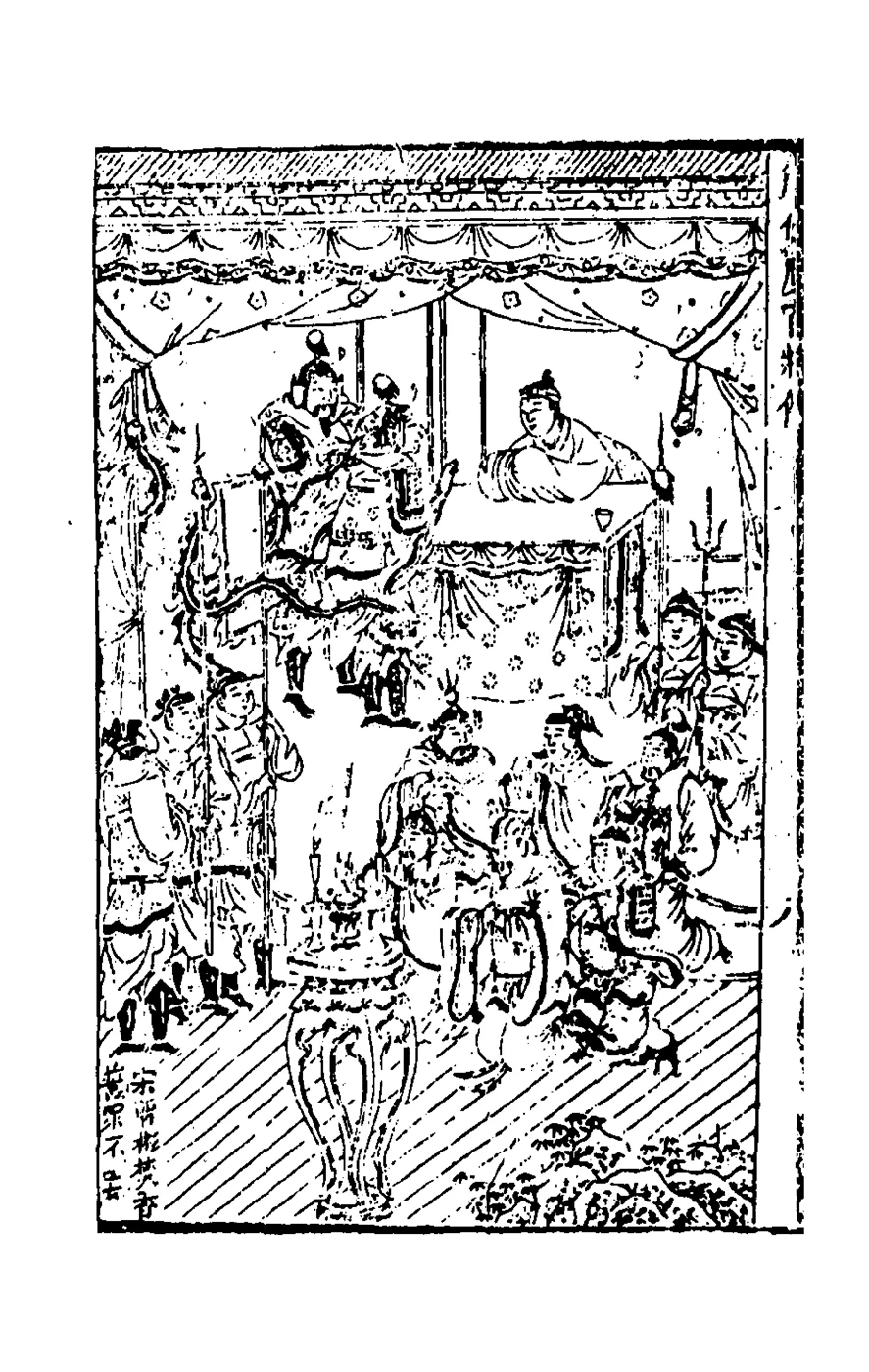
Cao Bin deliberately slowed the assault during the prolonged siege, hoping Li Yu would surrender. In the eleventh month he again sent a message saying that, given the situation, he chiefly pitied the people of the city and that surrender would be the best course. As the city was about to fall, Cao Bin suddenly claimed to be ill and stopped handling affairs. When the other generals came to visit, he told them that medicine could not cure his illness; only if they sincerely swore not to kill people indiscriminately once the city fell would he recover. The generals agreed and burned incense to take the oath. The next day Cao Bin announced some improvement, and the day after that Jinling fell.
Li Yu and more than one hundred ministers came to the army camp to admit defeat. Cao Bin consoled Li Yu and treated him as an honored guest. He allowed Li Yu to return to the palace to change clothing, leaving only a few cavalrymen outside the gate. Subordinates privately worried that Li Yu might attempt something unexpected, but Cao Bin laughed and said that Li Yu had always been indecisive and, having already surrendered, would not kill himself. Li Yu and his ministers were thus preserved. From the army's departure to its victorious return, Cao Bin's troops feared and obeyed him and did not dare act recklessly. At court he described himself on his calling card simply as one who had “returned after carrying out an errand in Jiangnan by imperial order,” showing his characteristic modesty.
Before the campaign, Emperor Taizu had promised that after Li Yu was defeated Cao Bin would receive a high ministerial appointment. Deputy commander Pan Mei congratulated him in advance. Cao Bin replied that the victory would depend on imperial prestige and court strategy, not on any special merit of his, and that such an office was not easily obtained. In the end Taizu made him Military Affairs Commissioner but did not give him the promised higher title. The episode was later taken as evidence that Cao Bin understood the danger of appearing too powerful through military success and deliberately remained self-effacing.
Later Years: Defeat at Qigou Pass and Posthumous Honors
After Emperor Taizong took the throne, Cao Bin was appointed Participant in Determining Government Matters and concurrently Palace Attendant. In 978, the third year of Taiping Xingguo, he became Acting Grand Preceptor, accompanied the campaign against Taiyuan, and received an additional appointment as Palace Attendant. In the first month of 983, after the Zhenzhou military supervisor and winery commissioner Mi Dechao falsely accused him, Cao Bin was removed as Military Affairs Commissioner and made Military Commissioner of Tianping and Palace Attendant. More than ten days later Taizong reconsidered and promoted him to Duke of Lu.
In 986, the third year of Yongxi, Emperor Taizong sent three armies against Liao, with Cao Bin commanding the eastern route. His army advanced too far and, exhausted and short of supplies, was forced to retreat. It was defeated by Liao forces at Qigou Pass, southwest of present-day Zhuozhou, and the defeat contributed to the collapse of the wider campaign. This was the greatest military setback of Cao Bin's life. He was demoted to Senior General of the Right Xiaowei Guard. In 987 he returned to high office as Palace Attendant and Military Commissioner of Wuning. In 994 he was transferred to the Pinglu military commission.
After Emperor Zhenzong ascended the throne, Cao Bin was again appointed Acting Grand Preceptor and Participant in Determining Government Matters, and a few months later he was summoned as Military Affairs Commissioner. In the sixth month of 999, the second year of Xianping, Cao Bin died at the age of sixty-nine. Zhenzong posthumously appointed him Secretariat Director, enfeoffed him as Prince of Jiyang Commandery, and gave him the posthumous name Wuhui. His wife Lady Gao was granted the title Lady of Han, and more than ten relatives, retainers, and close military officers received appointments. In the eighth month an edict ordered Cao Bin and Zhao Pu enshrined in Emperor Taizu's ancestral temple. He was later successively posthumously enfeoffed as Prince of Lu, Prince of Ji, Prince of Tang, and Prince of Zhou.
His Family and Early Years
Cao Bin, courtesy name Guohua, was a man of Lingshou in Zhending; his father Cao Yun was commissary of the Zhending army. On Cao Bin's first birthday his parents spread a hundred playthings on the mat to see what he would take; and Cao Bin took a spear in his left hand and a sacrificial vessel in his right, and in a moment took up a seal, looking at nothing else, so that all marvelled. When he grew up his temper was simple and solid. In the Qianyou period of the Later Han he was a junior officer of the Zhending army, and the commander Wu Xingde, seeing him upright and excellent, pointed him out to his attendants and said that this was a vessel for great things and no common man. The honoured consort Zhang of the Later Zhou was Cao Bin's aunt on his mother's side, and when the Zhou founder took the throne he summoned Cao Bin to the capital and attached him to the household of Shizong, following him to the garrison at Chanyuan, being made a eunuch of the household and raised to be commander of Hezhong. The commander of Pu, Wang Rengao, because Cao Bin was of the imperial kin, treated him with special courtesy; but Cao Bin bore himself the more respectfully, and at feasts in the government hall sat upright all day without looking aside, so that Wang Rengao told his secretaries that he had thought himself untiring morning and night but that seeing the solemn severity of the commissary he perceived his own slackness. In the fifth year of Xiande Cao Bin was sent to Wu and Yue, and having discharged his mission returned at once, taking nothing of private gifts; and the lord of Wu and Yue sent men in light boats after him with goods, again and again, and Cao Bin still would not take them, until presently he said that to refuse them to the end would be near to seeking a name, and so he took them and registered them and gave them all to the government on his return. When Shizong forced them back on him Cao Bin bowed and accepted and divided them all among his kin and old friends, keeping not a coin. Afterwards he went out as commissary of the troops of Jinzhou. One day Cao Bin sat with his commander and guests in a ring in the open country when an envoy came galloping with a letter from a neighbouring garrison commander; and the envoy, not knowing Cao Bin, secretly asked which was the commissary Cao, and when someone pointed him out the envoy thought himself deceived and laughed, asking where a near kinsman of the throne and an inner minister would be found wearing a gown of coarse cloth and sitting on a plain folding chair; and only after looking long did he believe it. Cao Bin was made master of reception. At first, when Emperor Taizu of Song commanded the forbidden troops, Cao Bin stood neutral and did not lean, and never went to his gate except on public business and seldom joined in gatherings, and so was held in esteem.
Entering Song and the Pacification of Shu
In the second year of Jianlong Cao Bin was recalled to court from Pingyang, and Zhao Kuangyin said to him that he had long wished to be close to him and asked why he kept aloof; and Cao Bin bowed and excused himself, saying that he was a near kinsman of the Zhou house and had shamefully held an inner office, and that being careful to keep his place he feared to fall into fault and dared not form connections at random. Zhao Kuangyin made him master of the reception of guests, and with Wang Quanbin and Guo Jin he led cavalry against Pingle county in Hedong and received the surrender of Wang Chao, Hou Barong and eighteen hundred others and took more than a thousand prisoners; and presently the rebel general Wei Jin came with relief and was beaten in three battles, so that the court made Leping into the Pingjin army. Early in Qiande he was made general of the left of the martial gods; and when Liaozhou had just been taken and Hedong called in sixty thousand Khitan horse against Pingjin, Cao Bin with Li Jixun and the others broke them utterly beneath the wall, and he presently held also the office of recipient of secret memorials. In the winter of the second year of Qiande the campaign against Shu was undertaken, and by decree Liu Guangyi was made deputy of the van of the Guizhou expedition and Cao Bin commissary; and the commanderies and counties of the gorges being all taken, the generals wished to massacre the cities to glut their slaughter, and Cao Bin alone restrained his men by order, so that wherever they came the people were pleased and obedient, and the emperor, hearing of it, sent down a decree praising him. When the two Shu provinces were pacified Wang Quanbin and the rest feasted day and night without pity for the officers and men, and their men plundered the people without cease, so that the men of Shu suffered, and Cao Bin several times asked to bring the army home and Wang Quanbin would not; and presently the old Shu general Quan Shixiong and others made trouble with a hundred thousand men, and Cao Bin with Liu Guangyi broke them at Xinfan and at last put down the disorder in Shu. At that time the generals took many children, women, jade and silk, while Cao Bin's bags held only books and clothing. On his return the emperor learned all, and gave Wang Quanbin and the rest over to the law; and holding Cao Bin clean, firm, honest and careful, he made him vice-director of the southern court of the palace and commissioner of the Yicheng army. Cao Bin came into the palace to see the emperor and declined, saying that the officers of the western campaign had all been found guilty and that he alone had been rewarded, which could not well serve to encourage men; and the emperor said that he had great merit and did not boast it, and that even had he some small fault would Ren Shan and the others have spared their words, for reward and punishment were the constant law of the state, and he should not decline. In the Kaibao period Cao Bin several times went north as commissary of the van with Li Jixun and Dang Jin against Taiyuan, beating the northern Han at the Dongwo river and beheading more than two thousand, and received the surrender of the northern Han general Chen Tingshan, and fighting south of the city of Taiyuan pressed close to the Hao bridge and took more than a thousand horses; and in the second year of Kaibao, when Zhao Kuangyin proposed to campaign in person against Taiyuan, Cao Bin was again made commissary of the van and sent ahead, halting at the Tuanbo valley and receiving the surrender of the rebel general Chen Tingshan; and when Taizu arrived Cao Bin had already set up camps on four sides and held the north himself.
The Pacification of Jiangnan
In the seventh year of Kaibao the expedition against Jiangnan was prepared. In the ninth month Cao Bin, by decree, with Li Hanqiong and Tian Qinzuo, went first to Jingnan to bring out the warships, and Pan Mei led the foot after them; in the tenth month by decree Cao Bin was made commander of the horse, foot and war-junk of the expedition of the southwest road of Shengzhou, and dividing his troops went east down the current from Jingnan, broke the Xiakou stockade and took Chizhou, taking in succession the two counties of Dangtu and Wuhu, and camped at Caishi. In the eleventh month he made a floating bridge to carry the army across the great river, and in the twelfth month broke their army utterly at Bailuzhou. In the first month of the eighth year he broke their army again at Xinlingang; in the second month the army advanced to the Qinhuai, and the ten thousand odd troops of Jiangnan by land and water were drawn up beneath the city and were utterly beaten, with many tens of thousands taken or killed; and when the floating bridge was made the men of Wu sent out troops to resist and were broken at Bailuzhou. From the third month to the eighth they were beaten again and again, and Runzhou was taken. The city of Jinling was besieged, the people's road for gathering firewood was cut off, and the Jiangnan army was beaten repeatedly, so that Li Yu in his extremity sent his minister Xu Xuan with a memorial to the palace gate begging that the army be stayed, and the emperor gave it no heed. Earlier the Song army had made three camps, and Pan Mei held the northern side and sent a map of the situation; and Taizu, pointing at the northern camp, told the envoy that the men of Wu would surely send troops out by night to attack, and bade him hurry back and have Cao Bin make a deep ditch quickly to hold his ground and not fall into the enemy's plan. When the ditch was made the men of Wu indeed came by night, and Pan Mei with his troops held them off along the new ditch and they were utterly beaten; and when the report came the emperor laughed and said it was as he had thought. In the long siege Cao Bin often delayed his attack, hoping that Li Yu would submit; and in the eleventh month he again sent to tell him that matters had come to this and that what he pitied was the people gathered in one city, and that if he could give himself up it would be the best policy. When the city was about to fall Cao Bin suddenly pleaded illness and would not attend to business, and the generals all came to ask after him; and Cao Bin said that his illness could not be cured by medicine and stone, but that if the generals would sincerely swear that on the day the city was taken they would not kill a man at random he would recover of himself, and the generals promised and burnt incense together for their oath. The next day he said he was somewhat better; and the day after, the city fell. Li Yu with more than a hundred of his ministers came to the army gate to confess their guilt, and Cao Bin comforted them and received them with the courtesy of guests, and asked Li Yu to go into the palace to change his dress, and Cao Bin waited with a few riders outside the palace gate. Those about him secretly told Cao Bin that if anything befell Li Yu within they would be at a loss; and Cao Bin laughed and said that Li Yu had always been weak and unable to decide, and having already surrendered would surely not take his own life. And so Li Yu and his ministers were at last preserved. From the setting out to the triumphal return the officers and men feared and obeyed him and none dared be careless; and going in to audience he wrote on his card that he had returned from doing business in Jiangnan, such was his modesty and freedom from boasting. When Cao Bin first took command the emperor had told him that when Li Yu was taken he would make him a commissioner with the honours of a minister, and the deputy commander Pan Mei congratulated him beforehand; but Cao Bin said it was not so, for in this undertaking they had relied on Heaven's majesty and followed the court's plans and so had succeeded, and what merit had he, and moreover was the honour of a minister the highest grade? Pan Mei asked what he meant, and Cao Bin said that Taiyuan was not yet pacified. And when he returned and presented his captives the emperor told him that he had meant to grant him the honours of a minister, but that Liu Jiyuan being not yet down they had best wait a little; and when Pan Mei heard this he stole a look at Cao Bin and smiled, and the emperor perceived it and at once asked the reason, and Pan Mei dared not conceal it, and told him the truth; and the emperor laughed too and gave Cao Bin two hundred thousand cash. And Cao Bin, coming out, said that in life why need one be a commissioner with the honours of a minister, for a good office was no more than the chance to get rather more money. Before long he was made recipient of secret memorials, vice-master of the imperial standards of inspection and commissioner of the Zhongwu army.
The Reign of Taizong and the Northern Expedition of Yongxi
When Taizong came to the throne he added to Cao Bin's titles the rank of joint manager of state affairs. When the campaign against Taiyuan was discussed he summoned Cao Bin and asked why Shizong and Taizu, both of whom had gone in person, had not been able to take it; and Cao Bin said that in Shizong's time Shi Yanchao had been beaten at Shiling pass and men's minds were shaken, so the army was brought back, and that Taizu had halted at Gancao and met an unseasonable summer rain and much sickness among the troops, and so had stopped; and the emperor asking what he thought of a northern campaign now, Cao Bin said that with the picked arms of the state to cut off the isolated stronghold of Taiyuan was like breaking dry wood, and why should it not be done, and the emperor's mind was made up. In the third year of Taiping Xingguo he was advanced to vice-master of the imperial standards and followed the campaign against Taiyuan, being given also the office of palace attendant; and in the eighth year he was falsely accused by Mi Dechao and removed to be commissioner of the Tianping army, but within ten days the emperor perceived the slander, made him duke of Lu, and treated him the better. In the third year of Yongxi the emperor directed Cao Bin with the horse, foot and water forces of the van of the Youzhou expedition, with Pan Mei and the rest, to go north in separate columns. In the third month he beat the Khitan at Gu'an and broke Zhuozhou, and when the barbarians came to relieve it he broke them utterly south of the city; in the fourth month with Mi Xin he broke the Khitan at Xincheng and beheaded two hundred; and in the fifth month they fought at Qigou pass and the armies were beaten and fell back to camp at Yizhou on the Yi river. Earlier He Lingtu and others had told the emperor that the Khitan ruler was young and his mother ruled and favourites held office, and that they should take the occasion to seize You and Ji; and so Cao Bin with Cui Yanjin and Mi Xin was sent from Xiongzhou, Tian Chongjin to Feihu and Pan Mei from Yanmen, to rise together at the appointed time. As they were about to set out the emperor told Cao Bin that Pan Mei's troops should first go toward Yun and Ying, and that they with a hundred thousand men should proclaim an attack on Youzhou, moving with weight and slowly, not coveting advantage, for when the enemy heard the great army had come he would bring all his host to save Fanyang and would have no leisure for the country behind the mountains. Presently Pan Mei's troops took Huan, Shuo, Yun and Ying and Tian Chongjin took Feihu, Lingqiu and Weizhou, gaining much of the vital ground behind the mountains, and Cao Bin too took commandery after commandery so that his power was much shaken; and at each memorial the emperor was already surprised at the speed of his advance. And when Cao Bin halted at Zhuozhou and in ten days his food was gone he fell back on Xiongzhou to fetch provisions; and the emperor, hearing it, said that where the enemy was before one should not retreat to bring up fodder, and that this was a gross error of policy, and sent envoys at once to stop Cao Bin from advancing and to have him lead his army along the Baigou river to join Mi Xin, resting the troops and husbanding their keenness to make a show of the western army, until Pan Mei had taken all the country behind the mountains and should join Tian Chongjin's army and go east with united force to take Youzhou. At that time the generals under Cao Bin, hearing that Pan Mei and Tian Chongjin had won merit again and again while they held a great army and could take nothing, raised a clamour of plans, and Cao Bin, unable to do otherwise, took grain again and went once more against Zhuozhou; and with the great Khitan host before them, the season being hot and the troops weary, their food nearly gone, Cao Bin fell back with his ranks no longer in order and was overtaken and beaten. When Cao Bin and the others came to court they were interrogated in the department of state affairs, and the Hanlin academician Jia Huangzhong and others were appointed to try them jointly, and Cao Bin and the rest confessed their guilt of disobeying the decree and losing order; and Cao Bin was reduced to be general of the right of the valiant guards, Cui Yanjin to general of the right of the martial guards and Mi Xin to general of the right of the garrison guards, and the rest degraded in order.
His Last Years and Afterward
When Zhenzong came to the throne Cao Bin's rank of vice-master of the imperial standards and joint manager of state affairs was restored; and some months later he was recalled to court and again made recipient of secret memorials. In the second year of Xianping he fell ill, and the emperor hastened to visit him and mixed his medicine with his own hand and gave him ten thousand taels of white gold; and asking about his after-affairs, Cao Bin answered that he had nothing to say, but that his two sons were of usable parts and that if he recommended from within his own house they were both fit to be generals. The emperor asked which was the better, and he answered that Can was not the equal of Wei. In the sixth month he died at sixty-nine, and the emperor came and wept bitterly, and whenever he spoke of Cao Bin to his ministers he would shed tears; he was given posthumously the office of palace secretary, enfeoffed as prince of Jiyang and given the posthumous name Wuhui, and his wife the lady Gao was made lady of Hanguo, and more than ten of his kin, retainers and officers were given office. In the eighth month of the second year of Xianping the Hanlin academician Song Bai and others proposed that the late Cao Bin should be given a place in the sacrifices at the temple of Taizu, and the decree followed their advice. In the twenty-first year of Hongwu the Ming founder took thirty-seven meritorious ministers of the past ages to be sacrificed in the temple of the emperors of all dynasties, and Cao Bin was among them. The shrine of the prince Wuhui stands at Gangtou village in Lingshou county; the year after Cao Bin's death Emperor Zhenzong decreed that the ministry of revenue with the prefecture of Zhending should build a shrine, cut stones and set up a stele, and sacrifice there in spring and autumn, and the shrine was also called the hall of Wuhui; and in 2015 the Cao of Gangtou village restored the shrine on its old site. The stele of the native place of Cao Bin, prince Wuhui of Song, stands at Gangtou village in Lingshou county in Hebei, and was set up by the Cao of the village in the seventeenth year of Kangxi and the twenty-second year of Guangxu. Besides this, the temple of the great prince Cao stands at Caowang village in Yuxin township of Jiaxing, and the Jiaxing county gazetteer of the Chongzhen period records that the temple of prince Cao was thirty li southeast of the county and that in the Song and Yuan the villagers honoured it most diligently, the old men saying that Cao Bin, prince Wuhui, leading the army to pacify Jiangnan, killed not a man at random, and that the people of the region were moved and sacrificed to him; it was rebuilt in the Wanli period, and every year in the third month the men and women of the commandery and county who came to burn incense could not be counted.