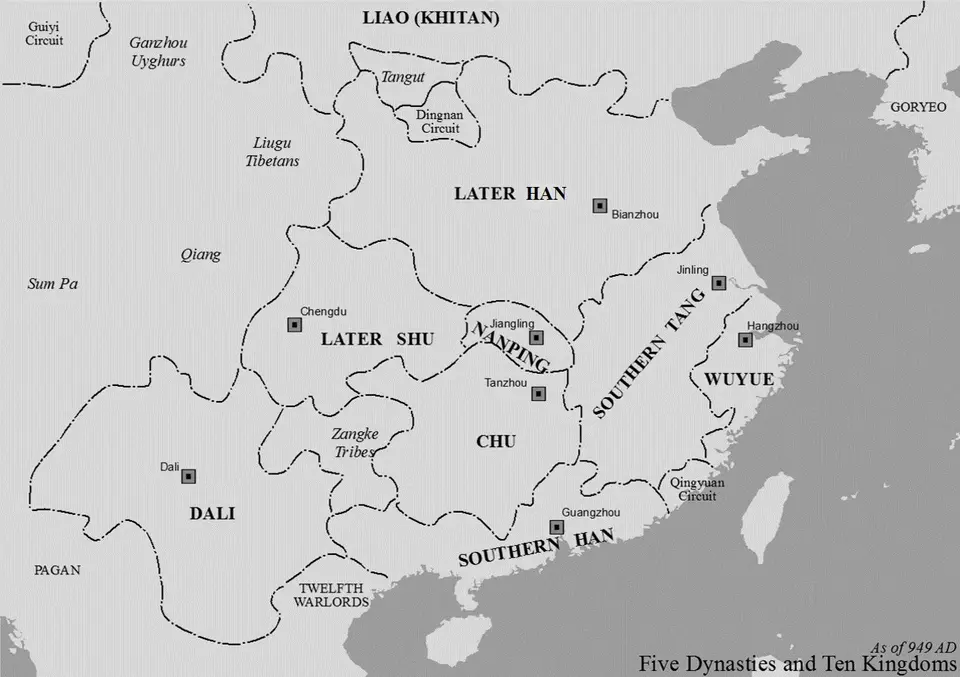
Command of Hedong
Later Jin authorities appointed veteran commander Liu Zhiyuan as Military Governor of Hedong and Regent of Taiyuan, building a formidable regional power base.
947 CE–951 CE
后汉
The Later Han dynasty (后汉; 947–951 CE) was the fourth of the Five Dynasties during the Five Dynasties and Ten Kingdoms period in Chinese history, maintaining its imperial capital at Kaifeng. Founded by the Shatuo Turkic commander Liu Zhiyuan, the dynasty spanned two monarchs across just three years and ten months, representing the shortest-lived imperial regime among the Five Dynasties. In late 946 CE, the Khitan Empire launched a massive invasion that captured Kaifeng and extinguished the…
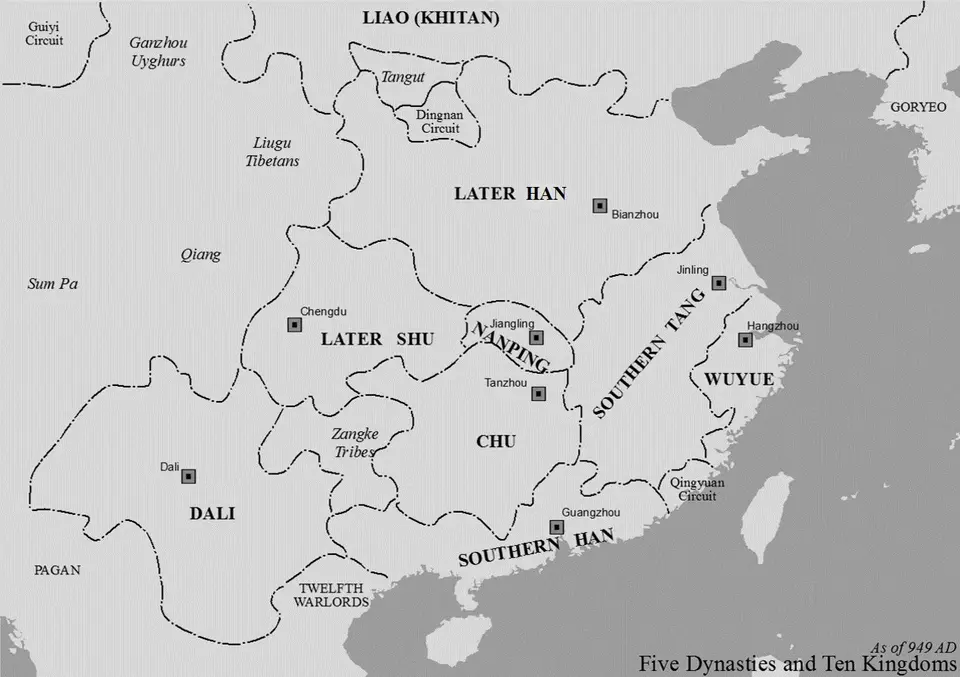
The Later Han dynasty (后汉; 947–951 CE) was the fourth of the Five Dynasties during the Five Dynasties and Ten Kingdoms period in Chinese history, maintaining its imperial capital at Kaifeng. Founded by the Shatuo Turkic commander Liu Zhiyuan, the dynasty spanned two monarchs across just three years and ten months, representing the shortest-lived imperial regime among the Five Dynasties. In late 946 CE, the Khitan Empire launched a massive invasion that captured Kaifeng and extinguished the Later Jin dynasty. With northern China plunged into widespread chaos and looting, Liu Zhiyuan, then serving as Military Governor of Hedong and Regent of the Northern Capital at Taiyuan, mobilized regional forces and declared himself emperor at Taiyuan in the second lunar month of 947 CE, initially retaining the Later Jin Tianfu reign title to reassure loyalists. As widespread popular resistance and severe logistical strain forced the Khitan armies to retreat northward beyond the Yellow River, Liu Zhiyuan led his armies southward, liberating Luoyang and Kaifeng, adopting the Qianyou reign title, and establishing undisputed control over the Central Plains. However, Liu Zhiyuan died of illness in early 948 CE after reigning for only ten months. His eighteen-year-old son Liu Chengyu ascended the throne as Emperor Yin, with actual executive power divided among veteran regents Yang Bin, Shi Hongzhao, Wang Zhang, and Guo Wei. Deeply resentful of his regents' overbearing authority, Emperor Yin orchestrated a violent palace coup in late 950 CE, butchering Yang Bin, Shi Hongzhao, and Wang Zhang in the imperial audience hall while dispatching assassins to kill Guo Wei at Weizhou. Anticipating his demise, Guo Wei revolted and marched south with northern border troops, crushing the imperial guards outside Kaifeng. Emperor Yin fled the capital and was murdered by mutinous retainers in the outskirts. Guo Wei subsequently deposed the newly acclaimed imperial heir Liu Yun and founded the Later Zhou dynasty in early 951 CE, terminating the Later Han. In Taiyuan, Liu Zhiyuan's younger brother Liu Chong declared himself emperor with Khitan support, establishing the regional Northern Han state.
Later Jin authorities appointed veteran commander Liu Zhiyuan as Military Governor of Hedong and Regent of Taiyuan, building a formidable regional power base.
Khitan Emperor Taizong captured Kaifeng, took Emperor Chu captive, and declared the Great Liao dynasty, triggering widespread uprisings across Henan.
Liu Zhiyuan declared himself emperor at Taiyuan, establishing the Later Han dynasty while cautiously preserving the Tianfu reign title to unite loyalists.
Following the death and northern withdrawal of Khitan forces, Liu Zhiyuan entered Luoyang and Kaifeng in triumph, establishing Kaifeng as his imperial capital.
Founding Emperor Liu Zhiyuan passed away; his son Liu Chengyu succeeded to the throne, leaving executive administration to regents Yang Bin, Shi Hongzhao, and Guo Wei.
Powerful warlords Li Shouzhen of Hezhong, Zhao Siwan of Yongxing, and Wang Jingchong of Fengxiang revolted; regent Guo Wei spent a year methodically crushing all three rebel garrisons.
Guo Wei breached the fortifications of Hezhong, compelling Li Shouzhen to commit suicide by fire, consolidating Later Han authority over Guanzhong.
Emperor Yin conspired with palace confidants, murdering chancellors Yang Bin, Shi Hongzhao, and Wang Zhang in court and dispatching orders to execute Guo Wei.
Fleeing execution, Guo Wei mobilized northern border garrisons at Weizhou, defeated the imperial army at Liuzi, and seized Kaifeng.
Fleeing the capital, Emperor Yin was betrayed and slain by his own attendants; Guo Wei entered Kaifeng, bringing the Later Han dynasty to a de facto conclusion.
Guo Wei staged the Chanzhou Mutiny and founded the Later Zhou dynasty; in Taiyuan, Liu Chong proclaimed the Northern Han state under Khitan vassalage.
The rise and fall of the Later Han dynasty unfolded across four turbulent years in the Central Plains:
The origins of the Later Han dynasty emerged directly from the military power base built in Shanxi by Liu Zhiyuan, a seasoned Shatuo commander who had served as chief general under Later Jin founder Shi Jingtang and was appointed Military Governor of Hedong and Regent of the Northern Capital at Taiyuan in 941 CE. Defeating Khitan forces at Xinkou in 944 CE and absorbing the wealth of the Tuyuhun tribes, Liu Zhiyuan turned Hedong into the strongest regional command in northern China.
During the winter of 946 CE, Khitan Emperor Taizong (Yelü Deguang) launched a massive invasion that forced the surrender of Later Jin general Du Wei at Zhongdu, entered the imperial capital Kaifeng, captured Emperor Chu (Shi Chonggui), and declared himself emperor of China under the Great Liao dynastic title. Liao cavalry embarked on brutal plundering sweeps throughout Henan and Hebei, termed "foraging for grass and grain" (Dacao'gu), slaughtering civilians and burning cities. Perceiving that direct confrontation with the Khitan army was premature, Liu Zhiyuan strengthened Taiyuan's defenses until widespread popular insurgencies erupted across Henan; in the second lunar month of 947 CE, he ascended the imperial throne at Taiyuan, proclaiming the Later Han dynasty while retaining the Tianfu reign title to rally loyalist governors.
Perceiving that direct confrontation with the victorious Khitan army was reckless, Liu Zhiyuan adopted a policy of armed neutrality, dispatching low-ranking envoys bearing superficial tribute to Kaifeng while strengthening the fortifications of Taiyuan and storing grain. Concurrently, spontaneous peasant insurgencies erupted across Henan and Shandong, ambushing Khitan foraging parties. In the second lunar month of 947 CE, responding to petitions from northern officials and military commanders, Liu Zhiyuan accepted the imperial title at Taiyuan, proclaiming the restoration of the Han dynasty while tactfully maintaining the Later Jin Tianfu reign title to attract loyalist governors across northern China.
By the fourth lunar month of 947 CE, facing unyielding popular resistance, scorching summer heat, and severe epidemics among his cavalry, Yelü Deguang resolved to evacuate Kaifeng and retreat northward to the steppe. He fell ill and died at Linzhang in Hebei. Capitalizing on the sudden collapse of Khitan command, Liu Zhiyuan led his seasoned Shatuo cavalry southward through the Taihang Mountains. He entered Luoyang in the fifth lunar month and marched into Kaifeng in the sixth lunar month of 947 CE. Khitan garrison commanders fled across the Yellow River, and Chinese warlords who had submitted to the Liao promptly yielded allegiance to Liu Zhiyuan.
In the first lunar month of 948 CE, Liu Zhiyuan formally inaugurated the Qianyou reign title, granting an empire-wide tax amnesty and attempting to reconstruct the shattered bureaucratic machinery of the Central Plains. However, Liu Zhiyuan was struck down by severe illness and died in the second lunar month of 948 CE, after reigning for merely ten months. On his deathbed, he summoned Chancellor Yang Bin, Commander of the Palace Guard Shi Hongzhao, Finance Commissioner (State Finance Commissioner) Wang Zhang, and Privy Councilor Guo Wei, entrusting them with the regency of his eighteen-year-old second son, Liu Chengyu, who ascended the throne as Emperor Yin.
Emperor Yin's accession immediately triggered widespread provincial rebellion. Veteran military governors who had held equal rank with Liu Zhiyuan refused to submit to an adolescent monarch. In the third lunar month of 948 CE, military governor Li Shouzhen of Hezhong (Puzhou) raised the banner of revolt, coordinating with Zhao Siwan of Yongxing (Chang'an) and Wang Jingchong of Fengxiang to ignite a colossal three-garrison rebellion that severed Guanzhong and Shanxi from the capital. The central court dispatched expeditionary armies under Bai Conghui and Du Chongwei, but the imperial generals quarreled and suffered battlefield reverses.
Confronting the imminent disintegration of the dynasty, Chancellor Yang Bin appointed Privy Councilor Guo Wei as supreme commander of the western campaign. Exhibiting exceptional tactical wisdom, Guo Wei rejected costly direct assaults against the heavily fortified walls of Puzhou. Instead, he mobilized thousands of civilian laborers to construct an unbroken line of siege trenches and earthen dykes enclosing the fortress, severing all external communications. Over a year-long siege, Li Shouzhen's supplies were exhausted, and famine decimated the garrison. In the seventh lunar month of 949 CE, Guo Wei launched a general assault, breaching the outer walls; Li Shouzhen committed suicide by fire alongside his family. Shortly thereafter, the rebel garrisons at Chang'an and Fengxiang collapsed, restoring total imperial control over northwestern China and elevating Guo Wei to the pinnacle of military prestige.
Following the pacification of the western rebellions, tensions between the young monarch and his senior regents reached a breaking point:
The suppression of the three garrisons fundamentally destabilized civil-military relations in Kaifeng. The three resident regents—Yang Bin, Shi Hongzhao, and Wang Zhang—monopolized administrative authority. Yang Bin directed political appointments, Shi Hongzhao enforced ruthless police discipline, and Wang Zhang imposed draconian commercial extraction. Emperor Yin felt completely marginalized and humiliated, complaining that he was treated like a child under house arrest. Surrounded by young sycophantic palace attendants including Li Ye and Nie Wenjin, the emperor covertly plotted to eliminate his overbearing regents.
On the thirteenth day of the eleventh lunar month in 950 CE, as Yang Bin, Shi Hongzhao, and Wang Zhang entered the palace for the morning imperial audience, heavily armed palace guards ambushed them, cutting down all three ministers in the audience hall. Concurrently, Emperor Yin dispatched secret emissaries bearing imperial decrees to the northern border garrison of Weizhou, commanding generals to execute Guo Wei and his chief of staff Wang Yin. Informed of the edict by loyal commanders, Guo Wei mobilized northern frontier armies and marched southward.
Emperor Yin commanded the remaining imperial guards to oppose the rebellion at Liuzi, outside Kaifeng, but the imperial troops were routed. Fleeing into the countryside, Emperor Yin was betrayed and slain by his own attendant Guo Yun at a village homestead. Guo Wei occupied Kaifeng, deposed imperial relative Liu Yun, and was acclaimed emperor during the Chanzhou Mutiny in early 951 CE, founding the Later Zhou dynasty. In Taiyuan, Liu Zhiyuan's brother Liu Chong seceded and established Northern Han, concluding the brief history of the Later Han.
The administrative framework of Later Han was characterized by the extreme concentration of power in the hands of military retainers. Because the dynasty emerged from the emergency mobilization against the Khitan, traditional civil institutions—such as the Department of State Affairs and the Censorate—were subordinated to the Bureau of Military Affairs (Shumiyuan). Governance was directed by the quartet of regents appointed by Liu Zhiyuan: Yang Bin managed judicial administration, Shi Hongzhao commanded the imperial capital police, Wang Zhang directed state finance, and Guo Wei commanded field armies. This martial oligarchy suppressed civilian scholar-officials, creating profound administrative friction that culminated in the regicide of 950 CE.
Under the direction of Commander of the Palace Guard Shi Hongzhao, Later Han enforced draconian criminal justice to curb banditry and military insubordination in the war-devastated capital. Minor thefts and breaches of curfew were punished by summary execution or mutilation, with severed limbs displayed publicly along city gates. While this severity temporarily suppressed urban street crime in Kaifeng, it terrorized civilian magistrates and intensified public resentment against the Shatuo military regime.
Later Han maintained the three-tier administrative hierarchy of circuits, prefectures, and counties inherited from the Tang and Later Jin, governing over one hundred prefectures across Henan, Shandong, Shanxi, and Shaanxi, with Kaifeng as the Eastern Capital, Luoyang as the Western Capital, and Taiyuan as the Northern Capital.
The military foundation of Later Han rested upon the Metropolitan Guards (Shiwei Jun), commanded by Shi Hongzhao. Composed predominantly of elite Shatuo cavalry and hardened frontier infantry from Shanxi, these troops served both as the central garrison protecting Kaifeng and as the mobile strike corps dispatched to suppress regional rebellions. However, the army was deeply plagued by the chronic Five Dynasties vice of mercenary opportunism; soldiers routinely demanded exorbitant monetary bounties before marching to battle and readily mutinied when their commanders were threatened.
Following the outbreak of the three-garrison rebellion in Hezhong, Yongxing, and Fengxiang in 948 CE, Privy Councilor Guo Wei commanded the western expeditionary armies to systematically besiege and eliminate the rebel strongholds, concentrating supreme military authority over the central and northern field armies in his hands.
In foreign relations, Later Han was founded upon direct defiance against the Khitan Empire (Liao). Unlike the preceding Later Jin dynasty, which had submitted as a vassal to the Khitan, Liu Zhiyuan achieved imperial legitimacy by championing national resistance against foreign occupation. Throughout its existence, Later Han maintained heavily fortified garrisons along the northern frontier at Weizhou, Dingzhou, and Cangzhou to repel seasonal Khitan raids. Toward the southern regimes of the Ten Kingdoms (such as Southern Tang, Wuyue, and Chu), Later Han maintained the posture of the legitimate northern sovereign, receiving tributary embassies in exchange for royal investitures.
The economy of the Central Plains under Later Han was devastated by the looting and foraging campaigns of the Khitan occupation. Farmlands lay uncultivated across Henan and Hebei, and state treasuries were completely empty. To finance military expeditions against the Three Garrisons, Finance Commissioner Wang Zhang implemented an aggressive fiscal policy: he confiscated private grain stores, imposed punitive commercial transaction levies, and taxed draft animals, market stalls, and irrigation wells. While these harsh measures replenished the imperial treasuries in Kaifeng, they severely impeded agricultural rehabilitation and impoverished the peasant populace.
Upon entering Kaifeng in 947 CE, Emperor Gaozu followed the counsel of Empress Li to disburse palace treasures rather than extort the citizenry to reward his troops, while remitting unpaid provincial tax arrears from the preceding year and halving summer and housing taxes around Luoyang and Kaifeng to stabilize the postwar order.
Trade in Later Han operated primarily through copper coins inherited from previous dynasties, supplemented by barter in raw silk and grain. Because of the acute shortage of circulating currency, the government attempted to enforce statutory exchange rates between coin and commodity. However, the brief duration of the dynasty and continuous military operations prevented comprehensive currency or hydraulic reforms, leaving the economic reconstruction of the Central Plains to the succeeding Later Zhou dynasty.
As a ruler of foreign Shatuo origin, Liu Zhiyuan sought political legitimacy by constructing an official genealogical link to the ancient imperial house of Han. Upon ascending the imperial throne, he declared that his Shatuo lineage descended from Prince Liu Bing of Huaiyang, a son of Emperor Ming of the Eastern Han dynasty. He established imperial ancestral temples in Kaifeng, honoring Emperor Gaozu (Liu Bang) and Emperor Guangwu (Liu Xiu) as his imperial forebears, while utilizing classical Han imperial ceremonial rites to win the allegiance of northern Chinese literati.
Despite the absolute dominance of military commanders, classical Chinese scholarship was maintained through dedicated civil officials serving in the chancellery and the Imperial Academy (Guozijian), such as veteran scholar Dou Yanwang and judicial specialist Dou Yi. These scholars preserved administrative archives, transcribed historical records, and prepared the legislative drafts that would ultimately materialize as the Great Zhou Penal Code under the Later Zhou dynasty.
Having settled across the Yellow River basin for generations, the Shatuo military nobility combined steppe equestrian traditions and adoptive kinship bonds with Central Plains social norms, intermarrying extensively with Han families while accelerating the replacement of medieval aristocratic lineages by a merit- and military-based bureaucratic stratum.
| Temple Name | Posthumous Name | Personal Name | Reign Period | Era Names |
|---|---|---|---|---|
| Gaozu | Emperor Ruiwen Shengwu Zhao | Liu Zhiyuan | 947–948 CE | Tianfu, Qianyou |
| None | Emperor Yin | Liu Chengyu | 948–950 CE | Qianyou |
The Later Han dynasty represents the briefest and most intense transitional episode within the Five Dynasties epoch. Emerging as an emergency national salvation movement against the Khitan occupation, the dynasty successfully restored Chinese imperial sovereignty over the Central Plains, safeguarding the administrative heartland of the Yellow River valley from foreign annexation. However, its political architecture remained fatally compromised by the militaristic tyranny of its founding generals and the destructive paranoia of its youthful monarch. The violent downfall of Later Han cleared the political landscape of unstable warlord factions, enabling Guo Wei and Chai Rong to establish the institutional centralism of Later Zhou, which directly paved the way for the enduring unification achieved by the Song dynasty.
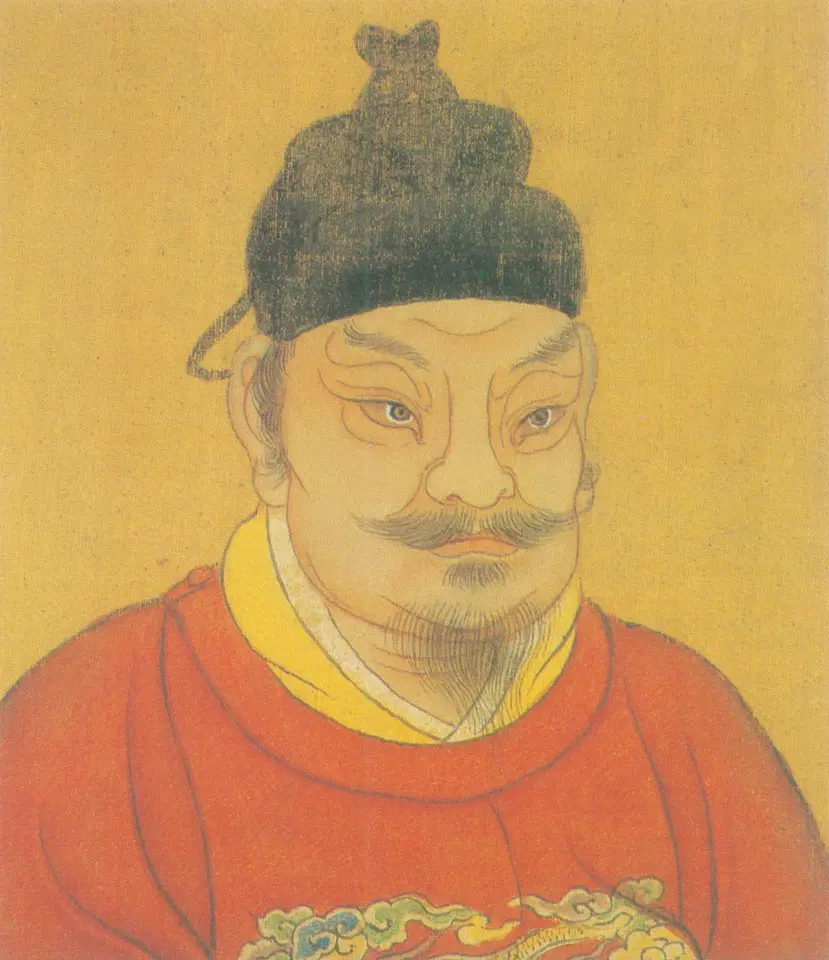 Later Han Dynasty (后汉)
Historical figure
Emperor Gaozu of Later Han (后汉高祖, March 4, 895 – March 10, 948), personal name Liu Zhiyuan (刘知远) and later Liu Gao (刘暠), was of Shatuo Turks origin from Taiyuan. He was the founding sovereign of the Later Han dynasty during the Five Dynasties and Ten Kingdoms period, reigning from 947 to 948. Emerging from humble origins among frontier garrison troops, he enlisted in the armies of Li Keyong and Li Siyuan. During fierce early campaigns against the Later Liang, Liu Zhiyuan repeatedly risked his life to rescue Shi Jingtang on the battlefield, earning profound trust and promotion to chief palace escort commander. When Shi Jingtang established the Later Jin dynasty in 936, Liu Zhiyuan served as Commander-in-Chief of the Palace Guard and Military Governor of Hedong, being enfeoffed as Prince of Beiping. When Shi Jingtang proposed ceding the Sixteen Prefectures of Yanyun and subserviently calling the Khitan emperor father, Liu Zhiyuan vehemently counseled against the concessions, demonstrating remarkable strategic foresight. In early 947, the Khitan Emperor Taizong (Yelü Deguang) swept south, capturing Kaifeng and extinguishing the Later Jin dynasty. Amid widespread devastation across the Central Plains, military and civilian leaders in Shanxi proclaimed Liu Zhiyuan emperor in Taiyuan, founding the Later Han dynasty. As Khitan forces retreated north in the face of widespread popular insurgencies, Liu Zhiyuan decisively mobilized the veterans of Hedong, advancing southward to liberate Luoyang and Kaifeng in rapid succession. Upon entering the capital, he adopted the enlightened counsel of Empress Li, strictly prohibiting troops from expropriating civilian wealth and distributing imperial storehouse textiles to reward the armies. He stabilized the ravaged Central Plains, enacted fiscal remissions, and curbed arrogant military warlords. Succumbing to illness in early 948 at the age of fifty-four, he was honored with the temple name Gaozu and buried at the Ruiling Mausoleum.
Second and Last Emperor of the Later Han Dynasty (后汉第二位皇帝)
Liu Chengyou (刘承祐, 931–950), a native of Taiyuan (modern Taiyuan, Shanxi Province) of the Shatuo Turks, was the second and final emperor of the Later Han Dynasty during the Five Dynasties period (reigned 948–950). He was the second son of dynastic founder Emperor Gaozu (Liu Zhiyuan) and Empress Mingde. In 947, following the establishment of the Later Han, Liu Chengyou was created Prince of Zhou. In March 948, Emperor Gaozu died, entrusting the seventeen-year-old sovereign to a collegiate regency led by Yang Bin, Shi Hongzhao, Wang Zhang, and Guo Wei. Upon his accession, dangerous provincial mutinies erupted when military governors Li Shouzhen, Zhao Siwan, and Wang Jingchong rebelled simultaneously. Demonstrating administrative resolve, Liu Chengyou appointed Guo Wei as supreme western commander, who systematically crushed the three rebellions within a year, temporarily securing dynastic survival. However, regents Yang Bin, Shi Hongzhao, and Wang Zhang grew overbearing, monopolizing civilian, military, and financial power while treating the young monarch with open disrespect. In November 950, Liu Chengyou orchestrated a violent palace coup alongside his maternal uncle Li Ye, ambushing and executing Yang Bin and his colleagues at court. He simultaneously dispatched secret orders to assassinate Guo Wei on the frontier and slaughtered Guo Wei entire family in Kaifeng. Driven to rebellion for survival, Guo Wei marched south on the capital. The imperial guards collapsed at the Battle of Liuzipo, and Liu Chengyou was slain by mutinous retainers at Zhao Village at age twenty. Guo Wei established the Later Zhou Dynasty, granting Liu Chengyou the posthumous title Emperor Yin.
Last Emperor of Cheng Han
Li Shi (c. 320 – 361), courtesy named Ziren, was the sixth and final emperor of the Cheng Han dynasty during the Sixteen Kingdoms period, and the eldest son of Emperor Zhaowen (Li Shou). In 343, Li Shou passed away from severe illness, and Crown Prince Li Shi ascended the imperial throne, adopting the era name Taihe. Although physically tall and dignified in appearance, Li Shi proved arrogant, suspicious, and excessively cruel. He alienated the imperial clan and founding statesmen, abused penal laws, and executed capable officials. He drove his popular younger brother Li Guang to suicide and put to death key counselors such as Director of the Chancellery Ma Dang and Prefect of the Masters of Writing Jie Siming. Consequently, the regime lost widespread political loyalty, while indigenous Liao tribal rebellions swept across the Sichuan basin, throwing the state into acute peril. In the third month of 347, Eastern Jin general Huan Wen mounted a daring combined naval and land invasion up the Yangtze Gorges. Huan Wen bypassed regional garrisons and marched directly to the outskirts of Chengdu. Li Shi suffered a decisive military defeat outside the capital gates at Zhaqiao. Fleeing northward under cover of darkness to Jinshou, Li Shi recognized that his cause was lost and formally surrendered to Huan Wen with his hands bound and carrying a funeral coffin. The surrender marked the end of the forty-four-year existence of Cheng Han. Li Shi was escorted to the Eastern Jin capital of Jiankang, where he was pardoned and enfeoffed as Marquis of Guiyi, living in retirement until his death in 361.
 Later Tang, Later Jin, Later Han, Later Zhou, Northern Song (后唐、后晋、后汉、后周、北宋)
General of the Five Dynasties and early Northern Song
Wang Quanbin (王全斌, 908–976), a native of Taiyuan, Bingzhou (present-day Taiyuan, Shanxi Province), was a prominent general of the Five Dynasties and early Northern Song (北宋) who served as commander-in-chief of the Western Sichuan route during the Song conquest of Later Shu (灭蜀之战). Born into a military family, at the age of twelve he volunteered to serve as a hostage in the camp of Li Cunxu (Emperor Zhuangzong of Later Tang) to dispel suspicions against his father, and during the Xingjiaomen Mutiny of 926 he fought to the death alongside Fu Yanqing to protect the mortally wounded Zhuangzong. Serving successively under the Later Tang, Later Jin, Later Han, and Later Zhou dynasties, he distinguished himself at Sishui, Qinzhou, Fengzhou, Huainan, and Waqiaoguan. After the founding of the Northern Song in 960, he helped suppress Li Yun's rebellion in Luzhou and was appointed Military Commissioner of Anguo Army, capturing Leping from Northern Han in 963. In the 11th month of the 2nd year of Qiande (964), appointed Military Commissioner of Zhongwu Army and Vanguard Commander-in-Chief of the Western Sichuan Expeditionary Force, he led 30,000 troops south via the Fengzhou route, capturing Xingzhou and Lizhou and sending a detachment along the narrow Laisu trail to outflank and storm the strategic Jianmen Pass, capturing Later Shu commander Wang Zhaoyuan and compelling Meng Chang to surrender in the 1st month of 965. However, after entering Chengdu, his failure to issue travel stipends to surrendered Shu soldiers, rampant plundering, and massacre of 20,000 disarmed prisoners triggered Quan Shixiong's massive seventeen-prefecture rebellion. Spared execution by Emperor Taizu in 967 out of regard for his conquest of Shu, he was demoted to Acting Military Commissioner of Chongyi Army in Suizhou before being restored as Military Commissioner of Wuning Army in 976, dying several months later at sixty-nine.
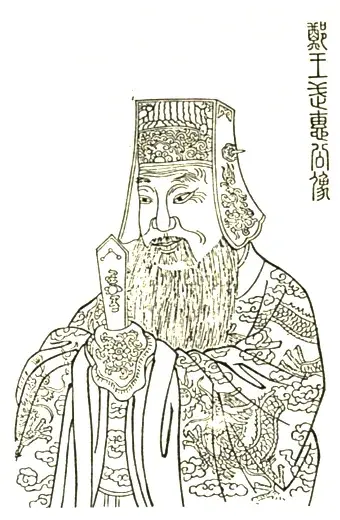 Five Dynasties and Ten Kingdoms (Later Han, Later Zhou), Northern Song (五代十国、北宋)
Founding General and Military Commander of the Northern Song Dynasty
Pan Mei (潘美, 925–991), courtesy name Zhongxun (仲询), a native of Daming Prefecture (modern Daming County, Hebei Province), was a celebrated founding general of the Northern Song Dynasty. Serving in his youth as a reception officer in Changshan, he joined the staff of Chai Rong (Prefect of Kaifeng) after the founding of Later Zhou, fought in the Battle of Gaoping under Emperor Shizong of Later Zhou, and rose to Vice Commissioner of the West Upper Palace Postern, Army Supervisor of Shanzhou, and Commissioner for Ceremonial Reception. Closely bound to Zhao Kuangyin (Emperor Taizu of Song), Pan Mei was sent ahead into Kaifeng after the Chenqiao Mutiny to proclaim the imperial mandate to the Later Zhou ministers, rode alone to Shanzhou to persuade the fierce warlord Yuan Yan to submit to the court, and helped suppress Li Zhongjin's rebellion in Yangzhou. As Defense Commissioner of Tanzhou during the Qiande era, he repelled Southern Han incursions and pacified the Xidong tribes. Appointed Commander-in-Chief of the Expeditionary Forces in the third year of the Kaibao era (970), he captured Fuzhou, Hezhou, and Shaozhou, used a fire attack at Zhatou to crush the 150,000-man Southern Han main army, seized Guangzhou, and captured the last Southern Han ruler Liu Chang, pacifying Lingnan. In 974 he served as Expeditionary Supervisor alongside Cao Bin to conquer the Southern Tang and was promoted to Commissioner of the Northern Palace Administration. Under Emperor Taizong of Song, he directed the conquest of Northern Han in 979, guarded the northern frontier at Sanjiaokou, and won a decisive victory over the Liao army at Yanmen Pass in 980, receiving the titles Duke of Dai and Duke of Han. During the Yongxi Northern Expedition of 986, he commanded the Western Route Army to capture Huanzhou, Shuozhou, Yunzhou, and Yingzhou; however, during the subsequent Battle of Chenjiagu Valley while escorting civilians south, army supervisor Wang Xian forced Yang Ye into battle and abandoned the valley entrance, leading to Yang Ye's death in battle and Pan Mei's demotion by three grades. Restored to command in Bingzhou, Pan Mei died in the second year of the Chunhua era (991) at the age of sixty-seven, receiving the posthumous title "Wuhui" and posthumous enfeoffment as Prince of Zheng under Emperor Zhenzong.
 Later Han Dynasty (后汉)
Historical figure
Yang Bin (杨邠, died 950), a native of Guanshi County in Weizhou (modern Guan County, Shandong), was a Chancellor and Privy Commissioner of the Later Han (后汉) dynasty during the Five Dynasties period (not to be confused with a homonymous Western Jin official named Yang Bin, courtesy name Qizhi, who served as Grand Administrator of Hengyang). Beginning his career as a local register clerk in Weizhou, he later served on the military staff of Liu Zhiyuan and won his deep trust. In the twelfth year of the Tianfu era (947), he and Guo Wei urged Liu Zhiyuan to claim the imperial title and found the Later Han dynasty, whereupon Yang Bin was appointed Privy Commissioner and Acting Grand Mentor. On his deathbed in 948, Emperor Gaozu (Liu Zhiyuan) named Yang Bin, Su Fengji, Shi Hongzhao, and Guo Wei as regent ministers to assist the young Emperor Yindi (Liu Chengyou). Promoted in the fourth month of 948 to Vice Director of the Secretariat, Minister of Personnel, and Chancellor while retaining the post of Privy Commissioner, Yang Bin took charge of state administration. He curbed arbitrary appointments, dismissed superfluous officials appointed through family privilege, and worked with Fiscal Commissioner Wang Zhang to replenish the state treasuries; yet he disdained Confucian scholars and ritual, grew increasingly overbearing, curbed the consort kinsman Li Ye, and bluntly told Emperor Yindi in open court to "simply keep silent." On the thirteenth day of the eleventh month of 950, Emperor Yindi ambushed and killed Yang Bin, Shi Hongzhao, and Wang Zhang in the eastern corridor of Guangzheng Hall; after Guo Wei founded the Later Zhou dynasty, he rehabilitated Yang Bin and posthumously enfeoffed him as Prince of Hongnong Commandery.
Founding general of Northern Song
Wang Yansheng (王彦升, 917–974), courtesy name Guanglie (光烈), originally from the Shu region and later settled in Luoyang, was an eminent founding general of the Northern Song dynasty who served across four successive five dynasties regimes before joining the Song, universally famed under the moniker Wang the Swordsman. In his youth, he achieved renown throughout the imperial guards for his immense physical power, violent daring, and consummate mastery of swordsmanship. During the Later Jin dynasty, he spearheaded a nocturnal commando raid into the Khitan Liao camp at Chanzhou, slaying dozens of enemy soldiers; under the Later Zhou, he campaigned under Emperor Shizong at Shouchun and in the northern expedition to recover Guannan, rising to general of the imperial palace guards and becoming an intimate confidant of Zhao Kuangyin. In 960, Wang Yansheng was an instrumental participant in orchestrating the Chenqiao Mutiny that elevated Zhao Kuangyin to the throne. Upon leading the advance guard back into Kaifeng, he pursued and slaughtered Han Tong, the only high-ranking Later Zhou commander attempting resistance, annihilating Han's entire household. Although this ruthless act eliminated armed opposition, it contravened Emperor Taizu's orders prohibiting violence against civilians and officials, causing the monarch deep displeasure. Shortly thereafter, Wang Yansheng rode alone in the dead of night to the residence of Chancellor Wang Pu to extort vast monetary bribes; an incensed Emperor Taizu permanently barred him from the capital guards and state council, exiling him to frontier commands in Tangzhou, Shenzhou, Fangzhou, and Yuanzhou. Serving seven years on the turbulent northwestern frontier in Yuanzhou, he governed with terrifying ruthlessness, routinely severing the ears of captured Tangut and Qiang raiders to consume raw with wine, thereby intimidating frontier tribes into total submission. He died of illness in Qianzhou in 974 at the age of fifty-eight while traveling to court.
Historical figure
Zheng Renhui (郑仁诲, ?–955), courtesy name Rixin (日新), was a native of Jinyang in Taiyuan who served as a founding statesman, chancellor, and Director of the Bureau of Military Affairs in the Later Zhou dynasty during the Five Dynasties and Ten Kingdoms period, playing an indispensable role in the dynastic founding under Emperor Taizu (Guo Wei) and the centralizing reforms of Emperor Shizong (Chai Rong). In his early career, Zheng served the Later Tang commander Chen Shaoguang before retiring to his hometown of Jinyang to avoid the chaotic factional conflicts of the five dynasties. While Liu Zhiyuan governed Hedong, the young general Guo Wei frequently visited Zheng's residence to consult on grand strategy, forging a close bond. When Guo Wei became Director of the Bureau of Military Affairs under Later Han, he summoned Zheng to serve as his chief military strategist during the western campaigns that pacified the insurgent warlords Li Shouzhen and Wang Jingchong, earning Zheng promotion to Acting Minister of Personnel. Following the establishment of the Later Zhou in 951, Zheng was honored as an instrumental founding minister, serving as Chief Palace Inspector and Director of the Bureau of Military Affairs before being elevated to Chancellor. When Emperor Shizong mounted his northern campaign against Northern Han and the Khitan, culminating in the critical Battle of Gaoping in 954, Zheng governed as Regent of Dongjing in Kaifeng, managing grain shipments, armament production, and metropolitan security without a single deficit. Promoted to concurrent Director of the Chancellery, he passed away from illness in late 955. Emperor Shizong personally attended his wake in deep mourning, defying astrological taboos, posthumously honoring him as Director of the Secretariat and Duke of Han State with the title Zhongzheng.
Historical figure
Hou Yi (侯益, 885–965) was a native of Pingyao, Fenzhou (modern Pingyao County, Shanxi Province). He was a seasoned military general and statesman who navigated the tumultuous political waters of the Five Dynasties and Ten Kingdoms and survived into the early Northern Song Dynasty. Born into an agrarian family, he enlisted in the army of Shatuo warlord Li Keyong due to his physical prowess and fighting skill. Over a military career spanning seven decades, he served five successive dynastic houses—Later Tang, Later Jin, Later Han, Later Zhou, and Northern Song—commanding strategic garrisons throughout Guanzhong and the Central Plains. Under Later Tang Zhuangzong (Li Cunxu), Hou Yi fought with conspicuous bravery in the conquest of the Later Liang. During the Later Jin, he crushed the rebellion of Zhang Congbin at Sishui, securing the throne for Emperor Gaozu (Shi Jingtang). Under the Later Han, he served as Military Commissioner of Fengxiang and Mayor of Kaifeng concurrently Chancellor (Zhongshu Ling), being ennobled as Duke of Lu. During the bitter feud with regional commander Wang Jingchong, seventy members of Hou Yi's immediate family were massacred in Fengxiang. Surrendering to Guo Wei during the founding of the Later Zhou, he was elevated to Grand Tutor to the Crown Prince and Duke of Qi. Following the establishment of the Northern Song Dynasty, he received respectful honors from Emperor Taizu (Zhao Kuangyin) as a venerable elder statesman. He passed away in Luoyang in the third year of Qiande (965) at the age of eighty-one, and was posthumously honored as Director of the Secretariat (Zhongshu Ling).
 Era not stated
Historical figure
Lv Yuqing (吕馀庆, 927–976), originally named Lv Yin (吕胤) and known by his courtesy name Yuqing to avoid the personal name of Emperor Taizu of Song (Zhao Kuangyin), was a native of Anci in Youzhou (present-day Anci District, Langfang, Hebei Province). He was the eldest son of Lv Qi, Vice Minister of War in Later Jin, and the elder brother of Lv Duan, the renowned Grand Councilor of Northern Song. A foundational statesman and veteran of Emperor Taizu's inner circle spanning the late Five Dynasties and early Northern Song, he rose to become Left Assistant Director of the Department of State Affairs and Assistant Grand Councilor, posthumously honored as Palace Attendant (Shi Zhong) and Military Commissioner of Zhenhai Command. Born into an esteemed official family, Lv Yuqing entered administrative service through ancestral privilege as a Guardsman of the Thousand Bulls, serving under Later Jin, Later Han, and Later Zhou as Adjutant in Kaifeng and Administrative Assistant in the military governorship. When Zhao Kuangyin was appointed Military Governor of Tongzhou, he recognized Lv Yuqing's administrative integrity and requested his transfer as Staff Officer; Emperor Shizong of Later Zhou (Chai Rong), who remembered Lv's exemplary conduct in Puzhou, promoted him to Director of Records for the Dingguo Army. In subsequent years, as Zhao Kuangyin presided over Huazhou, Xuzhou, and Songzhou, Lv Yuqing served as his principal staff confidant, ranking alongside Zhao Pu and Li Chuyun as the three vital pillars of Zhao Kuangyin's pre-enthronement council. Following the founding of the Northern Song in 960, Emperor Taizu summoned Lv Yuqing to court as Palace Remonstrance Official and Academician of the Duanming Hall, an office his father had held with identical rank during Later Tang. He subsequently served as Governor of Kaifeng and acted as Vice Regent of the Capital during Taizu's campaigns against Li Jun and Li Chongjin. Following the conquest of Jinghu, Lv governed Tanzhou, Xiangzhou, and Jiangling. Recalled to the capital, he was elevated to Assistant Grand Councilor (vice-chancellor). In 965, following the fall of Later Shu, Lv Yuqing was appointed Governor of Chengdu. Facing widespread mutinous insolence and plunder among Song expeditionary troops under General Wang Quanbin, Lv intervened decisively: when a drunken military officer drew his blade to rob market merchants, Lv had him arrested and executed on the spot, restoring order and winning the hearts of the Sichuan populace, for which he was promoted to Vice Minister of Personnel. In 973, Lv shared the custody of the Privy Seal with the Grand Councilor before resigning from central duties due to illness, appointed Left Assistant Director of the Department of State Affairs. He passed away in 976 at fifty years of age. In 995, when his brother Lv Duan became Grand Councilor, Emperor Taizong issued a decree posthumously advancing Lv Yuqing to Palace Attendant. Celebrated for his magnanimity, fairness, and moral rectitude, Lv Yuqing consistently defended disgraced colleagues such as Zhao Pu and Li Chuyun, earning enduring acclaim as a venerable gentleman of classical virtue.