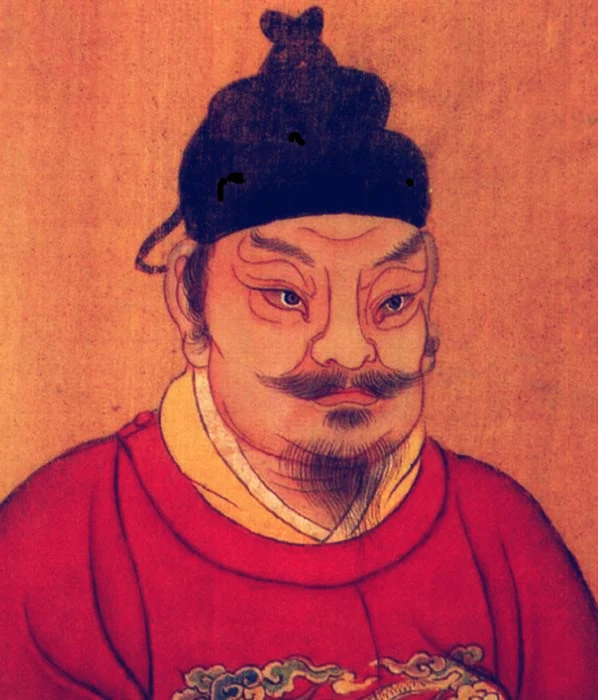
Later artistic depiction of Liu Zhiyuan in a historical painting or book illustration.
895 CE–948 CE
Emperor
Liu Zhiyuan
刘知远
Liu Zhiyuan (895–948), a Shatuo Turk from Taiyuan County, Taiyuan Prefecture (present-day Taiyuan, Shanxi), was the founding emperor of Later Han during the Five Dynasties period. After assuming the imperial title, he changed his personal name to Liu Gao. His temple name was Gaozu and his posthumous title was Ruiwen Shengwu Zhaosu Xiao Emperor. Born into a humble family, Liu Zhiyuan initially served as a common soldier under…
895 CE–948 CELater Han
PROFILE
Liu Zhiyuan (895–948), a Shatuo Turk from Taiyuan County, Taiyuan Prefecture (present-day Taiyuan, Shanxi), was the founding emperor of Later Han during the Five Dynasties period. After assuming the imperial title, he changed his personal name to Liu Gao. His temple name was Gaozu and his posthumous title was Ruiwen Shengwu Zhaosu Xiao Emperor. Born into a humble family, Liu Zhiyuan initially served as a common soldier under Li Siyuan, later Emperor Mingzong of Later Tang. He twice saved Shi Jingtang in battle and thereby won Shi's appreciation and became one of his trusted men. In 936, the third year of the Qingtai era of Later Tang, Liu Zhiyuan assisted Shi Jingtang in proclaiming himself emperor at Taiyuan and founding Later Jin. As a founding supporter of the new dynasty, Liu Zhiyuan successively held such important posts as commander of the palace cavalry and infantry, military governor at Yedu, military governor at Beijing (Taiyuan), and Military Commissioner of Hedong, and was enfeoffed as Prince of Taiyuan and later Prince of Beiping. After Emperor Chu of Later Jin, Shi Chonggui, came to the throne and relations with the Khitan deteriorated, Liu Zhiyuan remained in Hedong and watched events unfold. In 947, the fourth year of the Kaiyun era, the Khitan destroyed Later Jin. Liu Zhiyuan first submitted a memorial of allegiance to the Khitan, then took advantage of their withdrawal northward to proclaim himself emperor at Taiyuan and establish Later Han. He entered Bianjing later that year. In the first lunar month of 948, the first year of the Qianyou era, grief over the death of his eldest son Liu Chengxun contributed to a serious illness; he soon died in Wansui Hall after a reign of only a little more than one year. Later Han was the shortest-lived of the Five Dynasties, lasting only four years under two emperors. Although Liu Zhiyuan stabilized the Central Plains during his short reign, historical assessments have often been unfavorable because of his harsh penal policies and reputation for failing to keep faith.
Period
Five Dynasties · Later Han
Dynasty/Regime
Five Dynasties · Later Han
Identity
Emperor
Ethnicity/People
Shatuo Turks
Native Place
Taiyuan County, Taiyuan Prefecture (present-day Taiyuan, Shanxi)
Date of Birth
895
Place of Birth
Not recorded in historical sources
Date of Death
948
Reign
947–948
Predecessor
Emperor Chudi of Later Jin (Shi Chonggui)
Successor
Emperor Yin of Later Han (Liu Chengyou)
LIFE TIMELINE
Birth | Born in Taiyuan County, Taiyuan PrefectureOpen
Birth | Born in Taiyuan County, Taiyuan Prefecture
Youth | Entered the service of Li Siyuan of Later Tang as a common solOpen
Youth | Entered the service of Li Siyuan of Later Tang as a common soldier
Young adulthood | Served under Shi Jingtang as a senior gate officer; Open
Young adulthood | Served under Shi Jingtang as a senior gate officer; before this he had twice saved Shi Jingtang from danger in battle
Age forty-two | Urged Shi Jingtang to rebel against Later Tang; Shi prOpen
Age forty-two | Urged Shi Jingtang to rebel against Later Tang; Shi proclaimed himself emperor and founded Later Jin; Liu Zhiyuan became commander of the palace cavalry and infantry
Age forty-three | Appointed commander of the palace cavalry and infantOpen
Age forty-three | Appointed commander of the palace cavalry and infantry and concurrently Military Commissioner of Zhongwu
Age forty-four | Appointed commander of the palace guard cavalry and iOpen
Age forty-four | Appointed commander of the palace guard cavalry and infantry, transferred to Song Prefecture, and granted the title Participant in Determining Government Matters; angered at receiving the same honors as Du Chongwei, he initially refused and accepted only after He Ning delivered an imperial explanation
Age forty-six | Transferred to military governorship at Yedu while retOpen
Age forty-six | Transferred to military governorship at Yedu while retaining command of the palace guard cavalry and infantry
Age forty-seven | Appointed military governor at Beijing and Military Open
Age forty-seven | Appointed military governor at Beijing and Military Commissioner of Hedong
Age forty-eight | Emperor Gaozu of Later Jin, Shi Jingtang, died; Shi Open
Age forty-eight | Emperor Gaozu of Later Jin, Shi Jingtang, died; Shi Chonggui, Emperor Chu of Later Jin, succeeded; Liu Zhiyuan received the acting title of Grand Preceptor
Age fifty | Appointed campaign commander of the Youzhou route; defeateOpen
Age fifty | Appointed campaign commander of the Youzhou route; defeated the Khitan commander recorded as “Wei Wang” at Xinkou, was enfeoffed as Prince of Taiyuan, and concurrently became commander-in-chief of the northern expeditionary forces
Age fifty-one | Enfeoffed as Prince of BeipingOpen
Age fifty-one | Enfeoffed as Prince of Beiping
Age fifty-two | Given the title Defender-in-chief; killed Bai Chengfu Open
Age fifty-two | Given the title Defender-in-chief; killed Bai Chengfu and members of five Tuyuhun clans, totaling four hundred people; again defeated Khitan forces at Yangwu Valley in Shuo Prefecture
Age fifty-three | Proclaimed himself emperor at Taiyuan and founded LaOpen
Age fifty-three | Proclaimed himself emperor at Taiyuan and founded Later Han, while continuing to use the Tianfu era name as the twelfth year of Tianfu
Age fifty-three | Entered Bianjing, renamed the state Great Han, changOpen
Age fifty-three | Entered Bianjing, renamed the state Great Han, changed his personal name to Liu Gao, and proclaimed a general amnesty
Age fifty-three | Personally campaigned against Wei Prefecture, acceptOpen
Age fifty-three | Personally campaigned against Wei Prefecture, accepted Du Chongwei's surrender, and granted him the titles Acting Grand Preceptor, Grand Tutor, Secretariat Director, and Duke of Chu
Age fifty-four | Fell gravely ill after the death of his eldest son LiOpen
Age fifty-four | Fell gravely ill after the death of his eldest son Liu Chengxun; entrusted the heir to Shi Hongzhao, Wang Zhang, Su Fengji, Guo Wei, and others, and soon died in Wansui Hall
Burial | Buried at Rui Mausoleum; his son Liu Chengyou succeeded as EmOpen
Burial | Buried at Rui Mausoleum; his son Liu Chengyou succeeded as Emperor Yin of Later Han
BIOGRAPHY
Biography
Family Background and Early Years
Liu Zhiyuan was born in 895, the second year of the Qianning era of Emperor Zhaozong of Tang. He was a Shatuo Turk. He claimed descent from Liu Bing, the eighth son of Emperor Ming of Han, but later scholars have generally regarded this as a claim of affiliation with the imperial houses of the Han dynasties and have identified his actual ethnic origin with the Shatuo. His father Liu Tian was a junior military officer under Li Keyong, and the family was of modest standing. From childhood Liu Zhiyuan was calm and grave and had little interest in play. As an adult, sources describe him as having a purplish complexion, much visible white in his eyes, and an unusual appearance.
During Liu Zhiyuan's youth, Li Keyong and his son Li Cunxu controlled Taiyuan. Liu entered the army under Li Siyuan, Li Keyong's adopted son and the future emperor of Later Tang. Shi Jingtang was then one of Li Siyuan's commanders. In battle, Liu Zhiyuan twice risked his life to rescue Shi Jingtang from danger. Grateful for his service and impressed by his courage, Shi asked that Liu be retained in his own command and appointed him a senior gate officer. This experience established an unusually close relationship between Liu Zhiyuan and Shi Jingtang and began Liu's decades-long political association with him.
In 934, the first year of the Yingshun era of Later Tang, Emperor Min of Later Tang, Li Conghou, fled to Wei Prefecture. His discussions with Shi Jingtang had not reached a conclusion when the emperor's attendants attempted to use force. Liu Zhiyuan acted decisively, killed the attendants, and enabled Shi Jingtang to escape. The episode demonstrated Liu's decisiveness and loyalty at a critical moment.
In 936, the third year of the Qingtai era, Li Congke, the last emperor of Later Tang, ordered Shi Jingtang, then Military Commissioner of Hedong, transferred to Tianping in an apparent effort to strip him of his military base. Liu Zhiyuan and Sang Weihan strongly urged Shi to rebel. Shi accepted their advice and rose at Taiyuan. To obtain Khitan support, Shi decided to cede the Sixteen Prefectures of Yan and Yun and recognize Yelü Deguang as his father. Liu Zhiyuan disapproved. He argued that vassal submission to the Khitan would be sufficient and that calling their ruler “father” went too far; generous gifts of gold and silk could secure Khitan military aid without ceding territory, and territorial concessions would create endless future dangers. The source text presents later history as confirming the farsightedness of this judgment: the cession of the Sixteen Prefectures of Yan and Yun opened the northern approaches to the Central Plains and left later Chinese regimes without strong defensive barriers for centuries.
With Khitan support, Shi Jingtang destroyed Later Tang and founded Later Jin. As one of the founders of the new dynasty, Liu Zhiyuan successively held major offices including Acting Minister over the Masses, commander of the palace cavalry and infantry, and acting supervisor of the six accompanying armies and palace guards. When Yelü Deguang accompanied Shi Jingtang to Shangdang, he reportedly pointed at Liu Zhiyuan and told Shi that this commander was exceptionally formidable and should not be discarded without grave cause, showing that the Khitan ruler also recognized Liu's abilities.
Senior Minister of Later Jin and Commander in Hedong
After Later Jin was established, Liu Zhiyuan successively served as Military Commissioner of Shan Prefecture, Xu Prefecture, and Song Prefecture while continuing to command the imperial forces. In the tenth lunar month of 938, the third year of the Tianfu era, he became commander of the palace guard cavalry and infantry. In the eleventh month he was transferred to Song Prefecture and received the acting title of Grand Commandant; in the twelfth month he was granted the title Participant in Determining Government Matters. Because Du Chongwei received honors in the same decree, Liu Zhiyuan became angry, repeatedly declined the appointment, and shut himself in his residence for several days. Shi Jingtang was furious and summoned Grand Councilor Zhao Ying and others to discuss removing Liu's military authority. They opposed the idea, and the court instead sent He Ning, an academician of Duanming Hall, to explain the imperial intention. Only then did Liu accept. The episode reflects Liu's proud and obstinate character as well as the weight he carried at the Later Jin court.
In 940, Liu Zhiyuan was transferred to Yedu as military governor while concurrently retaining command of the palace guard cavalry and infantry. In 941, he became military governor at Beijing and Military Commissioner of Hedong. Hedong was the base from which Shi Jingtang had risen and one of the most important military centers of the Five Dynasties period. Liu's appointment there placed him among the most powerful subjects of the Later Jin state.
In 942, Shi Jingtang died and his adopted son Shi Chonggui, Emperor Chu of Later Jin, succeeded him. The new emperor broke with the Khitan and was wary of Liu Zhiyuan. To contain him while recognizing his standing, the court successively enfeoffed Liu as Prince of Taiyuan and Prince of Beiping and appointed him commander-in-chief of the northern expeditionary forces. Liu responded only selectively to court orders. On the one hand, he delayed and did not advance during some campaigns; on the other, he launched attacks when needed to protect his own position. In 944, the first year of the Kaiyun era, Yelü Deguang led a Khitan army south as far as Chan Prefecture and sent a commander called “Wei Wang” in the Chinese source through Yanmen Pass. As campaign commander of the Youzhou route, Liu Zhiyuan defeated this force at Xinkou and later again defeated the Khitan at Yangwu Valley in Shuo Prefecture, displaying considerable military ability.
The source text, however, characterizes Liu's principal aim during this period not as loyalty to Later Jin but as preserving his power in Hedong and preparing for kingship. He entrenched himself at Taiyuan with a strong army and watched developments in the Central Plains. In 946, the third year of the Kaiyun era, he killed the Tuyuhun leader Bai Chengfu and four hundred members of five clans, then placed the remaining people under Wang Yizong of another branch, removing potential rivals within Hedong.
Proclaiming Himself Emperor, Founding Later Han, and Final Years
In the first lunar month of 947, the fourth year of the Kaiyun era, the Khitan entered Bianjing, captured Shi Chonggui, Emperor Chu of Later Jin, and carried him north, bringing Later Jin to an end. On the first day of the second lunar month, Yelü Deguang proclaimed himself emperor in Bianjing and changed the state name to Great Liao. Liu Zhiyuan sent his gate officer Wang Jun to submit a memorial of allegiance to the Khitan. Yelü Deguang praised him in an edict, referred to Liu as a son, and awarded him a wooden staff, a valuable honor in Khitan custom reserved for important officials. Wang Jun carried the staff back, and the source says Khitan people stepped aside when they saw it. On his return, Wang Jun reported that Khitan government was disorderly and that it would be unable to hold the Central Plains. Liu Zhiyuan then began planning to establish his own regime.
Armed resistance to the Khitan was then breaking out across the Central Plains. He Jian, Military Commissioner of Qin Prefecture, submitted to Later Shu. The bandit leader Liang Hui in Ci Prefecture took Xiang Prefecture and came over to Liu. Shi Hongzhao, commander of a Wujie unit, seized Dai Prefecture and killed its prefect; the Jin Prefecture commander Yao Kechou killed the defending commander Luo Conglang and submitted. Zhao Hui, acting military governor of Shan Prefecture, and Wang Shou'en, acting military governor of Lu Prefecture, also came over. Zhang Yanwei, Hedong's Army Major, and other civil and military officers argued that the Central Plains lacked a ruler, Liu's prestige was growing, and popular sentiment was turning toward him. They sent a letter urging him to take the throne. Liu initially declined. After three rounds of petitions and repeated entreaties from officers, soldiers, nobles, and elders, he issued a proclamation accepting the request.
On February 15, 947, Liu Zhiyuan proclaimed himself emperor at Taiyuan and founded Later Han. He did not immediately change the dynastic designation. Instead, he abandoned the Kaiyun era name and continued the Later Jin Tianfu era as “the twelfth year of Tianfu,” explaining that he could not yet bear to forget Jin. He then prohibited the seizure of money and goods on behalf of the Khitan, rewarded local communities and armed groups that had resisted Liao, and ordered Khitan people in the circuits put to death. Former Jin officials consequently submitted to him in growing numbers.
Under continuing resistance from the population of the Central Plains, the Khitan were forced to withdraw northward. In June of the same year, Liu Zhiyuan led his army into Bianjing, changed the state name to Great Han, changed his personal name to Liu Gao, and proclaimed a general amnesty. He decisively followed Empress Li's advice and abandoned the previous practice of extracting money from the people to reward the army. Instead, he distributed all available palace wealth among the troops, winning their support. He then sent Shi Hongzhao south as the vanguard. The force advanced rapidly and soon secured Luoyang and Bianjing, stabilizing the Central Plains.
In the eleventh lunar month of the same year, Du Chongwei, Military Commissioner of Wei Prefecture, refused to obey a transfer order. Liu Zhiyuan sent Gao Xingzhou and Murong Yanchao against him, but the campaign made little progress. Liu then took personal command, and casualties were heavy. When supplies in Wei Prefecture were exhausted, Du Chongwei came out of the city and surrendered. Liu Zhiyuan kept his promise not to execute him and granted him the offices Acting Grand Preceptor, Grand Tutor, and Secretariat Director, together with the title Duke of Chu.
In the first lunar month of 948, the first year of the Qianyou era, Liu Zhiyuan became seriously ill after grieving over the death of his eldest son Liu Chengxun. Before his death he summoned Shi Hongzhao, Wang Zhang, Su Fengji, Guo Wei, and others and entrusted the young successor to them, particularly warning them to “guard carefully against Chongwei.” He soon died in Wansui Hall at the age of fifty-four. His posthumous title was Ruiwen Shengwu Zhaosu Xiao Emperor and his temple name Gaozu. His son Liu Chengyou succeeded as Emperor Yin of Later Han. Liu Zhiyuan was buried at Rui Mausoleum in the eleventh lunar month of 948.
Major Activities
Political Activities
Urging Shi Jingtang to rebel against Later Tang: In 936, the third year of the Qingtai era, the last Later Tang emperor ordered Shi Jingtang transferred to Tianping, intending to weaken his power. Liu Zhiyuan and Sang Weihan strongly urged Shi to rebel, helping bring about the founding of Later Jin. Liu was therefore one of the key figures in the establishment of the dynasty.
Opposing the cession of the Sixteen Prefectures of Yan and Yun: To secure Khitan aid, Shi Jingtang decided to cede the Sixteen Prefectures of Yan and Yun and recognize Yelü Deguang as his father. Liu Zhiyuan explicitly opposed the arrangement, arguing that vassal submission was sufficient, filial submission unnecessary, and generous gifts preferable to territorial concessions. His advice was not accepted, but the source presents it as evidence of political foresight.
Proclaiming himself emperor at Taiyuan and founding Later Han: After the Khitan destroyed Later Jin, Liu Zhiyuan first sent a submission to them as a temporary expedient. When the Khitan withdrew north and the Central Plains lacked a ruler, he proclaimed himself emperor at Taiyuan in the second lunar month of 947 and established Later Han. He entered Bianjing in June and stabilized the Central Plains.
Entrusting the succession before death: In 948, when seriously ill, Liu Zhiyuan summoned Shi Hongzhao, Wang Zhang, Su Fengji, Guo Wei, and others to serve as guardians of his heir and especially warned them to watch Du Chongwei. Du Chongwei was executed not long after Liu's death.
Defeating the Khitan at Xinkou: In 944, Liu Zhiyuan, serving as campaign commander of the Youzhou route, defeated the Khitan commander recorded as “Wei Wang” at Xinkou, one of the relatively few Later Jin successes against the Khitan in the dynasty's final years.
Defeating the enemy at Yangwu Valley in Shuo Prefecture: In 946, Liu Zhiyuan personally led his elite troops to Yangwu Valley in Shuo Prefecture and heavily defeated the Khitan army.
Pacifying the Central Plains: After proclaiming himself emperor, he accepted Guo Wei's proposal to move south along the Fen River, seize Henan, and then contend for the realm. He sent Shi Hongzhao as the vanguard; the army advanced rapidly and soon took Luoyang and Bianjing.
Campaign against Du Chongwei: In 947, the twelfth year of Tianfu, Du Chongwei resisted orders at Wei Prefecture. Liu Zhiyuan personally campaigned against him and, after a prolonged siege, accepted his surrender and enfeoffed him as Duke of Chu.
Governance Measures
Tax remissions: After entering Bianjing, Liu Zhiyuan proclaimed a general amnesty and remitted taxes. Within one hundred li of the eastern and western capitals, the summer tax for that year was remitted; outside that radius and within the capital, half of that year's house tax was remitted.
Harsh criminal laws:Liu Zhiyuan's government imposed severe penalties. If a privately owned ox died, its hide had to be surrendered to the authorities, and violation was punishable by death. Another rule provided that anyone privately trading salt, alum, or fermentation starter for alcohol would be executed regardless of quantity.
Execution of rivals: In 946, he killed Bai Chengfu and four hundred members of five Tuyuhun clans, then placed the remaining people under Wang Yizong of another branch.
Relations with Contemporaries
Liu Zhiyuan's relationship with Shi Jingtang was especially significant. He progressed from saving Shi's life in battle to becoming a founding supporter of Later Jin and later a powerful regional commander in Hedong. Liu disapproved of Shi's decision to cede territory and accept a father-son relationship with the Khitan ruler, but he did not openly break with him. Shi both trusted and feared Liu. In 938, when Liu refused the title Participant in Determining Government Matters, Shi became so angry that he considered removing Liu's command.
Liu Zhiyuan's relationship with Du Chongwei was tense. Both were senior Later Jin officials. Liu's anger when the two received honors together in 938 shows that he resented being placed on the same level as Du. Later, after Du surrendered first to the Khitan and then to Later Han, Liu accepted his surrender and granted him honors but still warned his guardians shortly before death to “guard carefully against Chongwei.”
Liu Zhiyuan's relationship with Guo Wei was also important. Guo served as a major adviser and played a key role in Liu's accession and southward advance into Henan. Liu entrusted the heir to Guo Wei before his death, but Guo later overthrew Later Han and founded Later Zhou, something the source notes Liu could not have anticipated.
Personal Relations
Father: Liu Tian, a junior military officer under Li Keyong
Wife: Empress Li, who advised Liu Zhiyuan to reward the troops with palace wealth
Younger brother: Liu Chong, Military Commissioner of Hedong and later founder of Northern Han
Younger brother: Liu Xin, Military Commissioner of Zhongwu, who killed himself after Guo Wei seized power
Younger brother: Murong Yanchao, his younger maternal half-brother
Eldest son: Liu Chengxun, mayor of Kaifeng, who died early and was posthumously made Prince of Wei
Du Chongwei: senior Later Jin official; Liu Zhiyuan resented receiving equal honors with him, and later accepted his surrender after Du resisted at Wei Prefecture
Shi Hongzhao: Liu Zhiyuan's commander and later one of the regents for his heir
Wang Zhang: Later Han regent entrusted with the heir
Su Fengji: Later Han regent entrusted with the heir
Wang Jun: gate officer under Liu Zhiyuan who served as envoy to the Khitan
Zhang Yanwei: Army Major of Hedong who urged Liu Zhiyuan to proclaim himself emperor
Historical Assessment
Five Dynasties / Contemporary Period
After founding Later Han, Liu Zhiyuan stabilized the Central Plains in a short time, but his harsh laws and punishments also drew dissatisfaction. Yelü Deguang was reported to have praised him as an exceptionally formidable commander who should not be abandoned without serious reason, indicating respect for his abilities. Liu's final warning to his regents to “guard carefully against Chongwei” shows that even at death he remained concerned about powerful military figures.
Song and Yuan Periods
Xue Juzheng and the other compilers of the *Old History of the Five Dynasties* wrote that Liu Zhiyuan seized the imperial position in a vacuum and formed imperial ambitions amid disorder. Although human planning was involved, they regarded Heaven's favor as part of the explanation. They nevertheless criticized his earlier reputation while commanding a frontier region and his inability, after accession, to satisfy popular expectations, concluding that although he bore the name of a ruler who had risen with the times, he did not display the full virtue of a sovereign.
Sima Guang, in the *Comprehensive Mirror in Aid of Governance*, judged Liu Zhiyuan harshly. He criticized him for killing 1,500 innocent people in You Prefecture, for luring Zhang Lian and then executing him, and for pardoning Du Chongwei despite his grave crimes. Sima Guang argued that a ruler needed benevolence to unite the people, trustworthiness to make orders effective, and punishment to restrain criminals; having failed in all three, Liu could not preserve his state, and the short life of his dynasty was therefore unsurprising.
Ouyang Xiu, in the *New History of the Five Dynasties*, included Liu Zhiyuan in the imperial annals but repeatedly criticized his conduct, especially his decision to keep his troops back while Emperor Chu of Later Jin was captured, thereby watching the destruction of his former ruler and failing the moral obligations between ruler and subject.
Ming and Qing Periods
Wang Fuzhi, in *Du Tongjian Lun*, assessed Liu Zhiyuan more favorably, arguing that Liu's intelligence far surpassed Shi Jingtang's and that after Li Cunxu he was the only figure capable of devising a grand strategy and establishing himself independently. Wang interpreted Liu's encouragement of Shi's rebellion as serving Liu's own long-term plan: Shi's uprising weakened Later Tang, while Shi himself absorbed the costs of relations with the Khitan, leaving Liu eventually able to benefit from the situation. Wang also praised Liu's patient strategy of strengthening Taiyuan, training troops, watching changes, and then advancing when the moment came. Even so, he acknowledged that Liu was ultimately unable to secure a lasting dynasty and that even a ruler who seized power amid fragmentation could not rely on intelligence and force alone.
Modern Period
Modern historical scholarship often evaluates Liu Zhiyuan against the background of the disorder of the Five Dynasties. Some scholars have noted that by founding Later Han after the Khitan destroyed Later Jin, Liu objectively ended the brief period of Khitan rule over the Central Plains and restored a Han Chinese regime there. Later Han nevertheless survived only four years, the shortest span of the Five Dynasties. The source links this fragility directly to harsh government under Liu and his successor and to a weak political foundation. Liu's practice of entrenching himself in Hedong and waiting to see which side prevailed has also been treated as a typical strategy of military self-preservation in Five Dynasties politics.