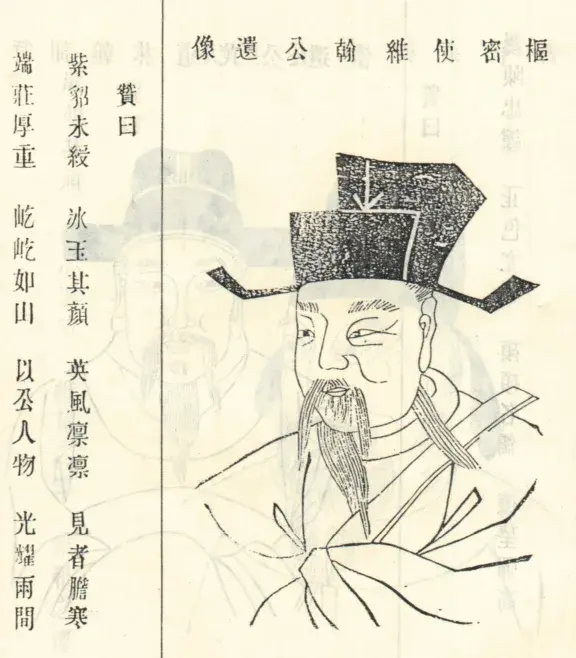
Biography
The Iron Inkstone Vow and Service in Shi Jingtang's Headquarters
Sang Weihan, courtesy name Guoqiao, was a native of Luoyang in Henan Prefecture whose father Sang Gong served as a guest-retainer general (kejiang) under Zhang Quanyi, Governor of Henan. Exceptionally intelligent from childhood and skilled in composing rhapsodies (cifu), Sang Weihan was short of stature with an unusually broad, homely face. Upon reaching adulthood, he often gazed into a mirror and sighed: "How can a seven-foot body be inferior to a one-foot face!" From then on he resolved to rise to the chancellorship. When he first sat for the jinshi examination, the chief examiner disliked his surname "Sang" because it was a homophone for "mourning" (sang) and failed him. When acquaintances advised him to abandon the examinations and seek office through other channels, Sang Weihan composed the Rhapsody on the Sun Rising from Fusang (Richu Fusang Fu) to declare his resolve and cast an iron inkstone (tieyan), showing it to others with the vow: "When this inkstone is worn through, I shall change course and seek office by another path!" In the third month of the third year of the Tongguang era (925 CE) of Later Tang, with the backing and recommendation of Zhang Quanyi, Sang Weihan passed the jinshi examination in second place.
In the second year of the Changxing era (931 CE) of Emperor Mingzong of Later Tang, the emperor's son-in-law Shi Jingtang was appointed Military Commissioner of Heyang and recruited Sang Weihan into his headquarters as Chief Secretary (zhangshuji). As Shi Jingtang was subsequently transferred to the military governorships of Hedong and Chengde, Sang Weihan accompanied him everywhere, drafting confidential correspondence and becoming his most trusted strategist. In the fifth month of the third year of the Qingtai era (936 CE), the Last Emperor of Later Tang (Li Congke), suspicious of Shi Jingtang's military power at Taiyuan, issued an edict transferring him to Tianping Circuit in Yunzhou. Alarmed, Shi Jingtang convened his advisers: while Duan Xiyao urged defiance and Zhao Ying counseled compliance, Chief Commander Liu Zhiyuan and Sang Weihan strongly advocated rebelling to seize the throne. Sang Weihan further proposed seeking military aid from the Khitan Empire to the north, arguing that if Shi Jingtang humbled himself and served the Khitan ruler Yelu Deguang with wholehearted deference, their enterprise would surely succeed.
Adopting Sang Weihan's counsel, Shi Jingtang instructed him to draft a memorial to Yelu Deguang offering to become a vassal, address the Khitan monarch as "Father Emperor," cede the Lulong Circuit and all prefectures north of Yanmen Pass (the Sixteen Prefectures of You and Yun), and pay an annual tribute of 300,000 bolts of silk. Despite Liu Zhiyuan's objection that such terms were excessively humiliating, Shi Jingtang dispatched the memorial. In the ninth month, Yelu Deguang led 50,000 cavalry south to relieve Taiyuan, crushing the Later Tang army at Fenqu and besieging the Tang commander Zhang Jingda at Jin'an Stockade; in the eleventh month, Yelu Deguang invested Shi Jingtang as Emperor of Great Jin (initiating the Tianfu era), and Sang Weihan was appointed Hanlin Academician, Vice Minister of Rites, and Acting Privy Councilor.
In the intercalary eleventh month, the Later Tang commander Zhao Dejun, who had halted his relief force in hopes of bargaining for the throne himself, secretly sent envoys to Yelu Deguang asking Khitan support to make him emperor. Fearing that Zhao Dejun might block his return north, Yelu Deguang wavered. Dispatched urgently by a terrified Shi Jingtang, Sang Weihan knelt before Yelu Deguang's tent from morning until evening, weeping as he argued that Zhao Dejun was a cowardly opportunist unworthy of trust and urging the Khitan ruler to uphold his word before the world. Moved, Yelu Deguang pointed to a boulder before his tent and declared to Zhao Dejun's envoy: "I have already given my promise to Master Shi; only when this stone rots can it be changed!" Shortly thereafter, deputy commander Yang Guangyuan killed Zhang Jingda and surrendered, sealing the fall of Later Tang. At Yelu Deguang's express recommendation, Shi Jingtang appointed Sang Weihan Vice Director of the Secretariat, Joint Manager of Affairs with the Secretariat-Chancellery, Grand Academician of the Jixian Hall, and Privy Councilor, and upon entering Luoyang ordered him to compose an inscription commemorating Yelu Deguang's merits.
First Chancellorship and Governance of Three Provincial Circuits
Confirmed as substantive Privy Councilor concurrently with his chancellorship in the first month of the second year of Tianfu (937 CE), Sang Weihan presented a five-point state policy to Shi Jingtang: "extend sincerity and put aside old grudges to pacify the regional military governors; use humble words and generous gifts to serve the Khitan; train soldiers and repair weapons to strengthen military readiness; promote agriculture and sericulture to fill the granaries; and facilitate commerce to enrich goods and revenues." In the sixth month, when Military Commissioner of Tianxiong Fan Yanguang rebelled at Weizhou and Zhang Congbin rose up at Luoyang and advanced on Sishui, panic gripped the court at Daliang (Kaifeng). While Shi Jingtang contemplated fleeing back to Taiyuan, Sang Weihan calmly directed military operations, received guests with his usual composure, and kowtowed to dissuade the emperor from retreating, stabilizing morale until the rebellions were crushed.
During the campaign against Fan Yanguang, the overbearing general Yang Guangyuan repeatedly made exorbitant demands that Sang Weihan rejected in accordance with the law. Incited by Palace Commissioner Liu Churang—who resented the chief ministers' concurrent control of the Privy Council—Yang Guangyuan submitted a secret memorial criticizing Sang Weihan after Fan Yanguang's surrender in 938 CE. Yielding to Yang Guangyuan's military clout, Shi Jingtang relieved Sang Weihan and Li Song of their Privy Councilor posts in the tenth month. Recognizing Yang Guangyuan as a menace to the throne, Sang Weihan advised Shi Jingtang to divide the Tianxiong garrison and transfer Yang Guangyuan to Luoyang, provoking Yang Guangyuan to impeach Sang Weihan in 939 CE for unfair appointments and operating commercial shops in the two capitals. In the intercalary seventh month of the fourth year of Tianfu (939 CE), Shi Jingtang sent Sang Weihan out as Military Commissioner of Zhangde Circuit at Xiangzhou.
Across three successive provincial governorships, Sang Weihan distinguished himself as an able administrator. In Xiangzhou, he petitioned to abolish the harsh Heshuo custom of confiscating the entire family property of arrested thieves, prompting an imperial edict that banned the practice across all prefectures of the empire, and he eliminated more than twenty local abuses. Transferred in the third month of the fifth year of Tianfu (940 CE) to Military Commissioner of Taining Circuit at Yanzhou, he captured over a thousand entrenched bandits across the Yanzhou and Haizhou region. In the sixth month of the sixth year of Tianfu (941 CE), when Military Commissioner of Chengde An Chongrong agitated for war against the Khitan, Sang Weihan foresaw his rebellion and secretly submitted a comprehensive memorial setting forth the "Seven Impossibilities" (qibuke) of attacking the Khitan—analyzing troop morale, armor and horses, command talent, strategic balance, and fiscal exhaustion—while urging Shi Jingtang to focus on training soldiers and resting the populace until the state grew strong, and advising an immediate imperial progress to Yedu to deter An Chongrong. Shi Jingtang followed his advice, and An Chongrong's revolt at year's end was swiftly crushed. Appointed Military Commissioner of Jinchang Circuit at Jingzhao in the sixth month of 942 CE, Sang Weihan climbed Mount Hua upon arrival to pray for rain during a severe drought, which was answered that very day.
Second Tenure at the Center and Martyrdom at the Fall of Later Jin
Following Shi Jingtang's death in the sixth month of 942 CE, his adoptive son Shi Chonggui (Emperor Chu) recalled Sang Weihan in the third month of the eighth year of Tianfu (943 CE) as President of the Chancellery and Supervisor of National History. At the time, Commander of the Imperial Guard Jing Yanguang dominated the court and provoked a rupture with the Khitan by sending a letter styling the Later Jin ruler "Grandson" rather than "Subject," overriding Sang Weihan's repeated pleas for peace. After the Khitan invasion of spring 944 CE and the Battle of Chanzhou, Sang Weihan persuaded Shi Chonggui to transfer Jing Yanguang out to Luoyang for failing to relieve Qicheng; in the sixth month (now the first year of the Kaiyun era), the Privy Council was restored and Sang Weihan was appointed Director of the Secretariat, Privy Councilor, Grand Academician of the Hongwen Institute, and Grand Mentor to the Crown Prince, and created Duke of Wei in the seventh month.
Entrusted by Shi Chonggui with full authority over state affairs, Sang Weihan restored order within a few months. Renowned for his stern and imposing demeanor, he awed the most arrogant generals of the era; in a single decree he appointed and deployed fifteen military commissioners to commands against the Khitan without a single commander daring to disobey, and when Military Commissioner of Shuofang Feng Hui nervously inquired why he had been omitted from the roster, Sang Weihan drafted a gracious rescript explaining that Feng Hui's prestige was indispensable on the northwestern frontier, winning his gratitude. When the court sought to appoint his sons Sang Tan and Sang Xun as Supernumerary Gentleman and Secretary of the Palace Library by hereditary privilege, Sang Weihan firmly declined on the grounds that the Han custom of naming sons of the Three Ducal Ministers as court gentlemen had long been abandoned, accepting only minor judicial and Proofreader posts for them. At the same time, however, bribes poured into his mansion from across the realm so that he amassed vast wealth within a year, and when he restored the Hanlin Academy he staffed it entirely with his own cronies; moreover, he was notorious for repaying every slight, persecuting Chen Baoji—who had once joked that Sang Weihan's ugly appearance made four new jinshi graduates "three and a half men"—and stripping Prince Ma Xifan of Chu of half his ceremonial insignia for having laughed at him in his youth.
Alienated from the emperor's favorites Feng Yu and Li Yantao, Sang Weihan saw his authority curtailed in the second month of the second year of Kaiyun (945 CE) when Feng Yu was named co-Privy Councilor, and in the eighth month Feng Yu was made a chief minister. After Sang Weihan refused to sign an appointment certificate by which Feng Yu irregularly promoted Drafter Lu Jia to Vice Minister of Works, their feud intensified. In the twelfth month of 945 CE, when Sang Weihan sent a maidservant to inquire after the Empress Dowager's health and asked whether the emperor's young brother Shi Chongrui was studying and needed a tutor, Feng Yu insinuated to the ailing Shi Chonggui that Sang Weihan harbored plans to depose him. Alarmed, Shi Chonggui removed Sang Weihan from the chancellorship and made him Prefect of Kaifeng, whereupon Sang Weihan pleaded foot trouble and withdrew from court audiences.
In the twelfth month of the third year of Kaiyun (January 947 CE), as Khitan armies advanced to Zhongdu Bridge on the Hutuo River, Sang Weihan went to the Secretariat to warn the chief ministers and knocked at the palace gate requesting an audience to urge Emperor Chu to take the field in person to steady the army's morale; the emperor, occupied with training falcons in the rear park, refused to see him until nightfall. Returning home, Sang Weihan lamented to his intimates that unless Heaven's Mandate remained unchanged, judging by human affairs the ancestral sacrifices of the House of Jin were about to end. On the tenth day of the twelfth month, Commander-in-Chief Du Chongwei (Du Wei), Li Shouzhen, and Zhang Yanze surrendered the main Later Jin army to the Khitan; at dawn on the sixteenth day, Zhang Yanze led vanguard cavalry into Kaifeng amid fire and mutiny. Refusing his attendants' pleas to flee, Sang Weihan declared, "I am a great minister of the state; where should I flee?" and sat calmly in his prefectural office.
Fearing that Sang Weihan would expose his responsibility for breaking the peace with the Khitan, Shi Chonggui secretly ordered Zhang Yanze to silence him, while Zhang Yanze also coveted Sang Weihan's vast wealth. When Zhang Yanze burst into the Kaifeng prefectural compound with armed troops, Sang Weihan took his seat in the main hall and sternly rebuked him: "What merit do you have that you wear the titles of a military governor and chief minister, yet in the hour of national peril fail to exert even the strength of a dog or horse to repay the state, instead betraying your sovereign to aid foreign invaders as a rebel and bandit—can your heart be at peace?" Trembling and unable to look up, Zhang Yanze retreated, remarking that even in defeat Sang Weihan's majesty remained unapproachable. When Sang Weihan rode out to Imperial Street and met President of the Chancellery Li Song, soldiers escorted him to the Imperial Guard Headquarters; looking back at Li Song, he asked why Li Song, who held the reins of state, let him go to his death when the dynasty fell. On the night of the eighteenth day (January 12, 947 CE), Zhang Yanze sent strongmen to strangle him at the age of forty-nine, placing a sash around his neck to report to Yelu Deguang that he had hanged himself. Yelu Deguang ordered his family consoled and their estates protected, and in 947 CE Emperor Gaozu of Later Han (Liu Zhiyuan) posthumously honored him as Director of the Department of State Affairs.