Birth in Yaoshan
Born on September 10 in Xingzhou; father Guo Jian dies in battle against Liu Rengong; mother dies during migration to Luzhou.
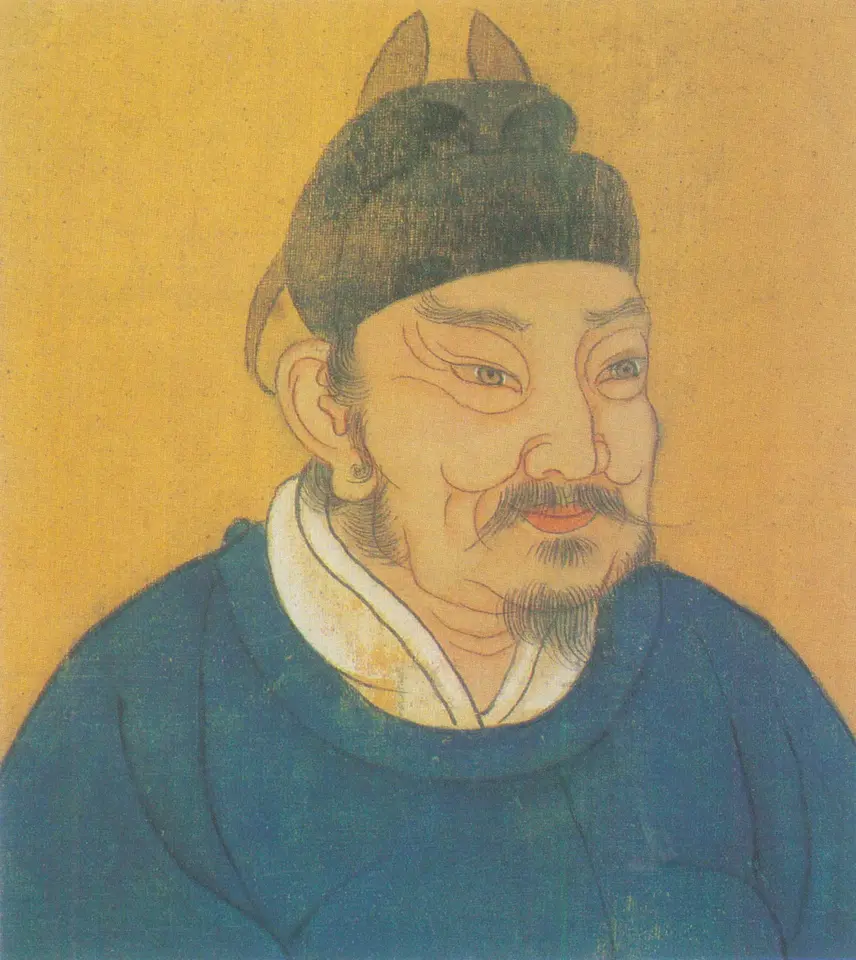
904 CE–954 CE
郭威
Guo Wei (郭威, September 10, 904 – February 22, 954), courtesy name Wenzhong and famously known by his childhood moniker Guo Que'er ("Guo the Sparrow"), was the founding emperor of the Later Zhou dynasty, the final and most consequential of the Five Dynasties. Born in Xingzhou to a military family, Guo Wei lost both parents in childhood during the chaotic warlord wars of the late Tang and was raised in poverty by his maternal…
Guo Wei (郭威, September 10, 904 – February 22, 954), courtesy name Wenzhong and famously known by his childhood moniker Guo Que'er ("Guo the Sparrow"), was the founding emperor of the Later Zhou dynasty, the final and most consequential of the Five Dynasties. Born in Xingzhou to a military family, Guo Wei lost both parents in childhood during the chaotic warlord wars of the late Tang and was raised in poverty by his maternal aunt in Luzhou. Enlisting as a young guardsman with a sparrow tattooed upon his neck, Guo Wei developed an imposing physique and distinguished himself by studying classical military manuals such as the Art of War. He subsequently rose through the ranks to become the chief military strategist and indispensable commander for Liu Zhiyuan, whom he persuaded to establish the Later Han dynasty in 947. Following Liu Zhiyuan's death, Guo Wei was appointed Commissioner of Military Affairs, single-handedly rescuing the dynasty by quelling the massive rebellion of Li Shouzhen and two allied military governors across the northwest. However, his soaring prestige provoked the paranoid hostility of the young Later Han emperor Liu Chengyu, who staged a bloody purge in 950, slaughtering Guo Wei's wives, young children, and infant kin in Kaifeng. Forced into armed rebellion to survive, Guo Wei routed imperial forces and was proclaimed emperor in a famous incident at Chanzhou where troops wrapped him in a yellow military banner. Ascending the throne in 951, Guo Wei initiated profound structural reforms: he abolished the oppressive State Agricultural Estates (Yingtianwu), distributing land and cattle directly to peasant tenant farmers; eliminated cruel corporal punishments; smashed luxury palace jade in full court to mandate imperial frugality; patronized Confucian scholarship by restoring the ancestral temple of Confucius; and laid the institutional foundation for the imperial Palace Guard. Dying in 954 at age fifty-one, Guo Wei bequeathed the throne to his capable adoptive nephew Chai Rong (Emperor Shizong) and ordered his own frugal burial in an unadorned clay-coffin tomb, establishing the political and military springboard for the Song unification of China.
Born on September 10 in Xingzhou; father Guo Jian dies in battle against Liu Rengong; mother dies during migration to Luzhou.
Tattoos a sparrow on his neck; slays an oppressive butcher in Luzhou; enlists as a guardsman under Li Jitao.
Persuades Liu Zhiyuan to declare imperial title in Taiyuan following Khitan devastation; leads vanguard to retake Kaifeng; appointed Vice Commissioner.
Promoted to Commissioner of Military Affairs; besieges and captures Hezhong, crushing Li Shouzhen, Zhao Siwan, and Wang Jingchong.
Later Han emperor massacres Guo Wei's family in Kaifeng; Guo marches south; soldiers drape him in yellow banners at Chanzhou.
Enthroned on February 13 in Kaifeng, adopting the dynastic name Zhou and era name Guangshun; posthumously honors Lady Chai as Empress.
Dissolves the Yingtianwu bureau, transferring official farmlands and draft cattle directly to destitute peasant cultivators.
Personally performs the Imperial Plowing ceremony in Kaifeng; visits Qufu to perform full kowtows before Confucius's tomb, ordering temple restoration.
Shatters imperial jade vessels with an iron hammer before assembled ministers; restructures Palace Guard command into dual inspectorates.
Adopts era name Xiande; creates Chai Rong Prince of Jin; dies on February 22 at age fifty-one; interred in a clay coffin at Songling.
Guo Wei was born on September 10, 904, in Yaoshan, Xingzhou (modern Longyao, Hebei Province). His father, Guo Jian, served the Shatuo warlord Li Keyong as the prefectural governor of Shunzhou (modern Shunyi, Beijing). During the violent territorial expansion of Liu Rengong, the warlord of Youzhou, Shunzhou was stormed and Guo Jian was killed in combat. Guo Wei was merely an infant at the time. His mother, Lady Wang, carried the child toward Luzhou in Shanxi, but perished from illness and deprivation along the road. The orphaned boy was taken in by his maternal aunt, Lady Han, who raised him in austere poverty.
Growing into a towering, muscular youth with extraordinary physical strength, Guo Wei exhibited a fearless, chivalrous disposition. In his youth, he had an image of a sparrow tattooed upon his neck, earning him the lifelong popular nickname "Guo Que'er" ("Guo the Sparrow") among commoners and garrison soldiers. In his late teens, Guo Wei enlisted as a bodyguard under Li Jitao, the military governor of Zelu. While walking through the market in Luzhou, Guo encountered an arrogant butcher who terrorized local shopkeepers and extorted patrons. Boldly confronting the butcher after drinking wine, Guo demanded specific meat cuts and rebuked his insolence. When the enraged butcher bared his chest and dared Guo to stab him, Guo drew his dagger and pierced his chest, killing him on the spot. Guo calmly surrendered to the authorities. Impressed by his audacity and sense of justice, Li Jitao pardoned his offense and retained him in his personal retinue.
Following Li Jitao's defeat and execution by Emperor Zhuangzong of Later Tang in 923, Guo Wei was incorporated into the imperial cavalry guard known as the Congmazhi. Recognizing that raw physical prowess was insufficient for enduring statecraft, Guo studied military history, mastered Sun Bin's Art of War, and examined classical texts under educated army scribes. He later transferred to the service of Shatuo generals Shi Jingtang and Liu Zhiyuan, who quickly came to value his operational genius and political foresight.
In 947, the Khitan army under Emperor Taizong of Liao sacked Kaifeng, capturing the last emperor of Later Jin and laying waste to the Central Plains. Amidst widespread panic and confusion, Guo Wei urged Liu Zhiyuan, then governor of Hedong based in Taiyuan, to seize the historical mandate: "The Khitans are savage pillagers who have alienated all Chinese populations. Nomadic cavalry cannot hold the central agricultural basin indefinitely. Hedong possesses impregnable passes and elite troops; Your Excellency must immediately assume the imperial title and march south to restore order!" Liu Zhiyuan followed Guo's counsel, proclaiming the Later Han dynasty. Guo Wei directed the vanguard offensive, clearing Khitan raiding parties and securing Kaifeng. In reward, Liu Zhiyuan appointed Guo Vice Commissioner of Military Affairs.
In January 948, Liu Zhiyuan died, leaving the throne to his teenage son Liu Chengyu (Emperor Yindi). In his deathbed testament, Liu Zhiyuan promoted Guo Wei to Commissioner of Military Affairs, entrusting him with supreme military command over the empire alongside chancellor Yang Bin and commander Shi Hongzhao.
Shortly after the accession, three powerful frontier warlords—Li Shouzhen at Hezhong, Zhao Siwan at Chang'an, and Wang Jingchong at Fengxiang—rose in concerted rebellion, threatening to tear the young dynasty apart. Imperial armies sent to quell the uprising suffered repeated reverses. Confronting dynastic collapse, Emperor Yindi dispatched Guo Wei to assume personal command of the western front.
Arriving at Hezhong, Guo rejected reckless frontal assaults, implementing a patient strategy of deep entrenchments, circumvallation, and economic blockade. He constructed continuous siege walls and dikes encircling Hezhong, severing all external food supplies while issuing generous pardons to defecting rebel soldiers. After a grueling one-year siege, Hezhong's granaries were exhausted. In July 949, Guo ordered a general assault, storming the fortress and forcing Li Shouzhen to immolate his entire family. Guo then marched rapidly across the Guanzhong region, compelling Zhao Siwan and Wang Jingchong to capitulate. The suppression of the three rebellions elevated Guo Wei to supreme military stature, earning him appointment as Military Commissioner of Tianxiong and Regent of Yedu (modern Daming, Hebei).
Guo Wei's immense popularity and military control over the northern borderlands stoked profound paranoia within the young Later Han emperor and his inner clique. In November 950, Emperor Yindi staged a bloody palace coup, ambushing and executing chancellors Yang Bin, Shi Hongzhao, and Wang Zhang during a dawn court audience.
Simultaneously, Yindi unleashed a monstrous purge against Guo Wei's family members remaining in Kaifeng. Imperial executioners slaughtered Guo Wei's three young sons (Guo Qingge, Guo Yige, and an infant), all his daughters, and the infant children of his adoptive nephew Chai Rong, butchering dozens of innocent relatives. Yindi then sent secret orders to generals in Yedu to assassinate Guo Wei in his military headquarters.
Receiving intelligence of the massacre and the assassination decree, Guo Wei was overcome with devastating grief. Urged on by his outraged officers, who feared identical purges, Guo raised the banner of righteous rebellion, marching south under the slogan of clearing the court of treacherous sycophants. Imperial forces disintegrated at the Battle of Liuzibei, and Emperor Yindi was slain by his own attendants during his flight.
In December 950, as Guo Wei reached Chanzhou (modern Puyang, Henan), thousands of frontier soldiers surrounded his command pavilion shouting imperial acclamations. An officer stepped forward, tore down the large yellow silk flag from the camp banner pole, and wrapped it around Guo Wei's shoulders. The assembled legions dropped to their knees, hailing him as the Son of Heaven. This iconic Chanzhou Mutiny set the historic precedent for the famous Chenqiao Mutiny staged a decade later by Zhao Kuangyin.
On February 13, 951, Guo Wei formally ascended the imperial throne in the Chongyuan Hall in Kaifeng, establishing the Later Zhou dynasty and adopting the era name Guangshun. He posthumously honored his deceased first wife Lady Chai as Empress Shengmu, creating his second wife Lady Yang as Noble Consort.
Having risen from the absolute bottom of the social hierarchy, Guo Wei understood that the rapid collapse of prior dynasties stemmed from military tyranny, extortionate taxation, and the moral corruption of the ruling elite. He immediately launched an ambitious program of structural reform to restore agrarian production and institutional discipline.
He abolished the notorious State Agricultural Estates (Yingtianwu), which had treated tenant farmers as state serfs subject to arbitrary extraction. By imperial decree, all estate lands, draft oxen, and agricultural tools were distributed unconditionally to cultivating peasant households, converting hundreds of thousands of impoverished tenants into tax-paying freeholders. Furthermore, he abolished arbitrary commercial surcharges, suppressed banditry, and drastically reduced land taxes across the war-torn Central Plains.
In his personal governance, Guo Wei exhibited a level of moral restraint and frugality unmatched among Five Dynasties sovereigns. Disgusted by the imperial luxury that bankrupted preceding regimes, Guo banned all precious luxury tributes from the provinces. He ordered the entire imperial treasury collection of ancient jade vessels, golden chalices, and carved ivory curiosities brought into the palace courtyard. Before his assembled civil and military ministers, Guo took an iron sledgehammer and personally smashed the priceless treasures into dust, proclaiming: "A true sovereign relies on the peace and prosperity of his subjects! While commoners suffer from hunger and cold, how could I indulge in useless toys? Let anyone who presents such baubles henceforth be punished for treason!"
In judicial affairs, Guo dismantled the brutal penal customs inherited from warlord administrations. He banned mutilating corporal punishments such as nose-cutting, foot-amputation, and face-branding, while formally outlawing the barbarous practice of collective family execution (lianzuo) for ordinary offenses. He ordered all capital cases thoroughly investigated and reviewed by the Court of Judicial Review, establishing a humane legal standard that directly inspired the foundational legal codes of the Song dynasty.
In January 954, the fifty-year-old emperor fell gravely ill. Having lost all his biological children in the Kaifeng massacre, Guo Wei resolved to prioritize talent and virtue over kinship in selecting an imperial successor. His most trusted and capable commander was his adoptive son and nephew Chai Rong (later Emperor Shizong), the nephew of late Empress Chai. On February 17, Guo Wei created Chai Rong Prince of Jin, officially investing him with state power.
On his deathbed, Guo Wei grasped Chai Rong's hand and issued his extraordinary funeral testament: "I rose from common soldiering and experienced the miseries of this broken world. When I die, do not waste the people's substance on an extravagant tomb! Build my grave with simple kiln bricks, use only a plain earthenware clay coffin, and shroud my body in coarse hemp cloth. Bury no gold, silver, or jewels in the earth, and erect no massive stone statues along the avenue!" To safeguard against future tomb robbers, Guo ordered a stone tablet carved and placed before his burial mound bearing this public pledge: "By decree of Later Zhou Taizu: Buried here in an earthenware coffin and clay vessel; tomb robbers will find neither gold nor silver, earning only the retribution of Heaven!"
On February 22, 954, Guo Wei died peacefully in his palace at age fifty-one. Chai Rong honored every word of his testament, laying him to rest in the austere Songling Mausoleum in Xinzheng, Henan. Though reigning for only three years and eight months, Guo Wei cleared away the barbarism of the Five Dynasties, inaugurating an era of cultural revitalization and good government that paved the way for the enduring unification of China.
Throughout the Five Dynasties, imperial authority was held hostage by insubordinate palace armies who routinely deposed monarchs and extorted gifts. Having attained power through a military mutiny himself, Guo Wei was determined to dismantle the structural menace of warlord praetorianism.
He divided central military command into two parallel, mutually checking institutions: the Palace Guard Bureau (Dianqian Si) and the Metropolitan Cavalry and Infantry Command (Shiwei Qinjun Si), both answering directly to the throne. He rigorously purged the ranks of elderly, disabled, and corrupt soldiers, replacing them with recruited young men from civilian households. This professionalized Palace Guard, perfected under Chai Rong and Zhao Kuangyin, eliminated the cycle of military mutinies and forged the elite standing army that later conquered the Ten Kingdoms.
In an era dominated by coarse illiterate warlords who held literary scholars in contempt, Guo Wei recognized that enduring civilization required the revitalization of classical Confucian ethics and civil governance. He elevated educated literati like Fan Zhi, Wang Pu, and Wei Renpu to the Grand Secretariat, directing them to restore state administrative statutes and civil service examinations.
In the winter of 952, while campaigning in Shandong, Guo Wei detoured to Qufu to pay homage at the tomb of Confucius. Dressed in full imperial ceremonial robes, he performed the solemn three-kneelings and nine-kowtows before the sage's altar. When military officers questioned why an emperor should bow to an ancient scholar, Guo rebuked them: "Confucius is the eternal teacher of mankind who illuminated the fundamental moral order; without his teachings, you would all be beasts and barbarians!" Guo allocated state gold to restore the ruined Confucius temple and granted hereditary offices and tax exemptions to the sage's descendants, cementing the cultural triumph of civil Confucian values over military feudalism.
Traditional and modern historians regard Guo Wei as the most enlightened, benevolent, and transformative founding sovereign of the Five Dynasties. The official Old History of the Five Dynasties (Jiu Wudai Shi) praised him: "Taizu experienced hardship in youth and military service in maturity. When the cruel Han emperor slaughtered his family, he marched south to save his own life, harboring no premeditated usurpation. Ascending the throne, he practiced extreme frugality, smashed luxury jade with a hammer, lowered peasant taxes, abolished cruel corporal laws, and honored Confucius. On his deathbed, he commanded an earthenware coffin and clay burial at Songling, leaving an eternal pledge. In over fifty years across five houses and thirteen sovereigns, Taizu stands supreme in civil governance and moral rectitude!"
Ouyang Xiu remarked in the New History of the Five Dynasties (Xin Wudai Shi): "Taizu rose from common origins with a sparrow tattooed upon his neck. Yet he loved goodness, employed the virtuous, curbed military arrogance, and rested the war-weary population. His bequest of the throne to the Chai lineage demonstrated absolute impartiality. The foundation of Zhou and the grand unification of Song both trace their origin to Taizu."
Sima Guang observed in the Comprehensive Mirror for Aid in Government (Zizhi Tongjian): "The rulers of the Five Dynasties were rough soldiers raised in civil war, mostly greedy, brutal, and ignorant of statecraft. Only Later Zhou Taizu rose as a commoner to govern with humility, frugal love for the people, and light taxes. Hearing his final command for an unadorned clay coffin without gold or jade, even the celebrated Baling tomb of Emperor Wen of Han could not surpass his virtue!"
FIGURES ASSOCIATED WITH THIS DYNASTY