Imperial Birth
Born in the princely mansion at Chanzhou as the fourth son of Chai Rong.
953 CE–973 CE
柴宗训
Chai Zongxun (柴宗训, 953–973), posthumously honored as Emperor Gong of Zhou (周恭帝), was the third and final emperor of the Later Zhou Dynasty during the Five Dynasties and Ten Kingdoms period. Born in Chanzhou as the fourth son of Emperor Shizong (Chai Rong), he was created Prince of Liang at the age of seven when his father fell mortally ill during the northern expedition against the Khitan. Following Shizong's premature death…
Chai Zongxun (柴宗训, 953–973), posthumously honored as Emperor Gong of Zhou (周恭帝), was the third and final emperor of the Later Zhou Dynasty during the Five Dynasties and Ten Kingdoms period. Born in Chanzhou as the fourth son of Emperor Shizong (Chai Rong), he was created Prince of Liang at the age of seven when his father fell mortally ill during the northern expedition against the Khitan. Following Shizong's premature death in July 959, the child-emperor ascended the throne before the imperial bier, with Empress Dowager Fu presiding over court audiences and Senior Chancellors Fan Zhi, Wang Pu, and Wei Renpu directing civil and military administration. During his brief seven-month reign, the imperial government dispatched relief commissioners to alleviate extensive flooding across the central plains and authorized the compilation of the True Records of Emperor Shizong. In January 960, false reports of a joint Khitan and Northern Han invasion prompted the deployment of the Palace Command under Grand Commander Zhao Kuangyin. At Chenqiao Station, mutinous troops acclaimed Zhao Kuangyin as emperor. Returning to Kaifeng, Zhao accepted Chai Zongxun's peaceful abdication, establishing the Song Dynasty. Chai Zongxun was enfeoffed as Prince of Zheng, relocated to Fangzhou, and granted permanent protection under the Song imperial oath. He died peacefully in 973 at the age of twenty-one and was entombed at Shunling beside his father's mausoleum.
Born in the princely mansion at Chanzhou as the fourth son of Chai Rong.
Created Prince of Liang and Senior General of the Left Guard by Emperor Shizong.
Ascended the imperial throne at age seven before his father's coffin, under the regency of Empress Dowager Fu.
Carried out major redeployments among palace and provincial commanders, confirming Zhao Kuangyin as Palace Commander.
Created his younger brother Zongrang as Prince of Cao (renamed Xirang) and enfeoffed other royal brothers.
Laid Emperor Shizong to rest at Qingling with full imperial honors, bestowing the posthumous title Ruiwu Xiaowen.
Dispatched Zhao Kuangyin northward following false frontier alarms; troops staged the Chenqiao Mutiny.
Formally abdicated at the Chongyuan Hall, yielding the mandate to the Song Dynasty and becoming Prince of Zheng.
Relocated alongside his mother to Fangzhou, where Magistrate Xin Wenyue provided careful supervision and comfort.
Died in Fangzhou at age twenty-one; Song Taizu suspended court for ten days, honored him as Emperor Gong, and interred him at Shunling.
Chai Zongxun was born on September 14, 953, in the princely mansion at Chanzhou. At that time, his father Chai Rong was serving as Military Governor of Chanzhou, diligently managing regional administration. When Chai Zongxun was born, the founding emperor of Later Zhou, Guo Wei, was still on the throne. Amid the ceaseless turmoil of the Five Dynasties period, the Chai lineage emerged as the preeminent ruling house of the northern plains, establishing Chai Zongxun's legitimate dynastic position.
In 954, Emperor Taizu passed away, and Chai Rong ascended the throne as Emperor Shizong. Because Shizong's three eldest sons had been brutally executed by the youthful Han emperor during the Qianyou era, court ministers repeatedly petitioned Shizong to invest young Chai Zongxun as an imperial prince. However, Emperor Shizong, characterized by modesty and preoccupation with administrative reform and military conquest, deferred the requests, refusing to rush dynastic succession.
In the summer of 959, while leading the northern expedition that successfully recovered three strategic northern passes from the Khitan, Emperor Shizong suddenly fell severely ill. Forced to return prematurely to Kaifeng, the dying monarch issued an imperial edict granting seven-year-old Chai Zongxun the rank of Specially Advanced, appointing him Senior General of the Left Guard, and creating him Prince of Liang with an appanage of three thousand households, thereby formally establishing him as the sole imperial heir.
On July 27, 959, thirty-nine-year-old Emperor Shizong passed away in the Wansui Hall in Kaifeng. On the following day, the inner palace proclaimed the late sovereign's testament, directing Prince Chai Zongxun to ascend the imperial throne directly before the imperial coffin, entering history as Emperor Gong of Zhou. Ministers performed formal obeisance before the funeral altar before dispersing to their offices, though the atmosphere across the capital was fraught with tension and anxiety over an orphaned monarch.
Aged only seven, Chai Zongxun was incapable of reading administrative memorials or adjudicating imperial policy. In accordance with Shizong's dying instructions, the younger Empress Fu, younger sister of the deceased Empress Xuan'yi, presided over the court as Empress Dowager behind the screen. The civilian government was headed by Grand Chancellor Fan Zhi, supported by Left Grand Chancellor Wang Pu and Bureau of Military Affairs Director Wei Renpu, who jointly handled central governance.
Although Empress Dowager Fu and Fan Zhi were devoted administrators who diligently maintained Shizong's institutional reforms, the young Dowager lacked commanding authority, and an infant ruler could not control veteran military commanders. The chronic Five Dynasties malady of warlords deposing emperors reemerged, with supreme power drifting toward imperial guards commanders, leaving the civilian regency vulnerable before military factions.
In July 959, less than a month after Chai Zongxun's coronation, the court executed sweeping military redeployments planned before Shizong's death. Chief of the Metropolitan Guards Li Chongjin was dispatched from the capital to govern Huainan, Deputy Commander Han Tong was named Military Governor of Tianping, and Palace Grand Commander Zhao Kuangyin was promoted to Grand Preceptor and Military Governor of Guide, retaining direct operational command over the Palace Command in Kaifeng.
Simultaneously, Xiang Gong was appointed Governor of the Western Capital, while junior commanders closely aligned with Zhao Kuangyin, including Murong Yanzhao, Shi Shouxin, Han Linkun, Gao Huaide, and Zhang Lingduo, received senior promotions. While Emperor Shizong had designed these assignments to establish a mutual balance of power, the reshuffle unintentionally concentrated metropolitan military supremacy entirely in the hands of Zhao Kuangyin and his close military brotherhood.
In August, Chai Zongxun issued edicts elevating his younger brother Zongrang to Prince of Cao, changing his name to Xirang, and enfeoffing infant brothers Xijin as Prince of Ji and Xihui as Prince of Qi. This traditional attempt to build imperial defenses through royal princely titles proved futile, as the young princes possessed no military retinues, leaving the Later Zhou monarchy entirely at the mercy of metropolitan generals.
On the Lunar New Year of 960, while civil and military officials gathered at Chongyuan Hall for festive ceremonies, frontier couriers from Zhenzhou and Dingzhou delivered alarming reports claiming that Khitan armies and Northern Han cavalry were invading the empire in force. Panicked by the news, Chancellors Fan Zhi and Wang Pu failed to verify the authenticity of the frontier intelligence and hastily ordered Palace Grand Commander Zhao Kuangyin to lead the metropolitan elite armies north.
On the second day of the new year, vanguard forces under Murong Yanzhao departed the capital; on the third day, Zhao Kuangyin set out with the main army. Reaching Chenqiao Station, roughly forty li northeast of Kaifeng, the army camped for the night. Rumors circulated rapidly among common soldiers and officers, who argued that risking their lives for a child-monarch would earn no recognition, proposing instead to acclaim Zhao Kuangyin as their new sovereign before advancing.
At dawn on the fourth day, officers including Zhao Pu, Gao Huaide, and Shi Shouxin surrounded the command tent and draped an imperial yellow robe over the ostensibly sleeping Zhao Kuangyin. Prostrating themselves, the soldiers shouted long live the emperor. Yielding to their orchestrated demands, Zhao Kuangyin marched his disciplined troops back to Kaifeng, seizing the city gates and palace complex in the bloodless coup remembered as the Chenqiao Mutiny.
Upon returning to Kaifeng, only Deputy Commander Han Tong attempted to mobilize resistance, but he was quickly cut down by rebel officer Wang Yansheng. Chancellors Fan Zhi and Wang Pu were escorted before Zhao Kuangyin; while Fan Zhi hesitated in bewilderment, Wang Pu knelt in submission, compelling Fan Zhi to follow suit. Recognizing the hopelessness of their situation, Chai Zongxun and Empress Dowager Fu complied with the transition.
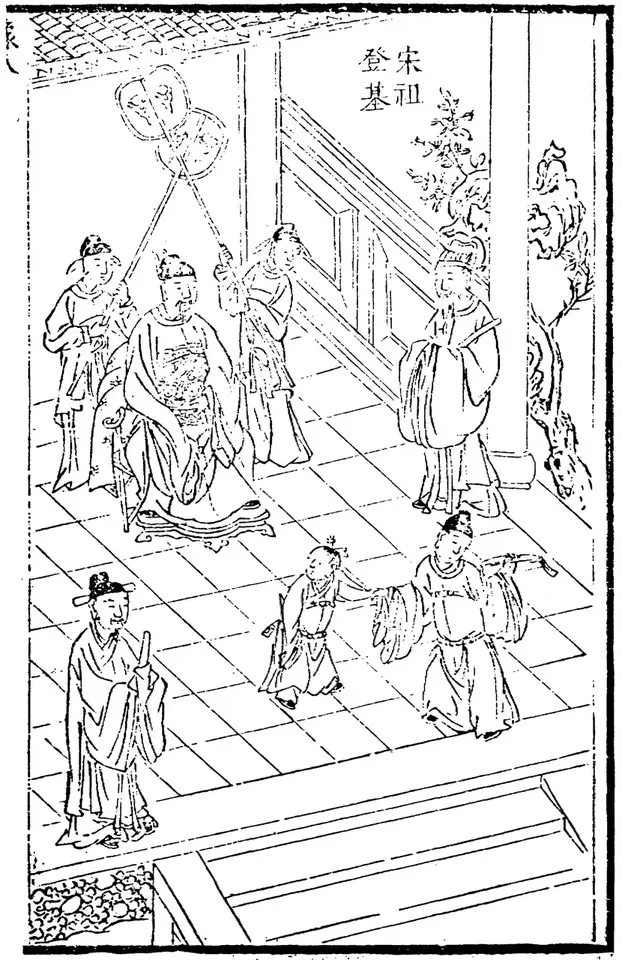
On the fifth day of the first month, seven-year-old Chai Zongxun presided over the solemn abdication ceremony in Chongyuan Hall. Hanlin Academician Tao Gu presented the pre-drafted abdication edict, formally yielding the imperial mandate to Zhao Kuangyin. Zhao ascended the throne as Emperor Taizu, naming the dynasty Song and the era Jianlong. Later Zhou was brought to an end, and the deposed child-emperor was demoted to Prince of Zheng.
In 962, to remove potential rallying figures from former imperial loyalists in the capital, the Song court relocated Chai Zongxun and his mother to the remote mountain district of Fangzhou in Hubei. Emperor Taizu appointed the upright and gentle scholar Xin Wenyue as Magistrate of Fangzhou to oversee their safety, allowing Chai Zongxun to live out his remaining years in quiet seclusion.
Although Chai Zongxun reigned for only seven months, the central plains experienced catastrophic weather and severe flooding throughout late 959. In July, prolonged torrential downpours caused the Yellow and Huai rivers to burst their dikes, destroying thousands of dwellings and submerging mature crops. Reports of widespread famine and population displacement flooded into the capital.
Throughout September, relentless rains inundated Kaifeng and surrounding commanderies for over ten days, causing municipal moats to overflow. In December, another four-day blizzard and rainstorm paralyzed transport routes across the north. Confronting these crises, the imperial court under Empress Dowager Fu and Chancellor Fan Zhi issued emergency decrees deploying relief commissioners across afflicted prefectures.
These commissioners distributed grain from state granaries, exempted devastated farming households from land taxes and labor service, and allocated funds to resettle homeless peasants. These benevolent measures alleviated agrarian hardship and preserved economic stability during the final months of the Five Dynasties era, illustrating the practical statecraft legacy inherited from Emperor Shizong.
In court ceremonial and institutional continuity, Chai Zongxun's administration scrupulously observed the precedents established by Emperor Shizong. In October 959, the court officially conferred the posthumous temple name Shizong and the posthumous title Emperor Ruiwu Xiaowen upon Chai Rong, composing eulogies commemorating his unifying campaigns.
Later that month, envoys from the kingdom of Goryeo arrived in Kaifeng to present tribute, offering rare Confucian classics including commentary volumes on the Classic of Filial Piety. The tributary mission demonstrated Later Zhou's ongoing diplomatic prestige and cultural authority across East Asia despite its internal political vulnerability.
In December, the Historiography Institute proposed the compilation of the late emperor's daily records, and Chai Zongxun authorized the formal compilation of the True Records of Emperor Shizong. This project systematically preserved the edicts, administrative decisions, and military campaigns of Chai Rong's reign, providing foundational source material for subsequent historical works during the Song Dynasty.
In frontier defense, the Later Zhou court maintained vigilance along the northern border. Immediately following Chai Zongxun's accession in July 959, Khitan cavalry raided the frontier outpost of Bazhou. Han Linkun, Military Commissioner for the Northern Deployment, executed a counterattack, ambushing five hundred Khitan horsemen and securing the frontier passes.
When reports of a major Khitan invasion arrived in January 960, the civilian ministers responded decisively by mobilizing the imperial army. Although subsequent historians identified these alarms as an orchestrated pretext for Zhao Kuangyin's military coup, the court acted in good faith to protect territorial integrity against northern invasion.
The deployment of the metropolitan armies under central command demonstrated Later Zhou's military preparedness. The tragic irony remained that the very army assembled to defend the empire against external foes became the instrument that peacefully displaced the imperial dynasty from within.
Following the peaceful transition of power, Emperor Taizu of Song implemented an extraordinary policy of clemency toward the deposed Chai family. Taizu bestowed upon the Chai lineage an iron certificate of exemption, granting them hereditary noble privileges, permanent protection from ordinary criminal prosecution, and immunity from capital punishment.
Furthermore, Song Taizu established a secret stone monument in the ancestral imperial temple in Kaifeng, inscribing an ancestral oath that every succeeding Song emperor was required to read upon coronation. The paramount clause of this oath mandated the perpetual preservation of the Chai lineage, declaring that any ruler who harmed them would face divine retribution.
This extraordinary policy of imperial mercy departed sharply from the bloody purges typical of Five Dynasties usurpations. The literary legend of Chai Jin possessing an ancestral iron certificate in the classic novel Water Margin drew its historical inspiration directly from the enduring imperial protections granted to Chai Zongxun.
On April 6, 973, Chai Zongxun died of illness in Fangzhou at the age of twenty-one. When news of his passing reached Kaifeng, Emperor Taizu was deeply grieved, donned mourning attire in his private apartments, and suspended court audiences for ten days. Civil and military officials submitted formal condolences, marking the passing of the last sovereign of Later Zhou.
Emperor Taizu dispatched palace commissioners to organize imperial funeral rites, posthumously honoring Chai Zongxun as Emperor Gong of Zhou and entombing him with full imperial ceremony at Shunling beside Emperor Shizong's Qingling mausoleum in modern Xinzheng, Henan.
Chai Zongxun's brief life embodied the pivotal transition from Five Dynasties fragmentation to Song dynastic stability. By abdicating peacefully at age seven, he spared the central plains the devastation of urban warfare, enabling the accumulated wealth, administrative talent, and military strength of Later Zhou to pass intact to the Song Dynasty, laying the foundation for centuries of cultural flourishing.
FIGURES ASSOCIATED WITH THIS DYNASTY