Born in Frontier Garrison
Hou Jing was born into a military family in Huaishuo Garrison, excelling in equestrian archery and serving as garrison clerk
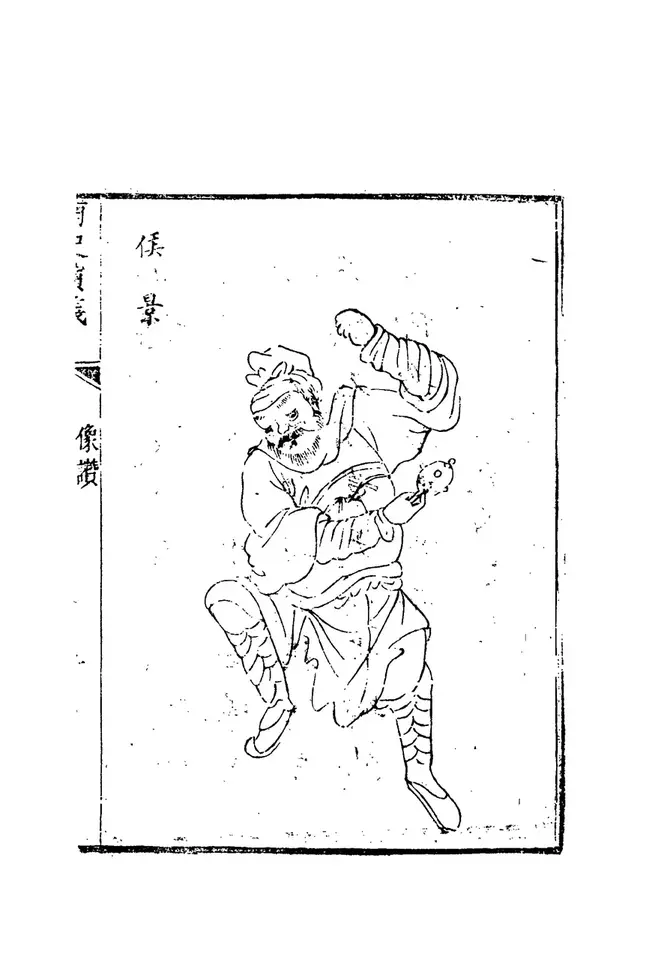
503 CE–552 CE
侯景
Hou Jing (侯景, 503–552), courtesy name Wanjing (万景), was a prominent military commander, warlord, and rebel leader during the Northern and Southern Dynasties, hailing from Huaishuo Garrison in Shuozhou (present-day Guyang County, Baotou, Inner Mongolia). Born into a frontier hereditary military family, he was renowned for his equestrian archery, cunning tactical mind, and ruthless temperament. In the chaotic twilight of…
Hou Jing (侯景, 503–552), courtesy name Wanjing (万景), was a prominent military commander, warlord, and rebel leader during the Northern and Southern Dynasties, hailing from Huaishuo Garrison in Shuozhou (present-day Guyang County, Baotou, Inner Mongolia). Born into a frontier hereditary military family, he was renowned for his equestrian archery, cunning tactical mind, and ruthless temperament. In the chaotic twilight of Northern Wei, Hou served as vanguard under Erzhu Rong and captured rebel chieftain Ge Rong at the Battle of Fukou, earning promotion to Inspector of Dingzhou. Following the demise of the Erzhu clan, he submitted to Gao Huan, who placed immense trust in him and appointed him Grand Branch Department of State Affairs of Henan Circuit and Minister of Education, granting him supreme control over Henan with an army of one hundred thousand troops. After Gao Huan's death, Hou rebelled against Eastern Wei due to deep mutual hostility with Gao Huan's heir Gao Cheng. Failing to secure firm Western Wei support, he offered Henan to the Liang Dynasty. Emperor Wu of Liang (Xiao Yan) welcomed him, enfeoffing him as Prince of Henan and appointing him General-in-Chief. In 548, Eastern Wei commander Murong Shaozong inflicted a crushing defeat on Hou at the Battle of Woyang. Hou fled south of the Huai River to Shouyang. Terrified that Liang would extradite him to Eastern Wei as part of peace negotiations, Hou conspired with Prince of Linhe Xiao Zhengde and launched a devastating rebellion. His army crossed the Yangtze River, encircled the imperial citadel of Taicheng in Jiankang, and starved Emperor Wu to death after a brutal siege. Hou enthroned Crown Prince Xiao Gang (Emperor Jianwen) as a puppet before deposing him in 551 to proclaim himself Emperor of Han with the era name Taishi. His brutal depredations decimated the aristocratic lineages of Jiangnan. In 552, loyalist armies led by Wang Sengbian and Chen Baxian recaptured Jiankang; Hou fled and was slain by his subordinate Yang Kun, ending the cataclysmic four-year uprising.
Hou Jing was born into a military family in Huaishuo Garrison, excelling in equestrian archery and serving as garrison clerk
Joined Erzhu Rong as vanguard and captured insurgent leader Ge Rong at Fukou, elevated to Inspector of Dingzhou
Submitted to Gao Huan upon the founding of Eastern Wei, appointed Grand Branch Department of State Affairs and Minister of Education
Resisted summons from Gao Cheng after Gao Huan's demise, raising rebellion in Henan and offering submission to Western Wei and Liang
Emperor Wu of Liang accepted his defection, enfeoffing him as Prince of Henan and appointing him General-in-Chief
Eastern Wei general Murong Shaozong crushed Hou's army at the Battle of Woyang, forcing Hou to flee with hundreds to Shouyang
Conspiring with Xiao Zhengde, Hou launched a full rebellion, crossed the Yangtze at Caishi, and laid siege to Taicheng
Breached Taicheng following the death of defender Yang Kan; starved Emperor Wu to death and installed Xiao Gang as puppet
Deposed and murdered Xiao Gang, coerced puppet Xiao Dong to abdicate, and proclaimed himself Emperor of the State of Han
Loyalists Wang Sengbian and Chen Baxian retook Jiankang; Hou fled and was killed by Yang Kun, his body consumed by vengeful locals
Hou Jing, courtesy name Wanjing, originated from Huaishuo Garrison, one of the vital Northern Six Garrisons established by Northern Wei to protect the northern frontier. Huaishuo occupied a volatile strategic frontier where nomadic tribes and Han populations mingled, fostering a culture of martial vigor. Hou was born into a hereditary military family. Although slightly crippled in both feet and clumsy on foot, he possessed extraordinary skill on horseback, and his archery was celebrated for its unfailing accuracy. Known for his suspicious and ruthless nature, he initially served as garrison record clerk before gathering a band of seasoned cavalry during the chaos of Northern Wei.
During the Zhengguang and Xiaochang eras, widespread uprisings among garrison troops shattered Northern Wei's administrative order. Hou led his followers to join Erzhu Rong, the ascendant military hegemon based in Bingzhou. Erzhu recognized Hou's tactical cunning and appointed him vanguard commander. During this period, Murong Shaozong, a senior commander under Erzhu, was renowned for military theory. Hou initially consulted Murong regarding formations and troop deployments; within a short period, Hou mastered the craft so thoroughly that Murong began seeking Hou's tactical counsel instead.
In the eighth month of 528, the rebel leader Ge Rong mobilized hundreds of thousands of insurgents to encircle Ye. Erzhu Rong led elite cavalry to confront Ge Rong at Fukou. Hou Jing commanded vanguard assault troops that sliced through the enemy center, capturing Ge Rong directly on the battlefield. Ge Rong's massive force collapsed into surrender. For this signal exploit, the Northern Wei court appointed Hou as Inspector of Dingzhou and created him Duke of Puyang Commandery, elevating him into the front rank of northern military commanders.
In 534, Gao Huan eradicated the Erzhu faction and established Eastern Wei under Emperor Xiaojing. Recognizing that Hou shared roots in Huaishuo and commanded high battlefield authority, Gao entrusted him with supreme regional responsibility. Hou was appointed Minister of Personnel, Grand Branch Department of State Affairs of Henan Circuit, and Minister of Education. Gao granted him plenary civil and military control over fourteen commanderies between the Yellow and Huai Rivers to counter threats from Western Wei and the Liang Dynasty.
Hou governed Henan for over a decade, assembling a formidable standing army numbering over one hundred thousand soldiers and transforming Henan into Eastern Wei's most powerful frontier military bloc. In 540, Hou marched south through Sanya Pass to seize Jingzhou. Western Wei Chancellor Yuwen Tai deployed generals Li Bi and Dugu Xin to block his advance; observing Western Wei's strong defenses, Hou chose to withdraw intact. Within Henan, Hou expanded his private headquarters, recruited local magnates and outlaws, and drilled cavalry, steadily cultivating autonomous power independent of central control.
Relying on his formidable army, Hou submitted only to Gao Huan and treated Gao Huan's heir Gao Cheng with undisguised contempt. Hou openly declared to his inner circle: "While King Gao lives, I dare not harbor disloyalty; but once King Gao departs, I will never bend my knees to serve that fledgling young master Gao Cheng!" Gao Huan was well aware of Hou's treachery, but due to strategic pressure from Western Wei, he tolerated Hou's insubordination.
In the first month of 547, Gao Huan became critically ill in Jinyang. On his deathbed, he grasped Gao Cheng's hand and issued an urgent warning: "Grand Branch Department of State Affairs Hou Jing in Henan is crafty and treacherous, shifting loyalties unpredictably. After my death, he will never serve you. Among all our generals, only Murong Shaozong can counter him; you must deploy Shaozong to keep Hou in check." When Gao Huan died, Gao Cheng issued an imperial edict summoning Hou to Jinyang for consultations, but Hou refused under the pretext of frontier security.
Aware that Gao Cheng intended his destruction, Hou raised a full rebellion across thirteen commanderies of Henan in the first month of 547. Initially, Hou sent emissaries to Western Wei Chancellor Yuwen Tai, offering his Henan territories in exchange for military alliance. However, Western Wei leaders recognized Hou's fickle treachery; Yuwen Tai withheld decisive military assistance while seizing strategic positions in Yuzhou and Guangling for himself. Trapped between hostile powers, Hou turned south and dispatched messengers to Jiankang, offering unconditional surrender to Emperor Wu of Liang.
Hou's petition triggered fierce controversy in the Liang court. Senior ministers such as Xie Ju and Xu Du urgently warned Emperor Wu that Hou was notoriously untrustworthy and rapacious, noting that Eastern Wei could not tolerate him and that accepting his submission would invite devastating northern reprisals. Nevertheless, the octogenarian Emperor Wu, harboring ambitions of recovering the central plains and reunifying China, overrode ministerial opposition. He issued an edict accepting Hou's defection, appointing him General-in-Chief and Prince of Henan, and dispatching Xiao Yuanming with fifty thousand troops to support him.
In response to Hou's defection, Gao Cheng appointed Murong Shaozong as commander-in-chief alongside generals Gao Yue and Pan Le to lead one hundred thousand Eastern Wei cavalry south. The Eastern Wei host first intercepted the Liang expeditionary force at Hanshan, where Murong employed river diversion tactics to flood the Liang camp, capturing commander Xiao Yuanming and destroying tens of thousands of Liang troops. Flushed with victory, Murong turned his full force against Hou Jing at Woyang.
At the onset of the Battle of Woyang, Hou's veterans fought fiercely and temporarily checked the Eastern Wei vanguard. However, Murong Shaozong understood Hou's tactical style intimately; he avoided rash frontal clashes, fortified defense lines, and cut Hou's logistical supply lines. As the campaign dragged on, Hou's army suffered from starvation and plummeting morale. Murong launched a comprehensive offensive, shattering Hou's main formation. Tens of thousands surrendered to Eastern Wei, while Hou's wife and eldest son were executed in Ye by Gao Cheng.
Having lost his entire army, Hou escaped with merely a few hundred surviving horsemen, fleeing south across the Huai River. Emperor Wu accommodated Hou at Shouyang, charging him with reorganizing remnants to guard the Huai border. Once in Shouyang, Hou rapidly gathered displaced migrants, outlaws, and deserters, swiftly reconstituting an armed force of more than ten thousand fighters and converting Shouyang into an insular military fortress.
In the summer of 548, Eastern Wei emissaries arrived in Jiankang proposing peaceful relations, offering to repatriate the captured Xiao Yuanming in exchange for Hou Jing. When Hou learned of the talks, he was consumed by panic, knowing that he would be traded away if peace succeeded. To test Emperor Wu's intentions, Hou forged an Eastern Wei letter proposing an exchange. Unaware of the ruse, Emperor Wu replied in his own hand: "If the Marquis of Zhenyang returns at dawn, Prince Hou shall be dispatched by dusk." Upon seeing the reply, Hou flew into a rage and finalized plans for rebellion.
Hou covertly allied with Prince of Linhe Xiao Zhengde, a disgruntled imperial relative, promising to crown him emperor in return for internal assistance. In the eighth month of 548, Hou rebelled under the banner of purging corrupt courtier Zhu Yi, marching eight thousand elite troops south from Shouyang. Facilitated by Xiao Zhengde, Hou's troops seized boats at Caishi and crossed the Yangtze River without resistance, advancing directly upon Jiankang and laying siege to the imperial citadel of Taicheng. Xiao Zhengde proclaimed himself emperor outside Xuan Yang Gate.
During the siege, Liang defender Yang Kan directed an unyielding resistance, repelling repeated fire and siege tower assaults across several grueling months. Although provincial Liang princes mobilized relief armies totaling hundreds of thousands outside the capital, each sought personal preservation and hesitated to engage Hou. In the third month of 549, Yang Kan died of illness; weakened by famine and rampant plague, the defenders collapsed, and Hou's forces breached Taicheng.
Upon entering Taicheng, Hou betrayed Xiao Zhengde, demoting him to Minister of Education before secretly strangling him. When Hou confronted Emperor Wu, the aged monarch remained composed and demanded why Hou had rebelled; Hou was overcome with shame and could not speak. Subsequently, Hou isolated the inner apartments and cut off all food supplies. In the fifth month of 549, eighty-six-year-old Emperor Wu perished of hunger in Jingju Hall. Hou installed Crown Prince Xiao Gang as puppet Emperor Jianwen, while assuming supreme titles as Grand Commander and General-in-Chief of the Cosmos, seizing complete mastery of southern China.
Following the fall of Jiankang, Hou gave free rein to his troops to plunder and terrorize Jiangnan. His forces massacred over three thousand civil and military officials. Aristocratic clans such as the Wang and Xie families suffered near-total annihilation, and classical libraries collected over centuries were destroyed. Hou dispatched detachments across the wealthy Sanwu region (Wujun, Kuaiji, Wuxing), burning estates and plundering grain and captives. Famine gripped the lower Yangtze; cannibalism emerged, and the countryside surrounding Jiankang was littered with corpses.
In the eighth month of 551, facing deepening isolation and encroaching loyalist armies, Hou accelerated his usurpation. He deposed and imprisoned Emperor Jianwen, temporarily enthroning Xiao Dong. Two months later, he coerced Xiao Dong to abdicate, constructing an earthen ceremonial altar outside the walls to proclaim himself Emperor of the State of Han, adopting the era name Taishi. Shortly thereafter, he brutally executed the deposed Emperor Jianwen.
During his brief reign, Hou indulged in debauchery, forcibly taking Emperor Jianwen's teenage daughter Princess Liyang as consort. His regime possessed neither civil administration nor enduring policy, relying solely on terror. As regional loyalists mobilized against him, Hou's regime descended into absolute crisis.
In late 551, Emperor Yuan of Liang (Xiao Yi) commissioned General Wang Sengbian as Commander-in-Chief in Jiangling to lead naval forces eastward; simultaneously, southern general Chen Baxian marched north with elite forces from Guangdong and Jiangxi, uniting with Wang at Baimaowan. The combined loyalist armies swept eastward along the river, capturing Xunyang and Penchen before bearing down on Jiankang.
In the third month of 552, Wang Sengbian and Chen Baxian encircled the outskirts of Jiankang. Hou deployed his remaining troops outside Stone City for a desperate stand. Chen Baxian led cavalry charges into Hou's flank while Wang commanded assault forces across land and water. The rebel army shattered under the onslaught. Seeing his cause lost, Hou rushed back to the inner citadel, seized gold and treasures, and fled downstream with dozens of horsemen in small boats, hoping to escape by sea.
Upon reaching Hudouzhou near modern Nantong, Hou's subordinate commander Yang Kun (son of the heroic defender Yang Kan) recognized that doom was certain and conspired with the crew to assassinate Hou. Yang stabbed Hou to death on board and severed his head, which was placed in a jar of quicklime and rushed to Jiangling for Emperor Yuan. Hou's headless body was delivered back to Jiankang and exposed in the marketplace; enraged citizens and soldiers hacked his remains to pieces and consumed every scrap of flesh, discarding his powdered bones in the river. Emperor Yuan ordered Hou's head exposed in the marketplace before having it lacquered and burned, concluding the four-year catastrophe of the Hou Jing Rebellion.
During the chaotic northern uprisings, Hou served as vanguard under Erzhu Rong at the Battle of Fukou, piercing enemy lines to capture rebel commander Ge Rong with his own hands. This battlefield triumph extinguished the largest peasant and garrison rebellion in Northern Wei, establishing Hou's military prominence.
Following the founding of Eastern Wei, Hou served as Grand Branch Department of State Affairs and Minister of Education for over a decade, commanding one hundred thousand soldiers across the Yellow and Huai Rivers. His defensive dispositions effectively checked Western Wei expansion and anchored Eastern Wei's southern frontier.
After defecting to Liang, Hou exploited inner political vulnerabilities to stage a rebellion. Moving eight thousand troops across the Yangtze, he besieged Taicheng for months, starved Emperor Wu of Liang to death, and usurped the imperial throne, precipitating one of the most drastic military ruptures of the era.
Hou's four-year campaign ravaged the aristocratic estates and economic foundations of the lower Yangtze. Lineages such as the Wang and Xie clans were physically decimated, and the southern economy suffered mortal injury, decisively tilting the long-term balance of power toward northern dynasties.
FIGURES ASSOCIATED WITH THIS DYNASTY