Birth at Canhebei
Born north of Canhebei as the posthumous son of Tuoba Shi and grandson of Tuoba Shiyijian.
386 CE–409 CE
拓跋珪
Tuoba Gui (拓跋珪, 371–409), formally known as Emperor Daowu of Northern Wei (北魏道武帝), was the founding monarch of the Northern Wei dynasty and a pivotal statesman and military commander in early medieval Chinese history. A grandson of King Shiyijian of Dai and the posthumous son of Tuoba Shi, he was born into deep political instability. Following the destruction of the Dai state by the Former Qin empire, he spent his youth in…
Tuoba Gui (拓跋珪, 371–409), formally known as Emperor Daowu of Northern Wei (北魏道武帝), was the founding monarch of the Northern Wei dynasty and a pivotal statesman and military commander in early medieval Chinese history. A grandson of King Shiyijian of Dai and the posthumous son of Tuoba Shi, he was born into deep political instability. Following the destruction of the Dai state by the Former Qin empire, he spent his youth in exile across the northern steppes under the protection of the Dugu and Helan tribal confederacies. In 386, at the age of sixteen, Tuoba Gui rallied ancestral loyalists at Niuchuan, proclaimed the restoration of Dai, and shortly thereafter assumed the title King of Wei, inaugurating the Northern Wei dynasty. Throughout his early reign, Tuoba Gui demonstrated exceptional strategic mastery. He crushed internal dynastic revolts, obliterated the formidable Tiefu Xiongnu confederacy led by Liu Weichen, and brought the diverse nomadic tribes of southern Mobei under unified imperial authority. In 395, he achieved a monumental victory against Later Yan at the Battle of Canhebei by ambushing and annihilating an eighty-thousand-strong invasion army. Exploiting this triumph, he led a massive southern expedition into the Central Plains, conquering Bingzhou and the entire Hebei plain, culminating in the capture of the Later Yan capital of Zhongshan. In 398, Tuoba Gui moved the imperial capital to Pingcheng and officially ascended the throne as emperor. He executed profound structural transformations, including the forced dissolution of traditional blood-lineage nomadic tribes and the implementation of household registration and land allotment. He established the Eight Bureau Ministers, instituted Han-style three-department civil governance, patronized Confucian learning through the Imperial Academy, and codified comprehensive statutory laws. Although his final years were clouded by paranoia resulting from the consumption of cold-food powder, leading to his assassination in a palace coup in 409, his conquests and state-building laid the enduring political and military foundations for the eventual unification of northern China.
Born north of Canhebei as the posthumous son of Tuoba Shi and grandson of Tuoba Shiyijian.
Former Qin destroyed Dai; shielded by loyalist Yan Feng and granted permission to remain in the steppes under maternal refuge.
Held tribal convention at Niuchuan to claim Prince of Dai, relocated to Shengle, and changed dynastic title to Wei.
Formed an alliance with Later Yan to crush the rebellious pretender Tuoba Kuduo and tribal rival Liu Xian at Gaoliu.
Launched an expedition across the Yellow River, crushing Liu Weichen, executing thousands of enemy elites, and unifying the southern steppes.
Ambushed and wiped out the elite army of Later Yan Crown Prince Murong Bao at Canhebei, reversing the balance of northern power.
Commanded four hundred thousand troops through the Jingxing Pass, capturing Bingzhou and besieging Zhongshan.
Stormed the Later Yan capital of Zhongshan after Murong Bao fled, bringing the vast agricultural plains of Hebei into Wei territory.
Relocated the imperial capital to Pingcheng, constructed palaces and ancestral altars, and assumed the title of Emperor.
Encircled and defeated the Later Qin invasion force under Yao Ping at Chaibi, securing absolute hegemony along the Fen River.
Slain during a nocturnal palace coup orchestrated by his second son Tuoba Shao at age thirty-nine; succeeded by Tuoba Si.
Tuoba Gui was born on the seventh day of the seventh lunar month in the thirty-fourth year of Jianguo (August 4, 371) to the north of Canhebei. His grandfather was Tuoba Shiyijian, the reigning monarch of the Xianbei kingdom of Dai, and his father was the crown heir Tuoba Shi. Because Tuoba Shi had died prematurely from wounds sustained while rescuing his father during a palace skirmish, Tuoba Gui was born as a posthumous child to Lady He, a noblewoman of the Helan tribe. Tradition recorded that strange luminous phenomena illuminated the yurt upon his birth, endowing him with prestige among the clan elders.
Disaster struck in 376 when the Former Qin emperor Fu Jian launched a massive multi-pronged offensive into the northern steppes. Caught between foreign invasion and internal betrayal by his eldest illegitimate son, Tuoba Shiyijian was murdered, and the Dai kingdom collapsed. While Qin occupation commanders prepared to deport the six-year-old heir to Chang'an as a political hostage, veteran Dai court minister Yan Feng intervened, passionately arguing that forcibly removing the child would incite endless nomadic rebellions, whereas leaving him in his native pasture would foster generational loyalty toward Qin benevolence.
Fu Jian consented, dividing the former Dai domains between Liu Kuren of the Dugu tribe and Liu Weichen of the Tiefu Xiongnu. Lady He took Tuoba Gui and his younger brothers to live under the protection of Liu Kuren in the Dugu camp. Liu Kuren treated the royal orphans with profound reverence and maintained their household with honor. Following the disastrous Former Qin defeat at the Battle of Fei River in 383, northern China erupted into widespread warfare. Liu Kuren was subsequently killed during a military expedition in 384.
Shortly thereafter, Liu Kuren's son Liu Xian murdered his uncle to seize leadership of the Dugu tribe. Viewing Tuoba Gui's rising popularity as an existential threat, Liu Xian orchestrated a plot to assassinate the young prince. Warned by loyal confederate Wei Guzhen, Lady He plied the conspirators with liquor while Tuoba Gui and trusted commanders like Changsun Song slipped away through mountain defiles under cover of darkness, successfully reaching safety within the Helan tribal territory.
In the spring of 386, tribal leaders representing the Helan, Dugu, and ancestral Dai clans convened a grand council at Niuchuan. At age sixteen, Tuoba Gui was formally acclaimed as Prince of Dai, initiating the Dengguo era. Recognizing the strategic vulnerability of Niuchuan, he promptly transferred his court to Shengle, the historic fortified heartland of his ancestors, where pastoral herds could be sustained alongside incipient agriculture. In the fourth lunar month of that year, he elevated his state title to King of Wei, marking the foundation of Northern Wei.
The fledgling realm faced immediate peril when his grand-uncle Tuoba Kuduo, backed by Western Yan and regional nomadic chieftains, marched north to usurp the throne. Many conservative clan leaders wavered, and internal elements conspired to support the usurper. Tuoba Gui acted with decisive resolve, executing internal traitors while dispatching envoy Antong on an urgent diplomatic mission to Murong Chui, the powerful emperor of Later Yan.
Acknowledging shared Xianbei origins and strategic alignment, Murong Chui dispatched an elite relief army commanded by Murong Lin. Joining forces with Later Yan cavalry at Gaoliu, Tuoba Gui orchestrated a coordinated pincer assault that shattered Tuoba Kuduo's army. The pretender fled toward the Ordos plateau, where he was slain by the Tiefu Xiongnu, allowing Tuoba Gui to incorporate thousands of elite soldiers and extensive herds into his royal forces.
Having pacified internal dynastic rivals, Tuoba Gui launched successive campaigns to eliminate hostile tribal confederacies across the northern perimeter. In 387, he pursued Liu Xian to Mize, scattering the remnants of the Dugu leadership. He subsequently conducted punitive strikes against refractory groups such as the Kumoxi, Baibu, and Luoni tribes, utilizing rapid cavalry mobility to achieve decisive victories around Shanwu.
The most dangerous rival in the southern steppe was the Tiefu Xiongnu ruler Liu Weichen, who commanded vast wealth and tens of thousands of horsemen across the Ordos loop. In October 391, Tuoba Gui mobilized a lightning expedition across the frozen reaches of the Yellow River, striking directly at Liu Weichen's administrative stronghold at Dailai. Surprised by the speed of the Wei advance, the Xiongnu defense disintegrated.
Wei pursuit detachments tracked down and killed Liu Weichen, executing thousands of elite clan members and casting their remains into the river, although his youngest son Liu Bobo escaped. The campaign yielded hundreds of thousands of captured mounts and cattle, bringing the entire Ordos plateau under Wei control. Subsequent thrusts pushed northward against the nascent Rouran confederacy and westward against the Gaoche, firmly establishing Northern Wei dominance across the southern Gobi.
Frictions with Later Yan escalated when Crown Prince Murong Bao detained Tuoba Gui's envoy Tuoba Gu in 391 to extort premium warhorses. Tuoba Gui severed relations and formed strategic ties with Western Yan and Later Qin. In May 395, Later Yan launched an eighty-thousand-strong invasion commanded by Murong Bao, aiming to crush the Wei state before Murong Chui passed away.
Tuoba Gui executed an exemplary scorched-earth withdrawal, abandoning Shengle and transporting his entire population and livestock west of the Yellow River. The two armies remained deadlocked across the water for months. Wei scouts intercepted all Yan dispatch riders heading between the front and the imperial capital at Zhongshan. Capitalizing on rumors regarding Murong Chui's failing health, Tuoba Gui forced captured messengers to shout across the river that the Yan emperor had died, precipitating severe panic among the invading troops.
In late October, facing impending winter storms and collapsing morale, Murong Bao burned his transport flotilla and commenced a disorganized retreat southward. Unbeknownst to Yan commanders, a sudden temperature drop completely froze the Yellow River overnight. Tuoba Gui personally led twenty thousand elite cavalry across the ice, maintaining an unrelenting pursuit for six consecutive days.
On November 30, 395, Wei vanguard forces outflanked the retreating columns and occupied the commanding heights at Canhebei. Attacking down the slopes during a blinding dust storm, the Wei cavalry routed the Yan army, killing tens of thousands and capturing forty thousand elite troops. Overriding initial thoughts of clemency, Tuoba Gui acceded to tribal elders who feared future Yan resurgence, ordering the mass execution of the captives. The catastrophe permanently crippled Later Yan and fundamentally altered the geopolitical balance in northern China.
In 396, Murong Chui attempted a retaliatory campaign but collapsed from anguish upon viewing the skeletal remains of his fallen army at Canhebei, dying during his withdrawal. Recognizing the vulnerability of the Yan throne under Murong Bao, Tuoba Gui mobilized four hundred thousand troops for a full-scale invasion of the Central Plains.
Crossing the Gouzhu mountains, Wei armies swiftly captured Bingzhou and forced the surrender of Taiyuan. Emerging through the formidable Jingxing Pass in September, Tuoba Gui marched onto the fertile Hebei plain. Local commanderies, alienated by Yan misrule, surrendered in rapid succession. While siege forces contained the strategic stronghold of Ye, Tuoba Gui laid close siege to the Later Yan capital of Zhongshan.
Murong Bao attempted a nocturnal assault against the Wei camp at Baisi, causing temporary disarray before Tuoba Gui personally rallying his cavalry to repulse the sortie. Despairing of relief, Murong Bao abandoned Zhongshan and fled toward his ancestral stronghold at Longcheng. In October 397, Wei assault corps stormed Zhongshan, exterminating remaining resistance and capturing imperial treasures. By the following year, Ye was subjugated, completing the conquest of Hebei.
Following the pacification of the Central Plains, Tuoba Gui confronted the strategic question of selecting a permanent imperial capital. Rejecting both the remote northern pastures of Shengle and the culturally divergent southern cities of Ye and Zhongshan, he chose Pingcheng in modern northern Shanxi, which bridged the nomadic steppe frontier and agricultural heartland.
In July 398, Tuoba Gui formally designated Pingcheng as the capital. He initiated massive resettlement operations, forcibly relocating hundreds of thousands of Han scholars, artisans, and farmers alongside subjugated nomadic tribesmen to populate the capital commandery. Intensive agricultural cultivation was mandated around Pingcheng to ensure local grain security for the imperial court.
Palatial complexes, ancestral shrines, and state altars modeled on Han Chinese architecture were erected across the new capital. Civil offices including the Department of State Affairs, the Chancellery, and the Secretariat were formally established, staffed by prominent northern Han gentry scholars such as Cui Hong and Zhang Gun. On January 24, 399, Tuoba Gui ascended the throne as Emperor, inaugurating the Tianxing era and confirming Northern Wei as an empire claiming universal mandate.
In 402, tensions with Later Qin erupted into open warfare after marriage negotiations collapsed. Later Qin ruler Yao Xing dispatched his brother Yao Ping with forty thousand elite troops into Hedong, seizing Pingyang and entrenching at Chaibi along the Fen River.
Tuoba Gui marched rapidly to the theater, constructing fortified circumvallations around Chaibi and bridging the river with pontoon dikes to sever enemy supply lines. When Yao Xing arrived with an eighty-thousand-man relief army, Tuoba Gui deployed forces across the Mengkeng defile, repelling repeated Later Qin assaults.
After months of complete encirclement, during which the garrison consumed pack animals and boiled armor leather, Yao Ping led a desperate breakout attempt. Wei archers and cavalry crushed the sortie, forcing Yao Ping to drown himself in the Fen River. Over forty commanders and twenty thousand soldiers were captured, permanently blunting Later Qin expansion and securing Wei supremacy over Hedong.
During the Tianci era (404–409), Tuoba Gui's mental and physical health deteriorated drastically. Seeking longevity, he regularly ingested cold-food powder, an alchemical concoction that induced severe physical discomfort, intense fever, and extreme psychological volatility. He became intensely paranoid, suspecting treason across his court and executing numerous loyal ministers and military veterans upon trivial pretexts.
Furthermore, seeking to prevent maternal clan interference during future imperial successions, Tuoba Gui instituted the draconian principle of executing the biological mother of the chosen crown heir, known as the system of noble son, doomed mother. When he designated his eldest son Tuoba Si as heir apparent, he ordered the suicide of Tuoba Si's mother, Consort Liu. Grief-stricken and fearing his father's wrath, Tuoba Si fled the capital to hide among local villages.
In November 409, Tuoba Gui detained Consort He, the mother of his sixteen-year-old son Tuoba Shao, declaring his intention to execute her the following morning. Consort He smuggled an urgent plea to Tuoba Shao. That night, Tuoba Shao assembled armed retainers, scaled the palace walls, and penetrated the bedchamber in the Tianhua Palace. Caught unarmed after palace eunuchs had concealed his weapons, Tuoba Gui was murdered at the age of thirty-nine. Tuoba Si returned to the capital, executed the conspirators, and assumed the throne as Emperor Mingyuan.
Tuoba Gui's most foundational structural reform was the formal dissolution of hereditary blood-related nomadic clans, known historically as dispersing the tribes and settling the lands. He dismantled the autonomous authority of tribal chieftains among both original Xianbei clans and subjugated confederacies, transforming nomadic pastoralists into registered subjects subject to imperial taxation and conscription.
To integrate the diverse population, he established a dual central administrative framework. Traditional Xianbei military nobility was organized under the Eight Bureau Ministers to oversee palace security, tribal affairs, and high judicial proceedings, while administrative governance was channeled through classical Chinese bureaucratized ministries. By actively enlisting leading northern Han aristocratic lineages such as the Cui of Qinghe, Zhang of Dai, and Feng of Bohai, he fostered an effective collaborative ruling model that sustained Northern Wei authority over the Central Plains.
To resolve severe food supply shortages for the burgeoning capital population, Tuoba Gui instituted an early prototype of the equal-field land distribution system. State lands surrounding Pingcheng were surveyed and distributed to relocated peasant households based on family size and labor capacity, with the government providing draft oxen, seed grain, and farming implements.
He eliminated chaotic wartime requisitions in favor of a regularized tax system levying specific quotas of grain and textile goods. Intensive irrigation networks were excavated along the Sanggan and Wuchuan river basins, creating extensive state agricultural colonies. Grain storage facilities were constructed throughout the capital commandery, transforming Pingcheng from an unproductive frontier outpost into a self-sustaining political and economic metropolis.
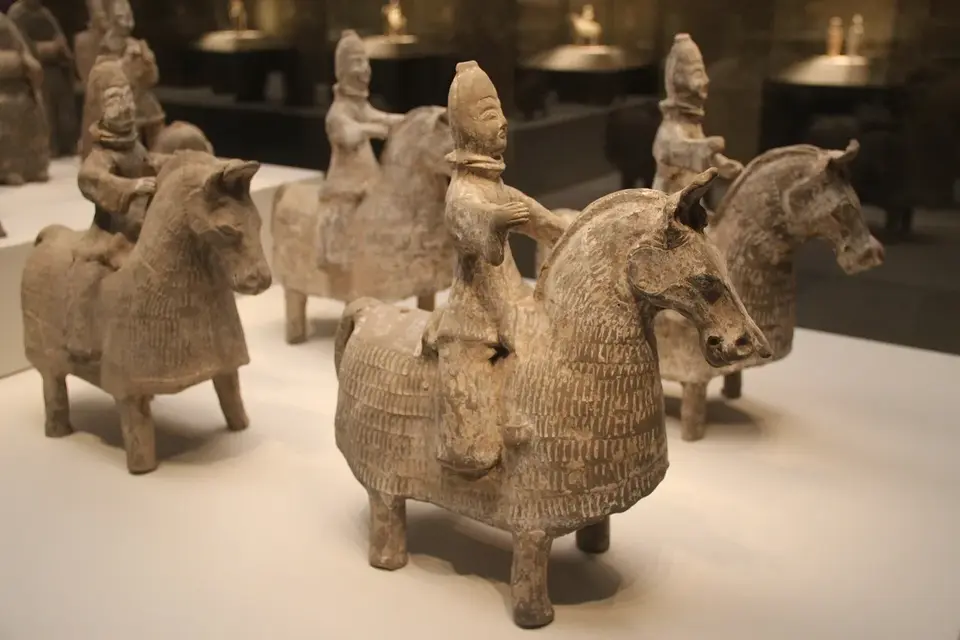
Tuoba Gui revolutionized the Northern Wei armed forces by combining the shock power of nomadic cavalry with the defensive discipline and engineering techniques of Chinese infantry. He established a standing imperial guard composed of elite horsemen selected from the eight tribes, maintaining absolute monarchical command over the central military forces.
Recognizing the emerging menace of the Rouran khaganate along the northern steppes, he established early military outposts and beacon systems stretching from the Yin Mountains to Mount Hei, laying the foundation for the renowned northern frontier garrison system. Additionally, hundreds of li of ramparts were constructed north of Pingcheng to intercept nomadic raiding parties, while heavy cataphract cavalry were systematically deployed to dominate battlefield engagements.
Understanding that lasting imperial rule required institutional legitimacy and cultural authority, Tuoba Gui placed significant emphasis on Confucian statecraft and statutory codification. Immediately after establishing Pingcheng, he founded the Imperial Academy, erected a temple honoring Confucius, and gathered hundreds of classical scholars to teach historical and ritual classics to both Xianbei nobles and Han students.
He appointed scholars Deng Yuan and Cui Hong to compile the first comprehensive statutory penal code of Northern Wei, known as the Tianxing Laws, which synthesized classical Han and Jin legal traditions with customary nomadic practices while mitigating excessively cruel punishments. Furthermore, he established formal ancestral temples, imperial altars, and state musical academies, systematically enacting orthodox Chinese rituals that solidified Northern Wei's claim to legitimate dynastic succession.
FIGURES ASSOCIATED WITH THIS DYNASTY