Enfeoffment as Duke of Dai
Western Jin Emperor Huai officially invested Tuoba Yilu with the titles of Grand Chanyu and Duke of Dai in recognition of his military assistance to Bingzhou.
315 CE–376 CE
代国
The Dai state (代国; 315–376 CE) was a regional regime established by the Tuoba branch of the Xianbei (鲜卑拓跋部) during the Sixteen Kingdoms period, serving as the historical precursor to the Northern Wei dynasty (北魏) of the Northern and Southern Dynasties. During the Wei and Jin dynasties, the Tuoba Xianbei pastured their herds across the grasslands of Yunzhong north of the frontier. After their third leader Tuoba Liwei relocated the tribal center to Shengle, he progressively consolidated supreme…
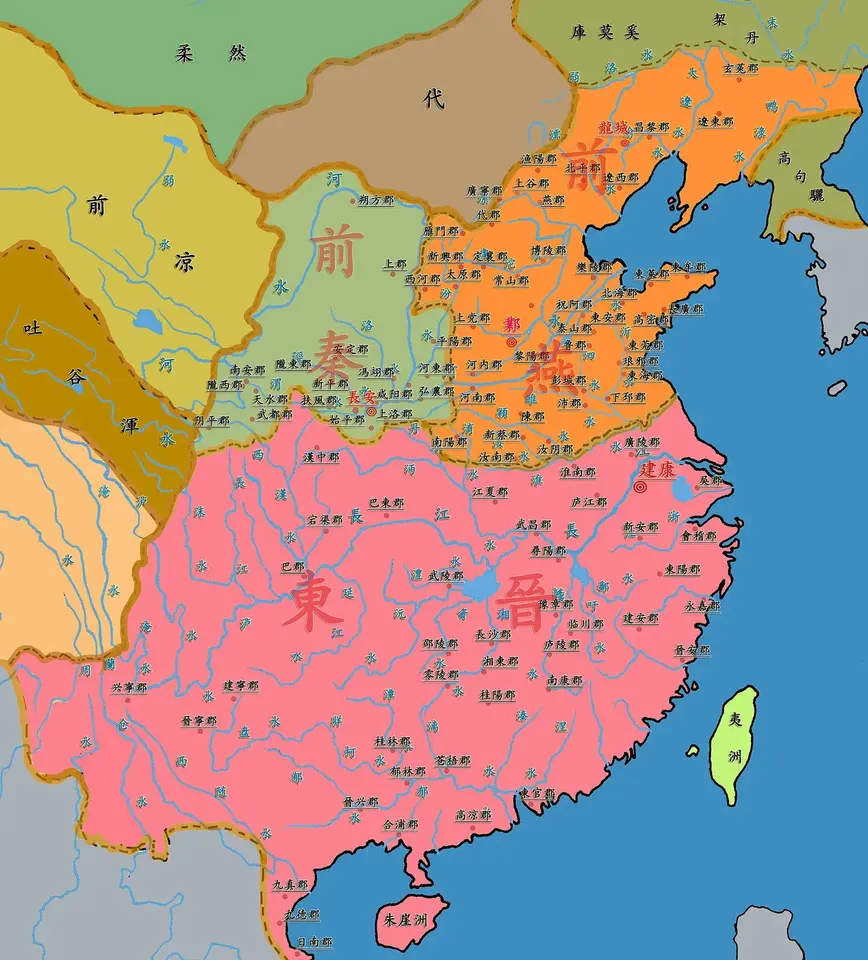
The Dai state (代国; 315–376 CE) was a regional regime established by the Tuoba branch of the Xianbei (鲜卑拓跋部) during the Sixteen Kingdoms period, serving as the historical precursor to the Northern Wei dynasty (北魏) of the Northern and Southern Dynasties. During the Wei and Jin dynasties, the Tuoba Xianbei pastured their herds across the grasslands of Yunzhong north of the frontier. After their third leader Tuoba Liwei relocated the tribal center to Shengle, he progressively consolidated supreme leadership over the nomadic confederacy. Following the outbreak of the Disaster of Yongjia in the Western Jin, chieftain Tuoba Yilu repeatedly led cavalry forces southward through Yanmen Pass to assist Liu Kun, the Inspector of Bingzhou, mounting a joint defense against the invasions of Han Zhao and the Xiongnu Tiefu tribe. In 315 CE (Jianxing 3rd year of Western Jin), Emperor Min of Jin formally elevated Tuoba Yilu to Prince of Dai, granting him the right to establish a princely administration and conferring the commanderies of Dai and Changshan as his fief, marking the formal establishment of the Dai state. Over subsequent decades, the Dai state weathered repeated succession disputes within the royal house and relentless pressure from powerful neighboring regimes. In 338 CE (Xiankang 4th year of Eastern Jin), Tuoba Shiyijian—who had resided for years as an imperial hostage in the Later Zhao capital—ascended the throne, inaugurating the Jianguo era and re-establishing Shengle as the dynastic capital. He systematically instituted imperial offices, codified statutory laws, and recruited Han scholar-officials, dramatically accelerating the institutional transition of the Tuoba tribes from a nomadic pastoral confederacy into a Chinese-style bureaucratic polity. At its zenith, the regime could muster nearly a million mounted archers. In 376 CE (Jianyuan 12th year of Former Qin), Former Qin ruler Fu Jian dispatched Fu Luo and Deng Qiang commanding two hundred thousand infantry and cavalry across multiple routes in a massive invasion. Shiyijian was defeated and withdrew into the Yin Mountains, where he was soon murdered in a mutiny orchestrated by his eldest concubine-born son, Tuoba Shijun, causing the temporary collapse of the Dai state. In 386 CE (Taiyuan 11th year of Eastern Jin), Shiyijian's grandson Tuoba Gui rallied the fractured Tuoba tribes at Niuchuan, reviving the Dai state before changing the dynastic title to Wei later that year, inaugurating the Northern Wei dynasty.
Western Jin Emperor Huai officially invested Tuoba Yilu with the titles of Grand Chanyu and Duke of Dai in recognition of his military assistance to Bingzhou.
Western Jin Emperor Min elevated Tuoba Yilu to Prince of Dai with a princely court and fiefs in Dai and Changshan commanderies, formally founding the Dai state.
Tuoba Yilu attempted to favor his younger son, prompting his eldest son Tuoba Liuxiu to stage a patricidal revolt; Tuoba Pugen suppressed the uprising, yet domestic turmoil persisted.
Emperor Pingwen (Tuoba Yulv) routed the invading Tiefu forces under Liu Hu, expanding tribal frontiers westward to the former Wusun lands and eastward toward the Wuji territories.
Returning from hostage residence in Later Zhao, Tuoba Shiyijian ascended the throne north of Fanhe, adopting the Jianguo era name and establishing a civil bureaucracy.
Tuoba Shiyijian relocated the royal seat from Yunzhong to the Shengle Palace, constructing a new capital fortress south of the ancient city the following year.
Dai forces advanced deep into the northern desert, crushing the Gaoche confederacies and capturing over a million captives and livestock, eliminating northern frontier threats.
Fu Jian dispatched Fu Luo with two hundred thousand troops to invade Dai; Shiyijian retreated to the Yin Mountains and was assassinated in a patricidal conspiracy, dissolving the regime.
The Tuoba branch of the Xianbei originated in the remote northern reaches of the Greater Khingan Mountains and the Hulunbuir grasslands. From the late Eastern Han through the Three Kingdoms Period, the tribe migrated southward toward the Yin Mountains and the Ordos Loop. In 258 CE (Ganlu 3rd year of Cao Wei), tribal chieftain Tuoba Liwei led his people to settle at Shengle (northwest of modern Horinger County, Inner Mongolia). Convening a grand assembly of regional tribal chiefs, Liwei performed sacrifices to Heaven and ancestors, establishing Tuoba hegemony over the grasslands south of the Gobi Desert.
Following Liwei's demise, numerous subordinate tribes rebelled. In 295 CE (Yuankang 5th year of Western Jin), Liwei's son Tuoba Luguan divided the tribal domain into three administrative wings: central, eastern, and western. Luguan personally governed the eastern wing, Tuoba Yilu directed the western wing, and Tuoba Yiyi commanded the central wing. Through mutual coordination and joint campaigns, the three wings steadily revitalized tribal power. In 307 CE (Yongjia 1st year of Western Jin), upon the passing of Luguan, Tuoba Yilu unified the command of all three divisions under his sole leadership, assembling an army of more than four hundred thousand mounted archers and emerging as the most formidable politico-military force north of the Great Wall.
Following the outbreak of the Disaster of Yongjia, the Western Jin central plains collapsed into turmoil. The forces of Han Zhao under Liu Cong expanded rapidly, leaving Liu Kun, the Inspector of Bingzhou, isolated at Jinyang and subjected to ceaseless incursions by Xiongnu general Liu Can and Tiefu chieftain Liu Hu. In response to Liu Kun's urgent appeals for aid, Tuoba Yilu repeatedly dispatched veteran cavalry armies southward through the frontier passes, defeating Han Zhao armies, lifting the siege of Jinyang, and recovering Xinxing and adjacent commanderies. Deeply indebted to his military assistance, Liu Kun entered into a sworn brotherhood with Yilu and memorialized the Jin imperial court to grant him Dai Commandery and lands north of Changshan to settle his people.
In 310 CE (Yongjia 4th year of Western Jin), Emperor Huai of Jin formally invested Tuoba Yilu as Grand Chanyu and Duke of Dai. In 315 CE (Jianxing 3rd year), Emperor Min dispatched imperial envoys to elevate Yilu to Prince of Dai, authorizing him to open a princely hall, appoint subordinate officials, and draw revenues from Dai and Changshan commanderies, formally establishing the Dai state. However, in the early years of the polity, tribal customs had long been lenient and informal, whereas Yilu abruptly instituted severe and draconic penal codes. Harsh punishments provoked intense discontent among tribal elites and ordinary nomads. In 316 CE (Jianxing 4th year), Yilu attempted to disinherit his eldest son in favor of a younger child. Infuriated, his eldest son Tuoba Liuxiu launched an armed rebellion and murdered Yilu. The tribal confederacy fragmented in panic, igniting years of bloody dynastic instability.
Following the assassination of Yilu, his nephew Tuoba Pugen marched from external territories with loyalist troops to quell the rebellion, executing Liuxiu. However, Pugen succumbed to illness after barely a month on the throne. Tuoba Yulv (posthumously Emperor Pingwen) was acclaimed by the tribal nobility as the new ruler. Endowed with commanding presence, martial prowess, and strategic vision, Yulv acted decisively. In 318 CE (Daxing 1st year of Eastern Jin), when Tiefu chieftain Liu Hu invaded the western borders, Yulv personally led his cavalry in a counteroffensive, devastating Liu Hu's army. Under his reign, the Dai state expanded westward to incorporate the ancient domains of the Wusun and eastward to absorb lands west of the Wuji, elevating tribal power to unprecedented heights.
Yet internecine rivalry among the ruling lineage remained unresolved. In 321 CE (Taining 1st year of Eastern Jin), Empress Dowager Wei (consort of Emperor Huan), terrified of losing control over the succession, staged a violent palace coup, assassinating Yulv and placing her own son Tuoba Heru (Tuoba Henu) (posthumously Emperor Hui) upon the throne. Facing strong disaffection among the populace at Shengle, Heru transferred the seat of power to Mount Dongmugen. In subsequent years, Tuoba Hena (Emperor Yang) and Tuoba Yihuai (Emperor Lie) alternated on the throne multiple times amid shifting interventions from Later Zhao warlord Shi Le and the backing of the Helan clan. The Dai court oscillated between Daning and Shengle, enduring nearly two decades of profound political turbulence.
In 338 CE (Xiankang 4th year of Eastern Jin), as Emperor Lie lay dying, he issued a testamentary edict recalling his younger brother Tuoba Shiyijian, who had long resided as a hostage in the Later Zhao capital of Xiangguo (modern Xingtai, Hebei). Shiyijian ascended the princely throne north of Fanhe and adopted the Jianguo era name. Having lived in Later Zhao for many years, Shiyijian was deeply conversant with Han-Wei political institutions and Chinese high culture. Upon accession, he immediately initiated comprehensive administrative reforms.
In 340 CE (Jianguo 3rd year), Shiyijian established Shengle as the formal permanent capital, constructing a new walled administrative fortress eight li south of the ancient city and actively encouraging his nomadic subjects to transition toward a combined agrarian-pastoral economy. Throughout the Jianguo era, Shiyijian created bureaucratic government departments, promulgated statutory penal codes, and recruited esteemed Han scholars such as Yan Feng and Xu Qian into his inner circle. In external affairs, he concluded marriage alliances with the Murong clan of Former Yan, subdued powerful desert confederacies including the Gaoche and Moge to the west, and forced Tiefu chieftain Liu Weichen into vassalage to the north. Expanding his territorial dominion across thousands of li, Shiyijian established a remarkably stable and prosperous northern steppe-borderland regime.
In 376 CE (Jianyuan 12th year of Former Qin), Tiefu chieftain Liu Weichen, who had submitted to Former Qin but faced persistent military pressure from the Dai state, petitioned Former Qin emperor Fu Jian for military intervention. Seizing this opportunity to absorb the northern frontier, Fu Jian ordered Grand Marshal Fu Luo commanding two hundred thousand infantry and cavalry, accompanied by renowned generals Zhang Hao and Deng Qiang, to launch a massive multi-pronged invasion against Dai. Liu Kuren, the Chieftain of the Southern Division of Dai, led one hundred thousand troops to confront the invaders at Shiziling, but the Dai army suffered a catastrophic defeat and dispersed.
Afflicted with severe illness, Shiyijian was unable to direct military operations in person. He led the tribal elders, women, and livestock northward to seek refuge in the rugged terrain of the Yin Mountains. Exploiting Dai's military reversal, subjugated nomadic confederacies including the Gaoche revolted en masse, plundering the frontier districts. In dire straits, Shiyijian recrossed the desert southward after Former Qin forces temporarily pulled back; however, internal cohesion had shattered. In December of that year, Shiyijian's eldest concubine-born son, Tuoba Shijun, deceived by malicious rumors into believing he was about to be executed, staged a mutiny and murdered Shiyijian alongside several younger princes. Former Qin forces swiftly surged forward to eliminate the mutineers and dismembered the Tuoba tribal divisions, bringing a temporary end to the Dai state.
The early political structure of the Dai state reflected archaic military democracy and steppe aristocratic council traditions, where major state policies were deliberated and decided jointly by the chieftains of the various tribal branches. Following his investiture as Prince of Dai in 315 CE (Jianxing 3rd year of Western Jin), Tuoba Yilu began enlisting displaced Han and Wei scholar-officials, creating preliminary bureaucratic positions such as Chief Clerk (zhangshi) and Marshal (sima), though the apparatus remained rudimentary and loosely defined.
Following the accession of Tuoba Shiyijian in 338 CE (Jianguo 1st year), comprehensive bureaucratic construction was formally inaugurated. The Dai state established specialized administrative offices to oversee state affairs, dividing functional responsibilities between officials directing military-administrative matters and magistrates managing judicial penal affairs and archival documentation. This fundamental institutional reform curtailed hereditary kinship monopolies over public offices, establishing a dual governing structure that harmonized Chinese bureaucratic principles with steppe tribal administrations. This dual administrative architecture served as the historical prototype for the Three Departments and Six Ministries system subsequently perfected by the Northern Wei.
In its formative era, the Dai state adhered to nomadic customary conventions; societal norms were loose and informal, and commoners possessed little knowledge of written statutes. Upon assuming authority, Yilu sought to establish despotic princely authority through draconic punishments, but the excessive severity alienated his tribal subjects and precipitated fatal internal revolts.
Under Tuoba Shiyijian, the government emphasized the synthesis of Confucian morality and legalist governance, enacting comprehensive written statutory codes. The Dai state clearly defined legal standards and penalties for major felonies, including homicide, robbery, and treason, governing the populace through predictable statutory norms that balanced steppe traditions with Han-Wei jurisprudence. Shiyijian's governance was characterized by benevolence and judicial leniency, frequently employing moral suasion rather than capital punishment for minor infractions. This enlightened policy mitigated the social fractures wrought by earlier penal severity, placing dynastic governance upon a stable and institutionalized legal foundation.
In territorial governance, the Dai state instituted a dual framework combining the commandery-county system with tribal division administration. For agricultural territories south of the Great Wall—such as Dai, Changshan, and Yanmen commanderies, where Han Chinese residents were concentrated—the regime preserved or replicated Han-Wei commandery and county institutions, appointing Han scholar-gentry to assist local administration and collect land taxes.
Across the northern frontiers and the grasslands south of the Gobi Desert, the regime established hereditary posts such as Chieftains of the Eight Divisions (babu daren), distributing authority among major clans while maintaining centralized supervision. Through periodic tribal assemblies, imperial inspection tours, military reviews at Canhebei, and political marriages with powerful aristocratic clans such as the Helan and Dugu, the Tuoba royal house reinforced its suzerainty and cohesive control over non-core nomadic confederacies.
The military forces of the Dai state centered upon ferocious Xianbei cavalry, retaining the steppe military tradition of universal mobilization where nomadic pastoralists doubled as active soldiers. During wartime, every able-bodied adult male in the tribes took up arms and mounted his steed upon receiving the royal summons; during peacetime, soldiers maintained combat readiness through seasonal nomadic hunts and tactical reviews. During the reigns of Tuoba Yilu and Tuoba Shiyijian, the regime could field anywhere from one hundred thousand to hundreds of thousands of armored horsemen at peak strength.
In addition to the core Tuoba Xianbei cavalry, the Dai military incorporated reorganized Wuhuan units, Han volunteer regiments, and auxiliary contingents contributed by subjugated Gaoche and Dingling tribes. This integrated approach created a versatile, combined-arms military organization anchored by heavy shock cavalry and supported by light horse archers and auxiliary foot soldiers.
The foreign policy of the Dai state was characterized by pragmatic flexibility. Toward the Western Jin and Eastern Jin courts, successive Dai monarchs maintained nominal tributary allegiance and active communications, utilizing imperial Chinese investiture to legitimize their status among non-Han northern states and securing Han gentry cooperation against neighboring rivals.
Toward formidable contemporaneous neighbors—including Later Zhao (governed by the Jie), Former Yan (governed by the Murong Xianbei), and Former Qin (governed by the Di)—the Dai state adopted a strategy of balancing distant alliances against immediate threats. During his early years as a hostage in Xiangguo, Shiyijian cultivated amicable relations with Shi Le and Shi Hu, insulating his realm from Later Zhao aggression. Toward Former Yan, the Dai court dispatched envoys and arranged high-level royal marriages, preserving a durable matrimonial alliance. Toward Former Qin, although Shiyijian initially dispatched Yan Feng on diplomatic goodwill missions, he remained deeply vigilant against Fu Jian's expansionist ambitions, culminating in catastrophic conflict under geopolitical pressures.
In frontier military operations, the Dai state engaged in prolonged campaigns against the Tiefu and Gaoche confederacies. In 318 CE (Daxing 1st year of Eastern Jin), Emperor Pingwen (Tuoba Yulv) personally led an expedition into Shuofang, utterly crushing the invasion of Tiefu chieftain Liu Hu and compelling the submission of the Lugu tribes. In 363 CE (Jianguo 26th year of Dai), Shiyijian commanded a long-distance expedition deep into the northern desert against the Gaoche, routing their confederacy and capturing over ten thousand prisoners and more than one million cattle and horses, eliminating frontier vulnerabilities along the northern border.
Confronted by the massive offensive commanded by Former Qin Grand Marshal Fu Luo, the Dai forces utilized the rugged terrain of the Yin Mountains and the vast strategic depth of the desert to wage maneuvering warfare, demonstrating the classic steppe defense of leveraging geographical expanse to dissipate superior enemy forces.
The socioeconomic structure of the Dai state underwent profound transformations during the reign of Tuoba Shiyijian. Prior to his accession, the Tuoba Xianbei had migrated strictly in pursuit of pasture and water, relying exclusively on animal husbandry and hunting for subsistence. After establishing Shengle as the dynastic capital, the Dai court implemented policies to promote agriculture and sericulture, absorbing displaced northern refugees and migrating Han Chinese to reclaim fertile lands along the Dahei River basin and the Horinger plain.
With the introduction of agricultural irrigation and advanced farming techniques, settled farming villages and official granaries steadily emerged around Shengle. This infusion of sedentary agrarian productivity into a pastoral economy provided a stable food supply, laying the material foundation for a standing army.
Pastoral livestock breeding remained the vital lifeblood of the Dai state economy. Abundant pastures and water sources along the north and south of the Yin Mountains provided ideal natural grazing grounds for horses, cattle, sheep, and camels. The Dai court established specialized state pasture directorates to oversee military steeds and official herds, employing livestock holdings as the primary metric of tribal wealth.
Substantial livestock captured during external military campaigns significantly enriched the state's material reserves. In the campaigns against the Gaoche in 363 CE and the Moge in 364 CE, Dai armies captured millions of livestock, ensuring abundant state finances and overflowing granaries.
Straddling the frontier between the Central Plains and the northern desert, and connecting the Chinese heartland with the Western Regions, the Dai state actively promoted trans-border commerce. The regime operated designated border markets (hushi) in conjunction with Han-governed commanderies in Bingzhou and Youzhou, trading fine steppe horses, furs, and animal horns for Central Plains textiles, iron implements, tea, salt, and agricultural tools.
Furthermore, Sogdian and Central Asian merchants traveled via the Hexi Corridor or desert routes to trade at Shengle, stimulating the rise of commercial market towns across the northern borderlands. Craft industries including iron smelting, gold and silversmithing, and felt textile manufacturing developed into significant organized enterprises within the new capital.
During the formative stage of the Dai state, indigenous steppe shamanic beliefs and primitive tribal customs held sway. Following Yilu's imperial enfeoffment and Shiyijian's extended hostage residency in Xiangguo, Central Plains Confucian ritualism and classical learning deeply permeated the Tuoba governing elite.
Upon ascending the throne, Shiyijian founded state academies, gathered classical canonical literature, established an imperial ancestral temple to honor royal forebears, and instituted ceremonial court audiences in the Bright Hall (mingtang), replicating the ritual protocol of Chinese emperors. Confucian moral ethics became the fundamental political philosophy for regulating subjects and harmonizing clan hierarchies, transforming a loose pastoral confederacy into a hierarchical state rooted in civil etiquette.
The rapid transformation of the Dai regime from a nomadic tribal league into an institutionalized dynastic state was driven in large part by the vital assistance of Han scholar-officials. Celebrated northern literati including Yan Feng and Xu Qian entered the inner administrative circles of the Dai court, participating in confidential policy formulation, drafting state edicts, and directing foreign diplomacy.
Yan Feng possessed comprehensive mastery of the Confucian classics and histories, coupled with exceptional diplomatic acumen; he repeatedly served as special envoy to Former Yan and Former Qin, while actively promoting cultural and educational institutions domestically. Xu Qian was widely learned in historical jurisprudence and administered state affairs with equanimity; his counsel was deeply valued by Shiyijian, and he later provided crucial literary education and administrative tutelage to the young Tuoba Gui, cementing the Tuoba dynasty's integration into mainstream Chinese statecraft.
In social stratification and ethnic relations, the Dai state comprised a multi-ethnic society presided over by the Tuoba Xianbei, integrating Wuhuan, Dingling, Gaoche, Xiongnu, and Central Plains Han populations.
The Tuoba royal clan cemented aristocratic alliances across ethnic lines through generational intermarriage with prominent clans such as the Helan, Dugu, and Murong. Toward subjugated populations, the regime combined customary tribal administration with regularized household registration, strictly prohibiting unauthorized feuds and protecting dual agrarian-pastoral production. This policy facilitated the blending of nomadic and sedentary cultures in the Shengle basin, establishing the demographic and social foundation for the large-scale ethnic integration achieved under the Northern Wei.
From its formal enfeoffment in 315 CE to its temporary fall in 376 CE, the Dai state was governed by eight monarchs (several of whom experienced repeated accessions and depositions):
| Temple Name | Posthumous Name | Personal Name | Reign Period | Key Historical Significance |
|---|---|---|---|---|
| Shizu | Emperor Mu | Tuoba Yilu | 315–316 CE | First Prince of Dai of the Tuoba Xianbei; laid the foundations of the regime; assassinated following succession disputes. |
| — | Emperor Wenping | Tuoba Pugen | 316 CE | Nephew of Yilu; suppressed the patricidal revolt of Tuoba Liuxiu; died of illness after barely a month on the throne. |
| — | Emperor Ai | Tuoba Shisheng | 316 CE | Posthumous son of Pugen; installed as infant ruler upon birth; died several months later. |
| Taizu | Emperor Pingwen | Tuoba Yulv | 316–321 CE | Paternal cousin of Yilu; formidable military commander who routed the Tiefu tribe and expanded borders; slain in a coup by Empress Dowager Wei. |
| — | Emperor Hui | Tuoba Heru | 321–325 CE | Nephew of Yilu; enthroned under the regency of his mother; relocated capital to Mount Dongmugen due to domestic discontent. |
| — | Emperor Yang | Tuoba Hena | 325–329, 335–337 CE | Younger brother of Heru; reigned twice amid pressures from Later Zhao and tribal rebellions; retreated to Daning and fled abroad. |
| Liezu | Emperor Lie | Tuoba Yihuai | 329–335, 337–338 CE | Eldest son of Yulv; installed twice with support from the Helan clan and Later Zhao; built new Shengle fortress; bequeathed throne to Shiyijian. |
| Gaozu | Emperor Zhaocheng | Tuoba Shiyijian | 338–376 CE | Second son of Yulv; adopted Jianguo era; built capital at Shengle, created bureaucracy, and codified laws, leading Dai to its zenith; killed in 376 CE mutiny. |
As the foundational state entity established by the Tuoba branch of the Xianbei, the Dai state has received sustained scrutiny from classical historians. In the Book of Wei (Weishu), imperial historians acclaimed the Dai rulers: "For generations they held the northern frontier and exercised their might beyond the desert; exalting benevolence and righteousness, they pacified diverse customs, illuminating moral transformation to lay a grand foundation." This tribute validated the arduous achievements of Yilu, Yulv, and Shiyijian in establishing royal dominion across the northern frontier.
In his Comprehensive Mirror for Aid in Governance (Zizhi Tongjian), the Song dynasty historian Sima Guang analyzed the rise and fall of the Sixteen Kingdoms regimes, observing that although the Dai state occupied a rugged borderland and weathered repeated patricidal and fratricidal coups among the royal house, its tribal forces were formidable and its population valiant. Shiyijian thoroughly understood civilized institutions and vigorously promoted agrarian legislation, building a solid institutional and economic foundation that proved far more durable than the short-lived marauding regimes of the Central Plains.
The transformation of political institutions and social structures achieved under the Dai state constituted a critical milestone in the sinicization and state-building of northern nomadic peoples. Tuoba Yilu's imperial investiture provided the Tuoba house with official political legitimacy recognized by Chinese dynastic orthodoxy. Subsequently, Tuoba Shiyijian's systemic reforms—establishing bureaucratic ministries, building the walled capital at Shengle, promoting agriculture and sericulture, and employing Han scholar-officials—successfully propelled the Tuoba Xianbei across the threshold from a kinship-based pastoral confederacy into an institutionalized territorial monarchy.
Even more importantly, the Dai state cultivated a resilient military apparatus and an enduring model of dual Sino-nomadic governance. The military collapse in 376 CE did not extinguish the dynastic prestige or political cohesion of the Tuoba royal house. In 386 CE (Taiyuan 11th year of Eastern Jin), Shiyijian's grandson Tuoba Gui assembled the scattered tribal chieftains at Niuchuan in the ancient lands of Dai, reviving the princely title of Dai before swiftly adopting the title of King of Wei and establishing the Northern Wei dynasty. Leveraging the profound institutional and geopolitical legacy forged during the Dai state, Northern Wei ultimately unified northern China, inaugurating over two centuries of historical development during the Northern and Southern Dynasties.
 Dai State (代国)
Early Xianbei tribal leader
Tuoba Pugen (拓跋普根) (died 316) was an early chieftain of the Xianbei Tuoba confederation and a monarch of the state of Dai during the transition from the Western Jin dynasty to the Sixteen Kingdoms period. He was the eldest son of Tuoba Yiyi, who was posthumously revered as Emperor Huan of Northern Wei. In 306, following his father's demise, Tuoba Pugen inherited direct command over the central branch of the tripartite Tuoba tribal division, coordinating border defenses in northern Shanxi alongside his uncle Tuoba Yilu. In 316, severe internal strife erupted within the royal family when Tuoba Yilu attempted to alter the succession in favor of a younger son, provoking the elder son Tuoba Liuxiu to launch an armed rebellion that resulted in Tuoba Yilu's murder. Receiving intelligence of the regicide, Tuoba Pugen led loyalist cavalry contingents into the capital from outlying garrisons, successfully crushing the rebellion and executing Tuoba Liuxiu. Elevated to the throne as King of Dai by assembly of clan nobility, Tuoba Pugen labored tirelessly to restore civil tranquility and conciliate dispersed border nomadic groupings. However, his promising rule was abruptly truncated after only several months by sudden fatal illness. When his posthumous son died mere days after birth, clan leaders gathered to enthrone his cousin Tuoba Yulu. Tuoba Pugen's swift suppression of domestic treason preserved dynastic legitimacy and prevented the premature disintegration of the nascent Dai state.
 Dai State (代国)
Historical figure
Tuoba Yulu (拓跋郁律, ?–321 CE) was an outstanding monarch and military commander of the Xianbei Dai state during the Sixteen Kingdoms period. He was a grandson of Tuoba Shamohan (Emperor Wen), a son of Tuoba Fu (Emperor Si), and a nephew of Tuoba Yilu (Emperor Mu). Following the founding of the Northern Wei dynasty, he was posthumously revered by Emperor Daowu as Emperor Pingwen with the initial temple name Taizu. Renowned for his imposing physical stature, military genius, and grand strategic ambition, Tuoba Yulu led Dai to the zenith of its power during his reign from 316 to 321 CE. In 316 CE, following the chaotic assassination of King Tuoba Yilu by Tuoba Liuxiu and the sudden demise of Tuoba Pugen, Tuoba Yulu was unanimously chosen by tribal chieftains to ascend the throne. As King of Dai, he restored tribal unity and crushed the invading Tiefu Xiongnu forces under Liu Hu in 318 CE, absorbing over ten thousand households. He subsequently expanded Dai dominion westward across ancient Wusun territories and eastward to the borders of the Wuji tribes, commanding hundreds of thousands of horsemen. Following the collapse of the Western Jin dynasty, Yulu envisioned unifying northern China, proudly rejecting diplomatic overtures from Liu Yao of Former Zhao and Shi Le of Later Zhao, while declining subordinate investiture from Emperor Yuan of Eastern Jin. In 321 CE, his soaring glory provoked fatal jealousy from his aunt, Empress Dowager Wei, who orchestrated a palace coup in Pingcheng and assassinated him. Tuoba Yulu's martial achievements established the military and territorial foundations for the future Northern Wei dynasty.
 Dai State (代国)
Historical figure
Tuoba Heru (拓跋贺傉, ?–325 CE) was a ruler of the Xianbei Dai state during the Sixteen Kingdoms period. He was a son of Tuoba Yiyi (Emperor Huan) and a cousin of Tuoba Yulu (Emperor Pingwen). Following the founding of the Northern Wei dynasty, he was posthumously honored by Emperor Daowu as Emperor Hui. Tuoba Heru reigned for four turbulent years (321–325 CE), his tenure overshadowed by court regicide and maternal tyranny. In 321 CE, his mother Empress Dowager Wei staged a violent palace coup, assassinating King Tuoba Yulu and purging rival imperial heirs to place the young Tuoba Heru on the throne. During his early reign, Empress Dowager Wei exercised absolute autocratic authority, reducing Heru to a powerless figurehead and inciting widespread alienation among tribal chieftains. In 324 CE, Heru formally assumed personal governance, but his gentle and modest disposition proved insufficient to overcome the moral stigma of his mother's usurpation. To escape the factional strife of Shengle, he relocated his court east to Mount Dongmugen (modern Zhuozi County, Inner Mongolia) and constructed a new fortified capital. Beset by external threats from Later Zhao and internal tribal fragmentation, Tuoba Heru passed away in deep distress at Mount Dongmugen in 325 CE. Dying without sons, he was succeeded by his younger brother Tuoba Hena.
Historical figure
Tuoba Hena (拓跋纥那, ?–337 CE) was a Xianbei chieftain and ruler of the Dai state during the Sixteen Kingdoms period. He was a son of Tuoba Yiyi (Emperor Huan) and a younger brother of Tuoba Heru (Emperor Ai). Following the founding of the Northern Wei dynasty, he was posthumously honored as Emperor Yang. Tuoba Hena lived during an era of fierce tribal fragmentation and foreign intervention, ascending the throne of Dai on two separate occasions (325–329 CE and 335–337 CE). In 325 CE, following the death of his brother Tuoba Heru, Tuoba Hena was acclaimed King of Dai by tribal chieftains. Early in his reign, Shi Hu of Later Qin launched a massive northern offensive against Dai. Following an unfavorable engagement north of Xing, Tuoba Hena took the strategic decision to relocate the capital from Shengle to the mountainous redoubt of Daning (modern Zhangjiakou, Hebei) to reorganize frontier defenses. However, tribal resentment against this withdrawal led chieftains to depose him in 329 CE in favor of Tuoba Yihuai, forcing Hena into exile among the Yuwen Xianbei. In 335 CE, exploiting internal rebellion in Dai, Tuoba Hena reclaimed the throne with military assistance from the Yuwen tribe. In 337 CE, Tuoba Yihuai counterattacked with overwhelming reinforcements provided by Shi Hu, routing Hena's forces. Tuoba Hena fled to Former Yan under Murong Huang and passed away in Liaodong shortly thereafter.
Historical figure
Tuoba Yihuai (拓跋翳槐, ?–338 CE) was a distinguished ruler of the Xianbei Dai state during the Sixteen Kingdoms period. He was the eldest son of Tuoba Yulu (Emperor Pingwen) and the elder brother of Tuoba Shiyiqian (Emperor Zhaocheng). Following the founding of the Northern Wei dynasty, he was posthumously revered by Emperor Daowu as Emperor Lie. Known for his imposing demeanor, martial prowess, and decisive leadership, Tuoba Yihuai held the throne of Dai on two separate occasions (329–335 CE and 337–338 CE). In his early youth, following the assassination of his father Tuoba Yulu in an internal coup, Yihuai found sanctuary among his maternal kin, the Helan clan. In 329 CE, tribal chieftains dissatisfied with Tuoba Hena's withdrawal to Daning deposed Hena and acclaimed Yihuai as King of Dai. To ensure peaceful relations with the dominant Later Zhao empire, Yihuai dispatched his younger brother Tuoba Shiyiqian as an imperial hostage to Ye. In 335 CE, domestic rebellion forced Yihuai to seek refuge under Shi Hu in Later Zhao. Supported by Later Zhao expeditionary forces, Yihuai launched a successful counter-offensive in 337 CE, reclaimed the kingship, and restored the ancestral capital of Shengle. On his deathbed in 338 CE, exhibiting exceptional political wisdom, he bypasses his young sons to bequeath the throne to his capable brother Tuoba Shiyiqian, ensuring the resurgence of Dai and laying the institutional bedrock for Northern Wei.