Fall of Dai and Royal Exile
Former Qin conquers Dai and slays King Tuoba Shiyijian; infant prince Tuoba Gui escapes into exile under his mother's care.
Dai State (代国) · HISTORICAL EVENT
拓跋
Tuoba (拓跋, historically denoting the rise of the Tuoba Xianbei and the founding of Northern Wei) was a foundational historical event from 386 to 398 CE (from the 1st year of Dengguo to the 1st year of Tianxing) during which chieftain Tuoba Gui reconstituted the scattered Daibei tribes, resurrected the Dai state, and established the Northern Wei imperial dynasty. Originating in the northern Greater Khingan Range, the Tuoba Xianbei founded the Dai state…
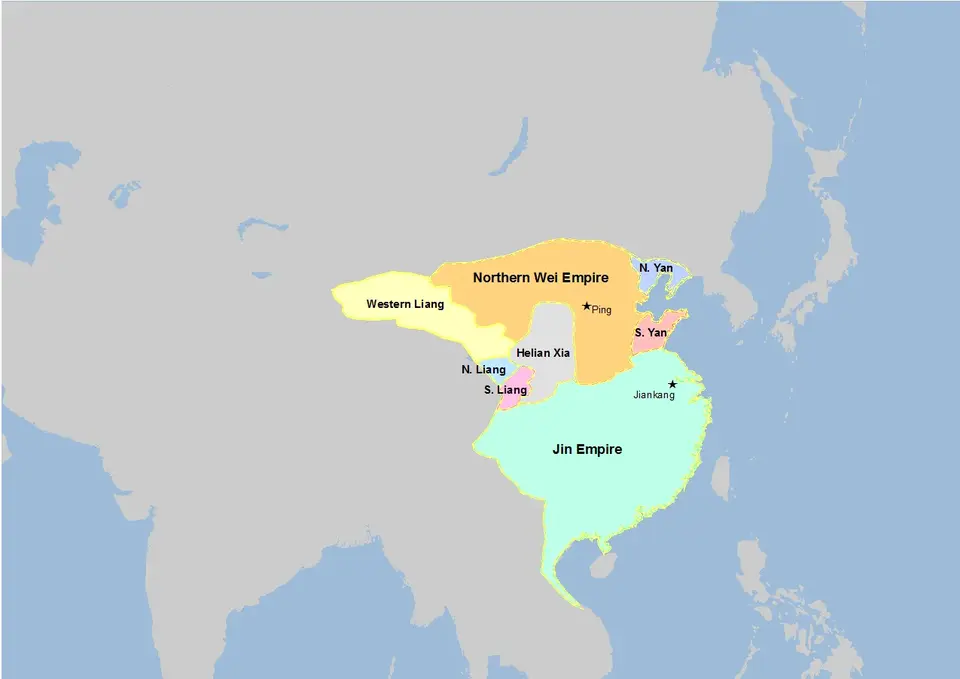
Tuoba (拓跋, historically denoting the rise of the Tuoba Xianbei and the founding of Northern Wei) was a foundational historical event from 386 to 398 CE (from the 1st year of Dengguo to the 1st year of Tianxing) during which chieftain Tuoba Gui reconstituted the scattered Daibei tribes, resurrected the Dai state, and established the Northern Wei imperial dynasty. Originating in the northern Greater Khingan Range, the Tuoba Xianbei founded the Dai state during the late Western Han and Jin periods before being subjugated by Former Qin ruler Fu Jian in 376 CE. Following Former Qin's collapse at the Battle of Fei River, Tuoba Shiyijian's grandson Tuoba Gui rallied his grandfather's loyalists, re-establishing Dai at Niuchuan in the spring of 386 CE before adopting the classical Chinese dynastic title of Wei. In the initial years of the reign, Tuoba Gui suppressed internal dynastic conspiracies and subdued neighboring nomadic tribes. In 395 CE, at the decisive Battle of Canhebei, Tuoba Gui deployed scorched-earth tactics and an amphibious cavalry ambush to annihilate an eighty-thousand-strong Later Yan invasion army led by Crown Prince Murong Bao, decisively shifting the regional balance of power. The Northern Wei subsequently crossed the Taihang Mountains, capturing the major cities of Zhongshan and Ye while absorbing the fertile plains of Hebei. In 398 CE, Tuoba Gui relocated his capital to Pingcheng and officially ascended the imperial throne as Emperor Daowu, completing the historic transition of the Tuoba Xianbei from nomadic pastoralism to an agrarian empire.
Former Qin conquers Dai and slays King Tuoba Shiyijian; infant prince Tuoba Gui escapes into exile under his mother's care.
Former Qin collapses following defeat at Fei River; northern China fractures into competing regimes, creating a power vacuum in Daibei.
The fifteen-year-old Tuoba Gui rallies ancestral retainers at Niuchuan, declaring the restoration of the Dai kingdom.
Tuoba Gui changes the state title to Wei, promotes agricultural cultivation around Shengle, and founds the Northern Wei Dynasty.
Tuoba Gui crushes the rebellious Dugu chieftain Liu Xian and crosses the Yellow River to annihilate the Tiefu Xiongnu, unifying Daibei.
Murong Chui dispatches Crown Prince Murong Bao with eighty thousand troops to invade Wei; Tuoba Gui conducts a tactical retreat behind the Yellow River.
Wei cavalry cross the frozen Yellow River and ambush the retreating Yan army at Canhebei, annihilating its forces.
Murong Chui dies of grief at Canhebei; Later Yan fractures into factional strife as Tuoba Gui mobilizes four hundred thousand troops to advance into Hebei.
Northern Wei forces capture the major Later Yan cities of Zhongshan and Ye, conquering the northern plains.
Tuoba Gui relocates his capital to Pingcheng, establishes imperial institutions, and formally ascends the throne as Emperor Daowu.
The Tuoba branch of the Xianbei people originated around the Greater Khingan Range in northeastern Manchuria (near the modern Gaxian Cave in Inner Mongolia), subsisting primarily on hunting and pastoral archery. During the Eastern Han and Cao Wei periods, tribal chieftain Tuoba Liwei led his people southward toward the Yin Mountains and Shengle (modern Horinger, Inner Mongolia), gradually transitioning from nomadic hunting to semi-sedentary pastoralism and grain cultivation.
Following the outbreak of the War of the Eight Princes and the Disaster of Yongjia in the early 4th century, northern China descended into prolonged chaos. In 315 CE, the Western Jin court ennobled chieftain Tuoba Yilu as King of Dai in recognition of his cavalry assistance against the Han Zhao Xiongnu forces, formally establishing the Dai state with Shengle as its fortified center. However, in 376 CE, Emperor Xuanzhao of Former Qin (Fu Jian) mobilized three hundred thousand troops to invade Dai. King Tuoba Shiyijian was betrayed and killed in dynastic turmoil, leading to the collapse of the Dai state. Former Qin partitioned the Daibei grasslands between the Dugu and Tiefu tribes. Tuoba Shiyijian's six-year-old grandson, Tuoba Gui, was protected by his mother Lady He, enduring a perilous childhood sheltered among the Dugu and Helan tribal camps.
In 383 CE, Fu Jian commanded a colossal imperial army to invade the Eastern Jin, suffering a catastrophic defeat at the Battle of Fei River. The fragile multi-ethnic coalition of Former Qin disintegrated rapidly, plunging northern and northwestern China back into chaotic fragmentation. General Yao Chang founded Later Qin in Guanzhong, Murong Chui proclaimed Later Yan in Hebei, and Murong Chong established Western Yan in Shanxi, leaving the Daibei borderlands in a total power vacuum.
Meanwhile, regional control by Former Qin's former tribal proxies collapsed. Chieftain Liu Kuren of the Dugu tribe was assassinated, triggering a violent succession struggle between his brother and son Liu Xian, who plotted to murder Tuoba Gui to extinguish the royal lineage of Dai. Alerted by loyal retainers, Tuoba Gui fled under the protection of elders Changsun Song and Yu Lidi to seek sanctuary with his maternal uncle He Ne of the Helan tribe. Remembering the generous rule of Tuoba Shiyijian, tribal elders across Daibei yearned to restore the legitimate Dai royal line, creating an opportune historical moment for the resurgence of the Tuoba Xianbei.
On February 20, 386 CE (the 6th day of the 1st lunar month in the 1st year of Dengguo), the fifteen-year-old Tuoba Gui convened a grand tribal assembly at Niuchuan (in the southern Xilingol Grassland or southeast of modern Hohhot), supported by loyalist clans including the Helan, Changsun, and Yu families. Ascending the royal throne as King of Dai, Tuoba Gui proclaimed the restoration of his ancestral state, adopting the era name Dengguo and re-establishing the capital at Shengle.
In May 386 CE, Tuoba Gui enacted a major political reform. Recognizing that the title "Dai" retained regional nomadic connotations inadequate for claiming universal legitimacy over the Central Plains, he issued an imperial decree changing the dynastic name to "Wei" (known to posterity as Northern Wei), claiming the cosmological legacy of the Central Plains. He restructured the administration, abandoning loose tribal governance in favor of functional bureaucratic departments, employing prominent Han scholars such as Feng Yi and Cui Cheng to design court etiquette and statutes. Simultaneously, he promoted agricultural settlement around Shengle, distributing land to settled nomads and surrendered tribes, establishing an agrarian-pastoral economic foundation for the burgeoning state.
In its infancy, Northern Wei faced severe existential threats from hostile tribal rivals. Chieftain Liu Xian of the Dugu tribe repeatedly raided Shengle and conspired with Tuoba Gui's estranged uncle, Tuoba Kuduo, to incite an internal military rebellion. Demonstrating extraordinary military resolve, Tuoba Gui personally led elite cavalry squadrons to rout Liu Xian's army at Mayi. Securing temporary reinforcement from Murong Chui of Later Yan, Tuoba Gui shattered Tuoba Kuduo's rebellious force at the Battle of Gaoliu, executing the conspirators and absorbing their tribal followers.
With internal security restored, Tuoba Gui launched decisive expansionist campaigns across the steppes. He marched north into the Gobi Desert to crush the newly emerging Rouran confederacy and Gaoche tribes, capturing hundreds of thousands of livestock and securing his northern borders. Turning westward across the Yellow River, Tuoba Gui launched a surprise raid against Yuebacheng (near modern Jungar Banner), the stronghold of Tiefu Xiongnu chieftain Liu Weichen. The Tiefu army was annihilated, yielding over thirty thousand horses and four million sheep and cattle, consolidating Northern Wei's absolute mastery over the Daibei grasslands and the eastern Ordos Loop.
As Northern Wei's power expanded, it inevitable clashed with the Later Yan Empire, the dominant superpower in eastern China. After Later Yan conquered Western Yan in 394 CE, tensions escalated when Murong Chui detained Northern Wei envoys demanding fine horses, shattering the bilateral alliance.
In May 395 CE (the 10th year of Dengguo), Later Yan Emperor Murong Chui dispatched an invasion army of eighty thousand men commanded by Crown Prince Murong Bao and Prince of Liaoxi Murong Nong to eliminate Northern Wei. Tuoba Gui executed an astute scorched-earth strategy, evacuating northern pastures and withdrawing his main forces to the southern banks of the Yellow River. The Later Yan columns advanced to Wuyuan, where their supply lines became overextended. Furthermore, Tuoba Gui captured all Later Yan couriers traveling to and from their capital of Zhongshan, while circulating rumors along the river that Murong Chui had died of illness. Plagued by collapsing morale and insubordination, Murong Bao ordered a retreat eastward in late October.
In November, sudden severe frost froze the Yellow River solid. Tuoba Gui seized the opportunity, leading twenty thousand elite shock cavalry across the ice and pursuing the retreating Yan army across hundreds of miles of wilderness. On the evening of December 7, the Yan army reached the defile of Canhebei (northeast of modern Liangcheng, Inner Mongolia), believing the Wei army remained far behind the river. At dawn the following morning, Tuoba Gui unleashed his cavalry from the surrounding cliffs, catching the eighty thousand Yan soldiers completely unprepared. The Later Yan army collapsed into panic, with tens of thousands trampled to death in the defile. Murong Bao escaped with a few thousand cavalry, while forty to fifty thousand elite Yan troops surrendered en masse and were executed. The Battle of Canhebei eliminated Later Yan's offensive military power and fundamentally altered the balance of power across northern China.
Following the catastrophe at Canhebei, the ailing seventy-year-old Murong Chui attempted a desperate retaliatory counter-offensive in the spring of 396 CE. Although his surprise march briefly drove Wei garrisons out of Pingcheng, Murong Chui passed through Canhebei on his return march. Beholding the vast mounds of unburied bones belonging to his fallen soldiers, the imperial army wept aloud. Overwhelmed by grief and remorse, Murong Chui vomited blood, collapsed, and died en route to Zhongshan, precipitating a bitter succession crisis among the Later Yan nobility.
In August 396 CE, Tuoba Gui mobilized an imperial expeditionary force of more than four hundred thousand infantry and cavalry, advancing across the Taihang Mountains into the Hebei heartland. The Wei armies advanced rapidly, capturing Bingzhou, Changshan, and Xindu before laying siege to the Later Yan capital of Zhongshan (modern Dingzhou, Hebei). In October 397 CE, Zhongshan fell to Wei troops, followed shortly by the capture of Ye (modern Linzhang). Later Yan disintegrated into two isolated remnants in Liaodong and southern Henan. Northern Wei gained complete control of the agricultural plains north of the Yellow River, shifting its center of gravity from the northern steppe to the heart of the Central Plains.
With the conquest of the rich Central Plains, the remote steppe citadel of Shengle was no longer suited to serve as the administrative nerve center of a vast agrarian empire. In July 398 CE (the 1st year of Tianxing), Tuoba Gui promulgated an imperial decree relocating the capital of Northern Wei to Pingcheng (modern Datong, Shanxi).
At Pingcheng, Tuoba Gui directed the construction of imperial ancestral temples, altars of soil and grain, and fortified palace enclosures spanning thirty-two li in circumference. Over one hundred thousand households of conquered aristocrats, craftsmen, and peasants from the Central Plains were forcibly relocated to Pingcheng to cultivate the surrounding arable lands and develop urban infrastructure. Collaborating with prominent Confucian scholar Cui Hong, Tuoba Gui established administrative statutes, official dress codes, court rituals, and standard weights and measures modeled after the Han and Jin dynasties, creating an imperial bureaucracy centered around the Three Excellencies and Nine Ministers.
On January 24, 399 CE (the 2nd day of the 12th lunar month in the 1st year of Tianxing), Tuoba Gui sacrificed to Heaven and Earth at the southern suburban altar in Pingcheng, formally ascending the imperial throne as Emperor Daowu of Northern Wei. This ceremony marked the full transformation of the nomadic Tuoba Xianbei into a recognized Chinese imperial dynasty, initiating a century and a half of Northern Wei rule that reshaped early medieval East Asian history.
The rise of the Tuoba Xianbei and the founding of the Northern Wei concluded in a sweeping strategic triumph for Tuoba Gui. Over twelve years of continuous military campaigns, Tuoba Gui progressed from an exiled youth to the sovereign master of northern China. He eliminated rival steppe confederacies across the Daibei grasslands, shattered the military hegemony of Later Yan at Canhebei, and absorbed the agricultural territories of modern Shanxi, Hebei, and Shandong. By establishing his fortified capital at Pingcheng in 398 CE and performing suburban sacrificial rites as emperor, Tuoba Gui successfully transformed a fragmented pastoral tribal coalition into a centralized, bureaucratic empire.
This foundational event altered the course of Chinese medieval history across multiple profound dimensions. First, it halted the destructive cycle of regional warlord warfare that had devastated northern China since the Disaster of Yongjia in 311 CE, providing the structural foundation for Emperor Taiwu (Tuoba Tao) to formally unify northern China in 439 CE and inaugurating the Northern and Southern Dynasties period. Second, it launched the historical process of deep ethnic assimilation between the Xianbei people and the Han population of the Central Plains; from Tuoba Gui's agrarian settlements through Emperor Xiaowen's radical Taihe Reforms and the relocation of the capital to Luoyang, the Tuoba elite integrated fully with Chinese civilization. Third, the institutional innovations pioneered during the early Northern Wei—including the Three Chiefs System, the Equal-Field System (Juntianzhi), and the embryonic structures of the Divisional Militia (Fubingzhi)—were inherited by the Western Wei, Northern Zhou, and ultimately formed the core governing apparatus of the reunified Sui and Tang empires.