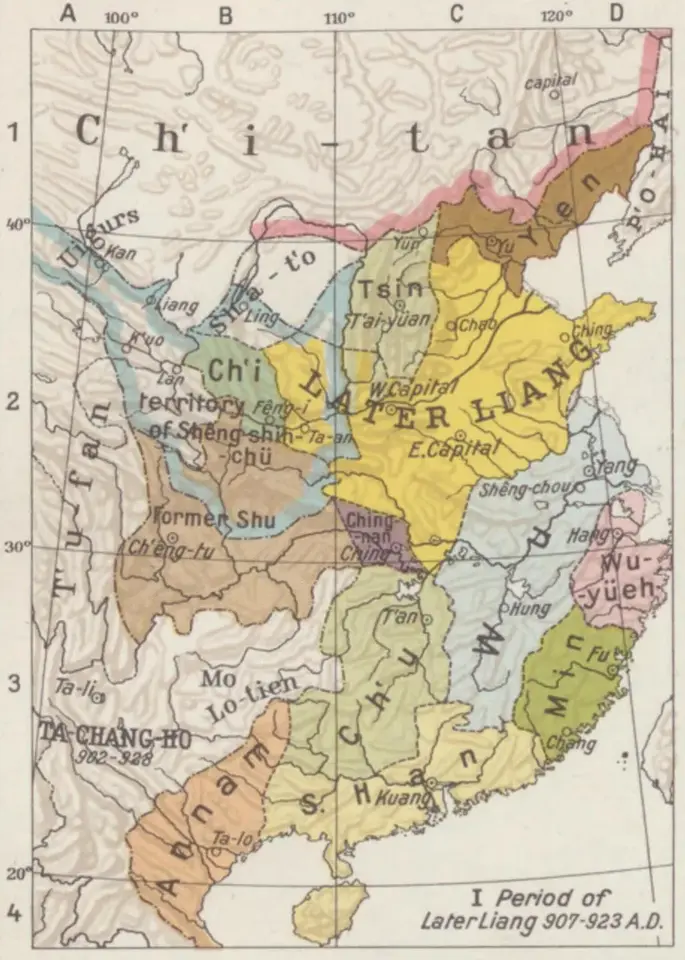
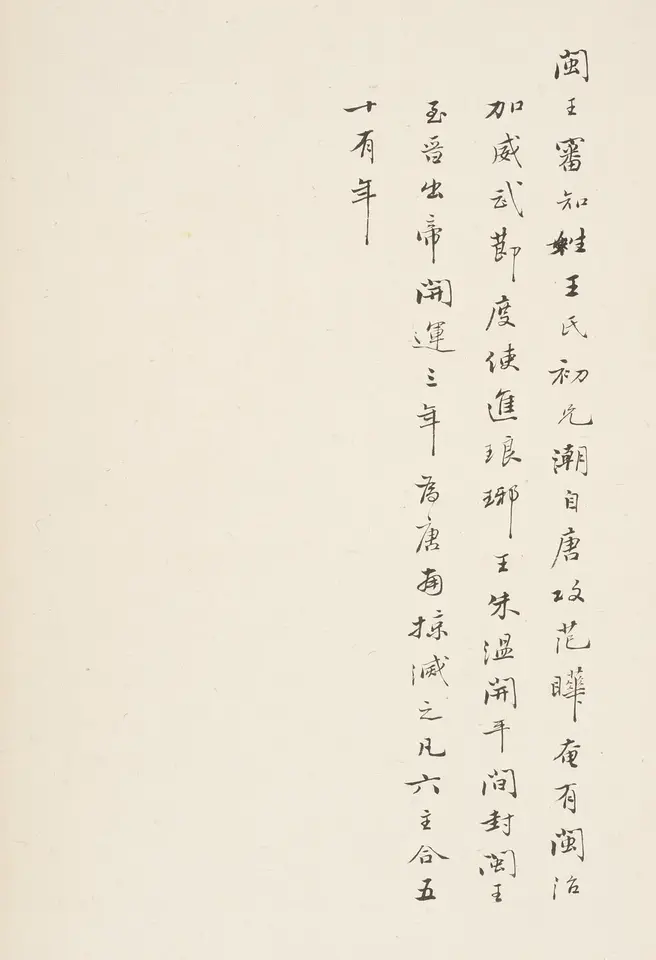
FULL ENTRY
Historical Evolution
Joining the Ranks in Turmoil and Marching into Min
In the twilight years of the Tang Dynasty, intense political chaos gripped the Central Plains as Huang Chao's insurgent forces traversed north and south, prompting local warlords across the empire to amass independent private armies. In Gushi County of Guangzhou, Henan, three brothers—Wang Chao, Wang Shengui, and Wang Shenzhi—hailed from a respected agrarian household celebrated locally for martial prowess and righteous conduct. The eldest brother, Wang Chao, served as a county administrative clerk and was well versed in penal codes and governance. In 881, Wang Xu, a butcher from Shouzhou, gathered local outlaws and seized both Shouzhou and Guangzhou. Aware of the three brothers' talent and clan prestige, Wang Xu conscripted them, appointing Wang Chao as an army commissioner in charge of rations and weapons, thrusting them into the turbulent whirlpool of late Tang warlord strife.
After consolidating his hold over Guangzhou with over ten thousand troops, Wang Xu sought survival by submitting to Qin Zongquan, a notorious warlord occupying Caizhou. Qin Zongquan appointed Wang Xu as Prefect of Guangzhou and subsequently commanded him to assist in crushing remnant peasant rebels while demanding exorbitant tributes. Hemmed in by limited troop strength and terrified by Qin Zongquan's renowned brutality, Wang Xu hesitated to mobilize, prompting Qin Zongquan to dispatch an expeditionary force against him. In early 885, cornered and outmatched, Wang Xu led his soldiers and civilian dependents to abandon Guangzhou and flee south. Over ten thousand families from Guangzhou and Shouzhou accompanied the vanguard across the Huai and Yangtze rivers, marching through Jizhou in Jiangxi and Chaoyang in Guangdong before penetrating the perilous, isolated ranges of the Min mountains.
Trudging across rugged, precipitous trails in southern Fujian, the migrating army suffered acute grain shortages and rampant epidemics, plunging soldiers and civilians alike into profound distress. A former outlaw of violent temper, Wang Xu grew increasingly suspicious and paranoid after tasting supreme authority, constantly dreading insubordination or assassination by ambitious subordinates. During the southward march, he not only executed his frontline vanguard general Liu Xingquan despite his distinguished battlefield feats, but even issued cruel orders to abandon elderly, sick, and disabled followers to speed up troop movement. Upon reaching Nan'an, Wang Xu went so far as to command the Wang brothers to abandon their aged mother. This ruthless edict ignited universal indignation and sorrow across the ranks, leaving officers and men in mortal terror and catalyzing a covert conspiracy to depose their erratic leader.
Wang Chao recognized that blind obedience to tyrannical decrees would inevitably lead to mutual annihilation, prompting him to forge a covert pact with frontline commanders and veteran officers. In the eighth lunar month of 885, as the army traversed the treacherous defile of Zhulin in Nan'an, Wang Chao pre-positioned dozens of robust warriors in ambush along the roadside. When Wang Xu rode past, the concealed warriors ambushed him, binding him and locking him securely inside a baggage cart. Once the bloodless coup concluded, the officers expressed deep gratitude for being spared slaughter and unanimously elected the composed, benevolent Wang Chao as supreme military commander. Assuming leadership, Wang Chao immediately released the abandoned elderly, restored military order, strictly outlawed looting, and thoroughly revitalized army morale.
Taking the helm, Wang Chao understood that a displaced army isolated in the remote southern wilderness could not endure without a secure territorial base to sustain its people. He encamped his forces in the Nan'an basin to rest and reorganize, issuing rigorous prohibitions against trampling standing crops and sericulture. His disciplined army's impeccable conduct won universal acclaim from both indigenous inhabitants and northern emigres. At that juncture, Liao Yanruo, the Prefect of Quanzhou, was extorting the populace through rapacious taxation and tyrannical cruelty, evoking widespread misery. Zhang Yanlu and other elder gentry of Quanzhou traversed mountain passes to Nan'an, presenting gifts of cattle and wine while earnestly pleading with Wang Chao to advance upon Quanzhou and liberate the distressed populace.
Besieging Quanzhou and Subduing the Five Prefectures
Heeding the popular clamor, Wang Chao resolved to lead his expedition eastward to besiege Quanzhou. In the autumn of 885, the army dismantled its camp and marched directly to the fortified walls of Quanzhou, establishing fortified encircling lines. Relying on formidable stone battlements and ample municipal fortifications, Liao Yanruo mounted stubborn resistance, plunging the confrontation into an agonizing, protracted siege. Wang Chao constructed deep perimeter trenches to cut off external reinforcement, repeatedly repulsing sortie attempts by the defenders. Chen Yan, the Surveillance Commissioner of Fujian stationed in Fuzhou, resented Liao Yanruo's longstanding arrogance and maintained a policy of passive observation, keeping his troops garrisoned for a full year without dispatching a single soldier to relieve Quanzhou, thereby affording Wang Chao an ideal operational opening.
The siege raged for an entire year until supplies within Quanzhou were completely exhausted, forcing the starving garrison to resort to tragic extremes and utterly shattering defensive resolve. In the eighth lunar month of 886, Wang Chao ordered Wang Shengui and Wang Shenzhi to lead assault teams against the weakest section of the ramparts using scaling ladders, successfully breaching the outer walls and decapitating Liao Yanruo. Upon entering the city, Wang Chao strictly forbade murder and plunder, opened granaries to feed starving refugees, and interred the remains of fallen combatants. Observing Wang Chao's disciplined governance and deep popular support, Surveillance Commissioner Chen Yan submitted an imperial memorial recommending Wang Chao as Prefect of Quanzhou. The Tang court formally approved the petition, legally validating the Wang clan's rule over southern Fujian.
During his tenure in Quanzhou, Wang Chao governed with diligence and benevolence, enlisting northern literary refugees and native elites to erect schools and pacify displaced households, swiftly restoring public stability. In 891, the political landscape of Fujian shifted abruptly when Chen Yan fell mortally ill. Recognizing the unruly nature of his garrison officers, Chen Yan dispatched envoys to Quanzhou intending to entrust regional military command to Wang Chao. However, before the envoys returned, Chen Yan died, and his brother-in-law Fan Hui, commander of the garrison, staged a mutiny to proclaim himself acting surveillance commissioner, seizing Fuzhou. Fan Hui ruled with haughty cruelty, executing veteran officers and alienating Chen Yan's former subordinates, who fled in large numbers to seek refuge under Wang Chao in Quanzhou.
In the third lunar month of 892, responding to fervent petitions from Chen Yan's former officers, Wang Chao mobilized an expedition to crush the rebellious Fan Hui. He designated his cousin Wang Yanfu as general commander and his youngest brother Wang Shenzhi as supervisor of armies, dispatching the elite Quanzhou host northward to invest Fuzhou. Fan Hui relied on Fuzhou's towering stone ramparts and the crack Jiulong Guard to defend the citadel, inflicting heavy casualties on the besiegers over months of bitter assault. Dressed in white armor and mounted on a white charger, Wang Shenzhi personally spearheaded frontline breaches with unmatched courage, earning the reverent moniker White Horse Third Brother. Facing a massive seaborne relief fleet dispatched by Dong Chang of Zhejiang, several vanguard officers faltered and urged retreat.
Informed of the crisis, Wang Chao displayed unyielding strategic resolve, flatly rejecting the plea to withdraw, decreeing that anyone who retreated would be executed on the spot, and sending forward elite reinforcements and siege engines. Deeply inspired, Wang Shenzhi resolved to fight to the finish, directing his men to dig subterranean tunnels and sever the city's water supply while pressing attacks day and night. In the fifth lunar month of 893, with supplies exhausted, a mutiny erupted within Fuzhou; Fan Hui abandoned the citadel at night and fled toward transport vessels, only to be slain en route by mutinous soldiers who surrendered his head. Wang Chao led his victorious army into Fuzhou, absorbing over ten thousand surrendered troops and pacifying the panicked populace, formally bringing the provincial capital under Wang clan hegemony.
Following the fall of Fuzhou, regional pacification proceeded rapidly. Zhong Quanmu, Prefect of Tingzhou, astutely evaluated the balance of power and surrendered his prefecture voluntarily. In Jianzhou, Prefect Xiong Bo sided with the defeated Fan Hui and mounted futile resistance until local militia commander Xu Guifan slew him and yielded the prefecture to Wang Chao. Wang Chao then deployed detachments to pacify more than twenty independent armed redoubts ensconced in mountain passes, while tasking General Li Chengxun with ten thousand troops to suppress the Huangliandong indigenous uprising besieging Tingzhou. Blending military firmness with administrative leniency, Wang Chao swiftly pacified every corner of the realm, bringing Fuzhou, Quanzhou, Jianzhou, Zhangzhou, and Tingzhou under unified Wang family sway.
Wang Chao's Bequest and Taizu Laying the Foundation
In the winter of 893, Emperor Zhaozong of Tang officially invested Wang Chao as Surveillance Commissioner of Fujian, with his brother Wang Shenzhi serving as deputy commissioner. In the ninth lunar month of 896, recognizing Fujian's strategic coastal significance and Wang Chao's remarkable administrative achievements, the Tang court elevated Fuzhou into the Weiwu Military Commission, appointing Wang Chao as Military Commissioner of Weiwu and granting him the honorific title of Acting Right Executive Assistant. Over years of ceaseless administrative exertion, Wang Chao's health deteriorated severely, and he passed away in the twelfth lunar month of 897. On his deathbed, Wang Chao placed the common welfare above family favoritism, recognizing Wang Shenzhi's peerless martial feats and designating his third brother to inherit supreme military authority over his own sons.
Following Wang Chao's passing, Wang Shenzhi conscientiously adhered to fraternal seniority and sought to yield leadership to his second elder brother, Wang Shengui. Wang Shengui resolutely declined the offer, arguing that Wang Shenzhi's monumental military accomplishments made him the sole natural choice to command the troops. In the third lunar month of 898, the Tang court designated Wang Shenzhi as Acting Military Commissioner of Weiwu and Minister of Justice, elevated him to Salt and Iron Transport Commissioner in May, and formally confirmed his appointment as Military Commissioner in October. Assuming total command over the Eight Min Prefectures, Wang Shenzhi took deferential submission to the central dynasty as the bedrock of his foreign policy, sending seaborne tributary missions to Chang'an and Luoyang, prompting the Tang court to advance him to Grand Mentor and Prince of Langya.
In 907, Zhu Wen deposed the puppet Emperor Ai of Tang to establish the Later Liang Dynasty, prompting regional warlords across China to declare themselves sovereign emperors. Several senior generals urged Wang Shenzhi to exploit the chaos and claim imperial dignity. Wang Shenzhi, fully cognizant of Fujian's modest territory and limited population, firmly rejected imperial elevation, uttering the famous historical aphorism: 'Better to remain an open-door military commissioner than a closed-door Son of Heaven.' He immediately dispatched naval envoys across the sea to Bianzhou to submit formal vassal memorials and tribute to the Later Liang. In the fourth lunar month of 909, Emperor Taizu of Later Liang reciprocated by issuing an imperial decree formally investing Wang Shenzhi as the Prince of Min and upgrading Fuzhou to a Grand Superior Protectorate, formally inaugurating the Min Kingdom.
At its founding, the Min state confronted a perilous geopolitical encirclement. To the west, the Yang Wu regime occupied the Jianghuai basin, severing overland post roads and executing central emissaries, completely choking off Min's landward tributary route. Showing remarkable strategic fortitude, Wang Shenzhi invested heavily in constructing an ocean-going fleet, opening a perilous maritime corridor from the mouth of the Min River across the East China and Yellow seas to Dengzhou and Laizhou on the Shandong peninsula, whence tribute was carried overland to Kaifeng. Despite raging typhoons and treacherous reefs that drowned nearly half of his emissaries, Wang Shenzhi maintained uninterrupted annual missions. In 923, when Later Tang destroyed Later Liang, Wang Shenzhi promptly pledged vassal allegiance to Luoyang, receiving appointments as Palace Secretariat Director and Department Director.
Domestically, Wang Shenzhi implemented statecraft centered upon 'protecting the realm and pacifying the people.' Mindful of the catastrophic devastation wrought by late Tang civil wars, he established an ancestral admonition never to initiate offensive campaigns across borders, repealed draconian penal statutes, and reduced agrarian taxes to an unprecedented one-thirtieth rate. Wang Shenzhi practiced strict self-discipline and austerity, habitually dressing in coarse hemp robes and inhabiting an unadorned residence. He organized soldiers and civilians to build sea dykes, reclaim littoral mudflats, and construct hillside terraces, while welcoming displaced northern scholars to live in peace. Through three decades of benevolent administration, Fujian was spared devastating warfare, winning fame as an affluent haven of high culture and prosperity.
Three Decades of Tranquil Prosperity under Taizu
To break Fujian's historical isolation between rugged mountains and turbulent seas, Wang Shenzhi aggressively developed maritime commerce. In the late Tang, coastal shipping was plagued by submerged reefs and frequent shipwrecks. Wang Shenzhi excavated and blasted a deep-water channel near Huangqi Port in Lianjiang, Fuzhou; according to lore, underwater boulders magically shattered during the excavation, prompting him to bestow the auspicious name Gantang Port. He established a merchant reception agency, abolished burdensome transit tariffs on incoming vessels, and attracted maritime merchants from the South Seas, Korea, and Japan to congregate in Fujian. Rhinoceros horns, ivory tusks, and exotic spices were traded in huge quantities for Fujianese tea and ceramics, elevating Quanzhou and Fuzhou into prominent international maritime emporiums.
Regarding urban development, Wang Shenzhi launched an ambitious expansion of Fuzhou's municipal defenses in 901, constructing an expansive outer perimeter wall measuring forty li in circumference outside the old inner fortress, equipped with more than ten land gates, side portals, and water gates. In 905, he erected additional semicircular outer wing walls to the north and south, fully enclosing Wushi Mountain, Yu Mountain, and Ping Mountain within the urban defensive perimeter, thereby establishing Fuzhou's enduring spatial layout of 'mountains embraced within the city.' He channeled Min River tidal currents through urban canals, facilitating naval mobilization and merchant navigation. This urban transformation multiplied Fuzhou's municipal expanse sevenfold, transforming it into the foremost metropolitan stronghold in southeastern China.
Wang Shenzhi deeply venerated Confucian learning and championed classical education. Amid the late Tang devastation of northern China, countless elite lineages and literary scholars sought haven in the south. Wang Shenzhi erected the Academy for Recruiting Talents and the Hall of Worthies within Fuzhou, providing generous stipends to host displaced northern dignitaries and master scholars, such as late Tang poet Han Wo, Chancellor Weng Chengzan, master rhapsodist Xu Yin, and learned essayist Huang Tao. He founded the Four Gates College to cultivate indigenous talent, revived regular local examinations for civil recruitment, and personally selected virtuous magistrates to govern prefectures and counties, elevating the formerly marginalized frontier of Min into a celebrated commonwealth of letters.
A devout patron of Chan Buddhism, Wang Shenzhi recognized the religion's vital capacity to soothe war-weary refugees and cultivate civic harmony. Throughout his reign, he generously funded the construction and renovation of over two hundred Buddhist monasteries and pagodas across the realm. Famous sanctuaries such as Yongquan Monastery on Mount Gu, Xichan Monastery on Mount Yishan, and Kaiyuan Monastery in Fuzhou underwent massive expansions. Wang Shenzhi donated five hundred thousand strings of cash to support master Yicun of Xuefeng in propagating Chan teachings, convened immense nondiscriminatory assemblies, and funded twenty-thousand-person vegetarian feasts alongside cast-iron statues and stone pagodas, earning Fuzhou renown as the Buddhist Kingdom of the Southeast.
In the twelfth lunar month of 925, after governing the Eight Min Prefectures for nearly three decades, Emperor Taizu Wang Shenzhi passed away at his Fuzhou residence at the age of sixty-four. The Later Tang court posthumously conferred upon him the noble title of Prince Zhongyi, and grateful Fujianese venerated him as the foremost founding father of Min. Aware of his sons' volatile temperaments and separate military commands, Wang Shenzhi left solemn deathbed admonitions enjoining fraternal harmony, vigilant defense, and the avoidance of internal bloodshed. Yet with the passing of this revered founding monarch, covert rivalries and factional grievances within the ruling house erupted violently, bringing Fujian's tranquil era of peace to a sudden close.
Fratricidal Discord and the Usurper King
Following Wang Shenzhi's death, his eldest son Wang Yanhan was acclaimed by the court bureaucracy to assume office as Acting Military Commissioner of Weiwu, shortly receiving formal investiture as Military Commissioner and Concurrent Chancellor from the Later Tang court. Arrogant, capricious, and fond of vainglorious display, Wang Yanhan cast aside his late father's legacy of administrative frugality the moment he took power. He conscripted heavy corvee labor to construct an extravagant Crystal Palace within the Fuzhou imperial compound for round-the-clock sensual revelry. Furthermore, he decreed the widespread selection of young maidens across all prefectures to populate his harem, enabling corrupt underlings to extort commoners and provoking pervasive indignation throughout the realm.
In the tenth lunar month of 926, taking advantage of the turmoil in northern China following the assassination of Emperor Zhuangzong of Later Tang in a Luoyang mutiny, Wang Yanhan harbored designs of autonomous kingship. Drawing upon ancient records in the Shiji concerning King Wuzhu of Minyue who carved out an independent realm in the Western Han, he declared to his assembled ministers that Min had been a kingdom since antiquity and asked why he should delay his own royal elevation. He unilaterally renounced Later Tang suzerainty and proclaimed himself King of the Great Min. Wang Yanhan not only instituted royal court protocols but also deeply suspected and marginalized his brothers governing outlying prefectures, stripping veteran commanders of authority and pushing the ruling elite into acute polarization.
Wang Yanhan's despotic rule triggered fierce resistance from regional prefects commanding powerful garrison forces. His younger brother Wang Yanjun served as Prefect of Quanzhou, while his adoptive brother Wang Yanbing governed Jianzhou; both commanded deep loyalty among soldiers and civilians. When Wang Yanhan dispatched imperial envoys to Jianzhou demanding the conscription of maidens, Wang Yanbing flatly rejected the decree and dispatched a scathing missive rebuking his brother's moral decay. Enraged by the defiance, Wang Yanhan threatened a punitive expedition. Realizing their peril, Wang Yanbing forged a covert military alliance with Wang Yanjun of Quanzhou, jointly plotting to mobilize their provincial armies and overthrow the tyrannical monarch.
In the first lunar month of 927, Wang Yanbing raised the banner of rebellion in Jianzhou, leading over ten thousand veteran northern troops aboard transport vessels down the Jianxi River toward Fuzhou. Simultaneously, Wang Yanjun mobilized cavalry and infantry from Quanzhou and Zhangzhou, marching northward along the coastal post road. Wang Yanbing operated with remarkable speed, his riverine vanguard smashing defensive barriers and reaching the gates of Fuzhou while the demoralized defenders offered token resistance. Wang Yanbing's assault forces stormed the palace, captured Wang Yanhan cowering in his Crystal Palace, publicly proclaimed his crimes of filial impiety and tyranny, and beheaded him in the marketplace. Wang Yanjun arrived with his army the following day, joining forces to secure the capital.
With Wang Yanhan eliminated, bitter rivalry erupted between Wang Yanbing and Wang Yanjun over supreme authority. Boasting the seniority of an elder brother and commanding the veteran Jianzhou army, Wang Yanbing recognized Wang Yanjun's overwhelming backing among local Fuzhou gentry and deemed it prudent to withdraw his forces to Jianzhou. At a farewell banquet outside the city, Wang Yanbing sternly admonished Wang Yanjun to honor their father's legacy and avoid compelling his elder brother to return under arms. Harboring deep resentment beneath a submissive facade, Wang Yanjun assumed the title of Acting Military Commissioner of Weiwu and sent tributary embassies to Later Tang. In 928, Later Tang formally invested Wang Yanjun as Prince of Min, opening the era of Huizong.
Fraternal Strife and Huizong's Imperial Coronation
Assuming command in Fuzhou, Wang Yanjun constantly regarded Wang Yanbing in northern Jianzhou as his most perilous rival. To lull his adoptive brother into complacency, Wang Yanjun adopted duplicitous tactics, repeatedly petitioning the Later Tang court to shower Wang Yanbing with honors, promoting him to Grand Protector and Secretariat Director, while covertly reinforcing military checkpoints around Jianzhou to monitor troop movements. Well aware of these machinations, Wang Yanbing attempted a deceptive maneuver in late 929 by requesting retirement from his commissionership and proposing that his son Wang Jixiong temporarily administer Jianzhou, seeking to gauge Fuzhou's intentions as both sides teetered on the brink of open war.
In the second lunar month of 931, learning that a disastrous fire had incinerated Fuzhou's palace compounds and left the capital vulnerable, Wang Yanbing resolved to launch a preemptive strike to seize all of Min. He personally led the main Jianzhou riverine and land army to assault Fuzhou's western gates, while ordering his son Wang Jixiong to navigate a seaborne flotilla around to strike the southern gate via the Min River. Facing this dual assault, Wang Yanjun dispatched his trusted general Wang Renda with elite amphibious forces to engage the invaders. A master strategist of formidable bravery, Wang Renda prepared an ambush at the mouth of the Nantai River, launching a ferocious fire-ship attack that incinerated Wang Jixiong's unprepared fleet and killed the young commander in battle.
Wang Renda suspended Wang Jixiong's severed head from the western ramparts of Fuzhou, instantly shattering the morale of Wang Yanbing, who was directing assaults against the western gate and collapsed in overwhelming grief. Seizing the psychological moment, Wang Renda led his garrison warriors on a thunderous countercharge, routing the Jianzhou troops who trampled one another in headlong flight. Wang Yanbing attempted to break out alone but was captured and brought before Wang Yanjun, who castigated him for treason before ordering his public execution by bisection in Fuzhou's central thoroughfare. Wang Yanjun then dispatched his younger brother Wang Yanzheng to occupy Jianzhou and pacify its garrison, eradicating the northern enclave and elevating his authority to an unprecedented zenith.
Having extinguished domestic threats, Wang Yanjun's political ambitions swelled, and he ceased to be content with the subordinate title of prince. In the summer of 932, citing imperial precedents wherein Kings Ma Yin of Chu and Qian Liu of Wuyue were granted the exalted rank of Grand Executive Assistant, Wang Yanjun submitted a memorial requesting the same title from Later Tang. Emperor Mingzong flatly rejected the petition on the grounds that such grand titles were reserved solely for imperial princes of extraordinary merit. Mortified and incensed by the rebuff, Wang Yanjun severed diplomatic relations with Later Tang, expelled imperial envoys, and accelerated the manufacture of imperial carriages, crowns, and regalia within the Fuzhou palace to prepare for his imperial coronation.
In early 933, Daoist sorcerers in Fuzhou proclaimed that an auspicious yellow dragon had manifested above Wang Yanjun's ancestral residence, the Zhenfeng Mansion, prompting him to rename the compound the Dragon Ascending Palace. In the second lunar month of 933, Wang Yanjun formally erected a grand sacrificial altar in Fuzhou, offering sacrifices to Heaven and ascending the throne as August Emperor. He changed his personal name to Wang Lin, proclaimed the era name Longqi, adopted the state title Great Min, and elevated Fuzhou to Changle Superior Prefecture. Emperor Huizong instituted the Three Departments and Six Ministries, posthumously venerating Wang Shenzhi as Emperor Taizu and transforming Min from a provincial military commission into a full-fledged autonomous empire.
Occult Corruption and the Yonghe Coup
Upon ascending the imperial throne, Wang Yanjun failed to consolidate state governance, abandoning himself to profligate extravagance and superstitious occultism. With Min's narrow territorial base unable to sustain vast palace expenditures, he appointed the rapacious Xue Wenjie as National Planning Commissioner. Xue Wenjie deployed plainclothes inquisitors across the realm to spy on affluent households, fabricating treasonous charges to confiscate private fortunes and driving merchants into despair. Simultaneously, Wang Yanjun embraced Daoist sorcery, squandering immense sums to construct the Baohuang Palace in Fuzhou, patronizing Daoist adept Chen Shouyuan as palace director and granting him the honorific title of Master Dongzhen.
Daoist Chen Shouyuan and sorcerers Xu Yan and Sheng Tao colluded closely with Xue Wenjie, exploiting divine séances to manipulate appointments and eliminate political rivals. Xue Wenjie urged the emperor to purge powerful royal kinsmen and veteran generals; consequently, famed general Wang Renda, whose battlefield heroics had saved the throne, was executed alongside his entire family on fabricated charges after daring to remonstrate. In his final years, Wang Yanjun suffered a debilitating stroke that left his limbs paralyzed, forcing him to abandon public audiences and cede court governance to his empress Chen Jinfeng and her male favorite Gui Shouming. Originally a maidservant of Wang Shenzhi, Empress Chen abused imperial authority with unbridled corruption.
Wang Yanjun's sons observed the court's moral decay and the succession rivalry with mounting dread and resentment. His eldest son, Prince of Fu Wang Jipeng, was an austere and scheming figure who had engaged in an illicit liaison with the emperor's maidservant Li Chunyan. As the emperor lay incapacitated, Commissioner of Public Works Li Keyin repeatedly slandered Palace Guard Commander Li Fang before the sovereign. Holding command over palace guards and fearing imminent execution, Li Fang formed a desperate pact with Prince Wang Jipeng, resolving to stage a preemptive palace coup to assassinate Empress Chen and Li Keyin. Long coveting the throne, Wang Jipeng readily consented, deploying trusted guards at critical palace choke points.
In the tenth lunar month of 935, Li Fang forged imperial orders to mobilize elite guards, storming the inner sanctum and dismembering Li Keyin outside the palace gates. Hearing the clamor, the bedridden Emperor Huizong dragged himself behind a nine-dragon screen to hide. Li Fang led his men into the royal bedchamber, discovered the cowering sovereign, and struck him with several sword thrusts. Writhing in agony and unable to survive, the emperor was finished off by a compassionate palace attendant. Li Fang and Wang Jipeng swiftly executed Empress Chen, Gui Shouming, and their faction. That very night, Wang Jipeng ascended the imperial throne over his father's bloodstained chamber, inaugurating his reign as Emperor Kangzong.
Usurping the throne, Wang Jipeng changed his personal name to Wang Chang and declared the era name Tongwen. To placate the Central Plains court and deflect public condemnation, he sent envoys to Later Tang claiming the humble title of Military Commissioner of Weiwu, while publicly laying sole blame for the regicide upon Li Fang. Appointed to high military office, Li Fang realized the new emperor's treacherous disposition and recruited hundreds of private retainers for protection. In late 935, Wang Chang ordered General Lin Yanhao to stage a surprise ambush during a morning audience, executing Li Fang on the spot and casting all guilt for the coup onto him, thereby consolidating sovereign control through yet another bloody purge.
Kangzong's Tyranny and the Chenwei Guard Insurrection
Ascending the throne, Wang Chang proved even more tyrannical and paranoid than his predecessor. He elevated his former consort Li Chunyan to Empress, invested Daoist Tan Zixiao as Master Zhengyi, promoted Chen Shouyuan to Heavenly Master, and placed blind trust in the charlatan sorcerer Lin Xing. Lin Xing manufactured fraudulent divine prophecies; whenever the emperor harbored suspicion toward an official or prince, Lin Xing claimed the deities demanded their elimination. In the fourth lunar month of 938, heeding Lin Xing's accusations, Wang Chang sent troops to murder his royal uncles Wang Yanwu and Wang Yanwang alongside their families, slaughtering even five infant nephews in their cradles.
Wang Chang's homicidal paranoia extended to his closest kin. His cousin Wang Jilong was beheaded on the spot merely for an etiquette misstep at a court banquet. His elder brother Wang Jiyan, celebrated for benevolence and military popularity, was stripped of military command and poisoned at home. His uncle Wang Yanxi, terrified of imminent execution, feigned madness and begged to become a Daoist recluse, yet Wang Chang remained suspicious and confined him under strict house arrest. Fratricidal carnage consumed the imperial clan, leaving court dignitaries in perpetual dread and fatally hollowing out the dynastic foundation, setting the stage for an explosive military catastrophe.
In military organization, Wang Chang committed a fatal blunder. The palace guards had historically relied on the Gongchen and Konghe divisions, composed of veterans from the founding Henan campaigns. Deeply suspicious of these seasoned units, Wang Chang conscripted over ten thousand ruffians and market butchers from Fuzhou to establish a personal guard styled the Chenwei Division. He lavished exorbitant bounties on the Chenwei Division while treating the veteran Gongchen and Konghe divisions with open contempt, frequently heaping vile abuse upon their commanders, Lian Chongyu and Zhu Wenjin, in the imperial presence. This overt humiliation provoked incandescent rage among the veteran palace guards.
Recognizing that Wang Chang's erratic fury would inevitably lead to their execution, Commanders Lian Chongyu and Zhu Wenjin covertly coordinated among officer networks to launch a preemptive strike. In the seventh lunar month of 939, a fire consumed the newly constructed Changchun Palace; Wang Chang blamed the palace guards and openly threatened to execute the entire Konghe Division. Informed of the threat, Lian Chongyu and Zhu Wenjin hesitated no longer, leading several thousand armored veterans in a night assault on the inner palace, setting fire to the gates and utterly scattering the undisciplined Chenwei guards who attempted feeble resistance.
Lian Chongyu led his men through the burning bedchambers hunting for the emperor. Wang Chang fled with Empress Li Chunyan over the rear palace wall, reaching Wutong Ridge where pursuing cavalry intercepted them. Lian Chongyu ordered his archers to unleash a volley of arrows, bringing down Wang Chang, whereupon mutinous soldiers hacked both the emperor and his empress to pieces. Wang Chang reigned for four years, his rule beginning with parricide and ending in bloody mutilation. Having seized the capital, Zhu Wenjin and Lian Chongyu sealed the municipal gates, exterminated the Chenwei faction, and escorted the feigning-mad prince Wang Yanxi from his residence to assume the throne as Emperor Jingzong.
Jingzong's Folly and the Outbreak of Civil War
In the seventh lunar month of 939, mutinous commanders Zhu Wenjin and Lian Chongyu installed Wang Yanxi upon the imperial throne. Upon his accession, Wang Yanxi changed his personal name to Wang Xi, adopted the era name Yonglong, and dispatched embassies to submit tributary memorials to Emperor Gaozu of Later Jin. Initially, Wang Xi executed the fraudulent sorcerer Lin Xing, presenting a facade of reform. However, he soon revealed a character of extreme cruelty and chronic alcoholism. Wang Xi spent his days carousing within the inner palace alongside Consort Shang and his nephew Li Renyu, drunkenly executing civil ministers and terrifying the surviving imperial princes with arbitrary slaughter.
Extremely paranoid, Wang Xi harbored virulent enmity toward his youngest brother Wang Yanzheng, who had governed Jianzhou for nearly a decade. Wang Yanzheng administered northern Fujian with diligence and integrity, winning broad support among local gentry. Observing Wang Xi's atrocities in Fuzhou, Wang Yanzheng dispatched earnest missives pleading for moral rectitude. Instead of heeding the counsel, Wang Xi was enraged, sending his henchman Du Jianchong with elite forces to garrison the Jianzhou border under the pretext of surveillance while seeking annexation. Outraged by this aggression, the soldiers and populace of Jianzhou united behind Wang Yanzheng, shattering fraternal ties and igniting an all-out civil war.
In the second lunar month of 940, Wang Xi mobilized forty thousand infantry and naval forces under Pan Shikui and Wu Xingzhen to invade Jianzhou, encamping outside Jian'an. Undaunted, Wang Yanzheng sallied forth, ordering General Chen Hui to lead a riverine force in a surprise raid that routed Pan Shikui's camp and slew the commanding general. At dawn the following day, Jianzhou forces crossed pontoon bridges to launch a crushing assault on Wu Xingzhen's entrenchments, annihilating the Fuzhou army. Infuriated by the defeat, Wang Xi conscripted regional forces for renewed assaults, forcing Wang Yanzheng to appeal to Wuyue for military aid and plunging Fujian into devastating internecine conflict.
Exploiting Min's civil strife, King Qian Yuanguan of Wuyue dispatched General Yang Renquan with forty thousand elite troops under the pretext of relieving Jianzhou. Upon arriving, the Wuyue host encamped on commanding heights, revealing designs to conquer Jianzhou for themselves. Recognizing the peril, Wang Yanzheng dispatched envoys to Wang Xi highlighting their mutual vulnerability, securing a temporary ceasefire. Wang Yanzheng then laid ambushes in the northern mountains, severing Wuyue supply lines and raining boulders down on the invaders, routing the foreign army with over ten thousand casualties. Yet despite repulsing the external threat, internal animosity between the two brothers remained entirely unresolved.
Following the defeat of Wuyue, Emperor Liezu of Southern Tang dispatched Shang Quangong to mediate between the brothers, urging peace to prevent outside conquest. However, flushed with his battlefield success, Wang Yanzheng arrogantly demanded that Wang Xi surrender the ancestral title of Military Commissioner of Weiwu to Jianzhou, while advancing troops to seize Tingzhou and the strategic outpost of Youxikou, directly menacing Fuzhou. Wang Xi responded with fury, slaughtering the families of Jianzhou officials resident in Fuzhou and stripping Wang Yanzheng of all titles. The Min state was irreparably fractured into two hostile armed camps, leaving the populace destitute and fields littered with unburied corpses.
Proclamation of the Great Yin and Territorial Partition
Protracted stalemate convinced Wang Yanzheng to formalize his political rupture with Fuzhou. In the second lunar month of 943, Wang Yanzheng erected a sacrificial altar outside Jianzhou, proclaimed himself Emperor of the Great Yin, and declared the era name Tiande, establishing Jianzhou as his imperial capital. He elevated Jiangle County to Yongzhou and the southern outpost to Tan Prefecture, appointing Pan Chengyou as Minister of Personnel and Chancellor, and Yang Sigong as Minister of War. The once-unified Min realm was now officially bifurcated into two mutually destructive regimes: the Great Min in Fuzhou and the Great Yin in Jianzhou, locked in mortal combat.
To fund his escalating military campaigns against Fuzhou, Wang Yanzheng entrusted state finances to Yang Sigong. Known for cruel extortion, Yang Sigong instituted over a dozen onerous levies across northern Fujian, taxing fish, salt, produce, and even nightsoil transport, provoking bitter popular hatred and earning the moniker Yang the Skinner. Chancellor Pan Chengyou bravely submitted his famous Memorial on Ten Difficulties, urging an immediate halt to crushing taxes and fraternal warfare. Enraged by the rebuke, Wang Yanzheng stripped Pan Chengyou of all offices and placed him under house arrest, alienating the gentry and destroying popular goodwill throughout the Great Yin.
While Jianzhou groaned under extortion, Wang Xi's misrule in Fuzhou reached depths of depravity. Wholly abandoning statecraft, he spent his nights drinking heavily with his jealous empress Lady Li and dissolute favorites, executing ministers on whim. His handsome nephew Li Renyu became the emperor's male paramour and was promoted to Left Executive Assistant and Secretariat Vice-Director, monopolizing power. Fearing his brothers, Wang Xi tortured and exterminated his confined brother Wang Yanxi and his family. Officials attending morning audiences bid farewell to their families in expectation of death, driving despair throughout the realm to an unprecedented pitch.
In the third lunar month of 944, Wang Xi drunkenly executed Palace Guard Commander Wei Conglang. A close associate of Zhu Wenjin and Lian Chongyu, Wei Conglang's execution convinced the two commanders that their liquidation was imminent. Simultaneously, Empress Li, seeking to depose the crown prince in favor of her own son Wang Yacheng, plotted to use the military commanders to assassinate her husband. Recognizing that hesitation meant execution, Zhu Wenjin and Lian Chongyu mobilized their trusted guard units, covertly preparing a third military coup within Changle Prefecture to overthrow the tyrant before he struck.
On the thirteenth day of the third lunar month in 944, having caroused heavily at a palace banquet, Wang Xi rode out in a carriage to visit his ailing minister Li Zhen south of the city. As the carriage passed through the southern avenue, Guard Commander Qian Da lunged forward with a concealed blade, assassinating Wang Xi inside his vehicle. Wang Xi had reigned for four years and eight months, receiving the posthumous title of Emperor Jingzong. Following the assassination, Lian Chongyu and Zhu Wenjin sealed Fuzhou's municipal gates and seized imperial arsenals, sounding the alarm as a catastrophic bloodbath enveloped the Wang clan.
Usurpation of Zhu and Lian and Quanzhou's Liberation
Having slain Wang Xi, Lian Chongyu convened the court bureaucracy, proclaiming that the Wang lineage had exhausted Heaven's mandate through relentless cruelty and that its dynastic line must be extinguished. He then installed Zhu Wenjin as King of Min, who dispatched envoys to submit vassalage to Later Jin. To forestall royalist counteroffensives, Zhu Wenjin issued an extermination order, sending squads to hunt down Wang clan members in Fuzhou. Over fifty sons and grandsons of the founding monarch Wang Shenzhi were dragged to the execution grounds and butchered, their corpses dumped into the Min River, evoking profound grief and horror among the populace.
Zhu Wenjin's regicide and slaughter of the royal house provoked boundless fury across the Eight Min Prefectures. In Jianzhou, Emperor Tiande Wang Yanzheng was overwhelmed with sorrow and immediately proclaimed a punitive expedition, ordering General Wu Chengyi to lead an amphibious host down the Jianxi River toward Fuzhou. Completely isolated, Zhu Wenjin appointed his confidant Huang Shaopo as Prefect of Quanzhou and Cheng Wenwei as Prefect of Zhangzhou to secure vital tax revenues. However, the Wang family's decades of benevolent rule commanded deep loyalty in southern Fujian, where the populace viewed Zhu and Lian as vile usurpers, fanning the flames of insurrection.
In the tenth lunar month of 944, Liu Congxiao, an administrative commander in Quanzhou, recognized the widespread yearning for royal restoration and conspired with fellow officers Dong Si'an, Wang Zhongshun, and Su Guanghui. Addressing his troops with impassioned eloquence, Liu Congxiao recalled the Wang family's deep benevolence and asked how they could submit to the butchers of their rightful lords. That night, Liu Congxiao led assault warriors over the municipal walls, stormed the prefecture headquarters, and beheaded Huang Shaopo, parading his head before cheering troops. He installed Wang Jixun, grandnephew of founder Wang Chao, as acting prefect and sent couriers to swear allegiance to Wang Yanzheng.
Inspired by Quanzhou's liberation, military officer Cheng Mo in Zhangzhou staged a mutiny, executing Zhu Wenjin's appointed prefect Cheng Wenwei and installing Wang Jicheng, grandson of Wang Chao, as prefect in submission to Jianzhou. Observing the collapsing tide, Prefect Xu Wenzhen of Tingzhou executed rebel envoys and surrendered his prefecture to Wang Yanzheng. Within months, Quanzhou, Zhangzhou, and Tingzhou returned to the Wang fold. His authority resurgent, Wang Yanzheng appointed Liu Congxiao as commander and coordinated southern and northern forces in a pincer offensive against Zhu Wenjin in Fuzhou.
Panicked by the collapse of his southern flank, Zhu Wenjin offered exorbitant bounties to press-gang twenty thousand urban commoners into an untrained militia deployed to defend Dongguan. General Wu Chengyi deployed his seasoned Jianzhou and southern veterans in an ambush, encircling the rebel militia and routing them with over ten thousand casualties. In the first lunar month of 945, recognizing that the usurpers were doomed, Fuzhou officer Lin Renhan covertly organized a palace strike, assassinating Lian Chongyu in his residence before beheading Zhu Wenjin and opening the gates. The ten-month usurper regime collapsed, and Jianzhou royalist forces marched triumphantly into Fuzhou.
Dynastic Restoration and Southern Tang Invasion
Following the destruction of the rebel regime, civil and military officials in Fuzhou dispatched delegations to Jianzhou, presenting memorials imploring Wang Yanzheng to return to the historic capital and restore dynastic order. In the first lunar month of 945, Wang Yanzheng formally abolished the Great Yin title and restored the dynastic name of Min. However, fearing Fuzhou's volatile politics and accustomed to his fortified base in Jianzhou, he committed a fatal strategic error by remaining in the north and dispatching his nephew Wang Jichang with three thousand troops to garrison Fuzhou, leaving central authority fractured and inviting external conquest.
Observing a decade of bloody fratricide in Min, Emperor Li Jing of Southern Tang resolved that his neighbor's mandate was exhausted and launched a full-scale invasion to conquer Fujian. In the winter of 944, Li Jing appointed Bian Gao as army provost, Zang Xun as strategist, and Cha Wenhui as commander, leading tens of thousands of crack troops south from Hongzhou through Da'an Pass. Tormented by Yang Sigong's extortion, the populace of northern Fujian greeted the invaders by clearing roads and providing grain. Southern Tang forces advanced virtually unopposed, capturing Pucheng and Jianyang before establishing siege lines outside Jianzhou.
Upon arriving at Jianzhou, Cha Wenhui encountered fierce resistance from commanders Meng Shencheng and Wang Zhongshun, suffering an initial tactical repulse. Southern Tang rushed reinforcements under veteran generals He Jingzhu and Zu Qu'en. Cha Wenhui adopted a stratagem of diminishing cooking fires, systematically reducing campfires daily to simulate massive desertion and lure the defenders into a sortie. Believing the enemy was fleeing, the garrison sallied forth and fell into a devastating ambush, where rain-like volleys obliterated Jianzhou's elite forces. General Wang Zhongshun fell in battle, and He Jingzhu tightened the siege around Jianzhou's crumbling perimeter.
While Jianzhou hung by a thread under relentless siege, a fatal mutiny erupted in Fuzhou. Garrison commander Wang Jichang indulged in debauchery and treated his subordinates with contempt, stoking widespread grievance. In the third lunar month of 945, Fuzhou generals Li Renda and Chen Jixun led an insurrection, assassinating Wang Jichang. Not daring to assume sovereign title immediately due to his vile reputation, Li Renda forced an eccentric Buddhist monk from Xuefeng, Zhuo Yanming, onto the throne, declaring an era name and submitting vassalage to Later Jin, once again pitting Fuzhou in armed opposition against Jianzhou.
Informed of Fuzhou's betrayal and his nephew's death, Wang Yanzheng committed an act of catastrophic folly amid his own encirclement, executing Li Renda's relatives in Jianzhou and diverting five thousand precious naval troops downriver to attack Fuzhou. Li Renda ambushed and crushed the punitive force. In May, using a military review as a pretext, Li Renda personally assassinated the monk Zhuo Yanming, declared himself Acting Military Commissioner of Weiwu, and submitted vassalage to Emperor Li Jing of Southern Tang, who bestowed upon him the name Li Hongyi. Caught in a pincer between Southern Tang and Fuzhou, Jianzhou was reduced to a besieged, isolated island.
The Fall of Jianzhou and Dynastic Extinction
Recognizing that Jianzhou was trapped, Emperor Li Jing ordered Bian Gao to tighten the perimeter with continuous trenches and earthworks while battering the walls around the clock. Within the city, rations were exhausted, forcing civilians to eat tree bark and weeds amid catastrophic starvation and death. Wang Yanzheng mounted desperate sorties, all of which were bloodily repulsed. On the twenty-fourth day of the eighth lunar month in 945, Southern Tang vanguard officer Wang Jianfeng scaled the battlements and torched the outer gate tower. Tang troops poured through the breach, and Wang Yanzheng, his options exhausted, surrendered with his officials and was escorted to Jinling.
The fall of Jianzhou brought a formal conclusion to the thirty-seven-year Min state and the sixty-year hegemony of the Wang clan. Escorted to Jinling, Wang Yanzheng was pardoned by Li Jing, who appointed him General of the Feathered Forest Guard and Prince of Poyang, later transferring him as Prince of Guangshan before his death years later in Jinling. However, though Southern Tang had captured the monarch, it failed to absorb all of Fujian. In Fuzhou, observing Tang armies converging and demanding his personal presence at Jinling, Li Renda feared execution, refused to comply, and invited the armed intervention of the Wuyue Kingdom.
In 946, King Qian Hongzuo of Wuyue dispatched General Bao Xiurang with an amphibious army to occupy Fuzhou. Southern Tang commanders Cha Wenhui and Chen Jue besieged Fuzhou for months without success, before being shattered in a coordinated pincer counterattack by Wuyue and Li Renda, suffering thousands of casualties whose corpses choked the Min River. Wuyue subsequently established permanent control over Fuzhou and the lower Min River, appointing Li Renda as military commissioner, while Southern Tang held only Jianzhou, Jianzhou (modern Nanping), and Tingzhou in northern Fujian, partitioning the region between rival powers.
In southern Fujian, observing the fall of Min and the rapacity of Southern Tang garrisons, Quanzhou commander Liu Congxiao staged an uprising in 946, expelling Southern Tang officials and seizing military control of Quanzhou and Zhangzhou. A master of regional diplomacy, Liu Congxiao nominally submitted to Southern Tang and received investiture as Military Commissioner of Qingyuan, while maintaining de facto autonomy and inaugurating over two decades of self-rule. Not until 978, when Chen Hongjin surrendered his territories to the Northern Song, did Fujian's century of division finally conclude under unified imperial authority.
From Wang Chao's conquest of Quanzhou in 886 to Wang Yanzheng's surrender at Jianzhou in 945, the Wang clan governed Fujian for sixty-one eventful years. Rising from humble agrarian roots in northern China, the three brothers led their people south, protecting the realm, pacifying the populace, and developing maritime commerce, transforming a rugged, isolated frontier into an affluent southeastern civilization whose accomplishments endure in history. Yet their descendants fell into the abyss of fratricidal hatred, court corruption, and military coups, bringing about foreign conquest and leaving posterity with profound lessons on the tragic rise and fall of dynasties.
Politics and Institutions
Evolution of Bureaucratic System and Central Governance
The central administrative apparatus of the Min state underwent a profound structural transformation, evolving from a late Tang regional military commission into an autonomous imperial regime. Under the founding leadership of Wang Chao and Wang Shenzhi, the regime strictly preserved the formal status of a loyal vassal within the imperial hierarchy of the Tang and early Five Dynasties. Its governing core operated entirely within the administrative conventions of the Weiwu Military Commission, establishing standard staff posts such as deputy commissioner, administrative director, judge, recording secretary, investigator, and regional inspector, while strictly implementing central penal codes and fiscal procedures.
Following Wang Shenzhi's demise and Wang Yanhan's declaration of kingship, and culminating in Wang Yanjun's imperial coronation in 933, Min's governmental system was fundamentally reorganized into an imperial bureaucracy. Modeling his administration upon the classic Sui and Tang institutional archetypes, Wang Yanjun established a full-scale central court at Changle Superior Prefecture. He erected imperial ancestral shrines and sacrificial altars, organizing the core administration around the Three Departments—the Department of State Affairs, the Secretariat, and the Chancellery—and appointing ministers, vice-ministers, directors, and assistant directors across the Six Ministries of Rites, Personnel, Punishments, Revenue, War, and Works.
In the early phase of this institutional adaptation, the Department of State Affairs held paramount administrative prestige. In deference to the historical legacy of Tang Taizu Li Shimin, who had held the post of Department Director, later imperial dynasties refrained from bestowing that supreme title; Min adhered to this tradition, placing executive authority in the hands of the Left and Right Executive Assistants. Wang Yanjun designated senior statesman Li Min as Left Executive Assistant and Crown Prince Wang Jipeng as Right Executive Assistant. Over time, however, actual executive dominance gravitated toward the Secretariat, whose directors functioned as de facto prime ministers, while Chancellery directorships became honorific sinecures.
Beyond the traditional Three Departments and Six Ministries, the Min court established the Office of the Palace Commissioner to assist the sovereign in managing critical military secrets and promulgating imperial edicts. Emerging amid the pervasive military conflicts of the late Tang, the palace commission gained widespread adoption across the Five Dynasties. In Min, this office was routinely entrusted to intimate royal favorites, military henchmen, or palace eunuchs, who exercised power that frequently superseded the civil chancellor, directly manipulating guard deployments, border garrisons, and palace security as potent instruments of imperial autocracy.
Specialized Fiscal Offices and Monopoly Administration
In fiscal administration, Min established the highly distinctive regional office of National Planning Commissioner. Hemmed in by rugged mountains and limited agrarian territory, the state could not sustain lavish court expenditures and mounting defense costs through conventional agrarian land taxes alone, overwhelming the traditional Bureau of Revenue. During Wang Shenzhi's early administration, veteran minister Zhang Mu was appointed to head the Monopoly Tax Bureau, overseeing maritime commerce and state monopolies to create an orderly revenue system. After declaring imperial title, Wang Yanjun institutionalized the National Planning Commission to centralize financial extraction.
The National Planning Commissioner wielded extraordinary executive authority that far surpassed standard revenue ministries, overseeing land taxes, commercial duties, salt and iron monopolies, and holding independent investigatory powers over private wealth. Wang Yanjun appointed the ruthless Xue Wenjie to the post, who deployed covert agents across the realm to spy on affluent households, fabricating treasonous pretexts to confiscate private estates and funnel the proceeds into imperial coffers. While this predatory fiscal apparatus generated short-term windfalls of gold and silk for the palace, it devastated merchant confidence, crippled capital formation, and alienated the populace.
Operating in close tandem with the National Planning Commission was the rigorous Monopoly Tax Bureau network. Min authorities established commercial tax stations and maritime customs offices across major ports and trade corridors in Fuzhou and Quanzhou, enforcing state monopolies and extracting percentage levies on passing consignments of tea, ceramics, ironware, marine salt, and luxury commodities imported from the South Seas. Under Wang Shenzhi's benevolent rule, the bureau operated with restraint and fairness, winning international acclaim; during later reigns, however, the commission weaponized these offices to levy crushing exactions on every domestic commodity.
Administrative Discipline and Talent Recruitment
During the founding era of the regime, Wang Chao and Wang Shenzhi drew profound lessons from the systemic corruption that destroyed the late Tang, devoting immense energy to enforcing administrative discipline and upholding legal integrity. Wang Shenzhi led by personal example, practicing strict frugality in his daily routine and managing public business with scrupulous moderation. When he committed an administrative oversight, he submitted to disciplinary punishment from his elder brother Wang Chao without pretense. He enacted strict statutes prohibiting bribery and appointed the unyielding jurist Jia Yu as judicial magistrate, whose incorruptible rigor terrified corrupt underlings into compliance.
Regarding bureaucratic selection, Wang Shenzhi rejected rigid aristocratic pedigree in favor of meritorious ability. Recognizing that lasting regional stability required administrators who understood local geography and master scholars versed in classic statecraft, he broke social barriers to elevate talent. He appointed Weng Chengzan of Fuqing as chancellor, engaged master rhapsodist Xu Yin of Putian as recording secretary, advanced Fuzhou scholar Chen Qiao as senior administrative officer, and tasked Huang Tao with judicial duties. Northern literati and native scholars converged in the Min court, enhancing administrative efficiency and securing the gentry's enduring loyalty.
Min also dedicated significant effort to restoring and regularizing the civil service examination system. Amid northern civil wars that disrupted classical examinations, Wang Shenzhi founded the Four Gates College in Fuzhou and reinstituted regular annual provincial examinations. By testing candidates in classical exegesis and policy treatises, the government directly recruited qualified civil magistrates from commoner ranks to staff prefectural and county offices, supplanting the violent military strongmen typical of Five Dynasties warlordism. This academic revival laid the institutional bedrock for Fujian's later intellectual brilliance during the Song Dynasty.
Regional Princely Garrisons and the Seeds of Division
In territorial administration, Min rulers relied heavily on appointing royal princes to govern outlying prefectures, seeking to consolidate family control over the realm. Throughout his reign, Emperor Taizu Wang Shenzhi appointed his sons and close kin as prefects and military commanders over Jianzhou, Quanzhou, Zhangzhou, and Tingzhou. Eldest son Wang Yanhan supervised the central administration, second son Wang Yanjun governed Quanzhou, adoptive son Wang Yanbing held long tenure over Jianzhou, and youngest son Wang Yanzheng later took command of the northern marches. While initially effective in consolidating dynastic control, this blood-based governance structure sowed catastrophic seeds of regional fragmentation.
The regional princely garrison system concealed grave institutional hazards. Prefects across Min's five provinces not only exercised sweeping civil and fiscal authority over their jurisdictions, but also raised independent personal guard units, commanding formidable military autonomy. Jianzhou and Quanzhou represented the two primary strategic pillars of the realm, possessing economic and martial strength capable of rivaling the capital in Fuzhou. Whenever central succession disputes or regicides occurred, regional princely prefects mobilized their private armies under the banner of dynastic restoration, culminating in devastating wars between Jianzhou and Fuzhou.
Beneath the princely prefectural tier, Min's local administrative structure preserved the standard two-tier arrangement of prefectures and counties inherited from the Tang. At its height, the realm comprised Fuzhou, Jianzhou, Quanzhou, Zhangzhou, and Tingzhou, with Wang Yanzheng briefly establishing Yongzhou and Tan Prefecture during his Great Yin interlude. Prefectures were governed by prefects directing civil and military officers, while counties were administered by magistrates, vice-magistrates, registrars, and marshals handling taxation, judicial affairs, and corvee labor. Along coastlines and mountain passes, specialized garrison towns were maintained to deter piracy and enforce public order.
Occult Interference and the Breakdown of Law
The most disastrous structural flaw of Min's mid-to-late political order was the absolute subversion of state authority by superstitious occultism and Daoist charlatans. From ancient times, the Min region had harbored widespread shamanic practices and irregular popular cults. While Wang Shenzhi rationally guided religious piety to maintain social harmony, Wang Yanjun and Wang Chang developed a pathological obsession with esoteric Daoist talismans and divine séances. They expended enormous state treasuries constructing the opulent Baohuang Palace, venerated adept Chen Shouyuan as court advisor, and surrendered sovereign decision-making to fraudulent prophecies.
Chen Shouyuan and sorcerers Xu Yan, Sheng Tao, and Lin Xing formed a corrupt court clique that dominated ministerial appointments, administrative promotions, and judicial sentences. Whenever principled officials voiced dissent, these charlatans proclaimed via fabricated divine revelations that the critics were treacherous conspirators who had to be exterminated. Wang Yanjun executed loyal general Wang Renda on such séances, while Wang Chang murdered his royal uncles Wang Yanwu and Wang Yanwang alongside their infant kin. Terrified civil dignitaries openly bribed sorcerers to secure protection, completely subverting the rule of law into a grotesque administrative theater.
This pervasive superstition shattered mutual trust between the monarchy and the military elite. Emperors sequestered themselves within inner sanctums scheming with sorcerers, frequently executing veteran commanders on whims of divine displeasure. The repeated bloody insurrections mounted by Palace Guard Commanders Zhu Wenjin and Lian Chongyu were directly precipitated by mortal terror that arbitrary séances would mark them for imminent execution. Occult interference not only dismantled the normal functioning of bureaucratic institutions, but also inexorably pushed the dynasty into parricidal slaughter, military mutiny, and total dynastic collapse.
Military and Foreign Affairs
Troop Composition and Evolution of Palace Guards
In its foundational era, Min's armed forces possessed the distinctive character of an armed migratory clan combined with local regional militias. When Wang Chao and Wang Shenzhi marched south from Gushi County in Henan, the core of their several-thousand-strong host consisted of veteran kinsmen from the Huai River basin. Battle-hardened across campaigns in Jiangxi, Anhui, and southern Fujian, these northern troops formed the most loyal and formidable combat backbone of the Wang regime. Following their entry into Fujian, Wang Chao aggressively incorporated indigenous Yue mountain tribes and pacified local famine refugees, expanding his ranks into a standing army numbering several tens of thousands.
Regarding command hierarchy, Min's imperial guard apparatus underwent critical structural adaptations. During Wang Shenzhi's reign, elite descendants of the founding Henan veterans were organized into crack imperial guard divisions. As recorded on the stone steles of the Jianlao Pagoda in Fuzhou, the capital garrison comprised six elite divisions, including the Left and Right Dragon Tiger, Dragon Martial, and Divine Martial guards, with the Gongchen and Konghe divisions forming the paramount royal bodyguard. These veteran guards enjoyed generous stipends and hereditary status, functioning for decades as the indispensable military anchor safeguarding central dynastic stability.
However, during Emperor Kangzong's reign, this delicate military balance was catastrophically upended. Having seized power through a palace coup, Wang Chang deeply distrusted the veteran Gongchen and Konghe divisions, establishing a rival personal guard designated the Chenwei Division by conscripting over ten thousand urban ruffians and market butchers in Fuzhou. He showered the Chenwei troops with extravagant bounties while subjecting the veteran Gongchen and Konghe divisions to humiliation and neglect, publicly heaping abuse upon Commanders Lian Chongyu and Zhu Wenjin. This alienated the veteran guard, transforming them into lethal enemies who repeatedly staged palace coups and murdered emperors.
Beyond the central imperial guards, Min's regional armed forces were organized around provincial garrison armies and local militias maintained by prefects. Strategic bastions such as Jianzhou, Quanzhou, and Zhangzhou maintained powerful provincial armies numbering from several thousand to over ten thousand crack troops. Due to Fujian's formidable mountain barriers, provincial garrisons were intensely loyal to their regional commanders rather than the central court. Wang Yanbing's assault on Fuzhou, Wang Yanzheng's protracted defiance of the capital, and Liu Congxiao's seizure of Quanzhou vividly demonstrated the fatal decentralized fragmentation that plagued Min's military structure.
Frontier Garrisons and Naval Defense Systems
In territorial defense, Min rulers prioritized the strategic fortification of mountainous frontier defiles. Surrounded by rugged mountain ranges, Fujian was connected to Zhejiang, Jiangxi, and Guangdong via a handful of narrow, defensible mountain passes. During his reign, Emperor Taizu Wang Shenzhi established the Northwest Defense Command at Mount Xiyan in Pucheng, situated at the strategic junction of Fujian, Zhejiang, and Jiangxi. He deployed General Zhang Zaijun to garrison the redoubt with heavy forces; Zhang systematically fortified the mountain bastion, creating an impregnable frontier fortress that successfully repulsed numerous external incursions over three decades.
To alleviate the heavy logistical burden of hauling grain across mountain trails, Min aggressively implemented military agricultural colonies during peacetime. Wang Shenzhi ordered frontier garrisons along coastal transit routes in Fuqing, Jian'an, and Changle to clear state lands and build agricultural colonies, directing soldiers to construct drainage dykes such as the massive Fuqing Grand Reservoir. Soldiers trained with bows and horses during military alerts and cultivated reclaimed salt marshes during peacetime, solving local garrison supply shortages while accelerating the agricultural transformation of coastal mudflats and bolstering state self-sufficiency.
As a maritime kingdom with an expansive coastline, naval defense occupied a paramount role in Min's military architecture. Fujian possessed an intricate, indented coastline dotted with thousands of offshore islands, where pirate fleets proliferated during the late Tang and Five Dynasties, threatening merchant shipping and coastal settlements. Wang Shenzhi built a formidable navy, deploying a battle fleet of over a thousand multi-decked warships and assault vessels that continuously patrolled the Min River estuary, Gantang Port, and the waters around Quanzhou. Min's naval forces repeatedly routed pirate fleets, ensuring the sustained security of coastal maritime trade routes.
In shipbuilding technology, Min shipwrights brilliantly fused northern riverine construction techniques with the ancient maritime expertise of the indigenous Yue boat-dwellers, innovating the sharp-bottomed Fuchuan vessel design equipped with watertight bulkheads. These revolutionary vessels possessed a deep draft and extraordinary seaworthiness, enabling them to navigate turbulent ocean swells without capsizing. Min's naval squadrons leveraged these advanced craft to maintain coastal security and dominate littoral waters, demonstrating exceptional operational mobility during civil conflicts and defensive engagements against fleets from Wuyue and Southern Han.
Central Plains Suzerainty and the Maritime Tribute Route
In external grand strategy, the Min state consistently regarded formal deference to Central Plains suzerainty as its foundational diplomatic pillar throughout its thirty-seven-year existence. Fully grasping the complex power dynamics of the Five Dynasties, Wang Chao and Wang Shenzhi recognized that their mountainous, insular realm would invite swift annihilation if it provoked surrounding powers. Consequently, regardless of northern dynastic upheavals, Wang Shenzhi adhered unswervingly to the legitimate central dynasty, submitting vassal tributes successively to the Tang, Later Liang, and Later Tang, and abiding by his pragmatic philosophy to never claim imperial title, earning deep central trust.
Because the rival Yang Wu regime occupied the Jianghuai region and blocked traditional overland post roads, Min's tributary missions could not traverse mainland China. To preserve diplomatic ties with the central court, Wang Shenzhi invested immense resources in constructing an ocean-going tributary fleet, inaugurating a perilous maritime route from the Min River estuary across the East China and Yellow seas to Dengzhou and Laizhou on the Shandong peninsula, whence missions traveled overland to the imperial capitals. Despite frequent shipwrecks in which nearly half of the emissaries drowned, Wang Shenzhi maintained unbroken annual seaborne missions.
This maritime tribute route secured prestigious political legitimacy for Min—including royal investiture as Prince of Min from Later Liang and high chancellor titles from Later Tang—while maintaining a vital official trade channel between northern China and the southeastern coast. Min presented lavish tributes of rhinoceros horns, ivory tusks, gold, silver, pearls, frankincense, and fine tea, receiving imperial counter-gifts of silk textiles, copper coins, classical libraries, and official court vestments. This tribute-trade model substantially enlarged Min's political security buffer, serving as an external cornerstone of its three decades of regional peace.
Following Wang Shenzhi's passing, however, Min's diplomatic policy toward the Central Plains deteriorated into erratic folly. Successor kings Wang Yanhan and Wang Yanjun behaved with reckless arrogance; Wang Yanhan declared independent kingship, while Wang Yanjun severed relations and expelled central envoys after his petition for the title of Grand Executive Assistant was rebuffed. While Emperors Kangzong and Jingzong briefly resumed tributary missions to Later Tang and Later Jin, their diplomatic conduct was insolent and arbitrary. Severing tributary ties stripped Min of northern protection, leaving it diplomatically isolated when Southern Tang launched its southward invasion.
Geopolitical Maneuvers with Neighboring Regimes
Regarding regional neighbors, Min maintained a longstanding strategic partnership with the Qian clan's Wuyue Kingdom to the north. Holding Zhejiang while Min governed Fujian, both states faced severe military pressure from the expansive Yang Wu and Southern Tang regimes to their west. Mutual security interests prompted a close alliance; Wang Shenzhi sent funerary tributes upon the death of King Qian Liu's mother and arranged a royal marriage between his son and Qian Liu's daughter. In 916, when Qian Liu requested passage through Fujian to access the Central Plains, Min granted safe escort, sustaining decades of peaceful diplomatic cooperation.
In containing Yang Wu's territorial expansion, Min actively participated in regional coalition warfare. During the early Five Dynasties, when Yang Wu general Zhou Ben invaded Jiangxi, besieging Wei Quanfeng in Fuzhou and Tan Quanbo in Qianzhou, Tan Quanbo desperately appealed to Min, Chu, and Wuyue for relief. Recognizing Jiangxi as Fujian's natural western shield whose fall would leave his borders exposed, Wang Shenzhi dispatched an army across the Wuyi Mountains to relieve Qianzhou. Although the coalition was ultimately repulsed by Yang Wu, Min's decisive intervention halted immediate enemy penetration into northern Fujian.
To the south, the Liu clan's Southern Han regime represented another critical neighboring state. Relations were initially amicable; Huang Tao visited Guangzhou as Wang Shenzhi's envoy, establishing warm ties, and in 917, Wang Shenzhi married his eldest daughter, Princess Qingyuan, to Southern Han ruler Liu Yan. In 922, however, an unexpected border skirmish erupted when Min general Wang Yanmei led several thousand troops in a surprise assault on the Southern Han border garrison of Meikou, retreating only after a spy leaked the operation. Both courts quickly restored cordial relations, maintaining peaceful southern borders throughout Wang Shenzhi's lifetime.
During Min's terminal civil wars, this delicate regional equilibrium collapsed completely. Besieged in Jianzhou by Fuzhou forces, Wang Yanzheng recklessly appealed to Wuyue, prompting King Qian Yuanguan to dispatch Yang Renquan with forty thousand troops under the pretext of aid while seeking territorial conquest. Meanwhile, Emperors Liezu and Yuanzong of Southern Tang treated the annexation of Fujian as a core strategic objective, dispatching Cha Wenhui and Bian Gao to besiege Jianzhou while Wuyue forces occupied Fuzhou. Former regional alliances disintegrated, leaving Fujian's rich territories partitioned and annexed by powerful external neighbors.
Economy and Commerce
Encouraging Agriculture and Expanding Arable Land
Agricultural production constituted the vital economic foundation sustaining the state apparatus and ensuring civic stability in Min. Cognizant of Fujian's natural geographic constraints of steep mountains and scarce arable lowlands, Emperor Taizu Wang Shenzhi prioritized agrarian rehabilitation from the outset of his administration. He dispatched competent agricultural commissioner Yan Renyu to inspect the eight prefectures, supervising seasonal plowing and harvesting while actively encouraging sericulture and crop cultivation. The government welcomed hundreds of thousands of famine refugees fleeing northern wars, distributing reclaimed forests, draft oxen, and seed grain to clear wilderness lands, dramatically enlarging arable acreage.
According to records in the celebrated Southern Song regional gazetteer Chunxi Sanshan Zhi, newly reclaimed mature arable land in the Fuzhou plains alone reached over fourteen thousand one hundred and forty qing during Wang Shenzhi's reign, generating over twenty thousand strings of registered land taxes and registering nearly one hundred thousand draft cattle, representing exponential growth compared to late Tang levels. Leveraging Fujian's humid subtropical climate, Wang Shenzhi introduced fast-ripening, drought-resistant rice varieties and pioneered a double-cropping rotation system of early and late rice across coastal plains, doubling agrarian yields per unit of land.
Regarding land tenure, Min combined public tenancy on state farms with legal protection for private smallholders. The government appointed agricultural commissioners to oversee cultivation, converting confiscated estates and barren state lands into public farms leased to landless refugees. Wang Shenzhi strictly prohibited powerful lineages and corrupt magistrates from annexing smallholder farms, securing private landownership for peasant households. Spared major military devastation for decades, Fujian's formerly deserted and overgrown valleys were transformed into contiguous, fertile fields that supported a flourishing and self-sufficient population, elevating regional agriculture into an unprecedented era of prosperity.
Hydraulic Engineering and Coastal Polder Reclamation
Hydraulic management was intimately linked to agricultural prosperity, and Wang Shenzhi's thirty-year reign witnessed an unprecedented surge in water conservancy projects across Fujian. In the provincial capital of Fuzhou, Wang Shenzhi personally directed the comprehensive dredging and enlargement of West Lake. The deepened reservoir expanded its storage capacity to irrigate surrounding farmland across a twenty-five-square-kilometer basin, providing irrigation during droughts and holding runoff during floods. He also excavated canals connecting urban waterways with Min River tidal flows, harmoniously integrating municipal drainage, agricultural irrigation, and urban water transport.
Across low-lying coastal plains and river estuaries, Min conducted extensive sea polder reclamation and seawall construction projects. To protect littoral flats from saltwater inundation, Wang Shenzhi mobilized garrison troops and local communities to construct massive stone seawalls and coastal dykes in Fuqing and Changle. These formidable dykes effectively repelled violent storm surges and tidal waves, washing out soil salinity with accumulated freshwater and converting previously barren coastal mudflats into thousands of hectares of fertile, productive farmland, establishing enduring agricultural granaries that benefited the coastal population for centuries.
In southern Fujian along the Jin River basin and the Putian-Xianyou plain, hydraulic engineering achieved comparable triumphs. Under Wang Shenzhi's guidance, Quanzhou constructed the renowned Liuli Dam and the Nine Streams and Eighteen Weirs irrigation network, excavating trunk canals and distributing channels extending over forty li along the Jin River, transforming hundreds of thousands of mu of arid hill country into reliably irrigated farmland. Additionally, the historic dredging of East Lake in Lianjiang County was completed, creating a sophisticated hydraulic infrastructure that provided the indispensable engineering foundation for Five Dynasties Fujian's economic takeoff.
Benevolent Taxation and Public Farm Leases
In stark contrast to the relentless fiscal extortion and militarized exploitation practiced by contemporary Five Dynasties warlords across northern China, the fiscal policy implemented during Wang Shenzhi's reign won enduring renown for benevolent moderation and light taxation. Following the mid-Tang introduction of the Twice-Yearly Tax, regional warlords had continually multiplied arbitrary levies, driving commoners into ruin. Recognizing that enriching the populace was the only durable path to state stability, Wang Shenzhi strictly enforced an agrarian tax rate of one-thirtieth of harvests. This exceptionally low rate stood far below the national norm, powerfully incentivizing peasant households to clear land and raise families.
For tenant farmers cultivating state-owned public lands, Wang Shenzhi stipulated that rents should not exceed one-tenth of total yields, strictly enjoining tax collectors from imposing violent levies or demanding arbitrary conversions into currency. In prefectures afflicted by natural disasters such as floods, droughts, or typhoons, the government routinely granted total tax remissions and issued relief loans of seed grain. Regarding corvee labor, Wang Shenzhi adhered to the classical maxim of employing the people only in season, scheduling municipal construction and dyke maintenance exclusively during agricultural lulls in winter and spring, strictly forbidding labor drafts during the planting and harvest seasons.
Throughout his three decades of rule, Wang Shenzhi preserved peaceful borders, sparing the people of Min the agony of military conscription and battlefield bloodshed, allowing private and public granaries to overflow with surplus reserves. Following his death, however, Wang Yanhan erected extravagant palaces, Wang Yanjun and Wang Chang squandered treasuries, and Wang Yanzheng appointed Yang Sigong to oversee the Great Yin's finances, imposing extortionate levies on produce, salt, and livestock, earning the hated minister the moniker Yang the Skinner. The dramatic contrast between early fiscal benevolence and late extortion directly shaped the rise and fall of the Min state.
Specialized Handicrafts and the Rise of Beiyuan Tribute Tea
Alongside agrarian prosperity, Min's handicraft industries experienced rapid expansion, achieving unprecedented heights of refinement during the Five Dynasties. Most renowned among these was the tea cultivation and processing industry centered in the mountainous north. Fujian had long been celebrated for mountain tea, and Wang Shenzhi astutely capitalized on northern China's booming tea culture by actively promoting commercial tea plantations. The government opened extensive state-managed tea yards and encouraged private tea plantations around Mount Fenghuang in Jian'an, with records showing thirty-eight state processing facilities and over thirteen hundred private tea workshops extending across the hills.
Northern Fujianese tea artisans perfected baking, grinding, and pressing techniques, producing tightly packed tea cakes of rich aroma and exquisite form, originating the celebrated Beiyuan Tribute Tea that would achieve worldwide fame during the Song Dynasty. Min rulers presented these exquisite tea cakes as core tribute items to the Later Liang and Later Tang courts, where they captivated imperial palaces and northern aristocratic elites, while massive consignments were shipped from Gantang Port and Quanzhou to overseas markets. Tea emerged as Min's premier commercial export to obtain northern and overseas commodities, elevating Fujian into China's foremost center of tea production.
Ceramic manufacturing constituted another flourishing pillar of Min's handicraft economy. Kiln complexes proliferated across Fujian, with famous kilns such as Huai'an in Fuzhou, Pukou in Lianjiang, and Nan'an in Quanzhou adopting advanced dragon kilns to fire high-temperature celadon and white porcelain bowls, platters, and vessels of elegant shape, dense body, and lustrous glaze. In Shuiji in northern Fujian, specialized kilns producing iron-rich black-glazed Jian tea bowls were also established to cater to the rising aesthetic of tea-whisking competitions. These ceramics were traded widely across domestic markets and became staple export commodities along the maritime Silk Road.
Development of Gantang Port and Maritime Trade Networks
Maritime trade served as the most strategically transformative pillar of Min's economic ascendancy. Capitalizing on Fujian's expansive maritime frontage, Wang Shenzhi vigorously modernized commercial harbors. To resolve the treacherous navigation through the Min River estuary, he mobilized workers to excavate a deep-water shipping channel near Huangqi in Lianjiang, naming it Gantang Port, which provided Fuzhou with an unobstructed ocean harbor. Wang Shenzhi created specialized maritime trade reception offices, abolished burdensome transit tolls, and appointed trusted minister Zhang Mu to direct the Monopoly Tax Bureau, who treated foreign merchants with courtesy and guaranteed their safety.
Under Wang Shenzhi's energetic promotion, Gantang Port and Quanzhou's Citong Port developed into world-renowned emporiums bustling with thousands of foreign merchants. Merchant vessels from Korea and Japan sailed south across the East China Sea, while large ocean-going dhows from Champa, Cambodia, Srivijaya, Borneo, Arabia, and Persia arrived with seasonal monsoons. Foreign traders imported precious cargoes of ivory tusks, rhinoceros horns, frankincense, myrrh, tortoiseshell, coral, and aromatic spices, exchanging them for Fujianese ceramics, refined teas, ironware, silk textiles, and white sugar. Vast maritime revenues enriched state treasuries, liberating Min from regional poverty.
Particularly monumental was the meteoric rise of Quanzhou as an international seaport during the Min era. Wang Shenzhi and his brother Wang Shengui, who governed Quanzhou, recognized maritime commerce as the lifeblood of regional prosperity, establishing permanent maritime trade administrative offices in Quanzhou to oversee customs inspection and tax collection, inaugurating Quanzhou's historical ascent into one of the world's greatest trading ports during the Song and Yuan dynasties. Arab and Persian Muslim merchants settled in Quanzhou, establishing permanent quarters and intermarrying with locals, securing the city's historic status as a vital starting hub of the Maritime Silk Road.
Coinage Minting and Commercial Monetization
The rapid expansion of overseas commerce and domestic commodity exchange exerted intense pressure on Min's monetary circulation system. Fujian possessed virtually no native copper deposits, while iron resources were strictly prioritized for agricultural implements and weaponry, yet market transactions and overseas trade tariffs required ever-growing volumes of physical currency. Facing an acute liquidity crisis, Emperor Taizu Wang Shenzhi demonstrated remarkable pragmatism by establishing state-run mints in Fuzhou to cast currency from copper, iron, and lead, pioneering a multi-metallic regional currency system that overcame the scarcity of traditional bronze coinage.
Wang Shenzhi pioneered the large-scale casting and official circulation of Kaiyuan Tongbao large lead coins, representing the earliest officially sanctioned lead currency systematically circulated throughout an entire province in Chinese monetary history. Because of their high lead content and soft texture, locals popularly referred to these large coins as Daluoqian or Big Glutinous Coins. Simultaneously, Wang Shenzhi minted large iron Kaiyuan Tongbao coins. Although lead and iron coins were prone to wear and oxidation, mandatory circulation within Fujian's relatively isolated geographic perimeter successfully prevented valuable copper coins from flowing outward, while supplying abundant liquidity for major commercial transactions.
During the reigns of Huizong Wang Yanjun and Jingzong Wang Yanxi, the Min government cast massive quantities of large-denomination iron coins, such as the Yonglong Tongbao, to finance escalating palace luxuries and civil war deficits. While later coin issues suffered from debasement and inflationary exploitation, Min's pioneering tri-metallic monetary regime of lead, iron, and copper tangibly reflected and stimulated the vibrant commercialization of the southeastern coast during the Tang-Song transition, bequeathing a deeply fascinating chapter to the historical study of regional currency systems in ancient China.
Culture and Society
Northern Emigres and the Academy for Recruiting Talents
In the late Tang, the Huang Chao Rebellion and regional warlord warfare ravaged the Central Plains, sacking Chang'an and Luoyang and dispersing noble lineages and literati in massive southward migrations. Because Wang Shenzhi maintained domestic peace and civic stability through his benevolent governance, Fujian became the foremost haven for displaced northern aristocrats and scholars. Upholding a reverent policy of recruiting virtue, Wang Shenzhi constructed the Academy for Recruiting Talents and the Hall of Worthies in Fuzhou, granting lavish stipends to settle emigre scholars. Renowned poet Han Wo and high dignitaries Yang Zantu, Wang Ti, and Gui Chuanyi gathered in Fuzhou, profoundly elevating regional cultural life.
Inspired by Wang Shenzhi's enlightened patronage, eminent native scholars who had passed imperial examinations and served in northern courts returned to their ancestral homeland to contribute their talents. Weng Chengzan of Fuqing, who earned his presented scholar degree under Emperor Zhaozong and rose to imperial counselor, returned to Min to serve as chancellor, meticulously designing dynastic rituals and court music. Renowned master rhapsodist Xu Yin of Putian was appointed recording secretary, drafting state memorials, while Fuzhou scholar Huang Tao was appointed judicial officer. Northern literati and native scholars collaborated harmoniously in Fuzhou, inaugurating the golden age of Min literature.
To institutionalize classical learning, Wang Shenzhi established an extensive public education network across the realm. In Fuzhou, he founded the Four Gates College to train advanced scholars in classical exegesis, historical annals, and literary composition, engaging master scholars to lecture from the dais. The creation of the college ended Fujian's historical lack of independent higher educational academies, opening clear avenues for sons of humble peasant families to achieve administrative rank through scholarly merit. Wang Shenzhi also established prefectural and county schools, regularizing provincial examinations and transforming Fujian from an uncultivated frontier into a celebrated realm of letters.
Preservation of Classics and Early Regional Historiography
A clear testament to Min's intellectual vitality was the extensive collection and printing of classical texts. Late Tang civil wars had incinerated public and private libraries across northern China. In 904, Wang Shenzhi promulgated a special edict commanding magistrates across Fujian to systematically collect scattered ancient manuscripts and clan writings, employing skilled calligraphers at the Academy for Recruiting Talents in Fuzhou to transcribe and collate them for archival preservation. Wang Shenzhi personally allocated state funds to print the collected literary works of master rhapsodist Xu Yin, the Diaoji Wenji, inaugurating the glorious tradition of official block-printing in Fujian.
In historical scholarship, the Min era witnessed the emergence of Fujian's earliest specialized regional historiography, signaling the awakening of local historical consciousness. Returning to Fujian after earning his presented scholar degree, Huang Pu spent years collecting and authenticating historical materials regarding prominent Fujianese statesmen and scholars of the Tang Dynasty, compiling the monumental fifty-four-volume Biographies of Minchuan Worthies. Additionally, Jiang Wenyi authored the ten-volume True Records of Min, while Chen Zhiyong completed the Biographies of the Kings of Min, preserving priceless historical records of the Five Dynasties for posterity.
Alongside elite scholarship, popular performing arts and folk theatrical traditions flourished throughout the Min realm. The Tang-Song transition represented a vital formative era in which ancient military farces evolved into structured musical theatre. Min court aristocrats and regional gentry routinely maintained private troupes of singers, dancers, and actors to perform dramatic ballads and comedic farces at banquets, while folk acrobatic shows were ubiquitous at temple festivals. The popular cult of Lei Haiqing, a Tang court musician venerated as the patron deity of theatrical performers, spread widely across southern Fujian, nurturing the fertile cultural soil that produced Southern Drama.
Devout Buddhism and the Monastic Economy
In religious life, Min rulers passionately patronized Chan Buddhism, enacting policies of extraordinary ecclesiastical generosity. Emperor Taizu Wang Shenzhi and Emperor Huizong Wang Yanjun were devout Buddhist practitioners; Wang Shenzhi regarded himself as an unordained disciple, donating private estates to erect monasteries and building over two hundred and sixty Buddhist temples and pagodas throughout his reign. Celebrated sanctuaries such as Yongquan Monastery on Mount Gu, Xichan Monastery on Mount Yishan, and Kaiyuan Monastery in Fuzhou underwent massive expansions. Wang Shenzhi also funded the casting of giant bronze and iron Buddha statues weighing tens of thousands of jin, alongside the White and Black pagodas.
Min rulers treated eminent Chan masters with supreme veneration. Wang Shenzhi personally invited the Chan patriarch Master Yicun of Xuefeng to preside at Xuefeng Monastery in Fuzhou, donating five hundred thousand strings of cash to construct sprawling monastic halls. The Min court convened immense assemblies of universality, providing state-funded vegetarian feasts to host over twenty thousand wandering monks and pilgrims. While northern China endured destructive Buddhist persecutions under Emperors Wuzong of Tang and Shizong of Later Zhou, Min provided a tranquil haven of fiscal exemption and royal protection, earning Fuzhou enduring renown as the Buddhist Kingdom of the Southeast.
While fostering cultural refinement and soothing popular trauma, intense Buddhist patronage produced profound economic consequences. Wang Shenzhi endowed major monasteries with vast tracts of fertile state lands as monastic support estates; Yongquan Monastery on Mount Gu alone received over eighty-four thousand mu of agricultural land, creating a powerful monastic landed economy. Thousands of able-bodied peasants tonsured their hair and entered monasteries to escape state corvee and taxes, eroding the state's direct tax base and peasant labor reserves, which ultimately precipitated fiscal strains during the dynasty's final decades.
Daoist Legitimacy and Folk Religious Synthesis
In addition to Buddhism, Min rulers deeply exploited Daoism to manufacture political myths of divine legitimacy. Seeking to envelop their regional monarchy in a sacred aura, Wang Chao and Wang Shenzhi claimed descent from Wang Ba, a legendary Daoist immortal of the Southern Liang Dynasty. Adepts such as Chen Shouyuan exploited royal vanity by erecting the lavish Baohuang Palace within the royal compound to venerate the Daoist Trinity and the Jade Emperor, manufacturing prophecies that Heaven had mandated the Wang clan to rule. Emperor Huizong Wang Yanjun received Daoist ordination and adopted imperial titles, tightly binding divine authority with temporal monarchy.
Among the grassroots populace, folk religious beliefs exhibited extraordinary vitality and syncretic integration. Ancient Yue shamanic animism merged seamlessly with the ancestral veneration practices carried south by northern Han migrants. Wang Shenzhi abolished late Tang prohibitions against unauthorized local cults, decreeing that communities across all prefectures could freely erect shrines, sparking an unprecedented surge in local temple building. In Zhangzhou, the populace revered the early Tang military pioneer Chen Yuanguang, dedicating shrines to worship him as the Sacred King of Kai-Zhang, creating an enduring regional protector-deity cult.
Alongside ancestral heroes and virtuous magistrates, Fujianese folk religion gave birth to distinctive female deities and occupational patron cults. Across Xianyou and Gutian, communities fervently worshipped Lady Linshui, Chen Jinggu, venerating her as a compassionate protector against pestilence and the divine guardian of women in childbirth, expressing profound cultural reverence for motherhood. Concurrently, northern migrants introduced the worship of Mount Tai deities and the widespread custom of placing Mount Tai Stone Gandang tablets at street intersections to ward off malevolent spirits, reflecting the deep integration of Central Plains folk traditions along the southeast coast.
Regarding demographic composition and social structure, the Min era permanently established a society centered upon northern Han emigres, harmoniously integrated with indigenous Yue descendants and mountainous tribal populations. Fujianese clans exhibited strong traditions of lineage solidarity and communal cohabitation, initiating the distinctive ancestral estate system whereby lineage members allocated collective lands to fund ancestral halls and subsidize clan scholars for civil examinations. Coastal boat-dwellers and inland mountain tribes lived peacefully under Wang Shenzhi's benevolent rule, jointly forging a rich, pluralistic Fujianese regional identity.
Key Figures
- Wang Chao: Founding pioneer of the Min realm and eldest brother of Wang Shenzhi; captured Quanzhou and Fuzhou, established the Weiwu Military Commission, and unified the five prefectures.
- Wang Shengui: Second brother of Wang Chao; governed Quanzhou for years with benevolence, promoting agriculture and patronizing northern literati with deep popular affection.
- Wang Shenzhi: Founding monarch invested as Prince of Min; governed for thirty years under the policy of protecting the realm, promoted trade and culture, revered as the Progenitor of the Eight Min Prefectures.
- Wang Yanhan: Eldest son of Wang Shenzhi; inherited rule and declared himself King of Great Min, indulged in tyranny and built the Crystal Palace, slain in a rebellion by his brothers.
- Wang Yanjun: Second son of Wang Shenzhi; changed name to Wang Lin, proclaimed himself August Emperor of Great Min, established imperial institutions, slain in a palace coup.
- Wang Jipeng: Eldest son of Wang Yanjun; murdered his father to seize the throne, changed name to Wang Chang, purged royal princes, slain in an uprising by the palace guards.
- Wang Yanxi: Youngest son of Wang Shenzhi; installed following Kangzong's death, changed name to Wang Xi, ruled with drunken brutality, assassinated by mutinous guard commanders.
- Wang Yanzheng: Youngest son of Wang Shenzhi; established the rival Great Yin in Jianzhou, restored the Min title after defeating usurpers, surrendered to Southern Tang.
- Weng Chengzan: Chancellor of Min and former Tang presented scholar; assisted Wang Shenzhi in designing imperial rituals, legal protocols, and public academies.
- Huang Tao: Famed late Tang literary master and native scholar; served as judicial investigator, advising Wang Shenzhi on statecraft with celebrated literary distinction.
- Xu Yin: Celebrated late Tang master rhapsodist; served as recording secretary, assisting in editorial compilations and pioneering southeastern literary arts.
- Han Wo: Eminent late Tang poet and Hanlin academician; sought haven in Min under Wang Shenzhi, steadfastly rejecting summons from Later Liang usurpers.
- Liu Congxiao: Military commander in Quanzhou; led an insurrection to liberate Quanzhou and Zhangzhou from usurpers, later founding the autonomous Qingyuan Army regime.
- Zhu Wenjin and Lian Chongyu: Mutinous palace guard commanders; murdered Emperors Kangzong and Jingzong, usurped royal authority, and slaughtered over fifty royal princes before being executed.
Monarchs and Rulers
Sovereign Succession
Wang Shenzhi, Wang Yanhan, Wang Yanjun, Wang Jipeng, Wang Yanxi, Wang Yanzheng.
Biographical Summaries
| Monarch | Reign Dates | Temple / Posthumous Name | Key Achievements and Historical Assessment |
|---|
| Wang Shenzhi | 909–925 CE | Emperor Taizu | Founding sovereign; invested as Prince of Min, preserved peace, reduced taxes to one-thirtieth, opened maritime trade, built Fuzhou walls, established the cultural and economic foundation of Fujian. |
| Wang Yanhan | 925–926 CE | King Si | Eldest son of Shenzhi; proclaimed himself King of Great Min, ruled with extravagance and oppressive taxation, building the Crystal Palace, overthrown and executed in a joint campaign by his brothers. |
| Wang Yanjun | 926–935 CE | Emperor Huizong | Second son of Shenzhi; renamed Wang Lin, proclaimed himself Emperor of Great Min, instituted the Three Departments and Six Ministries, assassinated in a coup during illness. |
| Wang Jipeng | 935–939 CE | Emperor Kangzong | Eldest son of Huizong; murdered his father to ascend the throne, renamed Wang Chang, murdered royal kinsmen, alienated palace guards by creating the Chenwei Division, slain in a palace fire coup. |
| Wang Yanxi | 939–944 CE | Emperor Jingzong | Youngest son of Shenzhi; renamed Wang Xi, engaged in bitter civil war against brother Yanzheng in Jianzhou, ruled with drunken tyranny, assassinated by guard commanders in southern Fuzhou. |
| Wang Yanzheng | 943–945 CE | Emperor Tiande | Youngest son of Shenzhi; established the breakaway Great Yin in Jianzhou, restored Min title after usurpers were slain, surrendered to Southern Tang under siege, concluding thirty-seven years of dynastic rule. |
Major Events
- 886 CE (Guangqi 2): Brothers Wang Chao, Wang Shengui, and Wang Shenzhi captured Quanzhou following the Nan'an mutiny, establishing the initial territorial foundation of the Wang clan.
- 893 CE (Jingfu 2): Wang Chao's forces stormed Fuzhou and executed Fan Hui, prompting the Tang court to elevate Fuzhou into the Weiwu Military Commission, unifying all five prefectures of Fujian.
- 909 CE (Kaiping 3): Emperor Taizu of Later Liang formally invested Wang Shenzhi as Prince of Min, establishing the capital at Changle Superior Prefecture and inaugurating thirty years of peace.
- 925 CE (Tongguang 3): Emperor Taizu Wang Shenzhi passed away; his eldest son Wang Yanhan inherited rule, renounced Central Plains suzerainty, and proclaimed himself King of Great Min.
- 927 CE (Tiancheng 2): Allied forces from Jianzhou and Quanzhou stormed Fuzhou and executed Wang Yanhan; Wang Yanjun assumed regional rule and submitted tributary allegiance to Later Tang.
- 933 CE (Changxing 4): Wang Yanjun declared himself August Emperor of Great Min in Fuzhou, adopting the era name Longqi and establishing the full imperial bureaucracy of Three Departments and Six Ministries.
- 935 CE (Qingtai 2): Prince Wang Jipeng conspired with Palace Guard Commander Li Fang to assassinate Emperor Huizong, ascending the throne as Emperor Kangzong under the era name Tongwen.
- 939 CE (Tongwen 4): Guard Commanders Zhu Wenjin and Lian Chongyu staged a palace insurrection, assassinating Wang Chang and enthroning Wang Yanxi as Emperor Jingzong under the era name Yonglong.
- 943 CE (Tianfu 8): Fraternal civil war culminated in Wang Yanzheng erecting an imperial altar in Jianzhou, proclaiming himself Emperor of Great Yin under the era name Tiande, bifurcating Fujian.
- 944 CE (Tianfu 9): Zhu Wenjin and Lian Chongyu ambushed and assassinated Emperor Jingzong south of Fuzhou, usurping royal authority and slaughtering more than fifty royal princes in the capital.
- 945 CE (Baoda 3): Royalist forces eradicated the usurpers, but Southern Tang forces under Bian Gao besieged and captured Jianzhou, forcing Wang Yanzheng to surrender as Wuyue took Fuzhou, ending the Min state.
Historical Assessment and Legacy
Official Dynastic Appraisals
In the New History of the Five Dynasties (Volume 68, Hereditary Family of Min), Song Dynasty historian Ouyang Xiu summarized Min's tragic trajectory: 'Shenzhi arose from among the outlaws, yet lived with exemplary frugality, bowed to scholars, and welcomed the displaced to consolidate his domain. Throughout the Liang era, he faithfully dispatched tributary offerings... Yet after Shenzhi died, his sons engaged in fratricidal warfare. By the time of his grandson Chang, kinsmen had slaughtered one another until scarcely any remained. Rebels seized the moment, and dynastic collapse followed in an instant. How lamentable indeed!'
In the Comprehensive Mirror in Aid of Governance (Later Tang Annals), Song historian Sima Guang lauded Wang Shenzhi's statecraft: 'Prince Shenzhi of Min was diligent, frugal, and benevolent, enforcing light taxes so that state granaries overflowed without burdening the commoners. For thirty years, his realm remained entirely tranquil. Although he outwardly honored the calendar of the Central Plains, he exercised complete internal autonomy. Yet when his dissolute heir sparked domestic strife, the seeds of ruin were irrevocably sown.'
In the Spring and Autumn Annals of the Ten Kingdoms, Qing scholar Wu Renchen observed: 'Secured behind mountain and ocean barriers, Taizu soothed his people, founded schools, paved roads, and welcomed maritime convoys that stretched continuously along the waves, making Min a great metropolis of the southeast. Yet after Huizong assumed imperial title, he was bewitched by sorcerers and consumed by fraternal jealousy. When kinsmen turned swords upon one another, Southern Tang swept across the borders. Heaven's retribution never errs.'
Civilizational Legacy and Significance
Wang Shenzhi's pioneering administration permanently established Fujian's strategic and commercial significance along China's southeastern seaboard, celebrated as the dawn of regional maritime development. In Fuzhou, he constructed the expansive outer walls, erected the twin pagodas, designed the historical layout of Three Lanes and Seven Alleys, and channeled Min River tidal currents through urban waterways, creating Fuzhou's enduring spatial identity of a city cradled within mountains.
Min's vigorous development of Gantang Port and Quanzhou's Citong Port transformed Fujian from an isolated agrarian hinterland into an outward-facing maritime commercial power, laying the vital institutional and technological groundwork for the Maritime Silk Road's golden age during the Song and Yuan dynasties. As founding statesmen who led northern settlers to cultivate the southeast, Wang Chao, Wang Shengui, and Wang Shenzhi remain deeply venerated across Fujian, Taiwan, and Southeast Asian Chinese communities as the benevolent progenitors of southeastern civilization.
Related Entries
- Tang Dynasty
- Five Dynasties and Ten Kingdoms
- Later Liang
- Later Tang
- Southern Tang
- Wuyue
- Wang Shenzhi
- Liu Congxiao