Du Chongwei Surrenders and Bianjing Falls
Du Chongwei surrenders Later Jin armies; Khitan forces occupy Kaifeng and capture Emperor Shi Chonggui.
Later Jin Dynasty (后晋) · HISTORICAL EVENT
后汉建立
The Founding of the Later Han (后汉建立, 947 CE) was a pivotal dynastic transition and national recovery during the Five Dynasties and Ten Kingdoms period, executed by the Shatuo commander Liu Zhiyuan following the Khitan destruction of Later Jin. In late 946 CE, Emperor Taizong of Liao (Yelü Deguang) invaded the Central Plains, capturing the Later Jin capital at Bianjing (Kaifeng) and taking Emperor Shi Chonggui captive. Khitan forces subjected northern…
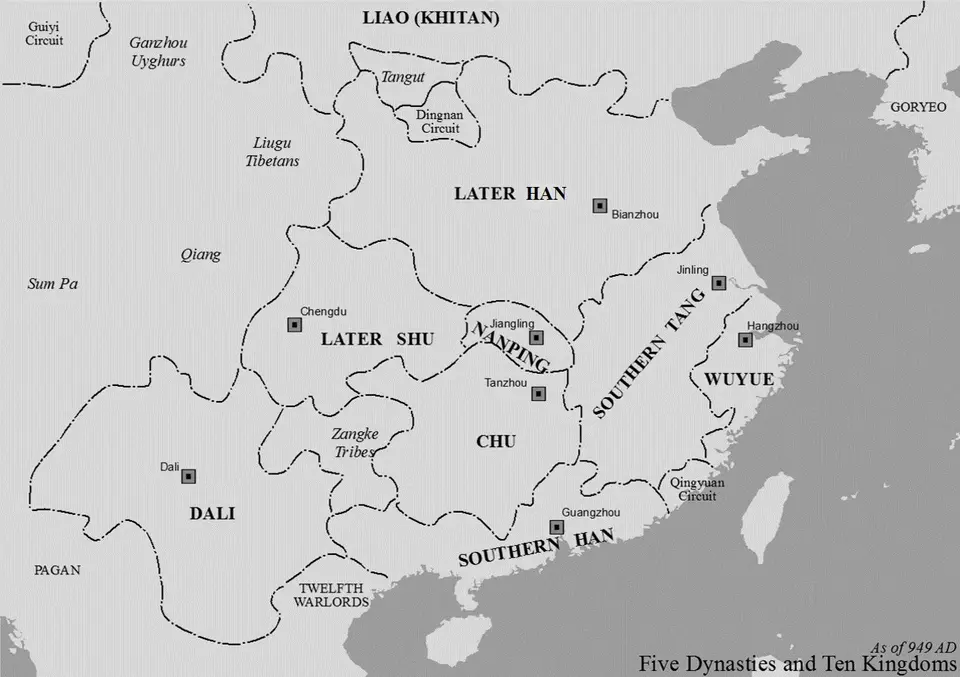
The Founding of the Later Han (后汉建立, 947 CE) was a pivotal dynastic transition and national recovery during the Five Dynasties and Ten Kingdoms period, executed by the Shatuo commander Liu Zhiyuan following the Khitan destruction of Later Jin. In late 946 CE, Emperor Taizong of Liao (Yelü Deguang) invaded the Central Plains, capturing the Later Jin capital at Bianjing (Kaifeng) and taking Emperor Shi Chonggui captive. Khitan forces subjected northern cities to brutal pillage and plunder (dacaogu), igniting fierce peasant uprisings across the Yellow River basin. Commanding veteran Shatuo cavalry divisions at the strategic citadel of Taiyuan, Military Commissioner Liu Zhiyuan feigned submission to assess Khitan strength before declaring himself emperor in February 947 CE, restoring the dynasty under the name Han. Paralyzed by ubiquitous guerrilla insurrections, Yelü Deguang abandoned Kaifeng and died of illness during his northward retreat. Seizing the opportunity, Liu Zhiyuan marched south, received the submission of regional warlords, and entered Kaifeng in June, officially establishing the Later Han Dynasty. This triumph protected Chinese civilization from northern nomadic annexation and formed the immediate political springboard for the rise of the Later Zhou and Song dynasties.
Du Chongwei surrenders Later Jin armies; Khitan forces occupy Kaifeng and capture Emperor Shi Chonggui.
Yelü Deguang assumes the throne in Kaifeng, inaugurating widespread pillaging (dacaogu) across northern China.
Liu Zhiyuan feigns allegiance from Taiyuan, receiving the Khitan imperial staff while gathering military defectors.
Liu Zhiyuan declares himself emperor, retains the Tianfu era name, and issues calls to arms against the Khitans.
Universal peasant resistance compels Yelü Deguang to evacuate Kaifeng and begin an arduous retreat northward.
Yelü Deguang dies of fever at Shahulin; his corpse is mummified as "Imperial Jerky" during succession disputes.
Khitan general Xiao Han crowns Li Congyi as puppet ruler and flees north, leaving Kaifeng defenseless.
Liu Zhiyuan enters Kaifeng, abolishes the puppet ruler, and rewards troops from palace treasures.
Liu Zhiyuan formally proclaims the Han Dynasty (Later Han), granting nationwide tax amnesties to consolidate the realm.
Liu Zhiyuan personally captures Weizhou, neutralizing the final significant military rebellion in the north.
In 936 CE (the first year of Tianfu of Later Jin), Shatuo general Shi Jingtang usurped the Later Tang throne by ceding the Sixteen Prefectures of Yanyun to Khitan ruler Yelü Deguang, debasing himself as a "Son Emperor" to secure Khitan military intervention.
Founded upon foreign subjugation, the Later Jin regime lacked domestic legitimacy and alienated Chinese civilian and military elites. Most critically, the loss of the Yanyun mountain passes deprived the Central Plains of its natural defense perimeter, exposing the North China Plain to direct nomadic cavalry strikes.
Throughout his reign, Shi Jingtang paid heavy annual tributes to the Khitans. However, indignation simmered throughout the army, with frontier generals and provincial commissioners fiercely resenting their tributary status and awaiting an opportunity to assert sovereignty.
In 942 CE, Shi Jingtang died and was succeeded by his nephew Shi Chonggui (the Chudi Emperor) under the sponsorship of Chancellor Feng Dao and military commander Jing Yanguang. Determined to repudiate servile vassalage, Shi Chonggui addressed the Khitan sovereign as "grandson" rather than "subject" in imperial communications.
Jing Yanguang provocatively declared to Khitan ambassadors: "Later Jin possesses one hundred thousand sharpened swords; if the grandfather desires battle, let him come!" Infuriated by this repudiation, Emperor Taizong of Liao launched sequential invasions of the Central Plains starting in 944 CE.
Although Later Jin armies fought valiantly at Qicheng and Yangcheng, protracted warfare drained state coffers and devastated the countryside. Internal court intrigues and military distrust crippled defensive preparations.
In late 946 CE (the third year of Kaiyun), Yelü Deguang personally commanded a final massive invasion. Emperor Shi Chonggui mobilized the empire's remaining armed forces under imperial relative Du Chongwei. Harring ambitions of personal usurpation, Du Chongwei surrendered his entire army of 200,000 men without battle at the Bridge of Zhongdu.
With northern defenses shattered and Kaifeng undefended, Khitan forces entered Bianjing unopposed on New Year's Day of 947 CE. Shi Chonggui offered unconditional surrender, extinguishing the Later Jin Dynasty.
Entering the imperial capital, Yelü Deguang assumed the imperial throne, renamed his realm the "Great Liao," and prepared to deport the Jin court into the northern steppes, planning to incorporate China permanently into the Khitan Empire.
Following their occupation of Bianjing, Khitan commanders possessed neither the bureaucratic apparatus to govern a vast sedentary empire nor sufficient logistical supplies to maintain their cavalry armies. Under the pretext of rewarding his soldiers, Yelü Deguang ordered divisions to pillage the surrounding provinces for food, horses, and treasure, euphemistically termed "forage-raiding" (dacaogu).
Khitan nobles extorted millions in gold and silk from metropolitan citizens, leaving the central river valleys littered with corpses and desolate towns.
This predatory devastation provoked widespread fury among all social strata. Across northern China, peasants, urban artisans, and disbanded soldiers formed indigenous militias—such as the Liangxian Army and the Anonymous Brigades—waging ferocious guerrilla warfare from fortified villages and swamps. Citizens in Xiangzhou, Cizhou, and Bozhou rose in revolt, slaughtering Khitan garrisons and plunging the occupiers into isolated urban garrisons.
Amid the collapse of Later Jin, Military Commissioner Liu Zhiyuan of Hedong commanded the preeminent intact military force in the north. Headquartered at the formidable mountain citadel of Taiyuan, Liu held thousands of elite Shatuo heavy cavalry and vast stores of grain.
Despite intense appeals to advance immediately, Liu Zhiyuan exercised strategic patience. He endorsed the prudent counsel of advisors Guo Wei and Yang Bin: "The Khitan host is fierce and reckless; we must not engage them rashly. Let us close our passes, strengthen our walls, and await their internal collapse."
Liu adopted a calculating two-front policy: he dispatched envoys Wang Jun and Li Guangyan to Bianjing with luxurious tribute gifts, offering nominal congratulations to assess Khitan cohesion. Delighted by his submission, Yelü Deguang presented Liu with an imperial wooden staff (an honor reserved for senior elders), calling him "son." Meanwhile, Wang Jun reported that Khitan misrule was provoking total anarchy. Liu barred all grain shipments to the Khitans, welcomed thousands of Han refugees, and covertly organized his striking force.
By February 947 CE, with anti-Khitan uprisings engulfing the Yellow River basin, Liu Zhiyuan's generals—including Guo Wei, Shi Hongzhao, and Su Fengji—urged him to claim the imperial mandate.
Recognizing that the strategic moment had arrived, Liu Zhiyuan proclaimed himself Emperor at Taiyuan on February 15. To preserve institutional continuity and reassure former Jin subjects, he maintained the "Tianfu" reign title of Shi Jingtang (styling it the 12th year of Tianfu), declaring to the realm: "The Khitans are savage and treacherous; they have violated sacred covenants and brutalized the people. I ascend the throne solely to rescue our populace and eradicate the barbarian foe!"
When Khitan guards escorted the deposed Jin emperor north through Shanxi, Liu made a public show of marching cavalry toward Shouyang under the pretext of an imperial rescue, reassuring northern loyalists before returning to Taiyuan. He issued imperial proclamations canceling debts and tax arrears, rallying regional military governors to join a coordinated national offensive.
Confronted by ubiquitous insurrections and Liu Zhiyuan's challenge, Yelü Deguang realized that occupying central China was untenable. Laments recorded in chronicles reflect his dismay: "I had no idea that the people of the Central Plains were so impossible to govern!"
In March 947 CE, having stripped Kaifeng of imperial regalia and royal captives, Yelü Deguang retreated north. His retreating columns were ambushed relentlessly by Chinese militias. In April, upon reaching Shahulin in Luancheng, the forty-six-year-old Liao emperor succumbed to sudden violent fever. To preserve his corpse in the summer heat, Khitan generals removed his entrails and salted his flesh, creating what contemporary Chinese mocked as the "Imperial Jerky" (Diba).
Yelü Deguang's demise sparked succession struggles within the Khitan royal clan. In Kaifeng, Khitan military governor Xiao Han panicked. Fearing the approach of Liu Zhiyuan's vanguard, Xiao installed Li Congyi, the young surviving scion of Later Tang, as a puppet ruler before evacuating his garrison north in May, leaving the imperial capital completely undefended.
Receiving intelligence of Xiao Han's flight, Liu Zhiyuan executed Guo Wei's operational strategy: "Descend the Fen River valley to secure Henan, and thence conquer the realm." He appointed general Shi Hongzhao as advance commander to clear resistance.
Shi Hongzhao maintained absolute field discipline, routing Khitan rear-guard commander Geng Chongmei at Luzhou, while governors Wu Xingde of Heyang and Zhai Lingqi of Zezhou surrendered without fighting.
Later Han armies advanced unopposed, capturing Luoyang and Zhengzhou in May. In June, Liu Zhiyuan arrived before Kaifeng, entering through the Zhuque Gate to depose the puppet Li Congyi. Acting upon Empress Li's advice, Liu prohibited military plunder, distributing his personal treasury to reward his soldiers.
On the fifth day of the intercalary seventh month, Liu Zhiyuan proclaimed the foundation of the Han Dynasty (Later Han), confirming Kaifeng as the Eastern Capital and Taiyuan as the Northern Capital. He granted broad tax exemptions, suspended summer levies, and integrated regional commanderies, inaugurating the fourth of the Five Dynasties.
Following his coronation in Kaifeng, Liu Zhiyuan confronted a formidable internal threat: renegade general Du Chongwei, who commanded a powerful private army at the northern stronghold of Weizhou (Tianxiong). Seeking to neutralize him without war, Liu ordered Du to exchange commands with Gao Xingzhou at Guide.
Du Chongwei rebelled, barricading himself in Weizhou and requesting Khitan military intervention. Liu dispatched Gao Xingzhou and Murong Yanchao to besiege the city, but early assaults failed with heavy casualties. In September, Liu arrived in person to direct the siege.
Later Han armies surrounded Weizhou with palisades and moats, cutting off food supplies until desperate garrison troops began scaling walls to surrender. Recognizing the futility of resistance, Du Chongwei yielded in November, presenting himself at the imperial pavilion. Honoring his promise of clemency, Liu spared Du's life and appointed him to titular high offices, securing the complete submission of northern China under Later Han authority.
In 948 CE (the first year of Qianyou), three major western military commissioners—Li Shouzhen of Hezhong, Zhao Siguang of Yongxing, and Wang Jingchong of Fengxiang—revolted simultaneously, throwing the Guanzhong region into civil war.
Following the death of Liu Zhiyuan from illness that same year, the teenage Emperor Yin (Liu Chengyou) commissioned Guo Wei as supreme commander to pacify the west. Demonstrating profound patience, Guo Wei constructed circumvallations around Hezhong, starving the rebels into submission. In July 949 CE, Hezhong fell, Li Shouzhen burned himself alive, and the remaining rebels surrendered. Guo Wei's triumph cemented his personal command over the empire's veteran armed forces, setting the stage for his eventual founding of the Later Zhou Dynasty.
The primary achievement of the founding of the Later Han was the definitive expulsion of nomadic occupation from the Central Plains. The Khitan effort to directly govern northern China disintegrated in the face of mass resistance.
By seizing military initiative and coordinating with popular militias, Liu Zhiyuan prevented the permanent subjugation of the Yellow River heartland. The Khitans were pushed back north of the Yanyun passes, preserving the integrity of Chinese social, cultural, and agrarian institutions.
Although the Later Han Dynasty endured for only four years across two reigns, its founding process forged the political and military leadership that would ultimately reunify China.
The core generals promoted by Liu Zhiyuan—specifically Guo Wei, Chai Rong, and their subordinate officers, including young Zhao Kuangyin—emerged directly from this crucible. When the Later Han regime fractured under young Emperor Yin, Guo Wei founded the Later Zhou Dynasty, which laid the direct operational and institutional groundwork for the Song Dynasty.
The haste of Later Han's foundation embedded fatal institutional vulnerabilities within the state. Liu Zhiyuan reigned for only ten months before dying of illness, leaving the throne to eighteen-year-old Liu Chengyou (Emperor Yin).
Governmental authority fell completely into the hands of crude military figures such as Shi Hongzhao, Yang Bin, and Wang Zhang, who openly despised civilian ministers and terrorized citizens with draconian punishments. When Emperor Yin attempted to reassert authority by murdering his senior marshals in 950 CE, Guo Wei revolted from Yedu, extinguishing the dynasty after just four years and marking it as the shortest-lived of the Five Dynasties.