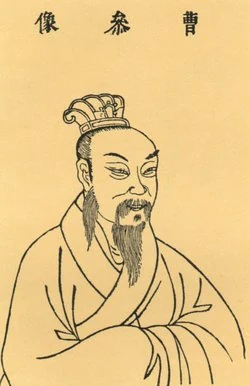
Biography
Family Background and Early Life
Cao Can was from Pei County. His family background is unknown, but he had already acquired a local reputation before the fall of Qin. Under Qin rule he served as the prison official of Pei County, responsible for managing the jail, while Xiao He was a senior county clerk. Both were influential local officials. Liu Bang was then chief of Sishui Pavilion and ranked below Cao Can. Cao Can, Liu Bang, Xiao He, and Fan Kuai were all natives of Pei, but Xiao and Cao were officials in the county administration and were widely respected, whereas Liu Bang and Fan Kuai were of lower standing in the eyes of local elders.
Pei Uprising and the War against Qin
In the autumn of 209 BCE, the first year of the Second Emperor of Qin, Chen Sheng and others rose in rebellion at Qi County and established themselves at Chen under the name Zhangchu. People in many commanderies and counties killed local officials and responded to the revolt. The magistrate of Pei became alarmed and considered joining the rebellion. Xiao He and Cao Can advised him that, as a Qin official, he would have difficulty commanding the young men of Pei in rebellion and should summon men who had fled outside the county, giving him several hundred armed followers with which to compel obedience. The magistrate therefore sent Fan Kuai to summon Liu Bang, whose force had already grown to dozens or more than a hundred men.
When Fan Kuai returned with Liu Bang, the magistrate regretted his decision. Fearing that Liu Bang might seize power, he closed the city gates and planned to kill Xiao He and Cao Can. The two men fled over the wall and joined Liu Bang. Liu Bang wrote a message on cloth and shot it into the city, urging the elders of Pei to join the uprising. The elders then led the local youths in killing the magistrate, opened the gates, and welcomed Liu Bang. They wished to make him county magistrate, but Liu initially declined. Xiao He, Cao Can, and other civil officials valued the safety of their households and feared that if the revolt failed Qin would exterminate their clans, so they also declined leadership. After repeated urging, Liu Bang was finally established as Duke of Pei. Local youths and influential officials, including Xiao He, Cao Can, and Fan Kuai, then recruited roughly two to three thousand men.
After Liu Bang raised his standard as Duke of Pei, Cao Can followed him as zhongjuan. He joined attacks on Huling and Fangyu. The Qin commandery inspector Ping of Sishui Commandery led troops to besiege Feng, and Liu Bang's men returned to defend it. Two days later they attacked and defeated the Qin force. Cao Can participated in the fighting and helped rout the commandery inspector's troops. Liu Bang ordered Yong Chi to guard Feng while Cao Can moved east and captured Xue County. Liu Bang's main force defeated the Sishui administrator Zhuang west of the outer walls of Xue; Zhuang fled to Qi County and was captured and killed by Liu Bang's Left Sima.
Liu Bang's forces again attacked Huling. Xiao He and Xiahou Ying went to persuade Inspector Ping to surrender, after which the city yielded. Liu Bang returned toward Kangfu, but on reaching Fangyu found the Wei commander Zhou Shi attacking it. Before battle was joined Liu sent Cao Can to defend the city. Fangyu then shifted allegiance to Wei, and Cao Can led troops against it. Zhou Shi also persuaded Yong Chi at Feng to defect. Liu Bang tried but failed to retake Feng and, falling ill, had to return to Pei.
East of Dang County, Cao Can attacked the Qin general Sima Yi, identified in another account as Sima Xin, defeated him, and captured Dang, Hufu, and the postal station at Qi County. He then campaigned west of Xiayi as far as Yu County and engaged Zhang Han's forces. At Yuanqi and Kangfu, Cao Can led troops that were first over the walls. His rank was raised to Fifth Grandee.
Cao Can moved north to relieve Dong'e, attacked Zhang Han, broke through the enemy formation, and pursued as far as Puyang. He attacked Dingtao and captured Linji. Moving south to relieve Yongqiu, he defeated Li You's army, killed Li You, and captured one Qin military officer.
At this time Zhang Han defeated Xiang Liang and killed him, and Liu Bang and Xiang Yu withdrew eastward. King Huai of Chu appointed Liu Bang commandant of Dang Commandery and put him in charge of its forces. Cao Can was then granted the rank Zhibo and the title Lord of Jiancheng, and later promoted as Duke of Qi, the lord of Qi County, under Dang Commandery.
Cao Can subsequently followed Liu Bang against the Dong Commandery commandant and defeated his army south of Chengwu. He attacked Wang Li south of Chengyang, fought him again at Gangli, and inflicted another major defeat. Pursuing westward to Kaifeng, he attacked Zhao Ben and surrounded him inside the city. Farther west at Quyu he defeated the Qin general Yang Xiong and captured one Qin military officer and one censor, after which Cao Can's rank rose to Zhigui.
He then joined Liu Bang in attacking Yangwu, capturing Huanyuan Pass and Goushi County, blocking the Yellow River crossings, and turning back to defeat Zhao Ben north of Shixiang. He accompanied Liu Bang south to Chou County, where they fought the Nanyang administrator Lü Yi east of the outer wall of Yangcheng and broke his formation. Cao Can then joined the westward assaults on Wuguan and Yao Pass and helped seize both passes. The army fought Qin forces south of Lantian and again attacked north of Lantian at night, inflicting a major defeat before entering Xianyang and bringing the Qin dynasty to an end.
Chu-Han Contention
After Xiang Yu entered the Guanzhong region, he enfeoffed Liu Bang as King of Han. Liu Bang in turn made Cao Can Marquis of Jiancheng. Cao Can followed him to Hanzhong and was promoted to general.
When Liu Bang returned east to pacify the Three Qins, Cao Can joined attacks on Xiabian, Gudao, Yong, and Tai counties. South of Haozhi he defeated Zhang Ping's army, surrounded the city, and captured Rangxiang. He then defeated Three Qins forces east of Rangxiang and around Gaoli. When Zhang Ping broke out of Haozhi and fled, Cao Can attacked forces under Neishi Bao and defeated them. He moved east to capture Xianyang, which was renamed Xincheng.
Cao Can guarded Jingling for twenty days. Zhang Ping and other Three Qins commanders attacked him, but Cao Can went out to meet them and won a major victory. Liu Bang granted him Ningqin as a fief. Cao Can then, as general, participated in the siege of Zhang Han at Feiqiu and, holding the office of commandant, followed Liu Bang through Linjin Pass.
In Henei Commandery, the Han forces captured Xiuwu and crossed the Yellow River at Weijin. Moving east, Cao Can fought the armies of Long Ju and Xiang Ta at Dingtao and defeated them. The Han then took Dang, Xiao, and Pengcheng, but when they attacked Xiang Ji's army they suffered a major defeat and fled. As commandant, Cao Can besieged and captured Yongqiu. When Han generals Wang Wu at Waihuang and Cheng Chu at Yan County rebelled, Cao Can attacked and defeated both. He also suppressed a revolt by the Marquis of Zhutian at Yanshi, fought Yu Ying at Kunyang, pursued to Ye County, then returned to attack Wuqiang and finally reached Xingyang. From his appointment as general and commandant in Hanzhong until Xiang Yu's eventual defeat and his return to Xingyang, roughly two years had passed.
In 205 BCE, the second year of Han, Cao Can was appointed acting Left Grand Councilor and stationed in Guanzhong. More than a month later, King Bao of Wei rebelled. As acting Left Grand Councilor, Cao Can separately joined Han Xin's eastern campaign and at Dongzhang defeated the Wei general Sun Su. Pressing the advantage, they attacked Anyi and captured the Wei commander Wang Xiang. At Quyang they attacked the king of Wei and pursued him to Wuyuan, where Bao was captured alive. Cao Can then took Pingyang and captured Bao's mother, wife, and children. Fifty-two cities were brought under Han control, and Liu Bang granted Pingyang to Cao Can as a fief.
Cao Can later joined Han Xin in defeating the state of Dai and capturing its chief minister Xia Yue. Han Xin and Zhang Er used a deceptive deployment at Jingxing to draw out Zhao's main force, while Liu Bang advanced against Handan. As the Zhao position deteriorated, Chen Yu was caught between competing pressures. Han Xin and Zhang Er emerged through Jingxing, defeated and killed Chen Yu, while the Zhao commander known as General Qi fled west to Wu County and was killed by Cao Can, who was then operating in the Wei-Dai region. King Xie of Zhao fled to Xiangguo. Liu Bang, Zhang Er, and Han Xin attacked Xiangguo from north and south, captured it, killed King Xie, and pacified Zhao. Han forces later secured Julu and Changshan and received Yan's submission.
In 204 BCE, the third year of Han, Cao Can and others supported Han Xin's invasion of Qi and captured Licheng. The king of Qi fled to Gaomi and requested Xiang Yu's aid; Xiang Yu sent Long Ju to assist him. In the eleventh month of 203 BCE, the fourth year of Han, Han forces killed both King Tian Guang of Qi and Long Ju. Qi chancellor Tian Heng then proclaimed himself king, but Guan Ying defeated him at Ying County, and Tian Heng fled to Peng Yue. Cao Can remained in Qi to continue suppressing remaining resistance.
Founding of Han and Government in Qi
After Xiang Yu's defeat and death, Liu Bang became emperor. Apart from the feudal kings, the first ranking of eighteen marquises placed Xiao He first and Cao Can second, followed by Zhang Ao, Zhou Bo, Fan Kuai, Li Shang, Xi Juan, Xiahou Ying, Guan Ying, Fu Kuan, Jin Xi, Wang Ling, Chen Wu, Wang Xi, Xue Ou, Zhou Chang, Ding Fu, and Chong Da. Many ministers believed Cao Can should rank first because he had personally fought throughout the wars, received seventy wounds, and accumulated exceptional military merit. Liu Bang, however, regarded Xiao He's logistics and planning as even more important. Marquis E of Guannei argued that although Cao Can's battlefield achievements were great, the five years of Chu-Han war had consumed vast manpower and Xiao He continuously supplied troops from Guanzhong; at Xingyang, when the Han faced a food crisis, Xiao He's transport system kept the armies supplied. Although Xiao had not personally campaigned, he had protected Guanzhong and supported the emperor continuously, an achievement worthy of first place. The ministers accepted the argument, and Xiao He was ranked first, Cao Can second.
When Han Xin was transferred to become King of Chu, Cao Can returned the seal of chief minister. In 201 BCE, the sixth year of Han, Liu Bang enfeoffed his eldest son Liu Fei as King of Qi and appointed Cao Can to assist him as chief minister. Cao Can was also enfeoffed as Marquis of Pingyang with 10,630 households.
In 194 BCE, the first year of Emperor Hui, after the system of chief ministers in feudal kingdoms was abolished, Cao Can became Grand Councilor of Qi. Qi was a wealthy kingdom of seventy cities, and Cao Can sought an effective method of governance. Since Qi was a major center of Confucian learning, he consulted many scholars, but their advice differed so greatly that he did not know which view to follow. He then heard of Master Gai of Jiaoxi, a scholar of Huang-Lao statecraft, and invited him at great expense. Master Gai argued that after prolonged warfare the people should be left in peace and not disturbed by burdensome government so that society could stabilize. Cao Can established a separate residence for him, treated him as a political adviser, and governed Qi largely according to Huang-Lao principles. People throughout Qi came to praise Cao Can as a “worthy chancellor.”
Chief Minister of Han
In 193 BCE, the second year of Emperor Hui, Xiao He recommended Cao Can as his successor shortly before his death. Soon after Xiao died, Cao Can told his subordinates, “I will certainly succeed him as chief minister.” The court soon summoned him. Before leaving Qi, Cao Can instructed his successor that the execution grounds and prisons, referred to in the source as yushi, were crucial and that their existing arrangements should not be disrupted. When asked whether government amounted only to this, Cao Can replied that it did not, but that the inclusiveness of Huang-Lao governance depended on reliable implementation of criminal law: if judicial investigation and punishment were thrown into disorder, there would be nowhere for wrongdoers to be contained, which was why he mentioned it first.
As chief minister at the Han court, Cao Can spent much of his time drinking and eating, governed according to Huang-Lao principles, practiced non-interference, and continued Xiao He's policies without alteration. Emperor Hui found this strange and sent Cao Can's son Cao Zhu to remonstrate. Cao Can became furious, gave Cao Zhu two hundred lashes, and rebuked him for interfering in affairs of state. Emperor Hui therefore questioned Cao Can directly. Cao Can asked which was wiser, Emperor Hui or Emperor Gaozu. Hui replied that he could not compare himself with his father. Cao then asked who was more capable, himself or Xiao He. The emperor replied that Cao seemed inferior to Xiao. Cao Can answered that the emperor was correct: Gaozu and Xiao He had already pacified the empire and established clear and complete laws; the emperor needed only to rule calmly while ministers remained at their posts and observed the established regulations without violation. Contemporaries sang: “Xiao He made the laws, orderly and uniform; Cao Can succeeded him, guarding them without loss. Bearing their purity and quiet, the people found unity and peace.” The approach became known as “Cao followed Xiao's rules.”
According to the *Book of Han*, Cao Can and Xiao He had been close friends when both served in Pei County under Qin, but after the Han conquered the empire and Xiao became chief minister, relations between them deteriorated. Nevertheless, after Cao succeeded Xiao he changed none of Xiao's institutions. When subordinate officials committed minor faults, Cao Can often concealed them and gave the officials a chance to correct themselves. He served as chief minister of Han for three years before his death and received the posthumous title Marquis Yi.
His Conduct as Chancellor and the Famous Exchange
After succeeding Xiao He as chancellor of Han, Cao Shen "undertook nothing that altered the old arrangements and in all things followed Xiao He's rules," and his daily conduct drew a good deal of comment. The Records of the Grand Historian note that he "drank strong wine day and night," and that when officials and guests came hoping to speak to him, "when they arrived, Shen would give them strong wine; and when he judged that they wished to say something, he gave them more, so that they went away drunk and could never open the matter — this became his custom." The History of the Former Han puts it more plainly: his purpose was to leave those who came to plead or to ask favours without a chance to speak. The habit was copied by his subordinates, and the garden behind the chancellor's house adjoined the clerks' quarters, where "the clerks drank and sang daily"; the attendants, hating it and helpless, asked Cao Shen to stroll in the garden, hoping he would put a stop to it, whereupon he "had wine brought, set out seats and drank, and sang and shouted in answer to them."
Emperor Hui also came to doubt his neglect of business. Cao Zhu, Cao Shen's son, was a palace counsellor, and the emperor, thinking the chancellor's inaction meant "does he perhaps slight me?", told Cao Zhu to go home and ask his father privately and easily, "The late emperor has but newly left his ministers, the emperor is in the flower of youth, and you, sir, are chancellor, drinking daily and undertaking nothing — how is the empire to be cared for?" — with the charge not to say who had prompted it. Cao Zhu, on leave, urged him in his own words, and Cao Shen flew into a rage and gave him two hundred strokes with the cane, saying, "Get in and serve the emperor; the affairs of the empire are not for you to speak of." At court the emperor reproached him — "Why did you punish Zhu? It was I who set him to admonish you" — and Cao Shen, taking off his cap, made his apology, and then came the famous exchange: he asked whether the emperor thought himself the equal of the late emperor in sageliness and martial virtue, and the emperor said he could not presume to look to the late emperor; he asked whether the emperor thought him the equal of Xiao He, and the emperor said he was not. Cao Shen then said: "Your Majesty's words are right. The late emperor and Xiao He settled the empire, and the laws are already clear; now if Your Majesty lets his robes hang down and we keep to our offices and follow without losing what was set, is that not enough?" and the emperor said it was well. From this exchange came the phrase, "Xiao's rule, Cao's following."
The Fief and After
Cao Shen held the marquisate of Pingyang, and its line rose and fell repeatedly through the Former Han. After his death his son Cao Zhu succeeded, became imperial counsellor under the empress dowager Lü and was made a marquis again when Emperor Wen came to the throne, dying after twenty-nine years with the posthumous name Jing; his son Cao Qi succeeded, dying after seven years as marquis Jian; Cao Qi's son Cao Shi succeeded and married the princess of Pingyang, fathering Cao Xiang, and dying in his fief of illness after twenty-three years as marquis Yi; Cao Xiang succeeded, married the princess of Wei and fathered Cao Zong, dying after sixteen years as marquis Gong. In 91 BC Cao Zong, implicated in the rising of the heir apparent Liu Ju, was condemned and put to death, and the fief abolished. Afterwards the Han repeatedly provided for Cao Shen's sacrifices: under Emperor Ai an edict restored his family "to maintain the sacrifices to Cao Shen," and in the second year of Yuanshou the marquisate of Pingyang was renewed with a thousand households, increased by another thousand in the first year of Yuanshi; under Guangwu and Emperor He of the Later Han his descendants were again sought out, and in the third year of Yongyuan an edict ordered the grand herald to find near kin to continue the fief, after which the line of the marquis of Rongcheng was never again broken in Han times; after Wei replaced Han it continued until Wei's fall. The Records of the Three Kingdoms opens the annals of Emperor Wu with the words, "The great ancestor, Emperor Wu, was a man of Qiao in the principality of Pei, surnamed Cao, named Cao, styled Mengde, a descendant of the Han chancellor Shen" — so that Cao Shen was taken as the ancestor from whom the Wei imperial house descended; and Sima Qian listed the Caos among the hereditary houses of merit of the Former Han, under the title "the Hereditary House of Chancellor Cao."