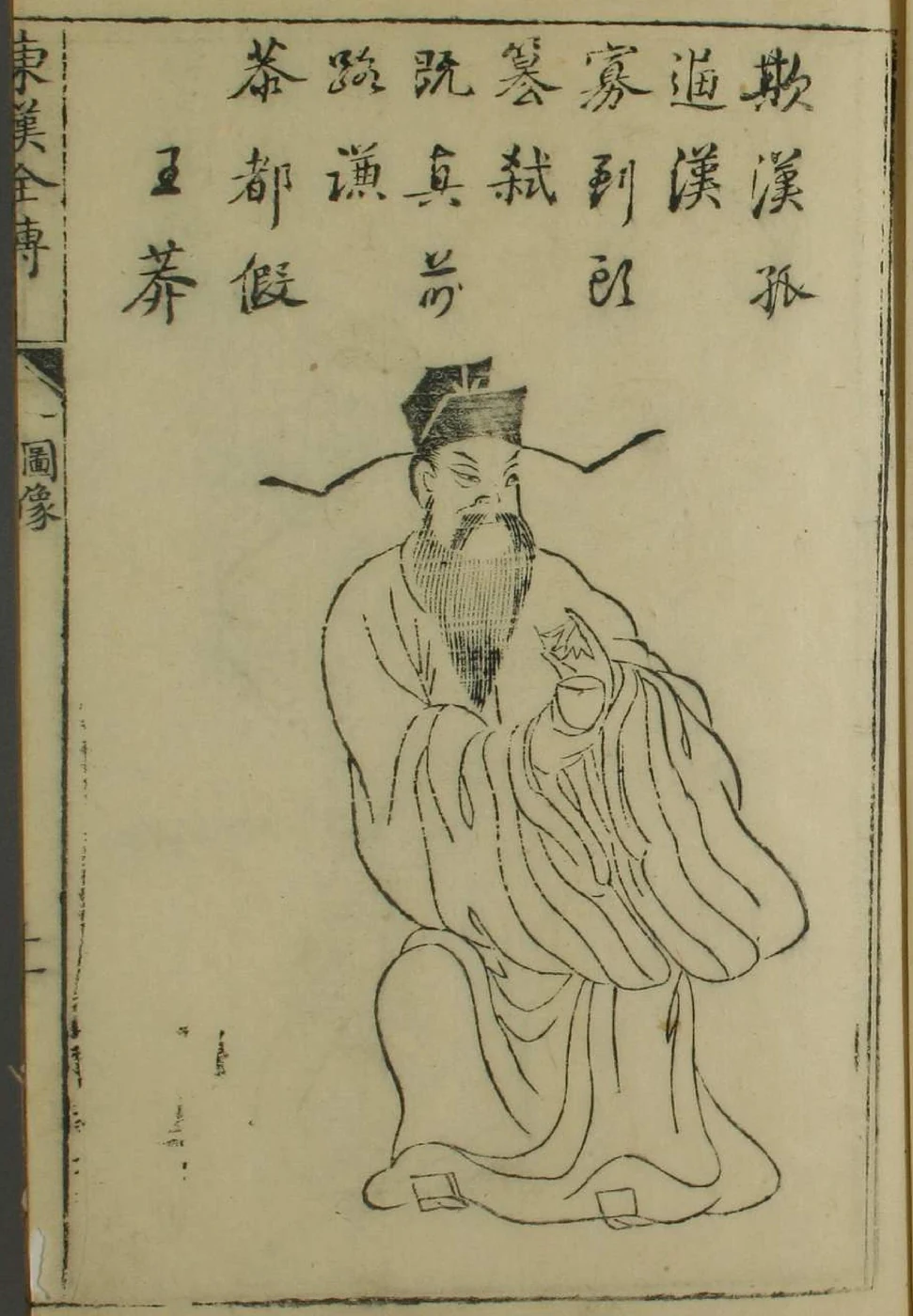
Biography
Family Background and Early Years
Wang Mang's family traced its origins to the Tian clan of the state of Qi, whose ancestral surname was Gui. After Qin destroyed Qi during the Warring States period, Xiang Yu later enfeoffed Tian An, a grandson of King Jian of Qi, as King of Jibei. After the Han dynasty was founded and Tian An lost his realm, people in Qi continued to refer to his household as the “king's family,” and the family consequently adopted Wang as its surname. Wang Mang was said to be a sixth-generation descendant of Tian An, King of Jibei.
Wang Mang was born in 45 BCE (the fourth year of the Chuyuan era of Han). His father was Wang Man and his elder brother Wang Yong. His paternal aunt Wang Zhengjun was empress of Emperor Yuan of Han, and the Wang clan therefore became a dominant consort family in the later Western Han; nine members were enfeoffed as marquises and five served as Grand Marshal. Wang Mang, however, lost his father and elder brother while still young and was raised by his uncles. Unlike other members of the clan, who were known for extravagance, he lived quietly and frugally, behaved modestly, studied diligently, and learned the *Book of Etiquette and Ceremonial* under Chen Can of Pei Commandery, dressing like a Confucian scholar. He cared for his mother and widowed sister-in-law, raised his late brother's son, served his uncles attentively, and cultivated relations with worthy men. He soon became celebrated for his virtue and was regarded as a moral exemplar.
Entry into Official Life
In 22 BCE, the third year of the Yangshuo era of Emperor Cheng of Han, Wang Mang entered central government service at the age of twenty-four. He worked conscientiously and showed great deference to his uncle Wang Feng, who held the office of Grand Marshal. Before his death, Wang Feng asked Wang Zhengjun to look after Wang Mang. That same year Wang Mang was appointed Gentleman at the Yellow Gate and was later promoted to Colonel of the Archers Who Shoot by Sound. Another uncle, Wang Shang, memorialized that he wished to transfer part of his fief to Wang Mang, while prominent men at court also spoke highly of him. Emperor Cheng consequently regarded Wang Mang as a worthy man.
In 16 BCE, the first year of the Yongshi era, Wang Mang, then thirty, was enfeoffed as Marquis of Xindu and appointed Commandant of Cavalry, Grand Master for Splendid Happiness, and Palace Attendant. Although he occupied high office, he did not act arrogantly. He treated worthy men with respect, remained frugal and incorrupt, frequently distributed his stipend to retainers and commoners, and even sold his carriage to aid the poor. He was greatly admired among the population, and his reputation eventually surpassed that of his powerful uncles.
His rise was not entirely smooth. His cousin Chunyu Chang enjoyed Emperor Cheng's confidence, became Commandant of the Guards, and was viewed as a leading candidate to succeed as Grand Marshal. To remove this rival, Wang Mang secretly collected evidence of Chunyu Chang's offenses. While visiting his uncle Wang Gen, he accused Chunyu Chang of maneuvering to obtain the Grand Marshalship and of having illicit relations with the deposed Empress Xu. Wang Gen was furious and ordered Wang Mang to report the matter to the empress dowager. She then had Emperor Cheng dismiss Chunyu Chang, who was eventually executed in prison after his offenses were investigated.
In 8 BCE, the first year of the Suihe era, Wang Gen became seriously ill and recommended Wang Mang as his successor as Grand Marshal. Wang Mang was then thirty-eight. After taking office, he worked tirelessly, recruited worthy men, spent his rewards and fief income on entertaining scholars, and lived with even greater frugality. On one occasion, court officials who came to visit his mother saw Wang Mang's wife dressed so simply that they mistook her for a household servant.
Retirement and Return
In 7 BCE, the second year of the Suihe era, Emperor Cheng died and Emperor Ai succeeded to the throne. The families of Emperor Ai's grandmother Empress Dowager Fu and Empress Ding gained influence, forcing Wang Mang to leave office and retire to his fief at Xindu, in present-day Xinye, Henan. During this period of seclusion, his second son Wang Huo killed a household slave. Wang Mang punished him severely and compelled him to commit suicide, an action that paradoxically enhanced Wang Mang's public reputation. Many officials and commoners protested his dismissal and called for his return. Emperor Ai eventually summoned him back to the capital to attend on Empress Dowager Wang but did not restore him to office.
In 1 BCE, the second year of the Yuanshou era, Emperor Ai died without an heir. On the day of the emperor's death, Empress Dowager Wang Zhengjun went to Weiyang Palace, recovered the imperial seal, and ordered the high ministers to nominate a Grand Marshal. The court understood her intention and overwhelmingly recommended Wang Mang; only Former General He Wu and Left General Gongsun Lu opposed him. The empress dowager immediately ordered Wang Mang to resume the Grand Marshalship, supervise the affairs of the Imperial Secretariat, and oversee military orders and the imperial guard. Wang Mang enthroned the nine-year-old Emperor Ping of Han and acted as regent, receiving broad support at court and beyond.
Thereafter, Wang Mang's political ambitions gradually became more apparent. He first pressured Wang Zhengjun to drive away his uncle Wang Li. He then had the veteran statesman Kong Guang impeach He Wu and Gongsun Lu, removing both from office, and subsequently dismissed Shi Li, Wujiang Long, Ding Xuan, Zhao Chang, and other senior officials of two-thousand-shi rank on various charges. At the same time he built a personal faction, relying on his cousins Wang Shun and Wang Yi as confidants, Zhen Feng to supervise investigations and impeachments, and Ping Yan to manage confidential affairs. Wang Mang usually maintained a grave demeanor. When he wanted some benefit, he merely hinted at it; his followers would submit memorials accordingly, after which he would kowtow, weep, and refuse repeatedly, thereby misleading the empress dowager and concealing his ambitions.
Regency and Usurpation
In 1 CE, the first year of the Yuanshi era, officials memorialized that Wang Mang's merit in “settling the succession and securing the ancestral temples” equaled that of Huo Guang and should receive the same rewards. Wang Mang replied that the settlement had been achieved together with Kong Guang, Wang Shun, Zhen Feng, and Zhen Han, and asked that only the other four be rewarded. After repeated recommendations and repeated refusals, he finally accepted the title Duke Who Brings Peace to Han but declined a fief of 28,000 households. Wang Mang and three principal associates were elevated as the “Four Assistants”: Wang Mang as Grand Tutor, Kong Guang as Grand Preceptor, Wang Shun as Grand Protector, and Zhen Feng as Junior Tutor. Their rank stood above the Three Excellencies. Except for matters of enfeoffment, governmental affairs were to be jointly decided by the Duke Who Brings Peace to Han and the Four Assistants.
Wang Mang proposed generous rewards for regional kings and descendants of meritorious officials and relief measures for commoners and scholars. He also urged Empress Dowager Wang Zhengjun to set an example of frugality and personally contributed one million cash and thirty qing of land to relieve the people. In 2 CE, the second year of the Yuanshi era, severe drought and locust infestations struck the empire and people fled Qingzhou. Following Wang Mang's example, 230 officials and private persons donated land and residences for disaster relief. Taxes were generally reduced in the affected regions, and one thousand residences were built in Chang'an for refugees.
Wang Mang feared that the Wei family, maternal relatives of Emperor Ping, would divide political power. He therefore confined Emperor Ping's mother and her kin to the kingdom of Zhongshan and prohibited them from returning to the capital. Wang Mang's eldest son Wang Yu feared that the emperor would later retaliate. After consulting his teacher Wu Zhang, Wang Yu had his wife's brother Lü Kuan splash blood mixed with wine on the gate of Wang Mang's residence, hoping that the ominous sign would persuade his father to share power with the Wei family. The scheme was exposed. Wang Mang arrested Wang Yu and forced him to die by poison, then used the incident to destroy the Wei relatives, implicate powerful local families, and compel political enemies including Princess Jingwu and Liu Li, King of Liang, to die. Hundreds were killed. Wang Mang then had the affair publicized as an act of “placing public duty above family loyalty.” Eulogistic texts were distributed throughout the empire for officials and commoners to recite and were entered into official records.
In 3 CE, the third year of the Yuanshi era, Wang Mang's eldest daughter Wang Yan was made empress of Emperor Ping. In 4 CE, the fourth year of the Yuanshi era, Wang Mang received the additional title Zaiheng and ranked above regional kings and dukes. He proposed the construction of ritual institutions including the Mingtang, Biyong, and Lingtai, had ten thousand residences built for scholars, and gathered several thousand learned men in Chang'an to promote ritual and music. More than 480,000 commoners, together with princes, dukes, and members of the imperial clan, memorialized for further honors for the Duke Who Brings Peace to Han, and nine hundred high officials requested that he receive the Nine Bestowments. The court accordingly granted them. Wang Mang also sent eight “customs envoys” to inspect the regions. On returning to court, they lavishly praised the peace of the realm. He further used substantial gifts to induce the Xiongnu and other foreign peoples to send envoys and offer submission, helping establish his image as a sage and worthy ruler.
In 5 CE, the fifth year of the Yuanshi era, Emperor Ping died. The *Comprehensive Mirror in Aid of Governance* records that Wang Mang poisoned him, while the *Book of Han* does not state a cause of death. Wang Mang installed the two-year-old Liu Ying, a great-great-grandson of Emperor Xuan, as crown prince and styled himself “Acting Emperor”; his subjects called him Regent Emperor. In 6 CE, the first year of the Jushe era, Liu Chong, Marquis of Anzhong, attacked Wan with just over one hundred men but was defeated before even breaching the city gate. In 7 CE, the second year of the Jushe era, Zhai Yi, governor of Dong Commandery, raised troops and proclaimed Liu Xin, Marquis of Yanxiang, emperor. Zhao Ming and other “bandits” in twenty-three counties west of Chang'an also rose in support. Wang Mang became deeply frightened. Day and night he held Ruzi Ying while praying in the ancestral temple. He also imitated the *Great Declaration* in composing a text explaining that his regency was temporary and that he would eventually restore the throne. He then mobilized a large army and suppressed Zhai Yi's forces.
On the gui-you day, the first day of the twelfth month of the first year of the Chushi era (15 January 9 CE), Wang Mang compelled Wang Zhengjun to surrender the imperial seal. After accepting the abdication of Ruzi Ying, he proclaimed himself emperor, entered the temple of Emperor Gaozu to receive the mandate, donned the imperial crown, and ascended the throne. He renamed the state Xin, changed the capital's name from the conventional Chang'an to a homophonous form also romanized Chang'an, with the first character changed to one meaning “constancy,” and declared the first year of the Shijianguo era. He was fifty-four. His progression from Duke Who Brings Peace to Han to Zaiheng, then Acting Emperor, and finally emperor took eight years. This established a precedent in Chinese history for usurpation through abdication.
Reforms and Downfall
After becoming emperor, Wang Mang implemented a series of archaizing reforms, conventionally known as the Wang Mang reforms. In 9 CE, the first year of Shijianguo, he ordered that all land be called “wangtian,” using the wangtian system in an attempt to revive the well-field system. Slaves were renamed “private dependents,” and neither they nor wangtian land could be bought or sold. He repeatedly reformed the currency system, changed the bureaucracy and official titles, and placed salt, iron, alcohol, coinage, and resources from mountains, forests, rivers, and marshes under state control. Wang Mang believed that the world had to return to the ritual order that Confucius associated with the age before the “collapse of rites and music” in order to achieve sound government and social harmony. Yet these policies pursued archaic forms without regard for practical conditions, and their severe and hurried enforcement left officials and commoners uncertain how to act, aggravating social instability.
To complete a symbolic arrangement of the “Four Seas,” Wang Mang sent troops to occupy the region around Qinghai Lake and established Xihai Commandery. He forcibly relocated settlers there and added fifty harsh laws so that offenders could be generated in sufficient numbers to meet relocation needs. He also downgraded the rulers of dependent states, including the Xiongnu, Goguryeo, states of the Western Regions, and peoples of the southwest, from “king” to “marquis.” He recalled the Xiongnu chanyu's seal and issued a new one, renamed the Xiongnu chanyu with the derogatory title “Submissive Slave Who Obeys Yu,” and changed the name Goguryeo to “Lower Guryeo.” The various states consequently refused submission, and frontier warfare became continuous.
In 17 CE, the fourth year of the Tianfeng era, uprisings spread across the realm, including the large-scale Chimei and Lulin movements. In 23 CE, the fourth year of the Dihuang era, Lulin forces entered Chang'an. Wang Mang held a ceremony at the southern suburbs in which he wept to Heaven, but he could not reverse the collapse. Amid the chaos he was killed by the merchant Du Wu at the age of sixty-eight. His head was cut off by the commandant Gongbin Jiu and carried to Wan, where the Gengshi Emperor ordered it displayed in the marketplace. The head was later preserved through successive dynasties until it was destroyed in the great fire at the Luoyang arsenal in 295, the fifth year of the Yuankang era of the Western Jin.
His Family and Early Years
Wang Mang, courtesy name Jujun, was a man of Yuancheng in Weijun, nephew of Wang Zhengjun, empress of Emperor Yuan of Han, and son of Wang Man, marquis of Xindu of the Western Han. His forebears were of the Tian clan of Qi in the Warring States: Wang Jian was destroyed by Qin; when Xiang Yu rose he enfeoffed Tian An, Jian's grandson, as prince of Jibei; and at the rise of Han, Tian An losing his fief, the men of Qi still called the house of Tian An the Wang house, whence the surname was changed from Tian to Wang, the family afterwards moving to Yuancheng in Weijun. In the reign of Emperor Cheng the Wang were at the height of honour, nine of them marquises and five grand commanders of horse, and the clansmen lived in luxury, vying in music, women, dogs and horses; and Wang Mang alone kept to purity and quiet, living simply and bearing himself humbly, diligent and fond of learning, learning the classic of rites under Chen Shen of Pei commandery, toiling at his studies and dressing like a scholar. He served his mother and his widowed sister-in-law, brought up his elder brother's orphan, was careful in conduct and strict in manner; within he served his uncles and elders most attentively, without he made friends with worthy men. Wang Mang was the odd one of that great clan, the model of virtue in the eyes of the world, and his fame soon spread far. In the third year of Yangshuo of Emperor Cheng of Han, at twenty-four, Wang Mang entered the central government and began to hold office. He was earnest in business and the more reverent to men; and when his uncle Wang Feng lay ill, Wang Mang waited on him with all his heart, and Wang Feng at the end memorialised to give part of his fief to Wang Mang, and many notable men of the court spoke for him, and Emperor Cheng too thought him worthy. Though he held high place Wang Mang never set himself above others, could always humble himself to the worthy and was pure and frugal, often giving his stipend to his retainers and the common people and even selling his carriage and horses to relieve the poor, so that the people loved him, and the famous of court and country all praised him, his fame surpassing even that of his uncles who held power.
His Offices and the Downfall of Chunyu Chang
Wang Mang was enfeoffed as marquis of Xindu and advanced to be cavalry commandant, grandee of brilliant emolument and palace attendant. At that time Chunyu Chang was one of the nine ministers, in charge of the guards of the palace, and the grand commander of horse Wang Gen was about to retire, and many thought Chunyu Chang should succeed him. Wang Mang, to overthrow this deadly rival in his career, secretly gathered up Chunyu Chang's crimes and then, taking the chance of a visit, told Wang Gen that Chunyu Chang had already made ready in secret to take the place of grand commander and had promised offices to many, and told him too of Chunyu Chang's illicit dealings with the deposed empress Xu. Wang Gen was enraged and bade him report at once to the empress dowager, who had Emperor Cheng dismiss Chunyu Chang; and his crimes being investigated he was killed in prison. Early in Suihe Wang Mang took Wang Gen's place as grand commander of horse.
His Removal under Emperor Ai and His Retirement at Xindu
When Emperor Ai came to the throne the families of the empress dowager Fu and the empress Ding began to rise, and Wang Mang had to give up office and live in retirement in his fief at Xindu, shutting his gate and behaving with care. During this time his second son Wang Huo killed a household slave, and Wang Mang punished him severely and forced him to take his own life, which won him the praise of the world. While Wang Mang lived retired at Xindu many officers and commoners complained on his behalf that he had been dismissed and asked for his return, and Emperor Ai had to summon him again to the capital to serve the empress dowager, though without restoring his office.
His Return as Grand Commander and the Setting up of Emperor Ping
In the second year of Yuanshou Emperor Ai died leaving no heir. On the very day of the emperor's death the empress dowager Wang Zhengjun went to the Weiyang palace and took back the imperial seal; and she decreed that the ministers should recommend a grand commander of horse, at which the ministers, taking her meaning, one after another recommended Wang Mang, only the general of the van He Wu and the general of the left Gongsun Lu opposing and recommending each other, to show their displeasure at the monopoly of the Wang consort kin. Presently the empress dowager decreed that Wang Mang should again be grand commander of horse and president of the secretariat, with charge also of military orders and the guards; and afterwards Wang Mang set up the nine-year-old Emperor Ping and governed in his stead, winning the willing allegiance of court and country, after which his political ambition showed itself. He began by driving out those who differed from him: he first forced Wang Zhengjun to send away his own uncle Wang Li, and then raised those who attached themselves to him and destroyed those who offended or resented him. Knowing that to keep his place he must strengthen his party in the court, he courted the famous scholar Kong Guang. Kong Guang was a veteran of three reigns deeply respected by the empress dowager and by court and country, but timid and over-cautious; and Wang Mang, while drawing near him and recommending his son-in-law as palace attendant and carriage commandant, at the same time used the empress dowager's name to force Kong Guang to build up his reputation for him, using the weight of Kong Guang's memorials as a tool for driving out those who differed from him; and so He Wu and Gongsun Lu were impeached and dismissed. Then by various charges he dismissed in succession the grand coachman of the middle Shi Li, the grand administrator of Nanjun Wu Jianglong, of Taishan Ding Xuan and of Henei Zhao Chang, officers of the two thousand shi and above, and deprived the marquis of Gaochang Dong Wu and the marquis of the pass Zhang You of their fiefs. At the same time Wang Mang gradually raised his own partisans, having his younger cousin Wang Shun manage the confidential business. Wang Mang was ordinarily grave and prim; and when he wished to gain anything he had only to hint, and his partisans would memorialise as he wished, whereupon Wang Mang would knock his head on the ground and weep and firmly decline, so deceiving the empress dowager above and hiding his ambition from the common people below.
The Duke Who Pacified Han, the Chief Minister, and the Nine Bestowals
The ministers held that Wang Mang should enjoy honours equal to Huo Guang's. Wang Mang, learning of it, memorialised that he had settled the succession together with Kong Guang, Wang Shun, Zhen Feng and Zhen Han, and asked that only those four be rewarded and himself considered later, and despite the empress dowager's repeated decrees he firmly declined. The ministers pressing the empress dowager again and again, Wang Mang after declining three times accepted the title of duke who pacified Han, but always refused the stipend of twenty-eight thousand households offered him; and he and his three chief confidants were raised to the four assistants. Afterwards Wang Mang first advised that great enfeoffments be made to the princes and the descendants of meritorious ministers and then to the serving officers, that the ritual music of the ancestral temples be increased, that the people and the widowed and orphaned all be benefited and that a policy of grace be carried out toward commoners and scholars, whereby he won the goodwill of court and country again; and next he advised that the empress dowager Wang Zhengjun lead the way in living frugally, while he himself contributed a million cash and thirty qing of land for the relief of the people, at which the hundred officials vied to follow. In every flood or drought Wang Mang ate only vegetables and took no wine or meat. In the second year of Yuanshi, when the whole realm suffered great drought with a plague of locusts and the people of the worst-hit districts wandered, at Wang Mang's lead two hundred and thirty officers and people gave up land and houses to relieve the victims, taxes were widely reduced in the stricken regions and the victims were fully succoured, and even in Chang'an a thousand dwellings were built for them. The assistant of the minister over the masses, Chen Chong, to promote Wang Mang, memorialised praising his merit and virtue and comparing him to the sages of antiquity. Wang Mang, fearing that the Wei family, kin of Emperor Ping's mother, would divide his power, enfeoffed the emperor's mother and her clan in the kingdom of Zhongshan and forbade them to return to the capital. Wang Mang's eldest son Wang Yu, fearing that the emperor would take revenge in after years, opposed this strongly, but Wang Mang would not listen; and Wang Yu, taking counsel with his teacher Wu Zhang, meant to change his father's mind by a superstitious device, and had his wife's brother sprinkle blood and wine on the gate of Wang Mang's house, meaning to use this as a portent to persuade Wang Mang to give power to the Wei; but it was found out in the doing. Wang Mang in a rage had his son Wang Yu arrested and poisoned, and on this pretext falsely accused and killed the whole clan of the Wei consort kin, implicated and punished the strongmen of the localities who opposed him, and forced to death the princess of Jingwu and the prince of Liang, Liu Li, and other political enemies in the court, more than a hundred being killed in the affair, at which the realm was shaken. To remove the bad impression Wang Mang had the matter proclaimed as his own great act of putting righteousness above family and forgetting private interest, and even had panegyrics written and distributed everywhere, so that officers and people could recite them, and then had them registered in the government archives and used as a list for selecting talent. After this Wang Mang set up granaries in Chang'an, built ten thousand dwellings for scholars, and gathered several thousand scholars and men of special gifts from the realm to Chang'an, greatly promoting the rites and music, whereby he won the adherence of the scholars. First more than four hundred and eighty thousand commoners with the princes, dukes and imperial clansmen memorialised asking that the duke who pacified Han be rewarded, and then nine hundred ministers and grandees asked that Wang Mang be given the nine bestowals; and the court granted Wang Mang the nine bestowals, the sign of the highest honour. Then, to make a show of an age of great peace, Wang Mang sent eight "envoys of manners" to inspect the several regions, who on their return praised the peace of the realm and made plain Wang Mang's merit in spreading civilization; and next, by the policy of heavy bribery, he brought the Xiongnu and other outer peoples to send envoys to submit and congratulate him, so that Wang Mang became in men's minds the worthy sage who ordered the realm and brought peace to the world.
The Poisoning of Emperor Ping and His Regency
In the fifth year of Yuanshi of Emperor Ping the emperor fell ill, and Wang Mang prayed to Heaven to die in his place. In the twelfth month of that year Emperor Ping died of illness, and Wang Mang, to avoid the accession of a grown emperor who would prevent him from managing the government as he pleased, set up the two-year-old great-great-grandson of Emperor Xuan, the child Liu Ying. Wang Mang was then fifty-one and the year was 6, the era being changed to the first year of Jushe. Wang Mang's power in the court was at its height, almost equal to the emperor's, which roused the opposition of the Liu imperial clan above all: first the marquis of Anzhong, Liu Chong, rose, and in the first year of Jushe Liu Chong with more than a hundred men attacked Wan and failed without even entering the gate; and in the ninth month of the next year the grand administrator of Dongjun, Zhai Yi, rose in arms, setting up the marquis of Yanxiang, Liu Xin, as emperor and proclaiming it through the regions, while the "robbers" Zhao Ming and others in twenty-three counties west of Chang'an also rebelled. Wang Mang was much afraid, could not eat, and day and night held the child Liu Ying in the ancestral temple and prayed, and wrote a document imitating the Great Announcement to show that his regency was temporary and that he would certainly return the throne to Liu Ying; and at the same time he kept moving great armies to suppress them and destroyed Zhai Yi's troops, and the next year sent Wang Yi to put down the rebellion, after which Wang Mang had the mind to take the throne.
The Usurpation and the Reform after Antiquity
From the time of Emperor Wu the ministers and scholars of the Western Han had much discussed prodigies and abdication, holding that prodigies were Heaven's reproof of a sovereign's want of virtue; under Emperor Zhao Sui Hong and under Emperor Xuan Gai Kuanrao had memorialised asking for abdication, and Emperor Ai had even changed the era on the word of alchemists and scholars, yet after the change the decline of the Western Han continued. This state of mind, shaped by the ideas of prodigy and abdication, prepared the way for Wang Mang to take the Han's place. Someone memorialised that Wang Mang was the true sovereign by Heaven's mandate, and eleven of the signatories held office. On the first day of the twelfth month of the first year of Chushi Wang Mang forced Wang Zhengjun to give up the imperial seal, changed the name of the realm to Xin, and made the era Shijianguo the first, Wang Mang being then fifty-four. Wang Mang, with the wide support of court and country, rose to the highest power, opening in Chinese history the precedent of becoming emperor by abdication on the strength of a mandate, taking eight years to pass from duke who pacified Han to chief minister, acting emperor and true emperor. In the first year of Shijianguo Wang Mang proclaimed that the land of the realm should be renamed the king's fields, replacing private fields, and that slaves should be called private dependants and, like the king's fields, might not be bought or sold; and afterwards he reformed the coinage and the offices, made salt and iron a state monopoly and took the hills, rivers and marshes into state ownership. He believed in Confucianism and held that the realm must be restored to the system Confucius had proclaimed, and so, following the institutions of the Zhou, he began to carry out the new measures known as Wang Mang's reform. Because these policies sought only to revive ancient names and many of them contradicted the actual situation, and because the means and methods of carrying them out were wrong, and because after meeting fierce opposition he tried to enforce them by harsh law, princes, ministers and commoners alike were punished with heavy penalties for breaking the decrees beyond counting, and the disorder of society grew; the orders changed from morning to evening so that officers and people did not know what to follow, and so the strongmen and common folk of the realm were all discontented.
His Measures toward the Outer Peoples and His Foreign Wars
Because the realm already had the commanderies of Beihai, Nanhai and Donghai and lacked only the Western Sea, Wang Mang, to make up the four seas, exhausted his armies to seize the land where the Western Sea had been and set up the commandery of Xihai; and to make this waste land look like a commandery he must forcibly move people there, and so added fifty harsh decrees to multiply criminals in thousands and tens of thousands and meet the need for settlers. He also reduced the rulers of the Western Regions and the southwestern Yi and other dependent states from kings to marquises, took back and destroyed the seal of the Xiongnu Shanyu and gave instead a seal of the Shanyu of the new Xiongnu, changing the Shanyu's title to that of the submissive slave, and changing the name of Goguryeo to that of the low Goguryeo; and the several peoples therefore refused to submit, and several hundred thousand troops were long held fast on the frontier, consuming vast strength and resources and bringing unending war to the borders. By the account of the Han History's chapter on the Xiongnu, Wang Mang divided the Xiongnu into fifteen Shanyus, sending the palace general Lin Bao and the deputy colonel Dai Ji with ten thousand horsemen and many treasures to the Yunzhong frontier to lure the sons of the Shanyu Huhanye and make them Shanyus one after another; and by interpreters they lured out beyond the frontier the right Ligan king Xian with his son Deng and Zhu, and having them there compelled Xian to be Shanyu of filial piety with a safe carriage, a drum carriage, a thousand catties of gold, a thousand bolts of silk and ten halberds for sport, and made Zhu Shanyu of obedience with five hundred catties of gold, sending Zhu and Deng to Chang'an. The Shanyu, hearing it, said in anger that the former Shanyu had received the grace of Emperor Xuan of Han and could not betray him, and asked how the present Son of Heaven, not being a descendant of Emperor Xuan, could be set up. In the third year of Shijianguo Wang Mang raised three hundred thousand convicts, able-bodied men and soldiers and sent them out beyond the frontier in ten columns against the Xiongnu; and where the northern Xiongnu, after the heavy blows of Emperor Wu, had for eighty or ninety years from the time of Emperor Xuan not raided the frontier, so that the border was quiet and production grew, this time it was Wang Mang who took the initiative in provoking war with the Xiongnu. In the third year of Tianfeng Wang Mang raised again the able-bodied men, criminals condemned to death and slaves of the realm to attack the Xiongnu. The kingdom of Juting in the region of Guangnan in Yunnan, whose ruler had been made king under Emperor Zhao, Wang Mang reduced to marquis and then lured to his death, so that all the peoples of the southwest rebelled; and Wang Mang again sent two hundred thousand troops against Juting, and the army coming to Yizhou, seven parts in ten of the officers and men died of plague, and he sent another hundred thousand soldiers and two hundred thousand labourers from Tianshui, Longxi and Ba-Shu against Juting, causing the death of great numbers again.
His Great Buildings, His Finances and the Risings
Wang Mang raised great buildings, not only temples for his ancestors but, claiming kinship with the Yellow Emperor as the first ancestor of the Chinese people, the nine temples of the emperors of all dynasties, summoning the finest craftsmen of the realm; and all the buildings were to be high and wide, the temple of the Yellow Emperor being forty zhang each way and seventeen zhang high and the others half, all inlaid with gold and silver and seeking splendour. When funds ran short he forced the people to contribute, and when materials ran short he pulled down more than ten buildings of the western park of Chang'an; and the work being urgent and the living conditions wretched and the labourers overworked, tens of thousands died of exhaustion. Wang Mang also wished to become an immortal, and not only had many men gather medicines and refine elixirs for him in search of long life but made a great carriage said to have been the Yellow Emperor's, called the flowery canopy, which when ridden would make one an immortal; it was eight zhang one foot high and needed six horses and three hundred strong men to draw it. Such extravagance emptied the treasury so that even the stipends of the officers could not be paid; and Wang Mang devised the excellent device of having the officers take their pay from the people themselves, so that from the dukes and marquises down to the petty clerks none received stipends but all taxed privately, opening the way for every officer to extort from the people and take bribes openly, so that the governors and magistrates piled up a thousand pieces of gold, while the labouring people fell into deeper misery and grew the more rebellious. Wang Mang then felt the danger and, laying all the blame on the officers, sought to squeeze something out of the governors and magistrates to meet his financial straits; and he decreed the suppression of wickedness, inviting denunciation and allowing clerks to accuse their superiors and slaves their masters, confiscating four fifths of the property of the accused for the public use. In the third year of Shijianguo the people of the regions, worn out by the constant levies of the new regime, abandoned their cities one after another and became robbers, especially in Bingzhou and other frontier regions. In the second year of Tianfeng the people of Wuyuan and Daijun, unable to bear the exactions of the troops marching north against the Xiongnu, rose in thousands. After the fourth year of Tianfeng the realm grew the more wretched and robbers rose, and the people everywhere began to resist: that year Gua Tianyi led a rising at Changzhou in Kuaiji that lasted several years; and in the same year the lady Lü of Haiqu in Langya, avenging her son wrongfully killed by the magistrate, led a crowd that broke the county town, put the magistrate to death and styled herself general, haunting the sea, and her force quickly grew to several tens of thousands, she being the first woman leader of a peasant rising in Chinese history. Afterwards Fan Chong and others rose with their followers, their band growing swiftly to tens of thousands and active about Xuzhou, and Wang Mang sent envoys to raise the troops of the commanderies and kingdoms against them and could not overcome them; in the north too several tens of bands arose, the best known being the Bronze Horse, the Green Ox, the Upper River and the City Head bands; and in the south there were the risings of Zhang Ba in Nanjun, Yang Mu in Jiangxia and Wang Zhougong in Lujiang. These bands were of various size, from some thousands to tens or hundreds of thousands, and their activity often spanned commanderies and provinces. In the second year of Dihuang the robbers of the three districts swarmed like hemp, and robbers appeared even in Chang'an itself, so that Wang Mang had to set up a commandant for the seizure of robbers and have the law-enforcing masters of reception pursue them in Chang'an. In the fourth year of Dihuang the rising army, the Green Forest, entered Chang'an, and Wang Mang fled to the Jian terrace under the guard of Wang Yi and others, with more than a thousand ministers, grandees, eunuchs and attendants; and Wang Yi held the city fighting day and night until his men were nearly all killed or wounded and he too fell back to the terrace; and when his son, the palace attendant Wang Mu, wished to take off his official dress and flee, Wang Yi checked him, and father and son guarded Wang Mang together; and at the last the thousand odd men about Wang Mang were all killed or slain. Wang Mang was killed by a soldier of the rising army, Du Wu of Shang county; and the colonel Gongbin Jiu, asking Du Wu where Wang Mang's body was, was told that it was in the northwestern corner of the room, and Gongbin Jiu cut off Wang Mang's head and hung it in the market of Wan, while several dozen soldiers vied to kill Wang Mang and tore his body apart. Wang Mang's head was afterwards kept in the arsenal, and with the sword with which the founder of Han had cut the serpent and the clogs of Confucius was reckoned a treasure of many ages; and when in the time of Emperor Hui of Jin the arsenal burned, Zhang Hua, fearing a disturbance, drew up troops to hold it and only then fought the fire, and the treasures of many ages, the sword, Wang Mang's head and Confucius's clogs, were all burnt.