Birth | Born at Zhongdu in the kingdom of Dai, southwest of present-day Pingyao in Shanxi; his father Liu Heng was Prince of Dai and his mother was Lady Dou
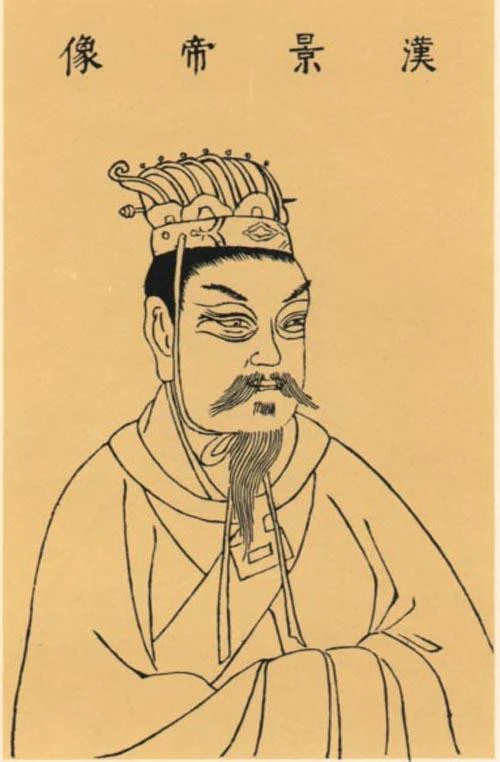
188 BCE–141 BCE
Emperor
Liu Qi
刘启
Emperor Jing of Han, Liu Qi (188 BCE–March 9, 141 BCE), was the sixth emperor of the Western Han and the son of Emperor Wen, Liu Heng, and Empress Dou, Dou Yifang. Liu Qi reigned for sixteen years from 157 to 141 BCE. He continued his father's policy of allowing the people to recuperate, maintaining light corvée and taxation and reducing punishments. He accepted Chao Cuo's proposal to reduce the power of the feudatory…
188 BCE–141 BCEWestern Han
PROFILE
Emperor Jing of Han, Liu Qi (188 BCE–March 9, 141 BCE), was the sixth emperor of the Western Han and the son of Emperor Wen, Liu Heng, and Empress Dou, Dou Yifang. Liu Qi reigned for sixteen years from 157 to 141 BCE. He continued his father's policy of allowing the people to recuperate, maintaining light corvée and taxation and reducing punishments. He accepted Chao Cuo's proposal to reduce the power of the feudatory kingdoms, suppressed the resulting Rebellion of the Seven States, and strengthened central authority. His reign and that of his father are collectively known as the Governance of Wen and Jing, which created a firm foundation for the prosperous and expansionist age of Emperor Wu. He died at Weiyang Palace in 141 BCE, the third year of his Later Yuan period, received the posthumous title Emperor Xiaojing, and was buried at Yangling, southwest of present-day Gaoling in Shaanxi.
- Also known as
- Emperor Jing of Han, Liu Qi
- Era
- Western Han
- Dynasty / polity
- Western Han
- Identity
- Emperor
- Ethnicity / people
- Not recorded in historical sources
- Native place
- Not recorded in historical sources
- Date of birth
- 188 BCE
- Place of birth
- Not recorded in historical sources
- Date of death
- March 9, 141 BCE
- Reign
- 157–141 BCE
- Predecessor
- Emperor Wen of Han (Liu Heng)
- Successor
- Emperor Wu of Han (Liu Che)
- Posthumous name
- Emperor Xiaojing
- Major achievements
- Son of Emperor Wen; reduction of princely power triggered the Rebellion of the Seven States, which he suppressed; continued the Governance of Wen and Jing and laid foundations for the prosperity of Emperor Wu's reign
LIFE TIMELINE
Age eight | Liu Heng became Emperor Wen; Liu Qi, as his eldest surviving son, was made Crown Prince
Age nine | His mother Lady Dou was made Empress
Crown Prince period | Studied under Zhang Xiangru and Shi Fen; Chao Cuo served as Household Steward to the Crown Prince and was called his “Wise Counsel”; Liu Qi killed Liu Xian, Crown Prince of Wu, during a board-game dispute and thereby incurred the hostility of Liu Bi, King of Wu
Age thirty-one | Emperor Wen died and Liu Qi ascended the throne
Age thirty-four | Adopted Chao Cuo's policy of reducing the feudatory kingdoms; seven states led by Wu and Chu rebelled; Chao Cuo was executed by waist-cutting; Zhou Yafu was appointed Grand Commandant and suppressed the rebellion within three months
Age thirty-seven | Deposed Empress Bo
Age thirty-eight | Deposed Crown Prince Liu Rong as Prince of Linjiang; made Lady Wang Empress and her son Liu Che Crown Prince
Age forty-one | Zhou Yafu was dismissed as chancellor and later imprisoned, where he died after refusing food
Age forty-eight | Died at Weiyang Palace and was buried at Yangling
BIOGRAPHY
Biography
Family Background and Early Life
Liu Qi was born in 188 BCE, the seventh year of Emperor Hui, when his father Liu Heng was Prince of Dai and his mother Lady Dou was a consort in the princely household. Among Liu Heng's sons, Liu Qi originally had three older half-brothers born to the Princess of Dai and younger brothers, including Liu Wu, born to Lady Dou. In 180 BCE, after Empress Lü died, senior ministers including Chen Ping and Zhou Bo eliminated the Lü faction and invited Liu Heng, Prince of Dai, to become emperor as Emperor Wen of Han. The three sons of the former Princess of Dai died in succession, and Liu Qi became Emperor Wen's eldest surviving son. In the first month of 179 BCE he was made Crown Prince; in the third month of the same year his mother Lady Dou became Empress.
Emperor Wen selected eminent tutors for the Crown Prince, first appointing Zhang Xiangru, Marquis of Dongyang, as Grand Tutor to the Crown Prince and later replacing him with Shi Fen, Lord of Five Thousand Shi. Liu Qi read extensively and was also skilled in riding and archery. The Erudite Chao Cuo memorialized Emperor Wen that although the Crown Prince had read many books, he had not yet learned the arts by which a ruler managed officials and governed the state. He recommended teaching the Crown Prince practical methods applicable to contemporary government. Emperor Wen accepted the proposal and appointed Chao Cuo Household Steward to the Crown Prince. Chao Cuo was eloquent and argumentative, won Liu Qi's confidence, and was known in the Crown Prince's household as the “Wise Counsel.” He repeatedly proposed weakening the feudatory princes and changing state institutions. Emperor Wen did not accept all of these proposals, but Liu Qi strongly approved of them.
Liu Qi had a forceful temperament as Crown Prince. On one occasion Liu Xian, son and heir of Liu Bi, King of Wu, came to court and drank and played a board game with Liu Qi. A dispute arose over the game. In anger, Liu Qi struck Liu Xian with the gaming board and killed him on the spot. Emperor Wen ordered the body returned to Wu for burial. King Liu Bi angrily declared that all under Heaven belonged to the same imperial clan, so if his son had died in Chang'an he should be buried in Chang'an rather than sent back to Wu, and he returned the body to the capital. From that time Liu Bi bore a deep grudge, ceased regular attendance at court on the pretext of illness, and quietly accumulated strength, creating a distant cause of the later Rebellion of the Seven States.
Accession and Reduction of the Feudatory Kingdoms
On the jihai day of the sixth month of the seventh year of Emperor Wen's Later Yuan period, July 4, 157 BCE, Emperor Wen died at Weiyang Palace. On the dingwei day of the same month, July 12, Crown Prince Liu Qi ascended the throne. He honored his grandmother Empress Dowager Bo as Grand Empress Dowager and his mother Empress Dou as Empress Dowager.
After accession, Emperor Jing first promoted Chao Cuo to Metropolitan Superintendent and later to Imperial Counsellor, one of the Three Excellencies. Chao Cuo urged the emperor to reduce the territories held by the feudatory kings, arguing that rebellion would occur whether or not their territories were reduced: if reduced immediately, rebellion would come sooner but the resulting disaster would be smaller; if not reduced, rebellion would come later and be more dangerous. Emperor Jing accepted the proposal. In the winter of 155 BCE, the third year of the Former Yuan period as given in the source, the court reduced East Sea Commandery from Liu Wu, King of Chu, on the grounds that he had engaged in illicit relations during mourning for Empress Dowager Bo. It also reduced Kuaiji and Yuzhang commanderies from Liu Bi, King of Wu, and removed territory from Liu Sui, King of Zhao, and Liu Ang, King of Jiaoxi, because of offenses.
The reduction orders alarmed the princes. Liu Bi, King of Wu, seeing the court move against the kingdoms, allied with Liu Wu, King of Chu; Liu Sui, King of Zhao; Liu Ang, King of Jiaoxi; Liu Xiongqu, King of Jiaodong; Liu Xian, King of Zichuan; and Liu Piguang, King of Jinan. Under the slogan of killing Chao Cuo and purging evil advisers from the emperor's side, they rebelled in the first month of 154 BCE, the third year of Emperor Jing's Former Yuan period. The conflict became known as the Rebellion of the Seven States.
Suppression of the Rebellion of the Seven States
When news of the rebellion reached Chang'an, Emperor Jing sent Grand Commandant Zhou Yafu with thirty-six generals against the allied armies of Wu and Chu. Li Ji, Marquis of Quzhou, was sent against Zhao; General Luan Bu was sent against Qi; and General-in-Chief Dou Ying was stationed at Xingyang to supervise forces facing Qi and Zhao.
At this point the consort relative Dou Ying introduced Yuan Ang, who had previously served as chancellor of Wu. Yuan Ang advised Emperor Jing to execute Chao Cuo in order to end the rebellion. After a long silence Emperor Jing said, in effect, that if this would truly bring peace he would not spare one man in order to answer the empire. He therefore ordered Chao Cuo executed by waist-cutting in the Eastern Market and exterminated his clan. Chao Cuo's death did not make the rebels withdraw. Liu Bi laughed that he was already “Emperor of the East” and had no one left to bow to, and continued the attack.
Zhou Yafu led the army east and accepted Zhao She's advice to bypass the usual route through Wuguan and proceed directly toward Luoyang. The Wu-Chu coalition attacked fiercely and pressed the kingdom of Liang, centered in the area of present-day Shangqiu, Henan. Liu Wu, Prince Xiao of Liang, repeatedly appealed for help, but Zhou Yafu held his fortified positions and instead used light cavalry to cut the rebels' supply lines. The Wu-Chu forces exhausted their food and became hungry and weakened. When they retreated, Zhou Yafu pursued and routed them. Liu Bi escaped with several thousand followers across the river to Dantu, in present-day Zhenjiang, where he was killed by men of Eastern Yue. Liu Wu, King of Chu, committed suicide after defeat. The other kings were subdued in succession. The Rebellion of the Seven States ended after only three months.
Consolidation of Central Authority and the Governance of Wen and Jing
After suppressing the rebellion, Emperor Jing took further measures to weaken the feudatory kings. In 152 BCE, the fifth year of the Former Yuan period, he ordered that kings no longer govern the inhabitants of their territories, reduced their administrative establishments, and placed kingdom officials under imperial appointment. The feudatory kings thereafter mainly received tax revenues but no longer exercised independent administrative authority. Their political power was greatly reduced and central authority strengthened.
Emperor Jing continued the policy of allowing the people to recuperate. Emperor Wen had reduced the land tax from one-fifteenth to one-thirtieth of the harvest, and in 156 BCE, the first year of Emperor Jing's Former Yuan period, Emperor Jing made the one-thirtieth rate a permanent rule of the Han. He repeatedly reduced punishments and moderated judicial administration, ordering doubtful cases to be retried so as to avoid wrongful convictions. Emperor Jing respected Huang-Lao teachings, favored quiet government and frugality, and avoided extravagance. During his reign society remained relatively stable, the economy expanded, population grew, and government granaries and treasuries became full. His reign and that of his father are collectively known as the Governance of Wen and Jing.
Deposition of the Crown Prince and Later Years
In 151 BCE, the sixth year of the Former Yuan period, Empress Bo, who had no son, was deposed. In 150 BCE, the seventh year of the Former Yuan period, Emperor Jing deposed Crown Prince Liu Rong and made him Prince of Linjiang. Liu Rong's mother Lady Li had fallen from favor, while Lady Wang was favored. Her son Liu Che, then Prince of Jiaodong, was made Crown Prince in the fourth month of the same year and Lady Wang became Empress. Not long after his deposition, Liu Rong was investigated by Zhi Du for encroaching on land associated with an ancestral temple and committed suicide in prison.
On the jiazi day of the first month of the third year of the Later Yuan period, March 9, 141 BCE, Emperor Jing died at Weiyang Palace at the age of forty-eight. His final edict granted horses to kings and marquises, gold to officials of two-thousand-shi rank, one hundred cash to each household of officials and commoners, and released a number of palace women to return home. On the guiyou day of the second month, March 18, he was buried at Yangling. Crown Prince Liu Che succeeded him as Emperor Wu of Han.
The Naming of the Heir and the Men of the Eastern Palace
Liu Qi became heir apparent through the insistence of the ministers of Emperor Wen's court. The Records of the Grand Historian record that in the first month the officials asked that an heir be named, and Wen declined, saying that "I am without virtue... and if I cannot seek out a worthy and virtuous man throughout the empire and yield the empire to him, then to speak of naming an heir in advance is only to double my want of virtue," and enumerating the kings of Chu, Wu and Huainan as fit to be entrusted with it, adding that "if I do not choose and raise up such a man, but say it must be my son, men will think me forgetful of the worthy and partial to my own son, which is not the way to care for the empire." The officials all pressed him, saying that "to establish an heir from among the sons is a practice of long standing," and that "among your sons Qi is the eldest, pure, generous and kind; we ask that he be made heir apparent," whereupon Wen consented, "granted every man in the empire who should succeed his father one grade of rank," and made the general Bo Zhao marquis of Zhi; in the third month, when the officials asked for an empress, the empress dowager Bo said that "the feudal lords are all of one surname; let the mother of the heir be empress." Connected with the eastern palace was the arrival of Chao Cuo: made an attendant of the heir, then a palace counsellor, then a court scholar, he memorialized on the "arts of rule," holding that "the reason a ruler's fame is honoured and made known to ten thousand generations is that he knows the arts of rule," and that "the heir apparent has read many books but does not deeply know the arts of rule, because he does not ask the meaning of what he reads; to recite much without knowing its meaning is what is called toiling without result." Wen approved, and made Chao Cuo family steward to the heir, who "because of his eloquence was favoured by the heir, and the heir's household called him 'the bag of wisdom'"; Chao Cuo further proposed reducing the feudal lords and revising the laws in thirty chapters, and Wen, though he did not follow all of it, "thought his talent remarkable," while "at that time the heir approved Chao Cuo's plans, and Yuan Ang and the other great ministers of merit disliked him" — the prelude to the reduction of the princedoms and the revolt of the seven states was thus already laid.
The Reduction of the Princes and the Revolt of the Seven States
On taking the throne Jingdi made Chao Cuo censor-in-chief, and the reduction of the princes went forward. Chao Cuo said to him: "When Gaodi first settled the empire his brothers were few and his sons young, and so he enfeoffed many of his own surname... three branches of the collateral line were enfeoffed and shared half the empire. Now the king of Wu, having the old grudge over his son, feigns illness and does not come to court, and by the ancient law should be executed; Wendi could not bear it and gave him a stool and staff. So great a kindness should have brought reform, but he grows the more insolent, coining money at his mountains, boiling sea water for salt, drawing the empire's fugitives to him and plotting rebellion. To reduce him now is to have rebellion; not to reduce him is also to have rebellion. Reduce him, and the rebellion comes soon but the harm is small; do not reduce him, and the rebellion comes late but the harm is great." In the winter of the third year, when the king of Chu came to court, Chao Cuo had him punished for misconduct during mourning by the loss of Donghai commandery, and further reduced Wu by Yuzhang and Kuaiji, Zhao by Hejian the year before, and Jiaoxi by six counties for fraud in selling rank. On the jiazi day of the first month of the third year the king of Wu, Liu Pi, rose at Guangling, crossed the Huai and joined the Chu troops, sending envoys with letters to the princes, claiming that "my state, though narrow, is three thousand li across; my people, though few, can furnish five hundred thousand picked troops," and offering rewards of "five thousand catties of gold and a fief of ten thousand households to any who kills or takes a great general." The emperor sent the grand commandant Zhou Yafu with thirty-six generals against Wu and Chu, Li Ji against Zhao, Luan Bu against Qi, and General Dou Ying to camp at Xingyang and oversee the Qi and Zhao forces. Before the troops moved, Yuan Ang came in and proposed that "the only plan now is to behead Chao Cuo, send envoys to pardon the seven states and restore the lands taken from them, and the armies may be dismissed without bloodshed"; the emperor was silent a long while and said, "If it truly be so, I will not grudge one man to satisfy the empire," and more than ten days later, on the impeachment of the chancellor and others that Chao Cuo "wished to give cities to Wu, without the duty of a subject, in great rebellion," the edict was "approved," and Chao Cuo was "beheaded in the eastern market in his court robes." Yuan Ang, sent to Wu, was told by the king with a laugh that "I am already Eastern Emperor — to whom should I bow?" and was kept in the camp to be forced into command; he escaped by night on foot to the Liang army and reported back. In the fighting, Wu and Chu first struck the Liang at Jibi, and the king of Liang held Suiyang, sending Han Anguo and Zhang Yu against them; "Wu and Chu, checked by Liang, did not dare pass west, and faced the grand commandant for three months," until the Wu troops went to Zhou Yafu's camp at Xiayi, where he held his walls and would not fight; their food gone and the men starving, they challenged again and again and one night rushed his rampart, feinting at the southeast, whereupon he strengthened the northwest, by which they came in, and the Wu army was heavily defeated and scattered of hunger. The king of Wu fled by night with several thousand strong men across the river to Dantu and took refuge with the Eastern Yue, who, bought by Han, tricked him, killed him as he came out to review the troops and sent his head post-haste to the capital; the king of Chu, defeated, killed himself. The rising began in the first month and all was broken by the third, only Zhao holding out longer; the emperor made Li, youngest son of the king of Yuan, king of Chu to continue that line, and moved the king of Runan to the old lands of Wu as king of Jiangdu.
The King of Liang and the Struggle over the Succession
After the revolt, the king of Liang — closest to the throne, of great service, and holding the richest land in the empire — became the other centre of gravity of Jingdi's reign. According to the Hereditary House of the King of Liang, Jingdi once drank with him and "said at leisure, 'After ten thousand years the throne shall pass to you,'" at which the king declined, and though he knew it was not meant in earnest, "was glad at heart, and the empress dowager likewise"; Dou Ying, sitting before them, said from his mat: "The law of Han is that the throne passes to the son and then to the eldest grandson; how can Your Majesty pass it to a brother and so disorder Gaodi's covenant?" and Jingdi fell silent, and the empress dowager was displeased. Later the empress dowager Dou argued that "the way of Yin was to love kin and the way of Zhou to honour the honoured, and their meaning is one," wishing to make the king of Liang heir; Jingdi summoned Yuan Ang and the other ministers versed in the classics, who answered that "the way of Yin, loving kin, set up the brother; the way of Zhou, honouring the honoured, set up the son," and cited the case of Duke Xuan of Song, who did not set up his son but gave the state to his brother, so that disorder ran on for five generations, concluding that "the noble man holds to what is correct; the disaster of Song was Duke Xuan's doing"; with this they persuaded the empress dowager, who was reconciled and sent the king of Liang back to his fief. Learning that this argument came from Yuan Ang and the ministers, the king of Liang in resentment had Yuan Ang and more than ten other ministers assassinated; when it came out, "envoys with canopies crowded the road" and the whole of Liang was searched, and when Gongsun Gui and Yang Sheng hid in the king's rear palace, Han Anguo remonstrated, saying that "the king should measure himself against the emperor: how near is he compared with the retired emperor to Gaodi, or the emperor to the king of Linjiang?... the government of the empire is never disordered by private feeling," whereupon the king made the two kill themselves and gave them up. The emperor sent Tian Shu and Lü Jizhu to try the case, and they, reaching Bachang stable, "took fire and burned all the depositions of Liang's treason and came back empty-handed," laying the whole blame on Yang Sheng and Gongsun Gui and reporting that "the king of Liang knew nothing of it," at which Jingdi was delighted and mother and son were reconciled; but "the emperor grew the more distant from the king and no longer shared carriage with him." In his later years the king of Liang "was downcast and joyless," and hunting north at Liangshan an ox was presented whose "feet grew out of its back," which he thought an evil omen; in the sixth month he fell ill of fever and died in six days with the posthumous name Xiao.
Major Activities
Reduction of the Feudatory Kingdoms and Suppression of the Rebellion of the Seven States
The most important political measure of Emperor Jing's reign was the reduction of princely power. He accepted Chao Cuo's proposal to remove territory from the feudatory kingdoms, triggering the Rebellion of the Seven States. After the rebellion began, Emperor Jing first executed Chao Cuo in an unsuccessful attempt to induce the rebels to withdraw, then appointed Zhou Yafu Grand Commandant and suppressed the rebellion militarily. The defeat of the seven states dealt a devastating blow to the political power of the feudatory kings and greatly strengthened central authority. Emperor Jing then further reformed the administrative systems of the kingdoms, leaving their rulers largely with tax income but without independent authority to govern, thereby establishing firmer imperial control over the localities.
Economic Policies
Emperor Jing continued Emperor Wen's policy of reducing burdens on the population. In 156 BCE he formally fixed the land tax at one-thirtieth of the harvest, making this the standard Han rate. He also repeatedly remitted taxes and corvée obligations and encouraged agriculture and sericulture. According to the “Annals of Emperor Jing” in the Book of Han, during his sixteen-year reign twenty-five major edicts were issued, roughly one-third of which concerned tax relief, grants of rank, agricultural promotion, or relief for the distressed. These measures aided economic recovery and development and laid the groundwork for the prosperity of Emperor Wu's reign.
Judicial Reform
Emperor Jing repeatedly reformed punishments. In 156 BCE he reduced sentences of five hundred blows to three hundred and three hundred blows to two hundred. In 144 BCE, the sixth year of the Middle Yuan period, he again reduced the number of blows and issued regulations governing the dimensions of beating rods and the parts of the body on which they could be used, increasing the likelihood that those punished would survive. These reforms continued Emperor Wen's earlier abolition of mutilating punishments and further moderated Han penal practice.
Relations with Neighboring Peoples
During Emperor Jing's reign the Han continued the heqin marriage policy toward the Xiongnu and maintained relative peace on the northern frontier. The court also strengthened active defense by adding fortified settlements and improving frontier preparedness. Toward the Yue peoples of the south, Emperor Jing generally pursued conciliatory policies. The absence of major foreign wars created a peaceful environment for domestic economic growth.
Relations with Chao Cuo and Zhou Yafu
Chao Cuo had been Emperor Jing's “Wise Counsel” during the Crown Prince period. After accession the emperor entrusted him with major responsibilities and allowed him to implement the policy of reducing princely power. When the Rebellion of the Seven States erupted, however, Emperor Jing executed Chao Cuo by waist-cutting in an attempt to secure rebel withdrawal, a decision later regarded as a major stain on his political record. Zhou Yafu was the leading general in suppressing the rebellion and later became chancellor. Yet disagreements with the emperor led to his resignation, and after his son purchased burial equipment reserved for the imperial household, Zhou Yafu was accused of treason, imprisoned, and died after refusing food for five days. Historians have frequently criticized Emperor Jing's suspicion and harshness toward meritorious officials.
Government by Frugality, and His Failures with Men
In his reign Jingdi continued the policy of encouraging farming and lightening taxes and levies, "accepting no tribute, reducing the imperial table, cutting corvée and taxes, wishing the empire to devote itself to farming and silk and to have stores laid up." In the fifth month of 156 BC he proclaimed the "half land tax," reducing the rate of one in fifteen under Wendi to one in thirty; he fixed the age of corvée at twenty; he allowed peasants on poor soil to move to richer and better-watered land to cultivate it, and let the Changling fields held as public land to those with little or no land. In the later years of his reign there was famine, which he blamed on the fact that "those who follow secondary pursuits are many and the farmers few," twice forbidding the brewing of grain liquor, forbidding the feeding of horses on millet in the interior commanderies, and punishing officials who obstructed farming, such as those who let their people gather gold and pearls. In scholarship he once made a famous ruling: when Yuan Gusheng and Huang Sheng argued before him, Huang holding that "Tang and Wu did not receive the mandate; they were regicides," and Yuan Gusheng answering that the people of Jie and Zhou gave their hearts to Tang and Wu and that "if it be as you say, was Gaodi's taking the throne from Qin wrong?", Jingdi said that "to eat meat without the horse's liver is not to be ignorant of its flavour, and for a scholar not to speak of Tang and Wu receiving the mandate is not to be thought foolish," and ended the debate, "and thereafter scholars did not dare to speak plainly of the mandate or of the killing of rulers" — settling a dangerous question by avoidance, which shows the temper of his government: conservative and stability-seeking.
His handling of old and close servants, on the other hand, is what later ages took as proof that he was "grudging and sparing of kindness." Deng Tong, a favourite of Wendi, had often sucked the pus from the emperor's sores, and when Wendi asked who in the empire loved him most, Deng Tong answered, "Surely the heir apparent"; afterwards Wendi had Liu Qi suck his own sores, and Liu Qi, "sucking, showed a grimace," and later, hearing that Deng Tong did so habitually, bore him a grudge. On taking the throne Jingdi at once dismissed him, and then, on the charge of coining money beyond the frontier, confiscated all his property; when the grand princess of Guantao gave him gifts privately, the emperor had the officials seize them at once, so that Deng Tong "could not keep even a hairpin on his person," had food and clothing only from the princess, and died in poverty in another man's house. Zhou Yafu, who had put down the revolt so swiftly and was made chancellor, opposed the deposition of the heir Liu Rong and was distanced; offending the king of Liang by not relieving him, he was slandered by the king to the empress dowager whenever he came to court; he objected to the enfeoffment of Wang Xin and to the recruiting of Xiongnu defectors, and finally asked leave on grounds of illness. The decisive affair was when the emperor summoned him to the palace and deliberately set before him a great piece of meat uncarved and without tableware; Zhou Yafu showed his displeasure openly, and after he left the emperor said: "This sullen fellow is no minister for a young ruler!" and before long, on a charge of privately buying armour and shields, drove him to his death. Later writers therefore say that "Jingdi was grudging and sparing of kindness, without a ruler's measure, and in truth not to be compared with Wendi," listing several cases in which "in the relations of ruler and minister, father and son, brother and brother, he turned his back on reason and wounded the Way," and holding that the reason he could still be named a worthy ruler alongside Wendi "was only that he did not change his frugality."
Personal Relations
- Grandfather: Emperor Gaozu of Han, Liu Bang
- Grandmother: Empress Dowager Bo
- Father: Emperor Wen of Han, Liu Heng
- Mother: Empress Dou, Dou Yifang
- Brother: Liu Wu, Prince Xiao of Liang, full younger brother
- Empresses: Empress Bo, later deposed; Empress Wang, Wang Zhi
- Sons: Liu Rong, former Crown Prince; Liu Che, Prince of Jiaodong and later Emperor Wu; Liu Yu; Liu Fei; Liu Duan; Liu Pengzu; Liu Sheng; Liu Fa; Liu Yue; Liu Ji; Liu Cheng; Liu Shun; and others
- Daughters: Princess Pingyang, Princess Nangong, Princess Longlü, and others
- Tutors to the Crown Prince: Zhang Xiangru; Shi Fen
- “Wise Counsel”: Chao Cuo, Imperial Counsellor, later executed by waist-cutting
- Grand Commandant: Zhou Yafu, suppressor of the Rebellion of the Seven States, later died in prison
- Chancellors: Shentu Jia, Tao Qing, Zhou Yafu, Liu She, Wei Wan
- Consort relative: Dou Ying, who served as General-in-Chief during the rebellion
- Yuan Ang: advised executing Chao Cuo to end the rebellion
- Zhi Du: harsh official who investigated the deposed Crown Prince Liu Rong
- Liu Bi, King of Wu: became hostile after Liu Qi killed Wu Crown Prince Liu Xian and later launched the Rebellion of the Seven States
- Chao Cuo: executed by Emperor Jing
- Zhou Yafu: imprisoned by Emperor Jing and died by self-starvation
- Deng Tong: favorite of Emperor Wen; his property was confiscated after Emperor Jing's accession and he died in poverty
- Liu Rong: Emperor Jing's son, deposed as Crown Prince and later committed suicide
Historical Assessment
Han and Contemporary Accounts
- Sima Qian, in the “Basic Annals of Emperor Jing” in Records of the Grand Historian, argued that Emperor Jing's reduction of princely power under Chao Cuo was too abrupt and failed to proceed gradually, helping trigger the Rebellion of the Seven States.
- Ban Gu, in the “Annals of Emperor Jing” in the Book of Han, praised Emperor Jing for carrying forward the achievements he inherited and compared the prosperity and moral transformation of the Governance of Wen and Jing to the celebrated reigns of Kings Cheng and Kang of Zhou.
- Gong Yu, writing during Emperor Yuan's reign, recalled that Emperor Gaozu, Emperor Wen, and Emperor Jing followed ancient standards of frugality, keeping only small numbers of palace women and horses.
- Cao Zhi's “Eulogy to Emperor Jing of Han” praised Emperor Jing's virtue, continuation of Emperor Wen's principles, defeat of the Seven States, reduction of labor and taxation, and the resulting prosperity of the people.
From the Wei and Jin through the Tang and Song
- Tang commentator Sima Zhen, in Shiji Suoyin, praised Emperor Jing for treating ministers with virtue and encouraging cultivation, and for leading commanders against the Wu-Chu rebellion, but lamented that the great rebel-suppressing general Zhou Yafu was later suspected and hurried into prison.
- Tang scholar Quan Deyu praised Emperors Wen and Jing for frugality and love of the people, their reduction of punishments, and the resulting simple social customs and decline in litigation.
- Tang scholar Li Bo wrote that Emperors Jing, Wu, Zhao, and Xuan each had notable virtues, especially their willingness to value worthy men and accept remonstrance.
- Sima Guang of the Song described Emperors Wen and Jing as succeeding one another with quiet, respectful, and frugal government that nourished the empire.
- Su Zhe called the twenty-three years of Emperor Wen and sixteen years of Emperor Jing examples of enlightened rulership in more recent times.
- Qian Shi of the Song argued that although Emperor Jing was not the equal of Emperor Wen, his ability to preserve the policies that restored the people's vitality without disruptive changes explains why their reigns were jointly celebrated and why the Western Han's prosperity was especially associated with Wen and Jing.
Yuan, Ming, and Qing Periods
- Xu Heng of the Yuan regarded the Governance of Wen and Jing as the greatest flourishing after the Three Dynasties, emphasizing their consistent attention to nourishing the people, encouraging agriculture, and reducing land taxes.
- Ming scholar Ge Qian cited Emperors Wen and Jing, together with Emperor Taizong of Tang, as rulers who lightened corvée and taxes, restrained expenditure, and limited personal desires, thereby approaching the ideal of rulers as parents of the people.
- Ming scholar Lang Ying observed that the edicts of Emperors Wen and Jing devoted an unusually large share to rent remission, grants of rank, agriculture, and relief, illustrating why historians described the period as one of allowing the people to rest.
- Qing writer Li Yu contrasted Emperors Wen and Jing, whom he considered skilled in taking pleasure without exhausting the state, with Emperor Wu, whom he regarded as the opposite.
Modern Assessments
- Lü Simian, in History of the Qin and Han, regarded the suppression of the Rebellion of the Seven States as a crucial step in Western Han centralization, while arguing that the execution of Chao Cuo revealed political indecision and harshness.
- Qian Mu, in Outline of Chinese History, described the Governance of Wen and Jing as the first great age of peace after political unification. He argued that Emperor Jing was less talented than Emperor Wen but successfully preserved his father's policies and allowed society to recover.
- Modern scholars generally regard Emperor Jing's principal political achievements as suppressing the Rebellion of the Seven States and strengthening central authority, thereby preparing the way for Emperor Wu's expansion. They also criticize his harshness toward Chao Cuo and Zhou Yafu and the death of his own son Liu Rong.
FIGURES ASSOCIATED WITH THIS DYNASTY
Bibliography
- Sima Qian, Records of the Grand Historian: “Basic Annals of Emperor Jing,” “Biography of Liu Bi, King of Wu,” and “Hereditary House of the Marquis of Jiang, Zhou Bo”
- Ban Gu, Book of Han: “Annals of Emperor Jing,” “Biographies of Yuan Ang and Chao Cuo,” and “Biographies of Wan Shi and Zhang Shu”
- Lü Simian, History of the Qin and Han, Shanghai Classics Publishing House
- Qian Mu, Outline of Chinese History, Commercial Press