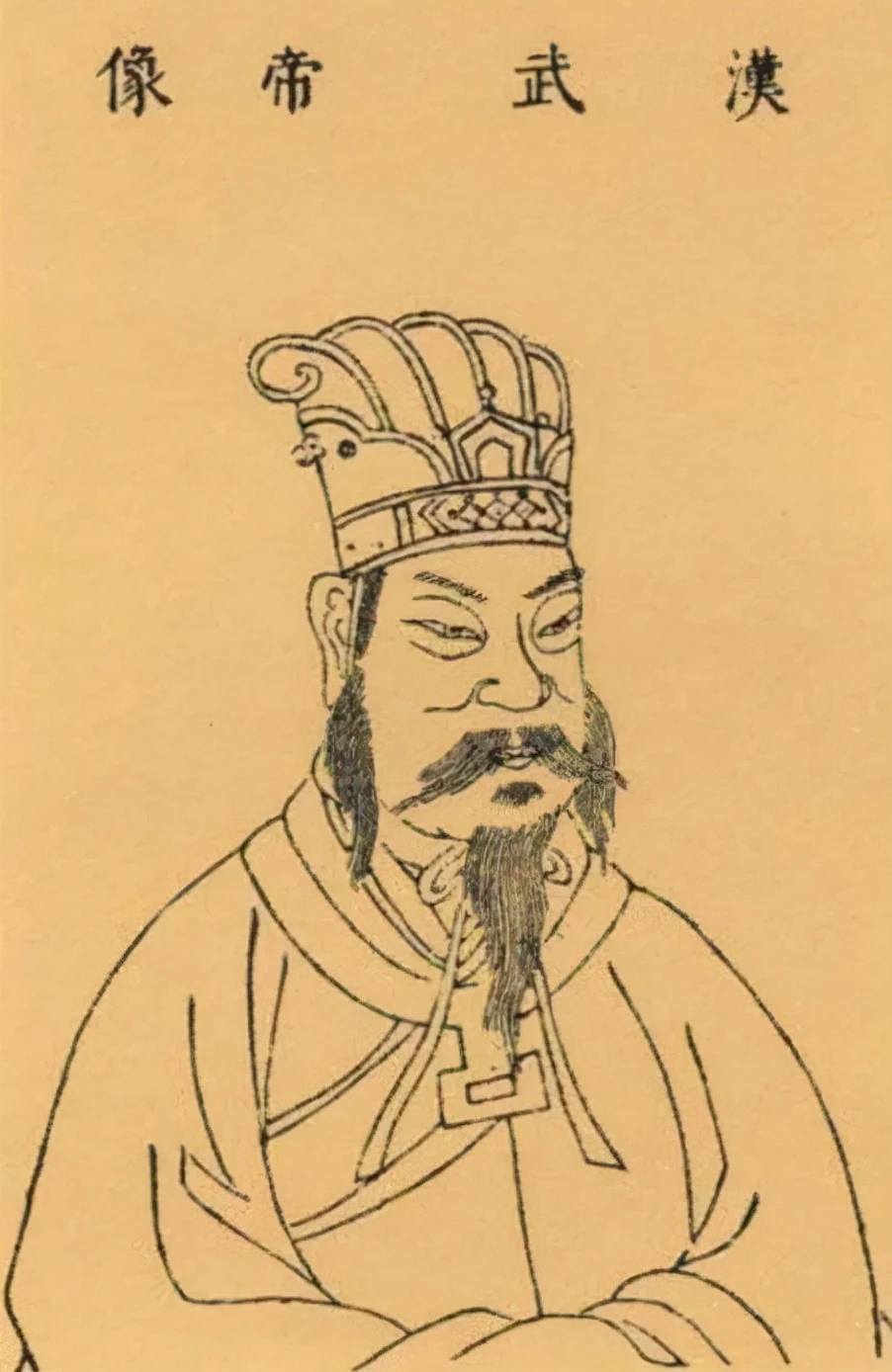
Biography
Family Background and Early Years
Liu Che was born in 156 BCE, the first year of Emperor Jing’s first Yuan cycle. He was Emperor Jing Liu Qi’s tenth son, or according to another tradition his ninth, and his mother was Wang Zhi. According to the “Hereditary House of Imperial Relatives” in the *Records of the Grand Historian*, while pregnant Wang Zhi dreamed that the sun entered her body. She told Liu Qi, who was then crown prince, and he interpreted it as an auspicious sign. Before Liu Che was born, his grandfather Emperor Wen of Han died and Liu Qi succeeded as Emperor Jing; Liu Che was born not long afterward.
In the fourth lunar month of 153 BCE, Emperor Jing made Liu Rong, eldest son of Consort Li, crown prince and at the same time enfeoffed Liu Che as King of Jiaodong. Liu Che’s paternal aunt Princess Guantao Liu Piao first sought to marry her daughter Lady Chen to Liu Rong, but Consort Li refused. Liu Piao then approached Wang Zhi, who agreed to a marriage with Liu Che. Liu Piao subsequently disparaged Consort Li and praised Liu Che before Emperor Jing. Consort Li, angered by jealousy, offended the emperor with intemperate remarks. In 151 BCE, the sixth year of the first Yuan cycle, Empress Bo was deposed. Wang Zhi secretly prompted the official in charge of state guests to petition for Consort Li to become empress; Emperor Jing was furious, executed the official, and distanced himself from Consort Li. In the first lunar month of 150 BCE, he deposed Liu Rong as Prince of Linjiang. In the fourth lunar month he made Wang Zhi empress, and on the twenty-fifth day made Liu Che crown prince.
After Liu Che became heir, Emperor Jing appointed Wei Wan Grand Tutor to the Crown Prince and Wang Zang Junior Tutor to the Crown Prince to supervise his education. In the first lunar month of 141 BCE, the third year of Emperor Jing’s later Yuan cycle, Liu Che performed the capping ceremony. Ten days later Emperor Jing died, and the sixteen-year-old Liu Che succeeded to the throne.
Consolidating Power and Beginning Personal Rule
At the beginning of Liu Che’s reign, the consort families represented by Grand Empress Dowager Dou Yifang and Empress Dowager Wang Zhi wielded great influence, and Liu Che had to report government matters to the Eastern Palace. In the sixth lunar month of 140 BCE, the first year of Jianyuan, Liu Che dismissed Grand Councilor Wei Wan and appointed Dou Ying Grand Councilor and Tian Fen Defender-in-chief. He also employed Confucian scholars Zhao Wan as Censor-in-chief and Wang Zang as Palace Gentleman Prefect, signaling his support for Confucian learning. He ordered the recommendation of worthy and upright men, summoned the eminent scholar Shen Gong, and considered construction of a Bright Hall, changing the calendar, and other Confucian ritual measures.
Grand Empress Dowager Dou, however, favored Huang-Lao teachings and strongly opposed the Confucian reforms. In the tenth lunar month of 139 BCE, the second year of Jianyuan, Censor-in-chief Zhao Wan requested that Liu Che stop reporting state affairs to the grand empress dowager. She reacted angrily and had Zhao Wan and Wang Zang imprisoned on accusations of illicit profit; both died in prison. Dou Ying and Tian Fen were removed, and the planned ritual reforms were abandoned. At the same time, Princess Guantao regarded herself as having helped secure Liu Che’s succession and repeatedly pressed requests on him, causing resentment. Empress Dowager Wang warned Liu Che to handle the princess cautiously, forcing him temporarily to conceal his intentions while turning his attention to private excursions and hunting.
Even during this period Liu Che began limited external initiatives. In 138 BCE, the third year of Jianyuan, he sent Zhang Qian to the Western Regions and also dispatched Yan Zhu with troops to assist Eastern Ou. When Grand Empress Dowager Dou died in the fifth lunar month of 135 BCE, the sixth year of Jianyuan, Liu Che gained full authority. He removed Xu Chang and Zhuang Qingdi and appointed his maternal uncle Tian Fen Grand Councilor and Han Anguo Censor-in-chief. He gradually freed himself from consort-clan constraints. In 131 BCE, the fourth year of Yuanguang, he used the affair in which Guan Fu insulted guests at a banquet as an occasion to execute Dou Ying; Tian Fen died soon afterward. Liu Che then promoted men of comparatively low social origin such as Zhufu Yan, Gongsun Hong, and Zhang Tang, broke the convention that only marquises could become Grand Councilor, and took comprehensive control of government.
Political and Military Achievements at the Height of the Reign
After taking full power, Liu Che reshaped government around the strengthening of imperial authority. Politically, he established an inner court in which trusted palace officials such as officials of the Imperial Secretariat formed a decision-making center, weakening the outer court led by the Grand Councilor. He created inspectorates for thirteen provinces to strengthen supervision of local government. He accepted Zhufu Yan’s proposal for the Decree of Extending Favor, which divided princely fiefs among multiple heirs, and developed the recommendation system by selecting candidates for filial piety and incorruptibility. Economically, he brought coinage under central control, implemented the state monopoly on salt and iron, and introduced equalization and transportation measures to increase state revenues. Culturally, he accepted Dong Zhongshu’s proposal to elevate Confucian learning, appointed Erudites of the Five Classics, established the Imperial Academy, created the Music Bureau to collect songs, and instituted era-name dating.
Militarily, after the Mayi Plot of 133 BCE, strategy toward the Xiongnu shifted from heqin marriage alliance to prolonged warfare. In 127 BCE, Wei Qing recovered the Hetao region and built Shuofang. In 121 BCE, Huo Qubing recovered the Hexi Corridor and Wuwei and Jiuquan commanderies were established, followed later by Zhangye and Dunhuang. In 119 BCE, Wei Qing and Huo Qubing launched the Battle of Mobei, pushing the main Xiongnu forces north of the Gobi so that, in the source’s phrase, there was “no royal court south of the desert.” In 111 BCE Nanyue was conquered and nine commanderies including Nanhai were created. In 108 BCE Wiman Joseon was conquered and four commanderies including Lelang were established. Campaigns were also directed toward the Southwestern Yi, bringing polities such as Yelang and Dian into Han control and establishing commanderies and counties. Zhang Qian’s two missions to the Western Regions opened the Silk Road and created sustained links between the Central Plains and Central Asia.
Late-Reign Crisis and the Luntai Edict of Self-Criticism
Years of warfare and coercive government imposed heavy social costs. During the Tianhan era, the source states that displaced people east of the passes numbered two million and that small uprisings occurred in many places; the government used severe statutes to suppress them. At the same time, Emperor Wu became increasingly suspicious and interested in religious specialists and immortality. In 91 BCE, the second year of Zhenghe, accusations by Jiang Chong and others triggered the Witchcraft Crisis of 91 BCE. Crown Prince Liu Ju raised troops after being unable to clear himself and ultimately committed suicide, while Empress Wei Zifu was also forced to kill herself. Tens of thousands were implicated. After Emperor Wu later investigated the affair, he exterminated Jiang Chong’s three kinship groups and built the Palace of Longing for the Son and a terrace memorializing his regret.
In 89 BCE, the fourth year of Zhenghe, after performing major sacrifices, Emperor Wu dismissed religious specialists, abandoned the search for immortality, and issued the Luntai Edict of Self-Criticism. He acknowledged errors and emphasized restraining harshness, stopping arbitrary exactions, and strengthening agriculture. Thereafter he largely ceased major campaigns and turned toward recuperative policies. In the spring of 87 BCE, the second year of Houyuan, he became gravely ill, made his young son Liu Fuling crown prince, and appointed Huo Guang, Jin Midi, Shangguan Jie, and Sang Hongyang as regents. He died that year at Wuzha Palace near Chang'an and was buried at Maoling.
The Deposition of Consort Li and the Elevation of Lady Wang
Liu Che became heir apparent through a change in the inner palace of Emperor Jing. The Shi ji, in the hereditary house of the imperial relatives by marriage, records that Jing's eldest son was named Rong, his mother being Consort Li of Qi, and Rong was made heir apparent. The grand princess Piao had a daughter whom she wished to give him as consort, but Consort Li was jealous, and since all the beauties of Jing's palace obtained access to him through the grand princess and were favoured above her, Consort Li grew daily more resentful and refused, dismissing the grand princess. The grand princess wished to give her daughter to Lady Wang, who consented. The grand princess in anger slandered Consort Li daily to Jing, saying that when Consort Li met the noble ladies and favoured consorts she had attendants spit and curse over their backs, practising wicked and beguiling arts; and Jing for this reason was estranged from her. Once when Jing was unwell and out of spirits he entrusted his sons who were kings to Consort Li, saying that after his death she should look after them well, but Consort Li was angry and would not answer, and spoke rudely, so that Jing was wroth and nursed his anger without showing it. The grand princess praised Lady Wang's son daily, and Jing thought him worthy, and there had been also the omen of the dream of the sun, so that the matter was long undecided. Lady Wang, knowing that the emperor was estranged from Consort Li and that his anger had not cooled, secretly had someone urge the ministers to make Consort Li empress; and when the master of ceremonies had finished his report, he said that the son is honoured by the mother and the mother by the son, that the mother of the heir apparent had no title and should be made empress, at which Jing was angry and asked whether that was a thing he ought to say, and had the master of ceremonies tried and executed and the heir apparent deposed as King of Linjiang. Consort Li grew more bitter and, unable to see the emperor, died of grief. Lady Wang was then made empress and her son heir apparent, and that son was Liu Che. His elevation rested in fact on the grand princess's slander and Lady Wang's scheming, and the alliance of the inner palace with the relatives by marriage became a hidden thread in the politics of the whole reign.
The Incognito Excursions of the Third Year of Jianyuan and the Rapid Gate Guards
At the beginning of his reign Liu Che was held in check by the grand empress dowager Dou, and so took to going out in disguise to hunt. The Han shu, in the life of Dongfang Shuo, records that at the beginning of the third year of Jianyuan he first began to go out in disguise, north to Chiyang, west to Huangshan, south to hunt at Changyang and east to Yichun; he usually went out after the offering of the new wine, and in the eighth and ninth months he appointed to meet at the palace gate the palace attendants, the ordinary attendants, the mounted guards and the sons of good families of Longxi and Beidi who could ride and shoot and were awaiting orders, whence the name of the Rapid Gate guards began. He went out in disguise at the tenth mark after nightfall, commonly giving himself out as the Marquis of Pingyang. At dawn he would ride and shoot deer, boars, foxes and hares in the hills, wrestling bears and brown bears with his hands, galloping over the fields of grain and rice, so that the people shouted and cursed him and gathered together to complain to the magistrate of Hu and Du; and when the magistrate came and wished to pay his respects to the Marquis of Pingyang, the riders wanted to whip him, at which he was greatly angered and had his clerks cry out to stop them, and several of the hunters were detained until they showed the imperial equipage, after which they were let go. Going out by night and returning at evening, and afterwards carrying five days' provisions and attending the court at the Palace of Long Life, the emperor took great delight in it. After this the people below the southern hills knew that he often went out in disguise, yet he was still pressed by the empress dowager and did not dare go far. The chancellor and the censor-in-chief, knowing his intention, had the commandant of the right of the capital patrol east of Changyang and the right internal secretary levy the common people to await the meeting places. Later he privately set up twelve places for changing clothes from Xuanqu southward, resting and changing on the way and lodging at the various palaces, of which Changyang, Wuzuo, Beiyang and Xuanqu were especially favoured. Then, thinking the road long and toilsome and the people troubled by it, he had the grand master of the palace Wuqiu Shouwang and two men awaiting orders who could calculate to register the land south of Acheng and east of Zhouzhi as far west as Yichun, with its area in mu and its value, intending to make of it the Shanglin park and attach it to the southern hills. The vastness of Shanglin dates from this.
The Night at the Inn at Bogu
In his incognito excursions Liu Che once met with danger. The Taiping yulan quotes the Hanwu gushi: the emperor once came to Bogu and at night sought lodging at a post station, but the station chief would not admit him, so he lodged at an inn. The old innkeeper said to him that he was grown large and strong and should work at farming, and asked why he suddenly came with a sword and a crowd to move about at night, which was either thieving or lewdness. The emperor answered nothing, and asking for a drink of water, the old man said that he had nothing but the contents of his own bladder and no water. After a while he went within, and the emperor sent a man to spy and saw that the old man was inviting more than ten young men, all with bows, arrows and swords, and telling the mistress of the house to go out and settle the guests. The woman came back and told her husband that in her judgement this man was no common person and was moreover prepared, so that he could not be plotted against, and that it was better to treat him well. Her husband said that he was easy enough to deal with, and that they should beat the drum, gather the crowd and put down these bandits. The woman said to wait and let him sleep, and then they could act, and the old man agreed. Of the emperor's attendants there were more than ten, and hearing the plan they were all afraid and urged him to leave by night, but he said that to go would bring disaster and that it was better to stay and quiet them. After a while the woman came out and told the emperor not to mind what the old men said, that her husband loved drink and was crazed and not to be reckoned with, and that she had settled the young gentlemen to sleep and there was nothing to fear. She went in again; the night was cold, and she poured wine and gave much of it to her husband, so that all the young men were drunk; she came out to thank the guests and killed a chicken and made food. At daybreak the emperor left, and returning to the palace that day had the husband and wife of the inn brought before him, gave the woman ten jin of gold and made her husband a guard of the imperial park. From this he took warning and seldom went out in disguise again.
The Entry of Wei Zifu and the Deposition of Empress Chen
In the inner palace of Emperor Wu the coming of Wei Zifu marked a turning point of the age. The Shi ji, in the hereditary house of the relatives by marriage, records that the empress Wei, whose courtesy name was Zifu, was of low birth, being of a family surnamed Wei from the fief of the Marquis of Pingyang, and that Zifu was a singer of the Princess of Pingyang. In the first years of his reign the emperor had no son, and the princess sought out more than ten daughters of good families and had them dressed and kept in her house. When the emperor returned from the purification at Bashang he passed by the princess's house; she presented the beauties she had in waiting, but the emperor did not take pleasure in them; then when the singers came forward he saw Wei Zifu and took pleasure in her alone. That day, when the emperor rose to change his clothes, Zifu attended him in the carriage of the robes and was favoured, and returning to his seat he was greatly pleased and gave the Princess of Pingyang a thousand jin of gold. The princess then presented Zifu and sent her into the palace. As Zifu mounted the carriage the princess patted her back and said: go, eat well and exert yourself; when you are honoured, do not forget me. For more than a year after entering the palace she was not favoured again; when the emperor chose out the useless women of the palace to send them away, Wei Zifu was able to see him, wept and asked to be sent out; the emperor pitied her and favoured her again, and she conceived, and her honour and favour grew daily greater. Her elder brother Wei Changjun and her younger brother Wei Qing were called as palace attendants. And Zifu, greatly favoured, bore three daughters and one son, the son being named Ju. Empress Chen, proud and noble, hearing that Wei Zifu was greatly favoured, was angry and came near to death several times, at which the emperor was the angrier; and the empress practised the beguiling arts of women, and the matter came to light, so that Empress Chen was deposed and Wei Zifu made empress. The honour of the Wei family went together with the military achievements of Wei Qing and Huo Qubing, and the greatness of the relatives by marriage of the Western Han began here.
The Case of Guan Fu and Dou Ying and the Debate at the Eastern Court
Among the conflicts between the relatives by marriage and the marquises in the reign of Emperor Wu, the case of Guan Fu and Dou Ying was the most famous. The Zizhi tongjian records that when Dou Ying lost power his retainers dwindled, and only Guan Fu, formerly chancellor of Yan and Marquis of Yingyin, did not leave him; Dou Ying therefore treated him generously and they supported one another, their friendship like that of father and son. Guan Fu was upright and outspoken and violent in drink, and would insult any man of power above him, and repeatedly offended the chancellor in his cups. The chancellor then memorialised that Guan Fu's household was overbearing in Yingchuan and that the people suffered by it, and had Guan Fu and his kinsmen arrested, all being liable to execution in the market. Dou Ying sent up a memorial pleading for Guan Fu, and the emperor ordered the matter to be argued out between him and the Marquis of Wu'an in the court; the two then accused each other, and when the emperor asked the ministers which of the two was in the right, only Ji An upheld Dou Ying, Han Anguo held both to be partly right, and Zheng Dangshi upheld Dou Ying but afterwards did not stand firm. The emperor was angry with Zheng Dangshi and said that he would behead them all together, then dismissed the court and went in. When the emperor ate with the empress dowager, she was angry and would not eat, saying that while she lived men trampled on her brother, and that after her death they would make mincemeat of him; and the emperor, unable to refuse, had Guan Fu's kin exterminated, and had the officers try Dou Ying, who was found liable to execution in the market. On the last day of the twelfth month of the winter of the fourth year of Yuanguang Dou Ying was condemned and killed at Weicheng, and on the yimao day of the third month of spring the Marquis of Wu'an, Tian Fen, also died. This case arose from the mutual grinding of the relatives by marriage and the old meritorious families, with the ministers wavering between them: the bluntness of Ji An, the smoothness of Han Anguo and the timidity of Zheng Dangshi all appeared in a single debate, and the emperor, caught between them, could neither refuse the empress dowager nor openly protect a relative by marriage, and so it became a great case of the Han court. For the politics of the reign it was a picture of the balance of three forces, the relatives by marriage, the imperial clan and the marquises.
The King of Jiangdu and the System of the Imperial Clan
In Liu Che's time the princes of the imperial clan repeatedly gave occasion for trouble. When the King of Jiangdu came to court he was permitted by edict to join the hunt in Shanglin; before the imperial carriage had set out the emperor had sent Han Yan in a secondary carriage with several dozen or a hundred riders galloping to look at the game, and the King of Jiangdu, seeing them from afar and taking them for the Son of Heaven, dismissed his followers and prostrated himself beside the road to pay his respects, while Han Yan drove past without looking at him. When he had passed the King of Jiangdu was greatly angered and wept before the empress dowager, asking leave to give up his kingdom and join the palace guard like Han Yan; and the empress dowager from this time bore a grudge against Han Yan. As for the system of the princes, after the ordinance of extending grace the kingdoms were gradually divided and the land of the principalities daily reduced while the enfeoffments of marquises multiplied, so that the strength of the imperial clan ceased to be a danger to the centre. Toward the imperial clan the emperor used both kindness and law, and the cases of Huainan and Hengshan were among the great events of the age.
The Remonstrances of the Heir Apparent and the Estrangement Between Father and Son
The relations between the heir apparent Liu Ju and Emperor Wu were the great change of his later years. The Zizhi tongjian records that at first, when the emperor was twenty-nine he had the heir apparent, the Li heir, and loved him greatly; that when he grew up he was of a benevolent, forgiving, mild and cautious nature, and the emperor thought his ability small and unlike his own; that the favoured Lady Wang bore a son Hong, Lady Li bore Dan and Xu, and Lady Li bore Bo, so that the favour of the empress and the heir apparent gradually declined and they were often ill at ease. The emperor, perceiving it, told the general-in-chief Wei Qing that the affairs of the Han house were newly founded and that with the four barbarians invading and insulting China, if he did not change the institutions there would be no model for later ages, and if he did not send out armies the empire would not be at peace, and that for this he could not but weary the people; that if later ages did as he did they would tread in the tracks of the perished Qin; that the heir apparent was grave and loved quiet and would surely bring peace to the empire and not trouble him; that in seeking a sovereign who would preserve the established order there could be none better than the heir apparent; and that he had heard that the empress and the heir were ill at ease, which was nothing, and that Wei Qing might make his meaning known to them. The general-in-chief bowed his head in thanks, and the empress, hearing of it, took off her hairpins and asked pardon. Whenever the heir remonstrated against campaigns against the four barbarians, the emperor laughed and said that he would bear the toil and leave the ease to him, and was that not well. Whenever the emperor went out he left the later matters to the heir and the palace to the empress; and when the heir had judged and settled anything he reported the chief points on the emperor's return, who found nothing amiss and sometimes did not look at them. The emperor used the law severely and employed many harsh officials; the heir was generous and reversed many judgements, and though he won the hearts of the people, the officials who used the law were all displeased. The empress, fearing that in time he would incur guilt, often warned him to keep to the emperor's mind and not to release or spare men on his own authority; and the emperor, hearing of it, approved the heir and not the empress. The generous and elderly of the ministers all attached themselves to the heir while the harsh upholders of the law slandered him, and since the wicked ministers had many partisans the heir's praise was small and the slander much. After Wei Qing's death there was no longer a family of the outer kin to rely on, and the ministers vied in plotting against the heir. Once the estrangement between father and son had arisen and the ministers were divided into two parties, the calamity of witchcraft had something to work upon.
The Calamity of Witchcraft and the Palace of Longing
About the second year of Zhenghe came the calamity of witchcraft, in which the heir apparent Liu Ju was defeated in arms, fled and died. The Zizhi tongjian records that the officials and people who informed against one another of witchcraft were for the most part found on trial to have no truth in their charges; that the emperor had some knowledge that the heir was frightened and had no other intention; and that when Tian Qianqiu, an attendant of the high bedchamber, sent up an urgent memorial pleading the heir's wrong, saying that a son who plays with his father's soldiers deserves the rod but that what crime was it for the Son of Heaven's son to kill a man by mistake, and that he had dreamed of a white-haired old man who taught him these words, the emperor was greatly awakened and called Tian Qianqiu before him, telling him that between father and son men find it hard to speak, and that he alone had shown it to be otherwise; that the spirit of the high temple had sent him to teach, and that he should become his assistant. He at once made Tian Qianqiu grand herald, had the household of Jiang Chong exterminated, burned Su Wen on the Heng bridge, and put to death the family of the man who had first been governor of Beidi and afterwards laid hands on the heir at Quanjiu. Pitying the heir's innocence, the emperor built the Palace of Longing and the Terrace of Looking Homeward at Hu, and all the world heard of it and grieved. On the dingsi day Tian Qianqiu was made chancellor and Marquis of Fumin; he had no other ability or learning and no seniority or merit, but by a single word awakening the emperor he took the chancellorship and a marquisate within a few months.
Liu Qumao, Li Guangli and the Plot for the Prince of Changyi
With the trials for witchcraft there was also a plot to settle the succession. The Zizhi tongjian records its beginning and end: when Li Guangli, the General of the Second Battalion, set out, the chancellor Liu Qumao made the sacrifice of the road and escorted him to the Wei bridge, where Li Guangli said that he hoped the marquis would early ask for the Prince of Changyi to be made heir apparent, for if he were made emperor what had the marquis to fear; and Liu Qumao agreed. The Prince of Changyi was the son of Lady Li, the younger sister of Li Guangli, whose daughter was the wife of Liu Qumao's son, and so they wished to set him up together. It happened that the palace usher Guo Rang informed against the chancellor's wife for cursing the emperor and praying with Li Guangli that the Prince of Changyi might be emperor, and on trial the crime reached to great sedition. In the sixth month an edict had Liu Qumao carried through the streets in a prison cart, cut in two in the eastern market, and his wife and children beheaded in Huayang street; and the wife and children of Li Guangli were also seized. This case joined hands with that of witchcraft, both being changes in the palace of his later years: since the emperor governed his subjects with severe law and faced his ministers with suspicion, a moment's slander or private plot could bring a great minister's family to extinction. With the heir wrongfully dead and no settled succession at court, there followed the decision of the second year of Houyuan to set up the youngest son and the death of Lady Gouyi.
The Death of Lady Gouyi and the Decision on the Succession
The Shi ji, in the hereditary house of the relatives by marriage, records that the emperor, dwelling in the Ganquan Palace, summoned a painter to depict the Duke of Zhou carrying King Cheng, and the ministers about him knew from this that the emperor meant to set up his youngest son. Some days later the emperor reproached Lady Gouyi, who took off her hairpins and earrings and knocked her head on the ground; the emperor said to take her away and send her to prison. She turned back to look at him, and he said to go quickly, for she could not live. She died in the Yunyang Palace. At that time a fierce wind raised dust, and the people grieved; and envoys carried the coffin by night to bury her. The Suoyin, citing the Sanfu gushi, says that she was buried south of the Ganquan Palace and that the Emperor Zhao afterwards raised the Yunling with three thousand households; and the Hanwu gushi says that when she was encoffined a fragrance was smelled for ten li, and the emperor, suspecting that she was no common person, opened the coffin and found no body, only her clothes and shoes remaining. The Zhengyi, citing the Kuodi zhi, says that the Yunyang Palace was the Ganquan Palace of the Qin, eighty li northwest of Yunyang county in Yongzhou; that the Yunyang tomb is the tomb of the Lady Gouyi of Han, fifty-eight li northwest of Yunyang county; that she was the Zhaojieyu Gouyi of Emperor Xiao Wu, mother of Emperor Zhao, a woman of Qi surnamed Zhao, who in youth loved quiet and lay ill for six years with her right hand clenched and ate little; that a reader of vapours said there was a noble person in the northeast, and on searching out the person she was found; that when she was summoned she was of very fine appearance, and the emperor stretched out her hand and obtained a jade hook, and she afterwards bore Emperor Zhao; and that the emperor killed her in his last years, and when she was encoffined her body was fragrant for a day, and Emperor Zhao buried her again and only silk shoes remained in the coffin. The Gong ji says that the emperor, thinking of her, built the Terrace of Communication with Spirits at Ganquan, where a blue bird often gathered and went to and fro, until the time of Emperor Xuan. To set up the youngest son and first kill his mother was the extreme measure of the emperor's later years against future trouble, and the settlement by which Emperor Zhao reigned with Huo Guang as regent was decided by it.
Han Yan, Li Yannian and the Rise of the Music Bureau
In the reign of Emperor Wu the favourites of the court and the rise of the Music Bureau went together. The Shi ji, in the account of the favourites, records that among the favoured ministers of the present Son of Heaven the one of the scholar class was Han Yan, grandson by a concubine of the Marquis of Gonggao, and the one of the eunuchs was Li Yannian. Han Yan had studied writing with the present emperor when he was Prince of Jiaodong, and their affection grew, and when the emperor became heir apparent he became yet closer to Han Yan. Han Yan was skilled in riding and shooting and in flattery; and when the emperor came to the throne and wished to make war on the Xiongnu, Han Yan had beforehand practised the Hu art of war, and for this he became more honoured and noble, rising to grand master of the palace, with gifts like those of Deng Tong, and was often in bed and rising with the emperor. When the King of Jiangdu came to court he was permitted to join the hunt in Shanglin, and before the imperial carriage had set out Han Yan was sent in a secondary carriage with several dozen or a hundred riders galloping to look at the game; the King of Jiangdu, seeing him from afar, took him for the Son of Heaven, dismissed his followers and prostrated himself at the roadside, while Han Yan drove past without looking at him; and when he had passed the King of Jiangdu was greatly angered and wept before the empress dowager, asking leave to give up his kingdom and join the palace guard like Han Yan, whereby the empress dowager bore a grudge against Han Yan. Han Yan, attending the emperor, went in and out of the long lanes of the palace unchecked, and his lewdness came to the ears of the empress dowager, who in anger sent an envoy to give him death; the emperor pleaded for him but could not save him, and Han Yan died. Li Yannian was a man of Zhongshan, whose parents, brothers and sisters were all musicians of old; he had suffered castration for an offence and served among the dogs, and when the Princess of Pingyang spoke of his younger sister as a good dancer and the emperor saw her and took pleasure in her, he called Li Yannian into the palace and advanced him. Li Yannian was a fine singer who made new music, and when the emperor was raising sacrifices to Heaven and Earth and wished to make song and poetry to be set to strings, Li Yannian was good at seconding his intent and set the first poems to music; his younger sister also was favoured and bore a son, and Li Yannian wore the seal of a grandee of two thousand piculs and was titled master of harmonised music, sleeping and rising with the emperor and highly favoured, on a par with Han Yan. In time he became embroiled with the palace women and was arrogant in going in and out, and after the death of his sister Lady Li his favour slackened and his brothers were seized and executed. To make a singer master of music and head of the Music Bureau, and to let a favourite into the secrets of the bedchamber, shows how Emperor Wu used men and how he used his affections; and the making of new music in the Music Bureau was in fact a great turning point in the rise of the yuefu poetic form in China.
The Household of the Great Nurse and the Stratagem of Guo Sheren
In his treatment of old favours the emperor had one affair long remembered. The commentary of the three scholars on the Shi ji, in the account of the jesters, records that when the emperor was young, the mother of the Marquis of Dongwu had nursed him, and when he was grown he called her his great nurse, and she came to court twice a month; and when her memorial of attendance was presented an edict had the favoured minister Ma Youqing give her fifty bolts of silk and supply her with drink, dried rice and cooked food. The nurse sent up a memorial saying that in such and such a place there was public land which she wished to borrow, and the emperor asked whether the nurse wanted it, and gave it to her; and nothing she asked was ever refused. By edict she was allowed to drive her carriage in the imperial way, and at that time the ministers and great officers all respected her. Yet the sons and grandsons and slaves of the nurse's household were violent and overbearing in Chang'an, halting people's carriages and horses in the streets and seizing their clothes, and the matter came to the emperor's ears, who could not bear to have the law applied. The officers concerned asked that the household of the nurse be moved to the frontier, and this was approved. When the nurse was to come in and take leave, she first saw Guo Sheren and wept before him; and Guo Sheren said that when she went in to take leave she should walk quickly and look back several times. The nurse did as he said, and as she left, walking fast, she looked back several times; and Guo Sheren cursed her in loud and violent words, saying: ho, old woman, why do you not go quickly? His Majesty is grown, and does he still need your milk to live? Why look back? At this the heart of the sovereign was moved to pity and grief, and he issued an edict forbidding the removal of the nurse, and punished those who had slandered her. That a single gesture should turn back the sovereign's mind was the art of a jester; and those who later spoke of the unreliability of old palace favours have generally cited this.
Palaces and Progresses After the Witchcraft Trials
Though in his later years the emperor was known for repenting of his campaigns, the building of palaces and the progresses did not cease. He repeatedly built and visited the Ganquan and Jianzhang palaces, raised the Terrace of Divine Brightness and Communication with Heaven, dug the Kunming Pool and built palaces of a thousand gates and ten thousand doors, all the splendour of the age. On his progresses the heir apparent remained in the capital to settle affairs and the palace was entrusted to the empress, so that the government continued to function in his absence. The sacrifices at Mount Tai, the building of the Bright Hall and the reform of the calendar and the reckoning of virtue were all carried out in the Taichu period, and the correction of the first month, the fixing of the calendar and the establishment of the five classics as academic subjects with the building of the Grand Academy were among the chief items of his civil government. Over several decades institutions were renewed within while the four barbarians were gradually settled without; his management of palaces, rites and music and calendar, and the severity of his campaigns, exactions and punishments, were the two sides of one reign.
The Edict of Luntai and the Ennoblement of Fumin
The turn of the emperor's later years appears in the edict of Luntai and the enfeoffment of Fumin. The Han shu, in the treatise on food and money, records that in his later years Wu regretted the campaigns, and therefore made the chancellor Marquis of Fumin and issued an edict saying that the business of the present was to exert himself in agriculture, making Zhao Guo grand commandant for the gathering of grain. The gist of the edict was to abandon the proposal for military farming at Luntai and to stop the campaigns, devoting the state to agriculture, and so later ages called it the edict of Luntai. In appointments he made Tian Qianqiu chancellor and Marquis of Fumin; Tian Qianqiu had no other ability or learning and no seniority or merit, and took the chancellorship and a marquisate by a single word pleading the heir's wrong, yet the substance of his chancellorship was to urge the emperor to rest from arms and attend to farming, and men of the time thought the appointment well made. From his accession to his last year the emperor reigned fifty-four years, with many desires within while he practised benevolence and righteousness without, with heavy punishments and exactions, devotion to magic arts, extravagance in palaces within and campaigns against the four barbarians without, so that within and without were worn out and far and near in want; yet when he turned and repented, as it were turning heaven and earth, and looked on what he had done as if it had been another man, this was how he preserved his house in his later years. When Emperor Zhao came to the throne as a child, Huo Guang held the government and set forth the policies of Wen and Jing to nourish the root, so that the source of the profits was stopped and grace flowed again, and much of this came of the single edict of Luntai.
The Deathbed Trust to Huo Guang and Jin Midi
The trust placed by Emperor Wu for after his death was settled in his testamentary edict. The Han shu, in the lives of Huo Guang and Jin Midi, records that in the first year of Houyuan the palace attendant and chief of the ushers, Mang Heluo, plotted treason with his brother, the Marquis of Chonghe, and Huo Guang and Jin Midi and Shangguan Jie and others together put them down, their merit not being recorded; and that when the emperor fell ill he sealed a writing, saying that when the emperor died it should be opened and acted upon, and by his testamentary edict enfeoffed Jin Midi as Marquis of Du, Shangguan Jie as Marquis of An Yang and Huo Guang as Marquis of Bolu, all for their former merit in capturing the rebels. At first Mang Heluo had been friendly with Jiang Chong, and when Jiang Chong ruined the heir apparent, Mang Heluo's brother had been enfeoffed for his desperate fighting at the killing of the heir; and when afterwards the emperor knew the heir to have been wronged and destroyed the clan and partisans of Jiang Chong, the brothers Mang feared they would be implicated and plotted treason. Jin Midi, seeing their disposition to be out of the common, suspected them and secretly watched their movements, going up and down with them; and Mang Heluo, perceiving Jin Midi's mind, could not for a long time act. At that time the emperor was at the Lin'guang Palace and Jin Midi lay ill in his lodge; Mang Heluo and his brother and their youngest brother Ancheng forged an order, went out by night, killed the envoys and raised troops. The next morning before the emperor had risen Mang Heluo came in from outside without reason; Jin Midi, on his way to the privy, was moved at heart and at once went in and sat below the inner door. In a moment Mang Heluo came up from the eastern chamber with a bare blade in his sleeve, saw Jin Midi, changed colour, ran toward the bedchamber to enter, and stumbling over a jewelled zither, fell. Jin Midi caught hold of him and cried that Mang Heluo had rebelled; the emperor started up and those about him drew their blades to cut him down, but the emperor, fearing that Jin Midi would be struck, ordered them to desist; and Jin Midi, seizing him by the throat, threw him down below the hall, took and bound him, and on full trial all were brought to justice, whereby Jin Midi's loyalty and filial piety were made known. To entrust the state to a loyal and cautious minister, and for Huo Guang afterwards to put down rebellion and set up Emperor Xuan for the restoration, all came of Emperor Wu's own discernment in raising him from among the attendants.
His Burial and the Judgements After His Death
In the second month of the second year of Houyuan the emperor died and was buried at Maoling with the posthumous name Xiao Wu and the temple name Shizong, the building of his tomb and the ministers buried beside him being the most splendid of the imperial tombs of the Western Han. Emperor Zhao then came to the throne at the age of eight, with Huo Guang, Jin Midi and Shangguan Jie jointly in charge of the secretariat, and continued the light taxes, reduced labour service and rest for the people of the emperor's last years, whence came the restoration of Zhao and Xuan. Historians have weighed his life, some raising his exaltation of Confucian learning, his frontier conquests, his opening of the western regions and his establishment of commanderies and counties, others naming his militarism, his trust in magicians and his building of palaces. As to the question of his temple name, the debate has lasted through the ages. Gaozu, rising in valour, was called zu, ancestor; Emperor Wen, honouring benevolence and righteousness, sparing punishments, ending war and practising frugality, with empty prisons and a pacified empire, was called taizong; and Emperor Xiao Wu, though he broadened the land and drove back the frontier, won no virtue for the people, and to honour him as zong became a matter of dispute among those who later discussed ritual. This judgement after his death is still unsettled, and the institution of temple names in the Han lost its proper measure from this; and its source was the reign of Emperor Wu alone.
Taking Up the Government in the Sixth Year of Jianyuan and the Ordinance of Extending Grace
At the beginning of his reign Liu Che was held in check by the grand empress dowager Dou Yifang and other relatives by marriage and could accomplish little; when the grand empress dowager died in the sixth year of Jianyuan the emperor was able to take up the government. After that he struck in turn at the princes and the relatives by marriage, issuing the ordinance of extending grace and cutting down the rank of marquises. The ordinance of extending grace allowed the kings to divide their territories and enfeoff their sons, so that the land of the principalities was divided and reduced day by day and their strength declined of itself, the trouble of the princes dissolving without war; and marquises were repeatedly deprived of their rank on the ground that their tribute gold was not according to rule or that they had committed faults, so that many marquisates were abolished at once. The power of the relatives by marriage was also gradually gathered into the inner court, the emperor himself holding the secrets of state through such offices as the secretariat, the palace secretariat and the palace attendants, while the authority of the chancellor was correspondingly lightened, and there arose the balance of inner and outer courts. The policy pursued over several decades came to concentrating authority in one man; and it was because his power was thus undivided that his orders were always carried out, and that with the strength of a single reign he could drive the Xiongnu north, open commanderies in the south and reach the western regions in the west.
The Order of the Frontier Achievements of the Reign
The military achievements of the reign had their order. At first the Xiongnu were resisted on the frontier, and though the plot at Mayi failed the marriage alliance was broken off; afterwards the land south of the river was taken and Shuofang built as a base for striking into the desert south of the Gobi; in the campaign of the fourth year of Yuanshou the army crossed the desert, the Xiongnu fled far away and no royal court remained south of the Gobi; afterwards communications were opened westward with the Yuezhi and Daxia and the four commanderies of Jiuquan and the rest were set up to cut the Xiongnu's right arm; in the east Hui and Chaoxian were taken and made commanderies, in the south Nanyue was pacified and nine commanderies made, and the southwestern tribes were opened and Qianwei and Yizhou set up. As for the campaign against Dayuan, it was a distant expedition to obtain fine horses, from which after years only several dozen head were obtained, with very many soldiers dead. All these campaigns were bound up with the revenue, the punishments and the palaces of the reign: when arms move exactions cannot but be urgent, when exactions are urgent official discipline cannot but be harsh, and when official discipline is harsh bandits cannot but multiply, so that in his later years came the edict of Luntai, and the policy changed to giving the people rest.
The Goods of the Four Quarters and the Splendour of the Parks and Palaces
Once the emperor had opened the western regions, pacified Nanyue and opened the southwestern tribes, the rarities of distant lands came in from every side. Among those that may be recorded: the treasures of bright pearls, tortoiseshell, rhinoceros horn and kingfisher plumage filled the inner palace; horses of the stock of Bo Shao, Dragon Pattern, Fish Eye and Bloody Sweat filled the imperial stables; and herds of great elephants, lions, fierce hounds and giant birds fed in the outer parks. Thereupon the Shanglin park was greatly widened, the Kunming Pool dug, palaces of a thousand gates and ten thousand doors built, the Terrace of Divine Brightness and Communication with Heaven raised, and tents of the first and second grades erected, hung with Sui pearls and He jade; and the Son of Heaven, seated within on the axe-figured screen, wrapped in kingfisher coverlets and leaning on a jade armrest, set out pools of wine and forests of meat to feast the guests of the four quarters. All this had the opening of the four quarters as its ground, while the expense of palaces and curiosities went alongside that of army and state, and the ministers of the day often spoke of it. Yet with the western regions opened, Han envoys came and went and Hu merchants traded at the frontier, so that the goods and the arts of distant lands came east with them; and later ages in China drew their wonders, famous horses and strange beasts mostly from the opening of the single reign of Emperor Wu.
The Eastern Progress, the Sacrifice at Mount Tai and the Change of the Year Name to Yuanfeng
Of all ritual matters the emperor attended most to the sacrifice at Mount Tai. In the first year of Yuanfeng he made progress east to the sea, ascended Mount Tai, performed the sacrifice on its summit and the sacrifice of the earth at Liangfu to announce his success to Heaven and Earth, and changed the year name to Yuanfeng. Thereafter there were repeated progresses: east to the sea to look for Penglai, north to Shuofang where he drew up a hundred and eighty thousand cavalry, west to Anding and Beidi to tour the frontier, and south to Jiangling and Yunmeng. His rites for the sacrifice, for the Bright Hall and for the suburban offerings became the institutions of a whole age. In the first year of Taichu he further corrected the beginning of the year and fixed the calendar, taking the month of the tiger as the first month, which became the settled system of the Han. For the sovereign to perform the sacrifices, the progresses and the offerings from afar brought the talk of the magicians and the arguments of the scholars together into the court, so that discourse of immortals and of omens flourished in that time, and this was how the temper of the age was formed.