Enlistment
Enlisted as a young gentleman to repel the Xiongnu invasion of Xiao Pass, decapitating many enemies and receiving appointment as Palace Attendant.
前?–119 BCE
李广
Li Guang (李广, ?–119 BCE) was a distinguished general of the Western Han dynasty, hailing from Chengji in Longxi Commandery. Born into a distinguished family of martial archers and descended from Qin general Li Xin, Li Guang entered the military during the reign of Emperor Wen of Han in 166 BCE. Over four decades, he served three successive emperors—Wen, Jing, and Wu—fighting in over seventy battles against the northern…
Li Guang (李广, ?–119 BCE) was a distinguished general of the Western Han dynasty, hailing from Chengji in Longxi Commandery. Born into a distinguished family of martial archers and descended from Qin general Li Xin, Li Guang entered the military during the reign of Emperor Wen of Han in 166 BCE. Over four decades, he served three successive emperors—Wen, Jing, and Wu—fighting in over seventy battles against the northern nomadic Xiongnu empire. During the Rebellion of the Seven States in 154 BCE, Li Guang demonstrated exceptional valor under Grand Commandant Zhou Yafu by seizing the enemy's main banner at Changyi. However, his unapproved acceptance of a general's seal from the King of Liang prevented him from receiving imperial noble honors. Throughout his subsequent frontier commands across six border commanderies, Li Guang became legendary for his informal, humane command style and supreme archery prowess, earning the reverent title of the "Flying General" from his Xiongnu adversaries. Despite his immense military prestige, Li Guang suffered continuous ill fortune and repeatedly missed opportunities to be enfeoffed as a marquis. In 119 BCE, during the climactic Mobei Campaign, the aging general was reassigned to a hazardous eastern detour, where his forces lost their way in the pathless Gobi Desert. Unwilling to endure interrogation and humiliation by military clerks, Li Guang took his own life by sword, an act of tragic martyrdom that drew tears from soldiers and commoners throughout the empire.
Enlisted as a young gentleman to repel the Xiongnu invasion of Xiao Pass, decapitating many enemies and receiving appointment as Palace Attendant.
Served under Zhou Yafu in crushing the Seven States, seizing the rebel banner at Changyi; accepted Liang seal and missed imperial awards.
Served successively as governor of Shanggu, Yanmen, Dai, and Yunzhong, engaging in constant skirmishes and terrifying the Xiongnu.
Appointed General of Brave Cavalry in the Mayi ambush; returned without combat after the Chanyu detected the trap.
Surrounded by superior Xiongnu forces at Yanmen and captured; staged a daring escape by feigning death, seizing an enemy bow and steed to return south, later demoted to commoner.
Appointed Governor of Youbeiping following nomad raids; frightened the Xiongnu into avoiding his jurisdiction, earning the moniker Flying General.
Led 4,000 cavalry out of Youbeiping and held off 40,000 Xiongnu riders under the Left Worthy King; sustained heavy casualties and received no enfeoffment.
Reassigned to the eastern detour during the Mobei expedition, lost direction in the sands, and committed suicide rather than face tribunal clerks.
Li Guang traced his ancestral home to Huaili in the Guanzhong region before his family settled in Chengji of Longxi Commandery. His ancestor Li Xin was a celebrated general of the Qin dynasty who had pursued and captured Crown Prince Dan of the Yan state. Generation after generation, the Li family preserved and passed down their mastery of mounted archery. His great-grandfather Li Zhongxiang had fallen in combat while suppressing a Qiang tribal revolt in Longxi, instilling in Li Guang a deep ambition to serve the state through frontier defense.
In the winter of 166 BCE, the Xiongnu Chanyu launched a massive invasion of 140,000 cavalry through Xiao Pass, burning the Huizhong Palace and dispatching scouting vanguards close to the capital. The Han court issued urgent calls for young men from noble and martial families in Longxi and Tianshui to enlist. The young Li Guang answered the call, distinguishing himself on the frontline through astonishing archery and horsemanship. For decapitating numerous enemy warriors, he was summoned to Chang'an and appointed Chamberlain Gentleman, accompanying Emperor Wen on royal hunts.
During these excursions, Li Guang frequently grappled bare-handed with ferocious wild beasts, protecting the imperial carriage. Emperor Wen marveled at his unmatched strength and prowess, remarking with regret that if Li Guang had lived during the founding era of Gaozu Liu Bang, he would have effortlessly attained a ten-thousand-household marquisate. This royal lament proved to be an unintended premonition of his lifelong inability to achieve a marquisate in an era of bureaucratic governance.
Following Emperor Jing's ascension in 157 BCE, Li Guang was promoted to Commandant of Longxi and subsequently to Cavalry Gentleman General. In 154 BCE, several regional kings launched the Rebellion of the Seven States. Grand Commandant Zhou Yafu was entrusted with thirty-six generals to suppress the insurgency in the east. Li Guang was appointed Commandant of Brave Cavalry and joined the campaign.
At the decisive battle of Changyi, Li Guang spearheaded the assault against fierce rebel resistance, breaching the enemy defenses, slaying opposing officers, and capturing the rebel army's main banner. However, during the campaign, King Liu Wu of Liang, deeply admiring Li Guang's bravery, privately conferred upon him the seal of a Liang state general. Unaware of the delicate factional tensions between the Han court and regional feudatories, Li Guang innocently accepted the appointment. When the grand army returned victorious, Emperor Jing and his ministers refused to reward Li Guang for his banner capture, denying him noble rank.
Soon after, Li Guang was transferred from the capital to serve as Governor of Shanggu Commandery on the northern frontier. Faced with constant nomadic incursions, Li Guang engaged in almost daily skirmishes, always leading his troops at the frontline. Anxious that this peerless warrior might perish prematurely, Gongsun Kunxie, Director of Vassal States, tearfully petitioned Emperor Jing, arguing that while Li Guang possessed unmatched talent, his reckless bravery would eventually cost him his life. Persuaded by the plea, Emperor Jing transferred Li Guang across various frontier commanderies, including Shangjun, Longxi, Beidi, Yanmen, Dai, and Yunzhong, stationing him wherever the nomadic threat loomed largest.
When Emperor Wu ascended the throne in 141 BCE, his counselors lauded Li Guang's exceptional martial ability, prompting the court to recall him to Chang'an as Chamberlain for the Palace Buildings at Weiyang Palace. At the same time, the veteran commander Cheng Bushi was appointed Chamberlain at Changle Palace. Both were famed frontier commanders, yet their military doctrines stood in sharp contrast.
Cheng Bushi governed with rigorous discipline and strict bureaucratic order. His camps maintained relentless night watches, drum signals, and constant inspections of rosters, ensuring that his formations were impervious to surprise attacks, though offering little room for spontaneous brilliance. Li Guang, by contrast, adopted an intuitive, unencumbered style. He rested his troops near abundant water and pastures, omitted night drum patrols, and drastically minimized bureaucratic paperwork, relying instead on extensive reconnaissance scouts.
Cheng Bushi remarked that while Li Guang's soldiers enjoyed comfort and were willing to die for him, his formations were vulnerable to sudden catastrophic routs; his own troops, though weary, were never defeated. Frontier soldiers uniformly preferred serving under Li Guang, revering him as a compassionate father figure.
During his tenure at Shangjun, Li Guang performed a legendary tactical deception known as the "Hundred Cavalry Retreat." When a favored eunuch envoy was ambushed and his entire escort slain by three expert Xiongnu eagle hunters, Li Guang personally set out with only one hundred elite horsemen to pursue them. After tracking them for leagues, Li Guang shot two and captured the third alive. Suddenly, thousands of Xiongnu cavalry appeared over the ridge.
While his panic-stricken men urged an immediate retreat, Li Guang recognized that fleeing over open ground would prompt the nomads to hunt them down. Instead, he ordered his hundred riders to advance to within two li of the enemy line, dismount, unloose their saddles, and let their horses graze peacefully. Perplexed by this unnatural composure, the nomadic commanders suspected that an imperial ambush lay waiting in the surrounding valleys. After a tense standoff lasting until midnight, the Xiongnu forces quietly withdrew into the darkness, allowing Li Guang and his men to return safely to camp at dawn.
In 133 BCE, Li Guang participated in the abortive Mayi Ambush, where 300,000 Han soldiers attempted to trap the Xiongnu Chanyu. The plot failed when a captured officer revealed the plan, and the nomads retreated unscathed. In 129 BCE, Emperor Wu launched a coordinated four-pronged offensive into the steppe. Li Guang commanded 10,000 cavalry departing from Yanmen.
Anticipating Li Guang's route, the Chanyu concentrated superior forces against him. Encircled and hopelessly outnumbered, Li Guang's command was annihilated. Seriously wounded and unconscious, Li Guang was captured alive by nomadic horsemen, who had been ordered by the Chanyu to preserve his life. Suspending him in a rope hammock strung between two galloping horses, the nomads rode north.
Observing his surroundings while feigning death, Li Guang spotted a young nomadic horseman riding a swift steed with a composite bow. Li Guang leaped onto the horse, hurled the youth to the ground, seized his bow and quiver, and spurred the animal southward. As hundreds of enemy riders pursued him, Li Guang turned back in the saddle, picking off the lead pursuers with precision shots. Although he reached Han territory safely, imperial law mandated execution for losing an entire army and suffering capture. Li Guang ransomed his life with his personal assets and was stripped of all official rank, becoming a commoner.
During his retirement in the mountains of Lantian, Li Guang spent his days hunting. One evening, returning late from a banquet, he was stopped at Baling Gate by a drunken station officer. Li Guang's attendant announced that he was the former General Li, to which the officer insolently replied that even a current general could not break curfew, let alone a dismissed one, forcing Li Guang to spend the night at the pavilion.
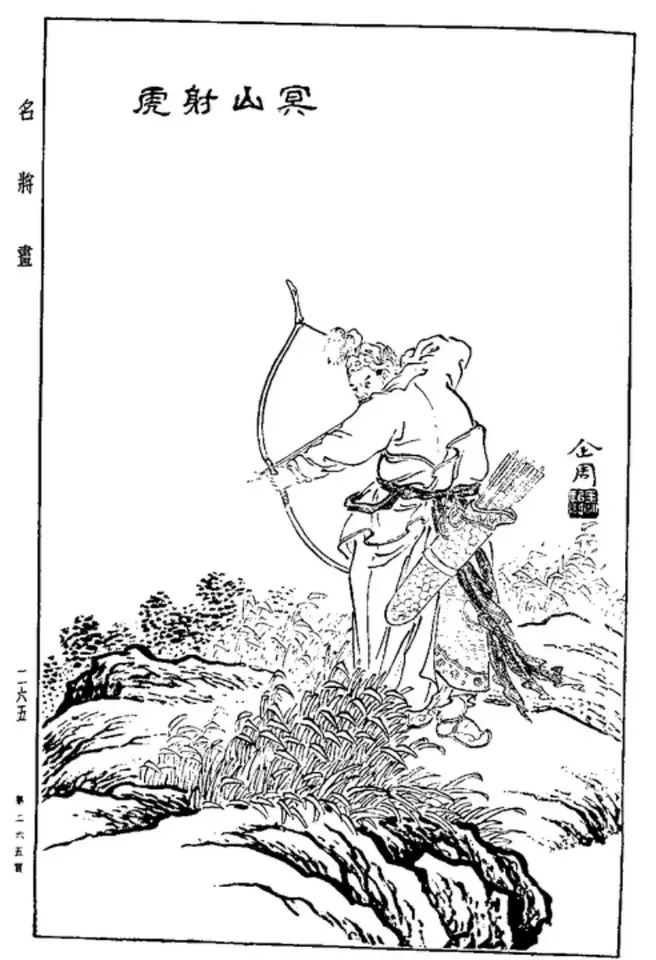
On another occasion while hunting at night in the brush, Li Guang glimpsed what appeared to be a crouching tiger. Drawing his heavy bow to full draw, he loosed an arrow that struck home. The following morning, he returned to inspect the kill, only to discover that the target was a colossal boulder. The bronze arrow point had driven so deeply into the solid stone that the fletching was nearly buried. Astonished, Li Guang stepped back and attempted several more shots, but every subsequent arrow shattered against the rock face, sparking without penetrating.
In 123 BCE, the Xiongnu struck the northeastern border, killing the Governor of Liaodong. Desperate for experienced frontier commanders, Emperor Wu recalled Li Guang and appointed him Governor of Youbeiping. Before departing, Li Guang requested that the Baling officer who had humiliated him be assigned to his staff; upon arrival at camp, Li Guang had him beheaded before submitting a memorial of self-condemnation. The emperor took no punitive action.
In Youbeiping, Li Guang's fearsome reputation preceded him. The Xiongnu avoided his territory, revering him as the "Flying General" of Han, and did not venture into the commandery for several years. Later that year, Li Guang was appointed Chamberlain for Attendants in the capital. Frustrated that lesser subordinates and his cousin Li Cai had received marquisates while he remained unennobled after seventy battles, Li Guang consulted the astrologer Wang Shuo. Wang Shuo asked if he held lingering regrets; Li Guang confessed that while governing Longxi, he had deceitfully slaughtered 800 surrendered Qiang tribesmen in a single day. Wang Shuo sighed, observing that slaughtering surrendered foes was the gravest sin in warfare, explaining his recurring misfortune.
In 121 BCE, during the Hexi campaigns, Li Guang was dispatched with 4,000 cavalry alongside Marquis of Bowang Zhang Qian, who commanded 10,000 men. Marching into the wilderness, Li Guang's vanguard suddenly ran headlong into 40,000 elite horsemen led by the Xiongnu Left Worthy King. Ten times outnumbered, the Han troops trembled with fear.
Li Guang ordered his son Li Gan to lead a cavalry charge directly through the enemy lines. Li Gan slashed through the nomadic formation and returned unscathed, reporting that the enemy was easily managed, restoring confidence to the ranks. Li Guang formed a circular perimeter of shields and heavy crossbows. As nomadic arrows rained down, cutting down half the defenders, Li Guang personally wielded a massive imperial crossbow, systematically sniping hostile commanders. At nightfall, he maintained steady vigilance, keeping his exhausted troops in formation. The following morning, as fighting resumed, Zhang Qian's relief force finally appeared, forcing the Left Worthy King to break off the siege. Although Li Guang had fought with astonishing valor, the near-total loss of his force and Zhang Qian's delayed arrival resulted in no awards, once again denying him enfeoffment.
In 119 BCE, Emperor Wu initiated the climactic Mobei Campaign, deploying Wei Qing and Huo Qubing with over 100,000 elite cavalry to destroy the Chanyu's court. Over sixty years of age, Li Guang repeatedly petitioned for an active role. The emperor reluctantly appointed him General of the Front under Supreme Commander Wei Qing.
However, Emperor Wu secretly warned Wei Qing that Li Guang was ill-fated and should not be allowed to face the Chanyu directly. When scouts located the nomadic main force, Wei Qing resolved to strike with his central corps, ordering Li Guang to join Right General Zhao Shiqi on an eastern detour across difficult terrain.
Li Guang objected strenuously in the commander's tent, declaring that he had waited a lifetime to face the Chanyu in open battle. But Wei Qing, constrained by imperial orders and desiring to elevate his confidant Gongsun Ao, dismissed Li Guang's pleas. Bitter and demoralized, Li Guang departed without formal leave-taking.
The eastern route was arid and devoid of experienced local guides. Li Guang and Zhao Shiqi lost their bearings in the trackless sands. By the time they rejoined the main force, Wei Qing had already engaged the Chanyu in a brutal dust storm, defeated the nomads, and returned south.
Wei Qing sent his senior administrative officer with wine and provisions to inquire into the details of the delay for the imperial report. Li Guang remained silent. When the tribunal officers summoned Li Guang's staff for interrogation, Li Guang intervened, stating that his subordinates bore no responsibility and that he alone had led the army astray.
Exiting his tent, Li Guang addressed his veteran soldiers with tears in his eyes, reflecting that he had fought over seventy engagements against the Xiongnu since his youth. Having been denied a frontline role and having lost his way in the sands, he saw his fate as an unalterable decree of heaven. Unwilling at over sixty years of age to submit to the arrogant browbeating of penal clerks, Li Guang drew his personal sword and slit his own throat before his command post.
The entire army broke into bitter weeping at the sight of their fallen commander. When news of his death reached the empire, commoners and scholars across Guanzhong and Longxi, whether they had known him personally or not, shed tears for the tragic passing of the legendary general.
Li Guang represented an extraordinary archetype among Han commanders, emphasizing humane affection over rigid bureaucratic coercion. Throughout four decades as governor across seven frontier commanderies and two appointments in the Nine Ministries, he received vast financial rewards from the court, yet he retained no private estates or wealth, distributing every gift among his soldiers and impoverished kin.
On arduous marches across arid borderlands, if water was discovered, Li Guang refused to drink until every soldier had quenched his thirst; when food was prepared, he did not touch a morsel until all his men were fed. By eschewing corporal punishment and legalistic cruelty, he earned the fierce loyalty of his troops, who were eager to follow him into the jaws of death.
Li Guang's mounted archery was acknowledged throughout the Han dynasty as the pinnacle of military skill. Cool-headed and deliberate, he refrained from loosing an arrow until his adversary was within several dozen paces, ensuring that every bowstring release resulted in the immediate death of an enemy commander.
His daring exploits—such as the tactical standoff with a mere hundred horsemen, the escape from nomadic captivity while wounded, the shooting of the stone tiger in Lantian, and the sniping of enemy chieftains during the siege by the Left Worthy King—became enduring legends. The Western Han philosopher Yang Xiong commemorated his dedication with the adage that perfect sincerity could pierce solid stone, elevating Li Guang into an eternal cultural symbol of martial devotion and valor.
Li Guang's lifelong military career was defined by the bittersweet tragedy of exceptional heroism devoid of institutional reward. While contemporaries, junior officers, and even his cousin Li Cai attained high offices and titles of marquis, Li Guang's campaigns consistently ended without the requisite body counts demanded by Han military statutes.
This paradox resonated deeply across Chinese literary and intellectual history. Tang poet Wang Bo immortalized his plight in the famous phrase "Feng Tang ages easily, Li Guang is hard to enfeoff" in his Preface to Prince Teng's Pavilion, while Gao Shi evoked the enduring memory of General Li amid the bitter frontier sands. Li Guang's personal sorrow illuminated the stringent and often merciless nature of the Han military meritocracy.
Following Li Guang's death, his younger son Li Gan, who had distinguished himself under Huo Qubing and attained the rank of Marquis of Guannei, assaulted Wei Qing out of filial grief. Though Wei Qing concealed the injury, Huo Qubing later assassinated Li Gan during an imperial hunt at Ganquan, a death Emperor Wu covered up as an accident.
Li Guang's grandson Li Ling, also a peerless archer, led 5,000 infantry deep into the desert in 99 BCE, fighting valiantly against 80,000 Xiongnu riders before surrendering when his arrows were exhausted. The tragic subsequent annihilation of the Li clan by imperial decree marked the sorrowful end of an illustrious martial lineage whose blood and valor had shielded the northern frontiers of the Western Han dynasty.
FIGURES ASSOCIATED WITH THIS DYNASTY