Birth | Born in the territory of Dai, by one account at Chenggao, the fourth son of Liu Bang and Lady Bo.
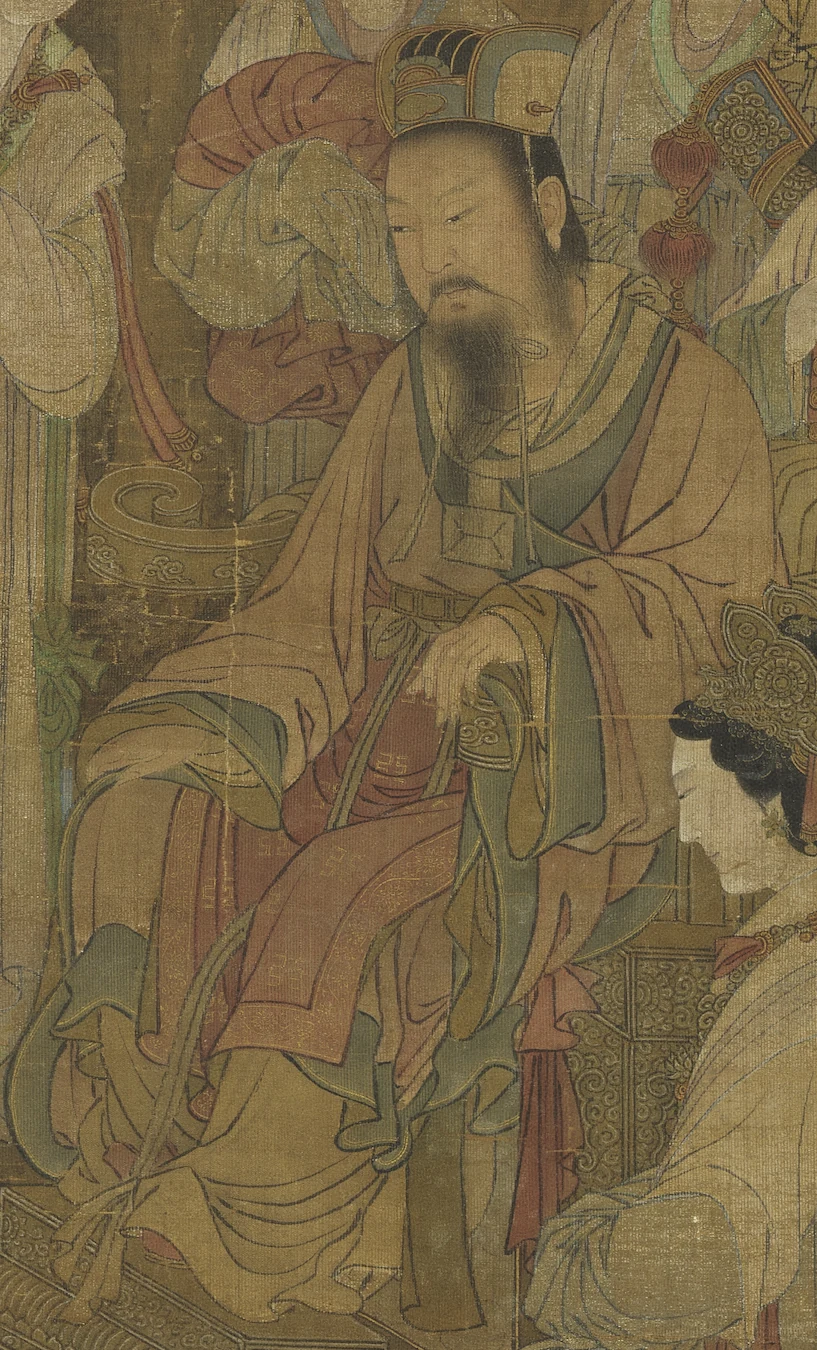
203 BCE–157 BCE
Emperor
Liu Heng
刘恒
Emperor Wen of Han, Liu Heng (203 BCE–157 BCE), was the fourth son of Liu Bang, the founding emperor of the Western Han, and Lady Bo. He was the fifth emperor of the Han dynasty, reigning from 180 BCE to 157 BCE. Initially enfeoffed as Prince of Dai, he guarded the northern frontier. After the death of Empress Lü, the group of senior meritorious officials suppressed the Lü Clan disturbance and installed Liu Heng as emperor.…
203 BCE–157 BCEWestern Han
PROFILE
Emperor Wen of Han, Liu Heng (203 BCE–157 BCE), was the fourth son of Liu Bang, the founding emperor of the Western Han, and Lady Bo. He was the fifth emperor of the Han dynasty, reigning from 180 BCE to 157 BCE. Initially enfeoffed as Prince of Dai, he guarded the northern frontier. After the death of Empress Lü, the group of senior meritorious officials suppressed the Lü Clan disturbance and installed Liu Heng as emperor. During his twenty-three-year reign, he pursued policies of recuperation with the people, reduced corvée and taxes, abolished mutilating punishments, and personally practiced frugality, helping inaugurate the Rule of Wen and Jing. His temple name was Taizong and his posthumous name Emperor Xiaowen. He was buried at Baling.
- Also known as
- Emperor Wen of Han, Liu Heng
- Period
- Western Han
- Dynasty / polity
- Western Han
- Identity
- Emperor
- Ethnicity / ethnic affiliation
- Not recorded in historical sources
- Native place
- Not recorded in historical sources
- Date of birth
- 203 BCE
- Place of birth
- Not recorded in historical sources
- Date of death
- July 4, 157 BCE(1st day of the 6th month, 7th year of the Houyuan era, Emperor Wen of Han)
- Reign
- 180 BCE–157 BCE
- Era name
- Not recorded in historical sources
- Temple name
- Taizong
- Posthumous name
- Emperor Xiaowen
- Major achievements
- Originally Prince of Dai, he was enthroned by leading meritorious officials, inaugurated the Rule of Wen and Jing, pursued policies of recuperation with the people, and was the first emperor to receive the honored temple name “Taizong.”
LIFE TIMELINE
Age one | Born at Chenggao Terrace of the Henan Palace
Age eight | Enfeoffed as Prince of Dai and went to Jinyang to take up his fief
Age twenty-three | Empress Lü wished to transfer him to the princedom of Zhao; he declined and asked to remain guarding the frontier of Dai
Age twenty-four | After Empress Lü died, the meritorious officials installed him as emperor; he ascended the throne at Weiyang Palace
Age twenty-five | Made his eldest son Liu Qi Crown Prince and Lady Dou Empress
Age twenty-seven | Prince Liu Xingju of Jibei rebelled; troops were dispatched to suppress him
Age thirty | Prince Liu Chang of Huainan plotted rebellion, was deposed and exiled to Shu Commandery, and starved himself to death on the way
Age thirty-seven | Abolished mutilating punishments and replaced them with flogging
Age thirty-six | Halved the land tax to one-thirtieth of the harvest
Age thirty-seven | Remitted the land tax throughout the empire
Age forty-seven | Died of illness at Weiyang Palace in Chang'an and was buried at Baling
BIOGRAPHY
Biography
Family Background and Early Years
Liu Heng was born in 203 BCE, the fourth year of the King of Han. His mother, Lady Bo, had originally been a concubine of Wei Bao, King of Wei. Early in the Chu–Han Contention, Wei Bao first joined Han and then rebelled. He was defeated and captured by the Han generals Han Xin and Cao Shen, and was later killed by Zhou Ke. Lady Bo was consequently taken into the weaving quarters of the Han palace. Liu Bang noticed her beauty and brought her into the harem, but for more than a year she received little favor.
In the tenth month of the fourth year of Han (November 204 BCE), while Liu Bang was at Chenggao Terrace of the Henan Palace, Consort Guan and Zhao Zi'er spoke of an old promise involving Lady Bo. After learning of Lady Bo's circumstances, Liu Bang took pity on her and summoned her that day. Lady Bo said that she had dreamed of a blue dragon coiled upon her belly. Liu Bang considered this an auspicious sign. She became pregnant after this encounter and gave birth to Liu Heng. Thereafter Lady Bo rarely saw Liu Bang.
In the first month of 196 BCE, the eleventh year of Emperor Gaozu of Han, Liu Bang reorganized the territory of Dai after suppressing Chen Xi's rebellion. The ministers, regarding Liu Heng as wise, intelligent, gentle, and good-natured, requested that he be made Prince of Dai. At the age of eight, Liu Heng went to Jinyang (present-day Taiyuan, Shanxi) to take up his fief. Liu Bang died the following year. Over the next decade or more, politics in Chang'an remained turbulent: Emperor Hui Liu Ying, the Former Young Emperor, and the Later Young Emperor Liu Hong successively occupied the throne while Empress Lü held actual power. Empress Lü caused the deaths of three of Liu Heng's brothers who had been enfeoffed as princes of Zhao: Liu Ruyi, Liu Hui, and Liu You.
In the autumn of 181 BCE, the seventh year of Empress Gao, Empress Lü wished to transfer Liu Heng to the princedom of Zhao. Liu Heng declined, stating that he wished to continue guarding the frontier of Dai. This display of restraint helped him survive Empress Lü's political purges.
Installed as Emperor
In 180 BCE, the eighth year of Empress Gao, Empress Lü died. Grand Councilor Chen Ping, Defender-in-chief Zhou Bo, Marquis Liu Zhang of Zhuxu, and others joined forces to eliminate the Lü clan. At the time, Prince Liu Xiang of Qi, Liu Bang's eldest grandson, appeared to be the strongest candidate for the throne. However, having learned from the Lü Clan disturbance, senior officials were unwilling to enthrone Liu Xiang because they regarded his maternal relatives as difficult to control. Prince Liu Chang of Huainan was also excluded because of the reputation of his maternal family. They ultimately chose Liu Heng, the oldest surviving son of Liu Bang, who was known for benevolence, filial conduct, and generosity, and whose maternal clan was regarded as cautious and respectable.
When Liu Heng met the envoys, he remained suspicious. Zhang Wu, Chamberlain of the Household in Dai, argued that the old meritorious officials were shrewd and not to be trusted and advised Liu Heng to plead illness and refuse. Song Chang, Commandant of Dai, rejected this view. He argued that the realm supported the Liu house, that Liu Heng was the oldest eligible son and was renowned for sage-like benevolence and filial conduct, and that his succession was proper. Liu Heng discussed the matter with Empress Dowager Bo but remained undecided, and they resorted to divination. The result was the “great horizontal” omen, interpreted as foretelling that he would become Son of Heaven.
Still cautious, Liu Heng first sent his maternal uncle Bo Zhao to Chang'an to investigate. Only after Bo Zhao reported that the situation was trustworthy did Liu Heng set out for Chang'an with Song Chang, Zhang Wu, and four others. He stopped at Gaoling and sent Song Chang ahead to reconnoiter. At the Wei Bridge, the assembled ministers bowed and acknowledged him as their ruler. Defender-in-chief Zhou Bo sought a private audience to present the imperial seals and credentials, but Song Chang replied publicly that public business should be spoken openly and that a ruler had no private business. Zhou Bo then knelt and presented the seals and credentials. Liu Heng declined them and said that the matter should be discussed again at the residence of Dai.
After entering the Dai residence, the ministers repeatedly urged him to take the throne. Liu Heng declined twice while facing west and three times while facing south, yielding the empire five times before finally consenting. Grand Coachman Xiahou Ying and Marquis Liu Xingju of Dongmou cleared the palace and removed the Later Young Emperor Liu Hong. That night Liu Heng entered Weiyang Palace, while the meritorious officials simultaneously put to death Prince Liu Tai of Liang, Prince Liu Wu of Huaiyang, Prince Liu Chao of Hengshan, and the Later Young Emperor Liu Hong. On the second day of the tenth month of the first year of Emperor Wen, Liu Heng formally ascended the throne.
Consolidation of Imperial Authority
On the night of his accession, Liu Heng appointed Song Chang General of the Guards to secure the Northern and Southern Armies, and Zhang Wu Chamberlain of the Household to command the palace guard, thereby ensuring his personal security. He then rewarded the officials who had supported his accession: Zhou Bo became Right Grand Councilor, Chen Ping Left Grand Councilor, and Guan Ying Defender-in-chief. Liu Jie, Bo Zhao, Song Chang, and Si Jun were enfeoffed as marquises, while Zhang Wu and the other five attendants were appointed among the Nine Ministers. He also restored titles and fiefs to members of the Liu imperial clan who had been demoted under Empress Lü.
In the first month of 179 BCE, the first year of Emperor Wen, the ministers requested that a Crown Prince be designated. Liu Heng initially refused. He argued that Prince Liu Jiao of Chu, Prince Liu Bi of Wu, and Prince Liu Chang of Huainan were all eligible and did not wish to appear to favor his own son. After repeated requests from the ministers, he finally made his eldest son Liu Qi Crown Prince and, in the third month, made Lady Dou Empress.
Government and Administration
During his reign, Emperor Wen continued the policy of recuperation with the people inherited from Emperor Gaozu. In 179 BCE, the first year of the Earlier Yuan period, he abolished laws imposing collective liability on relatives, and in the second year he abolished the offenses of slander and “ominous speech.” In 168 BCE, the twelfth year of the Earlier Yuan period, the land tax was reduced from one-fifteenth to one-thirtieth of the harvest. In the following year, land tax throughout the empire was remitted, a remission said to have lasted thirteen years. The poll tax was reduced from 120 cash per person to forty cash, and compulsory labor service was changed from annual service to once every three years.
In 167 BCE, the thirteenth year of the Earlier Yuan period, Chunyu Yi, Director of the Granary of Qi, was sentenced to a mutilating punishment. His daughter Tiying accompanied him to Chang'an and submitted a memorial asking to save her father. Moved by her filial conduct, Emperor Wen ordered the abolition of tattooing, cutting off the nose, and amputation, replacing them with comparatively lighter punishments such as flogging. This was the first systematic abolition of most mutilating punishments in Chinese history.
Emperor Wen was personally extremely frugal. During twenty-three years on the throne, he made no additions to palaces, parks, carriages, horses, clothing, or other imperial possessions. He was said to wear plain silk clothing and straw sandals at court, and the garments of women in the harem did not trail on the ground. In his final edict, he required that Baling use earthenware funerary goods rather than gold or silver and that the funeral be kept simple.
Internal and External Challenges
In 177 BCE, the third year of Emperor Wen, the Xiongnu invaded. Grand Councilor Guan Ying led an army northward while Emperor Wen personally went to Taiyuan to supervise operations. Prince Liu Xingju of Jibei, resentful that his elder brother Liu Xiang had not been enthroned and mistakenly believing the capital to be undefended, rebelled. Emperor Wen returned to Chang'an and dispatched Marquis Chai Wu of Jipu to suppress him. Liu Xingju was defeated and committed suicide.
In 174 BCE, the sixth year of Emperor Wen, Prince Liu Chang of Huainan and more than seventy others plotted rebellion. After the conspiracy was exposed, he was summoned to Chang'an. The ministers recommended execution for high treason, but Emperor Wen, mindful that Liu Chang was a son of the previous emperor, stripped him of his princely title and exiled him to Shu Commandery. Yuan Ang warned that Liu Chang's fierce temperament would not endure humiliation, but Emperor Wen did not heed him. Liu Chang starved himself to death on the journey. Emperor Wen, grief-stricken on hearing the news, held the county officials along the route responsible and had them executed, and ordered Liu Chang buried with the rites of a marquis.
Final Years and Death
In 157 BCE, the seventh year of the Later Yuan period, Emperor Wen died of illness at Weiyang Palace in Chang'an at the age of forty-seven. His final edict called for a simple burial and ordered that the mountains and rivers around Baling not be altered. His temple name was Taizong and his posthumous name Emperor Xiaowen. He was buried at Baling.
Lady Bo and the Years as Prince of Dai
Liu Heng's mother, Lady Bo, had been a concubine of Wei Bao, king of Wei, and entered the Han palace after Wei was destroyed. According to the Hereditary Houses of the Consort Kin in the Records of the Grand Historian, when Liu Bang sat on the Chenggao terrace of Henan Palace two beauties attended him and, laughing together, recalled an old promise to Lady Bo; asked why they laughed, they told him the truth, and Liu Bang, moved and pitying her, summoned her that day. She said that "last night I dreamed a grey dragon lay upon my belly", and he answered that "this is an omen of honour; I shall bring it about for you", and after one night she conceived and bore Liu Heng the next year; thereafter she seldom saw Liu Bang. In the eleventh year of Gaozu (196 BC), after the rebellion of Chen Xi was put down, Liu Bang held that Dai, lying north of Changshan and next to the barbarians, was too remote for Zhao to hold from south of the mountains and too exposed to the Hu to be a state, and so added the lands of Taiyuan south of the mountains to Dai, making the Yunzhong region west of Dai a separate commandery; the Prince of Yan, Lu Wan, Chancellor Xiao He and thirty-one others all called Liu Heng "worthy, wise, gentle and good" and asked that he be made Prince of Dai with his capital at Jinyang. In the seventh year of Empress Lü (181 BC) she proposed to transfer him to Zhao, and he declined, asking to keep guard on the frontier of Dai. Being far off and humble and cautious, he survived the purge of the Liu princes.
The Accession
After the Lü clan was destroyed in 180 BC the ministers debated a new sovereign. Some urged that the eldest son of Gaozu was Prince Dao of Qi and his heir was King of Qi, so that the succession belonged to him; but the ministers said that "the Lü as consort kin were wicked and nearly ruined the ancestral temple", and that the Qi king's maternal family, the Si Jun, were likewise bad, so that making him king "would be another Lü"; the Prince of Huainan was thought too young with a bad maternal family. They therefore summoned the Prince of Dai, "the emperor's surviving son, the eldest, humane, filial, generous and mild, whose mother's family, the Bo, are cautious and good". The palace commandant Zhang Wu and others advised pleading illness and sending no one, but the commandant of the guards, Song Chang, argued otherwise: that the realm had despaired of anyone but the Liu after Qin's fall; that Gaozu's enfeoffment of his sons and brothers interlocking like dogs' teeth made an unshakeable house; and that the abolition of harsh Qin laws had made the people secure. He added that the grand commandant, entering the northern army with a single tally, had needed only one call for the soldiers to bare their left arms for the Liu, which was Heaven's gift and not human effort; that within there were the kinsmen Zhu Xu and Dong Mou, and without, the strength of Wu, Chu, Huainan, Langya, Qi and Dai; and that the prince, being the eldest and of renowned worth, should not doubt. Liu Heng still hesitated, consulted his mother and then divined, obtaining the sign "great crosswise": "Great crosswise, firm and strong; I shall be king of Heaven, as Qi was glorified by Xia." The diviner explained that "king of Heaven" meant the Son of Heaven. He sent his uncle Bo Zhao to see the Marquis of Jiang, who reported that "it is true; there is nothing to doubt", and Liu Heng, laughing, told Song Chang that it was as he had said. Song Chang rode beside him and Zhang Wu and five others followed by post; halting at Gaoling, he sent Song Chang ahead into Chang'an to watch for changes. At the Wei bridge the ministers bowed as subjects and Liu Heng alighted to return the salute; when the grand commandant Zhou Bo asked for a private word, Song Chang said that "what you have to say, say openly; if it is private, a king does not receive private words", and Zhou Bo knelt and presented the imperial seals. Urged to take the throne, Liu Heng declined three times facing west and twice facing south before accepting because "the clan, the generals and ministers, the kings and marquises judged none more fit". That night he made Song Chang general of the guards over the northern and southern armies and Zhang Wu commandant of the palace, issued an amnesty granting a rank to every man, cattle and wine to the hundred households of every woman, and five days of feasting, and rewarded the merit of the accession: ten thousand households and five thousand catties of gold to Zhou Bo, three thousand households and two thousand catties each to Chen Ping and Guan Ying, two thousand households and a thousand catties each to Liu Zhang, Ji Tong and Liu Xingju, and the marquisate of Yangxin to Liu Jie.
Managing the Founding Ministers: Zhou Bo
Toward the ministers who had made him emperor, Liu Heng combined conciliation with measured pressure, most notably toward Zhou Bo. Proud of his merit, Zhou Bo would leave the audience haughty and contemptuous of the young emperor, who only treated him with greater courtesy and often watched him depart; when a minister said that this demeanour was beneath a sovereign, the emperor grew steadily more grave and Zhou Bo more deferential. His subordinates warned him not to overshadow the throne and bring fire on himself, and, suddenly awake to it, he resigned as right chancellor in the eighth month of 179 BC, which Liu Heng at once accepted. Two months later Chen Ping died and Zhou Bo was made chancellor again; more than a year after that the emperor decreed that marquises should reside in their fiefs, since "most marquises now live at Chang'an, their fiefs are far, the soldiers and clerks are burdened with supplying them, and the marquises have no way to instruct their people", requiring even those allowed to remain to send their heirs. When many pleaded reasons to stay, Liu Heng, angered, had the chancellor Zhou Bo take the lead and dismissed him. Later, when someone accused Zhou Bo of putting on armour with rebellious intent, the emperor had him arrested at once, and Zhou Bo, through the empress dowager's brother Bo Zhao, explained that he had donned armour only from fear and had no thought of rebellion; on re-examination no plot was found, and he was released and restored. Thereafter the chancellors he appointed were mostly men "of few letters but much substance".
The Problem of the Princes
Under Liu Heng the problem of the principalities grew. Liu Xingju, Prince of Jibei, and Liu Zhang, Prince of Chengyang, both thought their great services unrewarded, resenting that the emperor, hearing they had once wished to make the King of Qi sovereign, had diminished their merit; in the second year of his reign two commanderies of Qi were given them as principalities, and "they thought themselves stripped of office and merit". When Liu Xingju heard that the Xiongnu had invaded in force, that Chancellor Guan Ying was sent against them and the emperor had gone to Taiyuan, he assumed the emperor was campaigning in person and rose in Jibei, meaning to seize Xingyang. Liu Heng, on hearing it, at once recalled the chancellor's army, sent the Marquis of Jipu, Chen Wu, as general with a hundred thousand against him; Liu Xingju was defeated, captured and took his own life, and his land became commanderies. Liu Chang, Prince of Huainan, arrogant and lawless, had killed the Marquis of Piyang, Shen Shiqi, with a follower; when his rebellion was discovered, forty-three ministers asked for his execution, but Liu Heng deposed him and sent him to a post-house in the Qionglai mountains of Yandao. Yuan Ang warned that since the emperor had long indulged him, treating him now with strict law in wind and rain might bring blame for killing his own brother; Liu Heng answered that he meant only to cause him some hardship and would be kind later, but the prison cart was sealed, the officials along the way dared not open it, and Liu Chang himself would not break the seal and starved to death. Following Jia Yi's counsel to "multiply the principalities and diminish their strength", Liu Heng divided Qi into six and Huainan into three, which eased the military pressure of later rebel princes without preventing the divided states from joining rebellion. He also moved the Prince of Huainan away from Huainan to Zhouyang and applied the same policy in Qi, so that the Qi king's uncle Si Jun and the ten sons of Prince Dao of Qi were settled in Jibei and Jinan, bringing the two greatest principalities under the close watch of the imperial commanderies.
The Xiongnu and the Frontier
Toward the Xiongnu Liu Heng pursued restraint, marriage alliance and defence together. In the third year of his reign (177 BC) the Wise King of the Right broke the peace, seized the lands south of the Yellow River with tens of thousands of horse, raided Shangjun and threatened Chang'an; the emperor sent eighty-five thousand frontier cavalry to Gaonu and Chancellor Guan Ying against them, and after they withdrew posted officers of the central army under the general of the guards at Chang'an. In the sixth year (174 BC) he wrote to the shanyu that "Han and the Xiongnu are sworn brothers, and Han has sent the shanyu much", with gifts of embroidered robes, brocade, gold belt-fittings and silks; when the Laoshang shanyu came to the throne, Han again sent a princess of the imperial clan as his consort and the eunuch Zhonghang Yue as her escort, and Zhonghang Yue, sent against his will, went over to the shanyu and became his favourite. In the fourteenth year (166 BC) the shanyu entered Chaona and Xiao Pass with a hundred and forty thousand horse, killed the commandant of Beidi, took much plunder, burned the Hui palaces and sent patrols to Yong and Ganquan; the emperor made Zhou She and Zhang Wu generals, raised a thousand chariots and a hundred thousand horse about Chang'an, and appointed Lu Qing, Wei Xiu, Zhou Zao, Zhang Xiangru and Dong Chi to the border commands, but the shanyu stayed a month within the passes and the Han army, driving him out, killed none, so that the Xiongnu grew more arrogant and raided yearly, worst in Yunzhong and Liaodong. In the second year of Houyuan (162 BC) he wrote again that "by the late emperor's rule the bow-drawing lands north of the Long Wall obey the shanyu and the cap-and-sash houses south of it I also govern", wishing that both "cast off small matters and tread the great road", and that "after the peace, Han will not be the first to offend". In the sixth year of Houyuan (158 BC) the Junchen shanyu broke the peace and entered Shangjun and Yunzhong with thirty thousand horse each; the emperor hurriedly sent Ling Mian to Feihu and Su Yi into Dai at Juzhu, posted Zhang Wu at Beidi, and set three generals at Xiliu, Jinmen and Bashang west of Chang'an, so that beacon fires reached Ganquan and Chang'an.
Nanyue and the Other Peoples
Zhao Tuo, king of Nanyue, had been on bad terms with Han under Empress Lü and had taken the imperial title. Liu Heng reversed the blockade, sending iron tools, farm implements, horses, cattle and sheep, repairing Zhao Tuo's ancestral tombs at Zhending with guards and seasonal sacrifices, withdrawing the officers preparing to attack Nanyue and giving office to Zhao Tuo's kinsmen in the Central Plains; he then sent Lu Jia, who had gone there before, to persuade him to submit as a vassal, exchange envoys and send tribute. Zhao Tuo accordingly dropped the imperial title and bowed as a subject, though, by one account, he still used it within his own realm.
Law, Thrift and the Testamentary Decree
Liu Heng's legal policy was largely one of mitigation. In the twelfth month of 179 BC, two months after his accession, he abolished the law by which a criminal's kin were taken and punished with him, carrying it through despite the objections of Zhou Bo and Chen Ping; in 167 BC, on the petition of Chunyu Yi's daughter Tiying, he replaced branding, nose-cutting and foot-cutting with other penalties. He was not, however, uniformly lenient: when someone stole a jade ring from the shrine of Gaozu, Commandant of Justice Zhang Shizhi, applying the law, proposed execution in the market, and the emperor angrily said that a man so wicked as to rob the late emperor's shrine should be punished with his clan; Zhang replied that "the law is enough as it stands", and that if robbing the shrine brought clan punishment, what penalty would remain for a man who took a handful of earth from the imperial tomb. After consulting the empress dowager, the emperor agreed. Again, when a man startled the imperial horses and Zhang Shizhi sentenced him to a fine, the emperor protested that his own horses were gentle and others would have injured him, to which Zhang answered that "the law is what the Son of Heaven shares with the realm", and that "the commandant of justice is the balance of the realm; once tilted, all the realm's applications of law shift", and after a long silence the emperor allowed that the commandant was right. In the first year of Houyuan (163 BC), enraged that the adept Xin Yuanping had deceived him for years, he had him executed with his clan, restoring that punishment. In his person he was famously frugal: wishing to build a terrace, and learning from the craftsmen that it would cost a hundred catties of gold — "the property of ten households of middling means" — he said that, dwelling in the late emperor's palaces, he was ashamed even so, and abandoned the plan; he wore coarse silk, kept his favourite Lady Shen from trailing her skirts or embroidering her curtains, and had his tomb at Baling built of tiles without gold, silver, copper or tin, using the natural hill and raising no mound. His testamentary decree opposed lavish burial and long mourning, ordering that officials and people alike should put off mourning after three days and not be forbidden to marry, sacrifice, drink or eat meat.
The Favourite Deng Tong and the Scholars
Liu Heng's benevolence had its partialities. The favourite Deng Tong had been a boatman in Shu, raised to favour because the emperor dreamed of ascending to Heaven and a man dressed as Deng Tong pushed him up; wishing him rich, the emperor gave him the copper mountains of Yandao in Shu to coin money, so that Deng Tong's wealth equalled a king's. When Liu Heng had a boil, Deng Tong would suck it; asked who in the realm loved him most, Deng Tong answered that none could exceed the heir, but when the emperor had the heir Liu Qi do likewise, the prince could not bring himself to it, and, learning afterwards that Deng Tong often did so, he resented him — on succeeding he stripped Deng Tong of office and property, so that he starved to death in another's house. Among the scholars, Jia Yi was slandered by Zhou Bo, Guan Ying and others as "a man of Luoyang, young and newly learned, who wishes only to grasp power and throw affairs into confusion", and the emperor, believing it, distanced him and sent him as tutor to the King of Changsha, so that Jia Yi "went into exile ill at ease"; later, on a matter of sacrifice, the emperor summoned him back but "asked not about the people but about ghosts", talking until midnight and sighing that he had thought himself the better man and was not. Feng Tang once said openly that "even with Lian Po and Li Mu, Your Majesty would not use them", at which Liu Heng rose in anger and went within; later he reproached him for shaming him in public, and Feng Tang excused himself as a rustic ignorant of taboos. Yuan Ang, to foil the eunuch Zhao Tan, who slandered him, prostrated himself before the carriage when Zhao Tan rode with the emperor, saying that "those who share the six-foot carriage with the Son of Heaven are all heroes of the realm, and though Han lacks men, how can Your Majesty ride with one of the knife-and-saw?" The emperor laughed and made Zhao Tan dismount. So counsel and partiality coexisted in him.
The Temple Name and the Example of Thrift
In the tenth month of the first year of Emperor Jing, a decree to the censor-in-chief declared that "of old, ancestors were honoured for merit and progenitors for virtue", and listed the virtues of Emperor Wen: "he ruled the realm, opened the passes and bridges without distinguishing distant regions, abolished slander suits and removed the corporal mutilations, rewarded the aged, gathered in and relieved the orphaned and lonely to nourish all living things; he reduced his appetites and desires, accepted no offerings and took no profit for himself; he did not seize the families of criminals nor put the innocent to death; he abolished castration, released the palace women, and held it grave to cut off a man's line", all of which "the ancients did not attain, yet Emperor Wen practised". Chancellor Shen Tuijia and the others proposed that, since no merit in the world exceeded that of Emperor Gao and no virtue was greater than Emperor Wen's, the shrine of Emperor Gao should be the Great Ancestor's and that of Emperor Wen the Great Progenitor's, the Son of Heaven sacrificing to them generation after generation, and the commanderies and principalities each establishing a shrine to Emperor Wen. The decree said "approved". As to the moral effect of his thrift, Dongfang Shuo, recounting the age of Emperor Wen to Emperor Wu, said that he was "noble as Son of Heaven and rich in the four seas, yet wore coarse black silk, shod his feet in raw hide, belted on his sword with plain leather, sat on rush mats, kept weapons of wood without edges and garments without pattern, and gathered the cloth bags of memorials to make the palace curtains, taking virtue for his ornament and benevolence and righteousness for his standard", so that "the whole realm followed the fashion and was manifestly transformed". The words come from a later admirer and idealise his frugality, yet they chime with the record that he did not enlarge his palaces and that his tomb at Baling was built of tiles. In his twenty-three years on the throne "there was no increase in palaces, parks, dogs, horses or equipage; whenever a thing was inconvenient he set it aside to benefit the people", a side of him that stands alongside the disputed measures — private coining, indulgence of the King of Wu — and must be judged separately.
Major Activities
Political Reforms
After ascending the throne, Emperor Wen faced a complex political balance between the group of meritorious officials and the Liu imperial clan. He followed a cautious policy: while rewarding the officials who had supported his accession, he also restored the positions of Liu princes and nobles. He abolished harsh laws concerning collective liability, slander, and ominous speech and reduced criminal penalties. These measures eased tensions within the ruling elite and stabilized the political situation of the early Han.
Economic Policies
Emperor Wen pursued policies of light taxation and reduced labor service. The land tax was reduced from one-fifteenth to one-thirtieth of the harvest, and later remitted throughout the empire for thirteen years. The poll tax was cut from 120 to forty cash, while corvée service was changed to once every three years. These measures greatly reduced burdens on peasants and promoted economic recovery. According to the studies cited in the source, the population rose from about fourteen million to about thirty-one million during his reign.
Abolition of Mutilating Punishments
In 167 BCE, the case of Tiying petitioning on behalf of her father prompted Emperor Wen to issue an edict abolishing mutilating punishments. Under Grand Councilor Zhang Cang and Censor-in-chief Feng Jing, tattooing, nose-cutting, amputation, and related penalties were replaced by flogging, iron restraints, and other lighter punishments, and a system of progressively reducing sentences was introduced. Historical accounts state that after the reform social customs became more sincere, legal restrictions more lenient, punishments greatly decreased, and only about four hundred cases were adjudicated, creating an atmosphere in which penal measures were seldom required.
Exemplary Frugality
Emperor Wen promoted frugality by personal example. During twenty-three years on the throne, he made no additions to palaces, parks, carriages, horses, clothing, or imperial equipment. He was said to wear plain silk clothing and straw sandals at court, while women's garments in the harem did not trail on the ground. His final edict ordered a simple burial; Baling was to contain earthenware grave goods and no gold or silver. Later archaeological excavation confirmed that Baling was not lavishly furnished.
Handling the Feudal Princes
During Emperor Wen's reign, the rebellions of Prince Liu Xingju of Jibei and Prince Liu Chang of Huainan were successively suppressed. At the same time, further enfeoffment of regional princes strengthened the branches at the expense of the trunk. The abandonment of state monopolies over salt and iron and of centralized coinage authority also strengthened regional power, contributing to conditions that later led to the Rebellion of the Seven States.
The Nanyue Question
The kingdom of Nanyue had been established by Zhao Tuo at the end of the Qin. During Emperor Gaozu's reign, Lu Jia had been sent as an envoy and Zhao Tuo had been recognized as king of Nanyue. During Empress Lü's rule, restrictions on the export of ironware and other goods led Zhao Tuo to proclaim himself Martial Emperor of Nanyue and to attack Han frontier commanderies. After Emperor Wen came to the throne, he repaired the ancestral tombs of Zhao Tuo's family, treated Zhao Tuo's brothers generously, and again sent Lu Jia to Nanyue. Zhao Tuo abandoned the imperial title and resumed sending tribute as a subject.
Taxes, Agriculture and Ranks for Grain
Liu Heng continued the early Han policy of rest and, valuing farming, reduced the land tax in 168 BC and remitted it altogether in 167 BC; assessments and corvee were lightened, so that it was said "the people's tax was forty and a man laboured once in three years". He encouraged agriculture and in person ploughed the sacred field; when a man offered a thousand-li horse he decreed that, with the pennant before and the attendant carriages behind, a journey was fifty li a day, and that he would not accept the gift, ordering that none should seek out such offerings, and returned the horse with travelling expenses. In the sixth year of Houyuan (158 BC), in drought and locusts, he ordered the princes not to come to court, opened all mountains, marshes and waters to the people for mining, fishing and salt, reduced dress and carriages, cut the number of palace guards, opened the granaries for relief and permitted the sale of ranks. For the frontier, Chao Cuo advised that "if the people of the realm bring grain to the frontier in return for rank or remission, in three years the frontier will have grain in plenty", and Liu Heng adopted it, openly selling ranks to fill the frontier granaries; he also adopted Chao Cuo's plan of settling people on the frontier: cities were built, households from the interior moved there — a thousand or more to each city — with the government supplying tools, clothing and grain until they could support themselves, organised in fives and tens, trained in peace and able to resist in war, and whoever drove off the Xiongnu and recovered plunder being rewarded by the government with half its value.
Coinage and the Profits of Salt and Iron
In the fifth year of his reign (175 BC) Liu Heng minted four-zhu coins and abolished the law against private coining, letting the people cast money. Jia Yi remonstrated that, since the law allowed all to cast copper and tin into coin while punishing with branding any adulteration with lead or iron, and since profit was impossible without adulteration, the offence could not be stopped, hundreds in a single county being convicted; and that coins differed from commandery to commandery, so that without a standard coin, strict enforcement would be unbearably vexatious and laxity would throw the markets into confusion; he urged that copper be taken into government hands. Jia Shan likewise argued that "money is a useless thing that can yet buy wealth and honour, and the power to bestow wealth and honour is the sovereign's; to let the people have it is to share his grip on power with them", which could not be endured. Liu Heng did not listen. The grand counsellor Deng Tong was then in favour, and the emperor, wishing him rich, gave him the copper mountains of Yandao to coin; the King of Wu, Liu Pi, had the copper hills of Yuzhang, gathered fugitives to coin money and boiled sea water for salt, so that without taxes his state was well supplied, and "the coins of Wu and Deng spread through the realm". Later critics such as Liu Zhi of the Tang observed that under Emperor Wen a prince of Wu matched the sovereign in wealth and a grand counsellor equalled a king in goods, all because of private coining. The policy eased circulation but strengthened the provinces and the princes.
The Marriage Alliance and Frontier Letters
Toward the Xiongnu Liu Heng long combined marriage alliance with defence. In the sixth year of his reign (174 BC) he wrote to the shanyu that "Han and the Xiongnu are sworn brothers, and Han has given the shanyu much", while "those who break the agreement and divide brotherly kin are usually the Xiongnu", sending robes, gold belt-fittings and embroidered silks by the grand counsellor and the usher. In the second year of Houyuan (162 BC) he wrote again, proposing that "by the late emperor's rule the bow-drawing lands north of the Long Wall obey the shanyu and the cap-and-sash houses south of it I also govern", and that both "cast off small matters, tread the great road, destroy former enmity and plan for the long term, so that the peoples of the two states be as one family", declaring that "after the peace, Han will not be the first to offend". Yet he never abandoned armaments: in 177, 166 and 158 BC, at times of serious incursion, he moved troops, strengthened the frontier commands and, in 158 BC, set three generals at Xiliu, Jinmen and Bashang. Historians note that under Emperor Wen the scourge of war was perhaps a tenth or a fifth of what it became under Emperor Wu, though Lu Jiuyuan and others criticised him for a nature too yielding, content with the marriage alliance and failing to prepare defences and train troops.
Law and Punishment
Liu Heng's legal reforms came with controversy. In 179 BC he abolished the provisions by which a criminal's kin were seized and punished, mitigating collective liability rather than abolishing all joint punishment; in 167 BC, on Tiying's petition, he replaced branding, nose-cutting and foot-cutting, though the substituted penalties brought their own problems. Zhang Shizhi as commandant of justice heard the cases of the man who startled the imperial horses and of the theft of the jade ring from the shrine of Gaozu, in both of which the emperor wished to punish more severely and yielded to the argument that "the law is what the Son of Heaven shares with the realm". On the other hand, in the first year of Houyuan (163 BC) he had Xin Yuanping executed with his clan for deceiving him, restoring clan punishment, so that his legal policy cannot be read as simple leniency. In 168 BC he abolished the requirement of a passport for crossing the passes, easing travel.
Enfeoffment and the Debate on the Principalities
Liu Heng both enfeoffed his sons and kinsmen and divided the great principalities. In the second year of his reign he made Liu Pijiang, youngest son of Prince You of Zhao, Prince of Hejian; gave the rich commandery of Qi to Liu Zhang as Prince of Chengyang and to Liu Xingju as Prince of Jibei; and made his own sons Wu Prince of Dai, Shen Prince of Taiyuan and Yi Prince of Liang. Following Jia Yi, he divided Qi into six and Huainan into three, moved the Prince of Huainan from Huainan to be watched by the imperial commanderies, and settled the Qi king's uncle and the ten sons of Prince Dao of Qi in Jibei and Jinan. These measures eased the military pressure of later rebel princes without preventing the divided states from joining rebellion; later writers such as Zheng Xie of the Song, in "On the Han Enfeoffments", held that "the fault of the Han enfeoffments lay not with Gaozu but with Emperor Wen", criticising his failure to use Jia Yi's policy and his acquiescence in what became the revolt of the Seven States.
The Rise and Fall of Ritual and Sacrifice
In his later years Liu Heng grew interested in spirits. He once wished to change the calendar, the colours and the sacrifices, favouring the adepts Gongsun Chen and Xin Yuanping; when Xin Yuanping claimed to see a golden treasure aura at Fenyin portending the emergence of the Zhou cauldron, the emperor had a shrine built on the south bank of the Yellow River there to await it. When someone denounced Xin Yuanping's marvels as deception and he confessed under questioning, Liu Heng had him executed with his clan and thereafter neglected the reform of the calendar, the colours and the sacrifices, the Five Emperors' shrines at Weiyang and Changmen being kept but served only by officials, the emperor no longer attending in person.
Personal Relations
- Father: Liu Bang (Emperor Gaozu of Han)
- Mother: Lady Bo (Empress Dowager Bo)
- Brothers: Liu Fei, Liu Ying, Liu Ruyi, Liu Hui, Liu You, Liu Chang
- Empress: Dou Yifang (Empress Dou)
- Children: Liu Qi (Emperor Jing of Han), Liu Wu (Prince Xiao of Liang), Liu Can, Liu Yi; daughter Liu Piao
- Maternal uncle: Bo Zhao
- Song Chang: Commandant of Dai; urged Liu Heng to enter the capital and accept the throne; later General of the Guards
- Zhang Wu: Chamberlain of the Household of Dai; later served as Chamberlain of the Household
- Zhou Bo: Defender-in-chief; helped suppress the Lü clan, installed Emperor Wen, and later became Right Grand Councilor
- Chen Ping: Grand Councilor; took part in installing Emperor Wen
- Guan Ying: Defender-in-chief; suppressed the rebellion of the Prince of Jibei
- Jia Yi: young scholar-official who proposed policies of government
- Chao Cuo: an important adviser during Emperor Wen's reign
- Zhang Cang: Grand Councilor who presided over the reform of mutilating punishments
- Yuan Ang: outspoken remonstrating official
- Liu Xingju: Prince of Jibei; rebelled and committed suicide after defeat
- Liu Chang: Prince of Huainan; plotted rebellion, was deposed, and starved himself to death
Historical Assessment
Han Dynasty / Contemporary and Near-Contemporary Views
- Sima Qian, Records of the Grand Historian: Basic Annals of Emperor Wen, wrote that under Emperor Wen “the realm was prosperous and wealthy, and ritual and righteousness flourished,” praising his virtue as having reached great fullness.
- Ban Gu, Book of Han: Annals of Emperor Wen, praised him for devoting himself to transforming the people through virtue, so that “the realm was prosperous and wealthy, and ritual and righteousness flourished.”
- Chao Cuo stated that Emperor Wen's path for guiding the people lay in “attending to the fundamental occupation,” approving his emphasis on agriculture.
Wei, Jin, and Northern and Southern Dynasties
- Zhuge Liang referred in the Memorial on Dispatching the Troops to Emperor Wen as one who “personally practiced frugality,” holding him up as an exemplary ruler.
- Liu Xie in The Literary Mind and the Carving of Dragons characterized Emperor Wen's government as lenient, generous, benevolent, and forgiving.
- Cao Zhi praised Emperor Wen as broad-minded and benevolent, respectful and frugal, and restrained in his personal conduct.
Tang and Song Dynasties
- Emperor Taizong of Tang, Li Shimin, repeatedly took Emperor Wen as a model, stressing that “Emperor Wen was frugal, and therefore the state treasuries were full.”
- Bai Juyi in Celin praised Emperor Wen for abandoning expenditure on the Terrace of Dew and wearing plain silk clothing, presenting him as a model of imperial frugality.
- Sima Guang in the Comprehensive Mirror in Aid of Governance wrote that Emperor Wen “devoted himself to transforming the people through virtue; therefore the realm was prosperous and wealthy, ritual and righteousness flourished, and only several hundred cases were adjudicated, nearly achieving the ideal in which punishments could be set aside.”
Ming, Qing, and Modern Views
- Wang Fuzhi in Du Tongjian Lun wrote that “the government of Emperor Wen approached what the ancients called kingly rule.”
- Zhao Yi in Notes on the Twenty-Two Histories called Emperor Wen a “worthy ruler” and praised his “respectful frugality and love for the people.”
- Qian Mu in Outline of National History argued that society was stable and the economy recovered under Emperor Wen, and that the Rule of Wen and Jing laid the foundation for Han prosperity.
- Lü Simian in History of the Qin and Han described Emperor Wen as benevolent and frugal, one of the worthy rulers of Han.
FIGURES ASSOCIATED WITH THIS DYNASTY
Bibliography
- Sima Qian, Records of the Grand Historian: “Basic Annals of Emperor Wen,” “Basic Annals of Empress Lü,” and “Hereditary House of the Imperial Relatives”
- Ban Gu, Book of Han: “Annals of Emperor Wen” and “Biographies of Imperial Relatives”
- Qian Mu, Outline of National History
- Lü Simian, History of the Qin and Han