Born in Zhending, Hengshan Commandery, entering military service during Qin's wars of unification.
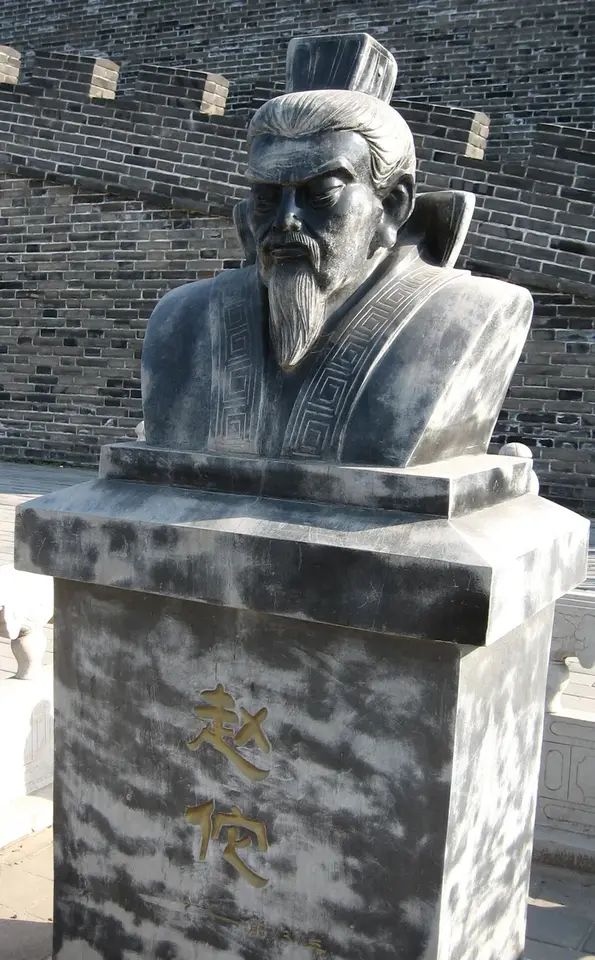
240 BCE–137 BCE
Qin Military GeneralFounder and First Monarch of Nanyue KingdomPioneer of Lingnan Development
Zhao Tuo (赵佗)
赵佗
Zhao Tuo (赵佗, c. 240–137 BCE), a native of Zhending in Hengshan Commandery (modern Zhengding, Hebei), was a preeminent statesman, military strategist, and the founding monarch of the Nanyue Kingdom, revered historically as the primary civilizing pioneer of the Lingnan region. Originally an officer under the Qin Dynasty, he participated in the southward conquest of the Baiyue tribes and subsequently served as the first…
240 BCE–137 BCEQin Dynasty (秦朝)
PROFILE
Zhao Tuo (赵佗, c. 240–137 BCE), a native of Zhending in Hengshan Commandery (modern Zhengding, Hebei), was a preeminent statesman, military strategist, and the founding monarch of the Nanyue Kingdom, revered historically as the primary civilizing pioneer of the Lingnan region. Originally an officer under the Qin Dynasty, he participated in the southward conquest of the Baiyue tribes and subsequently served as the first Magistrate of Longchuan, where he initiated the foundational policy of Harmonizing the Hundred Yue, encouraging intermarriage between Han settlers and indigenous tribes, introducing iron metallurgy and oxen-driven plowing, and establishing schools. During the chaotic fall of the Qin Dynasty, Zhao Tuo was entrusted with the administration of Nanhai Commandery by the dying commandant Ren Xiao. He immediately sealed the strategic mountain passes across the Five Ridges, insulating Lingnan from civil war; following Qin's collapse, he annexed Guilin and Xiang commanderies, establishing the independent Nanyue Kingdom in 204 BCE with its capital at Panyu (modern Guangzhou). In 196 BCE, persuaded by Han imperial envoy Lu Jia, Zhao Tuo accepted tributary vassal status under Emperor Gaozu of Han. Following trade embargoes imposed by Empress Dowager Lu, he temporarily declared himself Martial Emperor of Nanyue. In 179 BCE, after Emperor Wen of Han restored his ancestral graves in Zhending and dispatched Lu Jia on a second mission, Zhao Tuo voluntarily relinquished his imperial title and returned to Han vassalage, preserving regional peace for over seven decades until his death at the age of 103 in 137 BCE.
- Identity
- Qin Military General, Founder and First Monarch of Nanyue Kingdom, Pioneer of Lingnan Development
- Posthumous Title
- Martial Emperor (武帝, declared internally), Martial King (武王, bestowed by Han)
- Period
- Qin-Han Transition to Early Western Han Dynasty
- Dynasty
- Qin Dynasty, Nanyue Kingdom, Han Dynasty (Western Han Vassal / 汉朝)
- Died
- 137 BCE (Han Emperor Wu Jianyuan 4th Year)
- Ancestral Home
- Zhending, Hengshan Commandery (present-day Zhengding County, Shijiazhuang, Hebei)
- Major Offices
- Magistrate of Longchuan, Commandant of Nanhai, King of Nanyue, Martial Emperor of Nanyue
LIFE TIMELINE
Southward Expedition
Dispatched by Qin Shihuang as a senior general alongside Tu Sui to pacify the Baiyue tribes.
Appointed Magistrate of Longchuan following Qin victory, pioneering the policy of inter-ethnic harmony.
Succession as Commandant
Entrusted with Nanhai Commandery by dying Ren Xiao, sealing mountain passes against northern chaos.
Founding Nanyue Kingdom
Annexed Guilin and Xiang commanderies to establish the Nanyue Kingdom as Martial King.
Submitting to Han Rule
Welcomed Han envoy Lu Jia in Panyu, accepting imperial seals and tributary vassal status.
Declaring Imperial Title
Proclaimed himself Martial Emperor of Nanyue and struck Changsha after Empress Lu banned iron exports.
Relinquishing Imperial Title
Reconciled with Han after Emperor Wen restored his ancestral tombs, resuming tributary allegiance.
Maintaining Vassal Duties
Sent regular tributary missions to Chang'an during the reign of Emperor Jing of Han.
Peaceful Passing at 103
Died in Panyu at the extraordinary age of 103; succeeded by his grandson Zhao Mo.
Relationship graph
BIOGRAPHY
Life and Career
Northern Service and Southward Expedition
Zhao Tuo was born around 240 BCE in Zhending County, Hengshan Commandery (modern Zhengding, Hebei). He entered military service as a young soldier during Qin's rapid campaigns to conquer the Warring States. Gifted with physical courage, tactical agility, and administrative talent, he rose through the ranks of the Qin army. Following the unification of the Central Plains in 221 BCE, Qin Shihuang turned his attention to the vast southern expanse below the Five Ridges, then inhabited by autonomous Baiyue tribal confederations.
In 219 BCE, Qin Shihuang mobilized five hundred thousand troops divided into five field armies to execute the conquest of Lingnan. Commander Tu Sui led the overall expedition, with Zhao Tuo serving as a principal general. The southern campaign encountered fierce guerrilla resistance in tropical rainforests, where indigenous Yue warriors launched night ambushes and severed supply lines, resulting in Tu Sui's death in battle. To overcome logistical barriers, Qin engineers excavated the Lingqu Canal to link the Xiang and Li rivers, while reinforcements under Ren Xiao and Zhao Tuo renewed the offensive. By 214 BCE, Qin armies had subjugated the region, creating the three commanderies of Nanhai, Guilin, and Xiang, integrating Lingnan into the administrative framework of a unified China.
Governance of Longchuan and Inter-Ethnic Harmony
Following the conquest, Zhao Tuo was appointed the inaugural Magistrate of Longchuan, a pivotal border county in Nanhai Commandery controlling access between Guangdong, Jiangxi, and Fujian. Recognizing that military coercion alone could never secure durable control over culturally distinct indigenous populations, Zhao Tuo formulated and implemented the enlightened policy of Harmonizing the Hundred Yue.
He memorialized the Qin court to relocate tens of thousands of unmarried Central Plains women and skilled artisans to Longchuan, encouraging widespread intermarriage between northern soldiers and local Yue women. To bridge cultural divisions, Zhao Tuo adopted indigenous customs, donning lightweight Yue attire, dressing his hair in indigenous styles, and recruiting tribal chieftains into local administration.
Economically, Zhao Tuo introduced advanced Central Plains iron farming implements, draft oxen, and intensive irrigation techniques, transforming primitive slash-and-burn horticulture into settled agriculture. He directed the construction of fortified stone towns, drilled clean drinking wells, and established schools to promote Chinese characters and classical etiquette, transforming Longchuan into a vibrant cultural center that catalyzed the civilizational integration of southern China.
Strategic Isolation and the Founding of Nanyue
In 209 BCE, the Dazexiang Uprising led by Chen Sheng and Wu Guang triggered widespread rebellions that destroyed Qin authority across the Yangtze and Yellow River valleys. In 208 BCE, Commandant Ren Xiao of Nanhai fell gravely ill. Aware that northern warlords would inevitably seek to expand into the south, Ren Xiao summoned Zhao Tuo to Panyu, stating: Panyu possesses natural mountain barriers and sea access, stretching thousands of li; with the support of Han and Yue inhabitants, a flourishing kingdom can be established. Entrusting the commandery seal to Zhao Tuo, Ren Xiao expired.
Assuming authority as acting commandant, Zhao Tuo acted with decisive speed to protect the civilian populace. He dispatched strict orders to garrisons stationed at Hengpu, Yangshan, and Huangxi passes along the Five Ridges, commanding them to demolish bridges, sever transit roads, and maintain an impenetrable defense against northern armies. Simultaneously, he purged corrupt Qin magistrates who had oppressed local populations, replacing them with capable administrators drawn from both Han settlers and Yue elites.
By 204 BCE, following the total collapse of the Qin Dynasty, Zhao Tuo mobilized his disciplined provincial forces to annex Guilin and Xiang commanderies, uniting all territories south of the Five Ridges. Proclaiming the founding of the Nanyue Kingdom with Panyu (modern Guangzhou) as its capital, Zhao Tuo assumed the title of Martial King of Nanyue, establishing the first unified, stable regional monarchy in Lingnan history.
The Mission of Lu Jia and Feudal Subjugation
Following the defeat of Western Chu at Gaixia in 202 BCE, Emperor Gaozu established the Western Han Dynasty. Confronting economic devastation in northern China, Gaozu favored diplomatic reconciliation over military conquest regarding the autonomous southern realm. In 196 BCE, Gaozu dispatched the senior Confucian scholar Lu Jia as imperial ambassador to Panyu to persuade Zhao Tuo to accept Han suzerainty.
Upon Lu Jia's arrival at the palace, Zhao Tuo attempted to project independent royal authority by wearing indigenous Yue robes, styling his hair in a native topknot, and sprawling casually upon his couch. Lu Jia stood firm and delivered a stern rebuke: Your Majesty is by birth a native of the Central Plains, where your ancestors' tombs remain in Zhending. The Han Emperor has unified all under heaven. If the Han court should dispatch several tens of thousands of troops across the Five Ridges and destroy your family graves, what would become of your kingdom? You abandon civilized garments to adopt barbarian ways, meeting the Son of Heaven's ambassador with casual arrogance; should disaster strike, you will become the laughingstock of all heroes under heaven!
Struck by Lu Jia's principled eloquence and acute strategic appraisal, Zhao Tuo felt deep shame. He rose immediately, apologized for his breach of protocol, changed into formal robes, and entertained Lu Jia with lavish banquets. Over weeks of dialogue, Lu Jia expounded the benefits of imperial unity and peace. Zhao Tuo formally accepted the golden seal and ribbon of the King of Nanyue from Emperor Gaozu, removing all royal pretensions and entering into a formal tributary relationship with the Han court. The subsequent reopening of frontier markets stimulated massive trade, channeling northern iron, textiles, and literature into Lingnan.
The Iron Embargo and the Imperial Assertion
During the reigns of Emperor Hui and Empress Dowager Lu, peace prevailed along the southern frontier. However, in 183 BCE, influenced by memorials from King Wu Rui of Changsha, who feared Nanyue's growing strength, Empress Dowager Lu instituted a punitive economic embargo against Nanyue. The Han court prohibited all export of iron implements, military weapons, and female livestock across the Five Ridges, decreeing that even worn plowshares were contraband.
This embargo threatened to cripple Nanyue's agricultural expansion. Zhao Tuo dispatched senior ministers to Chang'an to appeal the decision, but his envoys were detained. Furthermore, imperial authorities in the north desecrated his family tombs in Zhending and executed his remaining relatives.
Enraged by this betrayal, Zhao Tuo declared an open breach with the Han court in late 183 BCE. He proclaimed himself Martial Emperor of Nanyue, adopting the imperial yellow roof and left-hand banners reserved exclusively for the Son of Heaven. He mobilized his field armies to invade the southern commanderies of Changsha, defeating Han border garrisons. Empress Dowager Lu dispatched General Zhou Zao with a large invasion force, but Han troops became bogged down in the humid swamps of Hunan, suffering severe epidemics that halted the offensive before crossing the mountains. Leveraging his enhanced prestige, Zhao Tuo extended his protectorate over Minyue, Xi'ou, and Luoyue, expanding Nanyue's sphere of influence across thousands of li from modern Fujian to northern Vietnam.
Reconciliation with Emperor Wen and Enduring Legacy
In 180 BCE, Empress Dowager Lu died, and Emperor Wen of Han ascended the throne. An enlightened ruler dedicated to benevolent governance, Emperor Wen sought to resolve the southern dispute through moral reconciliation rather than armed coercion.
In 179 BCE, Emperor Wen ordered the repair of Zhao Tuo's ancestral tombs in Zhending, appointing twenty resident households to maintain sacrificial offerings, while granting honorable offices and residences to surviving members of the Zhao clan. The emperor then drafted a personal letter to Zhao Tuo and recalled the aging diplomat Lu Jia to lead a second embassy to Panyu.
Emperor Wen's letter conveyed profound sincerity, apologizing for the excesses of Empress Lu and appealing to Zhao Tuo's sense of shared cultural identity and compassion for common soldiers. Reading the imperial missive, Zhao Tuo wept with gratitude upon learning that his ancestral resting places were honored.
Overcome by Emperor Wen's magnanimity, Zhao Tuo renounced his imperial title and sent a humble memorial of apology: This old barbarian subject Tuo previously presumed to take the imperial title solely in self-defense against the hostile measures of Empress Lu. Now hearing that Your Majesty has restored my ancestral graves and favored my kinsmen, your virtue covers heaven and earth. How dare this old servant fail to bow in submission!
Zhao Tuo dismantled the imperial carriage regalia, reverted to the title of Martial King, and restored formal tributary relations with the Han dynasty. Throughout the subsequent reigns of Emperor Jing and the early years of Emperor Wu, Nanyue remained an obedient tributary realm, dispatching annual tribute missions to Chang'an. In 137 BCE, Zhao Tuo died peacefully in Panyu at the extraordinary age of 103, having outlived his own son Crown Prince Zhao Shi, leaving the throne to his grandson Zhao Mo. Zhao Tuo's century-long life anchored the integration of Lingnan into the Chinese ecumene, leaving an indelible legacy as the founding father of southern civilization.
Major Achievements
Pacification and Integration of Lingnan
As a frontline commander during Qin's southern campaigns from 219 to 214 BCE, Zhao Tuo overcame severe terrain and logistical barriers to pacify the Baiyue tribes, establishing the commanderies of Nanhai, Guilin, and Xiang, which integrated the southern coast into China's unified geopolitical framework.
Pioneering the Policy of Ethnic Harmony
Serving as Magistrate of Longchuan, Zhao Tuo formulated and enacted the policy of Harmonizing the Hundred Yue. By encouraging mass intermarriage between Han migrants and indigenous populations, adopting local customs, and recruiting Yue leaders into governance, he created a durable model of inter-ethnic coexistence that averted protracted frontier warfare.
Economic and Cultural Civilizing of the South
Zhao Tuo spearheaded the technological transformation of Lingnan by introducing Central Plains iron smelting, ox-driven plowing, advanced irrigation, and settled village agriculture. He directed the building of Panyu and Longchuan, introduced standard Chinese orthography, and established educational academies, earning historical acclaim as the pioneer of Lingnan culture.
Diplomatic Wisdom and Commitment to Imperial Unity
Confronted with shifting northern dynasties, Zhao Tuo demonstrated profound political pragmatism. He twice welcomed Han ambassador Lu Jia, renouncing imperial titles in 196 BCE and 179 BCE to submit to Han suzerainty. His voluntary adherence to tributary vassalage secured over seven decades of uninterrupted peace, laying the socio-cultural groundwork for Emperor Wu's eventual full integration of the southern territories.
Personal Relationships
- Lifelong Mentor and Superior: Ren Xiao
- Imperial Overlords: Emperor Gaozu of Han, Emperor Wen of Han
- Imperial Diplomat and Friend: Lu Jia
- Son: Zhao Shi
- Grandson and Successor: Zhao Mo
- Great-Grandson: Zhao Yingqi
- Political Opponents: Empress Dowager Lu, General Zhou Zao
Historical Evaluation
- Emperor Wen of Han declared in an imperial edict: The King has ruled in Nanyue as an independent sovereign, yet he yearns for the civilization of Hua-Xia, adheres to ritual propriety, and presents tribute to pacify the multitude; the King's merits stand highest among all southern leaders.
- Sima Qian recorded in Records of the Grand Historian (Shi Ji): Commandant Tuo became king through the legacy of Ren Xiao. Taking advantage of chaotic times, he commanded troops in Lingnan, pacifying territories across thousands of li and ruling for over forty years. Though he briefly assumed the imperial title, he ultimately returned to Han vassalage; his strategic wisdom was truly remarkable!
- Ban Gu recorded in Book of Han (Han Shu): Zhao Tuo exploited Qin's collapse to hold Lingnan, harmonizing the Hundred Yue and terrifying distant barbarians. When Lu Jia arrived on embassy, he immediately cast aside imperial regalia and bowed in submission. Though situated in remote frontiers, he communicated with China and spread benevolent virtue; how could he not be deemed worthy?
- Song Dynasty poet Su Shi praised him in verse: Zhao Tuo of old held the southern domain, his merit in harmonizing the Hundred Yue towering high. For a thousand years iron plows have cleared the southern marshes, bringing hearth smoke and songs of peace to the southern realms.
Related Entries
- Nanyue Kingdom
- Ren Xiao
- Lu Jia
- Emperor Wen of Han
- Lingqu Canal
- Mausoleum of the Nanyue King
- Panyu
FIGURES ASSOCIATED WITH THIS DYNASTY
Bibliography
- Records of the Grand Historian, Volume 113, Biographies 53
- Records of the Grand Historian, Volume 97, Biographies 37
- Records of the Grand Historian, Volume 10, Basic Annals 10
- Book of Han, Volume 95, Biographies 65 (Southwestern Barbarians, Two Yues)
- Book of Han, Volume 43, Biographies 13 (Li, Lu, Zhu, Liu)
- Huainanzi, Volume 18