Birth in Xianyang
Born to King Huiwen of Qin and Queen Dowager Xuan; designated as an imperial prince.
306 BCE–251 BCE
嬴稷
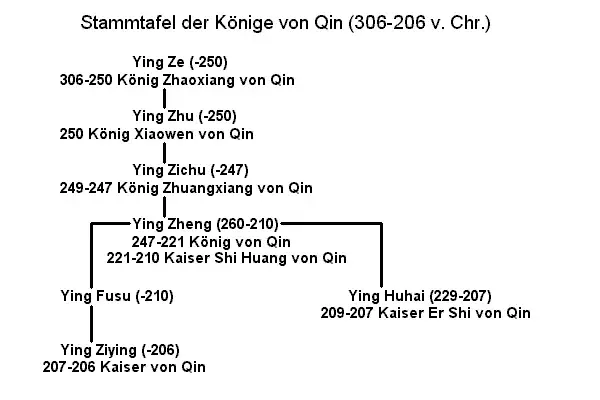
King Zhaoxiang of Qin (秦昭襄王, 325–251 BCE), personal name Ying Ji (嬴稷) and alternately Ying Ze, was the long-reigning sovereign of the State of Qin during the Warring States period, ruling for fifty-six years from 306 to 251 BCE. The son of King Huiwen of Qin and Queen Dowager Xuan (Lady Mi), he spent his early youth as a political hostage in the northern State of Yan. When his elder half-brother King Wu died abruptly in 307…
King Zhaoxiang of Qin (秦昭襄王, 325–251 BCE), personal name Ying Ji (嬴稷) and alternately Ying Ze, was the long-reigning sovereign of the State of Qin during the Warring States period, ruling for fifty-six years from 306 to 251 BCE. The son of King Huiwen of Qin and Queen Dowager Xuan (Lady Mi), he spent his early youth as a political hostage in the northern State of Yan. When his elder half-brother King Wu died abruptly in 307 BCE from injuries sustained while attempting to hoist a sacred bronze cauldron in Luoyang, Ying Ji was escorted back to Xianyang through the diplomatic intervention of King Wuling of Zhao and the military support of his maternal uncle Wei Ran, ascending the throne amidst intense factional rivalry. During the initial decades of his reign, supreme governance was largely exercised by Queen Dowager Xuan, while Wei Ran and the Four Nobles dominated civil and military administrations. In 266 BCE, King Zhaoxiang enacted the counsel of the strategist Fan Ju, stripping the Queen Dowager and the Four Nobles of power, consolidating sovereign authority, and embracing the foundational doctrine of allying with distant states while attacking adjacent rivals. Spanning more than half a century, King Zhaoxiang's reign was the decisive epoch that cemented Qin's absolute strategic hegemony over the Warring States. Employing supreme battlefield commanders such as Bai Qi, Sima Cuo, and Meng Ao, Qin prosecuted a series of massive annihilation campaigns, achieving crushing triumphs at Yique, Yan-Ying, Huayang, and the climactic Battle of Changping. His armies seized the Chu capital of Ying, annexed Nanjun and Qianzhong, subdued the Yiqu nomads in the northwest, and severely crippled the military potential of Han, Wei, Chu, and Zhao. In 256 BCE, he deposed the Western Zhou state, received the surrender of King Nan of Zhou, and transferred the Nine Tripod Cauldrons—the sacred symbols of universal Chinese kingship—to Xianyang. Passing away in 251 BCE at age seventy-five, he was entombed at Zhi Mausoleum. His relentless expansion dismantled the multi-state equilibrium and laid the direct geopolitical and military foundations for his great-grandson Qin Shi Huang to unify all of China.
Born to King Huiwen of Qin and Queen Dowager Xuan; designated as an imperial prince.
King Wu dies after lifting the bronze cauldron; escorted from hostage status in Yan to contest the succession.
Enthroned with military backing from Wei Ran and King Wuling of Zhao; Queen Dowager Xuan assumes administrative regency.
Undergoes the formal adulthood capping ceremony; concludes the Treaty of Huangji with King Huai of Chu.
Shuzhang Huan inflicts a crushing defeat on Chu forces at Zhongqiu; Sima Cuo pacifies unrest in Shu.
Lures King Huai of Chu to Wuguan pass, detaining him in Xianyang to extort territorial cessions; appoints Lord Mengchang as chancellor.
Lord Mengchang flees Xianyang; Qin armies strike Chu through Wuguan, capturing sixteen bastions.
King Huai of Chu dies in captivity; Lord Mengchang leads joint allied armies to breach Hangu Pass, forcing Qin to negotiate.
Accepts Chancellor Gan Mao's counsel to return Wusui to Han in order to stabilize the eastern frontier.
Qi, Wei, and Han form a coalition to attack Chu; King Zhaoxiang dispatches Crown Prince Heng of Chu back to his homeland with relief troops.
Maternal uncle Mi Rong leads Qin forces to attack Chu, slaying Chu general Jing Que and taking eight cities.
King Huai of Chu attempts to flee Xianyang toward Zhao, but is recaptured by Qin guards after Zhao refuses him entry.
Dismisses Lou Huan as prime minister and appoints maternal uncle Wei Ran, Marquis of Rang, as Chancellor of Qin.
Appoints Bai Qi as supreme commander; routs the combined hosts of Han and Wei at Yique, decapitating 240,000 enemy troops.
Qin armies under Sima Cuo and Bai Qi attack Han and Wei, capturing the strategic city of Wan and sixty-one fortresses.
Dispatches Qin forces to attack Wei, seizing the fortified towns of Xinyuan and Quyang.
Forces Wei to cede its former eastern capital of Anyi to sue for peace, relocating the inhabitants of Hedong.
Holds diplomatic summits with the King of Chu at Wan and with King Huiwen of Zhao at Zhongyang.
Proclaims himself Western Emperor while offering the title of Eastern Emperor to King Min of Qi; both subsequently renounce the designations.
Joins the multinational coalition commanded by Yue Yi to devastate the State of Qi, capturing vast eastern spoils.
Concludes diplomatic accords with King Huiwen of Zhao at Mianchi; Bai Qi seizes the Chu strongholds of Yan, Deng, and Xiling.
Bai Qi storms the Chu capital of Ying, desecrating ancestral royal tombs; establishes Nanjun Commandery and elevates Bai Qi to Lord Wu'an.
Wei Ran crushes allied forces at Huayang, slaughtering 130,000 Wei soldiers and drowning 20,000 Zhao captives in the Yellow River.
Qin armies press deep into Wei toward Daliang; attempts to exchange fifteen cities for Zhao's Heshi Bi jade disc, thwarted by Lin Xiangru.
Attacks Zhao, capturing two cities in 282 BCE, Shicheng in 281 BCE, and Daimen in 280 BCE, decapitating thirty thousand troops.
Governor Zhang Ruo of Shu annexes Wujun and Jiangnan from Chu, establishing Qianzhong Commandery.
Bai Qi attacks Wei and captures two cities, compelling Wei to cede Wen for peace in the following year.
Dispatches Hu Shang to attack Yanyu, where Qin forces suffer a major defeat at the hands of Zhao general Zhao She.
Adopts Fan Ju's strategy of attacking nearby states while befriending distant ones, dispatching troops to seize Huai from Wei.
Adopts Fan Ju's strategy to banish Queen Dowager Xuan and the Four Nobles, centralizing autocratic power and appointing Fan Ju chancellor.
Captures three fortified cities from Zhao; death of Queen Dowager Xuan.
Bai Qi attacks Han and conquers the Nanyang region, severing the Taihang Mountain pass corridor.
Han cedes Yuanyong and Zhao promises six cities to sue for peace; Qin launches the prolonged siege of Handan from 258 to 256 BCE.
Bai Qi encircles Zhao Kuo's army at Changping; slays Zhao Kuo and executes hundreds of thousands of surrendered Zhao troops.
General Jiu conquers Western Zhou; King Nan of Zhou passes away; captures the sacred Nine Cauldrons and relocates them to Xianyang.
Passes away at age seventy-five after reigning fifty-six years; succeeded by Crown Prince Ying Zhu (King Xiaowen).
King Zhaoxiang was born in 325 BCE as the son of King Huiwen of Qin, one of the most formidable monarchs of the mid-Warring States period, and Lady Mi, later consecrated as Queen Dowager Xuan. During King Huiwen's late reign, Lady Mi enjoyed imperial favor, but Ying Ji was not the designated heir apparent. Upon King Huiwen's passing, his eldest son Ying Dang ascended the throne as King Wu, while Ying Ji was dispatched north to serve as an imperial hostage in the State of Yan. In 307 BCE, during a visit to the Zhou royal precincts in Luoyang, King Wu engaged in a competitive trial of strength with wrestler Meng Yue, attempting to hoist the sacred Dragon Cauldron, which slipped and crushed his shins, resulting in his fatal injury. Because King Wu left no surviving biological sons, an acute dynastic crisis erupted in Xianyang. Queen Dowager Xuan sought to enthrone her younger son Prince Fu, while Queen Dowager Huiwen supported Prince Zhuang. Observing the escalating paralysis from Handan, King Wuling of Zhao dispatched diplomatic forces to extract Ying Ji from Yan and escort him back to Qin. Bolstered by the armed backing of his maternal uncle Wei Ran and prime minister Chuli Ji, Ying Ji emerged triumphant, assuming the kingship as King Zhaoxiang while his political competitors were ruthlessly executed in a court purge.
Because King Zhaoxiang ascended the throne at a youthful age, initial executive authority was entrusted to his mother, Queen Dowager Xuan, who exercised an unprecedented historical regency, while Wei Ran commanded the military garrison of Xianyang. In his inaugural year, King Zhaoxiang accepted prime minister Gan Mao's proposal to return Wusui to Han in order to pacify the eastern border; however, slanderous denunciations from rival courtiers Xiang Shou and Gongsun Shi compelled Gan Mao to flee to Qi. In 304 BCE, King Zhaoxiang celebrated his formal capping ceremony and assumed nominal personal charge of state business, though major decisions remained heavily guided by the Queen Dowager and Wei Ran. To stabilize relations with the south, he met King Huai of Chu at Huangji, returning the territory of Shangyong to Chu. When Qi, Wei, and Han subsequently formed an alliance to punish Chu for its rapprochement with Qin, King Zhaoxiang dispatched relief armies that overran Puban, Yangjin, and Fengling, effectively dismantling the anti-Qin coalition and forcing regional rivals into bilateral concessions.
In 295 BCE, Lou Huan was dismissed, and Wei Ran assumed undisputed leadership as chancellor of Qin. Over the ensuing three decades, Wei Ran directed Qin's strategic expansion, mobilizing massive conscript levies and cultivating brilliant military commanders. In 293 BCE, when the allied forces of Han and Wei threatened Qin's eastern approaches, King Zhaoxiang appointed the rising general Bai Qi as supreme commander. At the Battle of Yique, Bai Qi outmaneuvered the coalition, slaughtering 240,000 enemy troops and capturing commander Gongsun Xi. This catastrophic defeat shattered the defensive capabilities of the Three Jin states. Between 291 and 289 BCE, Qin captured Wan from Han, extracted four hundred li of fertile territory along the Yellow River from Wei, and overran sixty-one walled bastions. In 288 BCE, King Zhaoxiang briefly proclaimed himself Western Emperor alongside the King of Qi, though both monarchs rescinded the imperial designations following diplomatic protests from rival states. Between 282 and 278 BCE, Bai Qi conducted devastating campaigns against Chu, storming the regional bastions of Yan, Deng, and Xiling before capturing the imperial capital of Ying in 278 BCE, desecrating the ancestral tombs of the Chu kings and compelling Chu to relocate its capital eastward to Chen.
In 270 BCE, a Qin offensive against Zhao at Yanyu was repulsed by Zhao She. In the wake of this operational setback, a political refugee from Wei named Fan Ju arrived in Xianyang under the pseudonym Zhang Lu. Securing a private audience with King Zhaoxiang, Fan Ju delivered a trenchant critique of Qin's state apparatus, warning the king that while neighbors knew of Queen Dowager Xuan and the Four Nobles, they scarcely recognized the existence of a King of Qin. Fan Ju argued that Wei Ran utilized royal armies to conquer territories adjacent to his private fief of Rang, enriching his personal clan while leaving the core state vulnerable. Convinced of Fan Ju's strategic brilliance, King Zhaoxiang enacted a decisive royal coup in 266 BCE: he removed Queen Dowager Xuan from administrative participation, stripped Wei Ran, Mi Rong, Prince Fu, and Prince Kui of their ministerial offices, and banished them to their landed domains. Appointing Fan Ju as chancellor with the title Marquis of Ying, King Zhaoxiang embraced the doctrine of allying with distant kingdoms while crushing adjacent neighbors.
Under the strategic coordination of Fan Ju and the field leadership of Bai Qi, Qin unleashed a focused campaign against the Three Jin states. In 263 BCE, Bai Qi severed the Taihang mountain passes, cutting off the Korean commandery of Shangdang. When the governor of Shangdang surrendered to Zhao rather than Qin, King Zhaoxiang launched an all-out offensive against Zhao. For months, Zhao general Lian Po maintained an unyielding defensive posture along the Dan River, checking Qin advances. King Zhaoxiang dispatched secret agents to Handan with vast bribes to spread rumors that Qin feared only the inexperienced youthful strategist Zhao Kuo. When King Xiaocheng of Zhao fell into the trap and replaced Lian Po, King Zhaoxiang secretly dispatched Bai Qi to assume supreme command, while personally journeying to Henei to bestow one rank of nobility upon the local populace and conscripting all males over fifteen to blockade Zhao supply columns. At the Battle of Changping in 260 BCE, Bai Qi enveloped Zhao Kuo's army; after a desperate forty-six-day siege, Zhao Kuo fell in battle, and Bai Qi executed hundreds of thousands of surrendered Zhao soldiers, leaving Zhao irreparably crippled. In 256 BCE, when the ruler of Western Zhou allied with eastern princes to challenge Qin passages, King Zhaoxiang dispatched General Jiu; the Western Zhou sovereign capitulated, surrendering thirty-six settlements and thirty thousand residents. King Nan of Zhou died shortly thereafter, and Qin seized the royal regalia, transferring the Nine Cauldrons to Xianyang. King Zhaoxiang passed away in 251 BCE at age seventy-five, succeeded by his son King Xiaowen.
The ascension of King Zhaoxiang represented one of the most turbulent accessions in ancient Qin annals. Following King Wu's sudden death beneath the weight of the red bronze cauldron in Luoyang in 307 BCE, Xianyang descended into factional conflict. Queen Dowager Xuan marshaled her Chu-aligned kinship network to champion Prince Fu, while Lady Huiwen rallied native aristocrats behind Prince Zhuang. The intervention of King Wuling of Zhao decisively tipped the political scales, as Handan leveraged its military prestige to demand Ying Ji's repatriation from Yan. Upon his return, Wei Ran deployed military forces to crush aristocratic dissent. The Records of the Grand Historian recount that in 305 BCE, Prince Zhuang joined with senior ministers, princes, and foreign instigators in an armed rebellion; Wei Ran suppressed the insurrection, executing all conspirators alongside Queen Dowager Huiwen, while King Wu's widow was expelled back to Wei. This comprehensive bloodletting eradicated domestic opposition, securing undisputed royal authority for the young Ying Ji under his mother's watchful regency.
For the first two decades of his reign, King Zhaoxiang's foreign strategy was dominated by a ruthless campaign to subjugate the southern superpower of Chu. Although initial treaties like the Covenant of Huangji in 304 BCE restored border harmony, Qin rapidly exploited internal divisions among southern elites. In 299 BCE, King Zhaoxiang dispatched a letter to King Huai of Chu proposing a diplomatic summit at Wuguan pass, promising lasting brotherhood. Disregarding the passionate warnings of Qu Yuan, King Huai attended the meeting, where Qin ambush cavalry surrounded his entourage and escorted him under armed arrest to Xianyang. King Zhaoxiang demanded the immediate cession of Wujun and Qianzhong as ransom; King Huai indignantly refused, preferring imprisonment to national humiliation. In 297 BCE, King Huai managed a daring escape through the Qin borders, but found neighboring states paralyzed by fear of Qin retaliation; pursued by cavalry, he was recaptured and died in captivity in 296 BCE. This calculated treachery permanently crippled Chu diplomatic trust while consolidating Qin's absolute strategic initiative across the Han and Yangtze valleys.
The relentless grinding of the Three Jin states—Han, Wei, and Zhao—formed the central operational arc of King Zhaoxiang's middle reign. In 293 BCE, Bai Qi's triumph at Yique permanently broke the offensive capacity of Han and Wei. Between 290 and 286 BCE, repeated offensives compelled Wei to surrender ancestral lands around Anyi, where Qin deported the entire local population and repopulated the fertile valleys with royal colonists. In 288 BCE, King Zhaoxiang conceived the audacious scheme of dividing universal imperial supremacy between Qin and Qi, styling himself Western Emperor while investing King Min of Qi as Eastern Emperor. Although Qi's renunciation of the title and subsequent coalition mobilizations forced King Zhaoxiang to resume royal nomenclature, Qin successfully participated in the five-power dismemberment of Qi in 284 BCE, neutralizing its most potent maritime rival. Through an uninterrupted sequence of strategic sieges, diplomatic summits at Mianchi, and the procurement of territories through intimidation—typified by the diplomatic contest over the sacred Jade of He—King Zhaoxiang systematically transformed the Central Plains into vulnerable forward buffers for Qin's ultimate conquest.
King Zhaoxiang's fifty-six-year reign witnessed the most extensive military expansion in pre-imperial Chinese history. Through watershed victories at Yique, Yan-Ying, Huayang, and Changping, his armies annihilated over one million enemy soldiers, seized hundreds of enemy bastions, annexed the southern kingdom of Chu's heartland, and subdued the nomadic Yiqu tribes, expanding Qin's territorial boundaries to encompass modern Shaanxi, Sichuan, Chongqing, Hubei, Henan, and Shanxi.
King Zhaoxiang demonstrated extraordinary political boldness by neutralizing the aristocratic regency that had dominated his early reign. In 266 BCE, he successfully banished Queen Dowager Xuan and dismantled the private patronage empires of the Four Nobles. By reallocating executive authority to foreign talent like Fan Ju, he elevated royal supremacy over noble privilege and created an unencumbered autocratic state apparatus.
Under the guidance of Fan Ju, King Zhaoxiang revolutionized interstate diplomacy by abandoning costly expeditions against distant states in favor of the strategy of allying with distant realms while attacking neighboring states. By cultivating diplomatic friendships with Qi and Yan while concentrating military force against Han, Wei, and Zhao, Qin prevented unified collective coalitions and methodically absorbed the vital Central Plains piecemeal.
King Zhaoxiang's reign was characterized by momentous interactions with legendary statesmen, generals, and thinkers of the Warring States era. He engaged in high-stakes diplomatic maneuvering with King Wuling of Zhao, King Huai of Chu, King Min of Qi, Lord Mengchang, and Lin Xiangru. His court served as the operational platform for military titans including Bai Qi and Sima Cuo, shaping the political and military landscape of classical antiquity.
In 256 BCE, King Zhaoxiang achieved the ultimate symbolic culmination of pre-imperial hegemony by overthrowing the Western Zhou royal line. Upon capturing King Nan of Zhou, he annexed the sacred royal domain, terminated over eight centuries of Zhou dynastic suzerainty, and transported the Nine Bronze Tripods to Xianyang, formally claiming the cosmic mandate of heaven for the House of Qin.
During the late Warring States and early Han eras, King Zhaoxiang was recognized as the ruthless architect of Qin's military supremacy. Sima Qian, writing in the Records of the Grand Historian, observed that King Zhaoxiang ruled for fifty-six years with extraordinary tactical focus, utilizing Bai Qi and Fan Ju to sever the sinews of the eastern states. However, Han commentators frequently condemned his disregard for traditional interstate rites, highlighting his treacherous imprisonment of King Huai of Chu and the slaughter of surrendered prisoners at Changping as evidence of brutal despotism.
Scholars of the Song and Yuan periods acknowledged King Zhaoxiang's institutional discipline while delivering severe moral indictments of his governing philosophy. Sima Guang remarked in the Comprehensive Mirror for Aid in Government that King Zhaoxiang perfected the harsh legalist mechanisms of Shang Yang, reducing kingship to the extraction of territory and the destruction of human life. Neo-Confucian philosophers argued that although his policies made Qin invincible on the battlefield, they stripped the state of moral legitimacy, creating an ethos of sheer terror that ultimately precipitated the rapid fall of the Qin dynasty.
During the Ming and Qing dynasties, political commentators analyzed King Zhaoxiang's centralization maneuvers with strategic realism. The philosopher Wang Fuzhi noted in his Reading the Comprehensive Mirror that King Zhaoxiang's banishment of Queen Dowager Xuan and the Four Nobles was a masterpiece of royal self-preservation, without which Qin would have fractured into feudal fiefdoms long before the rise of Qin Shi Huang. Qing scholars highlighted his logistical coordination during the prolonged siege of Changping as a demonstration of supreme organizational statecraft.
Modern historical analysis views King Zhaoxiang as one of the most transformative rulers in classical Chinese history. By systematically executing total warfare strategies, integrating regional economies, and dismantling aristocratic enclaves, he created the direct geopolitical prerequisites for an imperial unified China. Contemporary historians emphasize that his long fifty-six-year tenure provided the continuous institutional momentum necessary to transform Shang Yang's legalist state into an unstoppable continental empire.
FIGURES ASSOCIATED WITH THIS DYNASTY