Biography
Family Background and Early Years
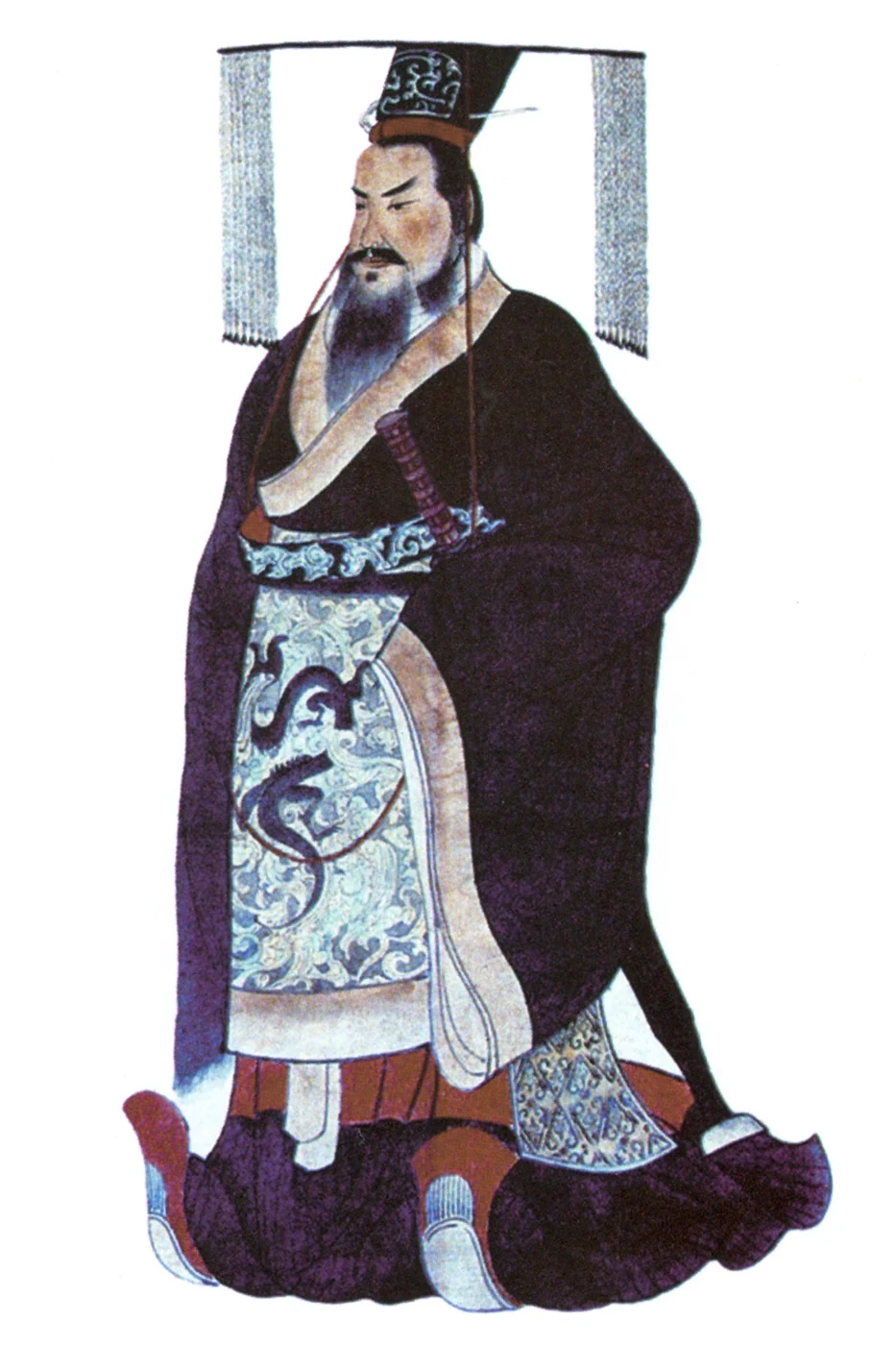
Qin Shi Huang, Ying Zheng, was born in 259 BCE, in the first month of the forty-eighth year of King Zhaoxiang of Qin, in Handan, the capital of Zhao. His father Yiren was a grandson of King Zhaoxiang of Qin and a son of Crown Prince Anguo, later King Xiaowen of Qin. Yiren's mother, Lady Xia, was not favored by Anguo. Yiren ranked among the middle of more than twenty sons and was sent to Zhao as a political hostage. Qin and Zhao were then frequently at war, and Yiren was treated coldly in Zhao, living in straitened circumstances without sufficient carriages, horses, or wealth.
The wealthy merchant Lü Buwei of Wey was doing business in Handan when he met Yiren and judged him to be a “rare commodity worth hoarding.” He therefore financed Yiren heavily and personally went to Qin to lobby Lady Huayang, the favored consort of Anguo. Lady Huayang had no son. Lü persuaded her to adopt Yiren, who changed his name to Zichu. Through Lady Huayang's influence, Anguo designated Zichu as heir. Lü Buwei also presented to Zichu a woman from Handan whom he favored, Zhao Ji, who later gave birth to Ying Zheng.
In 257 BCE, the fiftieth year of King Zhaoxiang of Qin, the Qin general Wang He besieged Handan and Zhao sought to kill the hostage Zichu. With Lü Buwei's help, Zichu bribed the guards with six hundred jin of gold and escaped to the Qin camp, returning to Qin. Zhao then sought to kill Zichu's wife Zhao Ji and their son Ying Zheng. Because Zhao Ji was the daughter of a wealthy Zhao family, mother and son were able to hide and survive.
In 251 BCE, King Zhaoxiang died. Anguo became King Xiaowen of Qin, Lady Huayang became queen, and Zichu was made crown prince. Zhao then sent Zhao Ji and Ying Zheng back to Qin. King Xiaowen's reign was extremely brief: he died only three days after formally becoming king. Zichu succeeded him as King Zhuangxiang of Qin, appointed Lü Buwei chancellor, and enfeoffed him as Marquis Wenxin. In the fifth month of 247 BCE, the third year of King Zhuangxiang, the king died, and the thirteen-year-old Ying Zheng succeeded as king of Qin.
Ying Zheng's parentage later became controversial. The “Biography of Lü Buwei” in the *Records of the Grand Historian* states that Zhao Ji was already pregnant when Lü Buwei presented her to Zichu, implying that Ying Zheng was Lü Buwei's biological son. The claim has long been disputed. Qing scholar Liang Yusheng argued in *Shiji Zhiyi* on the basis of the pregnancy chronology that it was impossible; modern scholars including Ma Feibai and Guo Moruo also treated it as an isolated claim and suspected later slander. More recent scholars such as Li Kaiyuan have analyzed it in the context of political struggle and suggested that the “Lü Buwei as biological father” story may have been a rumor spread by Zhao-linked relatives in competition for power.
Young King of Qin and Rule by Powerful Ministers
When Ying Zheng became king at thirteen, he was too young to govern personally, and state affairs were controlled by Chancellor Lü Buwei, whom he honored as Zhongfu, “Second Father.” Lü continued Qin's strategy of territorial annexation, recruited retainers and wandering scholars, maintained as many as three thousand household guests, and organized them to compile the *Lüshi Chunqiu*. Militarily, Qin continued campaigns against the Three Jin states—Han, Zhao, and Wei—under generals such as Meng Ao, Wang He, and Duke Biao.
At the beginning of Ying Zheng's reign, the Qin court was effectively shaped by three groups of imperial relatives: the Chu faction represented by Lady Huayang, the Han faction represented by Lady Xia, and the Zhao faction represented by Zhao Ji. Rivalry among these three groups strongly influenced politics before King Zheng assumed personal rule.
In 240 BCE, the seventh year of King Zheng, his grandmother Empress Dowager Xia died, greatly weakening the Han-linked relatives. At this time Lü Buwei was having an affair with Empress Dowager Zhao Ji. Fearing that the growing Ying Zheng might discover it, Lü arranged for his retainer Lao Ai to undergo a sham castration and enter the palace to serve the empress dowager. Lao Ai became deeply favored by Zhao Ji, was enfeoffed as Marquis of Changxin, received lands including Shanyang and Taiyuan, maintained thousands of servants and more than a thousand retainers, and became the second most powerful political figure after Lü Buwei.
In 239 BCE, Ying Zheng's younger brother Chengjiao, Lord of Chang'an, led an army against Zhao but rebelled at Tunliu, in present-day Shanxi. After Qin suppressed the revolt, Chengjiao's followers were executed under collective-liability rules and the people of Tunliu were deported to Lintao. Some scholars have argued that the rebellion may have been connected with the purge of Han-linked imperial relatives after the death of Empress Dowager Xia.
Personal Rule and the Removal of Powerful Ministers
In 238 BCE, the ninth year of King Zheng, Ying Zheng reached the age of twenty-two and held his coming-of-age ceremony at Qinian Palace in Yongcheng, formally assuming personal rule. Lao Ai, sensing that his position was collapsing, stole the king's seal and the empress dowager's seal and launched a rebellion, leading county troops, guards, official cavalry, and others against Qinian Palace. Ying Zheng had already positioned three thousand elite troops and ordered Lord Changping and Lord Changwen to mobilize forces to suppress the revolt. Fighting took place at Xianyang. Lao Ai fled after defeat but was soon captured. Ying Zheng had him torn apart by chariots, exterminated his three kinship groups, killed the two sons Lao Ai had fathered with the empress dowager, and confined his mother Zhao Ji at Fuyang Palace in Yongcheng.
In 237 BCE, Ying Zheng dismissed Lü Buwei as chancellor on the grounds of his connection to the Lao Ai affair. Lü was exiled toward Ba and Shu; on the journey, recognizing that his relationship with the king could not be repaired, he drank poison and killed himself. Ying Zheng was thereby freed from the restraints imposed by powerful ministers and began to exercise supreme authority directly.
The same year, after the Qin water engineer Zheng Guo was exposed as having originally come from Han to build a canal, Qin nobles used the incident to attack guest officials from the other states, and Ying Zheng issued an order expelling them. Li Si of Chu submitted the *Memorial Against the Expulsion of Guest Officials*, citing Qin's rise through the service of guest officials such as Baili Xi, Shang Yang, Zhang Yi, and Fan Ju and arguing that expulsion would harm the state. Ying Zheng accepted Li Si's argument, revoked the order, and gave important roles to Li Si, Wei Liao, and others as Qin pursued the strategy of unifying the Six States.
Unification of the Six States
By the time King Zheng assumed personal rule, Qin had already annexed Ba, Shu, and Hanzhong and established Nan Commandery; in the north it held territory east of Shang Commandery as well as Hedong, Taiyuan, and Shangdang; in the east it reached Xingyang, had destroyed Eastern Zhou and Western Zhou, and had established Sanchuan Commandery. The wars of unification had entered their final stage.
King Zheng adopted proposals by Li Si, Wei Liao, and others to use large bribes against influential ministers in the six states and sow distrust between rulers and subjects in coordination with military attacks. The stated sequence was to destroy Han first, then Zhao and Wei, then Chu and Yan, and finally Qi.
In 230 BCE Qin sent Neishi Teng against Han. King An of Han was captured and Yingchuan Commandery established in Han territory, ending the state of Han.
In 229 BCE Wang Jian led troops from Shangdi down through Jingxing while Yang Duanhe led troops from Henei to besiege Handan. Zhao generals Li Mu and Sima Shang resisted. Guo Kai, a favored courtier of the Zhao king, accepted Qin bribes and spread rumors that Li Mu intended rebellion. The Zhao king killed Li Mu and appointed Zhao Cong and Yan Ju instead. In 228 BCE Wang Jian decisively defeated Zhao forces, captured Handan and King Qian of Zhao, and destroyed Zhao. Prince Jia of Zhao escaped with several hundred members of the ruling clan to Dai Commandery and proclaimed himself king of Dai. King Zheng personally went to Handan and killed people who had feuded with his mother's family during his childhood there.
In 225 BCE Wang Ben attacked Wei and diverted the Yellow River to flood Daliang. The city walls collapsed, King Jia of Wei surrendered, and Wei was destroyed.
In 226 BCE Wang Ben attacked Yan and captured its capital Ji; King Xi of Yan fled to Liaodong. In 222 BCE Wang Ben attacked Liaodong and captured King Xi, ending Yan.
After Zhao's destruction, Wang Jian led 600,000 troops against Chu. In 223 BCE Wang Jian and Meng Wu captured the Chu capital Shouchun and King Fuchu, destroying Chu. The following year Qin armies pacified the lands south of the Yangtze associated with Chu, received the submission of Yue rulers, and established Kuaiji Commandery.
In 221 BCE Wang Ben advanced south from former Yan territory against Qi. King Jian of Qi surrendered without battle and Qi was destroyed. Qin had now unified the Six States and ended more than five centuries of rival regional states since the Spring and Autumn and Warring States periods.
Adoption of the Imperial Title and Institutional Construction
After unification, Ying Zheng judged that the title “king” was no longer sufficient for his achievements and ordered his ministers to discuss a new title. Chancellor Wang Wan, Imperial Secretary Feng Jie, Commandant of Justice Li Si, and others submitted that ancient tradition spoke of the Heavenly August, Earthly August, and Supreme August, of which the Supreme August was the most exalted, and recommended that title. Ying Zheng held that his virtue equaled the Three August Ones and his achievements surpassed the Five Emperors. He therefore combined *huang* from the Three August Ones with *di* from the Five Emperors to create the title *huangdi*, “emperor,” and styled himself the First Emperor, intending that successors be numbered Second, Third, and onward for ten thousand generations.
At the central level, Qin Shi Huang established the system of the Three Lords and Nine Ministers. The Three Lords were the chancellor, responsible for civil administration; the grand commandant, responsible for military affairs; and the imperial secretary, responsible for supervision. The Nine Ministers handled specialized functions of government. In local administration, he accepted Li Si's proposal to abolish enfeoffment and replace it with the commandery-county system, dividing the empire into thirty-six commanderies, later increased to more than forty. Commanderies had governors, military commanders, and supervisory officials, while counties had magistrates or chiefs. This centralized administrative system became a basic framework for Chinese government over the next two millennia.
In economic and cultural affairs, Qin Shi Huang carried out a series of standardizations: the script was standardized with small-seal writing as the official form; currency was standardized around the round bronze *banliang* coin with a square hole; weights and measures were standardized through official reference instruments; axle widths were standardized and a network of imperial roads was built around Xianyang. Laws were also unified across the empire on the basis of Qin law.
Inspection Tours and the Search for Immortality
After unification, Qin Shi Huang repeatedly toured the empire, both to overawe local populations and proclaim imperial virtue and to pursue his desire for immortality and elixirs.
In 220 BCE he first toured Longxi and Beidi, reached Mount Jitou, and passed through Huizhong. In 219 BCE he traveled east to Mount Yi near Zou, erected an inscription celebrating his achievements, performed the Feng and Shan rites at Mount Tai, and carved further commemorative inscriptions. He then traveled along the coast and sent Xu Fu of Qi to sea with several thousand boys and girls in search of immortals. He went south to Langya, remained there for three months, and moved thirty thousand households to the area below the Langya Terrace.
In 218 BCE, while traveling east through Bolangsha near Yangwu, he was attacked by Zhang Liang, a descendant of Han nobility, and a strongman wielding a heavy iron hammer. The weapon struck the secondary carriage instead of the imperial carriage. Qin Shi Huang escaped and ordered a ten-day search throughout the realm, but the attackers were not found.
In 215 BCE he toured Jieshi in the north and had an inscription carved there. He sent Lu Sheng of Yan to seek the immortals Xianmen and Gaoshi and sent Han Zhong, Hou Gong, and Shi Sheng to search for immortals and elixirs of deathlessness. Lu Sheng returned with the statement “Hu will destroy Qin.” Qin Shi Huang therefore sent Meng Tian with 300,000 troops north against the Xiongnu and seized the lands south of the Yellow River bend.
In 210 BCE he made his fifth eastern tour. He traveled south to Mount Jiuyi, descended the Yangtze, passed Danyang, reached Qiantang and the Zhejiang River, ascended Mount Kuaiji, sacrificed to Yu the Great, looked toward the Southern Sea, and erected another inscription. On the return north, he became ill at Pingyuan Ford, south of present-day Pingyuan County in Shandong. On a bingyin day in the seventh month, Qin Shi Huang died at Shaqiu Platform, northwest of present-day Guangzong County in Hebei, aged fifty.
Political Turmoil in His Final Years
In Qin Shi Huang's later years government became increasingly severe. In 213 BCE, at a banquet in Xianyang Palace, the scholar Chunyu Yue proposed restoring the enfeoffment system. Chancellor Li Si submitted a memorial denouncing scholars who “do not take the present as their teacher but instead study antiquity and use it to criticize their age,” and recommended burning the *Book of Songs*, *Book of Documents*, and writings of the Hundred Schools. Qin Shi Huang accepted the proposal and ordered the book burning. With the exception of Qin historical records and books on medicine, divination, and agriculture, privately held copies of the *Songs*, *Documents*, and writings of the Hundred Schools were to be surrendered and burned. Those who discussed the *Songs* and *Documents* were to be publicly executed, and those who used antiquity to criticize the present were subject to extermination of their kin.
In 212 BCE practitioners such as Hou Sheng and Lu Sheng, having failed in their search for immortality, fled and circulated criticisms that Qin Shi Huang was harsh, self-willed, and greedy for power. Enraged, he ordered the imperial censors to investigate the scholars. They denounced one another, and more than 460 people were implicated and buried or executed at Xianyang. This episode became known as the Burning of Books and Burying of Scholars. In the same year Qin Shi Huang ordered construction of an audience palace in Shanglin Park south of the Wei River, later called Epang Palace, on an enormous scale. The source describes its dimensions as five hundred paces east to west and fifty zhang north to south, large enough for ten thousand people to sit above and for a five-zhang banner to stand below. More than seven hundred thousand convicts and laborers were also mobilized to construct the mausoleum at Mount Li.
In 211 BCE, a meteorite fell in Dong Commandery and someone carved on it the words “The First Emperor will die and the land will be divided.” Qin Shi Huang sent censors to investigate. When no one confessed, he ordered the residents near the stone executed. That autumn, an imperial messenger traveling at night through Pingshu Road near Huayin was stopped by someone carrying a jade disk who declared, “This year the Ancestral Dragon will die.” Qin Shi Huang remained silent for a long time after hearing the report. Divination indicated that travel and relocation would be auspicious, so he moved thirty thousand households to Yuzhong in Beihe and in the next year, 210 BCE, began his fifth eastern tour.
In the seventh month of 210 BCE, Qin Shi Huang died at Shaqiu. Before his death, an edict ordered his eldest son Fusu to return to Xianyang, attend the funeral, and inherit the throne. Zhao Gao, Director of the Imperial Carriage Office, and Chancellor Li Si conspired to alter the edict, designate the younger son Hu Hai as crown prince, and order Fusu and Meng Tian to die. Hu Hai became the Second Emperor of Qin, and Qin rule rapidly moved toward collapse. Qin Shi Huang was buried in the mausoleum at Mount Li.
The Lao Ai Revolt and the Clearing of Rivals
In 238 BC (ninth year of King Zheng) Lao Ai forged the royal and dowager seals to levy county troops, guards, mounted attendants, Rong and Di chiefs and retainers in order to attack the Qinian Palace. King Zheng ordered the chancellors Changping and Changwen to raise troops against him; they fought at Xianyang, beheaded several hundred, and all who took part were given rank, even the eunuchs. Lao Ai fled but, with a price of a million cash for his capture and half that for his killing, he and his party were taken. The commandant of the palace guard Jie, the capital official Si, the assistant archer Jie and the grand counsellor Ling Qi, twenty men in all, were beheaded and their heads displayed, their bodies torn apart by chariots and their clans wiped out. In the ninth month Lao Ai was executed to the third degree, the two sons born of the queen dowager were killed, she was removed to Yong, and all Lao Ai's retainers had their households confiscated and were deported to Shu. The king wished to punish Chancellor Lü Buwei but, because of his great service to the late king and the many retainers and orators who pleaded for him, could not bear to proceed, and only the next year removed him. There followed a general search and the expulsion of foreign retainers, halted when Li Si memorialised; Li Si then urged the king to take Han first in order to overawe the other states. Wei Liao of Daliang came and offered the plan of sparing no wealth in bribing the enemy's powerful ministers so as to ruin their schemes, for thirty thousand gold would suffice to finish the other states; the king followed it, treated Wei Liao as an equal with the same clothes and food, yet Wei Liao judged him to have "a wasp's nose, long eyes, an eagle's chest and a jackal's voice, sparing of kindness and wolf-hearted", and fled, whereupon the king, discovering it, firmly detained him and made him commandant.
Mao Jiao's Remonstrance on the Queen Dowager
The king had removed the queen dowager to the Fuyang Palace and decreed that whoever remonstrated on her behalf would be killed, his back split with caltrops and his limbs cut off and piled below the gate; twenty-seven had already died so. Mao Jiao of Qi sought audience, saying that "Heaven has twenty-eight mansions, and twenty-seven men have now died; I come to make up the number", and declaring that he did not fear death. The king sat with hand on sword, froth at his mouth, and ordered a cauldron boiled. Mao Jiao said calmly that the king, by tearing apart his surrogate father with chariots, showed jealousy; by bursting his two brothers in sacks, cruelty; by exiling his mother, impiety; and by punishing remonstrants with caltrops, the rule of Jie and Zhou; and that the world, hearing of it, would crumble away and none would turn to Qin, so that he feared for the state. Having spoken he stripped and laid himself on the executioner's block. The king came down from the hall, raised him with his left hand, waved off his attendants with the right, said "pardon him; put on your clothes, sir, I wish to hear you", at once made Mao Jiao his "second father" and a high minister, and brought the queen dowager back to Xianyang.
The Campaigns against the Six States
In 230 BC the interior scribe Teng attacked Han, took King An and annexed all its land, making Yingchuan commandery. In 229 and 228 a great army attacked Zhao: Wang Jian led the troops of Shangdi down through the Jingxing pass, Yang Duanhe the troops of Henei, and Qiang Hui attacked Zhao, Yang Duanhe laying siege to Handan. The Zhao generals Li Mu and Sima Shang resisted, but the king of Zhao, falling for Qin's stratagem of slander, killed Li Mu and replaced him with Zhao Cong and Yan Ju; Wang Jian and Qiang Hui then took all the eastern lands of Zhao and captured King Qian. King Zheng went himself to Handan and buried alive all those who had wronged his mother's family when he lived there, returning by Taiyuan and Shangjun; Prince Jia of Zhao fled to Dai with several hundred clansmen, made himself king of Dai and joined Yan. In 227 Prince Dan of Yan sent Jing Ke to assassinate the king; the plot failed and Jing Ke was dismembered, whereupon Qin sent Wang Jian and Xin Sheng against Yan and broke its army west of the Yi River; the next year Wang Ben took Ji, the Yan capital, and the head of Prince Dan, while King Xi fled to Liaodong. In 225 Wang Ben attacked Wei and diverted the Yellow River to flood Daliang; the walls collapsed and King Jia surrendered. In the Chu campaign the king first sent Li Xin and Meng Tian with two hundred thousand men south, who after early success were routed by the Chu at Chengfu, the Chu pressing without rest for three days and nights, breaking into the two camps and killing seven commandants; the king then went in person to Pinyang to recall Wang Jian and compel him to take command of a great host, taking the land from Chen south to Pingyu and capturing King Fuchu of Chu, while the Chu general Xiang Yan enthroned Changping as king of Chu and rebelled in Huainan. In 223 Wang Jian and Meng Wu broke the Chu army, Changping died and Xiang Yan killed himself; the next year Wang Jian pacified the lands south of the Yangtze, received the submission of the Yue chief, established Kuaiji commandery, and in the fifth month the realm feasted. In 222 Wang Ben took Liaodong and King Xi of Yan, then took Dai and captured Prince Jia. In 221 Wang Ben marched south from Yan against Qi and took King Jian, and all six states fell.
The Institutions of the Empire
When the king first united the realm he ordered his chancellors and censors to deliberate on the imperial title. Chancellor Wang Wan, Censor Feng Jie and the commandant of justice Li Si, having consulted the erudites, reported that of old there had been the Heavenly, Earthly and Great August Ones, the last being the noblest, and asked that the title be "Great August", that his orders be called "zhi" and "zhao", and that he call himself "zhen". The king struck out "August", kept "Huang" and took the ancient "Di", styling himself Huangdi, Emperor; and decreed that the law of posthumous names be abolished, that he be the First Emperor, and that later ages count by number, Second, Third and so on for ten thousand generations without end. The central government had the chancellor, the grand commandant and the censor-in-chief and various ministers, among them the director of guests who handled relations with friendly non-Han peoples, the director of dependent states for those already subject, and the household manager for the empress and heir. Locally the feudatories were abolished for commanderies and counties, the commanderies having governor, commandant and inspector, the counties magistrates who handled civil affairs, commandants for arms and assistants for justice; below the county were the districts, which assessed levies, collected taxes, made neighbours watch and denounce one another and held a man's neighbours liable for his crime, and the post stations, which besides keeping order received officials and handled documents. Qin also adopted the doctrine of the Five Powers in succession, holding that Zhou had the virtue of fire and Qin succeeded it, so that now the virtue of water began, the year was re-dated, audiences were held from the first day of the tenth month, and clothing, banners, tassels, tallies and flags all favoured black.
Tours, Secrecy and the Search for Immortality
The First Emperor had the two hundred and seventy palaces and lodges within two hundred li of Xianyang joined by raised and covered ways, filled with curtains, bells, drums and beauties, each fixed in its registered place; wherever he went, whoever spoke of it was put to death. Once, from Mount Liang, he saw the chancellor's carriage and escort in great number and was displeased; someone told the chancellor, who thereafter reduced it, and the emperor, angry that "these attendants leaked my words", questioned them without answer and had all those present executed, after which none knew where he went. Lu Sheng and others reported that the herbs and immortals were never found, and advised the ruler to travel in secret to drive off evil spirits, keeping his dwelling unknown; the emperor accordingly declared his admiration for the "true man" and called himself such instead of "zhen". Xu Fu and the others, having spent years at sea without finding the drug and fearing punishment, falsely claimed that the herb of Penglai was attainable but for a great fish; the emperor dreamed of fighting the sea god, and the interpreter of dreams said the water god took the form of great fish and dragons, which must be removed, so he had the seafarers take fishing gear while he himself waited with a repeating crossbow, finding nothing from Langya north to Chengshan but killing a great fish at Zhifu. He had also sacrificed at Pengcheng, hoping to raise the Zhou cauldron from the Si River and sending a thousand men to dive without success; and, crossing to the Xiang Mountain shrine, he was nearly prevented by wind, and learning from the erudites that the Xiang goddess was the daughter of Yao and wife of Shun, he angrily had three thousand convicts cut down every tree on the mountain and strip it bare, though excavated Qin documents record the opposite, that he admired "the fine wild trees" and ordered that none be felled. Popular tradition told of a stone bridge he built to cross the sea and see the sunrise, with gods driving stones into the sea and whipping them until they bled. When a storm caught him on Mount Tai he sheltered under a tree and enfeoffed it as "Fifth Grandee".
The Burning of Books and the Burial of the Scholars
In 213, at a banquet in the Xianyang Palace, the erudite Chunyu Yue asked for the restoration of the feudatories, and Chancellor Li Si denounced those who "do not model themselves on the present but study antiquity and condemn their own age" and asked for the burning of books. It was decreed that histories other than the Qin records be burned; that any private person holding the Odes, Documents or the hundred schools' writings, unless an officer of the court, surrender them to the governors and commandants to be burned; that any who spoke of the Odes and Documents together be executed in the market; that any who used antiquity to condemn the present be exterminated with his clan; that officials who knew and failed to report share the guilt; that those who did not burn within thirty days be tattooed and sent to the wall; that medicine, divination and husbandry books be spared; and that those wishing to learn the laws should take officials as their teachers. In 212, when the adepts Hou Sheng and Lu Sheng fled after failing to find immortality and slandered the emperor, he angrily had the censors question the scholars, who informed on one another until more than four hundred and sixty were found to have broken the ban and were buried alive at Xianyang, the realm being told of it to warn the rest. The heir Fusu remonstrated that "the realm is newly settled, the people far off are not yet gathered, and the scholars all recite and follow Confucius; to bind them all with severe law, I fear, will unsettle the realm", whereupon the emperor, angry, sent him north to supervise Meng Tian in Shangjun.
Omens, Prophecy and the Coup at Shaqiu
In 211 (thirty-sixth year) Mars stood in Antares; a meteor fell in Dongjun and became a stone on which someone carved "when the First Emperor dies the land will divide". The emperor sent censors to question all, and when none confessed he had everyone living near the stone killed and the stone burned. That autumn an envoy, travelling by night past the Ping-Shu road at Huayin, was stopped by a man with a jade disc who said "give this to the Lord of Hao Pond" and then "this year the Ancestral Dragon will die", and vanished; the emperor, receiving the disc, was silent a long while, said that "a mountain spirit can know no more than one year's affairs", and had the disc examined, finding it the one he had sunk in the river in his twenty-eighth year. Divining, he obtained "travel and move: auspicious", and moved thirty thousand households to Beihe and Yuzhong, giving each a rank. In 210 he made his fifth eastern tour, with Li Si as left chancellor attending, Feng Quji as right chancellor keeping the capital, and his youngest son Huhai accompanying him by request. At Yunmeng he sacrificed in the distance to Shun on Mount Jiuyi, sailed down the Yangtze past Danyang to Qiantang, and, finding the Zhejiang dangerous, crossed a hundred and twenty li west at a narrow point, then ascended Mount Kuaiji to sacrifice to Yu, look toward the southern sea and set up a stone inscribed with his virtue. On the way north he fell ill at Pingyuan Ford and died at the Shaqiu platform in the seventh month. His deathbed decree summoned Fusu to the capital for the funeral and the succession, but it was never sent; the palace carriage officer Zhao Gao and Chancellor Li Si plotted, forging a decree making Huhai heir and another ordering Fusu and Meng Tian to die. At Shangjun the envoy arrived; Fusu wished to kill himself, Meng Tian urged him to ask again, but Fusu said "a father gives his son death — how can I ask again", and killed himself, while Meng Tian refused and was imprisoned at Yangzhou. The coffin travelled north in summer heat, the body already stinking, and the attendants loaded a picul of salted fish to confuse the smell. Mourning was held at Xianyang, Huhai became Second Emperor and Zhao Gao the chief of the palace guard, managing affairs at the emperor's side. Later the lost Zhao Zheng Shu appeared, recording that the emperor fell ill at Boren and that Huhai was named heir, while the calendar from the Qin tomb at Zhoujiatai has no bingyin day in the seventh month of that year, leading the Japanese scholar Tsuruma Kazuyuki to suggest that "seventh month, bingyin" should read the eighth month, though the question is unresolved.