Noble Birth
Born into the royal lineage of Wey; demonstrated early fascination with penal philosophy.
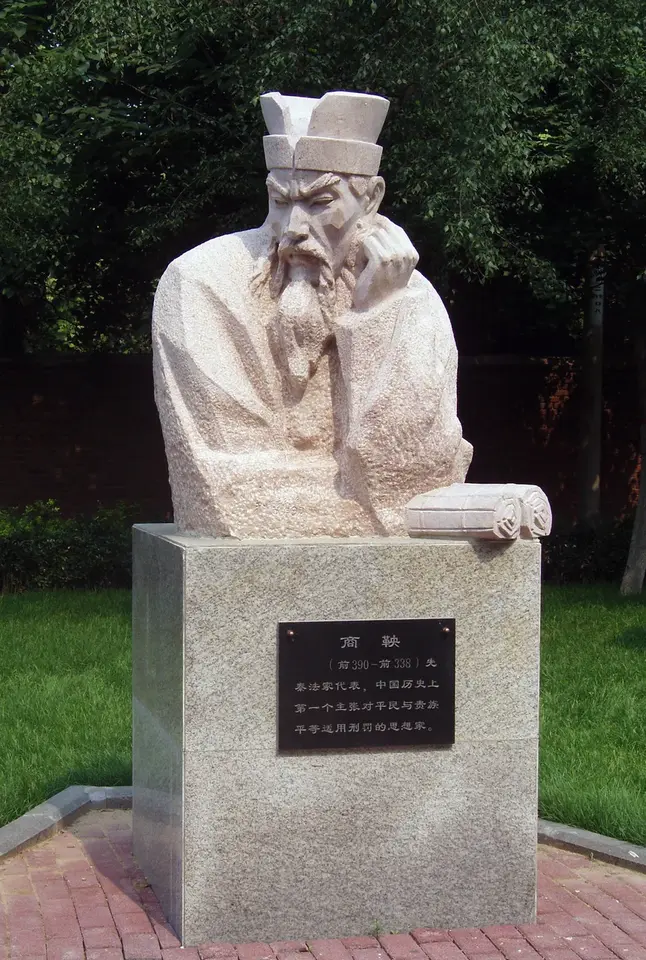
390 BCE–338 BCE
商鞅
Shang Yang (商鞅, c. 395–338 BCE), belonging to the Gongsun clan of the Ji royal lineage and originating from the ruling house of Wey, was popularly known as Wei Yang and Gongsun Yang. He was the foremost practical architect of Legalist philosophy in ancient China, a visionary statesman, and the institutional reformer who laid the foundations of the Qin Empire. In his early career, Shang Yang immersed himself in the penal and…
Shang Yang (商鞅, c. 395–338 BCE), belonging to the Gongsun clan of the Ji royal lineage and originating from the ruling house of Wey, was popularly known as Wei Yang and Gongsun Yang. He was the foremost practical architect of Legalist philosophy in ancient China, a visionary statesman, and the institutional reformer who laid the foundations of the Qin Empire. In his early career, Shang Yang immersed himself in the penal and administrative doctrines of Li Kui and Wu Qi, serving as Household Gentleman under Chancellor Gongshu Zuo in the State of Wei. In 362 BCE, attracted by Duke Xiao of Qin's famous decree soliciting external talent, Shang Yang crossed the passes into Qin with Li Kui's Classic of Law (Fa Jing). After four audiences, he persuaded Duke Xiao with realistic hegemonial strategies for state enrichment and military primacy, receiving appointment as Chief of the Left to orchestrate statewide institutional reform. Beginning in 359 BCE, Shang Yang crushed aristocratic opposition in court debates and established administrative credibility through the legendary "moving the log" demonstration. Over two decades, he launched two comprehensive waves of systemic reforms: organizing the populace into mutual-responsibility groups under collective liability; abolishing hereditary aristocratic privileges in favor of a twenty-tier military meritocracy; rewarding agriculture and weaving while suppressing non-essential commerce; abolishing the feudal well-field system to legitimize private land ownership; standardizing weights and measures via the bronze square grain measure; and establishing centralized county administration across the realm from the new capital at Xianyang. In 341 BCE, he commanded the Qin army to crush the Wei host, recapturing the Hexi region and earning enfeoffment over fifteen townships as Lord Shang. Following Duke Xiao's death, displaced aristocrats accused him of treason; he fell in battle and his corpse was subjected to dismemberment by chariots. Nonetheless, his legal institutions endured intact, providing the indispensable administrative machinery that enabled Qin Shi Huang to unify China.
Born into the royal lineage of Wey; demonstrated early fascination with penal philosophy.
Served as Household Gentleman under Chancellor Gongshu Zuo, who recognized his extraordinary genius.
Gongshu Zuo urged King Hui of Wei to employ or execute him; hearing Qin's call for talent, Yang entered Qin with the Classic of Law.
Impressed Duke Xiao with pragmatic statecraft of military wealth, earning appointment as Chief of the Left.
Overcame conservative ministers in court debate; established public trust by rewarding fifty gold pieces for moving a timber post.
Crown Prince Si violated the law; Shang Yang punished his tutors Prince Qian and Gongsun Jia, enforcing equal law.
Relocated capital to Xianyang; abolished well-field boundaries, legalized private land ownership, and instituted county governance.
Appointed Supreme Chancellor; captured Wei commander Prince Ang and compelled Wei to cede all lands west of the Yellow River.
Received fifteen townships around Shang and Yu, reaching the zenith of prestige as Lord Shang.
Duke Xiao died; framed by Prince Qian, Shang Yang died in combat and his corpse was torn apart by chariots.
Shang Yang was born in approximately 395 BCE (seventh year of King An of Zhou). His personal name was Yang, and he belonged to the Gongsun lineage of the royal Ji clan, being an agnatic descendant of the ruling ducal house of the State of Wey. Consequently, ancient historical chronicles refer to him interchangeably as Wei Yang or Gongsun Yang. Wey was the ancestral domain enfeoffed to Kang Shu, the younger brother of King Wu of Zhou. Though reduced to a modest vassal state during the Warring States period, Wey enjoyed commercial affluence and classical erudition.
From early youth, Shang Yang demonstrated acute intellect and a profound inclination toward the penal theories of legalism and administrative strategy. He studied the institutional manuals of early Legalist pioneers like Li Kui and Wu Qi, deriving lasting inspiration from Li Kui's Classic of Law, which pioneered codification, universal law, and the eradication of hereditary aristocratic privilege. Recognizing that the diminutive State of Wey offered no theater for his grand ambitions, Shang Yang traveled to the dominant and affluent central power of the era: the State of Wei.
In Anyi, the capital of Wei, Shang Yang entered the private retinue of Chancellor Gongshu Zuo, serving as Household Gentleman. Gongshu Zuo was a conscientious and experienced statesman who quickly recognized that Shang Yang possessed strategic foresight far exceeding his own. He treated the young retainer with deep esteem and intended to recommend him to the court.
In 362 BCE, Gongshu Zuo became critically ill. King Hui of Wei visited the chancellor's residence to inquire about state governance: "If Heaven takes you from me, whom shall I entrust with the altars of state?" Gongshu Zuo answered solemnly: "My Household Gentleman Shang Yang, though young, is a peerless talent under heaven. I pray Your Majesty entrust the entire realm to his administration, and our state will surely unite the world." King Hui remained silent. Seeing the king's skepticism, Gongshu Zuo dismissed attendants and whispered: "If Your Majesty chooses not to employ Shang Yang, you must execute him within our borders this very day. Never allow him to depart, lest he become an existential catastrophe for Great Wei!" King Hui vaguely agreed, but remarked derisively to his courtiers outside: "The chancellor's intellect is clouded by fatal sickness; how absurd that he advises me to surrender our vast kingdom to an obscure Household Gentleman!"
After the king departed, Gongshu Zuo summoned Shang Yang to his bedside and confessed: "I fulfilled my duty to the sovereign by advising your execution, and the king agreed. You must mount a fast horse and flee tonight!" Shang Yang smiled calmly and replied: "The king lacks the wisdom to employ me on your recommendation; how could he possess the resolve to execute me on your secret advice?" Shang Yang remained peacefully in Anyi, and King Hui indeed paid him no heed, illustrating Shang Yang's piercing psychological insight.
Following Gongshu Zuo's passing, the aristocratic families of Wei dominated politics, leaving no path of advancement for an outsider.
Simultaneously, transformative events unfolded in the western frontier. In 362 BCE, the youthful and determined Duke Xiao ascended the throne of Qin. Since Duke Mu's hegemony during the Spring and Autumn period, Qin had suffered decades of succession strife, losing its fertile lands west of the Yellow River to Wei's military genius Wu Qi. The eastern kingdoms looked down upon Qin as culturally unrefined, excluding its envoys from diplomatic leagues and contemplating its partition. Burning with humiliation, Duke Xiao issued his celebrated Order Seeking Talent throughout the Central Plains, proclaiming that anyone capable of enriching and strengthening Qin would be rewarded with high ministerial rank and land enfeoffment.
When the decree reached Anyi, Shang Yang recognized that Duke Xiao was an exceptional sovereign. Gathering his bamboo scrolls of Li Kui's Classic of Law, Shang Yang crossed the Tongguan Pass into Qin. In the capital at Yueyang, he secured an audience through Jing Jian, a trusted palace attendant.
Their encounters formed an intellectual contest across statecraft philosophies. In his first audience, Shang Yang expounded the philosophical "Way of the Emperors" modeled on the mythological rulers Fuxi and the Yellow Emperor. Duke Xiao grew drowsy and fell asleep, afterward rebuking Jing Jian for introducing an impractical dreamer. Shang Yang laughed: "I merely tested his scope of mind." In the second audience, Shang Yang presented the "Way of the Kings", advocating benevolent Confucian governance. Though staying awake, Duke Xiao felt this moral idealism unsuitable for immediate crises.
In the third audience, Shang Yang discarded classical antiquarianism, presenting the pragmatic "Way of the Hegemons", citing how Duke Huan of Qi and Duke Wen of Jin mobilized military arms to achieve interstate dominance. Duke Xiao's eyes gleamed with interest; he invited Shang Yang to dine and discussed strategy until nightfall. In the fourth audience, Shang Yang unleashed his comprehensive Legalist statecraft, detailing how to mobilize agrarian production, reward martial valor, enforce rigid penal codes, and transform the entire population into a disciplined war machine. Duke Xiao was thoroughly enraptured; he leaned forward unconsciously, moving his knees across his seating mat until he sat directly before Shang Yang, engaging in continuous discourse for several days without fatigue. When Jing Jian asked how he had captivated the duke, Shang Yang explained: "The Ways of Emperors and Kings require generations of moral cultivation. Qin is surrounded by predators; how could Duke Xiao wait decades for moral governance? By presenting the immediate methods of military enrichment, I addressed his burning hunger!" Duke Xiao immediately appointed Shang Yang as Chief of the Left, entrusting him with total authority over structural reform.
Although Duke Xiao resolved to transform his realm, conservative clans in Yueyang mounted vehement opposition. In 359 BCE, Duke Xiao convened a grand court debate to resolve the direction of the state.
Conservative leaders Gan Long and Du Zhi spearheaded the defense of ancestral privilege. Gan Long argued: "A sage does not alter customs to educate the people; a wise ruler does not overturn laws to govern. Governing according to existing ways brings success without exhausting toil." Du Zhi echoed: "Unless profit is hundredfold, one does not alter the law; unless merit is tenfold, one does not change an instrument. Modeling antiquity ensures freedom from error."
Shang Yang countered with impassioned and unassailable logic: "Ordinary folk rest content with obsolete customs, and petty scholars remain drowned in dogmatic texts. Both may serve as minor functionaries, but neither can deliberate statecraft beyond the letter of existing law! The Three Dynasties achieved universal rule through differing rites, and the Five Hegemons attained supremacy through distinct laws. The wise establish laws, while the foolish are bound by them; the worthy reform rituals, while the incapable are shackled by them!" Shang Yang concluded with iconic clarity: "Governing the realm requires no single path; benefiting the state demands no imitation of antiquity! King Tang and King Wu prospered without mimicking antiquity, while the Xia and Shang dynasties perished despite clinging to ancient rites. Rejecting antiquity is not necessarily wrongful, and clinging to archaic rites merits no special praise!" Duke Xiao struck his table in admiration, shouting: "Splendid!" He silenced the conservative faction and decreed total implementation of the new laws.
Having drafted the legal codes, Shang Yang recognized that western frontier populations were accustomed to private blood feuds and harbored skepticism toward bureaucratic edicts. To establish indelible trust, he engineered the famous demonstration of "moving the log".
He erected a cedar trunk thirty feet tall at the southern marketplace gate of Yueyang and posted an imperial notice: any citizen who relocated the timber post to the northern gate would receive ten pieces of gold. Citizens gathered in disbelief, suspecting a trap, and none volunteered. Shang Yang immediately increased the reward to fifty pieces of gold. Motivated by the astronomical sum, a robust commoner stepped forward, hoisted the post onto his shoulders, and carried it to the northern gate. Shang Yang summoned the man before the cheering crowds and handed him the fifty pieces of gold on the spot, demonstrating that government decrees were irrevocable and truthful. With popular confidence secured, Shang Yang promulgated the first reform edicts.
Under Duke Xiao's unswerving patronage, Shang Yang orchestrated two historic waves of reform that dismantled the archaic feudal fabric and established an efficient centralized state.
First Wave of Reforms (359 BCE):
During the opening year of the reforms, conservative nobles resisted, inciting Crown Prince Si to violate a sumptuary statute. Shang Yang stated firmly to Duke Xiao: "When laws fail, it begins with infractions from the summit. The Crown Prince is heir to the altars and cannot be physically mutilated; therefore, his tutors must bear the legal penalty!" Shang Yang ordered Prince Qian, Duke Xiao's elder brother, to suffer the mutilation of having his nose severed, while royal preceptor Gongsun Jia was branded upon the face. Terrified by this uncompromising impartiality, princes and commoners complied without exception. Within a decade, Qin was transformed into an orderly society where "belongings dropped on roadways were left untouched, bandits vanished from mountains, citizens fought fiercely in public war while shrinking from private violence, and peace prevailed across rural townships."
Second Wave of Reforms (350 BCE):
By 341 BCE, Qin's disciplined agrarian economy and formidable military divisions had transformed it into the foremost power of the Warring States. That year, Qi strategist Sun Bin crushed the Wei army at the Battle of Maling, leading to the suicide of Pang Juan and the capture of Crown Prince Shen, breaking Wei's interstate hegemony.
Shang Yang seized this moment, advising Duke Xiao: "Qin and Wei are like a mortal sickness of the heart; either Wei swallows Qin, or Qin absorbs Wei. Wei has been shattered by Qi at Maling; this is Heaven's gift to Qin to recover the lands west of the Yellow River! If we strike now, Wei will collapse and be forced to move its capital eastward to Daliang, leaving the strategic mountain barriers in our hands!" Duke Xiao appointed Shang Yang as Supreme Chancellor, granting him command of the armed forces to invade Wei.
King Hui of Wei dispatched Prince Ang with veteran heavy infantry to confront the invaders. Shang Yang, aware that he had maintained personal friendship with Prince Ang during his years in Anyi, sent a cordial letter: "We were once cherished friends; though commanding opposing armies, how can we bear mutual slaughter? Let us meet unarmed, formalize a covenant of peace, and withdraw our forces." Believing in his sincerity, Prince Ang arrived at the banquet. Once seated, Shang Yang's concealed armored guards ambushed Prince Ang, taking him prisoner, while Qin cavalry launched a coordinated surprise assault against the commanderless Wei encampment, shattering their army.
Reeling from defeats on multiple fronts, King Hui ceded all territories west of the Yellow River to Qin, suing for peace and hastily moving his capital from Anyi east to Daliang (modern Kaifeng). In retreat, King Hui wept: "I bitterly regret failing to heed Chancellor Gongshu's dying counsel to execute Wei Yang!" To honor this monumental conquest, Duke Xiao held a grand ceremony in 340 BCE, enfeoffing Shang Yang with fifteen wealthy townships across Shang and Yu, granting him the title "Lord Shang". Shang Yang reached the absolute pinnacle of interstate fame and domestic authority.
However, his immense authority sowed the seeds of catastrophe. Shang Yang's reforms had dismantled the privileges of the ancestral clans, and the severe mutilation inflicted upon Prince Qian had bred mortal hatred. Furthermore, Shang Yang traveled with ostentatious security, accompanied by armored squadrons and mounted retainers, provoking widespread resentment.
Recluse Zhao Liang sought an audience with Shang Yang through palace intermediary Meng Langao. Shang Yang asked: "Comparing my governance of Qin to that of Baili Xi, the Five Ram-Skins Grandee, who is superior?" Zhao Liang replied fearlessly: "Baili Xi rose from herding oxen, guided Duke Mu to hegemony over the western barbarians, and when he passed, the entire populace wept. By contrast, you attained power through court eunuch Jing Jian. In governing Qin, you oppressed the royal lineage, severed Prince Qian's nose, and forced him into seclusion for eight years. You travel behind bristling spears; the people perceive your executions but feel no virtue. Your peril is as fragile as morning frost! If you do not promptly return your fifteen fiefs, retire to cultivate gardens, and advise the duke to promote secluded scholars, disaster is upon you. Once the duke passes away, those who seek your life in Qin will be beyond counting!" Shang Yang remained silent, captivated by his monumental enterprise, and could not bring himself to step down.
In 338 BCE, Duke Xiao died from prolonged exhaustion. His nineteen-year-old son Crown Prince Si ascended the throne as King Huiwen. Prince Qian and conservative nobles immediately seized the moment, submitting joint memorials accusing Shang Yang of treasonous insurrection. King Huiwen, harboring old grievances over his punished preceptors and wary of Shang Yang's personal military power in Shang, issued secret warrants for his immediate arrest.
Alerted to the danger, Shang Yang mounted a fast horse and fled westward. Reaching a border waystation at nightfall, he sought lodging at an inn. The innkeeper, failing to recognize his face, barred the door: "Under the statutes enacted by Lord Shang, harboring travelers without official identification seals subjects the host to dismemberment!" Shang Yang sighed toward the heavens in grief: "Alas! The severity of my own law has come to this!"
Shang Yang then fled to Wei seeking political asylum. However, harboring deep bitterness over the capture of Prince Ang and the loss of Hexi, the court of Wei refused entry and forcibly escorted him back to the Qin border. Cornered and desperate, Shang Yang returned to his fief in Shang, rallying local retainers and household troops in a desperate northern raid against Zheng County (modern Hua County, Shaanxi). King Huiwen dispatched the elite imperial army, which cornered and defeated Shang Yang's forces at Mianchi. Shang Yang fell in combat.
To appease the fury of the conservative nobility, King Huiwen ordered Shang Yang's corpse transported to Xianyang, where it was tied to four galloping war chariots and torn to pieces in public execution, while his entire clan was exterminated.
Yet, King Huiwen and his successors—King Zhaoxiang and Emperor Qin Shi Huang—were pragmatic and calculating rulers. While eliminating Shang Yang the individual to placate dynastic relatives, they preserved every element of the administrative and military framework he had forged: the twenty ranks of merit, mutual surveillance, centralized counties, universal taxation, and the relentless focus on agriculture and war. As Eastern Han philosopher Wang Chong observed in Balanced Discourses: "Lord Shang died, yet the laws of Qin never fell!" Shang Yang sacrificed his life on the altar of the legal order he created, but the state machine he engineered propelled Qin to unify the Chinese world a century later, permanently transforming the trajectory of Chinese civilization.
FIGURES ASSOCIATED WITH THIS DYNASTY