July 15, 1613 CE(41st year of the Wanli era, Emperor Shenzong of Ming, 5th month, 28th day) | Birth | Born at Qiandeng in Kunshan, Southern Zhili. He was the biological son of Gu Tongying and was later adopted as heir by his father's cousin Gu Tongji.
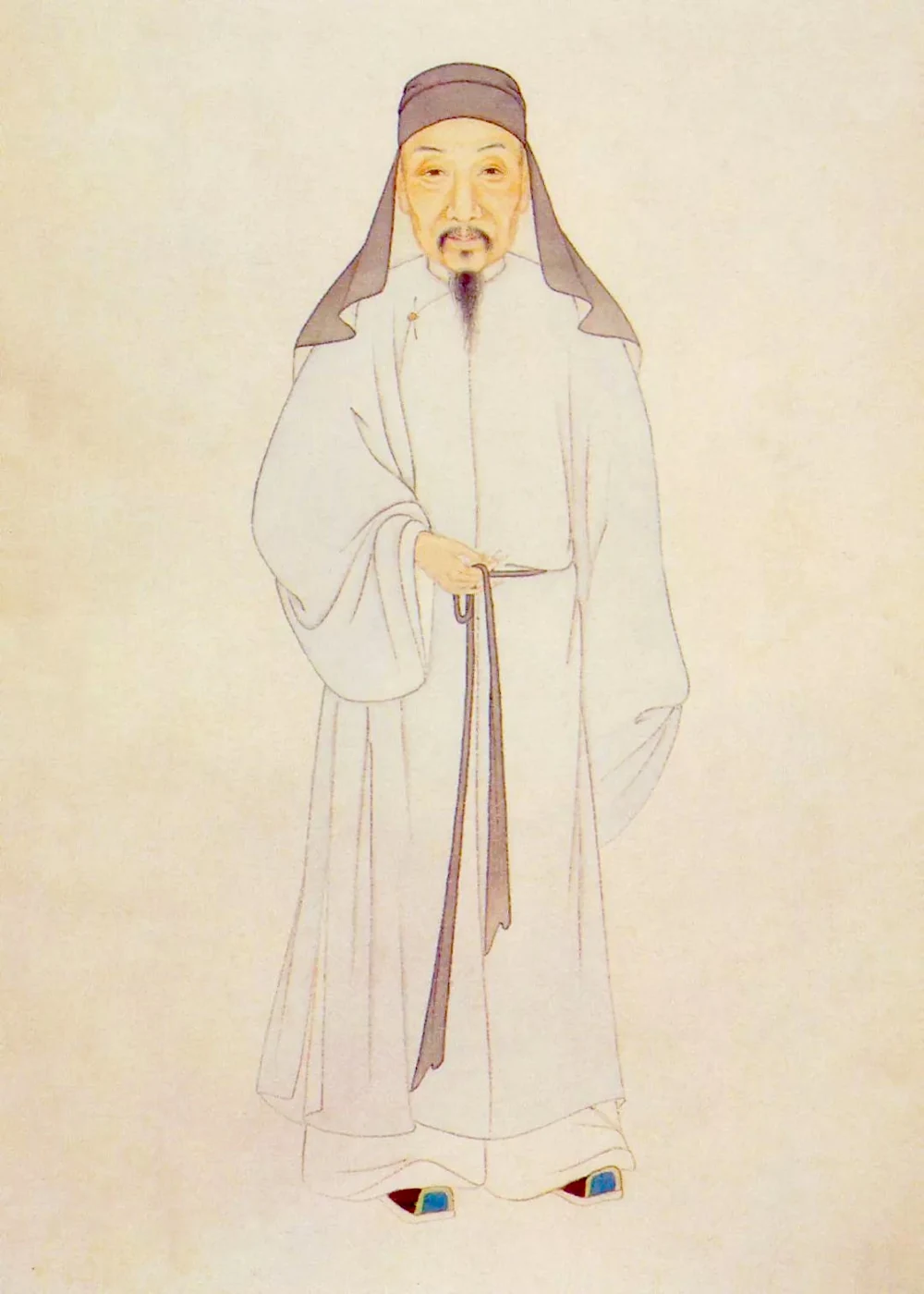
1613 CE–1682 CE
Thinker
Gu Yanwu
顾炎武
Gu Yanwu (1613-1682), originally named Jiang, courtesy name Ningren, and also known as Tinglin, was a native of Kunshan in Southern Zhili and a thinker, classical scholar, and Ming loyalist of the late Ming and early Qing. He joined the Restoration Society in his youth and later abandoned examination-oriented composition to investigate history, geography, institutions, and popular livelihood. After the fall of the Ming, he…
1613 CE–1682 CEMing Dynasty
PROFILE
Gu Yanwu (1613-1682), originally named Jiang, courtesy name Ningren, and also known as Tinglin, was a native of Kunshan in Southern Zhili and a thinker, classical scholar, and Ming loyalist of the late Ming and early Qing. He joined the Restoration Society in his youth and later abandoned examination-oriented composition to investigate history, geography, institutions, and popular livelihood. After the fall of the Ming, he joined anti-Qing forces in Kunshan and held office under the Southern Ming. After family disasters and setbacks to anti-Qing activity, he spent many years traveling in northern China. His scholarship took “broad learning in literature” and “conducting oneself with a sense of shame” as guiding principles and sought to apply textual study of the classics and histories, phonology and glossing, and field investigation to statecraft learning. His works include the Record of Daily Knowledge, Tianxia Junguo Libing Shu, and Five Books of Phonology. The later phrase “the rise and fall of the realm is the responsibility of every common person” is often used to summarize his thought, but it is a later condensation of his discussion of “preserving all under heaven,” not a direct quotation from him. Gu Yanwu refused Qing court recruitment in his later years and died at Quwo in Shanxi in 1682; he was later buried in Kunshan.
- Also known as
- Gu Tinglin, Master Tinglin
- Courtesy name
- Ningren
- Period
- Qing
- Date of Birth
- July 15, 1613 CE(41st year of Shen Zong Wan Li, 5th month, 28th day)
- Date of Death
- February 15, 1682 CE(21st year of Sheng Zu Kang Xi)
- Dynasty/State
- Qing
- Identity
- Thinker
- Ethnicity
- Not reliably established in the available historical materials
- Native place
- Kunshan, Southern Zhili (present-day Kunshan, Jiangsu)
- Place of birth
- Qiandeng, Kunshan, Southern Zhili
- Place of death
- Unknown
- Highest office
- See “Life” and “Major Deeds”
- Major achievements
- Late-Ming and early-Qing thinker and Ming loyalist; advocated practical statecraft; author of the Record of Daily Knowledge and the *Tianxia Junguo Libingshu
- Major offices
- Administrative Secretary in the Ministry of War under the Southern Ming; remotely appointed Secretary in the Bureau of Operations of the Ministry of War by the Longwu Emperor, but did not take office because of recent mourning for his adoptive mother
LIFE TIMELINE
Education | Obtained the status of student scholar and became close to Gui Zhuang.
Restoration Society activity | Went with Gui Zhuang to Nanjing for the Yingtian provincial examination and joined the Restoration Society.
Turn toward practical learning | Abandoned examination-oriented composition and began compiling historical records, local gazetteers, and institutional materials, working on Tianxia Junguo Libing Shu and Zhaoyu Zhi.
Family affairs | His grandfather Gu Shaofei died.
Entry into the Imperial University | Became a student of the Imperial University through a purchased qualification.
CE(17th year of the Chongzhen era, Emperor Sizong of Ming; 1st ye
1644 CE(17th year of the Chongzhen era, Emperor Sizong of Ming; 1st year of the Shunzhi era, Emperor Shizu of Qing) | Southern Ming office | After the Qing Entry through Shanhai Pass, Gu was recommended by the Kunshan magistrate Yang Yongyan to the Southern Ming court and appointed Administrative Secretary in the Ministry of War.
CE(1st year of the Hongguang era, the Southern Ming; 2nd year of
1645 CE(1st year of the Hongguang era, the Southern Ming; 2nd year of the Shunzhi era, Emperor Shizu of Qing) | Anti-Qing activity and family disaster | After Nanjing fell, joined Wang Yongzuo's armed force and wrote the “Four Essays of the Yiyou Year.” Kunshan fell; his biological mother Lady He was wounded, two younger brothers were killed, and his adoptive mother Lady Wang starved herself to death in loyalty to the fallen dynasty.
CE(2nd year of the Longwu era, the Southern Ming; 3rd year of the
1646 CE(2nd year of the Longwu era, the Southern Ming; 3rd year of the Shunzhi era, Emperor Shizu of Qing) | Remote appointment | The Longwu Emperor remotely appointed him Secretary in the Bureau of Operations of the Ministry of War. Because his adoptive mother had recently died, Gu did not take office and continued to maintain contacts with anti-Qing forces.
Setback to anti-Qing activity | Participated in plans for Wu Shengzhao to defect back to the Southern Ming. After the plan failed, Chen Zilong, Gu Xianzheng and his son, and others were killed; Gu Yanwu continued to travel and maintain contacts among various forces.
CE(4th year of the Yongli era, the Southern Ming; 7th year of the
1650 CE(4th year of the Yongli era, the Southern Ming; 7th year of the Shunzhi era, Emperor Shizu of Qing) | Flight and change of name | Left Kunshan because of a property dispute and persecution by Ye Fangheng, altered his appearance, and used the alias Jiangshan Yong.
CE(7th year of the Yongli era, the Southern Ming; 10th year of th
1653 CE(7th year of the Yongli era, the Southern Ming; 10th year of the Shunzhi era, Emperor Shizu of Qing) | Poetry society and anti-Qing activity | Formed the Jingyin Poetry Society with Gui Zhuang, Chen Chen, Wu Yan, Pan Chengzhang, Wang Xichan, and others, using literary gatherings as cover for secret anti-Qing activity.
CE(8th year of the Yongli era, the Southern Ming; 11th year of th
1654 CE(8th year of the Yongli era, the Southern Ming; 11th year of the Shunzhi era, Emperor Shizu of Qing) | Relocation | Moved to the southern foot of Shenlie Mountain in Nanjing.
CE(9th year of the Yongli era, the Southern Ming; 12th year of th
1655 CE(9th year of the Yongli era, the Southern Ming; 12th year of the Shunzhi era, Emperor Shizu of Qing) | Imprisonment | Returned to Kunshan and executed the disloyal servant Lu En. Ye Fangheng's side abducted and imprisoned him; the case was eventually decided as the “killing of a culpable servant.”
CE(10th year of the Yongli era, the Southern Ming; 13th year of t
1656 CE(10th year of the Yongli era, the Southern Ming; 13th year of the Shunzhi era, Emperor Shizu of Qing) | Release and decision to travel north | Released from prison. In midsummer he survived an assassination attempt outside Taiping Gate in Nanjing and decided to travel north.
CE(11th year of the Yongli era, the Southern Ming; 14th year of t
1657 CE(11th year of the Yongli era, the Southern Ming; 14th year of the Shunzhi era, Emperor Shizu of Qing) | Departure north | Paid respects at the Ming Xiaoling Mausoleum; over the following seven years he visited the mausoleum six times, sold family property, and left Kunshan.
CE(13th year of the Yongli era, the Southern Ming; 16th year of t
1659 CE(13th year of the Yongli era, the Southern Ming; 16th year of the Shunzhi era, Emperor Shizu of Qing) | Field investigation | Traveled to Shanhai Pass to reflect on the historical battlefield. He subsequently traveled for many years through Shandong, Yan, Shanxi, Henan, Shaanxi, and other regions, investigating passes and seeking local knowledge.
Huang Pei Poetry Case | Imprisoned because of the case and later released through the assistance of Li Yindu and other friends.
Refusal to compile history | In the capital, rejected Xiong Cilü's invitation to participate in compiling the History of Ming.
Refusal of recruitment | When the Kangxi Emperor opened the special examination for Outstanding Scholars of Vast Learning, Gu wrote three times to Ye Fang'ai firmly refusing nomination.
Second refusal to compile history | When the Qing court opened the Ming History Office, Gu declared that he would rather die or withdraw into hiding than accept a summons to compile the history.
Family affairs | His wife Lady Wang died, and Gu wrote poems mourning her.
Final illness | Fell while mounting a horse at the home of a friend surnamed Han in Quwo, Shanxi, after which he suffered persistent vomiting.
Death | Died at his friend's home at the chou hour, aged 70 by traditional reckoning, and was later returned for burial at Qiandeng in Kunshan.
BIOGRAPHY
Biography
Family, Education, and Turn toward Practical Learning Gu Yanwu was born at Qiandeng in Kunshan, Southern Zhili. His original name was Jiang and his courtesy name Ningren. Both sources state that he later changed his name to Yanwu and was known as Master Tinglin. The Gu family was an established Jiangdong lineage. His great-grandfather Gu Zhangzhi rose to Right Vice Minister of War in Nanjing. Gu Yanwu was the biological son of Gu Tongying and Lady He and, after birth, was adopted by his deceased father's cousin Gu Tongji as heir. His adoptive mother Lady Wang, a daughter of Wang Qiu, remained unmarried as a widow and raised Gu Yanwu, teaching him stories of loyalty associated with Yue Fei, Wen Tianxiang, and Fang Xiaoru. In 1626 (Tianqi 6, Ming), Gu Yanwu obtained student-scholar status and became close to his classmate Gui Zhuang. In 1630 (Chongzhen 3 under the Chongzhen Emperor, Ming), the two went to Nanjing for the Yingtian provincial examination and joined the Restoration Society. Their uncompromising temperaments led contemporaries to refer to them together with a saying that characterized Gui as strange and Gu as eccentric. Gu repeatedly failed to advance in the examinations. In 1639 (Chongzhen 12 under the Chongzhen Emperor, Ming), he abandoned examination-oriented composition and turned to broad reading in histories, local gazetteers, collected writings, and memorials. He organized materials on agricultural land, water control, mining, transport, historical geography, and other topics and began compiling Tianxia Junguo Libing Shu and Zhaoyu Zhi. In the second month of 1641 (Chongzhen 14 under the Chongzhen Emperor, Ming), his grandfather Gu Shaofei died. In 1643 (Chongzhen 16 under the Chongzhen Emperor, Ming), Gu Yanwu became a student of the Imperial University through purchase of a qualification. His scholarly direction shifted from examination preparation to the classics and histories, political institutions, and practical local problems, and he later combined field investigation with textual comparison and organized reading notes. ### Southern Ming Office and Anti-Qing Activity In 1644 (Chongzhen 17 under the Chongzhen Emperor, Ming; Shunzhi 1 under Emperor Shizu of Qing, Qing), after the Qing Entry through Shanhai Pass, Gu Yanwu temporarily lived at Yulianjing. On the recommendation of Yang Yongyan, magistrate of Kunshan, he entered the Southern Ming court and became Administrative Secretary in the Ministry of War. He then wrote the essays On Military Organization, On Strategic Situation, On Agricultural Production, and On the Monetary System, collectively referred to as the “Four Essays of the Yiyou Year.” They discussed military organization, strategy, agricultural administration, and currency policy in an effort to address the military, political, and fiscal difficulties of the Southern Ming. In the fifth month of 1645 (Hongguang 1, Southern Ming; Shunzhi 2 under Emperor Shizu of Qing, Qing), Gu Yanwu traveled by way of Zhenjiang toward Nanjing, but Nanjing fell before he arrived. He then joined Wang Yongzuo's armed force with Gui Zhuang and Wu Qihang. They first participated in an attack on Suzhou and, after defeat, Gu Yanwu joined Yang Yongyan, Gui Zhuang, and others in defending Kunshan. When Kunshan fell, Wu Qihang was killed, Gu Yanwu's biological mother Lady He had her right arm wounded by Qing soldiers, and two of his younger brothers were killed. Gu Yanwu had already left Kunshan and survived. Nine days later Changshu fell, and his adoptive mother Lady Wang starved herself to death in loyalty to the fallen dynasty, instructing him before her death not to serve a regime of another ruling house. After burying her, Gu Yanwu remained in contact with anti-Qing forces in different places. In 1646 (Longwu 2, Southern Ming; Shunzhi 3 under Emperor Shizu of Qing, Qing), on the recommendation of Lu Zhenfei, the Longwu Emperor remotely appointed Gu Yanwu Secretary in the Bureau of Operations of the Ministry of War. Gu did not take office because his adoptive mother had recently died. He later acted on Lu Zhenfei's request to contact forces in the Huai-Xu region and participated in efforts to induce the Qing general Wu Shengzhao to return to the Southern Ming side. In the summer of 1647 (Shunzhi 4, Qing), Wu Shengzhao's plan failed. Chen Zilong drowned himself, while Gu Xianzheng and his son and other participants were arrested and killed. Gu Yanwu attempted to rescue Chen Zilong and others. For several years thereafter he continued moving through the Jiangnan coastal region and the Huai-Xu area, while successive Southern Ming regimes collapsed and anti-Qing activities repeatedly failed. In 1650 (Yongli 4, Southern Ming; Shunzhi 7 under Emperor Shizu of Qing, Qing), amid drought in the Wu region, family property disputes, and persecution by Ye Fangheng, Gu Yanwu left Kunshan, cut his hair and altered his appearance, and used the alias Jiangshan Yong while traveling in the Wu and Kuaiji regions. In 1653 (Yongli 7, Southern Ming; Shunzhi 10 under Emperor Shizu of Qing, Qing), he formed the Jingyin Poetry Society with Gui Zhuang, Chen Chen, Wu Yan, Pan Chengzhang, Wang Xichan, and others. The society outwardly centered on poetry and drinking, but some members were anti-Qing activists, and Gu Yanwu continued to follow the military activities of Zhang Mingzhen and others. In the spring of 1654 (Yongli 8, Southern Ming; Shunzhi 11 under Emperor Shizu of Qing, Qing), he moved to the southern foot of Shenlie Mountain in Nanjing. ### Family Troubles, Release from Prison, and Northern Travels In the spring of 1655 (Yongli 9, Southern Ming; Shunzhi 12 under Emperor Shizu of Qing, Qing), Gu Yanwu returned to Kunshan. A hereditary servant, Lu En, had joined Ye Fangheng, and the two attempted to accuse Gu of illicit contacts with maritime forces. After Gu executed Lu En, Ye Fangheng's side abducted and imprisoned him. Through the mediation of his friend Lu Zebo, the case was transferred to Songjiang Prefecture and eventually decided as the “killing of a culpable servant.” During the case, Gui Zhuang submitted a disciple's card in Gu Yanwu's name to Qian Qianyi in order to seek assistance. When Gu learned of this, he publicly declared that he had never entered Qian's school. In the spring of 1656 (Yongli 10, Southern Ming; Shunzhi 13 under Emperor Shizu of Qing, Qing), Gu Yanwu was released. In midsummer he was attacked by an assassin outside Taiping Gate in Nanjing and escaped death after receiving assistance; his home was subsequently looted. He then decided to travel north, both to remain in contact with like-minded people and to investigate the terrain of northern China. On the first day of the first month of 1657 (Yongli 11, Southern Ming; Shunzhi 14, Qing), he paid respects at the Ming Xiaoling Mausoleum. Over the next seven years he visited it six times, then sold his property and left Kunshan. In 1659 (Yongli 13, Southern Ming; Shunzhi 16 under Emperor Shizu of Qing, Qing), Gu Yanwu reached Shanhai Pass and reflected on the old battlefield. For more than twenty years thereafter he traveled through Shandong, Hebei, Shanxi, Henan, Shaanxi, and other regions, visiting strategic passes, questioning old soldiers and retired servicemen, and checking books against what he observed in the field. He carried books during his travels and, when geographical descriptions did not match local conditions, consulted bookshops to verify the record. These investigations supplied material for his work on historical geography, administrative changes, and frontier defense. In later life he settled at Huayin in Shaanxi. ### Later Years and Death In 1668 (Kangxi 7 under Emperor Shengzu of Qing, Qing), Gu Yanwu was imprisoned in connection with the Huang Pei Poetry Case and was later released through the efforts of Li Yindu and other friends. In 1671 (Kangxi 10 under Emperor Shengzu of Qing), he went to the capital and stayed at the home of his nephew Xu Qianxue. Xiong Cilü invited him to participate in compiling the History of Ming, but Gu refused. In 1678 (Kangxi 17 under Emperor Shengzu of Qing), when the Qing court opened the special examination for Outstanding Scholars of Vast Learning, Gu wrote three times to Ye Fang'ai and firmly rejected nomination. In 1679 (Kangxi 18 under Emperor Shengzu of Qing), after the Ming History Office was opened, he again refused Xiong Cilü and stated that he would rather die or go into seclusion than accept a summons to compile the history. In 1680 (Kangxi 19 under Emperor Shengzu of Qing), his wife Lady Wang died, and Gu Yanwu wrote poems in mourning. On 10 February 1682 (4th day of the 1st month, Kangxi 21 under Emperor Shengzu of Qing), he fell while mounting a horse at the home of a friend surnamed Han in Quwo, Shanxi, and then suffered persistent vomiting. He died there on 15 February 1682 (9th day of the 1st month, Kangxi 21 under Emperor Shengzu of Qing) at the chou hour, aged 70 by traditional reckoning. His adopted heir Gu Yansheng and others escorted his remains back to Kunshan for burial at Qiandeng.
His Activities under the Southern Ming and the Troubles of His House
When the Hongguang court was set up at Nanjing, Gu Yanwu pinned his hopes of vengeance on it and, "wishing to make some contribution," wrote the Treatises on Military Organization, on Strategic Positions, on Agricultural Work and on Currency, the famous "four treatises of the yiyou year," offering the court plans and, against the decay of its administration and the abuses of the late Ming, a series of proposals on strategy, on the sources of troops and on fiscal reform. In the fifth month of 1645 he set out by way of Zhenjiang to take office at Nanjing, and before he arrived Nanjing was taken by the Qing, the Hongguang emperor captured and the southern armies broken. When loyalist forces rose throughout the south he threw aside the brush for the sword with his close friend Gui Zhuang and Wu Qihang, joining the force led by Wang Yongzuo, censor of the right; the several forces planned to recover Suzhou first and then Hangzhou, Nanjing and the coast, so that for a time "spears and halberds reached beyond the sea, and proclamations shook Jiangdong," but what remained could not stand against the Eight Banners at their height, and the force was ambushed and broken as soon as it entered Suzhou, with Songjiang and Jiading falling after.
Gu Yanwu slipped back to Kunshan and defended the city with Yang Yongyan, Gui Zhuang and others; within days Kunshan fell, with as many as forty thousand dead, Wu Qihang among them, his own mother Lady He's right arm cut off by Qing soldiers and two of his younger brothers killed, while he escaped only because he had gone to Yulianjing before the city fell. Nine days later Changshu fell, and his adoptive mother Lady Wang, hearing of it, starved herself to death, charging him at the end: "Though I am a woman, I have received the state's grace, and to die with the state is righteousness. Do not be a subject of another state, do not fail the grace of generations, do not forget the instructions of your ancestors, and then I may lie at peace below." In 1647 the plot of Wu Shengzhao was discovered, Chen Zilong drowned himself, Yang Yanshu and Gu Xianzheng and his son were put to death, and more than forty men were implicated and killed, Gu Yanwu labouring in vain to save them. He had meant to go to Fujian in 1646 to take the office of secretary of the bureau of ordinances, and as he was about to set out Lu Zhenfei sent to him to make contact with the "bold men of Huai and Xu"; for four or five years afterwards he "went east to the sea and north to Wangjiaying, hurrying to and fro," running between the several loyalist forces in the hope of gathering them for a stroke. As the Southern Ming regimes fell one after another and his own part in the resistance was repeatedly thwarted, he was not cast down, but likened himself to the jingwei bird that fills the sea with stones: "For all the wrongs in the world, why should you labour in vain, keeping your inch-long body and carrying wood to the end of time? I would level the eastern sea; my body may sink but my heart will not change; the sea has no day of peace, and my heart no hour of ceasing."
The quarrels of his kin and the persecution that followed were the immediate cause of his leaving Jiangnan. His cousins, contending for the inheritance, joined with the Ye family, who had long coveted his property, and his old house at Qiandeng in Kunshan and his lodging at Yulianjing in Changshu were several times plundered and set on fire. In 1650 Ye Fangheng again sought to injure him, and to escape he "shaved his temples a little and changed his dress to that of a merchant," leaving Kunshan under the name of the merchant Jiang Shanyong; for five years afterwards he hurried between Wu and Kuaiji, and though he hid as a trader he kept the old state in his heart. In this time Lu En, a hereditary servant of the family, seeing its decline and his master long absent, turned against him and went over to Ye Fangheng, and the two plotted to accuse Gu Yanwu of "communicating with the sea," that is, with the Southern Ming forces on the Zhejiang and Fujian coast, and so destroy him; Gu Yanwu returned to Kunshan and had Lu En secretly put to death, whereupon Ye Fangheng, in league with Lu En's son-in-law, had him seized and held and pressed him to take his own life, at which "his friends were all indignant" and the literary world in an uproar, until his close friend Lu Zebo, who had old ties with the military defence commissioner of Songjiang, spoke for him and the case was transferred elsewhere. To save him Gui Zhuang had gone so far as to enrol him as a pupil of Qian Qianyi, the literary leader of the day, without his consent; Gu Yanwu, learning of it, demanded the return of the pupil's card and, refused, wrote out a notice declaring that he had never entered Qian's school and had it posted at the crossroads, to Qian's great embarrassment. Released in the spring of 1656, he was still followed by assassins sent by Ye Fangheng, and in mid-summer, passing outside the Taiping gate at Nanjing, was set upon and barely saved; from this time he resolved to travel north, to make contact with loyalists elsewhere and to study the mountains and rivers of northern China in preparation for a future recovery, though escape from danger was certainly also a reason.
Major Activities
Statecraft Learning and Political Thought Gu Yanwu opposed empty discussion of mind and human nature detached from government and popular livelihood. He paired “broad learning in literature” with “conducting oneself with a sense of shame” as principles of scholarship and personal conduct, holding that study and practice should extend from personal ethics to affairs of the realm. He wrote that “the gentleman studies in order to illuminate the Way and save the world,” expressing the view that learning should not end with literary composition but should investigate political order and the livelihood of the people. In Tianxia Junguo Libing Shu and in essays such as On Military Organization, On Strategic Situation, On Agricultural Production, and On the Monetary System, Gu discussed land concentration, unequal taxation, military affairs, and public finance. He advocated enriching the people and expressed his policy tendency with the idea that “one who governs a state well stores wealth among the people.” He also argued that authority over the realm should not be monopolized by the ruler alone, advocating “government by the many” against “government by one.” These arguments remained within a traditional political framework, but they raised pointed questions about monarchical power and its distribution during the Ming-Qing transition. Later generations often use the phrase “the rise and fall of the realm is the responsibility of every common person” to summarize Gu Yanwu's thought. His original statement was that “as for preserving all under heaven, even the humblest common person shares responsibility.” The familiar shorter phrase is a later condensation and should not be quoted as Gu Yanwu's own exact wording. ### Critique of Classical Learning and Scholarly Method Gu Yanwu linked the lessons of the Ming collapse with scholarly habits and criticized the empty study of mind and nature in the late Ming, especially discussion of “mind, nature, principle, and qi” divorced from the classics, histories, institutions, and practice. He did not simply reject all Song-Ming Neo-Confucian learning. Rather, he advocated returning to the classics and examining the historical origins of ideas and institutions, using classical studies to correct abstract discussion detached from documents and government. His statement that “reading the Nine Classics begins with textual examination, and textual examination begins with understanding sounds” emphasized establishing the text, phonology, and documents before discussing philosophical meaning. Gu Yanwu frequently organized materials as reading notes, comparing different histories, local gazetteers, and institutional records. When he encountered conflicting accounts, he continued to trace their sources and historical development. He advocated verifying books through field investigation. During his northern travels he questioned old soldiers and retired servicemen, consulted local books, and checked strategic passes, geography, and historical changes against observation. His method combined documentary evidence with field knowledge and influenced classical textual scholarship and geographical and local-gazetteer research in the early Qing. ### Ancient Rhyme Studies and the Five Books of Phonology Gu Yanwu regarded phonological research as an important foundation for understanding the classics. He systematically compared ancient pronunciation with the rhyme tradition represented by the Tangyun and, by dividing older rhyme categories and regrouping them, proposed a system of ten ancient rhyme groups. He also discussed the relationship between entering-tone syllables and the yin-tone categories. His divisions were not identical with all later conclusions, but they provided testable materials and methods for Qing scholarship on Old Chinese phonology, which later scholars continued to revise and subdivide. The Five Books of Phonology comprises Table of Ancient Sounds, Sounds of the Changes, Original Sounds of the Poetry, Corrections to Tang Rhymes, and Discussions of Phonology, collecting the results of his long-term textual research. the work underwent repeated revision. Gu also wrote Record of Bronze and Stone Inscriptions and studied glossing, epigraphy, and historical geography. His phonological work is often regarded as one of the important beginnings of Qing research on ancient Chinese sounds. ### Major Works and Scholarly Range The thirty-two-volume Record of Daily Knowledge was a work that Gu Yanwu himself regarded highly. It covers classical studies, government, ritual institutions, the imperial examination system, literature, historiography, military affairs, geography, and miscellaneous textual research. He stated that the contents resulted from prolonged reading and repeated revision and that he removed points already made by earlier writers, indicating his emphasis on verification and correction. Tianxia Junguo Libing Shu compiles materials from historical works, local gazetteers, collected writings, and memorials, with particular attention to land, taxation, administrative divisions, transport, water control, and local advantages and problems. Zhaoyu Zhi focuses more directly on historical geography and changes in territorial administration. Gu also wrote Lidai Diwang Zhaijing Ji, Sheng'an Benji, Zuozhuan Dujie Buzheng, Shandong Kaogu Lu, Changping Shanshui Ji, and Ershiyi Shi Nianbiao. His work ranges across classical studies, history, phonology, writing, epigraphy, local gazetteers, and geography and should not be reduced to the single label “thinker.” ### Poetry, Prose, and Scholarly Influence Gu Yanwu's literary achievements are most notable in poetry and argumentative prose. one account counts more than four hundred poems and describes a forceful, somber style concerned with current affairs and practical realities. His prose and letters likewise frequently discuss politics, scholarship, and people in direct and concise language. Later writers sometimes compared his poetry with Du Fu's, but this is a later evaluation rather than a biographical fact. Later generations often regarded Gu Yanwu as an important precursor of Qing evidential scholarship or “plain learning” and discussed his relationship with Qian-Jia scholarship. A more cautious formulation is that his textual study of the classics and histories, research on ancient phonology, note-taking methods, and broad scholarship provided important resources for later scholars. Qian-Jia scholarship developed gradually under different scholars and historical conditions and cannot simply be attributed to Gu Yanwu alone.
His Scholarly Methods and His Influence on the Qianjia School
Gu Yanwu made pioneering studies in the classics, history, philology, phonology, epigraphy, archaeology, astronomy, calendrical science, geography and military affairs, and is regarded by later ages as the founder of Qing scholarship. His greatest contribution in phonology was to study ancient rhymes by analysing and splitting the "Tang rhymes," in fact the Guangyun: Song scholars had treated each rhyme category as a whole and never thought of dividing it, so that however broadly they set their categories they still fell into error, while the other extreme dealt with characters one by one without regard to the system of the language. Gu Yanwu divided certain rhymes and then recombined them with other categories, thus attending both to the systematic character of the sounds and to their historical development; he discarded the Pingshui rhymes and returned to the "Tang rhymes," assigning part of the you rhyme, such characters as "qiu" and "mou," to the zhi-tai category, which is the "splitting of the Tang rhymes," and dividing the zhi, ma and geng rhymes each in two and the wu rhyme into three, so that they fell into different ancient categories and the difference between ancient and modern systems was fully shown. He was also the first to pair the entering tone with the feminine, and divided the ancient rhymes into ten categories, and is honoured as the founder of the study of ancient sounds. From this he drew a line of method that had far-reaching effect: "To read the Nine Classics one begins with the examination of the characters, and to examine the characters one begins with the knowledge of the sounds — and it is so with the books of the hundred schools as well." Phonology was the key to the classics, the classics to the Way, the Way to the saving of the world.
His methods — the assembling of sources, the tracing of developments, induction, the seeking of corroboration, and personal investigation in the field — became the standard practice of the Qianjia scholars. It was said of his Record of Daily Knowledge that "in every matter he sets out the beginning and end, corroborates with evidence and then writes it down, so that his citations are copious and his contradictions few"; Qian Daxin imitated its form in his Shijiazhai yangxin lu, and Zhao Yi, whose Notes on the Twenty-Two Histories some compared to the Record, wrote that "if a man should compare my work with Gu Tinglin's Record of Daily Knowledge, saying that though he did not serve, his words may be used, how should I dare?" — modesty, but showing whose method he followed. Liang Qichao concluded: "Judged by minute completeness, Tinglin's writings cannot of course compare with those of later men. Judged by range of subjects and breadth of scale, none of the Qianjia masters could surpass him. In short, much of Qing scholarship began with Tinglin, and later men carried on his threads." Pan Lei said that "of the men of letters of our day many are able, but where scholarship is spoken of, all must bow and yield to Mr. Gu," and that "throughout the empire, wise or foolish, all know the gentleman as a scholar of universal learning." Before the rise of Qing learning, traditional scholarship had known only contending schools and no clear division into disciplines; Gu Yanwu, ranging over the hundred schools, helped turn phonology, textual criticism, epigraphy, archaeology and local topography from appendages of the classics into independent fields, and the minute specialisms of the Qianjia scholars were the further division and deepening of his broad enterprise.
Personal Relations
- Lady He: biological mother; her right arm was wounded by Qing soldiers when Kunshan fell.
- Gu Tongji: adoptive father and father's cousin; Gu Yanwu was adopted as his heir.
- Lady Wang: adoptive mother; daughter of Wang Qiu, who raised Gu Yanwu and starved herself to death after the fall of the Ming.
- Gu Zhangzhi: great-grandfather; rose to Right Vice Minister of War in Nanjing.
- Gu Shaofei: grandfather; died in 1641.
- Gu Xiang: elder brother; died before the family's wartime disasters.
- Lady Wang: wife, from Taicang; died in 1680.
- Gu Yigu: son by the concubine Lady Han; died young, after which Gu Yanwu had no surviving biological heir.
- Gu Yansheng: clansman later established as his adopted heir; escorted his remains back to Kunshan after his death.
- Xu Qianxue, Xu Bingyi, and Xu Yuanwen: nephews; Gu Yanwu lived at Xu Qianxue's home in his later years. ### Friends, Teachers, and Political Relationships - Gui Zhuang: classmate, close friend, and fellow member of the Restoration Society; participated with Gu in anti-Qing activity.
- Wu Qihang: friend and anti-Qing comrade; killed when Kunshan fell.
- Lu Zhenfei: Southern Ming Grand Secretary; recommended Gu Yanwu for office and asked him to contact forces in the Huai-Xu region.
- Zhu Yujian: the Longwu Emperor; remotely appointed Gu Yanwu Secretary in the Bureau of Operations of the Ministry of War.
- Lu Zebo: friend who worked to mediate Gu Yanwu's imprisonment case.
- Chen Zilong: member of the Restoration Society and anti-Qing participant; drowned himself after Wu Shengzhao's failed defection.
- Gu Xianzheng: older member of the same clan and anti-Qing participant; killed after Wu Shengzhao's failed defection.
- Ye Fangheng: powerful Kunshan local notable; involved in property disputes with the Gu family and repeatedly persecuted Gu Yanwu.
- Li Yindu: friend who helped secure Gu Yanwu's release during the Huang Pei Poetry Case.
- Xiong Cilü: Qing official who invited Gu Yanwu to participate in compiling the History of Ming; Gu refused.
- Ye Fang'ai: Qing official who repeatedly attempted to nominate Gu Yanwu during the special examination for Outstanding Scholars of Vast Learning; Gu refused.
- Pan Lei: student who edited and published the Record of Daily Knowledge.
- Huang Zongxi and Wang Fuzhi: contemporary thinkers later grouped with Gu Yanwu as the “Three Masters of the Early Qing.”
Anecdotes
The Source of “Every Common Person Is Responsible for the Rise and Fall of the Realm” Later writers often summarize Gu Yanwu’s sense of public responsibility with the phrase “The rise and fall of the realm is the responsibility of every common person.” These eight Chinese characters are not Gu’s verbatim wording. In Record of Daily Knowledge, chapter 13, “The Correct Beginning,” Gu wrote: “Those who preserve the realm, even the lowliest common person shares responsibility.” Liang Qichao and other modern writers condensed the idea into the familiar slogan. The quotation is therefore distinguished here from Gu’s original text.
Historical Assessment
Qing Historical Works and Scholars The Draft History of Qing: Biographies of Confucian Scholars summarized Gu Yanwu's learning as “restraining ornament and turning toward substance” and listed his research into state institutions, local historical traditions, astronomy and instruments, river transport, military affairs, and agriculture. Pan Lei, in his preface to the Record of Daily Knowledge, likewise emphasized Gu's learning in the classics and histories and in matters of practical statecraft. These assessments stress the breadth of his scholarship, textual verification, and concern with practical problems. ### Modern Scholarly Assessments Liang Qichao, in Academic History of China over the Past Three Hundred Years, treated Gu Yanwu as an important figure at the beginning of Qing scholarship while also noting that his writings ranged broadly and did not reach the later level of specialization in every field. Qian Mu praised his scholarship for dealing concretely with political advantages and defects. Such assessments reflect modern interpretations of Gu Yanwu's statecraft thought, scholarly method, and place in the history of Qing learning. The precise relationship between Gu Yanwu and Qian-Jia scholarship still requires discussion by field and cannot be captured solely by calling him its “founding patriarch.”
FIGURES ASSOCIATED WITH THIS DYNASTY
Bibliography
- Zhao Erxun et al., Draft History of Qing, vol. 481, Confucian Scholars II: Biography of Gu Yanwu.
- Liang Qichao, Academic History of China over the Past Three Hundred Years.
- Qian Mu, Academic History of China over the Past Three Hundred Years.