Birth | Born in the eastern countryside of Zhongli County, Haozhou (present-day Fengyang, Anhui)
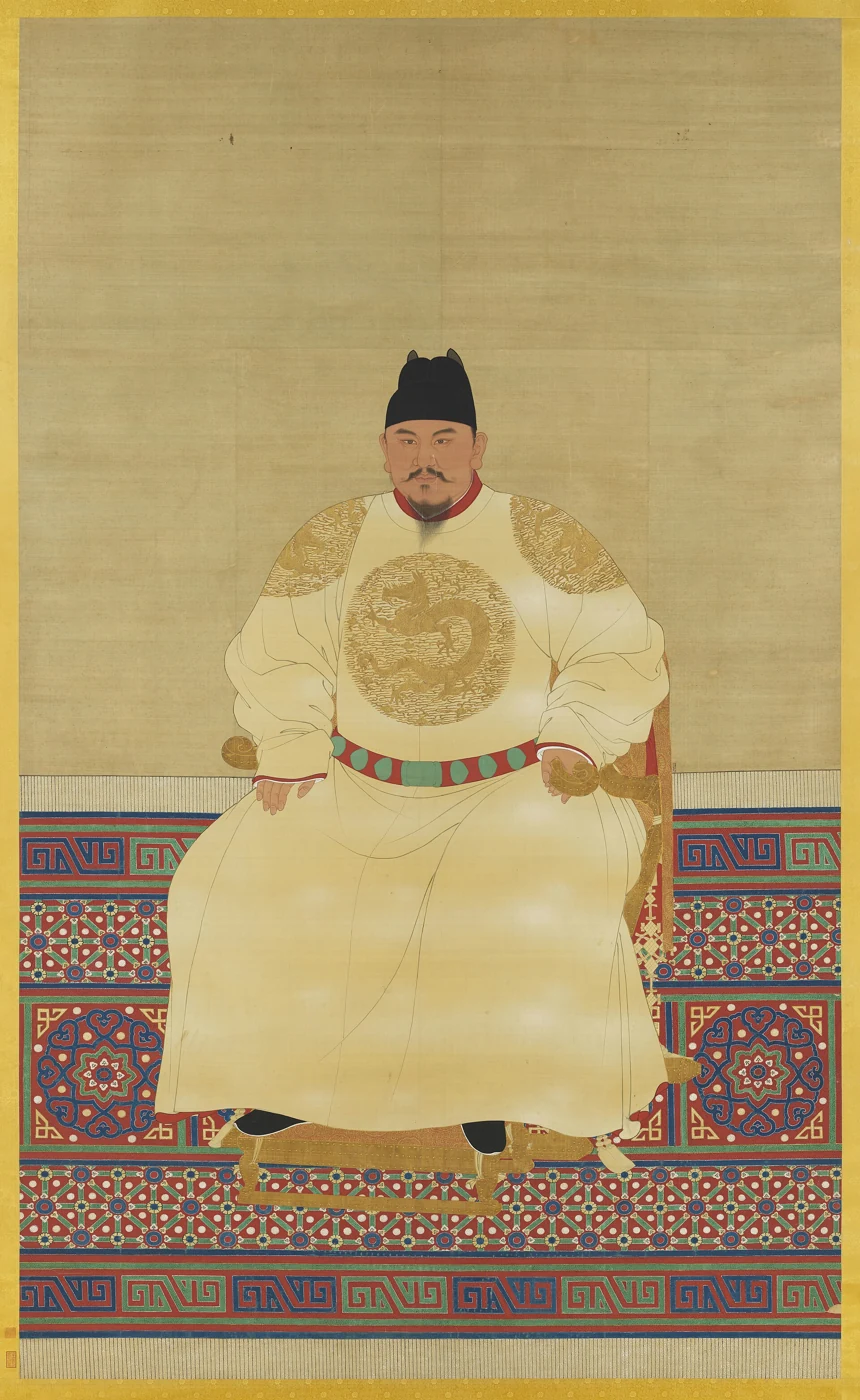
1328 CE–1398 CE
Emperor
Zhu Yuanzhang
朱元璋
Zhu Yuanzhang (October 21, 1328–June 24, 1398), courtesy name Guorui, was originally named Zhu Zhongba and Zhu Xingzong. A native of Zhongli in Haozhou (present-day Fengyang, Anhui), he was the founding emperor of the Ming Dynasty. He reigned from 1368 to 1398 under the Hongwu era name, with the temple name Taizu and the posthumous title “Kaitian Xingdao Zhaoji Liji Dasheng Zhishen Renwen Yiwu Junde Chenggong Gao Huangdi.”
1328 CE–1398 CEMing Dynasty
PROFILE
Zhu Yuanzhang (October 21, 1328–June 24, 1398), courtesy name Guorui, was originally named Zhu Zhongba and Zhu Xingzong. A native of Zhongli in Haozhou (present-day Fengyang, Anhui), he was the founding emperor of the Ming Dynasty. He reigned from 1368 to 1398 under the Hongwu era name, with the temple name Taizu and the posthumous title “Kaitian Xingdao Zhaoji Liji Dasheng Zhishen Renwen Yiwu Junde Chenggong Gao Huangdi.”
- Alternate names
- Zhu Yuanzhang, Emperor Taizu of Ming; Hongwu Emperor; Zhu Zhongba; Emperor Taizu of Ming
- Courtesy name
- Guorui
- Period
- Ming Dynasty
- Dynasty/Regime
- Ming Dynasty
- Identity
- Emperor
- Ethnicity
- Han Chinese
- Ancestral home
- Zhongli, Haozhou (present-day Fengyang, Anhui)
- Date of birth
- October 21, 1328
- Place of birth
- Eastern Zhongli, Haozhou
- Date of death
- June 24, 1398
- Reign
- 1368–1398
- Era name
- Hongwu; before becoming emperor, he also used Han Lin’er’s Longfeng era and the Wu era
- Temple name
- Taizu
- Posthumous name
- Kaitian Xingdao Zhaoji Liji Dasheng Zhishen Renwen Yiwu Junde Chenggong Gao Huangdi
- Age at death
- Seventy-one sui, as stateds
- Major achievements
- Founding emperor of the Ming Dynasty; rose from poverty and monastic life to the throne; established the capital at Nanjing, abolished the chancellorship, and governed officials through severe legal measures
LIFE TIMELINE
Age sixteen | Severe drought struck Haozhou; the following year locusts and epidemic disease followed, and his father, mother, and elder brother died in succession
Age seventeen | Entered Huangjue Temple as a novice, later forced to leave and travel to seek alms
Age twenty-one | Returned to Huangjue Temple after traveling through western Huai, Ru, Ying, and other areas
Age twenty-five | Joined Guo Zixing's Red Turban army, married Lady Ma, and adopted the name Yuanzhang
Age twenty-six | Returned home and recruited seven hundred men; promoted to zhenfu
Age twenty-seven | Led Xu Da, Tang He, and twenty-two other commanders south toward Dingyuan and recruited Li Shanchang
Age twenty-eight | Captured Hezhou and tightened military discipline; after Guo Zixing died, gradually took control of his forces
Age twenty-nine | Captured Jiqing, renamed it Yingtian, and made it his base
Age thirty-two | Took eastern Zhejiang and recruited prominent scholars including Zhu Sheng and Liu Ji
Age thirty-three | Defeated Chen Youliang decisively at the Battle of Longwan
Age thirty-six | Battle of Lake Poyang; Chen Youliang was killed by an arrow
Age thirty-seven | Proclaimed himself Prince of Wu
Age forty | Captured Zhang Shicheng and unified Jiangnan; dispatched Xu Da and Chang Yuchun on the northern expedition
Age forty-one | Ascended the throne in the first lunar month and named the state Great Ming; Xu Da captured Yuan Dadu in the eighth lunar month
Age fifty-three | Executed Hu Weiyong for treason and abolished the Secretariat and the office of Grand Councilor
Age sixty-six | Initiated the Case of Lan Yu, which implicated a very large number of people
Age seventy-one | Died at Yingtian, was buried at the Ming Xiaoling Mausoleum, and was succeeded by his imperial grandson Zhu Yunwen
BIOGRAPHY
Biography
Family Background and Early Life
Zhu Yuanzhang's ancestral home was Zhujiaxiang in Tongde Township, Jurong, Jinling. His grandfather Zhu Chuyi moved to Xuyi in Sizhou around the end of the Song and beginning of the Yuan, while his father Zhu Wusi, later renamed Shizhen, moved at the age of fifty to the eastern countryside of Zhongli County, Haozhou. Zhu Yuanzhang was the fourth child in his immediate household and the eighth among the male cousins of his generation, hence the childhood name “Zhu Zhongba.” According to the source text, Yuan regulations did not permit commoners without official rank to take formal personal names, and people were therefore sometimes named according to birth order or combinations of parental ages. His rough childhood name thus also reflected the poverty of his family background.
In 1343, the third year of the Zhizheng era, Haozhou suffered a severe drought. The following spring brought a major locust infestation and epidemic. Within less than half a month, Zhu Yuanzhang's father, eldest brother, and mother died one after another. The family could not afford coffins and did not even own land in which to bury their relatives. A neighbor, Liu Jizu, provided a burial plot, and the two surviving brothers wrapped the bodies in worn clothing and buried them hurriedly. Zhu Yuanzhang was then separated from his second elder brother, sister-in-law, and nephew as they each fled to survive. With nowhere else to go, Zhu Yuanzhang entered Huangjue Temple under the monk Gao Bin, shaved his head, and became a monk. He swept floors, burned incense, rang bells and drums, cooked, and washed clothes, and was often scolded by senior monks. When famine later struck the monastery, the abbot sent the monks away to travel and seek alms, forcing Zhu Yuanzhang into itinerant life.
From Haozhou he traveled south to Hefei, then west into Henan through Gushi and Xinyang, north through Ruzhou and Chenzhou, and east through Luyi and Bozhou, returning to Huangjue Temple in 1348, the eighth year of the Zhizheng era. Over three years he traveled through major towns across western Huai, encountered local customs and social conditions, broadened his horizons, and gained extensive experience of society. This period of wandering had a lasting influence on him. It also coincided with the rapid spread of peasant uprisings at the end of the Yuan. The slogan that a “King of Light would appear to save all beings” circulated widely, and during his travels Zhu Yuanzhang came into contact with White Lotus teachings.
Joining the Army and Rising to Power
In the fifth lunar month of 1351, the eleventh year of the Zhizheng era, Han Shantong and Liu Futong rose in rebellion at Yingzhou. Their soldiers wrapped red cloth around their heads and became known as the Red Turbans. In the second lunar month of the following year, the Dingyuan notable Guo Zixing joined Sun Deya and others in raising troops at Haozhou. Zhu Yuanzhang received a letter from his childhood companion Tang He inviting him to join the rebels. At the same time, a fellow monk secretly warned him that someone planned to report the matter. Zhu therefore joined Guo Zixing in 1352, the twelfth year of the Zhizheng era, at the age of twenty-five.
After joining the army, Zhu Yuanzhang fought bravely, showed flexibility and intelligence, and possessed some literacy. He quickly won Guo Zixing's favor and was appointed commander of a nine-man personal guard squad. He was capable and shrewd, handled affairs well, and led from the front in battle, soon becoming well known in the army. Guo treated him as a trusted confidant and married his adopted daughter Lady Ma to him. Thereafter he was called “Young Master Zhu” in the army, and he adopted the formal name Yuanzhang with the courtesy name Guorui.
At the time, five Red Turban marshals held power in Haozhou, and Guo Zixing's faction was in deep conflict with a rival group led by Sun Deya and others. After Sesame Li, a Red Turban leader at Xuzhou, was killed by Yuan troops, his subordinates Peng Da and Zhao Junyong brought their forces to Haozhou. Peng Da was friendly with Guo, while Sun Deya courted Zhao Junyong. At Sun's instigation, Zhao seized Guo Zixing and prepared to kill him. On hearing the news, Zhu Yuanzhang, supported by Peng Da, led troops to rescue Guo. The feud between the factions then deepened further.
Seeing the Haozhou commanders consumed by rivalry, Zhu decided to create a new position based on his own forces. In the middle of the sixth lunar month of 1353, he returned home to recruit troops. When acquaintances from his village and nearby communities learned that he had become a Red Turban leader, they came to join him, and he soon recruited more than seven hundred men. Guo Zixing promoted him to zhenfu. That winter, observing that the Haozhou commanders had not left the city for half a year, Zhu selected twenty-four trusted followers from his new troops, including Xu Da, Tang He, and Fei Ju, and departed Haozhou to campaign south toward Dingyuan. Along the route he first persuaded three thousand militia from Zhangjiabao and Lüpai Stockade to join him, then accepted the surrender of eight hundred men under Qin Batou, nicknamed Huobizi. At night he attacked and broke a Yuan encampment at Hengjian Mountain in Dingyuan, compelling Marshal Miao Daheng to surrender. Zhu selected twenty thousand strong Han Chinese from the surrendered troops, incorporated them into his army, and marched south to Chuzhou.
On the way south, Li Shanchang of Dingyuan requested an audience. Citing Emperor Gaozu of Han, Liu Bang, Li advised Zhu Yuanzhang that if he imitated Liu Bang's ability to recognize and employ capable men and refrained from arbitrary killing, he could quickly pacify the realm. Zhu accepted the advice and retained Li as a secretary in his staff. After taking Chuzhou, Zhu's nephew Zhu Wenzheng and brother-in-law Li Zhen arrived with Zhu's nephew Li Wenzhong. Zhu also adopted the orphan Mu Ying of Dingyuan as a son and later adopted more than twenty foster sons in total.
Crossing the Yangtze and Establishing a Base
In 1355, the fifteenth year of the Zhizheng era, Zhu Yuanzhang captured Hexian and was appointed zongbingguan to defend Hezhou. On one occasion outside the city he encountered a crying child. He learned that both the child's parents were in the army but were not allowed to acknowledge their marriage and could only call each other brother and sister. Zhu realized that military discipline had become a problem: soldiers disturbed civilians and seized women after capturing cities. He assembled the commanders, restated discipline, and ordered married women in the army returned to their husbands, allowing many separated couples to reunite. The story spread widely and strengthened his popular support.
In the same year Guo Zixing died. Guo's son Guo Tianxu was made Grand Marshal, while Zhu Yuanzhang and Guo Zixing's brother-in-law Zhang Tianyou became deputy marshals, nominally recognizing the Han Song regime of Han Lin'er. Feeling that their military achievements lagged behind Zhu's, Guo Tianxu and Zhang Tianyou decided to lead an attack on Jiqing themselves. Guided by the surrendered commander Chen Yexian, they fell into an ambush and were killed. After their deaths, Zhu became Grand Marshal and took command of Guo Zixing's former forces. In 1356, the sixteenth year of Zhizheng, he attacked Jiqing again, captured it, renamed it Yingtian Prefecture, and established his base there.
Zhu then gradually captured areas surrounding Yingtian in order to strengthen its defenses. Xu Da took Zhenjiang; Deng Yu took Guangde; Geng Bingwen captured Changxing; Xu Da took Changzhou; Zhu personally captured Ningguo; Zhao Jizu took Jiangyin; Xu Da captured Changshu; Hu Dahai took Huizhou; Chang Yuchun captured Chizhou; and Miao Daheng took Yangzhou. In 1358 Zhu personally captured Wuzhou, and the following year his forces successively occupied the rest of eastern Zhejiang. Chang Yuchun took Quzhou and Hu Dahai took Chuzhou. By this point Zhu's forces controlled the regions east of the Yangtze and west of Zhejiang, bordering Chen Youliang's territory to the west.
After taking eastern Zhejiang, Zhu gained the assistance of the scholars Zhu Sheng and Liu Ji. Zhu Sheng advised him to “build high walls, store grain widely, and delay proclaiming yourself king,” recommending a cautious strategy. Liu Ji proposed the sequence “first Han [Chen Youliang], then Zhou [Zhang Shicheng].”
Defeating Rival Regimes
In 1360, the twentieth year of the Zhizheng era, Chen Youliang captured Taiping Circuit, killed his ruler Xu Shouhui, proclaimed himself emperor of the state of Han, and then committed his full forces to an attack on Yingtian. Zhu Yuanzhang and Liu Ji devised a plan: Hu Dahai first attacked Xinzhou to cut Chen's support, while Kang Maocai feigned surrender and acted as an inside contact, drawing the main Han army into an ambush at Longwan outside Yingtian. The Han forces suffered a major defeat. Zhu then exploited the victory to recapture Taiping, Anqing, Xinzhou, and other areas.
In 1363, the twenty-third year of Zhizheng, Zhang Shicheng sent Lü Zhen to besiege the retreating “Little King of Light” Han Lin'er at Anfeng. Against Liu Ji's objections, Zhu sent troops north to lift the siege. Liu Futong was killed, while Han Lin'er was rescued and settled at Chuzhou. Taking advantage of the absence of Zhu's main force, Chen Youliang led a naval force of six hundred thousand against Hongdu. Zhu's nephew Zhu Wenzheng held Hongdu for more than two months until Zhu arrived with two hundred thousand troops, and the two sides fought a decisive engagement at the Battle of Lake Poyang. Chen relied on large warships, and Zhu at one point narrowly escaped capture. He later used a northeast wind to launch a fire attack that shattered the Han fleet. Chen Youliang was killed by an arrow and the Han army collapsed. Zhu then besieged Wuchang and took control of Hubei.
In 1364, the twenty-fourth year of Zhizheng, Zhu proclaimed himself Prince of Wu, appointing Li Shanchang as Right Chancellor of State and Xu Da as Left Chancellor of State, and designating his son Zhu Biao as heir. Wu forces then took Luzhou, Ji'an, Hengzhou, Baoqing, Ganzhou, Xiangyang, and other areas. In 1366, the twenty-sixth year of Zhizheng, Xu Da captured Pingjiang and Zhang Shicheng was taken prisoner, completing Zhu's unification of Jiangnan. In the same year, Zhu ordered Liao Yongzhong to escort Han Lin'er to Yingtian. During the journey Han's boat sank and he died.
Founding the Dynasty and Building Institutions
In the first year of Wu (1367), Zhu ordered Tang He, as General Who Conquers the South, to campaign against Fang Guozhen. He also formulated the strategy for the northern expedition: first take Shandong, next attack Henan, then seize Tong Pass in Shaanxi, and finally advance on Yuan Dadu. Xu Da was appointed General-in-Chief Who Conquers the Caitiffs, with Chang Yuchun as deputy, commanding 250,000 troops in the northern campaign. Fang Guozhen surrendered in the same year.
On the fourth day of the first lunar month in the second year of Wu (January 23, 1368), Zhu Yuanzhang ascended the throne at Yingtian, named the state Great Ming, adopted the Hongwu era name, made Yingtian the Southern Capital and Kaifeng the Northern Capital. On the second day of the eighth lunar month (September 14, 1368), Xu Da captured Yuan Dadu. The Yuan emperor fled north and Yuan rule over China came to an end. During the northern expedition Zhu proclaimed the slogan: “Drive out the Hu barbarians, restore Zhonghua, establish order and discipline, and relieve the people.” Over the following twenty years, Ming armies successively pacified the southwest, northwest, Liaodong, and other regions, broadly completing the unification of the realm.
After founding the dynasty, Zhu ordered peasants to return to farming, rewarded land reclamation, organized large-scale migration and both civilian and military colonies, promoted water-control works, encouraged the cultivation of mulberry, hemp, cotton, and other economic crops, ordered the freeing of slaves, reduced taxes, and sent officials to survey land and register households. He established the weisuo system, under which frontier soldiers cultivated land for their own support. He also enfeoffed regional princes to guard the northern territories, encouraging migration from the south to the north. The Great Ming Code was promulgated, and strict criminal law was used to govern both commoners and officials and to punish corruption. Social production gradually recovered and developed during the Hongwu period, later remembered as the “Hongwu Restoration.”
Later Years and Death
In 1380, the thirteenth year of the Hongwu era, Zhu executed Grand Councilor Hu Weiyong on charges of treason, abolished the Secretariat and the chancellorship, and placed the Six Ministries under the emperor's direct authority, further strengthening monarchical autocracy. In 1393, the twenty-sixth year of the Hongwu era, he initiated the Case of Lan Yu, implicating a very large number of people. He also established the Embroidered Uniform Guard to monitor officials, gather intelligence, arrest spies, and suppress elite forces he regarded as threats to the court.
In 1398, the thirty-first year of the Hongwu era, Zhu Yuanzhang died in the imperial palace at Yingtian at the age of seventy-one and was buried in the Ming Xiaoling Mausoleum. Because Crown Prince Zhu Biao had died earlier, the throne passed to Zhu's imperial grandson Zhu Yunwen, the Jianwen Emperor. Four years later, Zhu's fourth son Zhu Di, Prince of Yan, raised troops in the name of the Jingnan Campaign, displaced the Jianwen Emperor, and became the Yongle Emperor.
The Rescue of Guo Zixing, the Command at Hezhou and the Taking of Jiqing
By the first book of the Ming History, Guo Zixing's escape was wholly due to Zhu Yuanzhang: "Zixing and Deoya were at odds and the founder reconciled them again and again. In the ninth month of autumn the Yuan troops recovered Xuzhou, Li Er fled and died, and Peng Da and Zhao Junyong fled to Hao, where Deyya received them. Zixing treated Peng Da with courtesy but slighted Zhao Junyong, who resented it; and Deyya plotted with him, and watching for Zixing to go out, seized and bound him in the Sun house, meaning to kill him. The founder, then north of the Huai, heard of the trouble and galloped to him, and complained to Peng Da, who in a rage called out troops and marched, the founder too in armour and with a shield, and they broke open the house and brought Zixing out, struck off his bonds and had him carried home, and so he was saved. In the winter of that year the Yuan general Jia Lu besieged Hao, and the founder with Zixing held it with all their strength." In the spring of the following year, "Jia Lu dying, the siege was raised, and the founder gathered the troops of the villages, getting seven hundred men, at which Zixing rejoiced and made him a pacification commissioner". Of his command at Hezhou the record shows his mastery of men: "in the first month of the spring of the fifteenth year Zixing, using the founder's plan, sent Zhang Tianyou and others to take Hezhou and ordered the founder to command its army; and the founder, fearing the generals would not yield to one another, kept the order secret and appointed a meeting in the hall at dawn. The seats then ranking to the right, the generals came in first and all took the right; the founder purposely came late and took the left. When business was reached he decided it flowing like water, and the others stared and could not utter a word, and began by degrees to submit. It was proposed to divide the work of walling the city, with three days allowed; and the founder's work was finished, while the generals all fell behind. Then he brought out the order and, sitting facing south, said: 'I have been commanded to command your troops, and now the walling is all behind time — what of the military law?' and the generals were all in fear and apologised. And he had the women seized in the camps released and sent home, at which the people rejoiced greatly." Of the Longfeng reign-title, his acceptance and refusal show his judgement of the times: "in the third month Guo Zixing died; and Liu Futong then set up Han Shantong's son Lin'er at Bo with the dynastic name Song and the reign-title Longfeng, ordering Zixing's son Tianxu as grand marshal and Zhang Tianyou and the founder as marshals of the left and right. The founder said with spirit that 'how should a great man bear to be under another's control?', and would not accept it; yet, thinking Lin'er's power great and worth leaning on, he used his reign-title to order his army."
His measures on entering Jiqing show his art of winning men: "on the day Gengyin he beat the Yuan troops again at Mount Jiang. The Yuan censor-in-chief Fu Shou fought hard and died, Manzi Haiya fled to Zhang Shicheng and Kang Maocai surrendered. The founder entered the city and called together all the officials and elders and told them that 'the Yuan government was corrupt and disorder and arms sprang up on every side; I have come to rid the people of trouble, and each of you shall dwell in peace as before; the worthy I will treat with courtesy and employ, the old rules that are inconvenient I will abolish, and let no official harm my people by greed or violence', at which the people rejoiced beyond hope. He changed the Jiqing circuit into the prefecture of Yingtian, called in Xia Yu, Sun Yan, Yang Xian and more than ten others, and buried the censor-in-chief Fu Shou to honour his loyalty." The campaigns of the following years are year by year in the annals: "in the spring of the seventeenth year, in the second month, Geng Bingwen took Changxing; in the third month Xu Da took Changzhou; in the fourth month the founder went himself against Ningguo and took it, and Bie Buhua surrendered; in the fifth month Shangyuan, Ningguo and Jurong presented auspicious wheat; in the sixth month Zhao Jizu took Jiangyin; in the autumn and seventh month Xu Da took Changshu, and Hu Dahai took Huizhou, so that Baisir Buhua fled; in the winter and tenth month Chang Yuchun took Chizhou and Miao Daheng Yangzhou, and Zhang Mingjian surrendered; in the twelfth month prisoners were released. In that year Ming Yuzhen, a general of Xu Shouhui, held Chongqing." On the plan against Zhejiang there are his words to his generals: "in the first month of the spring of the nineteenth year, the founder planning to take the unsettled parts of eastern Zhejiang, warned his generals that 'to take a city is by arms, but to quell disorder is by benevolence; when I entered Jiqing I did no harm whatever, and so took it at one stroke. Whenever I hear that a general has taken a city without killing at random I am pleased beyond measure. An army moves like fire, and if it is not checked it will burn the plain. For a general to make not-killing his valour is not only the state's good but his descendants will surely enjoy its blessing.'" At that time Fang Guozhen "offered Wen, Tai and Qingyuan and sent his son Guan as hostage, but the founder would not accept", while "the Yuan garrison troops were few and weak and, hearing of the disorder in the Central Plain, men's minds were scattered, so that the commanderies of Jiangzuo and the western Zhejiang all fell as the armies came, and so the founder's territory touched that of Chen Youliang on the west."
The Regicide of Chen Youliang, the Victory at Longwan and the Surrender of Wuchang
The rise of Chen Youliang was marked by murder. By the Ming History's hundred and twenty-third book: "at first, when Youliang took Longxing, Shouhui wished to move the capital there, but Youliang would not; and before long Shouhui set out from Hanyang and reached Jiangzhou, where Youliang governed, and he hid troops outside the walls, welcomed Shouhui in and at once shut the gates and killed all his following; making Jiangzhou his capital he lodged Shouhui there and called himself king of Han, setting up the offices of a princely court. He then took Shouhui downriver with him and attacked Taiping, which was strong and could not be taken; and he brought great ships against the southwest wall, and his soldiers climbed the boats' sterns and swarmed up the battlements, and so it fell. His ambition grew prouder. Advancing to Caishi rock he sent a general to report business to Shouhui, with orders for braves to strike his head open with an iron club. Shouhui being dead, he made the Wutong temple at Caishi his hall of audience and took the imperial throne with the dynastic name Han and the reign-title Dayi... and there came a great wind and rain, and the ministers stood in ranks on the sandbank to congratulate him and could not complete the ceremony." The battle of Longwan was won by guile: "the founder, fearing that Youliang would join with Zhang Shicheng, devised a plan and had his old friend Kang Maocai write as if in betrayal, luring him to come quickly; and Youliang indeed led his fleet downriver and reached the Jiangdong bridge, and calling Kang Maocai and getting no answer knew he had been tricked; and fighting at Longwan he was utterly beaten, and the tide falling his ships were stranded, so that countless men died and several hundred warships were lost, and he fled in a light boat; Zhang Desheng pursued and beat him at Cihu and burned his ships, and Feng Guosheng pressed him with the five-wing army, and Youliang brought out his black-banner troops and was beaten again; so that he abandoned Taiping and fled to Jiangzhou... and his general Wu Hong surrendered Rao, Wang Pu Jianchang and Hu Tingrui Longxing." The Ming History also records the disposition and the reckoning with the weather: "and so Chang Yuchun lay in ambush at Shihui hill, Xu Da arrayed outside the south gate, Yang Jing camped at Dasheng harbour, and Zhang Desheng went out with the fleet by the Longjiang pass, the founder commanding in person on Mount Lulong. On the day Yichou Youliang reached Longwan and the host wished to fight, but the founder said that 'it is about to rain; eat quickly and strike in the rain', and presently it rained indeed and the soldiers strove with one heart, and when the rain stopped they joined battle and struck from land and water, breaking them utterly, and Youliang fled in a separate boat." The settling of Wuchang was by kindness: "Yuan Li, having returned to Wuchang, took the false throne and changed the reign-title to Deshou; and in the winter of that year the founder went against Wuchang in person and in the second month of the next year again; and Yuan Li's chancellor Zhang Bixian came up from Yuezhou to relieve him and camped at Hongshan, but Chang Yuchun attacked and took him and paraded him below the city. Bixian was a brave general, called in the army the Splashing Zhang, and on him they leaned; and when he was taken the city was in great fear and many wished to surrender. The founder then sent Yuan Li's former minister Luo Furen into the city to summon him, and Yuan Li surrendered and came to the gate of the camp, bowing and not daring to look up; and the founder, seeing him young and weak, raised him up and taking his hand said that 'I will not blame you', and let him take freely of the stores and treasures, and returning to Yingtian gave him the title of marquis of Guide."
The Surrender of Naghachu and the Settling of Liaodong
The settling of Liaodong ended with the submission of Naghachu. The hundred and twenty-fifth book of the Ming History records that "the grand general Xu Da and the left vice general Li Wenzhong both being dead, the Yuan grand commandant Naghachu held several hundred thousand men at Mount Jin and was long a scourge on the Liaodong frontier; in the twentieth year Feng Sheng was made grand general against the barbarians, with the duke of Ying, Fu Youde, and the marquis of Yongchang, Lan Yu, as vice generals of the left and right, leading Zhao Yong, marquis of Nanxiong, and others with two hundred thousand horse and foot against him, and the dukes of Zheng, Cao and Shen, Chang Mao, Li Jinglong and Deng Zhen, all accompanying; and the emperor again sent Naghachu's former general Nai Lawu, whom he had captured, with a sealed letter to call him to surrender. Feng Sheng went out by the Songting pass and built in divisions the four cities of Daning, Kuanhe, Huizhou and Fuyu, and remaining at Daning over two months, left fifty thousand to hold it and pressed on Mount Jin with his whole army. Naghachu, seeing Nai Lawu, cried in amazement that 'are you still alive?', and Nai Lawu told him of the emperor's goodness. Naghachu, pleased, sent his left secretary and his scouts with horses and to spy out Feng Sheng's army. Feng Sheng had already gone deep, crossed Mount Jin and reached the Nüzhen camp of Kucun, where the general Guan Tong submitted. The great army then came suddenly, and Naghachu, reckoning he could not resist, asked to surrender through Nai Lawu, and Feng Sheng sent Lan Yu with light horse to receive him. Lan Yu drank with Naghachu and was so merry that he took off his own coat to clothe him, but Naghachu would not wear it and, looking about him, muttered and plotted flight; and Chang Mao, Feng Sheng's son-in-law, sitting by, sprang up and cut off his arm, and the commandant Geng Zhong brought him before Feng Sheng. Naghachu's officers, wives and children, more than a hundred thousand, were camped at the Songhua river, and hearing of his wound were thrown into confusion; Feng Sheng sent Guan Tong to summon them and they surrendered, giving more than two hundred thousand men with sheep, cattle, horses, camels and baggage stretching more than a hundred li. Returning to the Yimi river he gathered two thousand more stragglers and fifty thousand carts and horses, while the commandant Pu Ying, bringing up the rear, was killed by the enemy. The army returning, the victory was reported, with a memorial on Chang Mao's provocation, and the whole two hundred thousand of the surrendered were brought within the passes. The emperor was greatly pleased and sent envoys to welcome and comfort Feng Sheng and his officers, and had Chang Mao put in chains. But there were those who said that Feng Sheng had concealed many good horses, that he had had a gatekeeper ply Naghachu's wife with wine to seek great pearls and rare treasures, that two days after a prince's son died he had forcibly taken his daughter, so losing the hearts of the surrendered, and that he had lost Pu Ying's three thousand horse, while Chang Mao too accused him. The emperor in anger took away Feng Sheng's grand general's seal, ordering him to retire to the Fengyang residence and attend court, and gave the officers no reward; and from that time Feng Sheng never again commanded a great army."
The Northern Commands, the Frontier Princes and an Edict of Remission
The management of the north is summed in Ma Wensheng's account of Liaodong: "great indeed was our founder, the high emperor, who by the favour of Heaven took all directions, and, the Hu barbarians being near on the west and north, set up the Shaanxi provincial command at Ganzhou, the Shanxi command at Datong and the Wanquan command at Xuanfu, and beyond the Xifeng pass in the old Huizhou region the Daning command, and the Liaodong command at Liaoyang, and at Ningxia in Shaanxi, the land where Zhao Yuanhao dwelt, the five Ningxia guards of the left and others, while Guangning in Liaodong, being the key point against the northern barbarians, was given the five Guangning guards and others, all these with the several provincial commands and Ningxia being called great garrison towns. At that time the princes of Su at Ganzhou, Qing at Ningxia, Dai at Datong, Gu at Xuanfu, Ning at Daning and Liao at Guangning were enfeoffed to screen the royal house and ward off the Hu, and whenever any did not submit the princes were ordered to chastise them, so that for more than thirty years the Hu barbarians did not dare drive their herds south." Of the rest given to the people there is the edict of remission, the veritable records for the second year of Hongwu, in the first month, giving the words that "I consider that the people, worn out in the last years of the Yuan by their exactions, being now submissive, how should I bear to weary them again? I had already remitted the tax grain of Shandong for the first year of Hongwu, but the drought coming on, the people are not yet recovered, and the summer and autumn taxes of this year shall be remitted again. Lately the great army pacified the Yan capital and took Jin and the east of the river, and I consider that the people of Beiping and the south of Yan and of Hedong and Shanxi have long suffered from war and are the more pinched by levies; let the tax grain of Qi and Lu this year also be remitted. As for the commanderies of Henan, since their submission I have long wished to relieve them, but the northwest was not yet pacified and the armies passing had to be supplied with grain, so that it could not be done; now that Jin and the east of the river are pacified, it is right to be generous: from Beiping and Henan, apart from the prefectures of Xu and Su which have already been remitted, from the Tong pass on the west, the great river on the north and Tang, Deng, Guang and Xi on the south, let the summer and autumn taxes of the second year of Hongwu be remitted as one, and the officers shall comfort them the more, to answer my heart."
The Naming Custom of the Late Yuan and the Guarding against Eunuchs and Chancellors
The origin of the name "Zhu Chongba" was examined by Yu Yue of the Qing in his Random Notes from the Spring Hall: "by the Yuan system, commoners without office were not allowed to take names, but were named by their order among the brothers and the sum of their parents' ages, though this is not attested in the Yuan History; but when we test it by the names of the brothers of the Ming founder, it is exactly so." He gave an example from the villages of Shaoxing: "if the husband is twenty-four and the wife twenty-two, the sum is forty-six, and a son born is called Forty-six; if the husband is twenty-three and the wife twenty-two, the sum is forty-five, and the son is called Fifty-nine, for five times nine is forty-five." By his researches, "the Ming general Chang Yuchun's great-grandfather was Chang Sisi, his grandfather Chang Chongwu and his father Chang Liuliu, and the general Tang He's great-grandfather was Tang Wuyi, his grandfather Tang Liuyi and his father Tang Qiyi, and so on, all of which bear witness". This custom shows both the namelessness of the Yuan commoner and the humbleness of the family.
The guarding against eunuchs was what Zhu Yuanzhang most attended to at the founding. Summing up the rise and fall of past dynasties he "recognised that among the causes of the fall of the Han and the Tang the monopoly of power by eunuchs was an important one", and so, "taking warning from the failures of former ages", "laid down that eunuchs should only sweep and serve, 'not be taught to read or write', 'not hold the titles of outer civil or military officers', and that 'the various offices should not correspond with them by document', and 'had an iron tablet set at the palace gate saying that inner ministers should not interfere in government, and that whoever did so should be beheaded'". His own words on the danger of eunuchs are most clear: "eunuchs are about the ruler morning and night, and in going out and coming in, in rising and resting, their voices and looks come daily to the ear and eye, and their small kindnesses and small faithfulness are enough to bind the ruler's heart. And to be partial, favourites and hard-hearted is their true nature. If one is once deceived by them and does not perceive it, they will surely borrow authority and steal power to meddle in government; and in time it comes to be past checking, and so the steps of disorder multiply." The abolition of the chancellorship was the same: his decree expressly provided that "hereafter the successor rulers shall not set up a chancellor, and any minister who dares memorialise for one, the civil and military ministers shall at once impeach him and punish him with a heavy penalty."
The Frontier Princes, the Pasturage of the Southern Desert and the Ban on the Princes' Pastures
The system of the frontier princes served both to ward off the barbarians and to screen the throne. Zhu Yuanzhang "laid down that should a treacherous minister monopolise power, the princes might denounce him, and even raise troops to 'clear the sovereign's side'", his intention being "to use his kin to maintain imperial power". The frontier princes being set up, the management of the southern desert took the form of pasturage, and it is said that he wished to use the abundance of which "the iron cavalry of the north swarm like ants" and "in the wide northwest there is not a city, and a million bowstrings range at will", "to raise fat cattle and sheep and war-horses in the southern desert", and to that end "promoted the pastoralisation of the northern garrisons, so that apart from the grain districts the people of the southern desert might not pasture, while on the waste levels and mountain grounds of the southern desert 'they were allowed to graze and cut wood'", and that "any prince who dared to say that it was 'his own pasture or mountain' was held to have committed no light offence", the princes being charged to pasture for the long term and the military households required to have herds of their own.
The Publication of the Great Warnings and the Restoration of Dress
The publication of the Great Warnings had its own method: "the book is a record of cases of corruption which he himself tried and judged, and it also sets out his attitude to corrupt officials, his method of handling cases and his means of dealing with them. Zhu Yuanzhang ordered the book to be widely proclaimed throughout the realm; and he had passages selected and copied and posted at roadsides and in wayside pavilions, so that officials might read it and discipline themselves, and the people learn from it how to deal with corrupt officials." The restoration of dress was set out in the greatest detail: the veritable records for the thirtieth chapter record that "scholars and people bound their hair on the crown; officials wore the black gauze cap, round collar, belt and black boots, while scholars and commoners wore the four-ribbon kerchief and the variously coloured round-collared robe, and might not use yellow or black. Musicians wore a blue cap with the ten-thousand character on the crown and red and green silk sashes. The wives of scholars and commoners might use silver-gilt earrings and gold and pearl bracelets and silver, and wore light-coloured round robes of ramie, silk and gauze. The singing girls wore bright-horned caps and black bodices, and were not allowed to be the same as the wives of commoners, nor to wear the two-part barbarian dress; and the queue, the knot, barbarian dress, barbarian speech and barbarian surnames were all forbidden", the adjustment being "all decided by the imperial mind, so that after more than a hundred years the barbarian customs had all returned to the Chinese."
The Victories of the Twenty-fifth Year, the Preparations against Pingjiang and the Extent of Zhang Shicheng's Lands
The first book of the Ming History records the campaigns of the twenty-fifth year in much detail: "in the first month of the spring of the twenty-fifth year, on the day Jisi, Xu Da took Baoqing and Huguang was pacified; Chang Yuchun took Ganzhou and Xiong Tianrui surrendered, and so pressed on to Nan'an, summoned the circuits of Lingnan and took Shaozhou and Nanxiong; on the day Jiashen he went to Nanchang and brought back the grand commander Zhu Wenzheng, recounted his crimes and settled him at Tongcheng. In the second month, on the day Jichou, Chen Youding, the chief minister of the Fujian provincial secretariat, raided Chuzhou, and the army secretary Hu Shen beat him off and so took Pucheng; on the day Bingwu, Zhang Shicheng's general Li Bosheng attacked the new city of Zhuji, and Li Wenzhong broke him utterly. In the fourth month of summer, on the day Gengyin, Chang Yuchun reduced the circuits of Xiang and Han; in the fifth month, on the day Yihai, he took Anlu, and on the day Jimao Xiangyang. In the sixth month, on the day Renzi, Zhu Liangzu and Hu Shen attacked Jianning and fought before the city, and Hu Shen was taken and died. In the autumn and seventh month it was ordered that soldiers who had crossed the river and were wounded or maimed should be maintained, and the dead's wives and children provided for. In the ninth month, on the day Bingchen, the imperial college was founded. In the winter and tenth month, on the day Wuxu, orders were given to chastise Zhang Shicheng. At that time the lands Zhang Shicheng held reached Shaoxing on the south and Tong, Tai, Gaoyou, Huai'an, Hao and Si on the north, and further north to Jining; and so Xu Da and Chang Yuchun were ordered first to reduce the east of the Huai. In the intercalary month Taizhou was besieged and taken; and in the eleventh month Zhang Shicheng raided Yixing, and Xu Da beat him off and so turned from Yixing against Gaoyou."
The strength of Zhang Shicheng's army and the swiftness of its ruin appear in the hundred and twenty-third book: "Zhang Shicheng had a brave-victory army called the Ten Dragons, all fierce and skilled in fighting, who went in and out of the ranks in silver armour and brocade, and these too were all beaten and drowned below the Wanli bridge." And when Pingjiang fell, some of his men still fought to the death: "at the last his chancellor Shi Xin was killed by a stone, and the city was in uproar with no firm purpose", yet Zhang Shicheng "gathered the remnant and fought in the east street of the Wanshou temple", and only when they scattered did he return to his mansion and hang himself.
His Dealings with the Four Barbarians and His Careful Measure
In the foreign relations of the early Ming the affairs of Annam and Champa best show his careful measure. In Annam, after the fourth year of Hongwu, "the politics were in disorder and five rulers succeeded one another without asking investiture by the rules of the vassal relation", and Zhu Yuanzhang "neither performed the rite of investiture nor took them to task, so that the envoys of the two states came and went as before; this was in effect to accept the fact of the change of power in Annam", his attitude to Annam's internal affairs being that he "never intervened rashly, holding to a manner of 'refusing none who come and pursuing none who go'". In the fourteenth year, when Siming prefecture in Guangxi complained that Annam had raided Yongping and other stockades and Annam retorted that Siming had attacked its own places, Zhu Yuanzhang "held that Annam 'practises villainy and insult, breeds quarrels and troubles and deceives China', and not only returned that year's tribute but ordered the Guangxi provincial office that 'from now on Annam's tribute shall not be received'". Afterwards envoys were sent to Annam "to demand the return of the old lands of Siming, and after long negotiation no agreement could be reached"; and when the envoy returned, the powerful minister of Annam, "fearing that Ming might take further military action, memorialised the board of rites directly, quibbling over the facts of its occupation and showing no intention of restoring anything"; and Zhu Yuanzhang "called his ministers to discuss the matter, and some held that Annam defied the court's command and proposed to send troops against it; but Zhu Yuanzhang would not accept this and, tolerating Annam's arrogance and provocation, said that 'quarrels among the barbarians there have been since antiquity; he relies on his stubbornness and will not submit, and in the end will bring ruin on himself — let him be for the present'". Of Champa, they had "already sent envoys with a memorial to court, offering elephants, tigers and local products", and Zhu Yuanzhang "was greatly pleased and sent officers with a sealed letter, the Great Unified Calendar and patterned silks and gauzes to bestow on them with their envoys, and their king sent envoys again with tribute; and thereafter Champa sent tribute frequently"; and he "had the secretary Gan Huan and the assistant of the hostel office Lu Jingxian invest A-da-a-zhe as king of Champa with forty pieces of coloured silk and three thousand copies of the calendar", and in the third year "sent envoys to sacrifice to its mountains and rivers and issue the decree on examinations", afterwards at their request "mediating in their quarrel with Annam"; and in the twenty-fourth year, hearing that the king had been "murdered by his minister", he "refused the tribute envoys of Champa", restoring it after the thirtieth year. All this shows his purpose of "choosing generals and drilling troops and being ever on guard" among the four barbarians without lightly opening war.
The State of the Contending Heroes and the Order of His Campaigns
The heroes of the late Yuan each held their own quarter: Chen Youliang with Xu Shouhui's host held the region of the Jiang and Han, usurping the title of Han with the Wutong temple at Caishi as his hall; Zhang Shicheng held Wu, reaching Shaoxing in the south and Tong, Tai, Gaoyou, Huai'an, Hao and Si in the north, and further north to Jining, usurping the title of Great Zhou; Fang Guozhen held Wen, Tai and Qingyuan in eastern Zhejiang; and Ming Yuzhen, a general of Xu Shouhui, held Chongqing; while the Song regime of Han Lin'er and Liu Futong was set up at Bo, changed the reign-title to Longfeng and ordered Zixing's son Tianxu grand marshal with Zhang Tianyou and Zhu Yuanzhang as marshals of the left and right. Zhu Yuanzhang's order was to secure Jiqing first as his root, then to take Jiangzuo and western Zhejiang to thicken his strength, then to turn west and break Chen Youliang at Longwan, take Jiangzhou and receive the surrender of Wuchang, and then to turn east and settle Zhang Shicheng at Pingjiang; after which Fang Guozhen submitted and eastern Zhejiang was pacified, and only then did he march north against the Central Plain. And the generals he received into his service, such as Kang Maocai, Hu Tingrui, Wu Hong, Wang Pu, Zhang Mingjian and Miao Daheng, all came over in these campaigns. This order of west before east and near before far agrees with his design of "Han first, Zhou after".
The Promulgation of the Calendar, of the Code, and the Year of His Accession
Before and after his accession two acts remain to record. The first book of the Ming History records that in the eleventh month of the Wu year "on the day Yiwei the Great Unified Calendar was promulgated", and in the twelfth month "on the day Jiachen the statutes were promulgated"; the first being the ground of a dynasty's legitimate reckoning and the second the ground of its penalties, and afterwards came the changing of Jiqing circuit into Yingtian prefecture, the founding of the imperial college, the issuing of the decree on examinations, and the bestowal of three thousand copies of the calendar on Champa — all showing that in founding the state he made the calendar, the code, the schools and the examinations his first businesses in order. In the first month of the first year of Hongwu Zhu Yuanzhang took the imperial throne at Yingtian with the dynastic name Great Ming and the reign-title Hongwu, making Yingtian the southern capital and Kaifeng the northern; and on the second day of the eighth month of that year Xu Da took the Yuan capital, the last Yuan emperor fled north, and the Yuan rule of China came to an end. His proclamation of the northern campaign called men to "drive out the Hu barbarians, restore China, set up the bonds and rules, and relieve the people", four phrases that are the aim of his founding.
The Northern Provincial Commands and the Matching Fiefs of the Princes
In the early Ming the northern defences were made of provincial commands matched with princes of the blood. By Ma Wensheng's account of Liaodong, "the Shaanxi provincial command was set up at Ganzhou, the Shanxi command at Datong and the Wanquan command at Xuanfu", and "beyond the Xifeng pass in the old Huizhou region the Daning command, and at Liaoyang in Liaodong the Liaodong command"; at Ningxia, "the land where Zhao Yuanhao dwelt, the five Ningxia guards of the left and others were set up", while "Guangning in Liaodong, being the key point against the northern barbarians, was given the five Guangning guards and others, and all these with the several commands and Ningxia were called great garrison towns". Matched with the commands were the fiefs of the princes: "the prince of Su at Ganzhou, of Qing at Ningxia, of Dai at Datong, of Gu at Xuanfu, of Ning at Daning and of Liao at Guangning, to screen the royal house and ward off the Hu, and whenever any did not submit the princes were ordered to chastise them, so that for more than thirty years the Hu barbarians did not dare drive their herds south." Later the frontier princes, "the thirteen garrisons of east and west, were in order the princes of Han, Shen, Liao, Ning, Qi, Yan, Gu, Dai, Jin, An, Qin, Qing and Su, all frontier princes, each holding passes and defiles and controlling the key points, supported by veteran generals, their authority high and their power equal to that of the pacifying generals, clearing the desert, their camps one in sight of another".
The Order of March in the Liaodong Surrender
The order of march in the surrender of Naghachu appears in the hundred and twenty-fifth book of the Ming History: the grand general Feng Sheng "went out by the Songting pass and built in divisions the four cities of Daning, Kuanhe, Huizhou and Fuyu", "remaining at Daning over two months and leaving fifty thousand to hold it, and pressed on Mount Jin with his whole army"; then he "crossed Mount Jin and reached the Nüzhen camp of Kucun, where the general Guan Tong surrendered"; then "the great army came suddenly" and Naghachu asked to surrender, Lan Yu receiving him with light horse, and Chang Mao cutting off his arm, whereupon Naghachu's officers and "wife and children, more than a hundred thousand, camped at the Songhua river, and hearing of his wound were thrown into confusion", and Guan Tong was sent to summon them and they surrendered, "giving more than two hundred thousand men, with sheep, cattle, horses, camels and baggage stretching more than a hundred li"; and at last "returning to the Yimi river he gathered two thousand more stragglers and fifty thousand carts and horses", while "the commandant Pu Ying, bringing up the rear, was killed by the enemy". The line from the Songting pass to Daning, to Mount Jin, to the Nüzhen camp, to the Songhua and Yimi rivers all lies in the regions beyond the passes of today, showing how deep his advance went.
The Question of the Tale of Flaying and the Order of the Heroes' Ends
Of the severity with which Zhu Yuanzhang punished corruption later ages told the tale of "flaying and stuffing with straw", which modern writers have questioned: "in truth we do not know where Hai Rui learned that Zhu Yuanzhang dealt with corrupt officials in that way. In history Zhu Yuanzhang did indeed apply an 'extra-legal law' to corrupt officials, that is, he increased the penalty beyond what the law provided; but no account of 'flaying and stuffing with straw' has been seen. Of course, that there was no flaying does not mean that Zhu Yuanzhang was not severe with corrupt officials." This shows that his severity in governing officials is well attested, while the tale need not be true.
Of the ends of the heroes of the late Yuan the order may be recorded: Xu Shouhui was murdered by his general Chen Youliang, who presently died of an arrow at Poyang lake, his son Chen Li surrendering and receiving the title of marquis of Guide; Zhang Shicheng held Wu the longest, and when Pingjiang fell hanged himself at forty-seven; Fang Guozhen offered Wen, Tai and Qingyuan and then fled to sea, and in the end came out and surrendered, so that eastern Zhejiang was pacified; and Ming Yuzhen, a general of Xu Shouhui, held Chongqing, his power touching Zhu Yuanzhang's western border. Before them the Song regime of Han Lin'er and Liu Futong gave orders to the armies under the Longfeng reckoning, and afterwards Lin'er was moved to Chuzhou and the name of Song came to an end. All these are the stages by which Zhu Yuanzhang united Jiangnan.
The Two Capitals and the Removal of the Yuan House
At his accession Zhu Yuanzhang established the two capitals, "making Yingtian the southern capital and Kaifeng the northern", a measure by which in founding the state he provided both for his base in the southeast and for the old capital of the Central Plain. In the eighth month of the same year, Xu Da having taken the Yuan capital, "the last Yuan emperor fled north and the Yuan dynasty came to an end", the Yuan imperial house and its officers moving north with him, while those who remained in the Central Plain either surrendered or were moved. In the twenty years thereafter the Ming armies "pacified the southwest, the northwest and Liaodong in turn, and unity was in the main achieved", while the remnant of the Northern Yuan still came out beyond the passes from time to time, so that the system of the frontier princes, the provincial commands and the garrisons went together, paired with the pastoral policy of the southern desert. His reign of thirty-one years without a change of reign-title is another aspect of the legitimate reckoning of the early Ming.
The Hongwu Reign-Name and the Practice of Not Changing It
Zhu Yuanzhang took the throne in the first month of the second year of Wu and from that time reckoned the years as Hongwu, to his death in the thirty-first year, without changing the reign-title; under that title he promulgated the Great Unified Calendar to fix the legitimate reckoning and the statutes to unify the penalties, the two proceeding together through the reign.
Major Activities
Political Institutions
The most important institutional measure of Zhu Yuanzhang's reign was the abolition of the chancellorship. After the Case of Hu Weiyong in 1380, the thirteenth year of Hongwu, he abolished the Secretariat and permanently eliminated the office of Grand Councilor, bringing the Six Ministries under direct imperial management. This was a major change in the history of Chinese political institutions and concentrated monarchical authority to an unprecedented degree. At the local level he replaced the Branch Secretariats with three separate provincial commissions—the Provincial Administration Commission, Provincial Surveillance Commission, and Regional Military Commission—dividing authority among bodies that were independent of one another and directly subordinate to the central government.
Zhu also established the Embroidered Uniform Guard as an intelligence and security institution directly controlled by the emperor, charged with investigating the words and actions of officials. He repeatedly conducted large political purges. The Case of Hu Weiyong and the Case of Lan Yu implicated and killed tens of thousands, and most founding meritorious officials were eventually eliminated. These measures strengthened imperial authority but also produced numerous miscarriages of justice and became one of the most controversial aspects of his rule.
Economic Recovery
Coming from poverty himself, Zhu Yuanzhang understood the hardships of ordinary people. He pursued policies of recovery, ordered peasants back to cultivation, recognized ownership of newly reclaimed wasteland, and granted three years of tax exemption. He organized migration and agricultural colonies, moving people from densely populated Jiangnan to less populated areas such as Huaibei and Fengyang, while also implementing military colonies so that weisuo troops could support themselves. During the Hongwu era, newly cultivated acreage increased substantially and grain output rose markedly. Zhu also strongly encouraged the planting of mulberry, hemp, cotton, and other commercial crops, setting planting quotas that helped supply raw materials for textile production.
Legal Construction
Zhu Yuanzhang ordered the compilation of the Great Ming Code. After repeated revisions, it was formally promulgated in 1397, the thirtieth year of the Hongwu era. The code comprised thirty juan and 460 articles. It drew on the Tang Code but was more severe. Zhu placed particular emphasis on punishing corruption, prescribing execution and public display for officials who embezzled sixty taels of silver or more, and even the punishment of flaying and stuffing the skin with grass. He also personally compiled four collections of the Great Pronouncements (Da Gao), which recorded cases and were distributed throughout the realm, with each household required to possess a copy for instruction and deterrence.
Military Unification
Zhu Yuanzhang demonstrated considerable military ability. Beginning with forces raised at Haozhou, he gradually expanded his strength and successively defeated the regional powers of Chen Youliang, Zhang Shicheng, Fang Guozhen, and others, unifying Jiangnan. In 1368, the first year of Hongwu, he sent Xu Da and Chang Yuchun north; they captured Dadu and overthrew Yuan rule. Ming armies later campaigned repeatedly against Ming Sheng in Sichuan, the Prince of Liang in Yunnan, Naghachu in Liaodong, and other forces, eventually completing the unification of the realm. Zhu also created the weisuo system, establishing hundreds of guards throughout the empire and using military farming to help meet military expenses.
Cultural Measures
Although born into poverty, Zhu Yuanzhang valued culture and education. He restored the imperial examination system and recruited officials through the eight-legged essay. He established the National University at Nanjing and schools at prefectural, subprefectural, and county levels, creating a comparatively complete educational network. Zhu himself also enjoyed poetry and prose. His works were preserved in the Collected Writings Personally Composed by Emperor Taizu, and his style was described as plain and forceful. He also ordered the compilation of the History of Yuan. Although it was completed in haste, the work preserved a large body of Yuan historical material.
Enfeoffment of Regional Princes
Drawing lessons from what he saw as the isolation of the imperial houses under the Song and Yuan, Zhu Yuanzhang adopted a system of enfeoffment and granted princely titles to more than twenty sons, stationing them at strategic locations across the empire to support the central government. Zhu Di, Prince of Yan, guarded Beiping; Zhu Quan, Prince of Ning, guarded Daning; Zhu Gang, Prince of Jin, guarded Taiyuan; and others held similar frontier responsibilities. During Zhu's lifetime this system did strengthen frontier defense, but it also created conditions that later contributed to the Jingnan Campaign and to the political power of regional princes.
The Garrisons, the Frontier Princes, Military Farming and the Encouragement of Agriculture
In border policy the garrisons and the frontier princes appear together. A writer of the Ming describes the linking of the garrisons, that "then the city of Dongsheng was set up east of the three Sangcheng cities and joined with them, linking Kaiping, Dushi, Daning and Kaiyuan on the east and the Helan mountains and the northern hills of Gansu on the west, forming one frontier; the ground being straight, it was near and easy to hold". His management of the southern desert was by pastoral means, and the imperial record of the Ming founder gives his words to the troops: "tell the soldiers to be like the Mongols and take the lambs' milk; for a household of three or four, if they plant some fields and reap some millet, and in one summer milk the sheep and eat it mixed, the soldiers save their strength. One sheep bears ten lambs, and by the year's end with lambs bearing lambs you get threefold profit, thirty sheep; give two in ten to the soldiers, and in three or four years the soldiers' sheep too will be a flock. If this be done, how shall the soldiers not prosper? Do it so." Of the frontier princes the scale was marked: the princes of the frontier were required "each year to go beyond the passes to comfort the soldiers, in preparation for a great war with the Mongols hereafter", and that "when the heir comes of age, at the moving of troops beyond the passes let the heir return to his principality, father and son relieving each other in turn and going and coming beyond the passes, leading great armies, to learn wind and frost; and so the father goes out and the son keeps his state, the son goes out and the father keeps it". The thirteen garrisons of the east and west were in order the princes of Han, Shen, Liao, Ning, Qi, Yan, Gu, Dai, Jin, An, Qin, Qing and Su, "all frontier princes, each holding passes and defiles and controlling the key points, supported by veteran generals, their authority high and their power equal to that of the pacifying generals, clearing the desert, their camps one in sight of another". Of land reclamation: "in 1370 he decreed that in the northern commanderies waste fields, whatever their acreage, should be free of rent for three years; and he used force to move farmers from crowded to thinly peopled regions, giving those who reclaimed land oxen, tools and seed, exempting them for three years and making the reclaimed land their own; and he required that a farmer with five to ten mu should plant half a mu each of mulberry, cotton and hemp, and one with more than ten mu double that; and these measures greatly spurred the enthusiasm of the farmers." In military farming both army and merchant farms were used: "the proportion of Ming soldiers garrisoning and farming was three parts to guard the city and seven to farm in the frontier districts, and two to guard and eight to farm in the interior, so that the army's grain was all but self-supplied; and the merchant farm was where merchants hired men to farm on the frontier and deliver the grain on the spot, saving the cost of transport and profiting more, and the practice solved the army's grain problem and opened up the frontier as well."
Assessment, Dress, the Ancestral Admonitions and the Four Barbarians
Of his strictness in assessment one case serves: "in the sixth month of the ninth year of Hongwu Ma Liang, magistrate of Rizhao county in Shandong, having completed his term, came to the capital for audience, and the prefecture's verdict on him was that 'he has no record of encouraging farming and promoting schools, but is good at supervising transport', to which the imperial endorsement was that 'farming and sericulture are the root of food and clothing and schools the source of manners; this magistrate neglects his own business and is good at transport — is that his office?', and so the magistrate was not promoted but degraded." His demanding attitude to scholars was the same: "once the founder summoned scholars to discuss the way of governing, and all spoke freely, save the scholars of the imperial college Li Sidi and Ma Yi, who were silent; and the founder, much displeased, degraded them, and in a notice to the college said that a teacher should 'model their will, exhaust what is in the breast, bring out the good ability of the age and teach without concealment'". The restoration of dress appears in the veritable records: "at first, when the founder of the Yuan rose from the northern desert to hold the world, he changed the institutions of China to the barbarian fashion, and scholars and commoners alike wore the queue and the hanging knot and the deep barbarian collar... the emperor had long disliked it, and now commanded all dress to be as in the Tang. Scholars and people all bound their hair on the crown; officials wore the black gauze cap, round collar, belt and black boots, and scholars and commoners the four-ribbon kerchief and the variously coloured round-collar robe, not being allowed yellow or black... and the queue, the knot, barbarian dress, barbarian speech and barbarian surnames were all forbidden. The choice and adjustment were all decided by the imperial mind, and so after more than a hundred years the barbarian customs had all returned to the Chinese." In the ninth year Zeng Bingzheng memorialised that "lately many Mongols and men of the various kinds have changed to Han surnames and are no different from Chinese, some seeking office, some rising to eminence, some becoming rich merchants... they should be made to restore their surnames and cut off their barbarian speech, so that they may be distinguished and dealt with as is fit". The ancestral admonition on war says that "the barbarians of the four quarters are all cut off by hills and seas and dwell in a corner; their land is not worth having for supply nor their people worth having for command. If they do not measure themselves and come to disturb my frontier, theirs is the ill fortune; but if they do not trouble China and I raise troops to attack them lightly, that too is ill fortune. I fear that my descendants, relying on China's wealth and strength and greedy for the merit of a moment, may raise troops without cause and take men's lives — remember this, and never do it. But the barbarians of the Hu and Rong are close to the northwestern frontier and have warred with us for generations; you must choose generals and drill troops and be ever on guard." Of Annam, "after the fourth year of Hongwu the politics of Annam were in disorder and five rulers succeeded one another without asking investiture by the rules of the vassal relation, and the founder neither performed the rite of investiture nor took them to task, so that the envoys of the two states came and went as before; this was in effect to accept the fact of the change of power in Annam", his attitude being that "those who come are not refused and those who go are not pursued"; in the fourteenth year, when Siming prefecture in Guangxi complained that Annam had raided Yongping and other stockades, the founder "held that Annam 'practises villainy and insult, breeds quarrels and troubles and deceives China', and not only returned that year's tribute but ordered the Guangxi provincial office that 'from now on Annam's tribute shall not be received'", and when envoys were sent to demand the return of the old lands and no agreement could be reached, "some ministers held that Annam defied the court's command and proposed to send troops against it; but the founder would not accept this and, tolerating Annam's arrogance and provocation, said that 'quarrels among the barbarians there have been since antiquity; he relies on his stubbornness and will not submit, and in the end will bring ruin on himself — let him be for the present'". The mission to Champa likewise shows a conciliatory mind: "they had already sent envoys with a memorial to court, offering elephants, tigers and local products, and the founder was greatly pleased and sent officers with a sealed letter, the Great Unified Calendar and patterned silks and gauzes to bestow on them with their envoys... and he had the Gan Huan of the secretariat and Lu Jingxian of the hostel office invest A-da-a-zhe as king of Champa with forty pieces of coloured silk and three thousand copies of the calendar", and in the third year sent envoys to sacrifice to its mountains and rivers and issue the decree on examinations, and at their request mediated in their quarrel with Annam, and in the twenty-fourth year, hearing that the king had been murdered by his minister, refused the tribute envoys, restoring it after the thirtieth year. Of the honouring of the old there is this to record: "to those who served the aged with filial piety the court gave not only praise but material reward, bestowing clothes and granting money; and such filial sons and daughters might enjoy special treatment in old age, receiving at sixty the benefits that ordinary old people receive only at eighty."
The Question of His Portraits and His Poetry and Calligraphy
Two traditions of Zhu Yuanzhang's portrait existed from Ming times. The Yiyao records that "when my late father governed Yunnan he had the high emperor's likeness copied from the household of the duke of Qian, a dragon form with curled beard and twelve black moles on the left cheek, a very strange appearance, the same as that handed down among the people, and it seems to be the true one; but I, being in the western province, obtained the imperial portraits of the two ancestors preserved in the prefectural office, and the high emperor was a handsome man, his beard and whiskers all of silver threads and easily counted, and not much trimmed, with nothing of the dragon form, the curled beard and the twelve moles". The examination of the portraits in the Nanxun hall records that "there were as many as twelve portraits of Zhu Yuanzhang, broadly falling into two classes: one with a full brow and handsome, gentle looks, such as the full-length seated portrait and the late-life half-length in the National Palace Museum of Taipei, called the correct likeness; and one with protruding jaw, long cheeks and cheeks covered with black moles, such as the full-length seated portraits in the National Museum of China and the National Palace Museum of Taipei, called the strange likeness". The strange likeness spread so widely "because Zhu Yuanzhang being a sovereign of the highest rank, the people often made him a god, which easily satisfied their sense of the mystery of an emperor, and because Zhu Yuanzhang himself furthered the strange likeness; and so from the Hongwu years of the Ming down to the Qing it flourished greatly". Of his letters and calligraphy, modern writers hold that "Zhu Yuanzhang was fond of poetry and prose and left a good deal, and it is generally held that his verse has some cultivation and a natural flavour, though it tends to carelessness and even to baldness, while judgements of his calligraphy differ widely", its manner being "a style exactly like the man: breaking free of established models and cleaving a new world with a domineering brush"; the surviving poems include the Zhongshan, with lines that "wandering the hills the mind circles, looking down the valleys and up the strange peaks; the sound of pine comes fine to the ear, and clouds rise by the water and stones", the Gengsengyun, the Ru Rulai Chan, and the Si Qin Ge, whose lines run that "in the garden the tall tree's branches are like clouds, and on it the filial crow feeds its young with diligence... I think of the days when I was a humble commoner, and the bitter toil of my parents at the hall". His calligraphy: "the surviving pieces are seven in number — the Zongbing tie, the Anfeng order scroll, the Gaoyou order scroll, the running-script autograph instructions, the Dajun tie, the hand-written rescript to the son-in-law Li Zhen, and the colophon after Li Gonglin's copy of Wei Yan's herd-painting scroll; and the National Palace Museum of Taipei holds more than seventy pieces of the imperial handwriting of the Ming founder, being rescripts and drafts of poems and prose, each from several dozen to several hundred characters, in varying hands, mostly cursive, differing much from the style of the Zongbing tie, on the whole terse and fluent with deep grounding".
Personal Relations
- Father: Zhu Shizhen (Zhu Wusi), poor peasant who died early
- Mother: Lady Chen, died early
- Elder brothers: Zhu Chongsi, Zhu Chongliu, and Zhu Chongqi, all of whom died early
- Wife: Empress Ma (Empress Xiaocigao), adopted daughter of Guo Zixing, known for virtue and political judgment
- Eldest son: Zhu Biao, Crown Prince, died before him
- Fourth son: Zhu Di, Prince of Yan, later the Yongle Emperor
- Eldest grandson: Zhu Yunwen, imperial grandson and later Jianwen Emperor
- Nephew: Zhu Wenzheng, defender of Hongdu and later punished
- Nephew through his sister: Li Wenzhong, Duke of Cao and founding meritorious official
- Adopted son: Mu Ying, defender of Yunnan
- Guo Zixing: Red Turban leader, Zhu's early patron and father-in-law
- Tang He: childhood companion, founding meritorious official, Duke of Xin
- Xu Da: childhood companion, foremost founding general, Duke of Wei
- Li Shanchang: important adviser, Duke of Han, later executed in connection with the Case of Hu Weiyong
- Liu Ji (Liu Bowen): scholar of eastern Zhejiang, important adviser, enfeoffed as Count Chengyi
- Zhu Sheng: advised “build high walls, store grain widely, and delay proclaiming yourself king”
- Chang Yuchun: prominent founding general, Duke of Zheng, died early
- Hu Weiyong: Grand Councilor, executed for treason in the thirteenth year of Hongwu
- Lan Yu: founding general, executed for treason in the twenty-sixth year of Hongwu
- Feng Sheng: Duke of Song, founding meritorious official
- Deng Yu: Duke of Wei, founding meritorious official
- Fang Guozhen: regional power in eastern Zhejiang who surrendered to Zhu Yuanzhang
- Chen Youliang: principal rival in the west, killed by an arrow at the Battle of Lake Poyang
- Zhang Shicheng: regional rival in the east, captured at Pingjiang
- Han Lin'er: the “Little King of Light,” nominal leader of the Red Turbans; died when a boat operated by Zhu's subordinates sank
- Yuan emperor: final ruler of the Yuan, driven from Dadu by the Ming northern expedition
Historical Assessment
Ming Period / Contemporary Sources
- Empress Ma admonished him on her deathbed: “May Your Majesty seek worthy men and accept remonstrance, and be as cautious at the end as at the beginning.” (History of Ming, “Biographies of Empresses and Consorts”)
- Liu Ji is quoted as saying: “Taizu pacified the realm from the status of a commoner; how could his capacity have been ordinary?” (Collected Writings of the Count of Chengyi)
- In his accession edict, the Jianwen Emperor Zhu Yunwen stated: “The Gao Emperor Taizu, endowed with sagely qualities, received the Mandate of Heaven and pacified the myriad regions.” (Veritable Records of Emperor Taizong of Ming)
Early to Mid-Qing
- The compilers led by Zhang Tingyu wrote in History of Ming: “Taizu, endowed with brilliant intelligence and martial vigor, held the ambition to save the age and bring peace to the people. Responding to the times and fortune, he drew heroes to him. He pacified disorder and crushed powerful foes, and in fifteen years completed the imperial enterprise.” (History of Ming, “Basic Annals of Taizu”)
- The same work also criticized him: “Yet he bound his subordinates with severe laws, and was rather harmed by excessive harshness.” (History of Ming, “Basic Annals of Taizu”)
- The Qianlong Emperor commented: “Ming Taizu rose from commoner status and pacified the realm; his talent and strategy truly surpassed ordinary men.” (Imperially Composed Collected Writings)
Late Qing and Republican Period
- Xia Zengyou wrote in Ancient History of China: “The grand talent and broad strategy of Ming Taizu were indeed rarely seen among emperors of successive dynasties.”
- Meng Sen wrote in Lectures on Ming History: “Taizu's government was primarily severe, yet it also contained elements of benevolence.”
- Wu Han wrote in Biography of Zhu Yuanzhang: “Zhu Yuanzhang was one of the most brutal autocratic emperors in history, but also one of the most capable founding rulers.”
Modern Period
- Mao Zedong stated: “Zhu Yuanzhang was a leader of a peasant uprising who became emperor, and one of the emperors in history most skilled at employing people.” (1953 conversation)
- Ray Huang wrote in 1587, A Year of No Significance: “The institutional framework established by Ming Taizu laid the foundation for the Ming Dynasty's 276 years of rule.”
- Shang Chuan wrote in Ming Taizu Zhu Yuanzhang: “Zhu Yuanzhang's life was a legend of rising from the very bottom of society to the summit of power, and one of the most typical cases in Chinese history of a commoner becoming emperor.”
FIGURES ASSOCIATED WITH THIS DYNASTY
Bibliography
- Zhang Tingyu (Qing), History of Ming, juan 1, Basic Annals 1
- Veritable Records of the Ming Taizu Emperor
- Wu Han, Biography of Zhu Yuanzhang, East China Normal University Press, 2014
- Meng Sen, Lectures on Ming History, Zhonghua Book Company, 2006