Born in Yingtianfu (modern Nanjing) | Eldest daughter of Founding Marshal Xu Da, gifted with sharp intellect
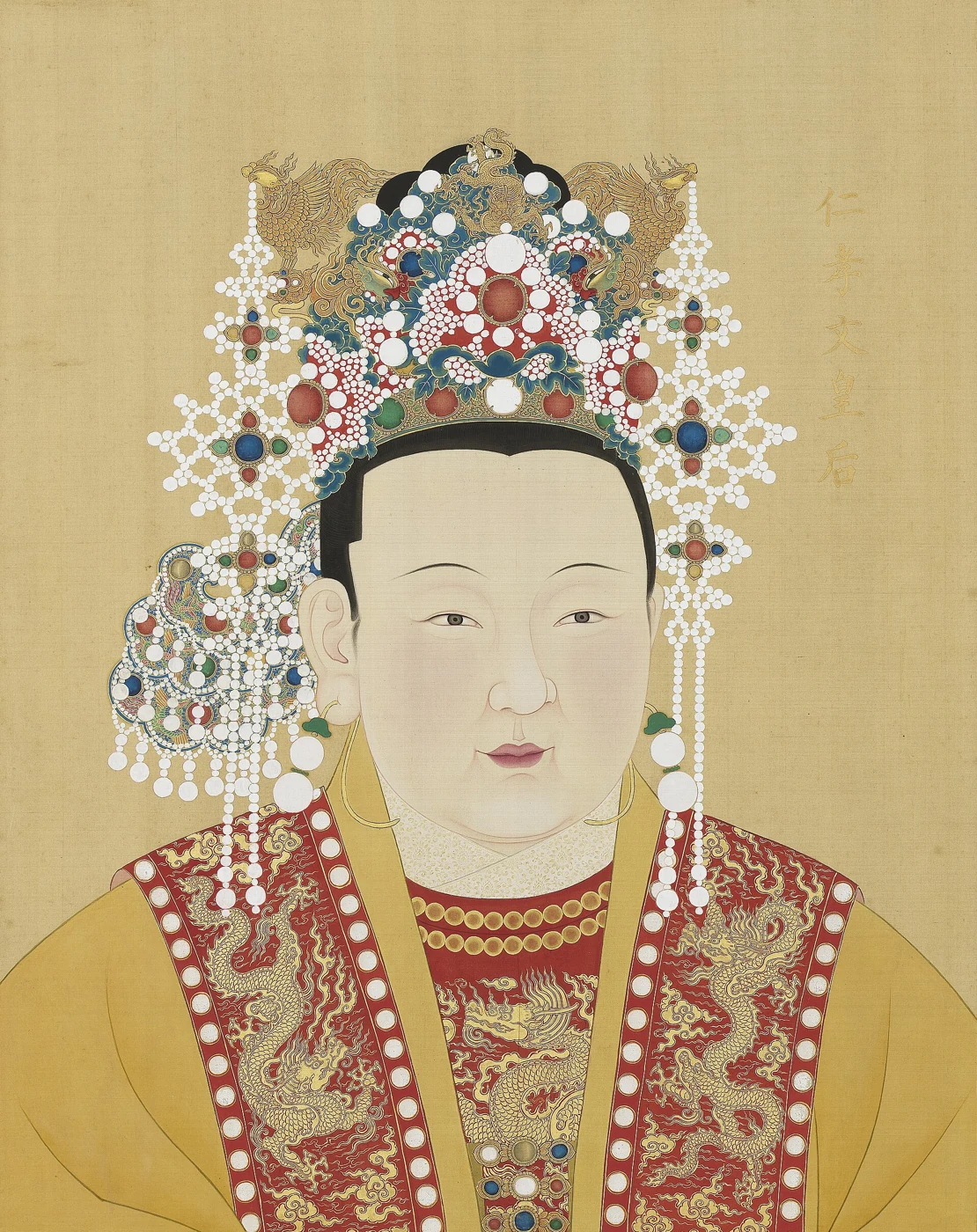
1362 CE–1407 CE
Empress
Empress Xu
徐氏(明成祖皇后)
Empress Xu (1362–1407), posthumously honored as Empress Renxiaowen, was the primary consort of Emperor Yongle (Zhu Di) of the Ming dynasty and the eldest daughter of Xu Da, the foremost founding general and Duke of Wei. Exceptionally educated in the Confucian classics and histories from childhood, she earned the distinguished moniker 'Female Scholar' (Nü Zhusheng). In 1376, she was formally invested as Princess of Yan,…
1362 CE–1407 CEMing Dynasty
PROFILE
Empress Xu (1362–1407), posthumously honored as Empress Renxiaowen, was the primary consort of Emperor Yongle (Zhu Di) of the Ming dynasty and the eldest daughter of Xu Da, the foremost founding general and Duke of Wei. Exceptionally educated in the Confucian classics and histories from childhood, she earned the distinguished moniker 'Female Scholar' (Nü Zhusheng). In 1376, she was formally invested as Princess of Yan, managing the princely household with prudence and virtue. During the Jingnan civil war, when Li Jinglong besieged Beiping with an army of 500,000 imperial troops, Princess Xu donned military armor, ascended the ramparts, and personally directed the city's defense by mobilizing soldiers' wives and civilian women to hurl stones and bricks, successfully preserving the base of the Yan army. After Zhu Di's accession to the throne in 1402, she was installed as Empress. Throughout her tenure, she tirelessly counseled the Emperor to govern with benevolence, appoint virtuous scholars, and curb the aggrandizement of imperial relatives. She authored the twenty-chapter Internal Instructions (Neixun) and the twenty-volume Book of Exhortations to Virtue (Quan Shan Shu) to moralize the populace. She passed away in 1407 at the age of forty-six and was interred in the Changling Mausoleum; deeply devastated, Emperor Yongle never installed another empress for the rest of his reign.
- Other names
- Empress Xu; Empress Renxiao
- Period
- Ming
- Date of Birth
- Not recorded in historical sources
- Date of Death
- Not recorded in historical sources
- Dynasty / Regime
- Ming
- Identity
- Empress
- Ethnicity / Affiliation
- Not reliably confirmed in historical sources
- Clan
- Empress Renxiao of the Xu family
- Native place
- Yongfeng Township, Zhongli County, Hao Prefecture (northeast of present-day Fengyang, Anhui)
- Place of birth
- Yongfeng Township, Zhongli County, Hao Prefecture
- Place of death
- Unknown
- Tenure as empress
- The exact tenure requires verification from reliable historical sources
- Highest office
- See Biography and Major Activities
- Major achievements
- Daughter of Xu Da and empress of Zhu Di; assisted in government with discernment; contributed to the defense of Beiping during the Jingnan Campaign
- Courtesy / Art Name
- Not recorded
- Era
- Ming dynasty
- Dynasty
- Ming Dynasty
- Ethnicity
- Han
- Ancestral Home
- Zhongli, Haozhou (modern Fengyang County, Anhui Province)
- Place of Birth
- Zhongli of Haozhou (present-day Fengyang county, Anhui)
- Place of Death
- Place of death unknown
- Lifespan
- 1362–1407
- Highest Office
- See Biography below
- Major Offices
- See Biography below
- Peerage
- Prince of Zhongshan
- Posthumous Name
- Wuning
- Posthumous Honors
- Three generations were made princes
- Major Achievements
- Defended Beiping ramparts in armor, guided Emperor Yongle with benevolence, restrained consort nepotism, authored Neixun and Quan Shan Shu
LIFE TIMELINE
Selected into the imperial palace for education | Served Empress Ma diligently, earning acclaim as the 'Female Scholar'
Formally invested as Princess of Yan | Married Zhu Di, Prince of Yan, in a grand imperial ceremony
Gave birth to eldest son Zhu Gaochi | Delighted Emperor Taizu and Empress Ma with the imperial heir
Accompanied Prince of Yan to feudal fief in Beiping | Governed the prince's estate with order, justice, and compassion
Father Xu Da passed away | Posthumously created Prince of Zhongshan; Princess Xu observed deep filial mourning
Emperor Taizu passed away; Jianwen began purges | Advised Prince of Yan on strategic defense and survival
Outbreak of the Jingnan Campaign and defense of Beiping | Donned armor atop city walls, directing women to throw stones to defeat Li Jinglong
Zhu Di captured Nanjing and ascended the throne | Formally invested as Empress of the Ming Empire
Hosted banquets for ministerial wives | Encouraged domestic virtues and benevolent household support for ministers
Promulgated twenty chapters of Internal Instructions (Neixun) | Established exemplary moral standards for court consorts and women nationwide
Compiled twenty volumes of Book of Exhortations to Virtue | Synthesized teachings across Confucianism, Buddhism, and Daoism
Passed away in the imperial palace in Nanjing | Died at forty-six; Emperor Yongle suspended court in deep grief, bestowing title Empress Renxiaowen
Coffin transferred to Changling Mausoleum in Beijing | Entombed in Changling; Emperor Yongle refused to designate another empress
In 1409 | In 1409, Emperor Yongle personally selected the site for her eternal resting place in Changling at the foot of Mount Tianshou in Beijing.
In 1413 | In 1413, her coffin was solemnly transferred to the underground palace of Changling.
Father: Xu Da (Foremost Founding General of the Ming Dynasty | Father: Xu Da (Foremost Founding General of the Ming Dynasty, Grand Preceptor, Duke of Wei, Prince of Zhongshan) - Mother: Lady Xie (Duchess of Wei, Princess of Zhongshan) - Husband: Emperor Yongle (Zhu Di, reigned 1402–1424) - Eldest Son: Emperor Renzong (Zhu Gaochi, Hongxi Emperor) - Second Son: Zhu Gaoxu (Prince of Han) - Third Son: Zhu Gaosui (Prince of Zhao) - Grandson: Emperor Xuanzong (Zhu Zhanji, Xuande Emperor) - Brothers: Xu Huizu (Duke of Wei), Xu Zengshou (Duke of Dingguo), Xu Yingxu - Mother-in-Law: Empress Xiaocigao (Empress Ma, wife of Emperor Taizu)
BIOGRAPHY
Biography
Noble Pedigree and the 'Female Scholar'
Empress Xu, posthumously celebrated as Empress Renxiaowen, was born into the most illustrious aristocratic family of the early Ming dynasty. Her father, Xu Da (courtesy name Tiande), was the preeminent founding commander of the Ming Empire, revered at the pinnacle of the six founding princes. From joining Zhu Yuanzhang's banners in 1353 onward, Xu Da campaigned tirelessly across north and south, attaining the supreme ranks of Grand Preceptor, Right Chancellor of the Central Secretariat, and Duke of Wei. In 1368, Xu Da spearheaded the northern expedition that seized the Yuan capital of Dadu, toppling Mongol dynastic hegemony over China. Her mother, Lady Xie, was an aristocratic matriarch known for domestic grace and decorum. Born in 1362 amidst the chaotic final campaigns of the Yuan-Ming transition, Lady Xu was reared in an environment combining martial valor with strict Confucian lineage discipline. As the eldest child among Xu Da's children, she was endowed with exceptional physical beauty, dignity, and intellectual acuity. Xu Da early recognized her rare potential, telling her mother: "This daughter's endowments are extraordinary; her knowledge must be nurtured through the classical canons and dynastic histories." Renowned tutors were engaged to instruct her in classical scholarship. Lady Xu systematically read the Four Books, Five Classics, Zuo Commentary, Records of the Grand Historian, and Book of Han, mastering dynastic ritual protocols. Possessing an eidetic memory, she recited entire scrolls after a single reading and deeply reflected upon the moral conduct of celebrated ancient empresses. Scholars and court elites marveled at her erudition and upright deportment, affectionately conferring upon her the honorary title "Female Scholar" (Nü Zhusheng)—an extraordinary tribute in an era when the status of Zhusheng was reserved exclusively for male scholars who had successfully cleared official regional academic testing. ### Palace Education and Marriage to Zhu Di Emperor Taizu (Zhu Yuanzhang) maintained unbounded trust in Xu Da, treating him as a brother-in-arms and trusted confidant. Aware of Lady Xu's exceptional virtue and intellectual renown, Emperor Taizu summoned Xu Da to the palace, remarking: "I and you arose from humble cotton-clad beginnings to pacify the realm. From antiquity, when enlightened sovereigns and heroic ministers share absolute accord, they forge matrimonial ties to ensure everlasting unity. My fourth son, Zhu Di, possesses heroic stature and talent; hearing that your daughter possesses peerless virtue, could she be matched with my son?" Xu Da reverently prostrated and consented, formalizing their betrothal. In 1373, at the age of twelve, Lady Xu entered the inner palace to serve Empress Ma (Empress Xiaoci). Empress Ma, celebrated for frugality, wisdom, and maternal benevolence, personally oversaw the instruction of imperial daughters-in-law. Lady Xu served Empress Ma day and night with impeccable filial devotion and humility. Deeply enamored of her modesty and intelligence, Empress Ma treated Lady Xu like her own daughter, inculcating principles of palace governance, household discipline, and empathy for commoners. In January 1376, the fifteen-year-old Lady Xu was officially invested as Princess of Yan and married to Zhu Di in a grand imperial ceremony in Nanjing. The young couple, who had grown acquainted during their shared palace upbringing, developed profound mutual respect and companionship. Zhu Di was resolute, bold, and fiercely ambitious, while Princess Xu was composed, perceptive, and morally steadfast. In 1378, she gave birth to Zhu Gaochi (the future Emperor Renzong), bringing boundless joy to Emperor Taizu and Empress Ma. Over subsequent years, she gave birth to Zhu Gaoxu, Zhu Gaosui, and four princesses; all of Zhu Di's early legitimate children were borne by Princess Xu, forging an unbroken bond of love and trust between husband and wife. ### Administration of the Northern Fief in Beiping In 1380, Prince Zhu Di relocated to his assigned fief in Beiping (modern Beijing). Positioned along the northern frontier and facing constant skirmishes against remnants of the Northern Yuan, Beiping was an arduous and strategically sensitive command. While Prince Zhu Di frequently led cavalry deep into the steppe on military expeditions, Princess Xu directed the entire domestic and administrative infrastructure of the princely palace. Princess Xu managed the household with order and benevolence. She instituted rigorous discipline among palace attendants, while displaying profound compassion toward the families of garrison soldiers, regularly providing clothing, grain, and medicinal supplies to the destitute and elderly. Both court dignitaries and regional military commanders came to venerate her wisdom and benevolence. When her father Xu Da died in 1385, Princess Xu mourned him with profound grief, observing traditional vegetarian fasts and rites. Throughout these decades, Princess Xu supervised the education of her sons in both literary classics and martial horsemanship, while providing Zhu Di with acute political counsel on regional and dynastic affairs, serving as his foremost confidante and intellectual partner. ### The Jingnan Crisis and the Defense of Beiping In 1398, Emperor Taizu died, and his grandson Zhu Yunwen mounted the throne as the Jianwen Emperor. Guided by courtiers Qi Tai and Huang Zicheng, the young emperor initiated drastic purges against his imperial uncles, imprisoning or driving several princes to suicide. Surrounded by imperial spies and hostile provincial divisions, the Prince of Yan faced imminent destruction. Princess Xu remained composed and steadfastly encouraged Zhu Di to launch a preemptive campaign for survival. In July 1399, Zhu Di formally raised his banners in Beiping, inaugurating the Jingnan Campaign under the banner of eradicating corrupt councilors. In October 1399, learning that the Prince of Ning held elite Mongol cavalry divisions in Daning, Zhu Di gambled by marching his main army northeast, leaving Beiping garrisoned by only a skeleton force under his ailing eldest son, Zhu Gaochi. Taking advantage of Zhu Di's absence, the imperial commander Li Jinglong converged upon Beiping with 500,000 troops, encircling the city with siege towers and artillery. The defenders were vastly outnumbered, and total collapse seemed imminent. In this supreme crisis, Princess Xu demonstrated the martial genius and courage of her lineage. Casting aside her royal robes, she donned steel armor, climbed the high stone battlements, and assumed operational command alongside Zhu Gaochi. Standing in the line of fire, Princess Xu exhorted the garrison: "The survival of this city is the survival of our lives and families!" Breaking all social conventions, she mobilized thousands of soldiers' wives and civilian women, organizing them into supply lines and artillery squads. Under her direct command, women carried stones, heated boiling water, and systematically stripped roof tiles from residential quarters to hurl down upon enemy troops climbing siege ladders. When freezing winter temperatures set in, Princess Xu directed the defenders to pour water over the outer battlements, transforming the brick walls into vertical sheets of slippery ice. Li Jinglong's assaults were repulsed with staggering casualties. The city held firm for weeks until Zhu Di's victorious relief columns returned from Daning and crushed Li Jinglong's forces, ensuring the ultimate triumph of the Jingnan cause. ### Empress of the Ming and Benevolent Council In June 1402, Zhu Di's forces captured Nanjing, and he ascended the imperial throne as Emperor Yongle. In November of that year, Princess Xu was formally invested as Empress of the Ming Empire in the Kunning Palace. Despite attaining supreme imperial majesty, Empress Xu retained her modesty and dedication to classical virtue. She constantly reminded Emperor Yongle of the heavy toll wrought by the civil war: "Your Majesty obtained the realm through arms, but the empire must be nourished through benevolence and rest. The people have suffered immensely; pacifying and sustaining their livelihoods is the foremost priority." Whenever Yongle returned to the private apartments agitated by political disputes or inclined to execute outspoken censors, Empress Xu gently reasoned with him, securing pardons for numerous upright officials. Empress Xu was especially vigilant regarding her own maternal relatives. When her brother Xu Zengshou was slain by the Jianwen Emperor for aiding Zhu Di, Yongle intended to confer upon him a first-class hereditary dukedom and substantial estates. Empress Xu adamantly opposed the measure, insisting that imperial consorts must never foster nepotism or allow consort clans to usurp political influence. Only after her death did Yongle posthumously elevate Xu Zengshou as Duke of Dingguo. ### Literary Legacy and Moral Philosophy Empress Xu was a prolific scholar whose contributions to moral philosophy and pedagogical literature remain unparalleled among Chinese empresses. In 1404, seeking to provide practical ethical guidance for imperial consorts and women throughout China, she authored the twenty-chapter Internal Instructions (Neixun). Drawing upon the Book of Odes, Rites of Zhou, and classical precedents, the work systematically expounded upon self-cultivation, measured speech, diligence, frugality, benevolence, and maternal pedagogy. In 1405, she compiled the monumental twenty-volume Book of Exhortations to Virtue (Quan Shan Shu), synthesizing the ethical core of Confucianism, Buddhism, and Daoism to illustrate how virtuous conduct generates cosmic harmony and domestic peace. She personally penned the preface and distributed copies to schools, magistrate offices, and families across the empire. In 1406, she supervised the compilation of the Biography of Empress Gao (Gao Huanghou Zhuan) to enshrine the legacy of Empress Ma. ### Final Admonitions and Imperial Mourning In the spring of 1407, Empress Xu fell gravely ill from accumulated exhaustion. Aware that her time was drawing near, she used her final breaths to present vital political admonitions to Emperor Yongle, urging him to recruit talent widely, show forbearance toward the common people, restrain consort kin from political aggrandizement, and provide pensions for the widows and orphans of soldiers who had fallen in the defense of Beiping. Emperor Yongle wept bitterly and pledged to uphold every request. She then summoned Crown Prince Zhu Gaochi and Prince Zhu Gaoxu to her bedside, entreating them to preserve fraternal harmony and govern with compassion rather than vindictiveness. On August 6, 1407 (4th Day of the 7th Month), Empress Xu passed away in the imperial palace in Nanjing at the age of forty-six. Emperor Yongle was utterly devastated, canceling court audiences for a month, wearing mourning robes, and conferring upon her the exalted posthumous title Empress Renxiaowen. In 1409, Emperor Yongle personally selected the site for her eternal resting place in Changling at the foot of Mount Tianshou in Beijing. In 1413, her coffin was solemnly transferred to the underground palace of Changling. Throughout the remainder of his life, despite having numerous concubines, Emperor Yongle never installed another empress, honoring her memory as his only true companion and partner.
Major Activities
Heroic Defense of Beiping Ramparts
During the Jingnan Campaign in 1399, when Li Jinglong besieged Beiping with 500,000 troops, Princess Xu donned steel armor, took command atop the city walls, and organized thousands of civilian women to hurl stones and pour freezing water, repulsing all assaults and safeguarding the base of the Yan army. ### Benevolent Counsel and Tempering Imperial Fury Empress Xu served as a vital check on Emperor Yongle's fiery temperament, consistently urging him to govern with Confucian benevolence, reduce corvee labor, and pardon outspoken scholar-officials facing imperial execution. ### Strict Containment of Consort Kin Vigorously upholding the principle that consort families must not monopolize state power, Empress Xu repeatedly rebuffed Emperor Yongle's attempts to lavish hereditary dukedoms and state stipends upon her brothers, preventing the rise of nepotism. ### Authoring the Neixun and Quan Shan Shu Displaying unmatched literary and philosophical acumen, Empress Xu authored the twenty-chapter Neixun and the twenty-volume Quan Shan Shu, creating seminal treatises on moral cultivation that were promulgated nationwide by imperial decree. ### Nurturing the Sovereigns of the Renxuan Golden Age Empress Xu personally educated Crown Prince Zhu Gaochi (Emperor Renzong) and her grandson Zhu Zhanji (Emperor Xuanzong) in benevolence and rectitude, laying the moral and administrative foundations for the celebrated 'Rule of Ren and Xuan'.
Personal Relations
- Father: Xu Da (Foremost Founding General of the Ming Dynasty, Grand Preceptor, Duke of Wei, Prince of Zhongshan)
- Mother: Lady Xie (Duchess of Wei, Princess of Zhongshan)
- Husband: Emperor Yongle (Zhu Di, reigned 1402–1424)
- Eldest Son: Emperor Renzong (Zhu Gaochi, Hongxi Emperor)
- Second Son: Zhu Gaoxu (Prince of Han)
- Third Son: Zhu Gaosui (Prince of Zhao)
- Grandson: Emperor Xuanzong (Zhu Zhanji, Xuande Emperor)
- Brothers: Xu Huizu (Duke of Wei), Xu Zengshou (Duke of Dingguo), Xu Yingxu
- Mother-in-Law: Empress Xiaocigao (Empress Ma, wife of Emperor Taizu)
Historical Assessment
- Emperor Yongle: 'Since the Empress joined me as consort over thirty years ago, we treated each other with mutual reverence like honored guests. Her domestic support was indispensable to my reign. Her sudden departure leaves me in inconsolable sorrow!'
- Ming Taizong Shilu (Veritable Records of Emperor Taizong): 'The Empress possessed exceptional intellect, surveyed the classics and histories, and acted with absolute decorum. She supported Emperor Taizong in adversity, secured victory during the Jingnan crisis, and morally transformed the world through her writings. She was truly a Yao and Shun among women.'
- History of Ming (Ming Shi): 'Empress Renxiao Xu was the eldest daughter of Xu Da. Upright and fond of learning, she was praised as the Female Scholar... Upon her passing, the Emperor was convulsed with grief, suspended court audiences for over a month, and never elevated another empress for the rest of his life.'
- He Qiaoyuan (Ming Historian, Mingshancang): 'Empress Wen possessed peerless virtue; her assistance during the Jingnan crisis and her philosophical treatises set an eternal standard of maternal majesty for the realm.'
FIGURES ASSOCIATED WITH THIS DYNASTY
Bibliography
- Ming Taizong Shilu (Veritable Records of Emperor Taizong)
- History of Ming, Volume 113, Biographies of Empresses and Consorts, Biography of Empress Renxiao Xu
- Quan Shan Shu (Book of Exhortations to Virtue) by Empress Renxiaowen