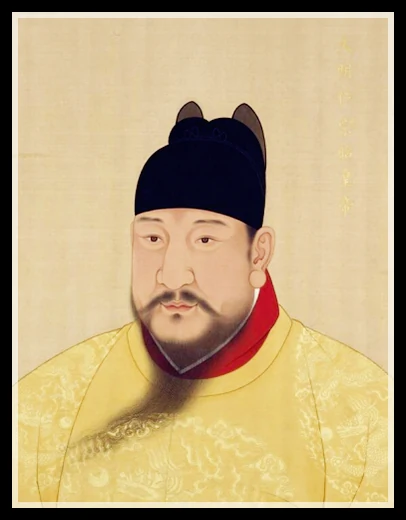
Biography
Family Background and Early Life
Zhu Gaochi was born on 16 August 1378, the 23rd day of the seventh lunar month in the 11th year of the Hongwu era, in Fengyang Prefecture of the Central Capital. His father Zhu Di was then eighteen years old, the fourth son of Emperor Taizu Zhu Yuanzhang and Prince of Yan. His mother was Lady Xu, later Empress Xu, a daughter of Xu Da, Duke of Wei and one of the founding military leaders of the dynasty. The source relates a story that Lady Xu dreamed of a man wearing ceremonial headgear and carrying a jade tablet before giving birth to Zhu Gaochi.
Zhu Gaochi was described as dignified, calm, and serious. Although proficient in archery, he did not enjoy mounted hunting or military pursuits and instead preferred reading and discussing the classics and histories with Confucian scholars. The source presents this disposition as markedly different from Zhu Di's martial temperament and as an early indication of later tensions between father and son.
In the intercalary ninth lunar month of 1395, Zhu Gaochi was made heir to the Prince of Yan. Emperor Taizu Zhu Yuanzhang once tested the heirs of several princes by ordering Zhu Gaochi and the heirs of the princes of Qin, Jin, and Zhou to inspect troops at dawn. Zhu Gaochi returned later than the others and explained that the morning was cold and the soldiers should be allowed to eat before inspection. On another occasion, Zhu Yuanzhang ordered the young princes to sort memorials. Zhu Gaochi submitted those concerning military and civilian affairs but held back documents containing minor textual mistakes. Asked whether he had ignored the errors, he replied that trivial faults should not trouble the emperor. Zhu Yuanzhang was delighted and praised him as having the bearing appropriate to a ruler. When asked how people had survived floods and droughts in the eras of Yao and Tang, Zhu Gaochi answered that the people endured because enlightened rulers adopted good policies of relief. Zhu Yuanzhang again praised him.
Heir of Yan and the Defense of Beiping
In 1399 the Jianwen Emperor Zhu Yunwen pursued a policy of reducing princely power, with the Prince of Yan Zhu Di as a principal target. Zhu Gaochi and his brothers were then in Nanjing. Qi Tai proposed arresting them first, while Huang Zicheng feared that doing so would alert Zhu Di and instead urged that they be released to lull him into complacency. The brothers were allowed to return north. The Jianwen court soon regretted the decision, but they were already beyond reach.
That summer Zhu Di began the Jingnan Campaign. After the veteran Geng Bingwen was defeated, the Jianwen Emperor appointed Li Jinglong commander-in-chief and sent a force described in the source as 500,000 strong northward. In the ninth lunar month Zhu Di led his main army away from Beiping, first moving to relieve Yongping and attack Wu Gao and then advancing on Daning to seize Zhu Quan, Prince of Ning. Before leaving, Zhu Di placed Zhu Gaochi in charge of Beiping, saying that he could win trust and employ men and was capable of defending against the enemy, while warning him not to leave the city for battle.
Beiping's defenders, including elderly and weak troops, numbered fewer than ten thousand, while Li Jinglong's army surrounded the nine gates. Zhu Gaochi supervised the defenses day and night and worked to reassure soldiers and civilians. He treated capable men with respect, consulted experienced military officers and learned civil officials, and entrusted them with responsibility. According to the source, he rose before dawn and rested only late at night. When attendants urged him not to exhaust himself, he replied that his father was facing danger in the field and that a son could not remain at ease, especially when Beiping was the essential base of the Yan army. On major matters he first sought the approval of the Princess of Yan, Lady Xu. Zhu Gaochi also repeatedly sent men out at night to raid enemy camps, creating confusion in the besieging army. In the 11th lunar month Zhu Di returned from Daning with Zhu Quan. After Zhu Di defeated Li Jinglong at Zhengcunba, Zhu Gaochi led troops out of the city to attack from within and without, and the siege was lifted.
Although Zhu Gaochi's defense was crucial, Zhu Di favored his second son Zhu Gaoxu, who accompanied him on campaign, while the youngest son Zhu Gaosui also enjoyed favor. The eunuch Huang Yan, associated with Zhu Gaosui, slandered Zhu Gaochi by claiming that he was close to the imperial court and intended to hold Beiping against his father. Zhu Gaoxu added that Zhu Gaochi had been close to Zhu Yunwen while Emperor Taizu was alive.
In 1401 Fang Xiaoru learned through his disciple Lin Jiayou that the brothers in the Yan household were divided and proposed a counterintelligence scheme to the Jianwen Emperor. He wrote directly to Zhu Gaochi, promising him the position of Prince of Yan if he submitted to the court, and deliberately publicized the letter. Huang Yan immediately informed Zhu Di at the front that the heir was conspiring with the Jianwen Emperor. Zhu Gaochi, however, sent the still-sealed letter together with the bound messenger to Zhu Di, thereby dispelling his father's suspicions.
Crown Prince and Years of Regency
In 1402 Zhu Di captured Nanjing and became emperor. Zhu Gaochi was still left to guard Beiping, soon renamed Beijing, while Zhu Gaoxu, who had entered Nanjing with the army, was also sent back north.
Zhu Di did not immediately name a crown prince. Military leaders who had risen through the Jingnan Campaign, including Qiu Fu, Duke of Qi, and the imperial son-in-law Wang Ning, Marquis of Yongchun, admired Zhu Gaoxu's battlefield record and petitioned for him to be designated heir. Zhu Di hesitated. Jin Zhong, Minister of War, recounted historical disasters caused by replacing an elder heir with a younger one and strongly supported Zhu Gaochi. Zhu Di privately consulted Xie Jin, Huang Huai, and Yin Changlong, all of whom agreed. Xie Jin also reminded the emperor of his “good imperial grandson,” Zhu Gaochi's son Zhu Zhanji, whom Zhu Di greatly favored. Zhu Di finally decided in Zhu Gaochi's favor.
In the second lunar month of 1404, Zhu Di sent Zhang Xin, Marquis of Longping, and Wang Ning to summon the three brothers to Nanjing. In the fourth lunar month Zhu Gaochi was invested as crown prince; Zhu Gaoxu became Prince of Han and Zhu Gaosui Prince of Zhao.
Zhu Gaoxu remained dissatisfied. Zhu Di assigned his princely domain to Yunnan, but Zhu Gaoxu refused to leave the capital. Zhu Gaochi interceded for him, allowing him to remain temporarily in Nanjing. Zhu Gaoxu compared himself to Li Shimin and requested the Tiance Guard as his personal military establishment. Zhu Gaosui was also once stripped of his cap and belt because of misconduct and recovered them only after Zhu Gaochi interceded.
Although Zhu Gaochi had formally become crown prince, his position remained insecure. He was corpulent and had difficulty walking, and his lack of skill in mounted warfare displeased Zhu Di. Zhu Gaoxu and Zhu Gaosui repeatedly accused him, and officials attached to the Eastern Palace were frequently punished. Xie Jin angered Zhu Di by warning him not to encourage a succession struggle; after later accusations by Zhu Gaoxu, Xie was killed in 1415. Huang Huai and others were imprisoned. Geng Tong, vice director of the Court of Judicial Review, spoke on behalf of the crown prince and was executed by slow slicing on the charge of lobbying for the Eastern Palace, violating ancestral rules, and alienating father and son.
In 1409, the seventh year of the Yongle era, Zhu Di made his first northern tour to Beijing and ordered the crown prince to act as regent. Before leaving, he summoned Jin Zhong, Jian Yi, Huang Huai, and Yang Shiqi and instructed them to assist the regency, invoking the precedent of Fang Xuanling assisting Emperor Taizong of Tang. After returning, Zhu Di asked Yang Shiqi how the regency had been conducted. Yang praised the crown prince's natural ability, willingness to recognize and correct mistakes, and concern for the people. Zhu Di was pleased.
In 1414 Zhu Di returned from his second personal campaign against the Mongols. Zhu Gaochi sent Jin Zhong to receive him but did not personally meet the emperor at Shahe until late July. Zhu Di was furious, and Huang Huai and other Eastern Palace officials were imprisoned. Yang Shiqi alone remained free and accepted responsibility on behalf of the officials, insisting that the crown prince was sincerely filial and respectful. Zhu Gaochi again survived the crisis.
In 1417, during Zhu Di's third northern tour, Zhu Gaochi acted as regent. After accusations that the Eastern Palace had committed many errors, Zhu Di secretly instructed Hu Ying, left vice minister of the Ministry of Rites, to stay several extra days in Nanjing during an official journey and investigate the crown prince's conduct. Hu recorded seven matters showing Zhu Gaochi to be sincere, respectful, filial, and cautious and submitted them in a secret memorial. Zhu Di was pleased and thereafter ceased to suspect the crown prince in the same way.
In 1420, after the Beijing palace complex was completed, Zhu Di summoned Zhu Gaochi to Beijing, ending the third regency. From 1422 to 1424 Zhu Di personally campaigned against the Mongols three more times, and the crown prince again acted as regent. By this period Zhu Di's health had declined, and Zhu Gaochi handled much day-to-day state business even when the emperor was in Beijing. During these years the commander Meng Xian was implicated in a plot to poison Zhu Di, depose the crown prince, and enthrone Zhu Gaosui, Prince of Zhao. After the plot failed, Zhu Gaochi again defended Zhu Gaosui and said the affair was the work of subordinates, helping save his brother from punishment.
Reign and the Hongxi Reforms
On the 18th day of the seventh lunar month in 1424, Zhu Di died at Yumuchuan while returning from a northern expedition. Grand Secretaries Yang Rong and Jin Youzi feared unrest by the guards of the Prince of Zhao if the news spread prematurely, so the death was kept secret. Yang Rong and the eunuch Hai Shou hurried to the capital with the testamentary order. Zhu Gaochi sent the imperial grandson Zhu Zhanji beyond Juyong Pass to receive the funeral cortege. On 7 September 1424, Zhu Gaochi formally ascended the throne, proclaimed a general amnesty, and announced that the next year would begin the Hongxi era.
After taking the throne, Zhu Gaochi quickly adopted a series of policies presented as lenient and humane. Economically, he ordered the suspension of Zheng He's maritime expeditions, stopped procurement in Yunnan and Jiaozhi, prohibited state purchase of private gold and silver, and abolished the administrative stores of the two capitals in order to reduce state expenditure. Politically, he restored Xia Yuanji and Wu Zhong to office, restored several high honorary offices, appointed Yang Rong as minister of the Court of Imperial Sacrifices, Jin Youzi as vice minister of Revenue and Grand Secretary, Yang Shiqi as left vice minister of Rites and Grand Secretary of the Huagai Hall, Huang Huai as transmission commissioner and Grand Secretary of the Wuying Hall, and Yang Pu as a Hanlin academician. The standing of the Grand Secretariat rose markedly. Militarily, he adjusted the senior commanders stationed at Datong, Jiaozhi, Shanhai, and Liaodong and established a permanent defense arrangement for Nanjing.
That winter he invested Lady Zhang as empress and named his eldest son Zhu Zhanji crown prince, while his other eight sons were enfeoffed as princes. He then ordered pardons for former officials of the Jianwen Emperor and for relatives of officials who had been implicated and exiled during the Yongle reign, and remitted tax grain in disaster-stricken areas.
In the spring of 1425, the first year of the Hongxi era, a solar eclipse led him to cancel banquets and music. He established the Hongwen Pavilion and placed Yang Pu in charge. He repeatedly called for direct remonstrance and was described as willing to hear criticism. In the third lunar month he issued an order on criminal justice intended to correct extralegal punishments used since the Hongwu era: except in cases of rebellion and high treason, collective liability was to be limited; punishments such as slow slicing and other tortures outside the legal code were restricted; and accusations of defamation were not automatically to be prosecuted. The source presents these measures as popular with the people.
Renzong was nevertheless in poor health and reigned for only ten months. In the fifth lunar month of the Hongxi year, the court lecturer Li Shimian submitted a memorial remonstrating over the selection of palace women. The emperor became angry and ordered guards to strike him with a metal mace, breaking three ribs, and imprisoned him. The lecturer Luo Rujing was likewise imprisoned after remonstrating. A day or two later the emperor fell ill, urgently summoned Crown Prince Zhu Zhanji from Nanjing, and prepared a testament naming him successor. On 29 May 1425, Zhu Gaochi died at Qin'an Hall at the age of forty-seven. His temple name was Renzong, and he was buried at Xianling in present-day Changping, Beijing.
After his death the system of consort burial sacrifice maintained under Emperor Taizu and the Yongle Emperor was continued, and five consorts were sacrificed according to the source.
His Birth and the Esteem of the Founder
Zhu Gaochi was the eldest son of Zhu Di by his principal wife, and tradition has it that the empress Renziao Wen dreamed that a man with a crown and a jade tablet came to visit her before he was born. By nature he was grave and quiet, and though his archery was excellent he did not care for riding and shooting but loved reading and often discussed with the Confucian ministers. The founder once ordered Zhu Gaochi and the heirs of the princes of Qin, Jin and Zhou to review troops at dawn, and Zhu Gaochi alone returned late; and Zhu Yuanzhang asking the reason, he explained that the morning was too cold and the review should wait until the soldiers had breakfasted. The founder then had Zhu Gaochi read the memorials in portions, and he took only those closely concerning the affairs of soldiers and people to present, and of memorials with errors in the writing he presented none and pointed out no such errors; and when the founder reproved him for overlooking the errors, Zhu Gaochi held that trifling mistakes should not be allowed to trouble the emperor, at which the founder was greatly pleased and praised him as having the measure of a ruler. The founder also asked him what the people could rely on in flood and drought, and Zhu Gaochi said that the people came through calamity because a wise lord had good policies of compassion for them, and the founder was much pleased with such understanding. Zhu Di too once asked him why the gentleman was hard to advance and easy to retire and the petty man the contrary, and Zhu Gaochi answered that the petty man showed off his talents without shame while the gentleman kept to the Way without desire; and being asked why the petty man's power was usually victorious, he said that it depended on the likes and dislikes of those above, and that with a wise lord above the gentleman would surely win; and being asked whether a wise lord used no petty men at all, he said that a petty man of real talent who could not be discarded should be constantly warned and restrained so that he had no chance of fault. Zhu Di was greatly pleased and praised his kindly nature, upright judgement and progress in learning, and charged the grand secretary of the right spring workshop, Huang Huai, and the left assistant of instruction, Yang Shiqi, to do their utmost to guide him. Zhu Gaochi was stout, his waist several spans about; and Zhu Di often had the heir and the princes practise riding and shooting, and Zhu Gaochi being unable by reason of his bulk, Zhu Di was angry and had the office concerned cut down his food, and an officer who privately gave him food from his own house during the serving of meals was one whom Zhu Gaochi remembered with gratitude, though Zhu Di, learning of it, had the officer minced into meat paste, and Zhu Gaochi on coming to the throne had his descendants given office.
The Defence of Beiping in the Jingnan War
When the war of Jingnan broke out Zhu Gaochi held Beiping as heir. At that time Li Jinglong and the others, though checked by Zhu Di, could not be strongly guarded against for want of troops, so that Li Jinglong reached Beiping without effort. Zhu Gaochi had then only the old and weak, less than ten thousand men; and Li Jinglong camped outside the city and invested it so that not a drop could pass, and massed his troops to storm the nine gates of Beiping. Before Li Jinglong invested the city Zhu Gaochi had already prepared for it, overseeing the defences day and night and taking care to soothe the soldiers and people of the city, so that within Beiping all were glad; and he not only honoured the worthy and questioned the old soldiers and the able clerks, taking counsel with them and treating them with sincerity, so that all within the city did their utmost, but set an example himself, rising at the fourth watch and resting only at the second, and when those about him thought the heir too weary he held that his father and lord was braving dangers abroad and that this was no time for a son to be idle and at ease, and that Beiping being the root of the Yan army and the place the southern army must take, its defence could not be neglected; and whatever great matter was to be done must first be reported to the princess of Yan, the lady Xu. Zhu Gaochi was by nature calm and not easily thrown into disorder, and with the lady Xu's help everyone in Beiping was full of fight. He also several times sent men by night to open the gates and raid the enemy camps, so that the southern army in its panic killed one another; and Li Jinglong and the others, investing the city long without success while their soldiers were harassed at night by the Yan troops and could not rest, had to withdraw their camp more than ten li. In the eleventh month Zhu Di, returning from Daning with the troops he had taken by holding the prince of Ning, came back and attacked from within and without and won a great victory. Zhu Gaoxu had slandered Zhu Gaochi to Zhu Di, saying that he was close to the court and would hold Beiping for the court against his father; and when Zhu Di doubted it and said that his elder brother had always been filial and how could this be, Zhu Gaoxu added that his brother was indeed filial but that under the founder he had been on good terms with the grand imperial grandson. The Jianwen emperor too sent a letter to Beiping offering the title of prince of Yan to win Zhu Gaochi over to the court, and purposely spread the matter abroad; and the eunuch Huang Yan at once told Zhu Di at the front that Zhu Gaochi was in league with the Jianwen emperor and that his envoy had reached Beiping. But Zhu Gaochi had the letter, still unopened, and the envoy bound and sent to Zhu Di's camp, and by this act dispelled his doubts.
The Contest over the Succession
After Zhu Di came to the throne he did not at once make Zhu Gaochi heir apparent, but there was a contest. At that time a group of generals who had followed Zhu Di in war, with the mind of political gamblers, saw that Zhu Gaoxu had won great merit in the Jingnan war and was much loved by Zhu Di, and that if he were made heir the military interest would profit more; and so with the duke of Qi, Qiu Fu, at their head they took Zhu Gaoxu's part and urged Zhu Di to set him up. Only Jin Zhong held it wrong, and before Zhu Di he recounted the cases of legitimate and illegitimate sons in antiquity; and Zhu Di, unable to overbear him, secretly told Xie Jin, Huang Huai and Yin Changlong, who all held Jin Zhong's words right. Zhu Di then secretly asked Xie Jin, who said that the eldest son was benevolent and filial and that the realm turned its heart to him; and Zhu Di not answering, Xie Jin bowed his head again and said "a good imperial grandson," meaning the Xuande emperor, and Zhu Di nodded, and the heir was fixed. In the second year of Yongle Zhu Di sent the marquis of Longping, Zhang Xin, and the commandant of the imperial son-in-law, the marquis of Yongchun, Wang Ning, to summon the three brothers Zhu Gaochi, Zhu Gaoxu and Zhu Gaosui to Nanjing, and made Zhu Gaochi heir apparent and enfeoffed the second son Zhu Gaoxu as prince of Han and the third Zhu Gaosui as prince of Zhao. Though Zhu Gaochi was duly made heir apparent his position was not secure, and his conduct often did not please Zhu Di, while Zhu Gaoxu was the more favoured and his rank and ceremonial exceeded that of the principal line. Xie Jin memorialised against it, saying that this would breed contention; and Zhu Di at once flew into a rage, saying that Xie Jin was estranging flesh and blood, and thereafter Xie Jin, Huang Huai and the rest were purged for having supported Zhu Gaochi: in the eighth year of Yongle Xie Jin came to the capital on business while Zhu Di was on the northern campaign, and having visited the heir apparent returned; and the prince of Han said that Xie Jin had spied out the emperor's absence, privately seen the heir and gone straight back, without the conduct of a subject, at which Zhu Di was greatly angered; and in the thirteenth year the commander of the embroidered-uniform guard, Ji Gang, presented the list of prisoners and Zhu Di, seeing Xie Jin's name, asked whether he were still alive, and Ji Gang made him drunk with wine and buried him in the snow, and he died at once at forty-seven, his house being confiscated and his wife, sons and clan banished to Liaodong.
Twenty Years of Regency and the Slanders
In the eighth month of the sixth year of Yongle Zhu Di decreed that at the beginning of his rule he had raised Beiping to be Beijing, and that now the four seas were clear and the people at peace, and that he would make a progress to Beijing in the second month of the next year and have the heir apparent hold the government. Thereafter, because of the northern campaigns and the plan to move the capital, Zhu Di stayed long at Beijing while Zhu Gaochi held the government at Nanjing, holding it twenty years in all, and in that time suffered slander again and again and was near to danger. Zhu Di, returning to the capital, once asked the Hanlin academicians Yang Shiqi and the others who had assisted Zhu Gaochi's regency how the heir had governed, and Yang Shiqi answered with the word filial and reverent, adding that the heir was gifted by Heaven, so that if he erred he knew it and knowing it amended it, and that he had a heart that loved men and would never fail the emperor's trust, at which Zhu Di was well pleased. The chief of the transmission office, Chen Tong, having been late in welcoming the imperial carriage, Huang Huai and the other officers of the eastern palace were put in prison one after another, and only Yang Shiqi was kept by Zhu Di and asked about the regency, and Yang Shiqi said that the heir's filial reverence was perfect and that whatever had been delayed was the fault of themselves, the ministers, at which Zhu Di was well pleased and Zhu Gaochi too came through. Zhu Gaoxu, returning to Nanjing, lent money at usury, seized the people's goods by force, privately made weapons, secretly kept strong men, usurped the imperial carriage and dress, and even of himself killed the commander of the horse and foot police, Xu Yelü, who had been examining the crimes of the strong men under him; and Zhu Gaochi let it all pass with mild reproof. In the fourteenth year of Yongle Zhu Gaoxu, hearing that Zhu Di was ill at Beijing, grew yet more restless; and Zhu Di, learning of it, was greatly angered and in the tenth month returned to Nanjing and published several tens of his crimes and had him confined at the Xihua gate facing heavy punishment; and Zhu Gaochi repeatedly crawling on the ground pleaded for him, so that in the end Zhu Di restored his cap and belt and cut off two of his guards, and the next year forced him to his fief. Zhu Di also once took the chance of a southern tour of Jiangsu and Zhejiang to stay longer at Nanjing and examine Zhu Gaochi's conduct carefully, and the vice-minister of rites Hu Ying recorded seven matters, all of which showed Zhu Gaochi's sincerity, reverence, filial piety and carefulness, and Zhu Di, receiving the secret memorial, doubted him no more: one of these was that at a court audience a certain meritorious minister shouted at a guard and even struck him, and Zhu Gaochi said he would not look into it, but after the audience at once summoned the guard to the hall and gave him several strings of cash, so that the ministers all said that the heir did not openly reprove the great minister but honoured the guard, thereby forgiving his fault and shaming his heart, which was the heir's clear judgement. From the twentieth to the twenty-second year of Yongle Zhu Di made three personal campaigns against the Mongols, each time still having Zhu Gaochi hold the government; but Zhu Di's health was failing, so that even when he was at Beijing the government was mostly handled by Zhu Gaochi. In this time occurred the plot of the commander of the Changshan middle guard, Meng Xian, to poison Zhu Di, depose Zhu Gaochi and set up the prince of Zhao, Zhu Gaosui; and during the trial Zhu Gaochi again spoke for Zhu Gaosui, saying that it was all the doing of his servants, so that Zhu Gaosui escaped disaster.
His Accession and His Government
On the eighteenth day of the seventh month of the twenty-second year of Yongle Zhu Di, sixty-five years old, died at Yumuchuan on the way back from the northern campaign; and before his grave illness he had issued a testament passing the throne to the heir apparent Zhu Gaochi, giving him a jade tally inscribed that the lord of men is upright and central. Someone reported it in secret to the capital, and Zhu Gaochi at once sent his son Zhu Zhanji out of the capital to meet the coffin; and to steady the situation was his first task. On the second day of the eighth month of the twenty-second year of Yongle Zhu Gaochi summoned the minister of personnel Jian Yi and the grand secretaries Yang Rong and Yang Shiqi and his other confidants to discuss the dispositions, and at the same time consulted the minister of rites. Because Zhu Di had been on the northern campaign, the picked troops had gone with him and most of those in the capital were old and weak; and to guard the capital, on the fourth day of the eighth month Zhu Gaochi at once sent letters to the marquis of Ningyang and the others who had gone with the campaign. He also gave Jian Yi, Yang Shiqi, Yang Rong and Jin Youzi silver seals inscribed with the words correcting faults and mending errors, giving them the power to send memorials of remonstrance straight to the imperial presence under that seal, and said that between lord and minister there should be perfect sincerity, so that the court might have no faulty government and the people no loss of their place, and that he and they should not fail the heavy trust their ancestors had left. Zhu Gaoxu several times sent several tens of men to spy, sometimes five or six times in a day and night; and when someone advised Zhu Gaochi to seize Zhu Gaoxu at once he would not listen, but eight days after his accession of himself summoned him to the capital, increased his annual stipend and gave him rich gifts. Zhu Gaoxu told Zhu Gaochi the reports Zhu Zhanqi gave him, such as that the court was deliberating to send troops against Le'an; and Zhu Gaochi reproved him, asking how, when he himself lent ear to empty words to estrange his brothers, others should not do so. Zhu Gaoxu asked leave to kill his son, and Zhu Gaochi would not allow it but sent him to Fengyang to guard the imperial tombs. Zhu Gaochi employed worthy and capable officers to fill the administrative offices, and of his new appointments many had already served him when he held the government at Nanjing or Beijing. In the winter of the eighteenth year of Yongle, on his way from Nanjing to Beijing, Zhu Gaochi passed Zou county in Shandong and saw men and women carrying baskets to gather grass seed by the roadside; and Zhu Gaochi halted his horse and asked what they gathered the grass for, and the people kneeling said that the year was barren and they ate it, at which Zhu Gaochi was moved to pity; and entering their houses he saw the men and women in patched clothes that did not cover them and their cooking vessels broken, and sighed. The Shandong provincial administrator Shi Zhizhong came to meet him, and Zhu Gaochi reproved him, asking whether it moved him that the people were so poor for whom he was shepherd; and Shi Zhizhong said that wherever there had been calamity he had already memorialised asking the remission of that year's autumn tax, and Zhu Gaochi said that the people were starving and dying and what was the use of discussing taxes, and that he should at once issue official grain to relieve them and the matter could not be delayed; and Shi Zhizhong asking whether three dou a head might be given, Zhu Gaochi said to give six dou, and told him not to fear having opened the granaries without authority, for he would memorialise the emperor himself.
The Proposal to Return to Nanjing and His Death
After Zhu Di's success in the Jingnan war the criminal law was severe, especially toward the Jianwen ministers who would not submit; and Zhu Gaochi after taking the throne made a series of adjustments, summoning the principal officers of the five offices, six ministries, transmission office, six offices of supervising secretaries and the three judicial offices to a joint hearing at the Chengtian gate to avoid wrongful convictions. He then summoned the grand secretaries Yang Shiqi, Yang Rong and Jin Youzi to his bedside and said that the recent laxness of the judicial offices was not unknown to him, that the crimes of great treason they alleged often came of weaving and forging, that the late emperor had repeatedly warned them strictly so that death sentences were memorialised four or five times, and yet the judicial offices paid no heed and were content to be cruel clerks without shame; and that from now on, in the trial and decision of capital prisoners, the three should sit in judgment together. He also twice pardoned the families of the Jianwen ministers, releasing those sent to the embroidered-uniform guard, the music office, the laundry office and the houses of meritorious ministers to become commoners, restoring their lands, and where a whole family had been sent to the frontier keeping one man and sending the rest home. In the Yongle period the quotas for the examinations were not equal between north and south and the regional difference was not settled by institution; and in the fourth month of the first year of Hongxi Zhu Gaochi, on Yang Shiqi's advice, instructed the ministry of rites that scholars in the examinations must be taken from both south and north, that the southerners were good at letters while the northerners were solid, and that in the recent examinations the northerners had been but one in ten, which was not the way to deal openly with the realm; and that from now the examinations should take six parts southerners and four parts northerners, and that the ministry should settle the numbers for each province and report. Many ministers then memorialised asking for the return of the capital to Nanjing, and Zhu Gaochi was moved and in the third month of the first year of Hongxi formally proclaimed that the capital would return to Nanjing and that the offices at Beijing should all be styled the travelling court and the Beijing travelling ministry and travelling rear office of the five armies restored; but in this time there were continual earthquakes at Nanjing and the return was never carried out, and he had to send the heir Zhu Zhanji to Nanjing first, and himself died soon after. Even on his deathbed he did not forget the matter, saying in his testament that the toil of supplying north and south left soldiers and people alike in distress, and that the whole realm turned its eyes to Nanjing, which had always been his own wish. The system of eunuchs holding garrison commands continued, and Zhu Gaochi also raised the standard of the defences, ordering the passes and watchtowers to keep watch day and night with all care and to let no negligence occur, and charging the commanders and defending officers of Ningxia, Gansu, Liaodong, Xuanfu, Shanhai, Yongping and Kaiping to do the same, and appointing the assistant commander of the travelling rear office of the five armies, Li Jing, to hold the post. In the fifth month of the first year of Hongxi Zhu Gaochi summoned Jian Yi and Yang Shiqi to the Fengtian gate and told them that in twenty years of regency he had been slandered and the perils of his heart had been shared by the three of them, and that but for the late emperor's benevolence and discernment he had been preserved, and having spoken he wept, and Jian Yi and Yang Shiqi wept too; and Zhu Gaochi said that after his death who would know that the three of them had been of one heart and one sincerity, and gave them each a decree and a seal, Yang Shiqi receiving the seal Yang Zhenyi. Within a month the imperial carriage had passed away.