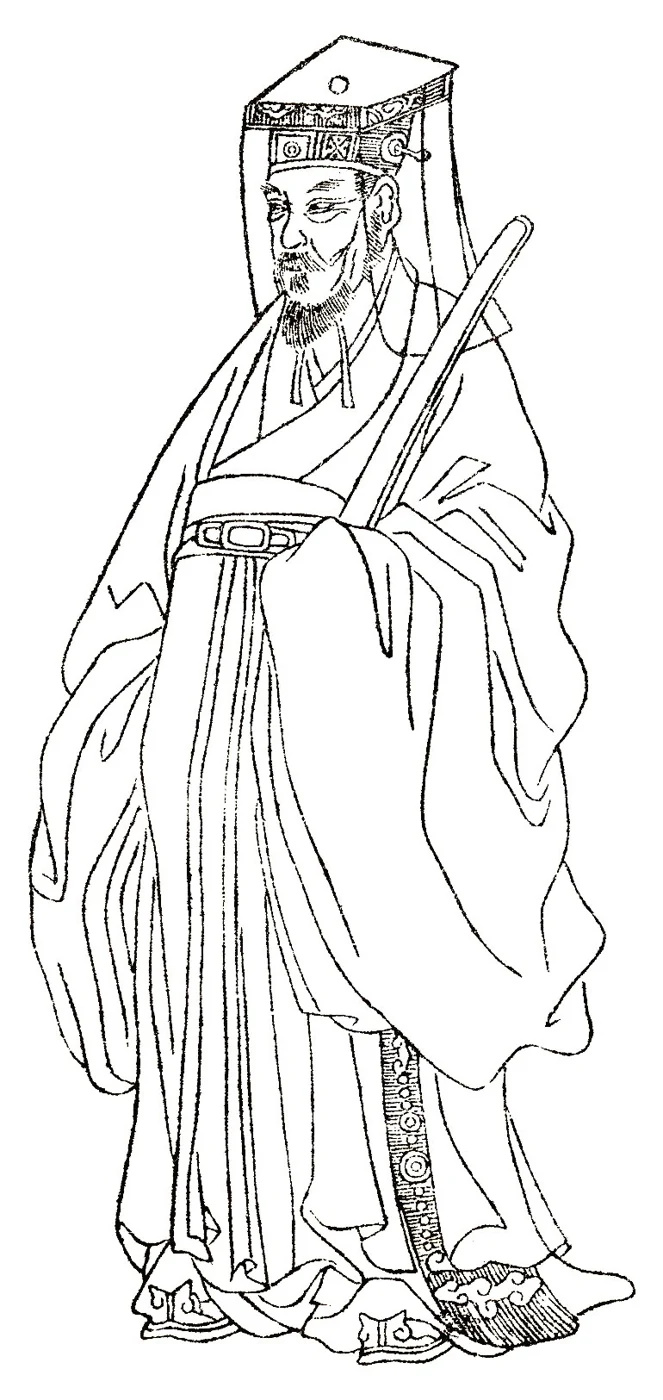
Biography
Family Background and Early Life
Yu Qian was born in 1398, the thirty-first year of the Hongwu era, in Taiping Ward, Qiantang County, Hangzhou Prefecture, Zhejiang, in what is now Citang Lane in Shangcheng District, Hangzhou. The Yu family's ancestral home was in Kaocheng, roughly corresponding to present-day Minquan and Lankao counties in Henan. His ancestor Yu Bohan had first lived in Shanxi and later moved to Suzhou. His great-grandfather Yu Kui served as an official under the Yuan, and his great-grandfather Yu Jiusi served as Grand Chief Administrator of Hangzhou Circuit, after which the family moved to Taiping Ward in Qiantang. His grandfather Yu Wenming served as a secretary in the Ministry of Works during the Hongwu era, while his father Yu Yanzhao remained in Qiantang and did not enter office.
Yu Qian studied diligently from childhood and had lofty ambitions. He admired Wen Tianxiang's integrity and kept a portrait of Wen beside his seat for decades. When Yu was seven, a monk who saw him is said to have remarked that he would one day become a chief minister who rescued the state in a time of crisis. At eight, while riding a black horse in red clothes, an elderly neighbor teased him with a line about a “red child riding a black horse through the street.” Yu Qian immediately replied with a matching line about the “son of the Red Emperor cutting down the white serpent in the road,” an answer regarded as both neatly balanced and unusually bold for a child.
Examination Success and Early Official Career
In 1420, Yu Qian passed the Zhejiang provincial examination. In 1421, he passed the metropolitan examination and entered official service. Early in the Xuande era he was appointed Investigating Censor. When responding to Emperor Xuanzong of Ming, he spoke fluently and with broad learning, winning the emperor's attention. Chief Censor Gu Zuo was normally severe toward his subordinates, but showed unusual respect toward Yu Qian and considered his ability superior to his own.
In 1426, Prince of Han Zhu Gaoxu rebelled at Le'anzhou. Yu Qian accompanied Emperor Xuanzong Zhu Zhanji on the imperial campaign. After Zhu Gaoxu surrendered, the emperor ordered Yu Qian, as a censor, to enumerate his crimes. Yu denounced him in severe and forceful language until Zhu reportedly bowed his head, trembled on the ground, and declared that he deserved death. The emperor was delighted and immediately sent Yu Qian to inspect Jiangxi. There he overturned several hundred wrongful convictions and also memorialized the throne about officials and military personnel harassing the people in Shaanxi, leading to an order that censors arrest those responsible.
Nineteen Years Governing Henan and Shanxi
In 1430, Emperor Xuanzong decided Yu Qian could bear major responsibilities. As the court was creating provincial grand coordinator assignments for vice ministers, the emperor personally wrote Yu's name and gave it to the Ministry of Personnel. Yu was promoted exceptionally to Vice Minister of War and appointed grand coordinator of Henan and Shanxi. He traveled lightly on horseback throughout his jurisdictions, spoke with local elders, investigated measures that needed to be introduced or reformed, and memorialized the court immediately. He submitted several memorials each year and reported even minor floods or droughts without delay.
In 1441, Yu Qian proposed that Henan and Shanxi use their large grain reserves to relieve poorer households lacking food. Each third lunar month, prefectures, subprefectures, and counties were to report needy households and distribute grain by quota—first beans and sorghum, then millet and wheat, and finally rice—with repayment after the autumn harvest. The elderly, sick, and impoverished who could not repay were to be exempted. Local officials whose terms had expired would not be allowed to leave if reserve stocks were insufficient, and supervisory officials were to inspect the system regularly. The emperor ordered the proposal implemented.
The Yellow River frequently breached its dikes in Henan. Yu Qian ordered the embankments reinforced, had pavilions established at intervals with local headmen responsible for supervising repairs, and directed residents to plant trees and dig wells. Elm and willow trees came to line the roads, and travelers no longer lacked water. Because Datong lay isolated beyond the frontier and officials responsible for Shanxi often could not reach it, Yu requested that a separate censor be appointed for the area. He also confiscated privately cultivated fields held by frontier commanders and turned them into official military farms to support border expenses. His authority and reputation spread widely, and bandits in the Taihang Mountains were said not to dare show themselves.
Early in the Zhengtong era, senior grand secretaries Yang Shiqi, Yang Rong, and Yang Pu all valued Yu Qian. His requests were often approved the same day. After the “Three Yangs” died, eunuch Wang Zhen gained power and openly solicited bribes. Officials competed to offer gifts. Those seeking an audience with Wang were said to bring one hundred taels of silver, while a thousand taels secured wine and food. Yu Qian never brought gifts when he entered the capital to report. When someone suggested that if he would not bring gold or silver he might at least bring local products, Yu shook his empty sleeves and replied that he had only the pure breeze. He also wrote the poem “Entering the Capital” to express this position, saying that silk handkerchiefs, mushrooms, and incense, though meant for people's use, had become a burden, and that he would go to court with nothing but pure wind in his sleeves so the common people would have no cause to criticize him.
In 1446, when Yu Qian entered court and recommended Wang Lai and Sun Yuanzhen to replace him, Communications Commissioner Li Xi, acting to please Wang Zhen, accused Yu of resentment at not having been promoted and of improperly nominating his own replacements. Yu was sent to the judicial authorities, sentenced to death, and imprisoned for three months. When the people learned of the sentence, widespread outrage led to collective petitions. Wang Zhen eventually found a way to retreat, claiming he had confused Yu Qian with another man of the same name with whom he had a grievance. Yu was released and demoted to Vice Minister of the Court of Judicial Review.
Officials and commoners from Shanxi and Henan then gathered at the palace gates by the thousands to petition that he remain in office. Princes including the Prince of Zhou and Prince of Jin also submitted memorials, and Yu Qian was again appointed grand coordinator. At the time more than 200,000 refugees from Shandong and Shaanxi had entered Henan in search of food. Yu asked that stored millet from Henan and Huaiqing prefectures be released for relief and requested that Provincial Administration Commissioner Nian Fu gather and resettle the refugees, providing them with land, cattle, and seed under the supervision of village elders. Yu Qian served in the region for nineteen years. When his parents died, he was allowed to return home for mourning, but before long was recalled to his former duties.
The Tumu Crisis and Emergency Appointment
In 1448, Yu Qian was recalled to Beijing as Left Vice Minister of War. In the seventh month of 1449, Oirat leader Esen launched a major invasion. Eunuch Wang Zhen urged the Yingzong Emperor to campaign in person. Yu Qian and Minister of War Kuang Ye strongly objected, but the emperor ignored them. Kuang Ye accompanied the emperor, leaving Yu Qian to manage the Ministry of War. When the emperor was captured at Tumu Fortress, Beijing was thrown into panic. Prince of Cheng Zhu Qiyu became regent and ordered the ministers to debate defense strategy.
Lecturer Xu Cheng, later known as Xu Youzhen, argued that ominous celestial signs required moving the capital to Nanjing. Yu Qian angrily replied that anyone proposing flight south deserved execution: the capital was the foundation of the realm, and once it moved, the great enterprise would be lost; the ministers should remember the Southern Song precedent. Yu's insistence on resistance won the support of officials including Minister of Personnel Wang Zhi and Grand Secretary Chen Xun. The Prince of Cheng accepted the argument and the decision to defend Beijing was made.
The empire's best troops and elite cavalry had been lost at Tumu, leaving fewer than 100,000 exhausted soldiers and widespread fear. Yu Qian requested that training troops from both capitals and Henan, coastal anti-piracy forces from Shandong and Nanjing, and grain-transport soldiers from the Jiangbei region and the prefectures under Beijing be ordered immediately to Shuntian Prefecture. He organized their deployment in sequence, calming public anxiety. He was then promoted to Minister of War and given full responsibility for the defense of the capital.
The Meridian Gate Bloodshed and Accession of the Jingtai Emperor
During the first court meeting under the regency, Right Chief Censor Chen Yi asked that Wang Zhen's entire clan be executed, and many officials joined the demand. Zhu Qiyu could not decide and ordered the issue postponed. The officials protested. Ma Shun, a commander of the Embroidered Uniform Guard and member of Wang Zhen's faction, stepped forward and rebuked them. Supervising Secretary Wang Hong suddenly struck Ma Shun in court, and other officials joined him; Ma was beaten to death and blood splashed across the audience hall. Soldiers also began clamoring for executions. Frightened, the Prince of Cheng moved to leave. Yu Qian pushed forward, supported the prince by the arm, and declared that Ma Shun and the others deserved death and that those who had beaten them should not be punished. The crowd then stopped. Yu's robe sleeve had been torn in the struggle. As he withdrew through the Left Side Gate, Minister of Personnel Wang Zhi grasped his hand and said that the state now depended on him, and that even a hundred Wang Zhis could not have handled what had just happened. At that moment the court looked to Yu Qian, who in turn took the safety of the state as his own responsibility.
The ministers feared leaving the state without a ruler while the crown prince was still young and the enemy approached. They therefore asked the empress dowager to make the Prince of Cheng emperor. The prince repeatedly refused. Yu Qian said loudly that the proposal was entirely for the sake of the state, not for personal interests. The prince then accepted. In the ninth month, Zhu Qiyu ascended the throne as the Jingtai Emperor. Yu Qian, speaking with intense emotion, warned that the enemy would use the captured former emperor as leverage and would likely underestimate Ming and push south. He asked that frontier officials be ordered to resist, that militia be recruited because the capital armies' weapons were nearly exhausted, and that the Ministry of Works manufacture arms and armor. Commanders Sun Tang, Wei Ying, Zhang Zhe, Zhang Yi, and Lei Tong were to divide the defense of the nine gates with troops outside the outer city; Yang Shan and Wang Hong were to assist; residents around the outer city were to be moved within the walls; grain stored at Tongzhou was to be collected by government soldiers rather than left to the enemy; capable civil officials such as Xuan Ni should serve as grand coordinators, and military men such as Shi Heng, Yang Hong, and Liu Bo as commanders. Yu declared that he would personally take responsibility for military affairs and accept punishment if the measures failed. The Jingtai Emperor accepted all of these recommendations.
Defense of Beijing
In the tenth month of 1449, Yu Qian was ordered to supervise the armies of the capital. Esen, holding the former emperor Zhu Qizhen, broke through Zijing Pass and advanced toward Beijing. Shi Heng proposed drawing all forces into the city and letting the enemy exhaust itself. Yu Qian rejected the idea, arguing that showing weakness would only make the enemy despise Ming more. He deployed 220,000 troops outside the nine gates. Tao Jin defended Anding Gate; Liu An defended Dongzhi Gate; Zhu Ying defended Chaoyang Gate; Liu Ju defended Xizhi Gate; Gu Xingzu defended Fucheng Gate; Li Duan defended Zhengyang Gate; Liu Dexin defended Chongwen Gate; Tang Lu defended Xuanwu Gate. Yu Qian himself, together with Shi Heng, Deputy Commander Fan Guang, and Wu Xing, formed the line outside Desheng Gate against Esen. He left routine Ministry of War affairs to Vice Minister Wu Ning, ordered all gates closed, and personally supervised the battle. His orders stated that if a commander abandoned his troops and retreated first, the commander would be executed; if soldiers abandoned their commander and fled first, the rear ranks would execute the front. Knowing that retreat meant death, the soldiers obeyed orders and prepared to fight.
Esen had penetrated deeply and expected Beijing to fall quickly, but the orderly Ming deployment discouraged him. Renegade eunuch Xi Ning advised Esen to demand that Ming send senior envoys to receive the captive Zhu Qizhen, hand over enormous amounts of gold and silk, and send Yu Qian, Wang Zhi, Hu Ying, and others for negotiations. The Jingtai Emperor refused, and Esen abandoned the talks.
On the eleventh day of the tenth month, the battle for Beijing began. Esen first sent a small force to probe the Ming position at Desheng Gate. Yu Qian and Shi Heng anticipated the tactic and set a trap. When an Oirat force of about 10,000 launched the main attack, Fan Guang ambushed it and counterattacked with firearms. Esen's younger brother Boluo and the official Maolihai were killed by cannon fire. The Oirats shifted their attack to Xizhi Gate, defended by Sun Tang, with Shi Heng sending reinforcements, and they were forced back. Wu Xing defeated Oirat troops outside Zhangyi Gate and, together with Wang Jing, checked their vanguard. As the Oirats began to withdraw, Ming troops seeking credit broke formation; Wu Xing was struck by a stray arrow and killed. The Oirats withdrew toward Tucheng, where Wang Hong and reinforcements led by Fu Shou arrived, forcing the Mongol army to retreat further. The two sides confronted one another for five days. Esen, hearing that relief armies were approaching from various regions and fearing his retreat might be cut off, withdrew westward with the captive emperor through Liangxiang. Yu Qian sent troops in pursuit beyond the passes before recalling them. The Oirats withdrew outside the frontier, and Ming won the Defense of Beijing.
The court rewarded the participants. Yu Qian was promoted to Junior Guardian and placed in overall command of military affairs, becoming popularly known as “Junior Guardian Yu.” He nevertheless argued that with warfare still raging on every frontier, there was shame rather than merit for officials, and he repeatedly declined additional rewards. The emperor refused his resignation. Yu then requested stronger defenses at Zhenzhou, Baoding, Zhuozhou, and Yizhou and the dispatch of senior officials to defend Shanxi against another Mongol invasion.
Oirat Peace Overtures and the Former Emperor's Return
In the third month of 1450, General Zhu Qian reported that 20,000 Oirat troops had surrounded Wanquan, and the Jingtai Emperor appointed Fan Guang as general to resist them. The Mongols soon withdrew. Yu Qian requested a permanent force at Juyong Pass, ready to sortie against invaders and resupplied from Beijing when the enemy withdrew. When Xu Gui, assistant commander at Datong, reported that three northerners had arrived requesting peace envoys, Yu opposed negotiations. He argued that in the previous year Ming had sent envoys seeking peace and had suffered the Tumu disaster, while the Oirats were now asking for peace only after retreating, probably in order to make Ming lower its guard. Ming should strengthen preparedness rather than trust negotiations. The emperor issued a stern order, and thereafter frontier generals concentrated on defense rather than proposing peace.
Yu Qian also tried to divide the Mongol camp. Esen had repeatedly used the captive former emperor as leverage, and renegade eunuch Xi Ning was central to such schemes. Yu secretly ordered commanders at Datong to seize Xi Ning when he came as an envoy and have him executed. He also arranged for Wang Wei to lure and kill the spy Xiao Tian'er. Yu further proposed pardoning the Earl of Zhongyong Jiang Xin and promising him an enfeoffment so that he could conduct covert operations. Esen gradually began considering the former emperor's return and sent envoys for peace, while security in Beijing relaxed. Yu Qian still submitted memorials urging stronger city defenses throughout the realm against surprise attack.
By the eighth month, Zhu Qizhen had been captive for nearly a year. Esen repeatedly sent envoys asking Ming to receive the former emperor, and Wang Zhi and other ministers favored sending a mission. Zhu Qiyu, now emperor, was reluctant to welcome his elder brother back, saying that he had never wanted the throne and had accepted it only because the ministers had pressed him. Yu Qian answered tactfully that the imperial position was already settled and there was no reason for further concern; however, righteousness demanded that the former emperor be received at once. If the Oirats were in fact deceiving Ming, the court would at least have a just cause. The Jingtai Emperor changed his expression and agreed. Li Shi and Yang Shan were successively sent out, and the former emperor was eventually brought back, an outcome to which Yu Qian's position contributed.
Military Reform and Final Years
After the former emperor's return, the Oirats again requested permission to send tribute missions. Previously their embassies had numbered no more than about a hundred people, but after 1448 Esen had repeatedly increased the number of envoys, at times to 3,000. Yu Qian memorialized for strict limits on the size of tribute missions and stronger frontier precautions.
In 1452, Yu Qian reformed the capital garrison. Previously the Five Armies, Three Thousand, and Firearms divisions operated separately without unified command. Yu proposed selecting the elite of the capital troops into ten training battalions, each of 15,000 men under a single commander, with unified command and deployment. The Jingtai Emperor accepted the proposal and placed Yu Qian in overall supervision of military affairs. The reform substantially strengthened the fighting capacity of the capital army.
In the first month of 1457, the Jingtai Emperor became gravely ill. Marquis of Wuqing Shi Heng, eunuch Cao Jixiang, and Chief Censor Xu Youzhen, formerly Xu Cheng, conspired to restore the former emperor Zhu Qizhen, who was confined in the Southern Palace. On the seventeenth day of the first month, they carried out the Duomen Coup and restored the Yingzong Emperor. After the restoration, Shi Heng and Xu Youzhen accused Yu Qian of treason and had him arrested. On the twenty-third day of the first month, Yu Qian was unjustly executed outside Chongwen Gate in Beijing at the age of sixty.
After his death, his property was confiscated. His household was found to possess no surplus wealth, only several chests of books. The sky was said to be dark and overcast on the day of his execution, and people throughout the realm regarded the sentence as unjust.
Yu Qian was known from the start of his career for plain speaking and competence. As a censor under Emperor Xuan he was sent to Jiangxi, where he cleared hundreds of wrongfully condemned prisoners, and memorialized against the officers of Shaanxi who preyed on the people, so that the court sent censors to seize them. The emperor, judging him fit for great trusts, and being then adding vice-presidents of the boards as provincial governors, wrote his name with his own hand and gave it to the board of personnel, promoting him out of turn to vice-president of the board of war as governor of Henan and Shanxi. Arriving at his post he rode lightly through the districts, sought out the elders, examined what should be changed and what kept up, and memorialized accordingly, often several times in a year and at once whenever flood or drought appeared.
In 1441 he memorialized that Henan and Shanxi each held several million jin of grain, and asked that in the third month of each year the prefectures and counties report the households short of food and issue grain to them by shares, beans and sorghum first, then millet and wheat, and rice last, to be repaid after the harvest, while the aged, the sick and the destitute were to be excused repayment. He further required that prefectural and county officials who had served their term and were due for promotion should not leave their posts while the reserve grain was short, and that the censors should inspect from time to time, all of which was approved. Where the Yellow River ran in Henan he had the dykes made thicker, with a pavilion every li and a headman in each to keep them repaired, and had trees planted and wells dug so that elms and willows lined the roads and no traveller went thirsty. Datong, hanging isolated beyond the frontier, was out of the reach of the censors of Shanxi, and he asked that a separate censor be appointed for it; and he took the fields privately opened by the frontier commanders and made them state farms for the frontier's use. He served in Henan and Shanxi nineteen years in all, twice leaving for the mourning of his parents and being recalled each time to office.
The eunuch Wang Zhen then held power, taking bribes and selling offices, and the officials vied in sending him gold. Yu Qian, coming to the capital on business, never brought a gift. When someone advised him to bring at least some local produce, he shook out his two sleeves and said there was nothing but clear wind, and wrote the poem On Entering the Capital to make his meaning plain. Later the chief of the court of reception, Li Xi, to please Wang Zhen, impeached him for resentment at not being promoted and for recommending another in his own place; he was tried, condemned to death, imprisoned three months and then released when Wang Zhen found the charge mistaken, being reduced to an assistant in the court of judicial review. The officials and people of Shanxi and Henan who petitioned at the palace for his retention numbered in the thousands, and the princes of Zhou and Jin spoke for him, so that he was sent back to his governorship. When more than two hundred thousand refugees from Shandong and Shaanxi came into Henan for food, he had the stores of Henan and Huaiqing opened to them, and had the provincial treasurer settle them with land, cattle and seed.
In 1449 Esen invaded in force and Wang Zhen carried the emperor with him on a campaign in person, against the remonstrance of Yu Qian and the president of the board of war Kuang Ye. At Tumu the emperor was taken, and the capital was shaken while no one knew what to do. The prince of Cheng held the government and asked the ministers to decide on war or defence; the lecturer Xu Cheng, on the ground of changed stars, urged moving the capital south, and Yu Qian said sharply that whoever spoke of moving south should be beheaded, that the capital was the root of the realm and a single move would ruin everything, and that the example of the Song's crossing south was there to be seen. The prince agreed and the decision to hold was taken. The armoured troops and best cavalry were gone and fewer than a hundred thousand weary men remained, and men's minds were in terror; Yu Qian asked the prince to call in the reserve troops of the two capitals and Henan, the anti-pirate troops of Shandong and Nanjing, and the grain transports of Jiangbei and the Beijing prefectures, and in a short time order was restored, and he was made president of the board of war. When the court fell into uproar and the supervising secretary Wang Hong struck down Wang Zhen's partisan Ma Shun in the hall, Yu Qian pushed through the crowd to hold the prince up and had him proclaim that Ma Shun deserved death, and the crowd was quieted, his sleeve being torn from him in the press. In the ninth month the prince took the throne as Emperor Jing.
In the tenth month Yu Qian was given command of all the camps. Esen came through the Zijin pass with the captured emperor toward the capital; Shi Heng advised concentrating the troops behind the walls to wear the enemy out, and Yu Qian refused, saying that they must not show weakness and make the enemy think less of them. He divided his generals with two hundred and twenty thousand men outside the nine gates, took the Desheng gate with Shi Heng against Esen himself, gave the business of the board to the vice-president Wu Ning, shut all the city gates and directed the fighting in person, ordering that any commander who fell back before his troops should be beheaded and that any soldier who fell back before his commander should be beheaded by the ranks behind them, so that all knew they must fight to the death. At the Desheng gate the Ming set an ambush in empty houses and sent out a few horsemen to lure the enemy; Esen's brother Boluo and the chancellor Maonahai were killed by artillery, and after several more checks and five days of standing off, Esen, unable to bring about talks and unsuccessful in battle, and hearing that relief armies were coming, withdrew westward by Liangxiang with his captive. For the merit of it Yu Qian was made junior guardian and overseer of military affairs, and declined, saying that with the enemy about the suburbs it was the shame of ministers and that he dared not claim reward.
He went on to direct military affairs, adding troops to defend Zhending, Baoding, Zhuozhou and Yizhou and asking that a great minister be posted to Shanxi against invasion from the south. When the Datong brigade general Xu Gui memorialized that men from the north had come to the town and that envoys should be sent to make peace, Yu Qian refused outright, holding that his hatred of Esen was of the kind that could not share the same sky, and that if peace were made the demands would be endless — granting them would bring great difficulty and refusing them would bring trouble; and he reproved Xu Gui severely, after which the frontier commanders all insisted on holding and none dared speak of peace.
In 1457, when the emperor Jing fell ill, Shi Heng, Xu Youzhen and Cao Jixiang carried out the coup that restored the captured emperor. Yu Qian was at once accused of treason, imprisoned and killed outside the Chongwen gate in the same month at sixty. When his property was searched, the main hall was found locked, and inside were only the dragon robe and the sword the emperor had given him, with nothing else. Under Emperor Xian he was cleared, given the posthumous name Sumin and afterward Zhongsu, and a tomb and shrine were raised for him beside the West Lake at Hangzhou. The lines of his boyhood poem on lime — hewn out of the deep hills by a thousand blows, burned by fire as if it were nothing, ground to powder without fear, to leave whiteness pure in the world — are commonly used by later ages to sum up his life.
From the Ming onward he has been taken as the model of the loyal minister.
His tomb and shrine still stand, a place of remembrance for later generations.
His portraits and his poems and prose have often been collected and recited by later ages.
From the Xuande years Yu Qian served as a vice minister of war in charge, as grand coordinator, of Henan and Shanxi, and held the post for nineteen years in all. Arriving, he rode light through his jurisdictions, sought out the elders, inquired into conditions and what should be reformed, and memorialized several times a year. In 1441 he asked that the millions of piculs stored in Henan and Shanxi be used to supply the poorer households each third month on the report of the prefectures and counties, to be repaid after harvest, with remission for the aged, sick and destitute; that magistrates whose term had expired but whose reserve grain was insufficient be kept from leaving; and that the censorial officials inspect on schedule — all of which was ordered done. Where the Yellow River threatened to break its banks he had the dikes thickened, rest-houses built at every li under headmen charged with repairs, trees planted and wells dug, so that willows and elms lined the roads and no traveler went thirsty. Datong, isolated beyond the frontier and beyond the reach of the Shanxi inspector, he asked to have a separate censor, and he took the fields privately opened by garrison commanders and made them state farms for frontier supply; with severity and kindness together he kept the peace, and the bandits of the Taihang hills went into hiding. After nine years he was promoted vice minister of the left with the salary of the second grade.
At that time the eunuch Wang Zhen dominated the court, selling office and taking bribes while officials vied in gifts, a hundred taels of silver being required merely for an audience. Yu Qian never brought a single gift to the capital, and when urged to take at least some local produce, he shook his sleeve and said he had "only the clear wind", writing a poem to the same effect. On coming to court he recommended Wang Lai and Sun Yuanzhen to replace him; the transmission commissioner Li Xi, courting Wang Zhen, impeached him for resentment at long neglect of promotion and for unauthorized recommendation, and he was condemned to death and imprisoned three months. Wang Zhen then learned his error and released him, but demoted him to be a vice minister of the court of judicial review. Thousands of officials and commoners of Shanxi and Henan petitioned at the palace gates for his retention, and the princes of Zhou and Jin spoke for him, so he was restored to the grand coordinatorship. After the Tumu disaster he directed the defense, and once the crisis passed he asked for the establishment of the training camps, choosing 150,000 of the best capital troops for ten camps, and submitted three measures for securing the frontier; when Oirat envoys brought back captured people he always had them rewarded, redeeming several hundred in all. After the retired emperor's return he claimed no credit, lived in a house that barely kept out the wind and rain, and firmly declined the mansion the Jingtai emperor offered. In 1457, when Yingzong was restored, Yu Qian was put to death; he was rehabilitated in the Chenghua reign and given the posthumous name Zhongsu, and later ages remembered him both for "two sleeves of clear wind" and for saving the capital.