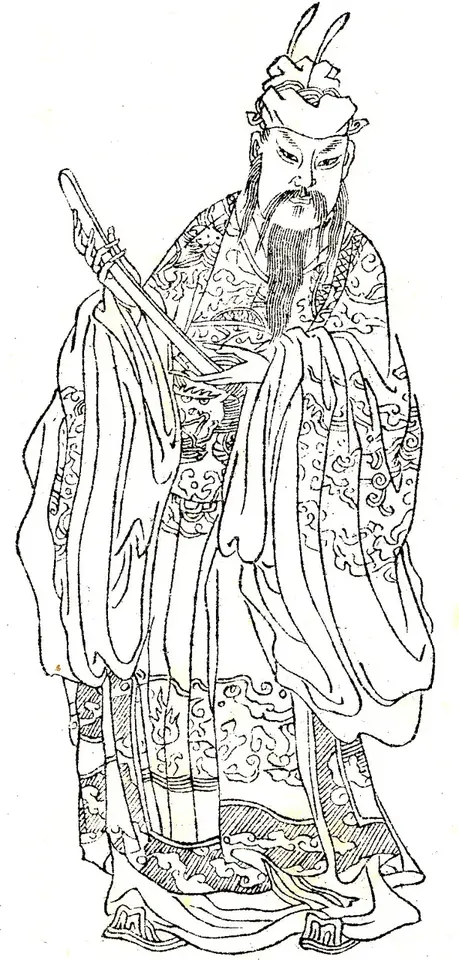
Life and Times
Arising through Military Exams and Frontier Duty
Guo Ziyi was born in the second year of Tongtian (697 CE) during the reign of Empress Wu Zetian, originating from Zheng County in Hua Prefecture (modern Huazhou District, Weinan, Shaanxi Province). The Guo clan was an esteemed aristocratic lineage of the Northern Dynasties and early Tang; his grandfather Guo Tong served as registrar in Meiyuan, while his father Guo Jingzhi served as prefect of Jizhou, Shouzhou, and Sizhou, receiving the posthumous title of Grand Guardian. Born into this administrative nobility, Guo Ziyi was endowed with towering physical stature, standing over seven feet two inches tall, commanding noble bearing, immense physical strength, and a passion for classical archery, horsemanship, and operational military theory.
During the early Kaiyuan era of Emperor Xuanzong, the imperial court expanded military examinations to recruit talented officers from across the empire. The young Guo Ziyi entered the competitions, excelling in mounted archery, field archery, heavy crossbow shooting, and tactical maneuvering. He passed with the preeminent grade of "Exceptional Distinction" (Yideng), receiving his first commission as Senior Officer of the Left Guard.
Entering military service, Guo Ziyi accumulated broad operational experience. He served successively as Vice Commander of the Chenggao Garrison in Henan, Right Officer of the Xingde Garrison in Tongzhou concurrent with the Left Golden Crow Guard, and Garrison Commander of Luyang in Ruzhou concurrent with the Right Feathered Forest Guard. Through these commissions, he mastered imperial palace security, garrison troop training, and administrative logistics. Subsequently dispatched south, he served as Senior Administrator of Guizhou Commandery, managing troop mobilization along the southern frontier.
During the mid-Kaiyuan and Tianbao eras, Emperor Xuanzong reorganized national defense, creating expansive border governorships (Jiedushi) to counter nomadic incursions. Recognizing Guo Ziyi's administrative and tactical talent, the court transferred him north. He served as Vice Protector of the Shanyu Protectorate, Commissioner of Zhenwu Army, and Vice Protector of both Anxi and Beiting Protectorates. In these desert expanses, he lived among Uyghur, Turkic, and Sogdian populations, mastering desert cavalry tactics, steppe warfare, and tribal psychology.
In the third month of 749 CE (Tianbao 8), Guo Ziyi was promoted to General of the Left Militant Guard, Commissioner of the Hengsai Army, and Vice Protector of Anbei. The original fortress was situated in arid terrain where logistics were precarious. Guo Ziyi surveyed the frontier and relocated the fortress to the fertile Tufei Plain south of the Yellow River, constructing a formidable citadel and opening thousands of acres of military farmland. This strategic reform secured the northern defense line and eliminated distant transport costs. Emperor Xuanzong praised his achievements, naming the new fortress the Tiande Army and retaining Guo Ziyi in command.
In 754 CE (Tianbao 13), he was appointed Governor of Jiuyuan, Commissioner of the Western Reception Fortress, Administrator of Jiuyuan, and Commander of the Right Wing of Shuofang. In Jiuyuan, he strengthened the Three Reception Fortresses and trained elite joint Chinese and nomadic cavalry corps.
In the autumn of 754 CE, his mother, Dowager Lady Xiang (Lady of Wei), passed away. According to Confucian mourning rites, Guo Ziyi resigned all civil and military duties to observe three years of filial mourning in his ancestral home in Huazhou. Yet as he guarded his mother's tomb, the catastrophic storm of the An-Shi Rebellion was gathering in the northeastern frontier.
Crisis Command and the Battle of Jiashan
On the sixteenth day of the eleventh month of 755 CE (Tianbao 14), An Lushan, military governor of Fanyang, Pinglu, and Hedong, launched an armed rebellion from Fanyang with 150,000 elite horsemen. Exploiting the demilitarization of the central plains, the rebel armies crushed all resistance, capturing the eastern capital of Luoyang within a month.
Confronted with the collapse of the imperial defense, Emperor Xuanzong recognized that the veteran army of Shuofang represented the empire's premier striking force. In the twelfth month, Xuanzong issued an imperial edict recalling Guo Ziyi from mourning, appointing him Minister of the Court of Imperial Insignia, Administrator of Lingwu, and Jiedushi of Shuofang, ordering him to mobilize the northwest frontier armies.
Suppressing his personal grief, Guo Ziyi hastened to Lingwu. He executed corrupt eunuch supervisor Zhou Wanqing to enforce military discipline, reconstituted the garrison, pacified allied nomadic tribes, and mobilized tens of thousands of prime frontier veterans, launching immediate counteroffensives.
At that time, An Lushan dispatched general Gao Xiuyan to invade the northern territories of Shuofang. In the first month of 756 CE, Guo Ziyi met the rebel cavalry at Jingbian. Deploying heavy spearmen and crossbow arrays to blunt the cavalry shock before executing enveloping counterattacks with his cavalry flanks, he annihilated the enemy vanguard, killing thousands. Pursuing the retreating foe, he dispatched Pugu Huai'en and Hun Shizhi to launch pincer attacks, capturing Yunzhong and Mayi, driving Gao Xiuyan across the northern sands and securing Shuofang's flank.
Recognizing that the strategic core of the rebellion lay in Hebei, Guo Ziyi observed that magistrates Yan Gaoqing of Changshan and Yan Zhenqing of Pingyuan had risen in arms behind rebel lines. Guo Ziyi memorialized the throne to recommend veteran commander Li Guangbi as Jiedushi of Hedong to launch a coordinated two-pronged offensive east of the Taihang Mountains.
In the third month of 756 CE, Li Guangbi advanced through Jingxing Pass to liberate Changshan, engaging in fierce combat with Shi Siming. Guo Ziyi marched his main Shuofang army through the mountains, uniting with Li Guangbi at Changshan with over 100,000 troops. Alarmed, An Lushan dispatched prime generals Shi Siming and Cai Xide with 50,000 elite cavalry to crush the imperial forces.
The two armies clashed along the Sha River. Employing flexible attrition tactics, Guo Ziyi defeated Shi Siming at Jumen, killing thousands and forcing him to retreat into Boling. In the fifth month, reinforced by elite Tongluo and Yeluhe cavalry from Luoyang, Shi Siming sought a decisive confrontation at Mount Jiashan.
At the Battle of Jiashan, Shi Siming deployed massed horse archers across the plains. Guo Ziyi arrayed his infantry in fortified defensive lines, blunting repeated charges with dense crossbow volleys. When the rebel cavalry showed exhaustion, Guo Ziyi signaled a general counteroffensive, sweeping into the rebel rear with elite cavalry. The rebel army collapsed completely.
The Battle of Jiashan was the first major strategic annihilation achieved by Tang forces. Guo Ziyi and Li Guangbi killed over 40,000 rebels, captured over 1,000 officers, and seized 5,000 warhorses and massive supply depots. Shi Siming lost his helmet, fled with disheveled hair, and barely escaped into Boling. Over ten commanderies across Hebei rebelled against the insurgent regime, severing the rebel logistics corridor between Luoyang and Fanyang.
However, as the imperial forces prepared to march on Fanyang, catastrophic news arrived from the southern front: Chancellor Yang Guozhong had forced Geshu Han to advance from Tongguan into an ambush at Lingbao, resulting in the annihilation of the 200,000-man imperial army. Tongguan fell, and Xuanzong fled south to Sichuan. Guo Ziyi and Li Guangbi were compelled to halt their advance and withdraw to Hedong and Shuofang to preserve the empire's remaining forces.
Sponsoring the Throne at Lingwu and Recapturing Twin Capitals
Following the mutiny at Mawei Courier Station, Crown Prince Li Heng parted from Emperor Xuanzong, marching northwest through treacherous territory with several hundred palace guards to reach the Shuofang command center at Lingwu.
On the twelfth day of the seventh month of 756 CE, Crown Prince Li Heng was enthroned as Emperor Suzong at Lingwu. The temporary capital possessed meager defenses and a handful of soldiers, with supplies critically depleted. Suzong's paramount edict was an urgent summons commanding Guo Ziyi and Li Guangbi to march their armies to Lingwu.
Guo Ziyi welcomed the news with immense joy, recognizing that the empire now possessed a unified leadership. Leaving defensive detachments in Hedong, Guo Ziyi marched 50,000 prime Shuofang troops across the desert to Lingwu.
Beholding the grand procession of 50,000 disciplined troops entering Lingwu with banners flying, the imperial court rejoiced. Emperor Suzong wept with relief, greeting Guo Ziyi at the palace gates and declaring: "The restoration of the imperial state is entirely your achievement!" Suzong elevated Guo Ziyi to Minister of War and Chancellor (Tong Pingzhangshi) while continuing as Jiedushi of Shuofang, granting him supreme command over the campaign to liberate the twin capitals.
At Lingwu, Guo Ziyi formulated the grand geopolitical alliance with the Uyghur Khaganate. Emperor Suzong cemented the alliance by betrothing Princess Ningguo to the Uyghur Khagan, who dispatched Prince Yebu commanding 4,000 elite horsemen to assist Tang forces. Supreme Marshal Li Chu formed sworn brotherhood with Prince Yebu, while the Uyghur prince revered Guo Ziyi as an honored elder. Guo Ziyi treated the Uyghur commanders with absolute integrity and lavish hospitality, integrating this cavalry contingent into his battle order.
In early 757 CE, internal strife erupted within the rebel regime when An Qingxu assassinated his father An Lushan. Capitalizing on this strategic opening, Guo Ziyi persuaded Suzong to launch the offensive against Chang'an. In the ninth month, Prince of Guangping Li Chu (later Emperor Daizong) was appointed Supreme Marshal, with Guo Ziyi as Vice Marshal in direct operational command of 150,000 Tang, Western Region, and Uyghur troops.
An Qingxu deployed prime commanders An Shouzhong and Li Guiren with 100,000 elite troops at the Xiangji Temple, ten li west of Chang'an along the Feng River.
On the twenty-eighth day of the ninth month of 757 CE, the Battle of Xiangji Temple commenced. The battle lines spanned twenty li. The rebel cavalry charged with ferocious momentum, pushing back the Tang vanguard and threatening a total collapse of the center.
At this critical juncture, vanguard commander Li Siye stripped to the waist, brandished his heavy double-edged sword, and leapt ahead of his lines, cleaving through a dozen enemy cavalrymen. With the front stabilized, Guo Ziyi ordered his heavy infantry phalanxes forward behind defensive shields, while dispatching Prince Yebu's 4,000 Uyghur cavalry around the rebel rear to strike from an elevated ridge.
Trapped between the advancing infantry and the rear cavalry charge, the rebel formations disintegrated. From noon until dusk, Tang troops pressed the attack, killing over 60,000 rebels and capturing 20,000 prisoners, with An Shouzhong escaping in disguise. The following morning, Tang forces liberated the capital of Chang'an after fifteen months of occupation, with citizens greeting the army with tears of relief.
Guo Ziyi advanced eastward without pause. On the fifteenth day of the tenth month, his army intercepted rebel remnants under Yan Zhuang and Zhang Tongru at Xindian outside Shanzhou. Deploying infantry along the frontal plains while Uyghur horsemen scaled the Bailuyuan plateau to launch surprise flanking strikes, he routed the rebel host. An Qingxu evacuated Luoyang and fled to Xiangzhou. On the eighteenth day of the tenth month, Tang armies liberated the eastern capital of Luoyang.
Upon Guo Ziyi's triumphant return to Chang'an, Emperor Suzong stepped down from the imperial dais, embracing him with tears: "Though this is the house and kingdom of the house of Li, the restoration of the state is truly your work alone!" Suzong promoted him to Minister of Education (Situ), enfeoffed him as Duke of Dai, and increased his estates.
Setback at Xiangzhou and Disarmament by Court Eunuchs
Following the liberation of the capitals, An Qingxu was besieged in Xiangzhou. However, Shi Siming preserved over 100,000 troops in Fanyang, keeping the northern rebellion alive.
In the autumn of 758 CE, Emperor Suzong assembled nine Jiedushi armies totaling 600,000 men to eliminate the rebel redoubt at Xiangzhou. These forces included Guo Ziyi's Shuofang army, Li Guangbi's Hedong army, and seven other regional commands.
However, Emperor Suzong made a disastrous command decision. Harbors of deep suspicion toward his premier commanders, Suzong refused to appoint a supreme commander-in-chief, commissioning instead his favored eunuch supervisor, Yu Chao'en, as "Military Inquisitor and Inspector-General" to oversee the campaign.
The nine armies constructed triple circumvallation trenches and diverted the Zhang River to flood Xiangzhou Citadel. Famine devastated the besieged garrison, bringing An Qingxu to the brink of surrender. Yet lacking a single field commander, coordination faltered. In early 759 CE, Shi Siming advanced from Fanyang with 130,000 elite troops to relieve the siege, drawing up battle arrays along the Anyang River.
As the opposing armies engaged on the third day of the third month, an apocalyptic sandstorm erupted across the plains. Howling winds blew dust that darkened the sky, snapping battle standards and scattering warhorses. Lacking unified command, the regional divisions panicked in the darkness, trampling each other in confusion before collapsing in disorder. Shi Siming's forces were equally shaken and retreated dozens of kilometers.
While the retreat was caused by lack of supreme command and freak weather, eunuch supervisor Yu Chao'en blamed Guo Ziyi in his dispatches to the throne.
Distrustful of Guo Ziyi's soaring prestige, Emperor Suzong recalled him to Chang'an in the seventh month of 759 CE, stripping him of the Shuofang command and transferring his army to Li Guangbi. Formally promoted to Director of the Chancellery, he was placed under soft house arrest in the capital.
Faced with blatant injustice and demotion, Guo Ziyi displayed sublime equanimity. Uttering not a word of complaint, he surrendered all command tallies and retired to his residence, attending court assemblies with unfailing punctuality, disarming imperial suspicion through pure submission.
Expelling Tibetan Forces and Reclaiming Chang'an
In 762 CE, both Emperor Xuanzong and Emperor Suzong passed away within weeks. Crown Prince Li Chu ascended the throne as Emperor Daizong.
In early 763 CE, Tang forces eradicated the An-Shi Rebellion following Shi Chaoyi's demise. However, the empire was exhausted. Capitalizing on court intrigue, senior Shuofang commander Pugu Huai'en rebelled after being slandered by eunuch Luo Fengxian.
Simultaneously, the Tibetan Empire invaded from the west with 200,000 troops, overrunning the Hexi and Longyou garrisons. Led by prime ministers Dalun Kangling and Mazhongying, Tibetan divisions surged across Binzhou and Fengtian, threatening Chang'an.
With palace guards untrained and fleeing, Emperor Daizong panicked, fleeing east to Shanzhou with eunuch Cheng Yuanzhen. On the twelfth day of the tenth month, Tibetan forces occupied Chang'an, installing Prince Li Chenghong as puppet emperor and pillaging the imperial palaces and city streets.
In total desperation, Emperor Daizong remembered Guo Ziyi, appointing him Vice Marshal of Guannei to liberate the capital.
Yet Guo Ziyi was provided zero troops! Accompanied only by twenty loyal cavalry retainers, he rode across the southern mountains to Shangzhou. There, he rallied 4,000 demoralized garrison troops who wept with joy upon seeing their venerable commander.
With a tiny force confronting tens of thousands of Tibetan troops, Guo Ziyi deployed an ingenious psychological deception:
First, he dispatched commander Changsun Quanxu with hundreds of light horsemen toward Lantian, dragging branches to raise dense dust storms by day and lighting thousands of bonfires across the hills by night.
Second, he infiltrated agents into Chang'an, spreading rumors: "Guo Ziyi has returned from Shangzhou commanding 800,000 imperial troops, and his vanguard has passed Lantian!"
Third, his scouts fired arrows bearing leaflets into Tibetan camps, declaring that allied armies were cutting off their retreat.
Terrified of Guo Ziyi's legendary generalship and convinced they were being surrounded, the Tibetan high command abandoned Chang'an and fled west in panic.
On the twenty-first day of the tenth month, Guo Ziyi entered Chang'an, extinguished fires, pacified the populace, and restored civil order. In the twelfth month, Emperor Daizong returned to the capital, weeping with remorse: "I employed you too late, bringing about this tragedy; the fault is mine alone!" Daizong elevated him to Prince of Fenyang Commandery, conferring iron certificates and immortalizing his portrait in the Lingyan Pavilion.
The Unarmed Feat at Jingyang and Pacification of Longyou
Yet the western crisis persisted. In the eighth month of 765 CE (Yongtai 1), rebel general Pugu Huai'en mobilized a massive coalition of 300,000 troops comprising Uyghur, Tibetan, Tangut, and Tuyuhun armies, marching into Guanzhong.
As the hordes converged upon Jingyang, Pugu Huai'en died suddenly from illness. Deprived of their mediator, bitter friction erupted between the Tibetan and Uyghur forces over plunder.
Appointed commander-in-chief, Guo Ziyi held Jingyang with barely 10,000 troops, surrounded by over 100,000 allied nomadic horsemen.
In this crisis, scouts reported that the Uyghur commander was Chancellor Yaogelu, who had fought alongside Guo Ziyi during the liberation of the capitals. Pugu Huai'en had deceived the Uyghurs by claiming that Emperor Daizong had died and that Guo Ziyi had been executed by the court. Learning that the defender was Guo Ziyi, Yaogelu suspected an imperial impostor.
Recognizing the opportunity, the seventy-year-old commander made an audacious decision: "The Uyghurs share deep past bonds with me. We are hopelessly outnumbered; if I ride alone into their camp, I can appeal to their honor and win them over!"
His son Guo Xi wept, clutching his reins: "The barbarians are beasts; you cannot throw your life away!" Guo Ziyi struck his mount and declared: "The empire faces ruin! If we give battle, our annihilation will doom the dynasty. If I go alone, I may preserve the state; if I fail, my death saves my army!"
Ordering his men to hold formation, Guo Ziyi removed his armor, discarded his sword, and rode toward the Uyghur lines in simple white scholar robes accompanied only by a few attendants.
Halting before the enemy lines, he called out: "Guo Ziyi is here!" The Uyghur warriors raised their bows. Chancellor Yaogelu rode forward, demanding: "Is it truly the Lord Guo?" Guo Ziyi removed his cap, revealing his snowy white hair, and smiled: "I am Guo Ziyi." Stunned, Yaogelu and his tribal chieftains threw down their weapons and prostrated themselves, shouting: "It is indeed our old father Guo!"
Dismounting, Guo Ziyi embraced Yaogelu: "The Uyghurs rendered immense service to Tang, and the court treated you with honor; why have you followed Pugu Huai'en in rebellion? He lied that I was dead, yet here I stand! The Tibetans plan to use you as their vanguard before destroying you. If you join Tang, the court will reward you richly and our brotherhood will endure!"
Overwhelmed with shame, Yaogelu swore an oath: "We were deceived! Let us slaughter the Tibetans to redeem our crime!" Guo Ziyi ordered wine brought to the lines, slaughtering a beast and drinking a blood oath with the Uyghur commanders.
Observing the alliance, the terrified Tibetan generals withdrew their host under cover of darkness. The following morning, joint Tang and Uyghur armies pursued the retreating Tibetans to Chishui, killing over 50,000 enemy warriors, capturing 10,000 prisoners, and liberating 4,000 captive civilians. The western frontier was permanently pacified.
Boundless Magnanimity and Exemplary Statesmanship
During the fourteen peaceful years of the Dali era (766–779 CE), Guo Ziyi held paramount office as Grand Defender, Director of the Chancellery, and Vice Marshal of All Armies, serving as the immovable anchor of the Tang Dynasty.
In imperial history, generals possessing transcendent military prestige rarely avoided tragic downfalls. Yet Guo Ziyi achieved the unique distinction of holding preeminent authority without exciting court jealousy. This arose from his profound political wisdom, self-effacing modesty, and absolute transparency.
When the powerful eunuch Yu Chao'en, consumed with jealousy, covertly dispatched thugs to desecrate and excavate Guo Ziyi's ancestral tombs in Huazhou, the court was paralyzed with dread, anticipating an armed coup.
Returning to Chang'an, Guo Ziyi prostrated himself before Emperor Daizong, weeping bitterly: "I have commanded armies for decades and failed to prevent my troops from despoiling civilian tombs; that my ancestral graves have been desecrated is divine retribution for my own shortcomings, not the fault of any minister!" This extraordinary display of magnanimity averted a bloody conflict, reducing the treacherous Yu Chao'en to tears of shame.
In domestic life, Guo Ziyi maintained complete transparency. His palatial residence in Chang'an kept its gates wide open day and night, permitting merchants, common citizens, and officials to wander through the halls without armed guards. When his sons complained that this lacked aristocratic dignity, he explained: "Our family holds premier glory. If we erect high walls and post guards, a single false accusation of treason could destroy our clan. By keeping our gates open to all, suspicion vanishes naturally!"
When his sixth son Guo Ai quarreled with his wife Princess Shengping, the prince shouted in anger: "You rely on your father being emperor! My father could have taken the imperial throne whenever he pleased!" The princess complained to Emperor Daizong. The emperor laughed: "He speaks the truth; unless one is deaf and dumb, one cannot be a wise family patriarch!" Guo Ziyi immediately bound his son in chains to await imperial punishment, prompting Daizong to intervene and feast with him in celebration.
His towering virtue commanded the reverence of rebellious warlords. When Tian Chengsi, the brutal warlord of Weibo, received an ordinary emissary from Guo Ziyi, he adjusted his robes, fell to his knees facing west toward Guo Ziyi's residence, and declared: "My knees have not bent before any man for decades; today I kneel out of pure reverence for Lord Guo!"
Honors of the Imperial Father and Royal Burial
In 779 CE, Emperor Dezong ascended the throne, summoning the eighty-three-year-old commander back to Chang'an.
Dezong elevated him to Grand Defender and Director of the Chancellery, conferring the supreme honorific "Imperial Father" (Shangfu). Relieving him of all military command, the emperor granted him extensive estates and supplies, permitting him to retire in peace.
Guo Ziyi enjoyed eight sons and seven sons-in-law, all holding senior court offices. When his hundreds of descendants gathered on his birthday, he could scarcely remember their names and merely nodded with a benign smile. His granddaughter became Empress Yi'an, mother of Emperor Muzong, honored across seven successive reigns. Folk tradition celebrated him as the ultimate historical archetype of fortune, prosperity, and longevity.
In early summer of 781 CE, eighty-five-year-old Guo Ziyi fell gravely ill. Emperor Dezong dispatched Prince Shu Li Yi to visit his bedside, where the old commander bowed his head from his couch in gratitude.
On July 9, 781 CE (Jianzhong 2), Guo Ziyi passed away peacefully in Chang'an.
The empire mourned with boundless grief. Emperor Dezong suspended court assemblies for five days, conferred the posthumous title of Grand Preceptor, and bestowed the supreme posthumous name Prince Zhongwu. The emperor personally climbed the palace gates to watch the funeral procession and decreed that his tumulus beside Emperor Suzong's Jianling mausoleum be raised by an additional ten feet to commemorate his eternal service.