Birth into an Illustrious Lineage
Born into an elite founding ministerial family; her father Wu Shiyue was an imperial founding meritorious official, and her mother Lady Yang descended from the Sui imperial house.
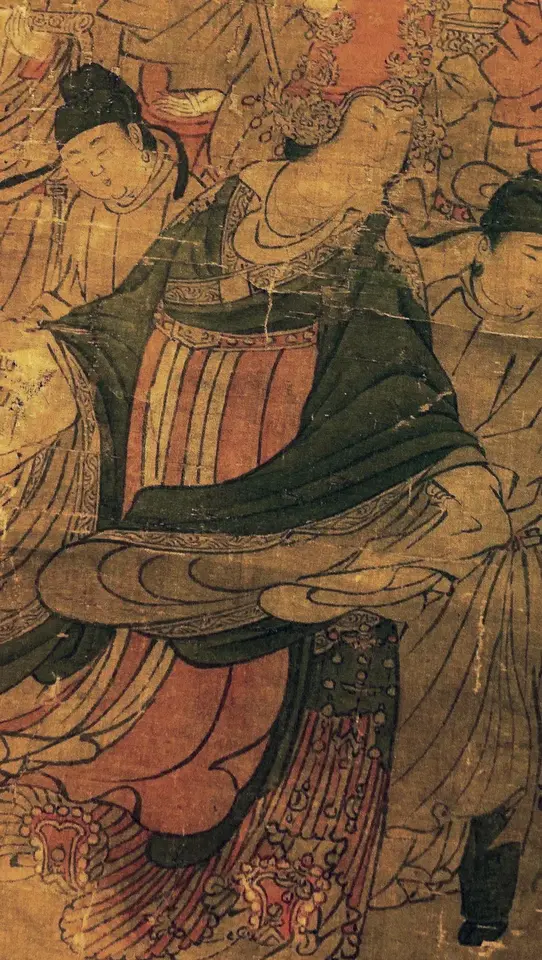
624 CE–705 CE
武则天
Wu Zetian (武则天; 624–705 CE), personal name Wu Zhao (武曌), was the only female monarch of imperial China who ruled in her own right, reigning as emperor of the Wu Zhou dynasty (武周). Born in Wenshui of Bingzhou, she entered the palace of Emperor Taizong of Tang at the age of fourteen as a Talented Lady of the fifth rank, receiving the sobriquet Wu Mei. Following Taizong's demise, she took Buddhist tonsure at Ganye Temple…
Wu Zetian (武则天; 624–705 CE), personal name Wu Zhao (武曌), was the only female monarch of imperial China who ruled in her own right, reigning as emperor of the Wu Zhou dynasty (武周). Born in Wenshui of Bingzhou, she entered the palace of Emperor Taizong of Tang at the age of fourteen as a Talented Lady of the fifth rank, receiving the sobriquet Wu Mei. Following Taizong's demise, she took Buddhist tonsure at Ganye Temple according to imperial protocol. Emperor Gaozong recalled her to the inner court and consecrated her as Lady of Bright Deportment. In 655 CE, she was formally elevated to Empress. As Gaozong suffered from debilitating hypertension and dizziness, Empress Wu increasingly took charge of imperial governance, ultimately assuming the honorific title of Heavenly Empress in 674 CE to govern jointly with Gaozong as the "Dual Sovereigns." Following the death of Emperor Gaozong in 683 CE, Empress Dowager Wu governed as regent, deposing Emperor Zhongzong and enthroning Emperor Ruizong in succession. In 690 CE, she formally ascended the imperial throne, altered the dynastic name to Zhou, designated Luoyang as the Divine Capital, and founded the Wu Zhou dynasty. Throughout her reign, she dismantled the aristocratic monopoly of the Guanlong nobility, pioneered palace examinations, military examinations, and probationary official appointments, and recruited talented commoners on merit. She vigorously promoted agrarian cultivation, reduced corvee exactions, stimulated demographic expansion, repulsed Tibetan and Second Turkic incursions, and restored the Four Garrisons of Anxi. In her declining years, she retired deep into the palace, placing excessive indulgence in the Zhang Yizhi and Zhang Changzong brothers. In 705 CE, Chancellor Zhang Jianzhi spearheaded the Shenlong Coup, obliging her to abdicate in favor of Li Xian (Emperor Zhongzong). Retiring to Shangyang Palace, she passed away in the winter of the same year at the age of eighty-two. By testamentary edict, she renounced the imperial title, was styled Empress Zetian Dasheng, and was interred alongside Emperor Gaozong in the Qianling Mausoleum.
Born into an elite founding ministerial family; her father Wu Shiyue was an imperial founding meritorious official, and her mother Lady Yang descended from the Sui imperial house.
Father Wu Shiyue passed away; alienated and mistreated by half-brothers, she relocated with her mother from Jingzhou back to the capital Chang'an.
At age fourteen, summoned into the palace by Emperor Taizong for her graceful demeanor, appointed as Talented Lady of the fifth rank, and bestowed the sobriquet Wu Mei.
Emperor Taizong passed away; according to imperial protocol, she moved with childless consorts to Ganye Temple in Chang'an and shaved her head as a Buddhist nun.
Emperor Gaozong visited Ganye Temple on the first anniversary of Taizong's death, reuniting with her and exchanging mutual expressions of longing.
Urged and supported by Empress Wang, Emperor Gaozong recalled her to the imperial harem; she soon gave birth to her eldest son Li Hong.
Consecrated as Lady of Bright Deportment of the second rank, enjoying Gaozong's exclusive affection and gradually eclipsing Pure Consort Xiao and Empress Wang.
Her newborn infant daughter died suddenly, prompting Gaozong to suspect Empress Wang; Gaozong attempted to create the special title Chenfei for Lady Wu, which was shelved due to chancellors' opposition.
Emperor Gaozong issued an edict demoting Empress Wang and Consort Xiao to commoners and formally consecrated Wu as Empress, banishing opposing Chancellor Chu Suiliang.
Supported Gaozong in thoroughly purging the Guanlong aristocratic faction headed by Zhangsun Wuji and Yu Zhining, centralizing dynastic authority in the imperial house.
Emperor Gaozong suffered severe chronic wind-dizziness and impaired vision; memorials from all imperial ministries were referred to Empress Wu for final deliberation.
Foiled Chancellor Shangguan Yi's plot to draft an imperial edict deposing her; Shangguan Yi was executed, and Empress Wu officially presided behind a screen during court audiences.
Accompanied Gaozong to conduct the Fengshan Sacrifices at Mount Tai, overturning the male ministerial monopoly by personally leading female nobles to conduct the secondary offering to Earth.
Donated twenty thousand strings of private cosmetic funds to sponsor the carving of the colossal Lushena Buddha at the Longmen Grottoes in Luoyang, completed after nearly four years.
Emperor Gaozong was honored as Heavenly Emperor and Empress Wu as Heavenly Empress, collectively hailed as the "Dual Sovereigns"; submitted Twelve Policy Proposals to initiate wide-ranging administrative and agrarian reforms.
Crown Prince Li Hong died suddenly; Gaozong's proposal to entrust her with supreme regency met resistance; established the North Gate Scholars to participate in policy formulation and balance the chancellery.
Discovered hundreds of suits of illicit armor in Crown Prince Li Xian's Eastern Palace; demoted him to commoner status on charges of treason and elevated Li Xian (Prince of Zhou) as Crown Prince.
Emperor Gaozong passed away in Luoyang, leaving a testament requiring imperial decisions to be submitted to the Heavenly Empress; Crown Prince Li Xian succeeded as Emperor Zhongzong, and Empress Dowager Wu presided over governance.
Deposed Zhongzong for attempting to empower maternal relatives, demoting him to Prince of Luling and enthroning Li Dan as Emperor Ruizong; quelled Xu Jingye's Yangzhou rebellion and executed Chancellor Pei Yan.
Promulgated an edict permitting officials and commoners to submit self-recommendations for office, breaking precedent to recruit talented scholars from non-aristocratic backgrounds nationwide.
Installed four bronze petition boxes in the imperial court for appeals and reports, opening avenues for denunciations and employing cruel officials such as Suo Yuanli, Zhou Xing, and Lai Junchen.
Discovered an inscribed stone in the Luo River; took the title Holy Mother and Divine Sovereign; crushed armed uprisings led by Li Chong (Prince of Langye) and Li Zhen (Prince of Yue), conducting sweeping purges of the Li Tang imperial clan.
Completed the monumental Mingtang (Hall of Wanxiang) and Tiantang complex in Luoyang; promulgated twelve newly coined Zetian characters created by Zong Qinke.
Monk Faming presented the Dayun Sutra to propagate prophecy; in the ninth month, amidst petitions from courtiers and foreign chieftains, ascended Zetian Gate, changed the dynastic title to Zhou, and assumed the title Holy and Divine Emperor.
Instituted the probationary official system; dispatched General Wang Xiaojie on a northwestern expedition, crushing Tibetan forces, completely recovering the Four Garrisons of Anxi, and reopening the Silk Road.
Wang Xiaojie routed the Western Turkic-Tibetan coalition; foreign chieftains pooled hundreds of millions in copper and iron to cast the Grand Axis Praising Dynastic Virtue outside the Duan Gate of the imperial city.
Khitan chieftains Li Jinzhong and Sun Wanrong seized Yingzhou in rebellion; deployed consecutive armies and allied with the Second Turkic Khaganate to thoroughly pacify the rebellion after thirteen months.
Cast the Nine Cauldrons of the Divine Capital; when Lai Junchen fabricated treason charges against Princess Taiping and Imperial Successor Li Dan, she decisively ordered his execution, ending secret police rule.
Heeded Chancellor Di Renjie's counsel and secretly recalled Li Xian from Fangzhou back to Luoyang, restoring him as Crown Prince and reaffirming Li Tang dynastic succession.
Issued an edict formally establishing the military examination system, testing archery, horsemanship, spears, physical strength, and bearing to select commanders and frontier talents nationwide.
In the first month, Chancellor Zhang Jianzhi executed the Zhang brothers in a coup; Wu Zetian abdicated to Li Xian and retired to Shangyang Palace; passed away in the eleventh month at age eighty-two, interred at Qianling.
Wu Zetian was born into a prominent bureaucratic household of the early Tang dynasty. Her father, Wu Shiyue, hailed from Wenshui in Bingzhou (present-day Wenshui County, Lvliang, Shanxi Province). In his early career, he engaged in the timber trade, amassing substantial household wealth. During the closing years of Emperor Yang of Sui's Daye era, Li Yuan (later Emperor Gaozu of Tang) served as an official in the Hedong region and repeatedly encamped along the Fen and Jin rivers, frequently lodging at the Wu residence. Through these encounters, Wu Shiyue and Li Yuan established a profound personal friendship. In 617 CE, when Li Yuan raised his righteous banners at Taiyuan against Sui rule, Wu Shiyue devoted his entire family fortune to supply the insurgent army with provisions, clothing, and military armaments, subsequently accompanying Li Yuan's host into the Guanzhong region to pacify the capital Chang'an. Following the proclamation of the Tang dynasty, Wu Shiyue, recognized as a founding meritorious courtier, successively occupied high ministerial offices including Minister of Works and Area Commander of Jingzhou, being enfeoffed as the Duke of Ying and successfully completing the transition from a wealthy merchant background into the ranks of the new bureaucratic aristocracy.
Wu Zetian's mother, Lady Yang, came from an exceedingly noble lineage as a kinswoman of the Sui imperial house; her father was Yang Da, Duke of Suining and younger brother of Prince Yang Xiong of Guande. Lady Yang possessed deep literary and historical learning, accompanied by a rigorous and composed temperament. At over forty years of age, through the direct matchmaking of Emperor Gaozu, she wed the widowed Wu Shiyue as his secondary wife. On February 17, 624 CE (the 23rd day of the 1st month in the 7th year of the Wude era), Wu Zetian was born. Concerning her precise birthplace, historical annals and modern scholars offer divergent traditions citing Lizhou (modern Guangyuan, Sichuan), the capital Chang'an (modern Xi'an, Shaanxi), or the eastern capital Luoyang. Regardless of the exact site, her childhood unfolded amidst the affluent domestic environment of a high official's residence. She was the second daughter of Lady Yang, having an elder sister (later Lady of Han, Wu Shun) and a younger sister (Lady Guo), alongside elder half-brothers Wu Yuanqing and Wu Yuanshuang born to Wu Shiyue's first wife. Under her mother's scholarly guidance, Wu Zetian read extensively in the Confucian classics and historical treatises, mastered poetry and calligraphy, and developed a sharp, resolute, and self-assured character.
In May of 635 CE (the 9th year of the Zhenguan era), Emperor Gaozu passed away; in the same year, Wu Shiyue succumbed to debilitating grief and died. With the demise of the household patriarch, the political standing and domestic harmony of the Wu family fractured abruptly. Wu Shiyue's sons by his prior marriage, Wu Yuanqing and Wu Yuanshuang, together with cousins Wu Weiliang and Wu Huaiyun, treated stepmother Lady Yang and her three young daughters with cold disdain, subjecting them to severe indignities in family etiquette and estate division. Refusing to endure persistent humiliation under a hostile roof, the resolute Lady Yang departed the official residence in Jingzhou and relocated with Wu Zetian and her sisters back to the capital Chang'an. This bitter experience of early paternal bereavement and familial hostility exposed Wu Zetian prematurely to the harsh realities of kinship rivalry and social vulnerability, forging in her an indomitable will and an exceptional capacity to navigate adversity.
In November of 637 CE (the 11th year of the Zhenguan era), Emperor Taizong (Li Shimin) conducted an imperial tour to Luoyang Palace. More than a year had passed since the demise of Empress Zhangsun. Having learned that the fourteen-year-old second daughter of the late founding courtier Wu Shiyue was renowned for her refined grace, dignity, and literary erudition, Taizong issued an imperial summons commanding her entrance into the inner palace. She was formally invested as a Talented Lady (Cairen) of the fifth rank and bestowed the personal sobriquet Wu Mei. Confronting her departure into the formidable seclusion and uncertain hazards of the imperial forbidden palace, Lady Yang wept inconsolably. The fourteen-year-old Wu Zetian, however, displayed extraordinary composure and foresight, reassuring her mother: "Serving the Son of Heaven is a rare blessing; why should mother weep so bitterly?" She then resolutely boarded the imperial carriage and departed for the palace.
Within the Tang imperial harem, Wu Zetian served as a Talented Lady for twelve continuous years. The position of Talented Lady of the fifth rank entailed overseeing court banquet ceremonies, maintaining literary records, and attending to daily imperial routines. In the vibrant Zhenguan court filled with accomplished consorts, Wu Zetian did not attain exclusive imperial favor, and her official standing remained unchanged throughout Taizong's reign. Nevertheless, an episode regarding the taming of a steed illustrated her extraordinary boldness and fortitude. Emperor Taizong had acquired a prized stallion named Shizicong ("Lion Stallion"), whose ferocious and intractable temperament defied the efforts of palace grooms and military equerries alike. Standing in attendance, Wu Zetian stepped forward and addressed the emperor: "Your servant can master this stallion, requiring but three implements: an iron whip, an iron mace, and a sharp dagger. First, I will strike it with the iron whip; if it remains disobedient, I will strike its head with the iron mace; if it still defies command, I will sever its throat with the dagger." Emperor Taizong marveled at her audacious spirit, yet privately felt a measure of caution and wariness toward her ruthless resolve.
Although relegated to subordinate ranks, her prolonged service within the intimate confines of imperial decision-making allowed Wu Zetian to observe firsthand the statecraft, administrative balances, and sovereign-minister dynamics of early Tang rule, accumulating indispensable political intuition. During the late Zhenguan era, weakened by continuous military campaigns and overwork, Emperor Taizong's health declined precipitously. Crown Prince Li Zhi (the future Emperor Gaozong) attended constantly at Taizong's sickbed, dutifully administering medicines day and night. Throughout this prolonged period of filial attendance, Wu Zetian and the mild, gentle Crown Prince interacted frequently. A mutual romantic attachment blossomed between them, establishing the crucial emotional foundation that would later enable Wu Zetian's miraculous resurgence and return to the center of dynastic authority.
On July 10, 649 CE (the 26th day of the 5th month in the 23rd year of Zhenguan), Emperor Taizong passed away at Cuiwei Palace on Mount Zhongnan, and Crown Prince Li Zhi ascended the throne as Emperor Gaozong. In accordance with early Tang dynastic protocol and ancestral rites, imperial consorts who had borne no sons were required to receive Buddhist tonsure and enter an imperial monastery to pray for the deceased sovereign's posthumous felicity. In the summer of that year, cloaked in sorrow, Wu Zetian departed the Daming Palace alongside fellow consorts, relocating to Ganye Temple south of Chang'an to shave her head as a nun. Amidst the secluded prayer halls and dim monastic lamps, Wu Zetian maintained unwavering composure, attentively observing political currents in the capital while awaiting an opportunity for her fortunes to turn.
In May of 650 CE (the 1st year of the Yonghui era), marking the first anniversary of Emperor Taizong's demise, Emperor Gaozong visited Ganye Temple in person to offer incense and conduct sacrificial rites. Amidst the solemn hall, Gaozong and the tonsured Wu Zetian met once again. Reunited after arduous separation, both wept copiously, pouring out mutual longings. This emotional reunion was observed attentively by Empress Wang, who was accompanying the sovereign.
At that juncture, the factional struggle within Gaozong's inner palace was reaching an acute crisis. Empress Wang, hailing from the prestigious Taiyuan Wang clan, was dignified and reserved, but had failed to bear a son. Conversely, the youthful Pure Consort Xiao enjoyed Gaozong's exclusive affection and had borne a son (Li Sujie, Prince of Xu) and two daughters (Princesses Yiyang and Gao'an), displaying increasing haughtiness that openly threatened the Empress's supremacy. Observing Gaozong's lingering attachment to Wu Zetian, Empress Wang devised a stratagem to introduce Wu back into the palace, hoping to divide Gaozong's affections away from Consort Xiao and thereby secure her own imperial position. Empress Wang accordingly counseled Gaozong to order Wu Zetian to let her hair grow and re-enter the harem, privately preparing garments and funds to facilitate her return.
Emperor Gaozong had never ceased longing for Wu Zetian, and received Empress Wang's counsel with immense satisfaction. In May of 651 CE (the 2nd year of the Yonghui era), upon the conclusion of the three-year imperial mourning period, Wu Zetian formally concluded her two-year monastic life and re-entered Daming Palace. Prior to her formal return, she was already pregnant with Gaozong's child, and soon gave birth to her eldest son, Li Hong. Well aware of the lethal hazards of court intrigue, Wu Zetian conducted herself with utmost humility and deference toward Empress Wang, winning her praise and frequent commendations before the emperor. Simultaneously, through superior intellect, perceptive insight, and tender attentiveness, Wu Zetian rapidly concentrated Gaozong's devotion upon herself, causing Consort Xiao to fall precipitously from favor.
In May of 652 CE (the 3rd year of the Yonghui era), Emperor Gaozong issued an edict promoting Wu Zetian from ordinary lady-in-waiting to Lady of Bright Deportment (Zhaoyi) of the second rank, elevating her to the head of the nine primary imperial concubines. With the dramatic ascent of Lady Wu, Empress Wang's original calculation to employ her as a counterweight against Consort Xiao collapsed completely. Empress Wang and Consort Xiao turned from bitter adversaries into allies, joining forces to repeatedly malign Lady Wu before the emperor. Yet Gaozong's devotion to Wu Zetian had become unshakeable; turning a deaf ear to their accusations, he grew increasingly alienated by Empress Wang's cold jealousy.
In 654 CE (the 5th year of the Yonghui era), Wu Zetian gave birth to a daughter (posthumously Princess Anding Si). According to accounts in the New Book of Tang and Zizhi Tongjian, when the infant was a month old, Empress Wang visited the chamber alone to fondle the child; shortly after her departure, the infant was discovered dead. Emperor Gaozong arrived for a visit and discovered the deceased child, his grief turning to rage when attendants reported that only the Empress had just left. Convinced that Empress Wang had murdered the child out of spite, Gaozong resolved to depose her and elevate Lady Wu (modern historians also evaluate the death in light of sudden infant death syndrome). To place Wu Zetian above all other consorts, Gaozong attempted to create the unprecedented first-rank title of Chenfei ("Celestial Consort"), but abandoned the initiative when Chancellors Han Yuan and Lai Ji objected on ancestral grounds that the four traditional consort ranks were fully established. At this juncture, Wu Zetian realized that palace favor alone was insufficient; she needed to enter the arena of statecraft and align her elevation with the emperor's drive to reassert sovereign authority over the entrenched ministerial oligarchy.
Upon Emperor Gaozong's accession, dynastic decision-making had fallen almost entirely into the hands of senior regents led by Grand Commandant Zhangsun Wuji and Left Servant of the Department of State Affairs Chu Suiliang. Zhangsun Wuji was Gaozong's maternal uncle and the paramount leader of the Guanlong aristocratic nobility, commanding extensive patronage networks throughout the bureaucracy; Empress Wang was the primary representative of this Guanlong elite within the inner palace. The young Emperor Gaozong felt severely constrained by these elder statesmen and sought to break the entrenched balance of power to achieve direct personal rule. In this historical context, the struggle to "depose Wang and elevate Wu" ceased to be a mere domestic harem rivalry, transforming into a climactic political confrontation between sovereign imperial authority and the Guanlong aristocratic oligarchy for supreme governance, with Wu Zetian serving as Gaozong's most resolute political ally.
In early 655 CE (the 6th year of the Yonghui era), the succession battle erupted into the open. To seize the moral and ritual initiative, Wu Zetian authored and promulgated the Internal Instructions (Neixun) in March, expounding feminine virtues and courtly conduct to cultivate an image of regal rectitude. In the same year, Middle Secretariat Drafter Li Yifu, an official of non-aristocratic background who acutely grasped the shifting political winds, submitted a memorial breaking court silence by openly petitioning Gaozong to depose Empress Wang and elevate Lady Wu. Li Yifu's initiative was rewarded with imperial commendation and extraordinary promotion. Soon afterward, other mid-level officials, including Director of the Armory Xu Jingzong, Grand Judge Cui Yixuan, and Palace Censor Yuan Gongyu, submitted similar memorials, creating a robust outer court faction supporting Lady Wu.
As support consolidated, Emperor Gaozong summoned core elder statesmen Zhangsun Wuji, Chu Suiliang, Han Yuan, and Lai Ji to the inner palace to deliberate the imperial deposition. Chu Suiliang offered the most vehement resistance, directly challenging the emperor: "Empress Wang was chosen and betrothed to Your Majesty by the late Emperor Taizong. She has committed no fault; how can she be lightly discarded? Furthermore, Lady Wu previously served the late Emperor, a fact known to all under heaven. If she is consecrated as Empress, what judgment will the realm and posterity pass upon Your Majesty?" At the peak of his argument, Chu Suiliang placed his court tablet on the palace steps, knocked his head against the stone until blood flowed, and begged to resign his post. Infuriated, Emperor Gaozong ordered guards to drag him from the chamber. Standing behind a screen near the throne, Wu Zetian shouted in indignation: "Why not take this old scoundrel out and execute him immediately!" The confrontation between sovereign and minister had reached an absolute impasse.
At this decisive juncture, the stance of the venerable military patriarch, Minister of Works Li Ji, tilted the balance. When Gaozong privately sought Li Ji's counsel on deposing the empress, Li Ji prudently replied: "This is Your Majesty's domestic family affair; why should you inquire of outsiders?" This single phrase, "this is Your Majesty's domestic affair," provided Gaozong with the definitive political justification to bypass the ritual constraints of the Guanlong nobility, shattering Zhangsun Wuji's constitutional defense and decisively shifting the equilibrium in favor of the emperor and Wu Zetian.
On November 27, 655 CE (the 13th day of the 10th month in the 6th year of Yonghui), Emperor Gaozong formally promulgated an edict stripping Empress Wang and Consort Xiao of their titles on charges of plotting assassination by poison, reducing them to commoners and banishing their maternal kinsmen to the remote regions of Lingnan. Concurrently, Chu Suiliang was demoted to Area Commander of Tanzhou. Seven days later, on November 20, Gaozong proclaimed Wu Zetian Empress. On December 1 (the 1st day of the 11th month), a grand ceremony of consecration took place at Suyimen, where Minister of Works Li Ji held the imperial tallies and presented the jade seal and book of investiture, formally consecrating Wu Zetian as Empress of the Great Tang amidst congratulations from civil and military officials and foreign envoys.
Following her elevation, Emperor Gaozong and Empress Wu carried out a sweeping purge of their political rivals. According to historical records, after Empress Wang and Consort Xiao were confined in a secluded palace wing, Gaozong secretly visited them and felt moved to pity upon seeing their wretched condition. Learning of this, Empress Wu ordered each given one hundred lashes, their limbs severed, and their bodies cast into wine vats, an atrocity known as "bone wine," causing their deaths within days, and decreed that their surnames be altered to Mang ("Python") and Xiao ("Owl") respectively. To neutralize the Guanlong network, Empress Wu composed the Admonitions for Imperial In-Laws (Waiqi Jie) in 656 CE to warn her own kin. In May of 659 CE (the 4th year of Xianqing), using an alleged conspiracy exposed by Xu Jingzong, Emperor Gaozong and Empress Wu stripped Grand Commandant Zhangsun Wuji of his offices, banishing him to Qianzhou where he was compelled to commit suicide; prominent Guanlong leaders Lai Ji, Han Yuan, and Yu Zhining were similarly expelled from the capital. The Guanlong aristocratic hegemony that had dominated northern China since the Western Wei and Northern Zhou was decisively shattered, resulting in an unprecedented concentration of direct imperial power.
In March of 657 CE (the 2nd year of the Xianqing era), Emperor Gaozong and Empress Wu relocated the imperial court to Luoyang, designating the Luoyang Palace as the Eastern Capital. By elevating Luoyang to equal status with Western Capital Chang'an, the court established a dual-capital governance model, deliberately distancing central administration from the geographical and political stronghold of the Guanlong nobility in Guanzhong. In November of 660 CE (the 5th year of Xianqing), Emperor Gaozong suffered an acute onset of severe wind-dizziness (recognized by modern medicine as hypertensive cerebral vascular spasms and vertigo), experiencing debilitating migraines and impaired vision that rendered him unable to review state memorials. Faced with burdensome imperial duties, Gaozong relied wholly on the erudite and administratively gifted Empress Wu, decreeing that all memorials from central ministries be submitted to her for final determination. Exercising exceptional decisiveness and political acumen, Wu Zetian assumed direct operational control over the core machinery of imperial administration.
However, the rapid expansion of Empress Wu's authority generated fresh tensions between sovereign and consort. Wu Zetian's assertive exercise of power led Gaozong, who had initially sought undivided imperial rule, to feel his authority eclipsed, breeding resentment and apprehension. In 664 CE (the 1st year of the Linde era), when Daoist adept Guo Xingzhen entered the palace to conduct talismanic rituals for Empress Wu, eunuch Wang Fusheng reported the incident. Chancellor Shangguan Yi seized this opportunity to advise Gaozong: "The Empress acts arbitrarily; throughout the realm there is widespread discontent. I urge Your Majesty to depose her." Concurring with the proposal, Gaozong secretly commissioned Shangguan Yi to draft a deposition edict. Attendants promptly alerted Empress Wu. Without hesitation, she went directly before Gaozong, forcefully presenting her case while appealing to their shared bond as husband and wife. Gaozong, inherently indecisive and moved by her tears, felt overcome with remorse. He tore up the draft edict and shifted blame onto Shangguan Yi, saying: "I had no such intention; I was entirely misled by Shangguan Yi." Empress Wu counterattacked swiftly, executing Shangguan Yi and Wang Fusheng on charges of treason; deposed former Crown Prince Li Zhong was ordered to commit suicide, and her eldest son Li Hong was formally installed as Crown Prince.
Following this crisis, Wu Zetian eliminated remaining opposition at court. Thereafter, whenever Emperor Gaozong held court in the Zichen Hall, Empress Wu sat behind a hanging screen directly behind the throne: "No matter, great or small, escaped her deliberation. Supreme authority throughout the realm resided in the inner palace; promotions, dismissals, life, and death were determined by her words, while the Son of Heaven merely folded his hands." The court and realm collectively revered Gaozong and Empress Wu as the "Dual Sovereigns."
Under this joint rule, Wu Zetian actively elevated the Tang dynasty's imperial prestige and reshaped state rituals. In November of 665 CE (the 2nd year of Linde), the Tang empire prepared to conduct the grand Fengshan Sacrifices at Mount Tai. In classical Confucian ritual, Fengshan represented the paramount sacrifice to Heaven and Earth, with the emperor performing the initial offering to Heaven and senior male ministers conducting the secondary offering to Earth. Wu Zetian perceptively observed that when sacrificing to the Earthly Deity, female imperial ancestors were venerated alongside Earth; having this rite conducted entirely by male outer ministers was ritually deficient, and the reigning Empress should properly lead inner and outer noblewomen to perform the secondary offering. Emperor Gaozong approved her memorial. In February of 666 CE (the 1st year of Qianfeng), the Mount Tai sacrifices were carried out. Wu Zetian led a solemn procession of noblewomen to present the ritual chalice, attended by chieftains and envoys from the Turks, Tibetans, Khotan, Persia, India, Japan, Silla, and Goguryeo, with banners stretching across hills, dramatically elevating her universal prestige and affirming female political legitimacy.
In May of 672 CE (the 3rd year of Xianheng), Empress Wu donated twenty thousand strings of private cosmetic funds from her treasury to sponsor the carving of the colossal Lushena Buddha on the cliff faces of the Longmen Grottoes in Luoyang. Completed after three years and nine months, the statue displayed a compassionate, dignified visage modeled on Empress Wu's own features, standing as an enduring artistic pinnacle of Wu Zhou political and religious theology. In September of 674 CE (the 1st year of Shangyuan), Emperor Gaozong assumed the title Heavenly Emperor (Tianhuang) and Empress Wu became Heavenly Empress (Tianhou), merging sacred sacral authority with temporal rule. In December of the same year, Heavenly Empress Wu submitted her celebrated Twelve Policy Proposals to Gaozong, advocating agricultural promotion, reduction of corvee and taxes, tax exemptions for the capital regions, cessation of unnecessary warfare, permission for peasants to reclaim fallow lands, broadening avenues for political remonstrance, curbing slander, reviewing judicial penal codes, and extending mourning dress for mothers to three years even while the father lived. Gaozong enacted these proposals across the realm, embedding Wu Zetian's governing philosophy throughout the administrative structure.
In 675 CE (the 2nd year of Shangyuan), Gaozong's chronic illness worsened and his eyesight failed, rendering him unable to govern. He consulted courtiers regarding formally abdicating executive duties to the Heavenly Empress. Chancellors Hao Chujun and Li Yiyan vehemently protested, citing ancestral precedents that the realm belonged to Gaozu and Taizong and could not be entrusted to an empress consort, forcing Gaozong to withdraw the proposal. To bypass the traditional chancellery, Wu Zetian gathered a cadre of brilliant literary scholars, including Yuan Wanqing, Fan Lvbing, Miao Chuke, Zhou Simao, and Han Chubin, into the palace during the Shangyuan and Yifeng eras. They compiled over a thousand volumes of statecraft texts, including Mystic Reflections (Xuanlan), Rules for Officials (Chenggui), and New Admonitions for Hundred Officials (Bailiao Xinjie), and were secretly commissioned to participate in reviewing state memorials and drafting policy, curtailing the chancellors' monopoly. These scholars were celebrated by contemporaries as the "North Gate Scholars," forming the central intellectual core through which Empress Wu directed central policy.
While presiding over administration, Wu Zetian carried out a rigorous consolidation of imperial succession. Her eldest son, Crown Prince Li Hong, was benevolent, modest, and compassionate toward the common folk, earning deep affection from both Gaozong and the realm. However, by repeatedly questioning his mother's decisions (such as requesting marriages for Consort Xiao's two confined daughters), mutual friction deepened. In May of 675 CE (the 2nd year of Shangyuan), Li Hong died suddenly at age twenty-four while accompanying the court at Yiyun Hall in the Hebi Palace of Luoyang. Gaozong mourned inconsolably and posthumously conferred upon him the title Emperor Xiaojing. Subsequently, her second son, Li Xian, was consecrated as Crown Prince. Erudite and articulate, Li Xian assembled eminent scholars to annotate the Book of the Later Han (Hou Hanshu) and repeatedly served as regent in Chang'an. Apprehensive of his growing prestige, Wu Zetian repeatedly commissioned the North Gate Scholars to compose works such as Orthodox Norms for the Heir Apparent (Shaoyang Zhengfan) and Biographies of Filial Sons (Xiaozi Zhuan) to admonish him. In 680 CE (the 2nd year of Tiaolu), following the assassination of Daoist adept Ming Chongyan, Empress Wu suspected Li Xian's involvement and dispatched Xue Yuanchao and Pei Yan to search the Eastern Palace, uncovering hundreds of suits of hidden armor in the stables. Disregarding Gaozong's pleas for clemency, Wu Zetian demoted Li Xian to commoner on charges of treason and exiled him to Bazhou, elevating her third son, Li Xian (Prince of Zhou), as Crown Prince.
On December 27, 683 CE (the 4th day of the 12th month in the 1st year of Hongdao), Emperor Gaozong passed away in Zhenguan Hall at Luoyang Palace at the age of fifty-six. His testamentary edict stipulated: "Should there be military or state matters of great moment that cannot be resolved, decisions shall be referred to the Heavenly Empress." Seven days later, Crown Prince Li Xian ascended the throne as Emperor Zhongzong, and Wu Zetian was honored as Empress Dowager, assuming full regency over the court. Upon accession, Emperor Zhongzong attempted to establish an independent base of authority, planning to elevate his father-in-law Wei Xuanzhen to Chancellor (Shizhong) and confer a fifth-rank post upon his wet nurse's son. When Chancellor Pei Yan firmly objected, Zhongzong exclaimed in anger: "Even if I gave the entire realm to Wei Xuanzhen, what of it? Would I begrudge him a mere chancellorship?" Alarmed, Pei Yan secretly reported this to the Empress Dowager. On February 26, 684 CE (the 6th day of the 2nd month in the 1st year of Sisheng), Empress Dowager Wu assembled the court in Qianyuan Hall, ordering General Cheng Wuting to lead imperial guards into the chamber to proclaim her edict. After a reign of just over a month, Zhongzong was deposed as Prince of Luling and confined in distant Junzhou and Fangzhou. Her fourth son, Li Dan (Prince of Yu), was enthroned as Emperor Ruizong. Confined to a separate palace, Ruizong was barred from managing state affairs, leaving all supreme authority in the Empress Dowager's hands.
The abrupt deposition of Zhongzong provoked armed rebellions among Li Tang loyalists and regional commanders. In October of 684 CE (the 9th month of Guangzhai), Xu Jingye (Li Jingye), grandson of founding hero Li Ji, allied with Tang Zhiqi, Du Qiuren, Wei Siwen, and the celebrated poet Luo Binwang in Yangzhou, declaring rebellion under the banner of restoring the Prince of Luling and gathering an army of one hundred thousand within weeks. Luo Binwang penned the famous Manifesto Denouncing Wu on Behalf of Li Jingye, excoriating Wu Zetian's background and usurpation. When Wu Zetian read the lines, "Before the earth on the imperial mound is dry, where can the six-foot orphan turn for aid?", she marveled at the author's literary brilliance and faulted the chancellors for failing to recruit such exceptional talent. Unfazed by the crisis, she appointed General Li Xiaoyi as Grand Commander of the Yangzhou March, dispatching three hundred thousand troops to crush the insurrection. By December, Xu Jingye was defeated and killed, and the Yangzhou rebellion collapsed. Concurrently, Wu Zetian executed Chancellor Pei Yan on charges of conspiring with the rebels and executed General Cheng Wuting, thoroughly intimidating potential dissidents at court.
To suppress resistance from the imperial clan and civil officials, in April of 686 CE (the 3rd month of Chuigong 2), Wu Zetian installed four bronze petition boxes in the palace court (designated Benevolence, Remonstrance, Redress, and Esoteric) to receive petitions and denunciations nationwide. She opened avenues for informers, mandating that local magistrates provide fast horses and fifth-rank official accommodations for anyone traveling to Luoyang to report treason, granting personal audiences to commoners and woodcutters alike. Informers whose allegations proved useful were awarded official ranks, while false accusers faced no penalties. Ruthless opportunists such as Suo Yuanli, Zhou Xing, Lai Junchen, and Hou Sizhi emerged, fabricating charges and inaugurating the era of cruel officials. Within Lijing Gate, they established a notorious prison (feared as Lijin Gate, meaning "all who enter meet their end"), employing horrific torture to extract confessions. Terrified officials dared not converse openly in the streets, parting from families before morning audiences as if facing death.
In September of 688 CE (the 8th month of Chuigong 4), realizing the Li Tang house faced extinction, Li Chong (Prince of Langye, Governor of Bozhou) and his father Li Zhen (Prince of Yue, Governor of Yuzhou) launched an armed uprising. Wu Zetian dispatched Generals Qiu Shenji and Ju Chongyu with heavy forces to suppress them; Li Chong fell within seven days, and Li Zhen committed suicide following his defeat. Wu Zetian directed cruel official Zhou Xing to expand interrogations, forcing princes such as Li Yuanjia (Prince of Han) and Li Lingkui (Prince of Lu), alongside Princess Changle, to commit suicide, and executing hundreds of imperial kin. The founding imperial house of Tang was virtually decimated, with surviving children banished to Lingnan.
Alongside the purge of political opponents, Wu Zetian orchestrated religious prophecies to prepare public opinion for her dynastic ascent. In June of 688 CE (the 5th month of Chuigong 4), Wu Chengsi had an inscribed white stone cast into the Luo River reading: "The Holy Mother descends to mankind; the imperial enterprise shall prosper forever." It was presented as a miraculous artifact, which Wu Zetian christened the "Heaven-Conferred Sacred Chart," assuming the title Holy Mother and Divine Sovereign. In December, she held a magnificent ceremony on the northern banks of the Luo River to formally receive the chart. Subsequently, on the site of Qianyuan Hall in Luoyang, she constructed the towering Mingtang (Hall of Wanxiang) and Tiantang complex, rising hundreds of feet to symbolize the celestial mandate of the emerging dynasty.
In August of 690 CE (the 7th month of Zaichu 1), Monk Faming and others presented the four-volume commentary on the Dayun Sutra, citing Buddhist scriptures to argue that Wu Zetian was the earthly incarnation of Maitreya destined to rule the realm in place of Tang. Wu Zetian ordered the text distributed nationwide, commanding the construction of Dayun Temples in both capitals and every prefecture to preach its doctrine, officially elevating Buddhism above Daoism. In October, Censor Fu Youyi led over nine hundred Guanzhong commoners to petition for changing the dynastic name to Zhou and bestowing the surname Wu upon Emperor Ruizong. Over sixty thousand civil officials, imperial clan members, foreign chieftains, and Buddhist and Daoist scholars submitted supportive petitions, and Emperor Ruizong himself requested the imperial surname Wu. On October 16, 690 CE (the 9th day of the 9th month, Double Ninth Festival), the sixty-seven-year-old Wu Zetian ascended the Zetian Gate in the Divine Capital Luoyang, proclaimed a universal amnesty, changed the dynastic title from Tang to Zhou, adopted the era name Tianshou, and established Luoyang as the Divine Capital. Courtiers presented the title Holy and Divine Emperor; Emperor Ruizong was demoted to Imperial Successor with the surname Wu, and the Wu ancestral temple was consecrated in the Divine Capital, inaugurating the Wu Zhou dynasty, the only legitimate female-ruled imperial dynasty in Chinese history.
Following her formal ascension, Wu Zetian instituted profound reforms across administrative structures, official nomenclature, court rituals, and written script. She reorganized the Department of State Affairs into the Wenchangtai, renaming the Left and Right Servants as Left and Right Chancellors, and restructured the six ministries into the Six Heavenly, Earthly, Spring, Summer, Autumn, and Winter Offices; the Chancellery became the Luantai, with the Director styled Nayan; the Secretariat became the Fengge, with the Chief styled Neishi; and the Censorate was reconstituted as the Suzhengtai. To break established traditions, Wu Zetian commissioned her nephew Zong Qinke to devise twelve new characters (later expanded to eighteen), including "Zhao" (signifying the sun and moon shining over space) as her personal imperial name, along with novel glyphs for heaven, earth, sun, moon, star, ruler, minister, people, and year, collectively known as the "Zetian Characters," mandated in state edicts and stone inscriptions.
In 691 CE (the 2nd year of Tianshou), to consolidate her authority and soothe public outrage over judicial abuses, Wu Zetian began dismantling the secret police apparatus. Employing Lai Junchen, she trapped cruel official Zhou Xing through the famous stratagem of "inviting the gentleman into the vat," arresting him before executing pioneer torturer Suo Yuanli. In February of 692 CE (the 1st month of Changshou 1), Wu Zetian instituted the "probationary official system," granting personal audiences to scholars discovered by imperial recruitment commissioners across the provinces. Disregarding pedigree, she appointed candidates to probationary posts ranging from Secretariat Drafters to Collators and Remonstrators. Although satirists mocked that "court remonstrators could be loaded onto carts and collators measured by bushels," Wu Zetian dismissed the mockery, maintaining rigorous performance evaluations to dismiss the incompetent while rapidly elevating genuine talent.
In frontier strategy, Wu Zetian maintained formidable strategic composure amidst shifting geopolitical challenges. In November of 692 CE (the 10th month of Changshou 1), adopting the counsel of Area Commander Tang Xiujing of Xizhou, she overrode court hesitation and dispatched Generals Wang Xiaojie and Ashina Zhongjie to campaign in the northwest. Her forces decisively crushed the Tibetan army, completely recovering the Four Garrisons of Anxi (Kucha, Khotan, Kashgar, and Suyab) and re-establishing the Anxi Protectorate-General at Kucha with a permanent garrison of thirty thousand troops, securing the Silk Road trade route. In 694 CE (the 1st year of Yanzai), Wang Xiaojie defeated a combined Tibetan and Western Turkic force of thirty thousand. In August, Persian chieftain Alohan and allied chieftains pooled vast funds to cast the hundred-foot-tall Grand Axis Praising Dynastic Virtue outside the Duan Gate of the Divine Capital. In June of 696 CE (the 5th month of Wansui Tongtian 1), Khitan chieftains Li Jinzhong and Sun Wanrong revolted in Yingzhou, defeating early Zhou expeditionary armies. Wu Zetian responded by enlisting the Second Turkic Khaganate under Qapaghan Khagan to strike the Khitan rear, completely suppressing the rebellion after thirteen months of campaigning.
In May of 697 CE (the 4th month of Wansui Tongtian 2), Wu Zetian cast the Nine Cauldrons of the Divine Capital using hundreds of thousands of pounds of bronze and iron, placing them beside the Bright Hall to symbolize realm-wide unity. In the same year, the rapacious cruel official Lai Junchen overreached, fabricating treason charges against Princess Taiping, Imperial Successor Li Dan, the Prince of Luling, and the Wu princes. Princess Taiping and the imperial kinsmen united to expose his conspiracy to the Empress. Recognizing that cruel officials had become a severe liability to dynastic stability, Wu Zetian ordered Lai Junchen executed in the bustling marketplace of Luoyang. Upon his death, citizens rejoiced, bringing an end to more than a decade of secret police terror.
With the termination of cruel official politics and her advancing years, imperial succession became the foremost political concern. Wu Chengsi and Wu Sansi actively lobbied to be named Crown Prince, supported by opportunistic courtiers. At this critical juncture, her most trusted chancellor, Di Renjie, offered courageous and reasoned counsel: "Your Majesty has ascended the imperial throne by celestial decree. Throughout history, I have never heard of a nephew who, upon ascending the throne, consecrated his paternal aunt in the ancestral temple. If Your Majesty designates your own son, you will be worshipped in the imperial ancestral temple for myriad generations; if you designate a nephew, only his own parents will receive sacrifices, and where will Your Majesty be placed?" Di Renjie's appeal to patriarchal ancestral rites and maternal kinship deeply swayed the Empress. In April of 698 CE (the 3rd month of Shengli 1), amidst northern Turkic raids calling for the restoration of the Prince of Luling and general popular yearning for the Tang dynasty, Wu Zetian dispatched Xu Yanbo to secretly escort Li Xian back to Luoyang from his fourteen-year exile in Fangzhou. In October, Imperial Successor Li Dan yielded his position, and Wu Zetian formally reinstalled Li Xian as Crown Prince, re-establishing Li Tang dynastic succession.
In her final years during the Shengli and Jiushi eras, the septuagenarian empress retreated into palace pleasures, patronizing extensive Buddhist temple constructions. Weakened by chronic illness and old age, she secluded herself in the inner palace, gradually relaxing her oversight of administrative affairs. During this period, the handsome Zhang Yizhi and Zhang Changzong brothers ("the two Zhangs") gained her exclusive favor. Wu Zetian established the Bureau of Crane Control (later renamed Fengchenfu), appointing Zhang Yizhi as Director. Relying on imperial favor, the brothers solicited bribes, intervened in state appointments, sowed discord among the imperial princes, and framed righteous Chancellor Wei Yuanzhong. In 701 CE (the 1st year of Dazu), Wu Zetian's granddaughter Princess Yongtai, grandson Li Chongrun (Prince of Shao), and nephew-in-law Wu Yanji were driven to suicide or premature death after criticizing the Zhang brothers' overreach. The arrogance of the favorites ignited outrage across the court, pushing the tolerance of the imperial family and ministers to its limits.
In February of 705 CE (the 1st month of Shenlong 1), the eighty-two-year-old Wu Zetian lay seriously ill in the Jixian Hall of Yingxian Palace in Luoyang, barring civil ministers from entering while the Zhang brothers attended her bedside. On February 20 (the 22nd day of the 1st month), Chancellors Zhang Jianzhi and Cui Xuanwei, allied with Jing Hui, Huan Yanfan, and Yuan Shuji, coordinated with Right Forest of Feathers Guard General Li Duozuo and Imperial Son-in-law Wang Tongjiao, leading five hundred elite guards into Xuanwu Gate. The coup forces executed the Zhang brothers in the palace corridor, surrounded Wu Zetian's bedchamber, and urged her to abdicate in favor of Crown Prince Li Xian. Awakening to find the palace occupied and the situation irreversible, Wu Zetian sighed and reclined upon her couch without further protest.
On February 21, Crown Prince Li Xian assumed regency, proclaiming a universal amnesty and changing the era title to Shenlong. On February 22, Wu Zetian issued an edict abdicating the throne. On February 23, Li Xian formally ascended the throne in Tongtian Palace, restoring the Tang dynasty as Emperor Zhongzong. The retired empress was honored as Zetian Dasheng Emperor and moved to Shangyang Palace to convalesce, with Emperor Zhongzong leading courtiers to inquire after her health every ten days. On March 3, Zhongzong formally restored the dynastic name Tang, returning ancestral temples, governmental offices, and court dress to traditional dynastic codes, concluding the Wu Zhou dynasty.
On December 16, 705 CE (the 26th day of the 11th month in Shenlong 1), Empress Wu Zetian passed away peacefully in the Xianju Hall of Shangyang Palace at the age of eighty-two. In her final testamentary edict, she voluntarily relinquished the imperial title, requesting to be styled "Empress Zetian Dasheng" and enshrined in the Tang ancestral temple as the consort of Emperor Gaozong; she requested burial alongside Gaozong in the Qianling Mausoleum, and extended universal amnesty to former political opponents, restoring the families of Empress Wang, Consort Xiao, Chu Suiliang, and Han Yuan. In May of 706 CE, Emperor Zhongzong fulfilled her testament, interring Wu Zetian beneath the main peak of Mount Liang at the Qianling Mausoleum in Shaanxi. From a meritorious courtier's daughter to an ascetic nun, imperial concubine, empress, co-ruling sovereign, and reigning emperor, she concluded her extraordinary life, leaving behind the Wordless Stele and an immortal historical legacy.
Throughout her reign, Wu Zetian implemented profound transformations within China's traditional bureaucratic and examination systems. Recognizing the structural stagnation caused by the hereditary monopoly of aristocratic lineages since the Wei and Jin dynasties, she systematically curtailed the power of noble clans while nurturing the scholar-bureaucrat class and expanding the civil examination channels. Under Emperor Taizong, the court had compiled the Record of Lineages (Shizuzhi) to rank clans by official status, yet traditional prejudices favoring the Shandong and Guanlong aristocracies persisted. In 659 CE, under Empress Wu's initiative, Emperor Gaozong promulgated the revised Compendium of Surnames (Xingshilu), decreeing that any official attaining the fifth rank or above, regardless of pedigree, was automatically elevated into the elite scholar gentry. This state measure demolished the hereditary monopoly of aristocratic bloodlines, enabling commoner officials with military or administrative merits to enter high gentry status and fostering dynamic social mobility in medieval China.
In bureaucratic recruitment, Wu Zetian introduced pathbreaking institutional innovations. She greatly developed the regular civil service examination system centered on the Jinshi and Mingjing curricula, doubling the annual recruitment quotas compared to the Zhenguan era, transforming the examinations into the primary vehicle for talented scholars nationwide to enter government service. In March of 690 CE, at the Luocheng Hall in the Divine Capital Luoyang, Wu Zetian personally examined tributary scholars, establishing the precedent of the Palace Examination presided over by the reigning sovereign. This innovation not only elevated the prestige of scholar-officials, but also instituted direct imperial patronage, mitigating the factional ties between examinees and aristocratic chief examiners.
In 702 CE, Wu Zetian formally created the Military Examination system. Historically, military commanders were recruited primarily through hereditary privilege or informal battlefield promotions. The new system introduced standardized testing disciplines, including mounted archery, pedestrian archery, distance shooting, lance techniques, physical weight lifting, and physical bearing. This opened military advancement to talent across the realm, producing distinguished commanders such as Guo Ziyi during the mid-Tang period. Furthermore, Wu Zetian instituted the system of self-recommendation as early as 685 CE, allowing officials of the ninth rank and ordinary commoners to submit memorials directly to the throne, appointing competent individuals regardless of formal qualifications, and dispatching recruitment commissioners across provinces to identify talented recluses.
To accommodate this influx of scholars, Wu Zetian instituted the "probationary official system." Adopting a pragmatic principle of extensive recruitment followed by rigorous screening, she appointed candidates to probationary offices across the Secretariat, Chancellery, and local administration. Demanding strict performance reviews, she rapidly dismissed or punished the incompetent while swiftly promoting officials demonstrating superior statecraft. As Northern Song historian Sima Guang observed in the Zizhi Tongjian, although the Empress utilized official titles lavishly to secure realm-wide allegiance, she promptly dismissed or executed those who proved unequal to their tasks, retaining undivided control over reward and punishment. Under this meritocratic policy, a stellar array of statesmen emerged, including Di Renjie, Yao Chong, Song Jing, Lou Shide, Li Zhaode, and Wei Yuanzhong, sustaining the prosperity of the Wu Zhou era and laying the indispensable human talent foundation for Emperor Xuanzong's subsequent Kaiyuan Golden Age.
Wu Zetian also placed immense emphasis on encouraging forthright remonstrance and administrative transparency. In 686 CE, she installed four bronze petition boxes in the Luoyang court, welcoming reports and policy critiques from scholars and commoners. When handling frank memorials, she demonstrated remarkable imperial forbearance. When Chancellor Di Renjie repeatedly offered unvarnished criticisms, she addressed him reverently as "Elder of the Realm" rather than taking offense; judge Xu Yougong repeatedly challenged arbitrary sentences during the height of cruel official terror, and though repeatedly dismissed, was consistently restored to office; outspoken remonstrators such as Song Jing and Yao Chong similarly earned her enduring trust. This tolerance of honest critique helped correct governance errors and maintained administrative vitality.
The employment of cruel officials and secret police methods constituted the most controversial dimension of Wu Zetian's statecraft. The 684 CE rebellion of Xu Jingye in Yangzhou and concurrent unrest among imperial princes convinced her that Li Tang loyalist grandees posed an existential threat to her regency. Lacking dynastic precedent as a female ruler, she adopted Draconian measures to intimidate potential conspirators and secure central control.
During the early Chuigong era, Wu Zetian removed barriers to political denunciations, mandating that local authorities provide horses and lodging for informers traveling to Luoyang. This policy attracted opportunistic individuals from the lower bureaucracy and urban populace. Figures such as Suo Yuanli, Zhou Xing, Lai Junchen, Hou Sizhi, and Wang Hongyi were elevated to high judicial posts in the Censorate, specializing in investigating imperial treason cases.
Within Lijing Gate in the Luoyang palace, these officials established specialized interrogation facilities and manufactured gruesome torture implements, while Lai Junchen and his confederates compiled the Manual of Entrapment (Luozhijing), a manual detailing methods for fabricating treason conspiracies. Imperial kinsmen and ministers cast into these prisons suffered severe physical torment, frequently confessing to false charges to escape prolonged suffering. Under this climate of surveillance and denunciation, court officials were paralyzed by fear, communicating only with guarded glances.
Nevertheless, Wu Zetian utilized these officials strictly as disposable political instruments with pragmatic restraint. Her objective was to eliminate recalcitrant Li Tang princes (decimating dozens of aristocratic households, including those of Li Zhen and Li Chong), veteran military generals (such as Cheng Wuting and Zhang Qianxu), and entrenched aristocratic grandees. Once her imperial authority was consolidated, the popular outrage generated by these secret police figures transformed them into liabilities. In 691 CE, when Zhou Xing was accused of treason, Wu Zetian commissioned Lai Junchen to conduct the interrogation; when Zhou Xing suggested placing a suspect inside a heated ceramic vat, Lai Junchen produced a burning charcoal vat and invited Zhou to step inside, securing his immediate confession.
In 697 CE, when Lai Junchen overreached by fabricating accusations against Princess Taiping, Imperial Successor Li Dan, and the Wu princes, Wu Zetian recognized his dangerous ambition and ordered his execution in the Luoyang marketplace. Following his execution, she abolished Draconian practices, closed the petition boxes to frivolous denunciations, and restored normal jurisprudence under upright judges like Xu Yougong and Wei Yuanzhong, returning the legal system to orderly statutory governance.
In frontier defense and military administration, Wu Zetian pursued an assertive and far-sighted strategy in the Western Regions. The Silk Road was the vital commercial and cultural conduit connecting China with Central and Western Asia. Although the early Tang had established the Anxi Protectorate-General under Emperor Taizong, the rise of the Tibetan Empire in the 660s led to decades of fierce contention over the Four Garrisons of Anxi (Kucha, Khotan, Kashgar, and Suyab), with the garrisons repeatedly falling under Tibetan control.
In 692 CE, Area Commander Tang Xiujing of Xizhou submitted a strategic memorial urging the reconquest of the Four Garrisons, identifying deep internal divisions within Tibet. Overriding ministers who opposed the expedition due to logistical costs, Wu Zetian appointed General Wang Xiaojie as Grand Commander alongside Tang Xiujing and Ashina Zhongjie to launch a major campaign. In October of that year, Wang Xiaojie led his cavalry across the Pamirs, surprising and crushing Tibetan garrisons to recover all four cities.
Following the reconquest, civil officials recommended abandoning the garrisons to avoid costly frontier provisioning. Wu Zetian recognized that losing the Western Regions would expose the Hexi Corridor to direct Tibetan cavalry raids and sever Silk Road trade. She firmly ordered thirty thousand elite troops to be permanently stationed in the Western Regions, relocated the Anxi Protectorate-General back to Kucha, and instituted military agricultural colonies and fortified outposts. This decisive commitment ended thirty years of oscillating warfare; throughout the reigns of Wu Zetian and Emperor Xuanzong, the Four Garrisons remained securely in imperial hands, safeguarding international trade and cultural exchange across Eurasia.
In 694 CE, Wang Xiaojie again defeated a combined force of thirty thousand Western Turks and Tibetans at Lengquan and Daling Valley; garrison commander Han Sichong crushed rebellious tribes and captured the Tibetan stronghold of Nishumeisi; and Vice Protector-General Guo Qianguan repelled twenty thousand Western Turkic nomadic warriors outside Yanqi. To complete the administrative framework of the northern frontier, in 702 CE Wu Zetian established the Beiting Protectorate-General at Tingzhou (modern Jimsar, Xinjiang), replacing the tributary Jinshan commandery to oversee the ten Western Turkic tribes between the Tianshan Mountains, Altai Mountains, and Lake Balkhash. The Beiting and Anxi protectorates operated in mutual coordination, cementing centralized imperial authority across Central Asian trade routes.
Across the northern steppes, Wu Zetian confronted severe security threats following the revival of the Eastern Turks. After the subjugation of the Eastern Turkic Khaganate under Taizong, the steppe had remained peaceful for decades. In 682 CE, Turkic chieftain Qutlugh rallied warriors in the northern sands, establishing the Second Turkic Khaganate and launching annual raids into northern frontier prefectures. Following Qutlugh's death, his ambitious and shrewd brother Qapaghan succeeded as Khagan, intensifying border clashes.
Wu Zetian employed a pragmatic strategy combining military defense with flexible diplomacy. In 694 CE, General Li Duozuo repelled Turkic invaders at Lingzhou, and Wang Xiaojie routed over thirty thousand Turkic horsemen along the northern frontier. Facing imperial military pressure, Qapaghan sent envoys in 695 CE offering formal submission, and Wu Zetian bestowed upon him the title Duke of Guoguo and General of the Left Guard. When the Khitans revolted in 696 CE, Qapaghan offered to attack the Khitan rear to demonstrate loyalty, and Wu Zetian granted him the title Khagan Who Achieves Merit and Repays the State, utilizing Turkic forces to crush the Yingzhou Khitans.
However, once the Khitan threat abated, Qapaghan renounced his alliance. In 698 CE, when Qapaghan offered his daughter in marriage to the imperial house, Wu Zetian sent her nephew Wu Yanxiu to the southern steppe court. Qapaghan seized Wu Yanxiu on the pretext of seeking a Li Tang prince rather than a Wu clansman, appointing defected general Yan Zhiwei as puppet khagan and invading Guizhou, Tanzhou, Dingzhou, and Zhaozhou with one hundred thousand horsemen, pillaging northern border prefectures.
Confronting this full-scale invasion, Wu Zetian acted decisively: she appointed Crown Prince Li Xian as Supreme Marshal of the Hebei Circuit to inspire national enlistment, rapidly raising fifty thousand elite recruits in the capital, while commissioning venerable Chancellor Di Renjie as Field Vice-Marshal to lead one hundred thousand troops to Hebei, supported by Generals Shazha Zhongyi and Zhang Rendan commanding two hundred thousand troops along multiple axes. Learning of Di Renjie's advance through Wuhui Pass, Qapaghan withdrew into the deep Gobi Desert with his plunder rather than risk open battle against the imperial army.
Following the campaign, Wu Zetian appointed Di Renjie Pacification Ambassador of Hebei. Rejecting calls from hardliners to punish local populations coerced into submitting to the invaders, Di Renjie urged general clemency. Wu Zetian adopted his counsel, issuing a pardon for the Hebei prefectures and distributing granary grain to relieve starving refugees. In 703 CE, acknowledging the unassailable strength of the Wu Zhou forces, Qapaghan dispatched high envoy Mohedagan to Luoyang with a tribute of one thousand horses to sue for peace, where Wu Zetian hosted a banquet at Xiuyu Terrace, re-establishing strategic equilibrium along the northern frontier.
In the northeast, the Yingzhou Uprising erupted in June of 696 CE (the 5th month of Wansui Tongtian 1). Zhao Wenxui, the Wu Zhou Area Commander of Yingzhou, was arrogant and corrupt, mistreating local tribal populations during famine relief and humiliating nomadic chieftains. Driven to revolt, Khitan chieftain Li Jinzhong and his brother-in-law Sun Wanrong killed Zhao Wenxui, captured Yingzhou, and rebelled against the Zhou dynasty. Li Jinzhong proclaimed himself Supreme Khagan, mobilizing tens of thousands of cavalry to sweep through Hebei and besieging Tanzhou and Pingzhou.
During the siege of Pingzhou, local Prefect Zou Baoying faced imminent collapse against heavy Khitan assaults. His wife, Lady Xi, assembled household retainers and adult women within the city onto the ramparts, hurling rocks and timber to successfully repel the besiegers. Wu Zetian commended her valor, bestowing upon her the title Lady of Sincere Fidelity. To suppress the rebellion, Wu Zetian dispatched twenty-eight generals and over one hundred thousand troops under Cao Renshi, Zhang Xuan'yu, and Li Duozuo. However, Cao Renshi fell into an ambush at Huangshi Valley, suffering severe losses. In March of 697 CE, General Wang Xiaojie engaged Sun Wanrong at Dongxiashi Valley with an army of one hundred seventy thousand; Wang Xiaojie was killed falling from a cliff, and his army was routed.
Faced with these setbacks, Wu Zetian maintained resolve, dispatching Wu Yizong to secure the Yuguan passes while coordinating with Qapaghan Khagan to strike the Khitan homeland. The Second Turks swept into the Khitan rear city, capturing their families and stores. Plunged into panic, the Khitan army disintegrated, and Sun Wanrong was killed by his servant during flight. In 699 CE, Wu Zetian appointed surrendered Khitan generals Li Kaigu and Luo Wuzheng as Left and Right Guard Generals to eliminate remaining insurgent pockets, fully pacifying the three-year Yingzhou rebellion. Li Kaigu served with distinction under the Zhou dynasty, and his great-great-grandson Li Guangbi later emerged as a pillar general defending the Tang dynasty during the An Lushan Rebellion, illustrating Wu Zetian's capacity to transform former adversaries into loyal commanders.
In foreign relations, the Wu Zhou empire maintained its position as the preeminent cultural and diplomatic hub of East Asia, welcoming foreign embassies and tributary missions. In 685 CE, while directing Tang governance, Wu Zetian presented two giant pandas and seventy pelts to Emperor Tenmu of Japan, an early milestone in Sino-Japanese diplomatic exchange. In 694 CE, Persian leader Alohan and Central Asian chieftains raised funds to erect the hundred-foot-tall Grand Axis Praising Dynastic Virtue outside the Duan Gate of the Divine Capital, inscribed with the names of civil and military officials and foreign envoys, for which the Empress brushed the calligraphic inscription.
In 696 CE, the Umayyad Caliphate dispatched envoys across the seas to present a live male lion to the Empress. Chancellor Yao Shu advised that feeding and transporting the predator imposed excessive burdens on the populace contrary to the virtue of frugality, prompting Wu Zetian to decline the gift and escort the animal back with honors. In 701 CE, an embassy from the Byzantine Empire (Fulin) arrived in Luoyang across central routes to present credentials and tributary offerings. These diplomatic exchanges underscored the global prestige and connectivity enjoyed by the Chinese court throughout Wu Zetian's reign.
In economic administration, Wu Zetian adhered consistently to the principle of prioritizing agriculture and moderating taxation. In her 674 CE Twelve Policy Proposals presented to Emperor Gaozong, she placed "promoting agriculture and sericulture, and lightening corvee and taxes" at the forefront, advocating that fallow lands across Guanzhong and mountainous regions be opened to landless peasants with tax and corvee exemptions. Emperor Gaozong enacted these proposals throughout the empire.
To institutionalize agricultural promotion, Wu Zetian incorporated rural economic development into the performance evaluations of local governors and county magistrates. She stipulated that officials presiding over regions characterized by expanding cultivation, surplus granaries, and demographic growth were awarded special promotions and generous stipends at annual reviews; conversely, those who governed through excessive exactions, harsh laws, or inequitable levies that provoked popular displacement faced dismissal and punishment regardless of family connections.
To disseminate advanced agricultural and sericultural techniques, Wu Zetian commissioned agrarian scholars and court officials to compile regional farming practices into the Record of the Hundred Million People's Primary Vocation (Zhaoren Benye Ji). She promulgated the text to every prefecture, county, and township across the realm as a required manual for local magistrates directing agricultural cycles, summarizing soil improvement, irrigation works, seasonal sowing, pest eradication, granary preservation, and silkworm rearing.
During this period, the Equal-Field System (Juntian) and the Tripartite Tax System (Zuyongdiao) established in early Tang faced structural strains from accelerating land transactions and aristocratic accumulation, producing growing numbers of displaced tenant peasants. Rather than resorting to forced repatriation, Wu Zetian adopted a pragmatic approach: she introduced the "Guest Household Law" (Kejifa), allowing displaced farmers to register their households in their new residences, reclaim uncultivated lands, and pay modest taxes based on actual cultivated acreage, transforming displaced wanderers into legally recognized smallholders.
Benefiting from these policies of agricultural encouragement and moderate exactions, the economy maintained steady growth throughout her half-century of rule. Household registrations demonstrated sustained demographic expansion: in 652 CE (the 3rd year of Yonghui), registered households numbered approximately 3.8 million; by 705 CE (the 1st year of Shenlong) upon her abdication, registered households had expanded to 6.15 million, reflecting an annual average growth rate of 7.21 per thousand over fifty years—an exceptional demographic achievement in pre-modern agrarian history. The material wealth and population reserves accumulated during her reign consolidated the achievements of the Zhenguan era, laying the economic foundation for the High Tang prosperity of the Kaiyuan era.
Wu Zetian was both an astute sovereign and an accomplished scholar, possessing refined literary and calligraphic mastery that invigorated early and high Tang artistic culture. Throughout her life, she patronized classical literature and history, spearheading extensive literary compilations.
In written orthography, Wu Zetian conducted a unique experiment by introducing the "Zetian Characters." In late 689 CE, to celebrate the dynastic transition to Zhou, she adopted the design of her nephew Zong Qinke, promulgating twelve novel Chinese characters, later expanded to eighteen. These characters encompassed foundational political and philosophical concepts, including heaven, earth, sun, moon, stars, ruler, minister, people, year, and correct. Foremost among them was her personal imperial name "Zhao", combining the characters for "sun" and "moon" above the character for "space," symbolizing the celestial brilliance of the sun and moon illuminating all creation. These characters were mandated in imperial edicts, historical annals, examination papers, and monumental steles across the realm (surviving in the Dunhuang manuscripts and Longmen Grottoes inscriptions) as distinct cultural emblems of the Wu Zhou era.
Wu Zetian established specialized editorial bureaus within the court, assembling prominent scholars to compile extensive encyclopedic and instructional works totaling thousands of volumes, including Compendium of Essentials (Yaolan), Sea of Characters (Zihai), Essentials of Music (Yueshu Yaolu), Gems of the Three Teachings (Sanjiao Zhuying), New Admonitions for Hundred Officials (Bailiao Xinjie), Rules for Officials (Chenggui), Biographies of Exemplary Women (Lienv Zhuan), and Orthodox Norms for the Heir Apparent (Shaoyang Zhengfan). Among these, the Zihai compiled and annotated contemporary character pronunciations alongside the Zetian glyphs; the two-volume Chenggui articulated standards of ministerial loyalty, personal rectitude, and administrative diligence, becoming required reading for imperial civil servants (preserved in Japan and later reintroduced to China); and the ten-volume Yueshu Yaolu (three volumes extant) provided foundational treatises on musical acoustic theory, scale tuning, and court instrumental practice.
In poetry and music, Wu Zetian fostered a vibrant cultural renaissance. By mandating poetic composition in the civil service examinations, she shifted the bureaucratic ethos away from early northern austerity, catalyzing the transition from delicate palace-style verse toward the vigorous, expansive poetry of the High Tang. Wu Zetian herself was a gifted poet; forty-six of her poems survive in the Complete Tang Poems (Quan Tangshi), characterized by sweeping vision, solemn diction, and regal bearing. In calligraphy, she excelled in the rare Feibai ("flying white") script as well as running and cursive scripts. In 699 CE, following the Fengshan sacrifices at Mount Song, she stayed at the Prince of Shengxian Shrine on Mount Gou, composing the text and brushing the calligraphy for the celebrated Stele of the Prince of Shengxian (Shengxian Taizi Bei). The six heading characters were rendered in dynamic Feibai script, while the body text blended running and cursive brushwork, standing as one of the rarest monumental calligraphic masterpieces executed by a reigning female monarch in Chinese art history.
Wu Zetian also reorganized imperial musical institutions, transforming the Neijiaofang into the Yunshaofu to standardize classical ceremonial music while refining secular court entertainment. She personally composed monumental ceremonial dance suites, including the Grand Music of the Divine Palace (Shengong Dayue), Joy of Birdsong for Ten Thousand Years (Niaoge Wansui Yue), Tianshou Music (Tianshou Yue), and Sacred Longevity Music (Shengshou Yue). During the 693 CE New Year celebrations at the Wanxiang Hall, nine hundred dancers performed her Grand Music of the Divine Palace simultaneously in intricate formations. These court compositions influenced the subsequent Tang banquet music traditions and were transmitted by envoys and court musicians to Japan and the Korean Peninsula.
As China's sole legitimate reigning female emperor, Wu Zetian's rule shattered traditional patriarchal orthodoxies. Throughout her half-century of political leadership, she introduced institutional reforms across state sacrificial rituals, patriarchal mourning codes, administrative recruitment, and matrimonial customs to elevate the status of women.
In state sacrificial rites, Wu Zetian overturned the male monopoly over supreme ceremonial proceedings. In 665 CE, Emperor Gaozong approved her memorial regarding the upcoming Fengshan sacrifices at Mount Tai. Wu Zetian argued that in classical rites to Heaven and Earth, the sacrifice to Earth honored female imperial ancestors alongside the terrestrial deity; having male ministers perform the secondary offering was ritually incongruous, and the Empress should lead imperial noblewomen to conduct the rite. In February of 666 CE, following Gaozong's initial offering, Empress Wu led a solemn retinue of noblewomen onto Mount Sheshou to perform the secondary offering, with Consort Dowager Yan of the late Taizong court conducting the final offering. This marked the first occasion in Chinese imperial history where female officiants conducted the secondary offering during the paramount Fengshan ceremonies.
In patriarchal mourning regulations, Wu Zetian overturned entrenched ancestral hierarchy. Traditional mourning codes in the Etiquette and Rites (Yili: Sangfu) mandated that children wear the second-degree mourning hemp (Qicui) for only one year for their mother if the father was alive, reserving the full three-year mourning period exclusively for the father. In her 674 CE Twelve Policy Proposals, Wu Zetian argued that a mother's sacrifice in gestation and nurture equaled that of a father, successfully enacting a reform establishing three years of mourning for mothers regardless of whether the father lived. This decree elevated the ritual and moral dignity of maternal authority to equal status with paternal authority.
In central governance, Wu Zetian opened executive avenues to talented women, cultivating China's earliest cadre of female political administrators. In 690 CE, she issued an edict seeking female scholars nationwide, inducting educated women into the inner court to draft imperial edicts and review memorials. Outstanding women, including the wives of Sima Shenwei, Yin Lizhi, and Wei Yuqing, along with the wife of General Pei Xingjian (Lady Kudi), were appointed to fifth-rank inner court administrative offices. Most prominent was Shangguan Wan'er, granddaughter of the executed Chancellor Shangguan Yi; recognizing her extraordinary literary genius, Wu Zetian pardoned her from palace servitude and entrusted her with reviewing state memorials and drafting imperial decrees.
In social customs, Wu Zetian modified wedding rituals by issuing an edict abolishing the traditional requirement that brides kneel and kowtow before the groom, substituting a dignified bowing posture. Song scholars Gao Cheng (Shiwu Jiyuan) and Wang Mao (Yeke Congshu) confirmed that the convention of brides not kneeling originated under Empress Wu, a practice visually documented in contemporary Tang wedding murals discovered at the Mogao Caves in Dunhuang. Throughout her reign, elite and commoner women enjoyed unprecedented personal autonomy, frequently engaging in horseback riding, wearing male attire, traveling, composing poetry, managing mercantile enterprises, and initiating divorces or remarriages, reflecting the vibrant and open social spirit of the era.
In ideological and religious policy, Wu Zetian implemented a strategy prioritizing Buddhism over Daoism while maintaining Confucian statecraft. In the early Tang, Emperors Gaozu and Taizong, sharing the imperial surname Li with Laozi (Li Er), had established Daoism as the primary state religion above Buddhism. However, Daoist patriarchal lineages were intimately intertwined with Li Tang dynastic legitimacy, offering no theological justification for female sovereignty. Consequently, Wu Zetian championed Buddhism, leveraging Buddhist scriptures to construct sacred legitimacy for her reign.
In August of 690 CE (the 7th month of Zaichu 1), Monk Faming and eight eminent clerics presented the four-volume commentary on the Dayun Sutra, citing Mahayana scriptures to argue that the pure celestial maiden destined to rule the earthly realm was none other than the Empress Dowager. Wu Zetian ordered the commentary distributed across all circuits, mandating that Dayun Temples be established in both capitals and every prefecture to expound its teachings, formally decreeing Buddhism's precedence over Daoism.
Beyond theological patronage, Wu Zetian sponsored the construction of monumental Buddhist temples and grotto complexes. In addition to financing the Lushena Buddha at Longmen, she appointed Xue Huaiyi as abbot of Baima Temple in Luoyang to expand its monasteries, and erected the colossal five-story Tiantang ("Heavenly Hall") north of Luoyang, housing a massive bronze Buddha whose little finger could accommodate dozens of seated people. She supported the Huayan and Chan traditions, honoring National Preceptor Fazang (the Third Patriarch of Huayan) and inviting Northern Chan Master Shenxiu to the imperial palace in Luoyang, revering him as the Spiritual Master of Two Capitals and Teacher of Three Emperors.
In imperial architecture, Wu Zetian directed the construction of the Mingtang ("Bright Hall"), an engineering marvel of pre-modern Chinese wooden architecture. In late 688 CE, having demolished Qianyuan Hall, she erected the Wanxiang Hall (Divine Capital Mingtang) on its foundations according to ancient Confucian ritual prescriptions. The structure rose two hundred ninety-four feet (approximately eighty-six meters) tall, measuring three hundred feet on each side. Comprising three tiers, the ground level represented the four seasons, the middle level symbolized the twelve terrestrial branches sheltered by a dome supported by nine gold-plated dragons, and the top tier represented the twenty-four solar terms capped by an iron phoenix plated in gold. A massive wooden pillar requiring ten men to encircle formed the central core, surrounded by an iron moat. Wu Zetian conducted grand sacrificial ceremonies, held court banquets, and opened the hall to visits by common citizens.
In February of 695 CE, Xue Huaiyi set fire to the adjacent Tiantang out of jealous rage, with flames consuming both monumental structures. Maintaining composure, the seventy-two-year-old sovereign comforted her ministers and ordered the immediate reconstruction of the hall. By April of 696 CE, the new Mingtang (designated Tongtian Palace) rose once again over the Luoyang palace grounds, crowned with a massive bronze pearl supported by dragons, exemplifying the vast economic capacity of the Wu Zhou state.
Along the southwestern frontier, the Tibetan Empire represented the most formidable military adversary confronting the Tang and Wu Zhou states, exerting persistent strategic pressure upon Sichuan's Jiannan Circuit and the Hexi Corridor. Following General Xue Rengui's defeat at Dafeichuan in 670 CE by Tibetan grand minister Gar Trinring Tsendro (Lun Qinling), Tibet controlled regions south of Qinghai Lake and launched repeated incursions into Liangzhou, Shanzhou, and Maozhou.
Wu Zetian pursued a frontier strategy combining fortified border defenses, scorched-earth denial, and diplomatic divide-and-rule tactics. Following Wang Xiaojie's recovery of the Four Garrisons in 692 CE, he launched a counter-offensive into Qinghai in 694 CE, routing Tibetan general Bolun Zanren, inflicting thirty thousand casualties, and capturing the strategic stronghold of Nishumeisi to relieve pressure on northern Sichuan.
However, the Tibetan Gar brothers (Trinring and Tsenba) remained formidable commanders. In April of 696 CE, Wang Xiaojie and Lou Shide led an imperial army to Mount Suluohan (in modern Qinghai), where they were drawn into an ambush and defeated by Trinring. Exploiting his victory, Trinring sent envoys demanding that the Zhou court completely withdraw troops from the Four Garrisons and cede the territory of the Western Turkic tribes. While timid courtiers favored appeasement, border strategist Guo Yuanzhen submitted a memorial advising: "The Four Garrisons are the gateway to the Western Regions and must not be abandoned. Trinring and his brothers have commanded armies on the frontier for years; their prestige eclipses their monarch, and deep mutual suspicion exists between them and the young Tibetan emperor, Tridu Songtsen. Your Majesty should reject the demands and employ counter-espionage to sow discord between the Tibetan monarch and his commanders."
Wu Zetian adopted Guo Yuanzhen's counsel, rejecting the territorial demands while dispatching secret emissaries to cultivate ties with the Tibetan sovereign, highlighting Trinring's overweening authority. In 699 CE, Emperor Tridu Songtsen executed over two thousand retainers of the Gar clan while Trinring was campaigning in Qinghai. Cut off from his base, Trinring committed suicide, while his younger brother Tsenba and Trinring's son Lun Gongren surrendered to the Zhou dynasty with seven thousand elite cavalry. Delighted, Wu Zetian issued imperial letters of welcome, appointing Tsenba Grand General of Assisting the State and Prince of Guide, and Lun Gongren General of the Left Jade Tally Guard, permanently neutralizing the Tibetan Gar clan's threat to the Hexi Corridor.
To eliminate remaining Tibetan raids, Guo Yuanzhen constructed Herong City at the southern gorge of Liangzhou (modern Gulang, Gansu) and established the Biting Army on the northern edge of the Tengger Desert, forming a mutual defensive network that secured Liangzhou. In 700 CE, when Tibetan remnants advanced toward Liangzhou, Area Commander Tang Xiujing engaged them at Hongyuan Valley, achieving six consecutive victories. In 701 CE, imperial forces crushed Tibetan invaders in Maozhou (modern Maoxian, Sichuan), establishing an enduring defensive equilibrium that stabilized the southwestern frontier.
In addition to securing the Four Garrisons of Anxi and the Beiting Protectorate-General, Wu Zetian extended her strategic focus westward across the Pamir Mountains into the Fergana Valley (recorded as the Kingdom of Bahan'na in Tang annals, spanning modern Uzbekistan, Kyrgyzstan, and Tajikistan). Fergana occupied a vital crossroads along the overland Silk Road connecting Central and Western Asia.
In 700 CE (the 1st year of Jiushi), regional insurrections erupted within Fergana, disrupting overland caravan routes and diplomatic communications. To restore security and assert imperial authority, Wu Zetian dispatched military commanders and emissaries to Bahan'na to requisition warhorses and lead allied Western Regional forces against the insurgents. Imperial forces captured sixteen fortified towns across the valley, eliminating dissident factions and restoring commercial autonomy to local Sogdian merchant guilds and tribal chieftains.
Through this trans-Pamir expedition, the Wu Zhou dynasty established profound authority among the oasis city-states of Central Asia. The northern and southern branches of the overland Silk Road, stretching from Luoyang through Hexi and Anxi across the Pamirs to the Sogdian states, the Persian Gulf, and the eastern Mediterranean, operated without obstruction, fostering vibrant economic and cultural exchanges between China and the wider Eurasian world.
FIGURES ASSOCIATED WITH THIS DYNASTY