Age one | Born on the first day of the first month at Liucheng in Yingzhou; originally surnamed Kang and named Yaluoshan; his mother was Lady Ashide, described as a Turkic shaman
703 CE–757 CE
Emperor
An Lushan
安禄山
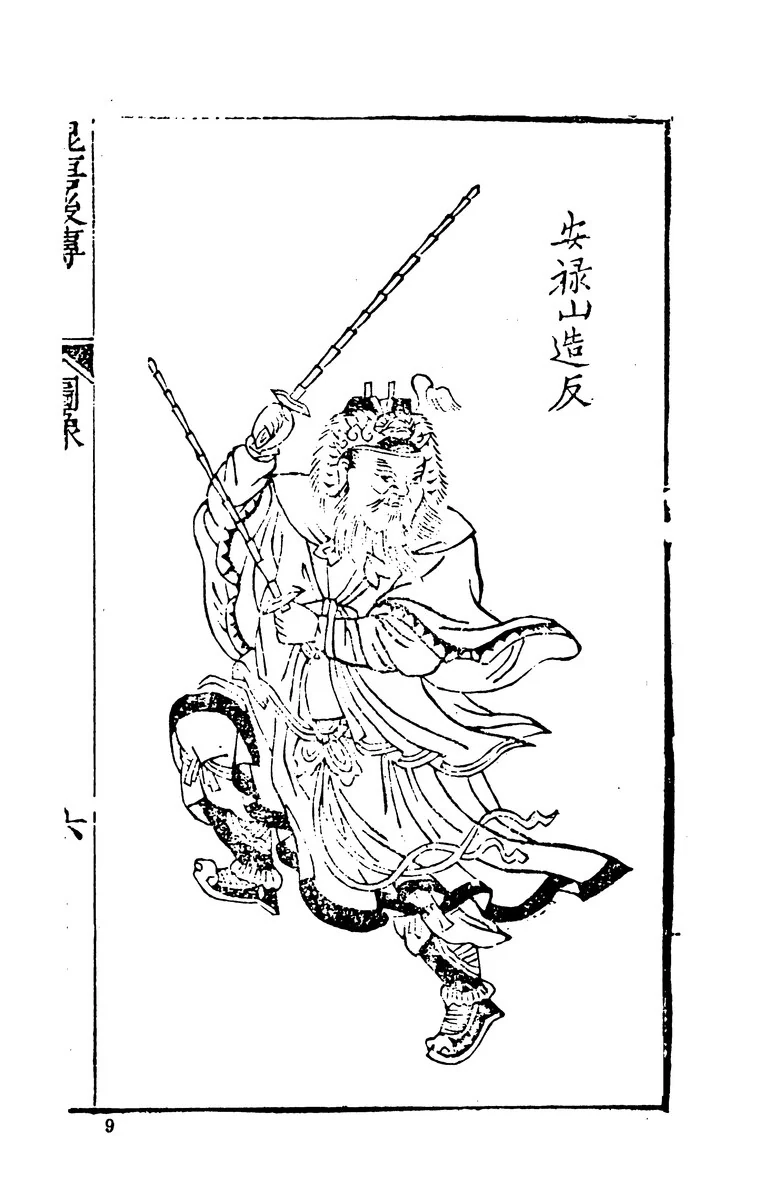
An Lushan (January 22, 703–January 29, 757), originally named Yaluoshan (also written Aluoshan), was said in the source to have originally borne the surname Kang, possibly reflecting origins connected with Kangju/Samarkand. After his mother married the Turkic man An Yanyan, he took the surname An and the name Lushan. He was from Liucheng in Yingzhou (south of present-day Chaoyang, Liaoning) and became the initiator of the An…
703 CE–757 CETang Dynasty
PROFILE
An Lushan (January 22, 703–January 29, 757), originally named Yaluoshan (also written Aluoshan), was said in the source to have originally borne the surname Kang, possibly reflecting origins connected with Kangju/Samarkand. After his mother married the Turkic man An Yanyan, he took the surname An and the name Lushan. He was from Liucheng in Yingzhou (south of present-day Chaoyang, Liaoning) and became the initiator of the An Lushan Rebellion against the Tang. He was said to know six non-Han languages. In 732, Zhang Shougui, Military Commissioner of Youzhou, recognized his courage and quick wit, appointed him to a raiding unit tasked with capturing enemy personnel, and adopted him as a son. By 740 An Lushan had risen through military service to become military commissioner and governor-level official in the northeast. He later gained the confidence of Emperor Xuanzong of Tang and Yang Guifei and came to hold the military commissions of Pinglu, Fanyang, and Hedong simultaneously. Famous for extreme obesity yet still capable of performing the Sogdian whirl dance, he received imperial privileges and noble titles including Prince of Dongping. In the winter of 755 he rebelled from Fanyang, marched south, and captured Luoyang, initiating the An Lushan Rebellion. In 756 he proclaimed himself Emperor Xiongwu of Yan and adopted the Shengwu era. His forces later captured Tong Pass and Chang’an. In 757 his second son An Qingxu, seeking the throne, arranged his murder. The rebellion An Lushan began became a major turning point in the Tang dynasty’s decline.
- Period
- Tang
- Dynasty/Regime
- Tang Dynasty
- Identity
- Emperor
- Ethnicity
- Not recorded in historical sources
- Native place
- Liucheng, Yingzhou (south of present-day Chaoyang, Liaoning)
- Date of birth
- January 22, 703 (first day of the first month, third year of Chang'an)
- Place of birth
- Not recorded in historical sources
- Date of death
- January 29, 757 (sixth day of the first month, second year of Zhide)
- Reign
- 756-757
- Predecessor
- Not applicable (proclaimed himself emperor of Yan)
- Successor
- An Qingxu
- Era name
- Shengwu
- Temple name
- Not recorded in historical sources
- Posthumous name
- Not recorded in historical sources
- Major achievements
- Frontier military commissioner who launched the An Lushan Rebellion, proclaimed himself Emperor Xiongwu, and severely undermined the foundations of the High Tang.
LIFE TIMELINE
In his teens | His mother married the Turkic general An Yanyan; he took the surname An and name Lushan and became sworn brothers with An Sishun and others
Age thirty | Arrested for stealing sheep by Zhang Shougui, Military Commissioner of Youzhou; released after a bold response, appointed to a raiding force, and adopted by Zhang
Age thirty-eight | Became Military Officer of Pinglu, Governor of Yingzhou, and military commander at Pinglu; bribed visiting officials and gained Emperor Xuanzong’s confidence
Age forty | Appointed acting Censor-in-Chief and Military Commissioner of Pinglu, gaining regular access to court
Age forty-two | Replaced Pei Kuan as Military Commissioner of Fanyang while retaining additional Hebei and Pinglu commissions; later requested to become Yang Guifei’s adopted son
Age forty-five | Promoted to Censor-in-Chief; feared chief councilor Li Linfu and called him “Tenth Elder Brother”
Age forty-eight | Promoted to Prince of Dongping and granted an iron certificate of privilege
Age forty-nine | Also became Military Commissioner of Hedong, thus holding three major commands; built Xiongwu City at Fanyang and secretly stockpiled weapons, grain, and warhorses
Age fifty-one | Yang Guozhong repeatedly warned that he would rebel; palace eunuch Fu Qiulin was sent to investigate but was bribed and returned praising his loyalty
Age fifty-two | Went to Huaqing Palace in the first month and tearfully claimed Yang Guozhong intended to kill him; departed rapidly for Fanyang on the first day of the third month, traveling three to four hundred li per day
Age fifty-three | Rebelled from Fanyang in the eleventh month with about 150,000 troops, falsely claiming imperial orders to punish Yang Guozhong; captured Luoyang in the twelfth month
Age fifty-four | Proclaimed himself emperor on the first day of the first month, founded Great Yan, and adopted the Shengwu era; in the sixth month his forces broke Tong Pass and occupied Chang’an while Emperor Xuanzong fled toward Sichuan
Age fifty-five | On the night of the fifth day of the first month, assassinated in a plot involving his son An Qingxu, adviser Yan Zhuang, and eunuch Li Zhuer
BIOGRAPHY
Biography
Family Background and Early Years
The source states that An Lushan originally had no surname and was named Yaluoshan. He was born on the first day of the first month of 703. His mother, Lady Ashide, was described as a Turkic shaman who practiced divination. The source explains his early name as a Turkic word connected with battle. His father died when he was young, and he lived among Turkic groups with his mother. An Yanyan, elder brother of the general An Bozhi, later married her.
Early in the Kaiyuan era, An Lushan and a son of the general An Daomai fled from the Turkic community. An Zhenjie, second son of An Daomai and vice prefect of Lanzhou, brought them back. When An Lushan reached his teens, he became ashamed of living with his elder brother and stepfather An Yanyan and entered sworn brotherhood with An Sishun and others, taking the surname An. As an adult he knew six languages and worked as a market broker negotiating prices between merchants.
The source preserves a scholarly debate over An Lushan’s ethnic origins. Takao Moriyasu, drawing on ancient Central Asian documents, argued that both Kang, said to be his original surname, and An, his later surname, were Chinese surnames used by Sogdians. W. B. Henning proposed that Lushan or Luoshan reflected the Sogdian name Rokhshan, meaning “bright.” Yoshida Yutaka likewise treated the name as a direct rendering of a Sogdian form, An Rokhshan. Kuwabara Jitsuzō, Edwin Pulleyblank, Xiang Da, Chen Yinke, Rong Xinjiang, and others have argued for Sogdian origins. Antonino Forte accepted the Sogdian derivation of the name but argued that An Bozhu and An Yanyan were Turkic and only assumed the surname An after attaching themselves to An Zhenjie, leading him to consider An Lushan Turkic. The Chinese source does not resolve this debate.
Rise to Power
In 732, Zhang Shougui became Military Commissioner of Youzhou. An Lushan was caught stealing sheep and was about to be beaten to death. He shouted: “Does the governor not wish to destroy the two barbarian peoples? Why kill me?” Zhang, struck by his bold words and imposing appearance, released him and ordered him to serve with his fellow townsman Shi Siming in capturing enemy personnel. Their success led to An Lushan’s promotion to junior command. Zhang often criticized An’s obesity, and because Zhang inspired fear, An restrained his eating. His bravery became famous, and Zhang adopted him as a son.
In 740 An Lushan became a senior military officer at Pinglu. He was described as clever and quick and was praised by many. The court appointed him Governor of Yingzhou and commander of the Pinglu forces. He gave rich gifts to officials passing through the region and asked them to speak well of him at court, which increased Emperor Xuanzong’s trust.
In 742, after a military commission was established at Pinglu, Xuanzong appointed An Lushan acting Censor-in-Chief and Military Commissioner of Pinglu. This allowed him to enter court and submit memorials directly, and the emperor’s favor deepened.
In 744, An Lushan replaced Pei Kuan as Military Commissioner of Fanyang while retaining Hebei inspection and Pinglu military duties. Officials including Zhang Lizhen and Xi Jianhou accepted gifts or praised him, while Pei Kuan and chief councilor Li Linfu also spoke favorably of him. Since these men were trusted by Xuanzong, the emperor’s confidence in An Lushan became stronger.
An Lushan later asked to become Yang Guifei’s adopted son. When entering the palace, he paid respects to Yang before the emperor. Asked why, he replied: “I am a Hu man; among Hu people the mother comes before the father.” Xuanzong was delighted and ordered members of the Yang family to treat An Lushan as a brother.
In 747, An was promoted to Censor-in-Chief. He frequently sent Liu Luogu to report palace affairs. An Lushan and Wang Hong both held high censorial rank. Although An was confident because of imperial favor, he was deeply intimidated by chief councilor Li Linfu. Li repeatedly anticipated his thoughts before he voiced them, and An came to regard him as almost supernaturally perceptive. Even in winter, An was said to sweat with fear in Li’s presence. Li addressed him warmly and An called him “Tenth Elder Brother.” After envoys returned from court, An’s first question was often what Li Linfu had said; favorable words delighted him, while even mild criticism caused panic.
In later years An Lushan became extremely obese, with the source claiming that his belly hung below his knees and that he weighed 330 jin. He needed to lift his body with his shoulders to walk, yet in front of Xuanzong he could perform the Sogdian whirl dance with remarkable speed. His residence was extremely lavish, with everyday containers made of gold and silver. The emperor’s favor toward him was conspicuous at court.
In 751, An went to court again and asked for the Hedong military commission, which Xuanzong granted. The source states that he had eleven sons. His eldest, An Qingzong, was Court of Imperial Stud director, and his second, An Qingxu, held a high diplomatic ceremonial office. An Qingzong married a daughter of the crown prince.
Preparations and Rebellion
An Lushan secretly prepared for rebellion. North of Fanyang he built Xiongwu City, outwardly as a defensive position but in practice as a depot for weapons and grain and as a stronghold. He accumulated 15,000 warhorses and comparable numbers of cattle and sheep. Holding the Pinglu, Fanyang, and Hedong military commissions simultaneously, he received imperial approval for virtually all his requests. He gathered Zhang Tongru, Li Tingjian, Ping Lie, Li Shiyu, Dugu Wensu, and others around him; Gao Shang handled written affairs; Liu Luogu remained in Chang’an as an intelligence agent; and trusted commanders including An Shouzhong, Li Guiren, Cai Xide, Niu Tingjie, Xiang Runke, Cui Qianyou, Yin Ziqi, He Qiannian, Wu Lingxun, Neng Yuanhao, Tian Chengsi, and Tian Qianzhen were selected from the army. Constant demands for donkeys, camels, warhorses, falcons, and hounds placed heavy burdens on the population.
Right chief councilor Yang Guozhong repeatedly told Xuanzong that An Lushan would rebel. In 753, the emperor sent the palace eunuch Fu Qiulin to investigate. Fu accepted An’s bribes and returned praising his loyalty. Yang then predicted that if summoned An would refuse to come, but An did appear when called. In the first month of 754, he visited Xuanzong at Huaqing Palace and tearfully said: “I am a man of foreign origin and do not know Chinese writing. Your Majesty promoted me beyond rank, and now Yang Guozhong wishes to kill me.” Xuanzong treated him with still greater favor and gave him further high office. An subsequently sought control over imperial stables and state pastures, placing trusted associates in key posts and selecting superior horses for his own use. On the first day of the third month he hurried from Chang’an back to Fanyang, covering three to four hundred li a day. The source states that by then anyone who accused An of plotting rebellion risked being angrily punished by Xuanzong and handed over to An himself.
In 755, Xuanzong summoned him again, but An claimed illness and did not attend. He also used illness as an excuse to avoid the wedding ceremony arranged for his eldest son An Qingzong.
In the eleventh month, An Lushan rose in rebellion at Fanyang, falsely claiming that he acted under Xuanzong’s orders to punish the “traitorous minister” Yang Guozhong. He led approximately 150,000 cavalry and infantry from multiple ethnic groups southward, marching at night and eating at dawn and advancing sixty li a day. Yan Zhuang became chief strategist, while Sun Xiaozhe, Gao Miao, and He Qiannian were leading figures. Because the realm had enjoyed long peace and few people had direct experience of war, the rebellion caused panic at court. The palace guard itself was poorly prepared, and the government had to open the imperial storehouses and use silks to recruit soldiers. Gao Xianzhi, Feng Changqing, and others were appointed to resist.
An Lushan imposed severe discipline, and the source describes his troops as men willing to fight to the death, with individual soldiers able to fight many opponents. Tang forces suffered repeated defeats.
Proclaiming Himself Emperor and Death
In the twelfth month, the rebel army crossed the Yellow River and reached Chenliu. Zhang Jieran, the Henan military commissioner, died after the city fell, and his severed head was sent north. When An Qingxu learned from a public notice that his elder brother An Qingzong had been executed, he wept and told An Lushan. An Lushan cried out in shock and anger and ordered surrendered government troops lining the road to kill one another; six or seven thousand were reportedly killed before he entered Chenliu. Governor Guo Na, who had initially resisted, then surrendered.
The rebels advanced to Xingyang. Governor Cui Wubi resisted and died when the city fell. At Yingzigu near Sishui, the Tang commander Li Fei Shouyu shot arrows from a crouching position and killed hundreds of rebels; one arrow struck An Lushan’s war chariot. An avoided the position and detoured south. When Li Fei Shouyu exhausted his arrows, he drowned himself. Officials in Luoyang broke the Heyang bridge to obstruct the advance, but An pressed forward.
Feng Changqing blocked roads with felled trees before retreating. An Lushan entered Luoyang, executed Jiang Qing and others, summoned Henan governor Daxi Xun, and put him to work. Gao Xianzhi and Feng Changqing withdrew toward Tong Pass, with panic and trampling causing casualties. Cui Qianyou was left to hold Shanzhou, while other local officials surrendered.
After occupying Luoyang and seeing its imposing palaces, An Lushan became determined to claim the imperial title. On the first day of the first month of the following year, he arranged for elders, Buddhist monks, and Daoist clergy in Luoyang to urge him to ascend. He proclaimed himself Emperor Xiongwu, established the state of Great Yan with Luoyang as capital, and adopted the Shengwu era.
In the fifth month, Tang forces assembled from Jingzhou, Xiangzhou, Qianzhong, and Lingnan under Lu Jiong fought the rebels near Ye County and were destroyed. In the sixth month, Li Guangbi and Guo Ziyi defeated rebel forces at Jiashan east of Changshan, prompting more than ten Hebei prefectures under rebel control to return to the Tang. An Lushan became anxious and considered withdrawing to Fanyang. At this moment, however, Geshu Han led eighty thousand cavalry and infantry out of Tong Pass and was crushed west of Lingbao by Cui Qianyou. Geshu Han was captured and handed to the rebels. Tong Pass fell, the rebels entered Chang’an, and Emperor Xuanzong fled toward Sichuan.
In his later years An Lushan suffered severe eye disease and became nearly blind. His temperament changed and he frequently abused close attendants. Yan Zhuang, one of his most trusted advisers, was often beaten and came to resent him. On the fifth day of the first month of 757, An Qingxu feared that An Lushan might replace him with the younger son An Qingen. He conspired with Yan Zhuang, who persuaded the eunuch Li Zhuer to take part. Yan and Li entered An Lushan’s chamber at night while An Qingxu waited outside. Li struck An Lushan in the abdomen with a large blade. Unable to find the sword kept beside his bed, An shook the bedpost and shouted: “This must be the work of a household traitor!” His organs spilled onto the bed and he died. An Qingxu did not immediately announce his death, instead claiming that An Lushan had abdicated in his favor and had become Retired Emperor. After Shi Siming later killed An Qingxu and took the Yan throne, he posthumously honored An Lushan as Emperor Guanglie.
Major Activities
Launching the An Lushan Rebellion
In the eleventh month of 755, An Lushan rebelled at Fanyang under the pretext of punishing Yang Guozhong and “clearing the ruler’s side,” leading roughly 150,000 troops south from his three commands. The rebellion became a landmark in the Tang dynasty’s transition from strength to decline. Luoyang fell in the twelfth month. In the first month of 756, An proclaimed himself emperor of Great Yan and adopted the Shengwu era. In the sixth month, rebel forces broke Tong Pass and occupied Chang’an. Xuanzong fled toward Sichuan while Crown Prince Li Heng later ascended at Lingwu as Emperor Suzong. The An Lushan Rebellion lasted eight years. Although eventually suppressed, it severely weakened central authority and contributed to the later pattern of powerful regional military commands.
Holding Three Military Commissions
An Lushan became Military Commissioner of Pinglu in 742, added Fanyang and Hebei responsibilities in 744, and obtained Hedong in 751. By simultaneously holding Pinglu, Fanyang, and Hedong, he controlled major military, civil, and fiscal resources across parts of present-day Hebei, western Liaoning, and Shanxi. He used this position to build Xiongwu City at Fanyang, stockpile weapons and grain, accumulate tens of thousands of horses, and gather surrendered Tongluo, Xi, and Khitan men as adopted retainers called yeluohe, described in the source as a Turkic term for strong warriors.
Winning the Trust of Xuanzong and Yang Guifei
An Lushan used calculated behavior to secure the trust of Emperor Xuanzong and Yang Guifei. He asked to become Yang’s adopted son and, when entering court, greeted her before the emperor, explaining that among Hu peoples “the mother comes before the father.” Xuanzong was delighted. Despite his obesity, An performed the Sogdian whirl dance “swift as the wind.” Asked why his belly was so large, he reportedly answered, “It contains only a loyal heart!” He also flattered Xuanzong by saying he knew only that the realm had the emperor and did not know what office the crown prince held. Xuanzong granted him an iron certificate, ennobled him first as Duke of Liucheng and later Prince of Dongping, and appointed him to major offices. Officials including Li Linfu, Pei Kuan, and Xi Jianhou also spoke well of him.
Campaigns against the Xi and Khitan
While serving in Hebei, An Lushan fought the Xi and Khitan, whose forces sometimes raided Tang territory. The source states that he used warfare, deception, and indiscriminate killing to suppress them and gain military credit, causing Xuanzong to regard him as a “Great Wall” of frontier defense. From 732 onward he served under Zhang Shougui with Shi Siming in raiding and captive-taking operations and earned repeated military merit. His familiarity with local non-Han groups and command of six languages helped him establish himself in the northeast and rise in power.
Building Court Connections and His Own Faction
An Lushan was skilled at cultivating powerful officials. He gave rich gifts to visiting court officials, leading Zhang Lizhen, Xi Jianhou, Pei Kuan, and others to speak well of him before Xuanzong. He deeply feared chief councilor Li Linfu and called him “Tenth Elder Brother.” After Li’s death, An lost the person he most feared at court and his relationship with right chief councilor Yang Guozhong deteriorated sharply. Yang repeatedly warned that he would rebel, and their conflict became an immediate political trigger of the revolt. An gathered literary advisers such as Zhang Tongru, Gao Shang, and Yan Zhuang, commanders including An Shouzhong, Li Guiren, Cai Xide, Cui Qianyou, and Tian Chengsi, and an intelligence network centered on Liu Luogu in Chang’an, forming a complete rebel organization.
Personal Relations
- Father: a man of the Kang surname, described in the source as Sogdian, who died early
- Mother: Lady Ashide, described as a Turkic shaman
- Stepfather: An Yanyan, brother of the Turkic general An Bozhi
- Wives: Lady Kang; Empress Duan
- Eldest son: An Qingzong, Court of Imperial Stud official, married a daughter of the crown prince and executed by Emperor Xuanzong in 755
- Second son: An Qingxu, later killed his father and proclaimed himself emperor
- Younger son: An Qingen
- Other children: An Qinghe, An Qingyu, An Qingze, An Qingguang, An Qingxi, An Qingyou, An Qingchang
- Zhang Shougui: Military Commissioner of Youzhou, patron and adoptive father
- Shi Siming: fellow townsman and early companion in raiding service, later another leader of the rebellion
- An Sishun: sworn brother
- Li Linfu: chief councilor feared by An Lushan and called “Tenth Elder Brother”
- Yang Guozhong: right chief councilor and political enemy who repeatedly warned of rebellion
- Gao Shang and Yan Zhuang: principal advisers
- Ji Wen: trusted associate, appointed military ministry official and censor
- Emperor Xuanzong of Tang, Li Longji: patron whom An Lushan ultimately betrayed
- Yang Guifei: An Lushan’s adoptive mother
- Emperor Suzong of Tang, Li Heng: former crown prince who later directed the suppression of the rebellion
- Yang Guozhong: principal political enemy
- Li Guangbi and Guo Ziyi: major Tang generals suppressing the rebellion
- Gao Xianzhi and Feng Changqing: generals resisting rebel advance
- Geshu Han: defender of Tong Pass, defeated and captured
- Yan Zhenqing: governor of Pingyuan who was among the earliest to report the rebellion and organize resistance
Historical Assessment
Tang / Contemporary
- Emperor Xuanzong is recorded as saying: “Lushan is my Great Wall for ten thousand li.” (Old Book of Tang: Biography of An Lushan)
- Li Linfu repeatedly anticipated An Lushan’s thoughts in conversation, and An “regarded him as divinely perceptive,” illustrating the depth of Li’s political calculation. (Old Book of Tang)
- Yang Guozhong “repeatedly memorialized that Lushan would certainly rebel,” making him one of the earliest senior officials to recognize the danger. (Old Book of Tang)
- When Zhang Shougui first met An Lushan, he saw that An was “fat and pale, admired his bold words and released him,” later adopting him after he gained a reputation for bravery. (Old Book of Tang)
Song and Yuan Periods
- The New Book of Tang states that “Lushan, possessing the nature of a treacherous thief and commanding barbarian troops, took advantage of a realm long at peace where people no longer knew warfare, drove deep into the Central Plains as though entering unoccupied territory.”
- Fan Zuyu wrote in Mirror of the Tang that Emperor Xuanzong’s use of Li Linfu as chief councilor and An Lushan as general ultimately produced great disorder and represented a failure in choosing men.
- Sima Guang wrote in the Comprehensive Mirror in Aid of Governance that “Lushan concealed a rebellious heart, used frontier defense as a pretext, accumulated troops and grain, and secretly planned disloyal acts.”
Ming and Qing Periods
- Wang Fuzhi argued that Xuanzong’s excessive favor toward the non-Han general An Lushan and his simultaneous control of three commands allowed the danger to grow until it caused the emperor’s flight.
- Wang Mingsheng wrote that although Yang Guozhong helped precipitate the rebellion, An Lushan had long harbored rebellious intentions.
- Zhao Yi commented that An Lushan, despite receiving extraordinary favor and reaching the heights of wealth and office, remained unsatisfied and brought destruction upon his own house.
Modern Scholarship
- Chen Yinke treated the rebellion as the beginning of the Tang regional military problem and linked An Lushan’s background to deeper tensions in Tang ethnic and frontier administration.
- Xiang Da argued that An Lushan descended from Sogdians and connected the rebellion with the interests of Sogdian mercantile groups.
- Rong Xinjiang further examined An Lushan’s Sogdian background and interpreted the rebellion as a challenge by increasingly “Hu-influenced” frontier forces to Tang central authority.
- Huang Yongnian regarded the rebellion as the turning point from Tang prosperity to decline and argued that regional military separatism, eunuch domination, and the Niu–Li factional strife became major chronic problems thereafter.
FIGURES ASSOCIATED WITH THIS DYNASTY
Bibliography
- Liu Xu et al., Old Book of Tang, juan 200, part 1, "Biography of An Lushan."
- Ouyang Xiu and Song Qi, New Book of Tang, juan 225, part 1, "Biography of An Lushan."
- Sima Guang, Zizhi Tongjian, "Annals of Tang."
- Chen Yinke, A Draft Study of the Political History of the Tang Dynasty.