Birth
Born into a prominent military family in Chang'an.
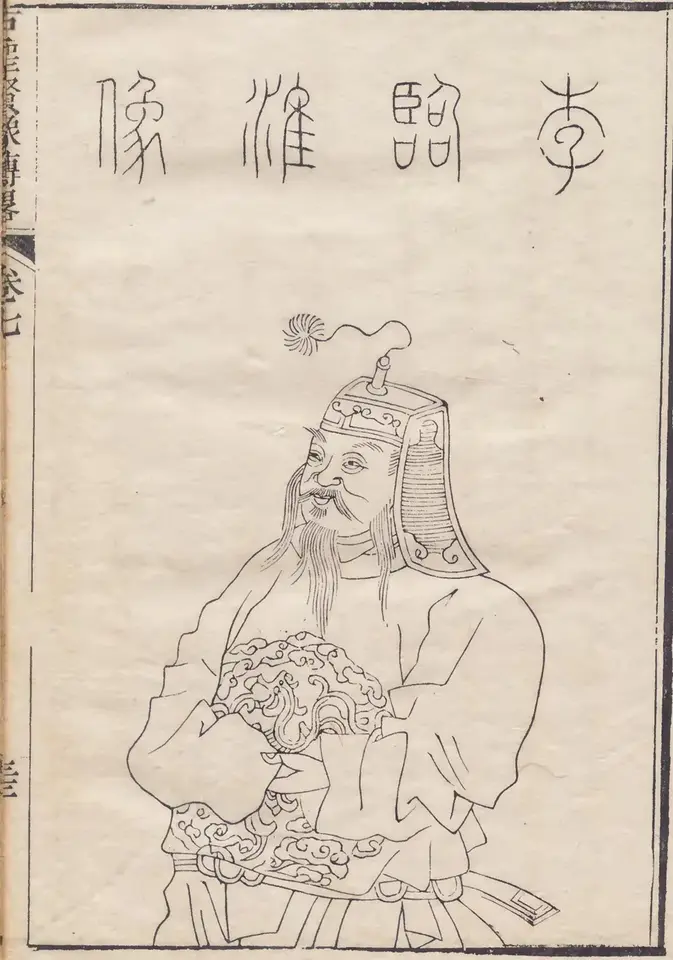
708 CE–764 CE
李光弼
Li Guangbi (李光弼, 708–764), a native of Liucheng in Yingzhou (modern Chaoyang, Liaoning) born in Chang'an, was a preeminent military strategist, supreme commander, and foundational savior of the Tang Dynasty during the An Lushan Rebellion. Born into an illustrious Khitans aristocratic martial lineage serving the Tang court, Li Guangbi was renowned for strict military discipline, brilliant tactical calculations, and battlefield…
Li Guangbi (李光弼, 708–764), a native of Liucheng in Yingzhou (modern Chaoyang, Liaoning) born in Chang'an, was a preeminent military strategist, supreme commander, and foundational savior of the Tang Dynasty during the An Lushan Rebellion. Born into an illustrious Khitans aristocratic martial lineage serving the Tang court, Li Guangbi was renowned for strict military discipline, brilliant tactical calculations, and battlefield composure. Following the outbreak of the An Lushan Rebellion in 755, Li Guangbi was recommended by Guo Ziyi to command the Shuofang garrison. Operating across northern China, he defended Taiyuan with merely ten thousand soldiers against Shi Siming's host of one hundred thousand, orchestrating subsurface tunneling and catapult barrages to inflict crushing defeats on the rebels. Promoted to Vice Grand Marshal of the Realm (Tianxia Bingma Fu Yuanshuai), Li Guangbi masterminded the legendary defense of Heyang, constructing fortified river islands to annihilate Shi Siming's amphibious strike fleets. Alongside Guo Ziyi, he recovered the eastern capital Luoyang and extinguished the rebel regime. Celebrated as the greatest general of the Tang restoration (Zhongxing Diyi), Li Guangbi held the supreme offices of Grand Defender (Taiwei) and Prince of Linhuai.
Born into a prominent military family in Chang'an.
Appointed Military Governor of Hedong upon Guo Ziyi's recommendation.
United with Guo Ziyi at Changshan, severing An Lushan's northern communication lines.
Repulsed Shi Siming's massive assault on Taiyuan using tunneling and trench warfare.
Elevated to Vice Grand Marshal; fortified Heyang to block rebel forces along the Yellow River.
Coordinated imperial and Uyghur forces to liberate Luoyang, breaking the rebel backbone.
Passed away in Xuzhou at age fifty-seven; posthumously honored as Grand Guardian (Taibao) and Duke Wumu.
Served under Wang Zhongsi in the Hexi and Longyou frontier commands, earning recognition for military talent.
Appointed Deputy Military Commissioner of Daning Army in Shuofang.
Marched through Jingxing Pass to capture Changshan and joined Guo Ziyi to rout Shi Siming at Jiashan.
Participated in the nine-jiedushi coalition siege of An Qingxu at Yecheng.
Executed a strategic withdrawal from Luoyang to fortify the three cities of Heyang, routing Shi Siming's main army.
Defeated rebel garrisons at Huaizhou and captured rebel generals Zhou Zhi and An Taiqing.
Suffered a setback at Mangshan due to eunuch Yu Chao'en's interference; subsequently reappointed to command in Huainan and Xuzhou.
Dispatched lieutenants down the Yangtze and Huai basins to crush the rebellion of Yuan Chao in eastern Zhejiang.
Remained in Xuzhou during the Tibetan incursion into Chang'an due to deep distrust of court eunuchs Cheng Yuanzhen and Yu Chao'en.
Li Guangbi grew up immersed in the military classics and horse archery. In his youth, he served with distinction under Wang Zhongsi along the western frontiers, earning renown for integrity and tactical astuteness. When An Lushan ignited his catastrophic rebellion in late 755 CE, capturing Luoyang and Chang'an, the Tang dynasty stood on the brink of total annihilation. Appointed Military Governor of Hedong on Guo Ziyi's direct recommendation, Li Guangbi mobilized elite cavalry from Taiyuan and crossed Mount Taihang into the central plains. In 756 CE, Li Guangbi recaptured Changshan and joined forces with Guo Ziyi at Jiayu, executing a crushing envelopment that routed Shi Siming's northern army, isolating An Lushan from his logistics hub in Fanyang.
In early 757 CE, Shi Siming rallied over one hundred thousand veteran rebel soldiers to siege Taiyuan, seeking to seize the gateway to Shanxi. Li Guangbi had fewer than ten thousand troops in the city. Demonstrating extraordinary engineering ingenuity, Li Guangbi ordered his men to construct giant trebuchets capable of hurling massive boulders into enemy ranks, while simultaneously digging deep subterranean tunnels beneath the enemy siege lines. When rebel assault towers approached the parapets, the ground collapsed beneath them, burying thousands. When Shi Siming attempted subterranean tunneling, Li Guangbi dug counter-trenches and captured the enemy diggers alive. After forty days of desperate assaults, Shi Siming withdrew in humiliation, leaving over seventy thousand dead and wounded outside Taiyuan's walls.
In 759 CE, following the Tang setback at Xiangzhou, Emperor Suzong entrusted the supreme military command of the empire to Li Guangbi, elevating him to Vice Grand Marshal. Anticipating that Shi Siming would march down the Yellow River to crush the imperial capital, Li Guangbi evacuated the exposed city of Luoyang and entrenched his army at Heyang, occupying three strategic fortress islands linked by pontoon bridges.
When Shi Siming sent flaming barges to incinerate the bridge, Li Guangbi deployed underwater iron palisades that trapped the burning vessels. When Shi Siming deployed thousands of combat-trained warhorses, Li Guangbi unleashed female mares to break their formations. Coordinating an amphibious double envelopment, Li Guangbi routed Shi Siming, beheading tens of thousands of elite rebel cavalry and seizing vast stockpiles of armaments.
In 762 CE, Li Guangbi directed the allied Tang and Uyghur armies in the final offensive that recaptured Luoyang, driving the remaining rebels into flight and sealing the survival of the Tang Empire. In his final years, troubled by eunuch intrigues at court, Li Guangbi garrisoned Xuzhou, where he passed away in 764 CE at the age of fifty-seven.
Descended from the Khitan chieftain Li Kaigu and Duke Li Kailuo, Li Guangbi combined nomadic cavalry prowess with strict classical military discipline on the northwestern frontier.
In early 756 CE, leading ten thousand elite Shuofang troops through Jingxing Pass, Li Guangbi liberated Changshan Commandery in a swift surprise assault.
Uniting his forces with Guo Ziyi's main Shuofang army, Li Guangbi crushed over fifty thousand rebel troops under Shi Siming at Jiashan, recovering more than ten commanderies in Hebei.
During the 758–759 CE siege of Yecheng, Li Guangbi advocated immediate decisive assaults, and when a storm disrupted the coalition lines in March 759 CE, he maintained strict formation and withdrew his troops in complete order.
Recognizing that the burned and open city of Luoyang could not be defended against Shi Siming's resurgent host, Li Guangbi evacuated its populace and garrisoned the three fortified river cities of Heyang.
In 760 CE, after months of methodical siege warfare along the Qin River, Li Guangbi stormed Huaizhou and captured rebel commanders An Taiqing and Zhou Zhi alive.
In early 761 CE, coerced by Army Supervisor Yu Chao'en and imperial decrees to abandon rugged terrain and deploy on the open plains of Mangshan, Li Guangbi suffered a rare tactical defeat.
Reappointed Grand Defender and Commandery Prince of Linhuai at Linhuai and Xuzhou, Li Guangbi cut off Shi Chaoyi's southern expansion and dispatched troops to crush Yuan Chao's rebellion in Zhejiang.
Fearing assassination by court eunuchs Cheng Yuanzhen and Yu Chao'en, Li Guangbi declined imperial summonses to Chang'an in 763 CE, which eroded his prestige among his subordinates before his death in 764 CE.
By holding Taiyuan against a tenfold larger rebel army in 757 CE, Li Guangbi protected the eastern flank of Emperor Suzong's restoration court in Lingwu and Fengxiang.
His victory at the Battle of Heyang in 759 CE halted Shi Siming's westward offensive and preserved the Tongguan and Guanzhong heartland.
By garrisoning Xuzhou and Linhuai during the final phase of the rebellion, Li Guangbi kept the Grand Canal grain transport route open for the central government.
Li Guangbi pioneered the coordinated use of heavy multi-man trebuchets, subterranean counter-mining, and amphibious river-island fortifications.
Many famed generals of the mid-Tang period, including Hao Tingyu, Lun Weizhen, and Bai Xiaode, rose to prominence under Li Guangbi's rigorous command.
Liu Xu in the Old Book of Tang praised Li Guangbi's unparalleled tactical mastery: "Li Guangbi held the military reins of the realm; his strategic calculations and victorious deployments were once-in-a-generation. His rewards were reliable, his punishments impartial, and his warriors fought with boundless vigor, displaying the true spirit of ancient heroes." Historians widely regard Li Guangbi as the greatest field tactician of the mid-Tang period, whose defensive triumphs at Taiyuan and Heyang preserved the dynastic continuity of the Tang Empire.
Both the Old Book of Tang and the New Book of Tang acclaimed Li Guangbi as "First in the Restoration" (Zhongxing Diyi), comparing his battlefield genius to the legendary commanders of antiquity.
Song historians such as Sima Guang and Ouyang Xiu analyzed the contrast between Li Guangbi's austere severity—which ultimately left him vulnerable to eunuch slander—and Guo Ziyi's magnanimous flexibility.
Modern military historians recognize Li Guangbi's campaigns at Taiyuan and Heyang as masterpieces of active defense, combined-arms engineering, and strategic interior-line operations.
Memorial temples and historical records in Taiyuan, Mengzhou, and Xuzhou long commemorated Li Guangbi's defense of the cities and his unyielding devotion to the Tang state.
Scholars point to Li Guangbi's tragic final years in Xuzhou as a pivotal turning point illustrating how the rise of the eunuch army-supervision system undermined central military authority in the post-An Lushan era.
In subsequent imperial eras, Li Guangbi was enshrined among the foremost celebrated generals in the Martial Temple alongside Guo Ziyi, honoring his decisive role in saving the Tang Dynasty.
FIGURES ASSOCIATED WITH THIS DYNASTY