Age one | Born on the wu-yin day of the eighth lunar month in the Eastern Capital, Luoyang.
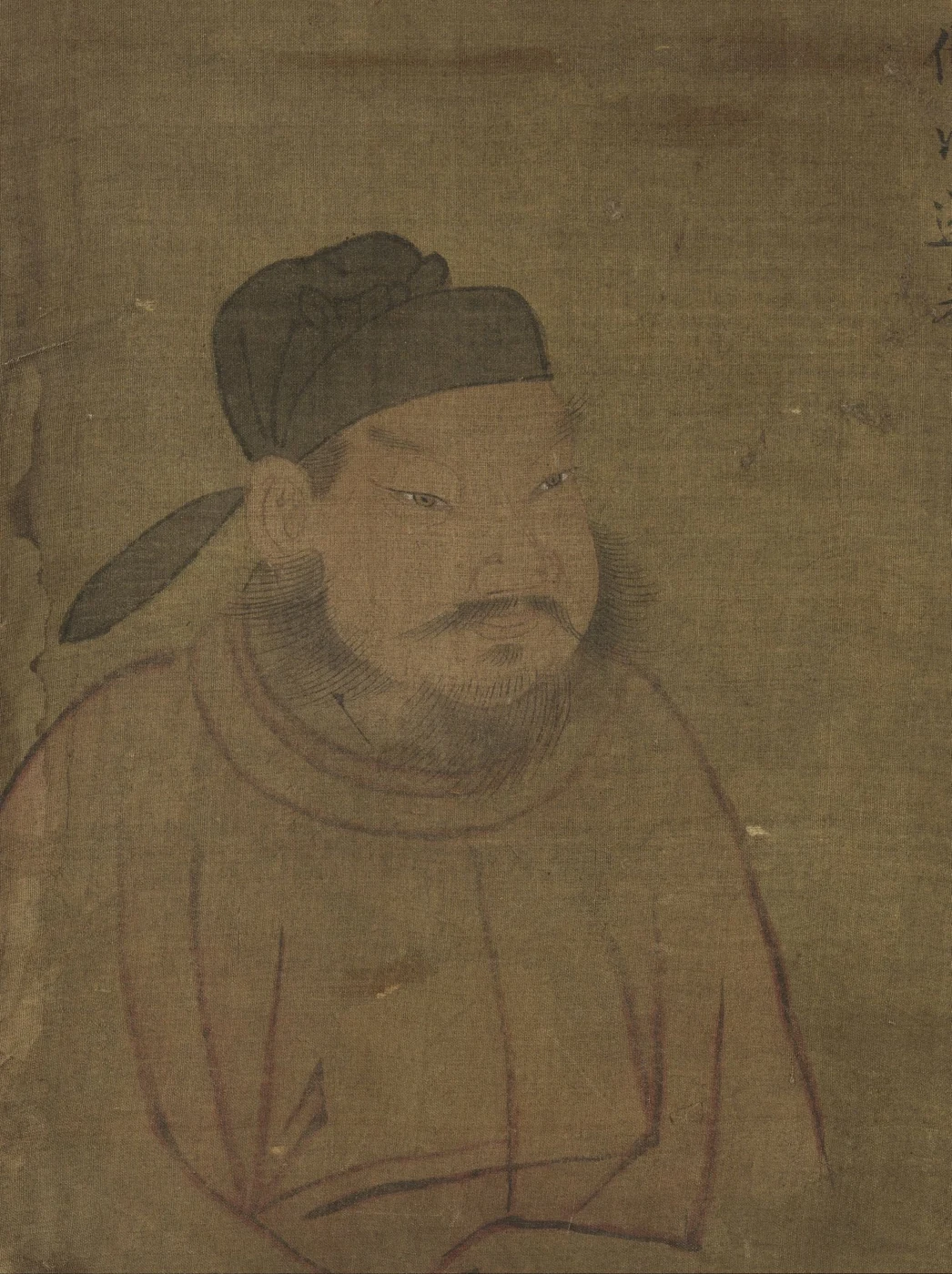
685 CE–762 CE
Emperor
Li Longji
李隆基
Emperor Xuanzong of Tang, Li Longji (8th day of the 9th lunar month in the first year of the Chuigong era, September 8, 685–jia-yin day of the 4th lunar month in the first year of the Baoying era, May 3, 762), was a grandson of Emperor Gaozong of Tang, Li Zhi, and Wu Zetian, and the third son of Emperor Ruizong of Tang, Li Dan. His mother was Consort Dou. Because he ranked third among his brothers, he was also known in his…
685 CE–762 CETang Dynasty
PROFILE
Emperor Xuanzong of Tang, Li Longji (8th day of the 9th lunar month in the first year of the Chuigong era, September 8, 685–jia-yin day of the 4th lunar month in the first year of the Baoying era, May 3, 762), was a grandson of Emperor Gaozong of Tang, Li Zhi, and Wu Zetian, and the third son of Emperor Ruizong of Tang, Li Dan. His mother was Consort Dou. Because he ranked third among his brothers, he was also known in his time as “Third Son Li.” He was the longest-reigning emperor of the Tang Dynasty, ruling from the first year of the Xiantian era to the fifteenth year of the Tianbao era, 712–756, and was also among the dynasty’s longest-lived emperors, dying at the age of seventy-eight. The source presents his life as deeply contradictory: he was both the architect of the Kaiyuan era of prosperity and the ruler under whom the An Lushan Rebellion broke out. In the early part of his reign he worked energetically, employed capable Grand Councilors, and brought Tang power to a peak; in his later years he neglected government, favored corrupt ministers, and ultimately presided over a rebellion that shook the dynasty and marked its turn from prosperity to decline. His temple name was Xuanzong, his posthumous title was Zhidao Dasheng Daming Xiao Huangdi, and he was buried at the Tailing Mausoleum. Because later Song and Qing rulers avoided the character “xuan” as a taboo, later generations also commonly called him Emperor Ming of Tang.
- Alternative Names
- Emperor Xuanzong of Tang; Emperor Ming of Tang
- Period
- Tang Dynasty
- Dynasty/Polity
- Tang Dynasty
- Identity
- Emperor
- Ethnicity/People
- Not recorded in historical sources
- Native Place
- Not recorded in historical sources
- Date of Birth
- September 8, 685
- Place of Birth
- Eastern Capital, Luoyang
- Date of Death
- May 3, 762
- Reign
- September 8, 712–August 12, 756
- Predecessor
- Emperor Ruizong of Tang (Li Dan)
- Successor
- Emperor Suzong of Tang (Li Heng)
- Era Names
- Not recorded in historical sources
- Temple Name
- Xuanzong
- Posthumous Title
- Zhidao Dasheng Daming Xiao Huangdi
- Major Achievements
- Founder of the Kaiyuan era of prosperity and a ruler who personally experienced the An Lushan Rebellion; the source presents his reign as both the high point of the High Tang and the beginning of its decline.
LIFE TIMELINE
Age three | Enfeoffed as Prince of Chu.
Age five | At Wu Zetian’s order, adopted posthumously into the line of Crown Prince Li Hong, Emperor Xiaojing.
Age seven | Established a separate household and staff; later that year, after the Pei Feigong and Fan Yunxian affair, he and his brothers were confined in the palace.
Age nine | His mother Consort Dou was secretly executed by Wu Zetian; Li Longji was demoted from Prince of Chu to Commandery Prince of Linzi.
Age fourteen | He and his brothers were again permitted to establish separate residences and were given a mansion in Jishan Ward in Luoyang.
Ages seventeen to twenty | Served as Right Guard Gentleman General and Stable Service Director and witnessed the Shenlong Coup.
Age twenty-one | Promoted to vice minister in the Court of the Imperial Stud.
Age twenty-four | Concurrently appointed vice prefect of Luzhou in the fourth lunar month.
Age twenty-six | On the gengzi day of the sixth lunar month, launched the Coup of the Prince of Linzi and destroyed the faction of Empress Wei; in the seventh lunar month he was made Crown Prince.
Age twenty-seven | Ordered to supervise government in the second lunar month.
Age twenty-eight | On the gengzi day of the eighth lunar month, accepted abdication from his father and took the throne, changing the era name to Xiantian.
Age twenty-nine | On the jiazi day of the seventh lunar month, launched the Xiantian Coup and compelled Princess Taiping to die; in the twelfth lunar month changed the era name to Kaiyuan.
Ages twenty-nine to forty-nine | Successively employed Yao Chong, Song Jing, Zhang Shuo, Zhang Jiuling, and other Grand Councilors and established the Kaiyuan era of prosperity.
Age fifty | Appointed Li Linfu as Grand Councilor; the source marks this as the point from which politics gradually deteriorated.
Age fifty-three | Deposed Crown Prince Li Ying and had him executed the same day; Consort Wu died that year.
Age fifty-six | Brought Yang Yuhuan into the palace.
Age sixty-one | Formally invested Yang Yuhuan as Noble Consort.
Age sixty-eight | Li Linfu died and Yang Guozhong became Grand Councilor.
Age seventy-one | The An Lushan Rebellion began in the eleventh lunar month.
Age seventy-two | Abandoned Chang'an and fled toward Sichuan in the sixth lunar month; in the seventh lunar month Crown Prince Li Heng proclaimed himself emperor at Lingwu and honored Li Longji as Retired Emperor; Li Longji formally relinquished power in the eighth lunar month.
Age seventy-three | Returned to Chang'an in the tenth lunar month and lived in Xingqing Palace.
Age seventy-six | Moved to Ganlu Hall in the Western Inner Palace and placed under confinement.
Age seventy-eight | Died on the jia-yin day of the fourth lunar month at Shenlong Hall in Chang'an.
BIOGRAPHY
Biography
Family Background and Early Years
Li Longji was born in 685, the first year of the Chuigong era, on the wu-yin day of the eighth lunar month in the Eastern Capital, Luoyang. He was born into the central line of the Tang imperial house. His grandfather was Emperor Gaozong of Tang, Li Zhi, his grandmother was Wu Zetian, his father was Li Dan, then Prince of Yu and later Emperor Ruizong of Tang, and his mother was Consort Dou. The source places his childhood in an unusually tense political environment. Wu Zetian had not yet formally taken the throne but already exercised effective control over government. Li Dan, though emperor in name for a period, is described as a figurehead who lived separately and did not participate in state affairs. After suppressing the rebellion led by Xu Jingye, Wu Zetian encouraged denunciations, employed harsh officials, and carried out purges of members of the Tang imperial clan and court officials.
Li Longji therefore spent his childhood amid severe political pressure. In 687 he was enfeoffed as Prince of Chu. In 689 Wu Zetian ordered that he be adopted as heir to the deceased Crown Prince Li Hong. In 690, when Wu Zetian replaced the Tang with her Zhou dynasty, Li Dan was reduced to the status of imperial heir and moved into the Eastern Palace, and Li Longji moved with him. In 691, at seven years old, Li Longji was allowed to establish a separate household, but in the eighth lunar month the court executed Pei Feigong and Fan Yunxian for privately visiting Li Dan. Li Longji and his brothers, together with three sons of Li Xian, were then confined again inside the palace and were unable to leave for more than ten years.
In the first lunar month of 693 Li Longji’s mother Consort Dou was falsely accused by a palace maid named Tuan’er of using sorcery. She and Li Dan’s principal consort Lady Liu were secretly executed in the palace by Wu Zetian, and their bodies were never recovered. In the eighth lunar month Li Dan himself was accused of treason. He escaped disaster only after a palace artisan, An Jinzang, cut open his own abdomen to demonstrate Li Dan’s innocence. That year Li Longji was demoted from Prince of Chu to Commandery Prince of Linzi. After losing his mother, he was raised by his father’s concubine Lady Doulu and by an aunt from the Dou family. In 698, after Di Renjie and other ministers persuaded Wu Zetian not to make Wu Chengsi heir, Li Xian was recalled to Luoyang and restored as Crown Prince. Li Dan was made Prince of Xiang, and Li Longji and his brothers were again permitted to establish their own residences.
Youth and the Politics of Coup
During the Chang'an era, 701–704, Li Longji served successively as Right Guard Gentleman General and Stable Service Director, an office connected with the imperial stables. During this period he witnessed the Shenlong Coup led by Zhang Jianzhi and others, which forced Wu Zetian to abdicate and restored Li Xian to the throne. The source presents the experience as an early lesson for Li Longji in palace politics and struggles for power. In 705 he was promoted to vice minister in the Court of the Imperial Stud. In the fourth lunar month of 708 he was concurrently appointed vice prefect of Luzhou and left Chang'an.
Li Longji returned to Chang'an in 710. By then, the source says, government was dominated by Empress Wei and Princess Anle. Emperor Zhongzong, Li Xian, was politically weak, Crown Prince Li Chongjun had been killed, and important ministers associated with the restoration of the Tang had been demoted or forced out. Empress Wei was said to have ambitions to imitate Wu Zetian and take the throne. Li Longji therefore cultivated talented and courageous men in secret and paid particular attention to building support among the emperor’s elite Wanqi troops. He and his aunt Princess Taiping, her son Xue Chongjian, and Zhong Shaojing, director of the imperial garden administration, planned to strike first.
On the gengzi day of the sixth lunar month of 710, Li Longji launched the coup later called the Coup of the Prince of Linzi. Ge Fushun attacked the Yulin barracks, killed Empress Wei’s supporters Wei Bo, Wei Xuan, and Gao Song, and brought the Yulin troops over to Li Longji’s side. Li Xianfu led troops through the White Beast Gate, and around midnight the forces joined at Lingyan Pavilion. Li Longji then entered the inner palace. Guards there turned against Empress Wei. She fled to the Flying Cavalry camp and was killed by mutinous troops. Princess Anle, Wu Yanxiu, Shangguan Wan’er, Zong Chuke, and other members of Empress Wei’s faction were also killed. The source says that the capital was searched for members of the Wei faction and that even males above a specified height were executed. The episode became known as the Coup of the Prince of Linzi.
Only after the coup succeeded did Li Longji report what had happened to his father, Li Dan. The source quotes Li Dan as saying that Li Longji had pacified the danger facing the ancestral temples and the state and that both the spirits and the people depended on his efforts. Li Longji was made Prince of Ping and appointed to high palace and central-government offices, including service as one of the Grand Councilors and command over the left and right Wanqi. He and Princess Taiping then compelled the young emperor Li Chongmao to abdicate and restored Li Dan as Emperor Ruizong.
When the court debated the succession, the principle of primogeniture would have favored Li Dan’s eldest son Li Chengqi, Prince of Song. Li Chengqi refused, arguing that the man who had saved the state should not rank below him. Officials who had taken part in the coup also supported Li Longji. Emperor Ruizong therefore made Li Longji Crown Prince.
The Crown-Prince Period and the Xiantian Coup
After Li Longji became Crown Prince, conflict with Princess Taiping intensified. Confident in the influence she had gained by helping restore Emperor Ruizong, Princess Taiping intervened repeatedly in government, placed informants in the palace and around the Crown Prince, and sought to replace him. In the first lunar month of 711 she intercepted Grand Councilors at Guangfan Gate and openly tried to persuade them to change the heir. Song Jing refused. Emperor Ruizong became increasingly uneasy. In the second lunar month, after an astrologer warned of troops entering the palace within five days, he ordered the Crown Prince to supervise state affairs.
In the seventh lunar month of 712, despite Princess Taiping’s opposition, Emperor Ruizong abdicated in favor of Li Longji. Li Longji ascended the throne and adopted the Xiantian era name, becoming Emperor Xuanzong of Tang. Ruizong, as Retired Emperor, nevertheless continued to control appointments of officials of the third rank and above and decisions on major military and governmental matters. Princess Taiping continued to influence the retired emperor. The source states that she and her allies, including Dou Huaizhen, Cen Xi, Xiao Zhizhong, Cui Shi, Xue Ji, and Li Jin, plotted to overthrow Li Longji and even considered poisoning his food.
In the seventh lunar month of 713, after receiving secret information from Wei Zhigu, Li Longji consulted Wang Ju, Zhang Shuo, and Cui Riyong and chose to strike first. With a small group of trusted officials, the eunuch Gao Lishi, several military officers, and more than three hundred armed retainers, he first killed the two Yulin generals Chang Yuankai and Li Ci and seized other supporters of Princess Taiping. The Grand Councilors Cen Xi and Xiao Zhizhong were executed, while Dou Huaizhen killed himself amid the fighting. Princess Taiping fled to a Buddhist temple, returned three days later, and was ordered to die at home. This was the Xiantian Coup. The source treats it as the moment at which Li Longji gained full control of imperial authority. In the twelfth lunar month he changed the era name to Kaiyuan, signaling his intention to restore vigorous rule.
The Kaiyuan Era of Prosperity
After the Xiantian Coup, Li Longji consolidated imperial power. The source says he faced a court weakened by repeated palace coups and by administrative disorder and corruption and responded by seeking officials on the basis of ability.
Early in the Kaiyuan era, Li Longji selected Yao Chong because the state needed decisive reform. At a meeting by the Wei River, Yao Chong reportedly presented a ten-point program that included avoiding unnecessary frontier warfare, opening channels for remonstrance, rewarding outspoken officials, restricting eunuch interference in government, and preventing domination by imperial relatives. Li Longji accepted the program and Yao Chong became Grand Councilor. Under Yao, the source says, political order improved and the economy recovered. Li later employed Song Jing, who was known for integrity and direct criticism. Yao and Song were remembered together as two central Grand Councilors of the early Kaiyuan period. Later Li Longji employed Zhang Shuo and Zhang Jiuling. Zhang Shuo was known for literature and helped compile the Kaiyuan Li, while Zhang Jiuling was celebrated for frank remonstrance.
The source describes the Kaiyuan years, 713–741, as the Tang Dynasty’s high point. Li Longji reorganized officialdom, eliminated redundant posts, and strengthened evaluation of officeholders. In economic administration he encouraged agriculture, promoted water-control projects, and reformed grain transport; Pei Yaoqing’s transport reforms reduced the need for the court to move in search of supplies. In culture he promoted education, established the Academy of Scholarly Worthies, gathered books, and encouraged literary composition in examinations, helping Tang poetry flourish. In military affairs he reformed the Fubing system, expanded the Recruitment-Based Standing Army System, and relied increasingly on Military Commissioners for frontier defense.
The source also describes an active frontier policy. Li Longji recognized the Mohe leader Da Zuorong as Prince of Bohai and established administrative institutions in Bohai and Heishui; he recognized the Nanzhao ruler Piluoge as Prince of Yunnan and the Uyghur leader Gulipeiluo as Huairen Khagan. These measures are presented as stabilizing the frontiers and extending Tang prestige.
From Prosperity to Decline: Politics in the Tianbao Period
According to the source, after 734 Li Longji gradually became less attentive to government, increasingly satisfied with earlier achievements and more absorbed in luxury and pleasure. He appointed Li Linfu as Grand Councilor. Li Linfu is portrayed as outwardly flattering but inwardly ruthless, eliminating rivals and monopolizing power for nineteen years. Capable officials such as Zhang Jiuling were pushed aside, access to frank advice narrowed, and politics deteriorated.
In 737 Li Longji accepted accusations associated with Consort Wu and the imperial son-in-law Yang Hui and deposed Crown Prince Li Ying, Prince Li Yao of E, and Prince Li Ju of Guang. All three were ordered to die on the same day, an episode remembered in the source as the “killing of three sons in one day.” Consort Wu died later that year. In 740 Li Longji brought Yang Yuhuan, who had been the wife of his son Prince Li Mao of Shou, into the palace. In 745 she was formally invested as Noble Consort. The source depicts Li Longji as deeply devoted to her and says her family benefited from her favor. Yang Guozhong rose through the court and, after Li Linfu’s death in 752, became Grand Councilor and exercised increasing power.
At the same time, the weakening of the old military system increased the power of Military Commissioners. An Lushan held the commands of Fanyang, Pinglu, and Hedong and commanded a very large regional military force. In the eleventh lunar month of 755, the fourteenth year of the Tianbao era, he rebelled at Fanyang under the pretext of attacking Yang Guozhong. The An Lushan Rebellion had begun.
The An Lushan Rebellion and the Last Years
After the rebellion began, Tang armies suffered repeated defeats. In the sixth lunar month of 756, rebel forces broke through Tong Pass and threatened Chang'an. Li Longji fled the capital with Yang Yuhuan, Yang Guozhong, imperial princes, and other members of the court, heading toward Sichuan. At Mawei Station the escort troops mutinied, killed Yang Guozhong, and compelled Li Longji to order Yang Yuhuan’s death. This became known as the Mawei Station Incident.
Li Longji continued into Sichuan, while Crown Prince Li Heng traveled north to Lingwu. In the seventh lunar month of 756 Li Heng proclaimed himself emperor there, becoming Emperor Suzong of Tang, and honored Li Longji as Retired Emperor. Li Longji ultimately accepted the situation. In 757, as the Tang position improved, he returned to Chang'an and lived in Xingqing Palace. The source depicts his last years as lonely, with only a few old attendants such as Gao Lishi and Chen Xuanli nearby.
In 760 the eunuch Li Fuguo used a false imperial order to move Li Longji to Ganlu Hall in the Western Inner Palace, effectively placing him under confinement. Gao Lishi was exiled and Chen Xuanli forced to retire. On the jia-yin day of the fourth lunar month in 762, the first year of the Baoying era, Li Longji died in Shenlong Hall in Chang'an at the age of seventy-eight.
Childhood, Seclusion and Early Daring
Li Longji was born on the wuyin day of the eighth month of the first year of Chuigong (8 September 685) in the eastern capital Luoyang, "by nature brave and decisive and accomplished in many arts, especially versed in music, skilled in the clerical script, of noble bearing and uncommon appearance". In 687 he was made Prince of Chu, in 689 the empress Wu had him adopted as heir to the dead crown prince Li Hong, and in 690, when Wu deposed the Tang and founded Zhou, his father Li Dan was reduced to imperial heir and moved to the Eastern Palace, Li Longji with him. In 691 he was given a household and officials, but in the eighth month of that year, because the director Pei Feigong and the eunuch Fan Yunxian had privately visited the heir Li Dan and were executed, Li Longji and his brothers were again shut up in the palace, and in the first month of 693 his mother, the Consort De of the Dou, accused by a palace maid of sorcery, was secretly killed in the palace with the consort Liu of the heir, "no one knowing where they were buried"; he "lost his mother young and was raised by his aunt of the Dou", and also by his father's concubine of the Doulu. In the same eighth month his father was accused of treason and saved only by An Jincang's cutting open his own belly in protest, and Li Longji was demoted from Prince of Chu to Prince of Linzi. In 698, when Wu Zetian abandoned the plan to make Wu Chengsi heir and restored Li Xian as crown prince, Li Longji and his brothers were again given a household and a residence in Jishan ward. It is recorded that at seven, at a sacrifice in the throne hall, when the chief guard general loudly berated the attendants, he glared at him and shouted that "this is the hall of my Li family; what business is it of yours to berate our knights and guards so?" In the Chang'an years he served as a guard general and as master of the imperial carriages, in charge of the palace stables, and witnessed the Shenlong coup; in 705 he became assistant director of the imperial insignia and in 708 assistant of Luzhou. At a polo match given by Emperor Zhongzong for a Tibetan embassy, when the Tibetans beat the palace team, Zhongzong set the then Prince of Linzi with three others against ten Tibetans, and he "charged east and west like wind and lightning, irresistible", crushing the Tibetan side, and was rewarded with a hundred bolts of silk.
The Coup of Tanglong
In 710 Emperor Zhongzong was poisoned by the Empress Wei and the Princess Anle, and the empress, wishing to be a second Wu Zetian, plotted with Wei Wen, Zong Chuke and others against the dynasty. Li Longji secretly gathered men of courage and made his following among the ten thousand cavalry of the imperial guard, who traced their origin to Taizong's "hundred riders" of brave warriors in tiger-skin coats who hunted with him. When someone advised telling his father, the Prince of Xiang, first, he answered that he acted to save the altars of state and relieve his lord and father, that success would profit the dynasty and failure would be death in loyalty and filial duty, and that he could not bring worry upon his father; and so he acted without telling him. His ward was named Longqing, which the vulgar pronounced "dragon", and the era proclaimed by the empress was Tanglong, both matching his name, so that he grew the more confident, and joined with the Princess Taiping, who was pleased and sent her son Xue Chongjian with him. On the gengzi night he entered from the south of the park with Liu Youqiu and several dozen men, joined by the director Zhong Shaojing with more than a hundred craftsmen and labourers, whom his wife Lady Xu persuaded when he wavered. Detachments of the ten thousand cavalry were sent to the Xuanwu gate to kill the guard generals Wei Bo and Gao Song and brought back their heads, "the crowd shouting and gathering in joy"; the Baishou and Xuande gates were stormed, the left cavalry entering from the left and the right from the right, meeting before the Lingyan pavilion; the guards at the Taiji hall, hearing the uproar, put on armour and joined him. The Empress Wei fled to the flying cavalry camp and was killed by the soldiers, and all her party were hunted down and executed before dawn. Only then did Li Longji hasten to his father and beg pardon for acting without leave, and the Prince of Xiang, embracing him weeping, said that "the calamities of the dynasty were settled by you, and gods and people alike depend on your strength", making him director of the palace, a chancellor of the third rank, commander of the ten thousand cavalry and Prince of Ping.
Heir Apparent and the Coup of Xiantian
When Ruizong took the throne and consulted on the heir, all said that "he who removes the calamities of the realm should enjoy its blessings", and Li Chengqi and the rest declining, the emperor made Li Longji heir apparent, the decree reciting how he had "thrown himself forward and struck, so that all answered as if returning home, and in a breath the criminals were destroyed, settling the seven temples when they were nearly fallen", comparing him to Shun and to King Wu, and on the jisi day of the seventh month the emperor received him at the Chengtian gate, "and on that day there was an auspicious cloud", so that the era was changed to Jingyun with a general amnesty. His quarrel with the Princess Taiping grew: relying on her part in the restoration she meddled in government, and finding the heir able and a hindrance, wished to replace him; at first the emperor heard her before his son, but came to incline to his son. In the first month of 711 she had the chancellors stopped within the Guangfan gate and urged them to change the heir, and Song Jing refused sternly; and the emperor, warned by a diviner that within five days armed men would enter the palace, ordered the heir to supervise the government. In 712, against her opposition, Ruizong abdicated to him and changed the era to Xiantian, though retaining the appointment of officials of the third rank and above and the decision of great military matters, so that the quarrel sharpened and both sides gathered strength to destroy the other. On the third day of the seventh month of 713 Dou Huaizhen, Cen Xi, Xiao Zhizhong, Cui Shi, Li Jin, the left guard general Chang Yuankai and the right guard general Li Ci, with the Princess Taiping, planned to rise with the guards on the fourth, and had even planned to poison him. Learning of it, he told it to the princes Fan and Ye, to the minister of war Guo Yuanzhen and the general Wang Maozhong, took three hundred horses from the imperial stables and retainers, and with a dozen trusted men — Li Lingwen, Wang Shouyi, the eunuch Gao Lishi and Li Shoude — went out by the Wude hall and the Qianhua gate, "hung the heads of Chang Yuankai and Li Ci on the northern gate-tower, seized Jia Yingfu and Li You in the inner hostel and dragged them out, arrested Xiao Zhizhong and Cen Xi in the hall and beheaded them all", Dou Huaizhen killing himself in the confusion; and the Princess Taiping, her party destroyed, fled into a Buddhist temple and, returning after three days, was ordered to die at home. His power was now complete, and in the twelfth month he changed the era to Kaiyuan.
Appointments, Administration and Relief in the Kaiyuan Era
The coup had left the court weakened and its administration corrupt, and he declared that he would appoint by ability and raise the worthy to be chancellors. Needing to set the state right, he chose the resourceful Yao Chong, who at Weichuan set before him "ten points" — not to covet frontier glory, to open the way for remonstrance, to reward the outspoken, to forbid eunuchs to meddle in government, to prevent the consort clans from monopolising power and the rest — which he agreed to one by one, and Yao Chong then took office. When the Yellow River region suffered a great locust plague he ordered it destroyed, Yao Chong directing the work and rewarding those who did it, and the plague was soon checked. Wishing afterward to govern by law, he let Yao Chong, who had attacked rivals and taken bribes, go, and chose the upright Song Jing, who spoke his mind, showed no private favours and kept a strict discipline, continuing Yao Chong's good measures and demanding more of his own kin than of others, until he too was dismissed for an error and for being too conservative. He then employed Zhang Yue and Zhang Jiuling, the former a man of letters who compiled the Rites of Kaiyuan, the latter famous for blunt remonstrance. He reformed the administration in four ways: he reduced and simplified the offices, abolishing the many useless posts created since Wu Zetian's time; he established strict assessment, sending officers each tenth month through the provinces and, by the decree on rectifying the administration, having the circuit inspectors grade prefects and magistrates into three classes as the basis of promotion and demotion; he restored the attendance of remonstrance officials and historians at the chancellors' council; and he valued the appointment of magistrates, examining them himself on questions of his own setting, so that some twenty failed and were posted provisionally and forty-five were sent back to their studies.
The Frontier, the Militia and the Military Commands
He governed the frontier with effect, recovering lands that had been lost and enfeoffing Da Zuorong of the Mohe as Prince of Bohai with the commanderies of Bohai and Heishui, Piluoge of Nanzhao as King of Yunnan and Guli Peiluo of the Uighurs as the Merciful Qaghan. Since the militia system could no longer meet the frontier, especially with the rise of Tibet, whose heartland lay high on the plateau, standing armies on the frontier became necessary, and the "long-campaign veterans" marked the shift from militia to mercenary service, extended over more than ten years to the whole realm, ending the rotation of militiamen to the frontier and allowing concentrated training. He made Wang Maozhong master of the stables to supply army horses and had the military farms expanded. With the ten military commands fixed as permanent military regions, a commissioner on appointment received the double banner and double tally, power of life and death in the field, and set up his standard with six great flags, holding military, civil and financial power at once and often two or three, even four, commands together, so that "his authority exceeded that of the tally-bearing commanders of Wei and Jin", creating the imbalance in which the frontier outweighed the centre and preparing the disaster of the Tianbao years. Because the frontier generals were overbearing, quarrels that should have been settled escalated, and the Tang war against Nanzhao cost two hundred thousand dead of battle and disease.
Land Registers, the Grain Transport and the Peak of Population
To increase revenue and check the great families who seized land and concealed it, he undertook a survey of fields and households: land held outside the registers was confiscated and the concealed households registered, and Yuwen Rong's proposal to "search out the surplus fields beyond the registers" yielded more than eight hundred thousand households, an equivalent area of land, and several million strings of cash, so that he thought Yuwen able and raised him within a few years to censor-in-chief and vice-minister of revenue; the household levy alone brought several million more. Li Linfu, made chancellor, continued the search and also reformed the commutation of taxes, turning the grain sent to the capital and the commands into cloth or coin and buying grain again for the frontier, lowering transport costs, and drew up graded standards for cloth and coin. For grain transport, since the passes produced too little and the militia was failing, Pei Yaoqing's plan was adopted: warehouses were built at Heyin, Baiya, the eastern and western passes of Sanmen and Taiyuan, and the Sanmen mountain was cut through for eighteen li to avoid the rapids, so that grain from the Huai came to Heyin and thence by river and land to the passes; "in three years seven million piculs were carried, saving four hundred thousand strings in porterage" — some say three hundred thousand — and when urged to keep the saving as profit he answered that it was "the gain of the ministers' own economy, not a thing to be used for favour", and had it applied to state purchases. Later the old channel at Panzhu was dredged and, over three months, a canal was cut on the left bank of the Renmen gorge at Sanmen, the "New Canal of Kaiyuan", so that boats could pass the danger and more grain went west. These works improved the capital's food supply and ended its dependence on Luoyang, and after 736 the court rarely went east. In the thirteenth year of Tianbao the ministry of revenue reported three hundred and twenty-one commanderies, fifteen hundred and thirty-eight counties, sixteen thousand eight hundred and twenty-nine townships, nine million sixty-nine thousand one hundred and fifty-four households and fifty-two million eight hundred eighty thousand four hundred and eighty-eight persons, of which Hu Sanxing noted that "the abundance of Tang households reached its height here".
Daoism, Buddhism, Confucian Learning and the Libraries
His patronage of Daoism was famous, placing it above Confucianism and Buddhism. He gave Laozi the title "Great Sage Ancestor, High and Mighty, Golden Portals, Dark Prime, Heavenly Emperor", far above Confucius's title of King of Literary Culture; since Laozi was styled emperor, the temple of the Dark Prime was raised to a palace, and Zhuangzi, Liezi, Wenzi and Gengsangzi were honoured as the Four True Men with their books called "classics". In 737 he established the doctorate of dark learning, the first appearance of a Daoist examination among the state examinations; in 735 he annotated the Daodejing himself, promulgated it and ordered every household in the realm to keep a copy; he honoured the Daoist masters, and after Tianbao his devotion grew more urgent, going first to the Taiqing palace each year before the suburban sacrifices. Scholars distinguish his "honouring of the Way", properly applied, from his "infatuation with the Way", carried too far, and note a passage from one to the other. Toward Buddhism he was for a time repressive: in 714 he reduced the numbers of monks and nuns, twelve thousand returning to lay life, forbade the building of new temples, the casting of images and the copying of sutras and barred officials from associating with clergy; yet scholars note that apart from a brief early repression he did not restrict Buddhism, and in 736 he promulgated his own commentary on the Diamond Sutra. In Confucian learning he had the Analects and Classic of Filial Piety written out for the imperial sons-in-law and selected a doctor of the National Academy to teach the princes; besides the official schools he permitted private teaching in 733 and in 737 ordered a school in every township, carrying schooling to the lowest level of society. He honoured Confucius, ranking the ten philosophers and giving robes from the palace to his image, and in his decree praised the teaching that "reforms government, changes custom, makes ruler ruler and subject subject, father father and son son". Above all he valued the Classic of Filial Piety, promulgating his own annotated version in 722 and again in 743, decreeing in 744 that every household keep a copy, and writing, annotating and inscribing the famous Stele of the Stone Platform. For books he had Chu Wuliang and Ma Huaisu sort the old books left from Taizong and Gaozong, establishing the Qian-yuan Institute in Luoyang in 717, renamed the Lijing Institute, then the Jixian Institute; the Catalogue of the Four Treasuries in two hundred chapters listed two thousand six hundred and fifty-five works in forty-eight thousand one hundred and sixty-nine chapters, with twenty-five hundred Daoist and Buddhist titles besides, and the Kaiyuan libraries held seventy thousand chapters, Zhang Yue and forty-seven academicians dividing the texts. The books had originals and copies with differently coloured rollers, ties and slips for each of the four treasuries — classics on white ivory rollers with yellow ties and red slips, histories on green ivory with pale ties and green slips, philosophers on carved sandalwood with purple ties and jade slips, belles-lettres on green ivory with vermilion ties and white slips; hemp paper came from Shu by the five thousand sheets a month, ink from Shanggu by three hundred and thirty-six cakes a season, and fifteen hundred rabbit skins a year from four prefectures for brushes. When the catalogue was finished he had the officials view the collated books in the eastern gallery of the Qian-yuan hall, "all astonished at their extent"; but soon the An Lushan rebellion came, Luoyang and Chang'an fell, and the collection was utterly destroyed.
Neglect, Favourites and Hidden Perils under Tianbao
After 734 he grew slack, content with his achievements and given to luxury. He made Li Linfu chancellor, a man with "honey in his mouth and a sword in his belly" who destroyed all abler than himself, bought the emperor's attendants so that every word and act was reported, and in 747 was even given all the tribute of the realm; because the emperor neglected government his doubleness bore fruit. In 737, believing the slanders of Consort Wu and the consort's son-in-law Yang Hui, he deposed the heir Li Ying, the Prince of E and the Prince of Guang and had all three killed on one day; Consort Wu dying that year, he took his son's wife Yang Yuhuan into the palace and in 745 made her Imperial Consort. More than seven hundred served her wardrobe, a courier road for lychees ran thousands of li from Lingnan, and her kinsman Yang Guozhong rose to hold more than forty commissions, her three sisters being made ladies of Han, Guo and Qin; the luxury of the palace was such that, by the eunuch biographies, the three palaces, the princes' ten residences and the eastern capital held some forty thousand palace women, three thousand eunuchs in yellow and more than a thousand in purple and red. Eunuchs of any competence were given the third rank and halberds at their gates; memorials from all quarters went first to Gao Lishi, who decided small matters, so that the emperor said that "with Lishi on duty I sleep sound", the heir calling him "second brother", princes and princesses "old father" and consorts' husbands "sire"; and Yuwen Rong, Li Linfu, Li Shizhi, Gai Jiayun, Wei Jian, Yang Shenjin, Wang Hong, Yang Guozhong, An Lushan, An Sishun and Gao Xianzhi all rose to high office through him. Sima Guang therefore held that "the Ming emperor first broke the old rules... and in his later years had Gao Lishi decide memorials and even discuss the making and unmaking of generals and chancellors, so that heir, princes and nobles all feared him, and the eunuchs prospered from this". Meanwhile he launched a series of foreign wars, the frontier generals provoking conflicts for reward, so that the frontier was in constant disorder and the realm at last fell into chaos.
The An Lushan Rebellion, Mawei and His End
On the jiazi day of the eleventh month of 755 An Lushan raised his own troops and those of the Tongluo, Xi, Khitan and Shiwei, a hundred and fifty thousand, claiming two hundred thousand, in revolt at Fanyang, leaving Jia Xun at Fanyang, Lü Zhihui at Pinglu and Gao Xiuyan at Datong, and all his generals marched by night. As the Tang armies fell back he pressed Geshu Han to attack, and Geshu Han was defeated at Lingbao, his army destroyed and himself taken; in the sixth month the rebels entered Chang'an. Fleeing before the fall of the capital, he reached Mawei, where the soldiers mutinied, killed Yang Guozhong and compelled him to have the Imperial Consort strangled. He went on into Shu, and the heir Li Heng, going north to Lingwu, took the throne there as Suzong in the seventh month of 756 and honoured him as retired emperor, a fact he had to accept. In 757, with the rebellion subsiding, he returned to Chang'an and the Xingqing palace, his last years desolate with only Gao Lishi, Chen Xuanli and a few old servants, amusing himself with former palace women and the musicians of the Pear Garden. He never ceased to grieve for the Consort, sending to sacrifice to her, seeking to rebury her, keeping the scent-bag brought by a eunuch in his sleeve and having her portrait hung in a side hall, "gazing at it morning and evening and sobbing". In 760, when the eunuch Li Fuguo, seeking merit and favour, memorialised that "the retired emperor in the Xingqing palace daily receives outsiders, and Chen Xuanli and Gao Lishi plot against Your Majesty", he seized the moment of Suzong's illness to forge an order and move the old emperor forcibly to the western palace; on the way, at the double wall, Li Fuguo came with five hundred horse, sword and bow drawn, and the emperor, terrified, nearly fell from his horse, and only Gao Lishi's stepping forward brought him safely to the Ganlu hall, nor did Suzong reprove Li Fuguo but rather comforted him. Within days Gao Lishi was exiled to Wuzhou on a charge of secret correspondence with rebels, Chen Xuanli was retired, the Princess Yuzhen sent to her convent, and the old emperor left alone. He died in the Shenlong hall on the jiayin day of the fourth month of 762, at seventy-eight, and was given the posthumous name Emperor Zhidao Dasheng Daming Xiao, with the temple name Xuanzong. He had once visited the five imperial tombs and, at Qiaoling, seeing the dragon-coiling, phoenix-soaring aspect of the Jinsu hills, told his attendants that he should be buried there to attend upon his forebears; and so in the third month of 764 he was buried at Tailing, laid out after the plan of Chang'an, whose thirty-four pairs of stone figures along the spirit way still stand after more than a thousand years.
Major Activities
Political Activity
Li Longji’s political career began with two coups and ended amid a major rebellion. The source highlights several turning points.
Coup of the Prince of Linzi (710): Li Longji acted with Princess Taiping to destroy Empress Wei’s faction and restore his father Li Dan, after which Li Longji became Crown Prince.
Xiantian Coup (713): Li Longji eliminated Princess Taiping and her political network and gained full control of imperial authority.
Kaiyuan-era prosperity: He employed Yao Chong, Song Jing, Zhang Shuo, Zhang Jiuling, and other capable Grand Councilors, reorganized administration, promoted economic development, and presided over the Kaiyuan era of prosperity. The source links the period with reforms of grain transport, the military system, and the imperial examination system.
Tianbao politics: From the later Kaiyuan period onward, the source says Li Longji became increasingly inattentive to government and relied on Li Linfu and Yang Guozhong. Political corruption and the expansion of regional military power contributed to conditions in which the An Lushan Rebellion broke out.
Literary Contribution
The source describes Li Longji as accomplished in music, calligraphy, calendrical studies, and literature. He was skilled in clerical-style calligraphy and wrote poetry and prose; several dozen poems are said to survive in the Complete Tang Poems. He supported education, established the Academy of Scholarly Worthies and the Hanlin Academy, collected books, and gave literary composition a stronger role in the jinshi examination. The source links his reign with the flourishing of Tang poetry and with the activity of poets such as Li Bai, Du Fu, Wang Wei, and Meng Haoran.
Music and the Arts
Li Longji is portrayed as one of the most musically accomplished rulers in Chinese history. He understood musical modes and composition, and tradition attributed to him an adaptation of the celebrated piece Nishang Yuyi Qu from music of the western regions. He established the Pear Garden and personally instructed musicians there. Later theatrical professions used “Pear Garden” as a collective term, and Li Longji was honored in later tradition as a founding patron of the theatrical arts. He also reorganized court musical institutions and expanded the scale of state entertainment bureaus, contributing to the prosperity of Tang music and dance.
Travels
Li Longji was born in Luoyang and spent much of his youth in Chang'an. From 708 to 710 he served in Luzhou, in the region of present-day Changzhi in Shanxi. During the Kaiyuan era he repeatedly traveled to the Eastern Capital, Luoyang, and also made a northern progress to Taiyuan. In 756 he fled through Mawei Station into Sichuan and stayed in Chengdu for about a year. He returned to Chang'an in 757 and remained there until his death.
Contemporaries and Associates
Li Longji had close political relationships with Yao Chong, Song Jing, Zhang Shuo, and Zhang Jiuling, Grand Councilors associated with the Kaiyuan era of prosperity. He was also closely connected with the eunuch Gao Lishi, one of his most trusted attendants. His relationship with Yang Yuhuan became one of the best-known stories about his reign. The source also describes a famous association with Li Bai, who served at court in the Hanlin establishment and was later dismissed with gifts after court intrigue. Li Longji’s relationship with An Lushan is presented as especially consequential: he trusted and favored An, who ultimately rebelled and triggered the crisis that defined the end of Li Longji’s reign.
Music, Calligraphy and the "Musician Emperor"
Li Longji was deeply accomplished in music and is known as the "musician emperor" of Chinese history. The Record of the Jie Drum says that "the emperor understood music by nature, so that of all strings and pipes he reached the mystery; he composed pieces at will, without fixed measure, taking what suited the length, and every note he struck fell on the beat; as to the passing from clear to turbid and the calling of the pitch-pipes, the mutual control of ruler and minister, of things and affairs, even the ancient Kui and Kuang could not surpass him; he loved above all the jie drum and the jade flute, saying that they were the leaders of the eight sounds, than which no music could be compared". The musical treatise of the Old Tang History records that "in the leisure of government the emperor taught three hundred sons of the musicians of the Court of Imperial Sacrifices to play strings and pipes together, and if one note was wrong the emperor would detect and correct it", a sign of his ear. He played the pipa, the erhu, the flute and the jie drum, and the Song of Rainbow Garments and Feathered Dress is said to have been arranged by him from a western melody; he founded the Pear Garden and taught its musicians himself, so that "Pear Garden" became the name for the acting profession and he its patron, and he reformed the palace musical offices and enlarged the court entertainment office. At the full moon of the first month in Luoyang he "moved his court to the Shangyang palace, spread out lanterns and set torches of sacrifice, so that from the forbidden precincts to the hall courtyard wax candles stood in unbroken line"; and the craftsman Mao Shun "by his wonderful invention built of coloured silk thirty lantern towers a hundred and fifty feet high, hung with pearls, jade, gold and silver, so that at the least breeze they chimed in harmony", shaping lanterns like dragons, phoenixes, tigers and leopards leaping as though not made by human hands. In calligraphy he was one of the notable imperial writers, his script neat, clear and graceful; the surviving "Ode to the Wagtail", whose strokes are little hidden at beginning and end, is majestic, richly formed and thick in the brush, deriving from the two Wangs but growing plumper, the only surviving ink specimen of his hand — Zhang's Maxims on Calligraphy judging that "the Ming emperor's steles had already opened the school of ripeness, and this piece is soft yet boned, and so may be handed down", while Huang Tingjian said that "the emperor's writing still shows his forebears' manner".
Foreign Wars, the Nanzhao Campaign and the Frontier
In the Tianbao years, slack at home, he launched a series of campaigns abroad. Political corruption bred a hunger for merit in the generals, and many frontier commanders provoked conflicts to win reward and rank, so that the frontier was in constant disorder, his own love of war adding fuel; the earlier peace was broken. The worst was Nanzhao: because the frontier generals were overbearing, quarrels that should have been settled escalated, and the Tang went to war with Nanzhao, losing two hundred thousand men to battle and disease. These wars stand in contrast to his earlier measures of enfeoffing Da Zuorong, Piluoge and Guli Peiluo, and interlock with the change of the army into long-service mercenaries and the creation of the ten military commands, which made the frontier outweigh the centre and formed one of the distant causes of the An Lushan rebellion.
Personal Relations
- Grandfather: Emperor Gaozong of Tang, Li Zhi.
- Grandmother: Wu Zetian.
- Father: Emperor Ruizong of Tang, Li Dan.
- Mother: Consort Dou, later honored as Empress Zhaocheng Shunsheng.
- Brothers: Li Chengqi, later posthumously honored as Emperor Rang; Li Chengyi; Li Longfan; Li Longye; Li Longti.
- Sisters: Princess Shouchang, Princess Anxing, Princess Jingshan, and others.
- Empresses and consorts: Empress Wang, later deposed; Consort Wu, posthumously honored as empress; Yang Yuhuan, Noble Consort.
- Children: thirty sons and twenty-nine daughters. His third son Li Heng became Emperor Suzong of Tang; his eighteenth son Li Mao was Prince of Shou and had previously been married to Yang Yuhuan.
- Yao Chong, Song Jing, Zhang Shuo, Zhang Jiuling: Grand Councilors associated with the Kaiyuan era of prosperity.
- Gao Lishi: eunuch and long-serving trusted attendant.
- Li Bai: poet who served at the Hanlin establishment.
- Wang Maozhong: Longwu general and participant in political struggles.
- Emperor Ruizong of Tang, Li Dan: his father, who abdicated in his favor.
- Emperor Suzong of Tang, Li Heng: his third son, who took the throne at Lingwu.
- Li Linfu: Grand Councilor, portrayed in the source as deceptive and exclusionary.
- Yang Guozhong: Grand Councilor and powerful imperial relative.
- An Lushan: Military Commissioner who launched the An Lushan Rebellion.
- Wu Zetian: his grandmother, who ordered the killing of his mother Consort Dou.
- Empress Wei: principal target of the Coup of the Prince of Linzi.
- Princess Anle: killed during the Coup of the Prince of Linzi.
- Princess Taiping: his aunt, whom he defeated in the Xiantian Coup and compelled to die.
- Crown Prince Li Ying: his son, deposed and ordered to die.
Historical Assessment
Tang and Contemporary Assessments
- Emperor Ruizong of Tang is quoted in the Old Book of Tang as praising Li Longji for pacifying the danger that threatened the ancestral temples and the state.
- The historian Liu Xu is quoted as judging that Li Longji worked energetically in the Kaiyuan period and employed Yao Chong, Song Jing, Zhang Shuo, and Zhang Jiuling, thereby bringing peace, but that after the Tianbao period he became absorbed in pleasure, delegated power to corrupt ministers, and allowed disaster to grow.
- Du Fu’s poem Yixi looks back on the prosperity of the Kaiyuan era, describing small towns with large populations and full public and private granaries.
- Yuan Zhen’s Lianchang Gong Ci praises the role of Yao Chong and Song Jing in remonstrating with the emperor and maintaining domestic and foreign order.
Song and Yuan Periods
- Sima Guang, in the Comprehensive Mirror in Aid of Governance, is quoted as praising Li Longji’s energetic government at the beginning of the Kaiyuan era but blaming his later indulgence and reliance on corrupt ministers for the fragmentation of the empire.
- Ouyang Xiu, in the New Book of Tang, likewise praises the clarity of Li Longji’s early rule and criticizes his later fascination with women and favored subordinates.
- Fan Zuyu is quoted as saying that the emperor began by gaining the empire through diligence and frugality but ended by losing it through extravagance and indulgence.
Ming and Qing Periods
- Wang Fuzhi, in Du Tongjian Lun, argues that the prosperity of the Kaiyuan era cannot be attributed to Li Longji alone or to his ministers alone, but that responsibility for the later collapse rested primarily with the emperor.
- Zhao Yi compares the Kaiyuan government favorably with the Zhenguan era but characterizes the Tianbao turmoil as more severe than the disturbances under Wu Zetian, in his Notes on the Twenty-Two Histories.
- Hong Sheng’s drama Changsheng Dian uses the relationship of Emperor Xuanzong and Yang Yuhuan as its subject and combines criticism with sympathy.
Modern Assessments
- Chen Yinke is quoted as describing the Tang period as a transition between earlier political structures inherited from the Northern and Southern Dynasties and patterns that shaped the Song and later eras, with the Xuanzong reign at a critical turning point.
- Fan Wenlan describes Emperor Xuanzong as capable and the Kaiyuan period as the Tang Dynasty’s most prosperous age but criticizes his later extravagance and reliance on corrupt ministers as factors leading to the An Lushan Rebellion.
- Huang Renyu is quoted as calling Li Longji’s life dramatically contradictory: he was both a creator of the High Tang and a ruler under whom that age ended.
FIGURES ASSOCIATED WITH THIS DYNASTY
Bibliography
- Old Book of Tang, Basic Annals, juan 8–9
- New Book of Tang, Basic Annals, juan 5–6
- Institutional History of Tang
- Chen Yinke, Political History of the Tang Dynasty: A Study
- Huang Yongnian, Twelve Lectures on Tang History