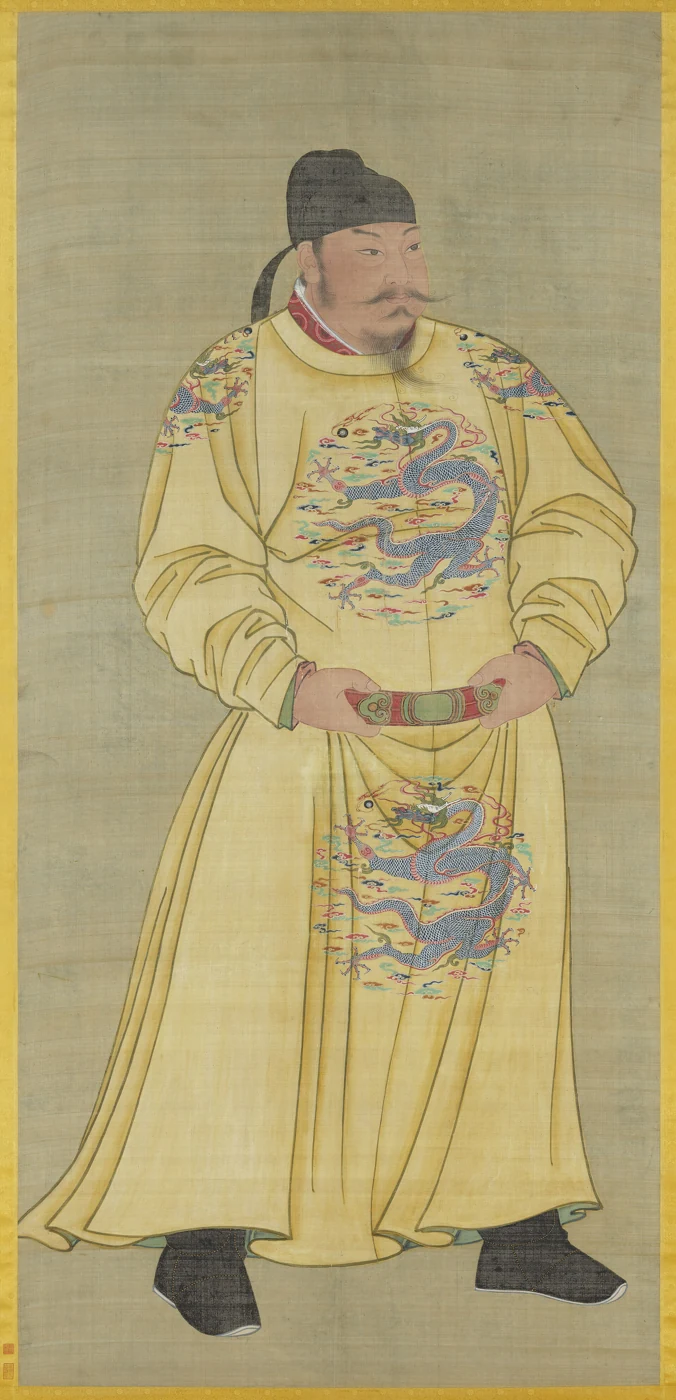
Biography
Family Background and Early Life
Li Shimin came from the Guanlong military aristocracy. His eighth-generation ancestor Li Gao was Emperor Wuzhao, founder of Western Liang. His great-grandfather Li Hu was one of the Eight Pillars of Western Wei, held the title Duke of Longxi, and was posthumously made Duke of Tang under Northern Zhou. His grandfather Li Bing served Northern Zhou as commander of Anzhou and Pillar-of-State General and inherited the title Duke of Tang. His father Li Yuan was Duke of Tang under the Sui and successively served as governor of Qiao, Qi, and Long prefectures. His mother, Lady Dou, was a niece of Emperor Wu of Northern Zhou, Yuwen Yong, and came from the Xianbei Hedouling clan.
Li Shimin was born at the Li family residence in Wugong, present-day Wugong, Shaanxi, on January 23, 599, the wuwu day of the twelfth lunar month in the eighteenth year of the Kaihuang era. The *Old Book of Tang*, volume 2, Basic Annals II, states: "At that time two dragons played outside the gate of the residence and departed after three days." This was clearly a later supernatural embellishment, but the source uses it in describing the Li family's roots in Guanzhong at the time of his birth. The *Old Book of Tang* describes him as "intelligent and perceptive from childhood, with deep foresight, decisive when confronted with events, unconstrained by minor matters, and unfathomable to contemporaries."
Li Yuan, himself from the Guanlong group, placed importance on the education of his children. As a boy, Li Shimin received an introduction to the Confucian classics, studying the *Classic of Filial Piety*, *Analects*, and the Five Classics, as well as poetry, prose, and calligraphy, while also training in horsemanship and archery. In 606, the second year of the Daye era, Li Shimin fell ill. Li Yuan went to Caotang Temple in Chang'an to pray for him and commissioned a Buddhist image after his recovery. Li Shimin later wrote a poem praising Kumarajiva, patriarch of Caotang Temple.
In 613, the ninth year of the Daye era, Li Shimin's mother Lady Dou died in Zhuo Commandery, whose seat lay southwest of present-day Beijing. He later married Lady Zhangsun, a niece of Gao Shilian, a protocol official of the Court of State Ceremonial; she later became Empress Zhangsun of Emperor Taizong.
Early Military Service and the Jinyang Rising
In 615, the eleventh year of the Daye era, Emperor Yang of Sui was surrounded at Yanmen by Shibi Qaghan of the Turks. Li Shimin responded to the call for recruits and served under Yunding Xing, General of the Tunwei Guard. Li Shimin advised him to create the appearance of a large relief force: "We must carry flags and drums to create a deception. Shibi Qaghan dares to surround the Son of Heaven with the forces of his whole realm because he must think that no relief can arrive in such haste. If we greatly magnify the appearance of our army, extend banners for dozens of li, and have gongs and drums answer one another at night, the northern barbarians will surely believe that a mass relief army has assembled and will flee at the sight of our dust." Yunding Xing adopted the plan, and the Turks indeed lifted the siege and withdrew. This account appears in the *Old Book of Tang*, while the *Diary of the Founding of the Great Tang* instead records that Li Yuan led the relief forces. Scholars have therefore disputed Li Shimin's precise role in the campaign.
In 616, the twelfth year of the Daye era, Li Yuan became garrison commander of Taiyuan and Li Shimin accompanied him. The Gao Yang rebel leader Wei Dao'er, who called himself Lishanfei, attacked Taiyuan. Li Yuan entered deep into the enemy lines and was surrounded. Li Shimin broke through with elite cavalry and rescued his father from an enemy force numbering in the tens of thousands.
In 617, the thirteenth year of the Daye era, Sui rule was collapsing. Li Shimin secretly planned an uprising, frequently lowering his own status to honor scholars and spending his wealth to support retainers, so that "among bandits and great knights, none were unwilling to risk death for him." He urged his father Li Yuan to rebel against the Sui, leading to the Jinyang Rising. Historical sources differ over who took the leading role. The *Old Book of Tang*, *New Book of Tang*, and *Zizhi Tongjian* emphasize the advocacy of Li Shimin, Liu Wenjing, and others and at times portray Li Yuan as being pushed into the uprising by outside forces. The earlier *Diary of the Founding of the Great Tang*, however, stresses Li Yuan's own planning and decisions. Modern researchers have argued that later histories were influenced by political narratives from Emperor Taizong's reign and magnified Li Shimin's role in the founding of the Tang.
After the Jinyang Rising began, Li Shimin led forces against Xihe and issued orders there. After Xihe fell, Li Yuan made Li Shimin Duke of Dunhuang and Grand Commander of the Right Army, giving him command of the three right-wing armies. When the rebel army attacked Jiahu Fort, the Sui general Song Laosheng stationed twenty thousand elite troops at Huoyi to block them. Prolonged rain caused food shortages, and Li Yuan and Pei Ji discussed temporarily returning to Taiyuan and resuming the enterprise later. Li Shimin firmly opposed retreat. He wept outside the tent and persuaded Li Yuan to continue, arguing that "if we advance to fight we will surely win, but if we withdraw the army will certainly collapse." When the rain stopped in the eighth lunar month, the army attacked Huoyi. Li Shimin led two thousand cavalry down from the heights of the southern plain, split Song Laosheng's formation, killed Song in battle, and secured Huoyi.
Li Shimin then proposed advancing through the passes, seizing the Yongfeng granary to relieve the poor, and winning over the various rebel groups before moving against Daxing City, Chang'an. Li Yuan approved. Li Shimin crossed the Yellow River with the vanguard and first secured the area north of the Wei River. Officials, commoners, and prominent men of the Three Capital Districts came to join him by the thousands each day. Li Shimin accepted talented men into his staff, and by the time he camped at Jingyang he had ninety thousand elite soldiers. He later went personally to Sizhu and joined the rebel leaders Li Zhongwen and He Panren, gaining another 130,000 troops. Military discipline was strict and the army committed no offenses against the population. Soon afterward it joined the main force in securing Daxing City. After Li Yuan took charge of the government, he appointed Li Shimin as chief administrator of the Tang fief, changed his title to Duke of Qin, and granted him a fief of ten thousand households.
In the twelfth lunar month of 617, the first year of the Yining era, Li Shimin was appointed Right Marshal and led one hundred thousand troops against the eastern capital, Luoyang, but failed to take it and withdrew. On the return march he set three ambushes at Sanwangling and decisively defeated a pursuing force of more than ten thousand under the Sui general Duan Da. He was then transferred to the title Duke of Zhao.
Commander in the Wars of Unification
In the fifth lunar month of 618, the first year of the Wude era, Li Yuan proclaimed himself emperor and founded the Tang. He made Li Shimin head of the Department of State Affairs, General of the Right Wuhou Guard, and Prince of Qin, and additionally appointed him governor of Yongzhou. Over the next several years, Li Shimin served as a principal Tang commander and successively defeated the forces of Xue Rengao, Liu Wuzhou, Wang Shichong, Dou Jiande, and Liu Heita, making the leading military contribution to Tang unification.
Defeat of Xue Rengao: In the seventh lunar month of 618, Xue Ju invaded Jingzhou and Li Shimin led an army against him. Li Shimin fell ill and entrusted the troops to Liu Wenjing and Yin Kaishan, who disobeyed orders and fought, suffering a major defeat at Qianshuiyuan. Xue Ju died in the ninth lunar month and his son Xue Rengao succeeded him. Li Shimin again took command, maintained deep defensive works around Zhezhi City for more than sixty days, and waited until the enemy was exhausted. When Xue's army ran out of provisions, the officers Mou Juncai and Liang Hulang surrendered. Li Shimin sent Pang Yu south of Qianshuiyuan to lure the enemy, then unexpectedly brought the main army over northern Qianshuiyuan and personally led several dozen elite cavalry into the enemy formation. Attacked from inside and outside, Zong Luohou's army collapsed. Li Shimin pursued with just over twenty riders to the walls of Zhezhi. The next morning Xue Rengao surrendered, together with more than ten thousand elite troops and fifty thousand men and women. When asked how he had won, Li Shimin explained that he had used an expedient method to deny the enemy time to act and then pursued immediately so that the defeated Longxi soldiers could not scatter back beyond Longshan, leaving Zhezhi exposed and causing the defenders to surrender from fear.
Defeat of Liu Wuzhou: In 619, Liu Wuzhou allied with the Eastern Turks, and his general Song Jingang captured Taiyuan, causing a crisis in Hedong. Li Shimin was ordered east across the Yellow River. Against Song Jingang he adopted a strategy of prolonged confrontation and exhaustion of enemy supplies, avoiding premature battle. In 620, with his provisions exhausted, Song Jingang withdrew. Tang forces pursued, Yuchi Jingde and other commanders surrendered to Tang, Liu Wuzhou and Song Jingang fled to the Turks, and Hedong was recovered.
Defeat of Wang Shichong and Dou Jiande: In 620, Li Shimin led an army against Wang Shichong's regime at Luoyang and gradually took control of the surrounding region. Wang Shichong sought aid from Dou Jiande, who controlled Hebei. In 621 Dou Jiande led troops west to relieve Luoyang. Li Shimin left part of his army to continue the siege while leading the main force east to meet Dou at Hulao Pass. Dou Jiande was defeated and captured. Wang Shichong, deprived of outside aid, then surrendered. The Zheng and Xia regimes collapsed in succession, and the Tang obtained the key Central Plains regions of Henan and Hebei. This was the largest and most consequential engagement of the early Tang wars of unification and enabled Li Shimin to secure the Central Plains in a single campaign.
Defeat of Liu Heita: In 622, former followers of Dou Jiande under Liu Heita again rose in Hebei. Li Shimin and Li Yuanji led forces against them, dammed water in the Mingshui area, and released it during battle to strike Liu Heita's army, severely damaging his main force. Liu fled to the Turks after defeat, later returned with Turkic support, and was ultimately defeated by forces under Crown Prince Li Jiancheng.
In 621, the fourth year of the Wude era, Emperor Gaozu appointed Li Shimin Heavenly Strategist General and also gave him the posts of Grand Minister over the Masses and head of the Branch Department of State Affairs for the Shandong Circuit. The Tiance Office became an important political and military institution of the Prince of Qin's household, enabling Li Shimin to recruit civil and military talents such as Fang Xuanling, Du Ruhui, Zhangsun Wuji, Yuchi Jingde, and Qin Shubao. The source also notes, however, that the Tang wars of unification were not accomplished by Li Shimin alone. Li Jiancheng, Li Yuanji, Li Xiaogong, Li Jing, Chai Shao, Princess Pingyang, and other imperial relatives, generals, and local forces that joined the Tang played important roles in different theaters, while many southern separatist regimes were defeated mainly by other Tang commanders.
Xuanwu Gate Incident and Accession
As the Tang gradually unified the realm, Li Shimin's political and military prestige continued to rise, and his rivalry with Crown Prince Li Jiancheng over the succession grew increasingly intense. Li Jiancheng allied with Prince of Qi Li Yuanji to consolidate the Eastern Palace, while Li Shimin relied on the civil and military group around the Prince of Qin's household. The two factions gathered their own advisers and commanders: Wang Gui, Wei Zheng, Xue Wanche, and others supported Li Jiancheng, while Fang Xuanling, Du Ruhui, Zhangsun Wuji, Yuchi Jingde, Qin Shubao, and others supported Li Shimin.
In the sixth lunar month of 624, Li Jiancheng secretly recruited brave men as Eastern Palace guards. Officer Erzhu Huan and commandant Qiao Gongshan went to Renzhi Palace, where Emperor Gaozu was spending the summer, and reported him. Gaozu was furious and detained Li Jiancheng. Yang Wengan, governor of Qingzhou and an associate of Li Jiancheng, became afraid and rebelled. Gaozu sent Li Shimin to suppress Yang and promised to make Li Shimin crown prince after the rebellion was defeated. After Li Shimin departed, however, Li Yuanji, Chancellor Feng Deyi, Consort Yin, Lady Zhang, and others interceded for Li Jiancheng, and Gaozu ultimately changed his mind.
In 626, the ninth year of the Wude era, the struggle reached its climax. Li Jiancheng and Li Yuanji intensified their efforts to remove key members of the Prince of Qin's household. Fang Xuanling and Du Ruhui were expelled, and Yuchi Jingde was nearly executed. On the fourth day of the sixth lunar month, Li Shimin struck first, set an ambush at Xuanwu Gate, and shot Li Jiancheng and Li Yuanji dead. Yuchi Jingde then entered the palace in armor and, under the pretext of protecting the emperor, compelled Li Yuan to accept the accomplished fact. On the seventh day of the sixth lunar month, Li Shimin was made crown prince. On the ninth day of the eighth lunar month, Li Yuan abdicated and Li Shimin ascended the throne as Emperor Taizong of Tang. The following year he adopted the era name Zhenguan.
The Xuanwu Gate Incident was the most controversial event of Li Shimin's political career. Emperor Taizong later attempted to beautify his actions by revising the Veritable Records, but early sources such as the *Diary of the Founding of the Great Tang* retained parts of the earlier account. Later historians differed in their assessments. Objectively, however, the Zhenguan era of good government inaugurated after Li Shimin's accession gave the coup a measure of legitimacy in later historical narrative.
Zhenguan Era of Good Government
After taking the throne, Li Shimin treated the fall of the Sui as a warning and governed energetically. He often discussed the lessons of the Sui collapse with his ministers and held that "water can carry a boat, but it can also overturn it," emphasizing that rulers had to restrain personal desires and care for popular livelihoods. He reduced corvée and taxes and pursued recuperative policies to ease burdens on the people; perfected the Three Departments and Six Ministries system to improve administrative efficiency; placed importance on law and ordered Fang Xuanling and others to revise the *Zhenguan Code*; and recruited talented officials broadly rather than according to a single standard.
Many celebrated ministers served during the Zhenguan era. Fang Xuanling and Du Ruhui were chancellors and became known for "Fang's planning and Du's decisions." Wei Zheng was famed for outspoken remonstrance and submitted more than two hundred remonstrances. Li Shimin both respected and relied on him. After Wei Zheng died, Li Shimin lamented: "Using bronze as a mirror, one can straighten one's cap and clothes; using antiquity as a mirror, one can understand rise and decline; using people as a mirror, one can see gains and losses. I have always preserved these three mirrors to guard against my own errors. Now that Wei Zheng has died, I have lost one mirror!"
In relations with surrounding peoples, Li Jing and others destroyed the Eastern Turkic Khaganate in 630, the fourth year of the Zhenguan era, and captured Illig Qaghan. Leaders from the Western Regions and northern frontier honored Li Shimin as "Heavenly Qaghan," greatly expanding Tang influence in the north and west. Li Shimin adopted a policy of "loving them as one," allowing surrendered Turks to move within Tang territory and appointing Turkic nobles to office, promoting ethnic integration.
In 643, the seventeenth year of the Zhenguan era, Li Shimin ordered Yan Liben to paint portraits of twenty-four meritorious officials, including Zhangsun Wuji, Fang Xuanling, Du Ruhui, Wei Zheng, and Yuchi Jingde, at Lingyan Pavilion, creating the Twenty-four Meritorious Officials of Lingyan Pavilion. In the same year, Crown Prince Li Chengqian was deposed after plotting rebellion, and Li Shimin made Prince of Jin Li Zhi crown prince.
In 645, the nineteenth year of the Zhenguan era, Li Shimin personally campaigned against Goguryeo and captured Liaodong and other places, but cold weather and inadequate supplies forced him to withdraw. The campaign failed to achieve complete success and remained a major regret of his later years.
Later Years and Death
In the later Zhenguan years, Li Shimin gradually became less diligent than earlier, his lifestyle grew more luxurious, and his receptiveness to remonstrance changed. He nevertheless remained attentive to state affairs and wrote the twelve chapters of *Difan* as instruction for Crown Prince Li Zhi. In 649, the twenty-third year of the Zhenguan era, Li Shimin became seriously ill and died on the jisi day of the fifth lunar month, July 10, at Hanfeng Hall in Cuiwei Palace, aged fifty-two. The officials conferred the posthumous name Emperor Wen, his temple name was Taizong, and he was buried at Zhaoling, northeast of present-day Liquan County, Shaanxi.
Li Shimin was the second son of Li Yuan, founder of the Tang, and belonged to the Guan-Long aristocracy. His father, who had inherited the title duke of Tang at seven, was at the end of the Sui the commander of Taiyuan; his mother, née Dou, a niece of the Northern Zhou emperor Yuwen Yong and daughter of Dou Yi, was versed in letters and history and strict in the schooling of her sons. Li Shimin, his elder brother Li Jiancheng and his younger brother Li Yuanji were all her children, and a further brother, Li Xuanba, died young. He read widely in the histories as a boy, was fondest of military works, and was a fine horseman and archer; at Taiyuan his father let him act on his own in dealings with the northern nomadic powers, an experience that shaped his later judgment of cavalry mobility and intelligence.
In 615, when Emperor Yang of Sui was besieged at Yanmen by the Eastern Turks under Shibi Khan and called for volunteers, Li Shimin enlisted under the garrison general Yun Dingxing. He advised that Shibi would never have surrounded the emperor with his whole army unless he judged the state unable to send relief quickly, and that they should therefore make a great display — banners strung out for tens of li, gongs and drums answering one another by night — so that the Turks would think a host of relief troops had arrived and withdraw; otherwise, with the enemy many and themselves few, they could not withstand a general attack. Yun Dingxing took the advice, camped at Guoxian, and the Turkish scouts reported that the Sui host had come, whereupon the besiegers broke off and fled. This use of a show of force to make an enemy retire on his own is the first recorded instance of Li Shimin's military judgment. The next year, when the bandit chief Wei Dao'er, calling himself Lishan Fei, attacked Taiyuan, Li Yuan went deep into the enemy formation; Li Shimin cut his way in with light cavalry, shooting as he went, and brought his father out from the midst of the host, and when the infantry came up the two of them broke the enemy utterly.
In the collapse of the Sui, Li Shimin was the driving force behind the rising at Jinyang. He made friends with Liu Wenjing, magistrate of Jinyang, and Pei Ji, overseer of the Jinyang palace, secretly gathered braves and enrolled fighting men, and used Pei Ji to bring his father to the decision to rise. In the fifth month of 617 Li Yuan had Wang Wei and Gao Junya killed on the charge of conspiring with the Turks and rose in arms; in the sixth month he left Li Yuanji to hold Taiyuan and marched south with Li Shimin in his train. In the seventh month the army reached Jiahubao, where the Sui general Song Laosheng held Huoyi with twenty thousand picked troops to block them; with long rain, broken roads and dwindling supplies, Li Yuan and Pei Ji proposed to fall back on Taiyuan and try again later. Li Shimin argued that they had risen to save the people, that they should enter Xianyang first and there give law to the empire, and that to turn back at the first small enemy would dissolve the following they had gathered; to hold one city of Taiyuan would make them mere bandits, with no way to preserve themselves. Li Yuan would not hear him and ordered the march. Li Shimin then wept bitterly outside the tent until his father heard and asked why; he answered that an army acting on righteousness wins if it advances and disperses if it retires, and that with the troops scattered in front and the enemy pressing behind, death would be upon them in a moment. Li Yuan saw the point and halted the withdrawal — a remonstrance decisive for the founding of the Tang.
When the rain stopped in the eighth month, Li Yuan marched straight on Huoyi. Fearing that Song Laosheng would not come out, Li Shimin rode to the wall with a few horsemen, waving his whip as if about to besiege the place, and stung him into opening the gates and drawing up with his back to the city. Li Yuan and Li Jiancheng formed on the east, Li Shimin and Chai Shao on the south. Song Laosheng charged hard, first at Li Yuan; Li Jiancheng fell from his horse and both were driven back, whereupon Li Shimin led his cavalry down the slope from the south, broke the enemy formation and counterattacked, and the enemy broke and threw away their arms. The city gate was dropped: Song Laosheng, clutching the rope to climb the wall, was overtaken and killed by Li Shimin, and Huoyi was taken.
The Tang army then moved west into Guanzhong. Li Shimin asked to lead the advance into the passes, to seize the Yongfeng granary for relief of the poor and to gather the bandit bands for the taking of the capital, and Li Yuan approved. Crossing the Yellow River with the forward army he first pacified the north of the Wei: officials, commoners and local strongmen came to his gate to offer service at the rate of a thousand a day, the old and the young in tow, filling the ground beneath his banners; he took the able among them into his staff, and men came from far and near to attach themselves to him. When the army camped at Jingyang it had ninety thousand effective troops; he destroyed the Hu bandit Liu Yaozi and absorbed his men. Li Zhongwen, He Panren and Xiang Shanzhi then came in with their troops, and at A-cheng his force grew to a hundred and thirty thousand. The elders of Chang'an brought cattle and wine to his camp in numbers beyond counting; he thanked and dismissed them, accepting nothing, and his orders were strict and his troops took not a hair — in sharp contrast to the plundering of the other armies abroad. Chang'an was soon taken, Li Yuan took over the government, and Li Shimin was made minister of the Tang princedom and enfeoffed duke of Qin. When Xue Ju pressed on the Wei with a hundred thousand tried troops, Li Shimin met him in person, broke his host, pursued and killed more than ten thousand and took the country as far as Longdi.
In the twelfth month of 617 Li Shimin was made marshal of the right with a hundred thousand men to take the eastern capital, Luoyang, and returned unsuccessful. Judging that the enemy would follow, he laid three ambushes; the Sui general Duan Da came after him with more than ten thousand men and, crossing the Sanwang tumulus, was set upon from all sides, heavily defeated and pursued to the city walls. The Tang then set up the two prefectures of Xiong and Gu at Yiyang and Xin'an, garrisoned them and returned, and Li Shimin was transferred to the dukedom of Zhao. The next year Li Yuan took the abdication and founded the Tang, and Li Shimin, as prince of Qin, began the years of unification: Liu Wuzhou and Song Jingang in the north, Xue Ju and his son in the west, Wang Shichong in the east, Dou Jiande and later Liu Heita in Hebei, Fu Gongshi in the Huai region — most of them subdued under his command.
After the founding of the Tang, Li Shimin's energies went chiefly to subduing the rivals on every side. In the seventh month of 618 Xue Ju invaded Jingzhou and Li Shimin, sent against him, was at first beaten back; Xue Ju died in the ninth month and his son Xue Rengao succeeded, and Li Shimin, again made marshal, faced him at Zhezhe city for sixty days. The enemy had more than a hundred thousand men and a sharp edge; they challenged repeatedly and he held his deep ditches and high walls, wearing their ardor down, until their grain failed and their commanders Mou Juncai and Liang Hulang came over to him. Judging that their spirit was spent and the time had come, he sent Pang Yu to form south of Qianshui plain to draw them, and when Zong Luohou took the bait and pressed Pang Yu hard, Li Shimin himself brought the main army suddenly against the north of the plain, drove into the enemy with a few dozen picked horsemen, and shattered Zong Luohou's army from within and without, killing thousands and drowning countless more in the gullies. With some twenty riders he pursued without pause to the walls of Zhezhe; Xue Rengao, terrified, shut himself in, and when the Tang army came up and surrounded the place he surrendered the next morning, yielding more than ten thousand picked troops and fifty thousand men and women. Asked why, having won in the field, he had not waited for siege engines before riding to the walls, he answered that he had used a stratagem to force the issue before the enemy could think: Zong Luohou's men were all from Longxi and, once broken, scattered homeward without looking back, leaving Zhezhe empty — which was why fear had brought the surrender.
In 619 Liu Wuzhou sent Song Jingang south, Jinzhou and Huizhou fell one after another, Li Yuanji abandoned Taiyuan and fled to Chang'an, Guanzhong was shaken, and Li Yuan even ordered the abandonment of Hedong to hold only the west of the passes. Li Shimin memorialized against it: Taiyuan was the seat of the dynastic enterprise, the root of the state, and wealthy Hedong was what the capital depended on; to cast both away was intolerable to him, and with thirty thousand picked troops he would pacify Liu Wuzhou and recover Fen and Jin. Li Yuan gave him all the troops of Guanzhong and saw him off in person from Changchun palace. He crossed the Yellow River on the ice at Longmen and camped at Baibi facing Song Jingang; he first sent Yin Kaishan and Qin Shubao to ambush and shatter the enemy at Meiliangchuan, where Xun Xiang barely escaped and Yuchi Jingde was taken. When his generals asked to fight he refused: Song Jingang was an army a thousand li from home, wanting a quick decision, and Liu Wuzhou in Taiyuan relied on him as his shield; the troops were many but the state was hollow within, so the thing to do was to sit tight, husband strength and blunt his edge until grain and stratagems alike ran out. In the second month of the next year Song Jingang indeed withdrew for want of grain; Li Shimin pursued him to Jiezhou, where the enemy drew up seven li north to south. He set Li Shiji, Cheng Yaojin and Qin Shubao against their north and Zhai Changsun and Qin Wutong against their south, and when his own lines gave a little he led picked cavalry against the enemy's rear and broke them, chasing them for tens of li. Yuchi Jingde and Xun Xiang came in with eight thousand men, and he let Jingde keep command of them, intermixed with his own; warned that they might turn, he answered with the old saying about a king who put his own heart into other men's breasts and was served to the death. Liu Wuzhou fled to the Turks, and the lands of Bing and Fen were recovered.
In the seventh month of 620 Li Shimin took command against Wang Shichong. He posted Shi Wanbao, Liu Dewei and Wang Junkuo to hold the key points and cut the enemy's supply roads, and sent Huang Junhan by night to storm the Huiluo fort, after which the fortresses south of the Yellow River came over one after another. Wang Shichong drew up thirty thousand picked troops at Cijian; Li Shimin provoked them with light horse and, being outnumbered, was surrounded, his men afraid, so that he sent them back to camp and held the rear alone, shooting so that every arrow brought a man down and taking the enemy general Yan Qi. In the ninth month, reconnoitering with five hundred horse, he met more than ten thousand of the enemy and broke them again, killing three thousand and taking the general Chen Zhilüe; he then advanced to Qingcheng palace, where he fought Wang Shichong's twenty thousand at the Gu river and on Mangshan from morning to afternoon until they fell back, taking eight thousand prisoners and dead, and sat down to a long siege before the city.
In 621 Dou Jiande came to the rescue with more than a hundred thousand men as far as Suanzao. Xiao Yu, Qutu Tong and Feng Deyi, fearing an enemy front and rear, asked to retire to Guzhou and wait; Li Shimin judged that Wang Shichong, his grain gone and his household divided, could be left to rot without a blow, while Dou Jiande, fresh from beating Meng Haigong, had proud officers and idle soldiers: to seize Wulao and hold the throat of the position would break him if he risked battle and would see Wang Shichong collapse within ten days if he did not; to delay until Dou entered Wulao, with the newly submitted cities unable to hold, would be to face the two together. He left Qutu Tong with the prince of Qi, Li Yuanji, to continue the siege and rode with three thousand five hundred horse and foot to seize Wulao. After more than twenty days facing each other he learned that Dou meant to fall on Wulao while the Tang horses were grazing north of the river, and turned the trick about by grazing them there as bait. Next morning Dou came on with his whole force and drew up along the Si river in a line several li long, drums and shouting, and the Tang generals were much afraid. Li Shimin climbed a height to look and said that men risen in Shandong had never seen a great enemy, that crossing a defile in an uproar showed no discipline and forming close to the city showed contempt for them, so that if he held still their spirit would fail and, standing long in ranks, hungry and weary, they would withdraw of themselves — and he undertook to break them after noon. By afternoon the enemy were sitting in their ranks, quarrelling for water and edging backward. He gave the word, led light horse out to pursue and draw them, and the army followed; he charged in first, and as Shi Danai, Cheng Yaojin, Qin Shubao and Yuwen Xin waved the banners and burst out behind the enemy line, the enemy saw the Tang colors at their backs and broke utterly. They were chased thirty li with three thousand killed, fifty thousand taken, and Dou Jiande himself seized in the field. Brought before the walls of Luoyang, Wang Shichong in terror came out with more than two thousand of his officials and surrendered, and Shandong was pacified. In the city Li Shimin set Xiao Yu and Dou Gui to seal the treasuries, took nothing, had his secretary Fang Xuanling collect the Sui registers and maps, put to death fifty-odd men who had shared in the crimes, released the unjustly imprisoned and sacrificed to those wrongly killed, and feasted and rewarded his troops by rank. Returning in triumph in the sixth month, he wore golden armor himself at the head of ten thousand armored horse and thirty thousand mailed men with bands before and behind, presenting the two false rulers and the Sui regalia at the ancestral temple; in the tenth month Li Yuan, finding no old office adequate to his service, created him generalissimo of the heavenly strategy with the great headquarters of Shaandong, above all princes, with thirty thousand households, a gilded carriage, robes and crowns, bands and a bodyguard of forty swordsmen.
In the twelfth month of 621 Liu Heita, an old officer of Dou Jiande, rose in Hebei and took Mingzhou, and Li Shimin was sent east. In the first month of 622 he advanced to Feixiang and detached troops to cut the enemy's grain roads, and the two sides stood off for two months. Liu Heita, pressed, came out to fight with twenty thousand horse and foot, crossing the Ming river at dawn against the Tang camp; Li Shimin led picked cavalry against their horsemen, broke them, rode down their infantry and routed them, killing more than ten thousand. He had already had the river dammed upstream to make it shallow, letting Liu Heita cross; in the battle he had the dam broken, and the water, more than ten feet deep, drowned the beaten men as they fled. Liu Heita escaped north to the Turks with two hundred riders and his army was taken; Hebei was pacified, and Li Shimin turned back to destroy Xu Yuanlang, who held Xu and Yan, after which the commanderies of the He, Ji, Yangtze and Huai regions all submitted.
His Family, His Early Years and the Rising at Jinyang
Li Shimin was a man of Chengji in Longxi, that is Qin'an in Tianshui of Gansu, his ancestral home being Didao in Longxi, the present Lintao in Gansu, and he was born at Wugong, the present Wugong in Shaanxi, as the second son of Li Yuan, the founding emperor of the Tang. He served in the army from his youth and once went to the Yanmen Pass to rescue the Sui emperor Yang. In the thirteenth year of Daye, that is 617, Li Yuan rose at Jinyang, and Li Shimin, as Duke of Dunhuang and commander of the right guards, led the right of the three armies and took Chang'an with the army. After the founding of the Tang, Li Yuan enfeoffed Li Shimin as Prince of Qin, and he led troops to pacify the separatist forces of Xue Rengao, Liu Wuzhou, Dou Jiande and Wang Shichong, winning great merit for the unification of the empire, being enfeoffed as Grand General of the Heavenly Strategy and opening the Heavenly Strategy Office at Luoyang. To be the son of a great house and to bear the work of founding a dynasty, his early years ran together with the rise of the Tang house.
Breaking the Enemy by Expedience: His Own Account After the Battle of Qianshuiyuan
When the generals had offered their congratulations they asked Li Shimin how the victory had been won. The Zizhi tongjian records the exchange: that at first the prince had broken the enemy in the field but the enemy still held strong cities, and that he had no siege engines, and with light cavalry had fought and pursued without waiting for the foot, pressing straight to the enemy's wall, so that they had doubted he could win, and yet he had taken the city, and why? Li Shimin said that he had pressed them by an expedient, giving their plans no chance to unfold, and so had won; that Zong Luohou, relying on his victories of former years and having long nourished his keenness, had despised him when he would not come out; that when the enemy saw him take the field they were delighted and came on with their whole army, and though he had broken them, few had been taken or killed; and that had he not pursued at once, the enemy would have returned into Zhezhe city and Xue Rengao, gathering and comforting them, could never have been beaten. He said also that the enemy's soldiers were all men of Longxi, and fleeing scattered they had no time to look back, so that fleeing beyond Long they left Zhezhe empty, and his army pressing on, the enemy surrendered out of fear; and that these had been settled plans, and could the generals not all see them? The generals answered that this was beyond the reach of ordinary men. This passage is his own account of his art of war, to see the moment and decide, without waiting to form the array.
The Four Methods of Reconnaissance Before the Battle of Hulao
Li Shimin gave the greatest weight to the discovery of the enemy's condition, and his methods were four. First, he led light cavalry to look at the enemy himself: he would ride out with a few horsemen to spy on them, as at the battle of Cijian, where he went forward with light cavalry to look at Wang Shichong, and in attacking the outlying posts of Luoyang took five hundred horsemen over the ground of battle; all of which shows that he gave weight to reconnoitring the enemy at the front and to knowing precisely how the field stood. Second, he climbed high to look out on the enemy: this way of reconnoitring was of long standing and of great military value, and in the battle of Hulao he took several horsemen up a high mound to look about, and so learned Dou Jiande's dispositions fairly accurately. Third, he used the method of testing the enemy's array: at Hulao, when the Tang army faced Dou Jiande, and to discover the truth of his array, Li Shimin ordered Yuwen Shiji to lead cavalry in a probing attack, warning him that if the enemy did not move he should bring his troops back but if they did he should lead toward the eastern hill; and when he saw the enemy's array waver he knew their ranks were unsteady and their orders confused, and so ordered the whole army to attack. Fourth, he went himself into the enemy's camp to learn the circumstances, which was of course a course of considerable risk and only occasionally taken.
After the Xuanwu Gate and the Government of the Eastern Palace
After the change at the Xuanwu Gate Li Shimin's measures were swift and orderly. The Jiu Tang shu, in the annals of Taizong, records that on the fourth day of the sixth month, the jiazi day, he was made heir apparent with all government decided by him; that he then released the falcons and hounds kept in the forbidden park and stopped the rare and strange things presented from every quarter, governing with simplicity and restraint so that all the empire rejoiced; and that he ordered the officials each to send up sealed memorials setting out fully the essentials of settling the people and ordering the state. On the jisi day he decreed that by the rites the two characters of a name were not to be avoided separately, that in recent times both had been avoided and much had thereby been spoiled, and that such practice was contrary to the classics; and that in official titles, personal names and public and private documents, where the two characters Shimin did not occur together no avoidance was needed. He abolished the metropolitan command of Youzhou; on the xinwei day he abolished the eastern Shaanxi grand commission and established the Luozhou metropolitan command, and abolished the Yizhou circuit commission and established the Yizhou metropolitan command; on the renwu day the metropolitan commander of Youzhou, the Prince of Lujiang, Yuan, plotted rebellion and was reduced to commoner; and on the yiyou day the Heavenly Strategy Office was abolished. On the renchen day of the seventh month the left common attendant of the heir apparent, Gao Shilian, was made palace attendant, the right common attendant Fang Xuanling chancellor of the Secretariat, the right vice director Xiao Yu left vice director, the minister of personnel Yang Gongren governor of Yongzhou, the left common attendant Zhangsun Wuji minister of personnel, the right common attendant Du Ruhui minister of war, the household manager of the heir apparent Yuwen Shiji chancellor of the Secretariat, and Feng Deyi right vice director. By abolishing the Heavenly Strategy Office, ending the circuit commissions and changing the order of the hundred officials he gathered the power of the empire into the eastern palace, which was the government of the days before and after his accession.
His Accession and the Oath at the Bian Bridge on the Wei
The Jiu Tang shu, in the annals of Taizong, records that on the guihai day of the eighth month Gaozu abdicated in favour of the heir apparent and Taizong took the throne in the Xiande Hall of the eastern palace; that Pei Ji, minister of works and Duke of Wei, was sent to announce it at the southern suburb and a general amnesty was proclaimed, those exiled for their sentiments since the first year of Wude being released; that civil and military officials of the fifth rank and above without rank were given one grade and those of the sixth and below one turn of merit; that the whole empire was exempted from taxes and service for one year; and that on the guiyou day more than three thousand palace women were released from the side courts. On the jiashu day the Turkic Khans Xieli and Tuli raided Jingzhou; on the yihai day the Turks raided Wugong and the capital was put under martial law; on the bingzi day his consort, the lady Zhangsun, was made empress; on the jimao day the Turks raided Gaoling; on the xinsi day the marching commander Yuchi Jingde fought the Turks at Jingyang, breaking them utterly with more than a thousand heads taken; and on the guiwei day the Turkic Khan Xieli reached the north of the Bian Bridge on the Wei River and sent his chief Zhishi Sili into the court as a spy, making a show of his strength, and Taizong had him imprisoned. He went out of the Xuanwu Gate in person and rode with six horsemen to the bank of the Wei, and speaking to Xieli across the ford reproached him for breaking faith; and presently the armies came up, and Xieli, seeing the strength of the array and learning that Zhishi Sili was imprisoned, was greatly afraid and asked for peace, which was granted by edict, and the emperor returned to the palace that day. On the yiyou day he went again to the Bian Bridge and swore an oath with Xieli by killing a white horse, and the Turks withdrew. To meet the threat of the Turks within days of his accession and turn them back by riding to the Wei with six horsemen and reproaching them with breach of faith was the daring of his early government.
The Shelving of Arms and the Cultivation of Letters, and "Stilling the People to Comfort Them"
After his accession Li Shimin shelved the use of arms, cultivated letters, stilled the people and attended to farming, restoring and developing the economy as a chief part of governing by civil means. He told his ministers that he had just come to the throne and that those who govern a state must be quiet; and again that with the state not yet at peace and the people not yet comforted, they must for the present be stilled and comforted. To still and comfort them meant to lighten the burden of military and labour service so that the people might rest and recover. The core of this policy, under the principle that the state is founded on the people and the people on food and clothing, was to let the people live, the farmers farm and agriculture be restored and developed as the basis of settling society and governing the state. In the second year of Zhenguan, in 628, Li Shimin told his attendants that in all things one must attend to the root; that the state is founded on the people and the people on food and clothing; that in gaining food and clothing the essential is not to miss the season; and that not to miss the season could only be achieved if the ruler were simple and still, for with wars repeatedly stirred and building never ceasing how could the farming seasons be spared? He said also that to settle the people and quiet the state lay only with the ruler; that when the ruler did nothing the people were glad and when he had many desires the people suffered; and that the state was founded on the people and the people on food, so that if the grain did not ripen the multitudes would no longer belong to the state. He made the letting of the people farm the centre of settling the people and quieting the state, and therefore held that the ruler should carry out the Daoist spirit of doing nothing and oppose having many desires.
The Tripartite Tax, Remissions and the Ransom of Captives
The three chief exactions on the equal-field peasants of the Tang were: the land tax of two piculs of millet a year from every able-bodied man; the household levy of two bolts of silk and three ounces of floss, or two and a half bolts of cloth and three catties of hemp; and the labour service of twenty days a year, commuted where unpaid at three feet of silk or three feet seven inches and a half of cloth a day, called the commutation. Because of the shock of the peasant wars of the end of the Sui, the early Tang relaxed the ages for commuting service compared with the Sui and made the reckoning of the commuted time stricter; Li Shimin on his accession followed the regulations in the main, making no great change. The working of commutation gave the peasants more time for production. To lighten the burden and let more peasants farm, in the Zhenguan years Li Shimin issued formal edicts remitting the taxes and service of the whole empire more than once: in the summer of the first year of Zhenguan, when the prefectures of Shandong suffered a great drought, the year's taxes were remitted; in the first month of the thirteenth year the taxes of Sanyuan county were remitted for a year; in the fourth month of the fifteenth year those of Luochuan for a year; and in the third month of the seventeenth year those of Qizhou for a year — twelve times in all. Though the newly founded state had a very weak economic base and the scope of the remissions was limited, they did lighten the peasants' burden and helped restore and develop production. Of the recovery of population there is also this to record: at the end of the Sui, when the central plain was in chaos, Chinese fled north while the Turks raided and carried off great numbers, so that the Chinese in the north were said to be very many, gathered and holding the mountain defiles, and would answer when the royal armies came; and Li Shimin on his accession, to increase the labour force, did not grudge gold and silk to ransom those captured by the Turks, in the fifth year of Zhenguan, 631, ransoming eighty thousand Chinese held by the Turks with gold and silk, and in the twenty-first year, 647, ransoming those in the Tie-le country; and when ransoming Chinese from the raiders of the northern desert he found that people of the Shiwei, Mohe and Wuluohu had also been carried off, and ransomed them as well with the same relief. In the old Turkish lands, when the Khan Xieli surrendered he offered the sheep and horses of the northern grasslands, and Li Shimin, considering the state of recovery, not only refused the tribute at once but required him to release the Chinese in his territory so as to gain more labour for the war-worn agriculture. He also made the increase or decrease of households an important standard in assessing local officials, decreeing that where prefects and magistrates could see that marriages were timely and few widows and widowers remained, and where the households had increased, they should be advanced in their assessment, and that where they had advised men ill and failed to see them married and the households had decreased, they should be ranked lowest.
The Reorganisation of the Military System and the Establishment of the Protectorates
The Tang, following the Sui, divided the empire into military regions so as to govern the many as the few. In the first year of Zhenguan, 627, Li Shimin divided the empire into ten circuits, the court stationing troops by circuit, each circuit containing both the local troops and frontier forces of the circuit and the mobilisation offices directly under the centre; and the basic principle of the dispositions was to make the metropolitan region and the regions of serious danger the chief points, stationing troops by region so as to form a system of defence heavy within and light without, with central and local armies interlocking and both defending the empire. By incomplete statistics Li Shimin established more than six hundred mobilisation offices in the Zhenguan years with a total of some six hundred thousand troops, distributed over ten circuits, seven commands and seventy-seven prefectures; and of these the Guannei circuit, in which the capital Chang'an lay, had more than two hundred and eighty offices and some two hundred thousand troops, more than a third of the whole, forming the disposition of bringing the host of the passes against the four quarters. Afterwards the empire was rearranged into twelve circuits, and in point of disposition the forces of the Hexi, Longyou and Jiannan circuits guarding against the Tibetans and of the Hedong, Fanyang and Pinglu circuits guarding against the Turks, the Xi and the Khitan were markedly strengthened, while the circuits with lighter frontier duties, such as Jiangnan and Henan, had fewer troops; and this disposition was of great importance for maintaining the unity of the state. To strengthen the military and political management of the remote regions, from the fourteenth year of Zhenguan, 640, the Tang court established one after another six protectorates on the frontiers, whose chief duty was to comfort the various peoples and quiet outer enemies, to record merit and punish fault, and to decide all military and political affairs within their jurisdiction.
The Honour to Confucius and the Flourishing of the National Academy
At the founding of the Tang, on the wuxu day of the sixth month of the second year of Wude, 619, Gaozu decreed that the national academy should set up temples to the Duke of Zhou and Confucius with sacrifices at the four seasons and should seek out their descendants widely; in the seventh year of Wude, 624, Gaozu went to the national academy and made the offering to the former sages and teachers; and in the ninth year of Wude, 626, the descendants of Confucius were enfeoffed as the Marquis of Baosheng. After his accession Li Shimin honoured Confucian learning and its founder above all: in the second year of Zhenguan, 628, on the advice of Fang Xuanling and others he set aside the Duke of Zhou and raised Confucius to be the former sage, establishing a hall of Confucius with Confucius as the former sage and Yan Hui as the former teacher; and the Zhenguan zhengyao records that in the second year of Zhenguan an edict stopped the Duke of Zhou as the former sage and first established the hall of Confucius in the national academy, following the old statutes with Confucius as the former sage and Yanzi as the former teacher, so that the vessels and the shields and axes of the sacrifice were first complete from that time; and that in that year the Confucian scholars of the empire were gathered in great numbers, given silk and post carriages and summoned to the capital, advanced out of the ordinary and placed in numbers in the courts; and that students who had mastered one of the great classics were all given office. In the eleventh year of Zhenguan, 637, Li Shimin further decreed that Confucius should be honoured as the Declared Father and a temple hall specially established at Yanzhou with twenty households to maintain the offerings. As for the schools: in the fifth month of the first year of Wude, 618, Gaozu decreed the establishment of the schools of the sons of the state, the great learning and the four gates with more than three hundred places, and the commandery and county schools each with their students; and in the seventh year of Wude he decreed schools in every department, county and district. After his accession Li Shimin gave the more weight to schooling, and the system of schools became daily more complete, the three levels of central, provincial and county schools all attaining considerable scale; the central school was the Directorate of Education, also called the national academy, which in the Wude years had already added more than four hundred rooms; and Li Shimin several times inspected the academy and had the libationer, the vice director and the erudites lecture, giving them bundles of silk, so that the Confucian scholars of the four quarters came with their books in numbers reckoned in the thousands. In the sixth year of Zhenguan, 632, the Directorate, as the highest seat of learning in the empire, added the school of law to the schools of the sons of the state, the great learning, the four gates, calligraphy and mathematics already established under the Sui; the students of the six schools numbered three hundred, five hundred, thirteen hundred, fifty, thirty and thirty respectively, the first three admitting the sons of officials of the third, fifth and seventh ranks and above and the last three taking the sons of officials of the eighth rank and below and of ordinary landlord families. At that time within the academy the Confucians from the four quarters numbered in the thousands, and with the students sent from the surrounding states, those who opened their book boxes and ascended the lecture mats in the academy came to nearly ten thousand, so that the flourishing of Confucian learning had not been seen since antiquity.
Selecting and Employing Generals: Four Ways of Gaining Talent
Li Shimin gave great weight to the selection and employment of generals and from the beginning of his enterprise attended to gathering talent on every side; he collected counsellors and bold commanders in numbers and knew men and used them well, having many successful methods. First, he made good use of those recommended by his subordinates: when Li Shimin was Prince of Qin and his power newly risen, not yet a match for the heir apparent Li Jiancheng, some in his household who were apt to trim their sails took the occasion to leave for new masters; and then Fang Xuanling strongly recommended Du Ruhui, holding him a man of intelligence and understanding, a talent to assist a king, of no use if the prince meant only to hold his fief and fold his hands, but indispensable if he meant to order the four quarters. Li Shimin, giving great weight to Fang Xuanling's recommendation, at once employed Du Ruhui, who played a great part in governing the state and settling the empire. Second, he made good use of the talent of the opposing camp: in employing men he raised only the able, avoiding neither kin nor enemy, and could take into service the men of former adversaries, which the more showed his breadth of mind, his eye for talent and his boldness in using it. Wei Zheng had served Li Jiancheng as libationer of the household and served him faithfully, and when Li Shimin and Li Jiancheng became enemies Wei Zheng strove to devise plans for Li Jiancheng; and after the failure Li Shimin, who had long admired his name, forgot the former enmity, summoned him at once, gave him office and rank, trusted him greatly and laid weight upon him, so that the two became the model of an enlightened sovereign and a good minister. Third, he made good use of surrendered commanders: in his campaigns Li Shimin took in many officers and men after victory, giving particular weight to choosing commanders of outstanding ability; in the wars of unification he took into service one after another such bold commanders as Qutu Tong, Yin Kaishan, Qin Qiong, Cheng Yaojin and Yuchi Jingde. Qutu and Yin were surrendered Sui generals, while Qin and Cheng were cavalry commanders of the Wagang army who afterwards came over to the Tang; Li Shimin made Qin Qiong commander of the cavalry and Cheng Yaojin commander of the left third army, and the two won great merit at the battle of Hulao and elsewhere. Yuchi Jingde, bold and skilled in war, had followed Liu Wuzhou and fought the Tang armies several times; after his surrender Li Shimin made him commander of one of the guards and trusted him wholly, so that Yuchi Jingde, grateful, fought bravely and won repeated merit against the forces of Wang Shichong and Dou Jiande. Fourth, he held Chinese and barbarian as one and used Chinese and barbarian commanders together, as has been told above. Moreover, his bold employment of Li Jing was another successful example: Li Jing had been an official of the Sui and after coming over to the Tang was taken into Li Shimin's staff; and after his accession Li Shimin, having made several years of military preparation, began a policy of active defence, first striking at the eastern Turks who threatened the northern frontier, and Li Jing, much relied upon, was ordered out and broke the Turkic armies; and some years later, when the Tuyuhun in the northwest rose swiftly and threatened the western frontier, Li Jing, then advanced in years, was again laid under weight by Li Shimin and led a great army west with complete success and outstanding merit.
The Recompilation of the Register of Clans and the Dispute Over Family Rank
Li Yuan and his sons, as members of the Longxi military aristocracy, held political rank far above that of the Shandong and Jiangnan aristocratic landlords after taking the state; yet the old great Shandong houses, such as the Cui, Lu, Li, Zheng and Wang, still enjoyed great social repute. In the making of marriages, some of the chief ministers of the early Tang, to raise their social standing, were willing to send great wealth with their daughters to marry into the declining Shandong clans, while toward marriage with the imperial house they were often passive; Gaozu had complained that the men of the east of the pass married with the Cui and Lu and still boasted, and Li Shimin and his ministers, when they spoke of the men of the passes and of Shandong, held differing views. Some of the commoner landlords who entered the upper ruling group in the early Tang, though high in political status, being without family repute, sometimes had to bear the mockery of officials of old clans. It is recorded that in the sixth year of Zhenguan, 632, Li Shimin told the left vice director Fang Xuanling that the four Shandong surnames, Cui, Lu, Li and Zheng, though their generations had declined, still relied on their old standing and loved to give themselves airs, calling themselves the great officers; and that when they married a daughter into another clan they always demanded a great bride-price, valuing it the more the greater it was and making the contract by number like a market huckster, which much harmed the manners and disordered the ritual. He therefore decreed that the minister of personnel Gao Shilian, the censor-in-chief Wei Ting, the vice minister of the Secretariat Cen Wenben and the vice minister of rites Linghu Defen should revise the surnames, calling in the genealogies of the empire generally, relying also on the histories and traditions, cutting away the showy and settling the true and the false, advancing the loyal and worthy and degrading the rebellious, and compile a Register of Clans. But in the register compiled by Gao Shilian and the others the Shandong surname Cui was placed in the first rank, at which Li Shimin was much angered; for Gao Shilian and the others had not grasped his purpose in ordering the recompilation and had not compiled it as he directed, and were sharply reproached; and Li Shimin required Gao Shilian to revise it anew, judging rank solely by the offices of the present dynasty. Under this principle the recompiled register placed the imperial house in the first rank and the relatives by marriage in the second. To judge rank solely by the offices of the present dynasty was to fix family standing by contemporary office and title, the purpose being to press down the social repute of the old Shandong clans and establish that of the imperial house and the newly risen officials.
The Compilation of Histories and of the Book of Jin
Among Li Shimin's literary works the compiling of histories is also to be recorded. He decreed the compilation of the histories of the former dynasties, giving particular weight to the Book of Jin; and he wrote the discussion of the life of Wang Xizhi in that book, praising his achievement in calligraphy, which went with his own love of the art, as will be told below. As for the discussion of the classics and histories, in the Zhenguan years he often went to the Wenhua Hall to discuss the meaning of the classics with the scholars and had the Correct Meaning of the Five Classics and other works compiled to unify the interpretation of the classics. For a sovereign in his dignity to take part in the discussions and praises of a history and to settle the acceptance or rejection of interpretations himself was one side of his civil government.
Calligraphy: The Purchase of Famous Works and the Discussion of Wang Xizhi
The highest achievements of Tang culture are represented by its calligraphy and its poetry, and Li Shimin was one of the sowers of that culture. The copying of models is the first and most important step into the temple of the art, and the choice of models is of the greatest moment; yet at that time it was very hard to obtain good models of famous steles and marvellous traces: first, though there were steles, they were scattered throughout the empire and travel was inconvenient, so that not everyone who wished to learn had the means to wander among the famous mountains and great rivers and see the famous traces of the empire; second, though the Wei, Jin and Northern and Southern dynasties had many epitaphs, they lay deep underground and could not see the light; third, many famous traces were the drafts of patents or letters, kept in the imperial treasury or held privately, passed down from father to son or given as dowry to kin, so that even between friends at most they could be shown about; and fourth, frequent wars, changes of dynasty and poor keeping had destroyed or scattered many famous works. To solve the problem of gaining first-hand material for study, Li Shimin issued edicts throughout the empire and brought out gold and silk from the inner treasury to buy in great quantity; and partly through the emperor's authority and the administrative means from above down, and partly through purchase at high prices, there arose for a time throughout the empire a fever of seeking out, presenting and selling, and many genuine and spurious traces of Wang Xizhi and others of the Wei and Jin were obtained. To distinguish the true from the false he appointed Chu Suiliang specially to examine the traces of the two Wangs closely and arrange them in a catalogue; and where the owners would not sell he sought by every means to obtain them. Of special note is that Li Shimin wrote a discussion especially for the life of Wang Xizhi in the Book of Jin, that is, a commendation of Wang Xizhi's achievement in calligraphy: that Zhong You, though he excelled for a time and was indeed peerless, might yet be doubted as to complete excellence, since his forms were ancient and not modern and his characters long and beyond measure, which must be counted his blemish in point of scale; that Xianzhi, though he had his father's manner, was yet not novel or skilful; that his characters, looked at in their leanness, were like a withered tree in deep winter, and his brush tracks, cramped, like a starving servant in a severe house; and that therefore, examining ancient and modern, studying the seal and the plain, the wholly excellent and wholly beautiful was Wang Yishao alone; that the skill of his dots and sweeps and the wonder of his cutting and forming were like mist gathering and dew congealing, as if broken and yet joined, like the soaring of a phoenix and the coiling of a dragon, in force as if slanting and yet straight; that to play with them one never wearied and to look on them one could not find their ends; and that to copy him in heart and pursue him in hand this was the one man, and the rest of that petty kind were not worth speaking of. By the method of comparison Li Shimin affirmed Wang Xizhi's calligraphy as wholly excellent and wholly beautiful; and though he was unjust to Zhong You and Wang Xianzhi, his view that Zhong You was ancient and not modern and Xianzhi not novel or skilful set out the principle that calligraphy must innovate on the basis of inheritance. Through the gathering and arrangement of Wang Xizhi's traces and Li Shimin's full affirmation of him in the discussion, Wang Xizhi's position as the sage of calligraphy was in the main established, with an influence on the Tang and later ages that was very deep.
Poetry and the Court Circle
Looking over Li Shimin's surviving poems, one may see that as the central figure of the court poetic circle and the founder of a dynasty he had, for practical political need, to regulate his conduct by orthodox Confucian ideas, showing a marked political intent; and that the life of the court and his taste for southern fashions led him to lose himself in the aesthetic charm of ornate language. The political unification of north and south moved him to reconcile the soft and languishing manner of the south with the stern and plain temper of the north, so as to express the grand and solemn air of the new dynasty; yet Li Shimin was more a man of practical affairs, and the press of daily business left him little energy to study and feel deeply the essence of southern poetic art, so that his assimilation of it could only be a swallowing whole, his own work following step by step in imitation. More important still, the narrow enclosure of the court circle left him without the inner feeling that quickens inspiration, the fixed range of subjects — the praise of victory, the joy of peace, the celebration of good government — left him without deep emotional experience, and the happy words that reproduce the banquets and hunts of court life dulled his artistic sensibility; and all this determined that he could hardly reach a higher literary achievement. In Li Shimin's poems one may see everywhere the imitation of earlier writers in word and phrase, giving a mixture that is blended and not fused; and even in the so-called frontier poems, praised for their recollection of his former life in arms, one may see everywhere the piecing together of the conceptions and even the phrases of earlier writers, showing an artistic immaturity.
The Return of Xuanzang and the Audience at the Luoyang Palace
In Li Shimin's time the flourishing of Buddhism and the return of Xuanzang were a chief matter of letters. Chapter 6 of the Life of the Master of the Law of the Great Ci'en Temple records that in the first month of the spring of the nineteenth year of Zhenguan the Master Xuanzang had audience with the Civil and Martial Sage Emperor at the Luoyang Palace; that on the jihai day of the second month he was received in the Yiluan Hall, where the emperor welcomed and comforted him with great warmth; and that when they were seated the emperor asked why he had not reported his going. The Master apologised, saying that when he went he had memorialised again and again but that his sincere wish being slight he had not been permitted, and that unable to bear his longing for the way he had gone privately, and that for the offence of acting on his own authority he was deeply ashamed and afraid. The emperor said that though a monk was separated from the world, yet to have given his life for the law and brought benefit to living things was something he much admired, and that he need not be ashamed; but that he had wondered how the Master could reach those distant mountains and rivers and those peoples of different customs. He then asked much of those matters. The Master said further that from the western regions he had obtained more than six hundred Sanskrit works not one word of which was translated; and that he understood that south of Mount Song and north of Mount Shaoshi there was the Shaolin Temple, far from the market and with clear springs and quiet rocks, built by the Emperor Xiaowen of the Northern Wei, where the Tripitaka master Bodhiruci had translated the sutras; and that he hoped for the state's sake to translate there, awaiting the imperial order. The emperor said that he need not be in the mountains, for after the Master had gone to the west he had, in honour of the Empress Dowager Mu, built the Hongfu Temple at the western capital, whose meditation court was very still, and the Master might translate there. On the jisi day of the third month the Master returned from Luoyang to Chang'an and took up residence in the Hongfu Temple to begin the translation. That a sovereign in his dignity should inquire personally into his journey and have a translation hall built for him gave Xuanzang's work of translation the help of the court, which was one side of the civil government of the Zhenguan reign.
His Illness in Later Years and His Words of Trust
In the twenty-third year of Zhenguan Li Shimin's illness grew daily worse, and his words of trust are recorded in the histories. It is recorded that Li Shimin suffered from dysentery and his illness daily worsened, and that the heir apparent Li Zhi never left his side day or night, sometimes going for days without eating or drinking, so that some of his hair turned white; and Li Shimin said with tears that if he could be so filial and fraternal he had nothing to regret in dying. On the dingmao day Li Shimin's illness became grave and he summoned Zhangsun Wuji into the Hanfeng Hall; and Li Shimin, lying on the bed, reached out and stroked Zhangsun Wuji's cheek, and Zhangsun Wuji wept bitterly and could not master his grief, and Li Shimin in the end could not utter a word and dismissed him. On the jisi day, the tenth of July, Li Shimin summoned Zhangsun Wuji and Chu Suiliang into the sleeping chamber and told them that he now entrusted the affairs after his death wholly to them; that the heir apparent was humane and filial, as they both knew, and that they should support and teach him well. He told the heir apparent also that with Zhangsun Wuji and Chu Suiliang there he need not worry about the affairs of the empire. And he told Chu Suiliang that Zhangsun Wuji had served him with utter loyalty, and that it was in great part by his strength that he held the empire; and that after his death they should not let petty men slander and divide the relations of sovereign and minister. He then had Chu Suiliang draft the testamentary edict, and before long Li Shimin died. With the words that the heir apparent was humane and filial and that with Zhangsun Wuji and Chu Suiliang there he need not worry about the empire as his last words, the government of Zhenguan passed into the hands of Emperor Gaozong and Zhangsun Wuji.
The Campaigns Against the Four Quarters in the Zhenguan Years
Besides the personal campaign against Koguryo, several other campaigns of Li Shimin's reign may be recorded. The Jiu Tang shu, in the annals of Taizong, records for the first month of the eighth year of Zhenguan the death of the right guard general Ashina Tubi; that on the xinchou day the right garrison general Zhang Shigui campaigned against the rebellious Liao of the eastern and western five caves and pacified them; that on the renyin day the left vice director Li Jing, the retired grand master Xiao Yu, Yang Gongren, the minister of rites Wang Gui, the censor-in-chief Wei Ting and others were sent as envoys to the four quarters to inspect the customs; that in the tenth month of winter the right swift guard general and Duke of Bao, Duan Zhixuan, attacked the Tuyuhun, broke them and pursued them more than eight hundred li; that on the xinwei day of the eleventh month the right vice director and Duke of Dai, Li Jing, resigned office on grounds of illness and was given the title of retired grand master; that on the dinghai day the Tuyuhun raided Liangzhou; that on the jichou day the Tuyuhun detained our envoy Zhao Daode; that on the xinchou day of the twelfth month Li Jing, the minister of war Hou Junji, the minister of justice the Prince of Rencheng, Daozong, and the commander of Liangzhou, Li Daliang, were made commanders-in-chief with orders to lead troops by separate routes against the Tuyuhun; and that on the yimao day the emperor accompanied the retired emperor in reviewing troops west of the city. Afterwards, when the Xueyantuo of the north were destroyed, the tribes of the Tie-le asked that he be given the title of Khan; and the battle against the Xueyantuo was fought with Li Shiji as commander-in-chief, destroyed in a single engagement, the peoples formerly subject to them submitting to the Tang. The order of his military achievements was thus: the breaking of the eastern Turks in the fourth year of Zhenguan by Li Jing's merit; the campaign against the Tuyuhun in the eighth and ninth years; the pacification of Gaochang, Karashahr and Kucha after the fourteenth year; and the destruction of the Xueyantuo about the twentieth year, the whole management of the northwest going together with the systems of the mobilisation offices and the protectorates.
His Progresses, His Inspection of Customs and the Edict Delegating Power to the Heir Apparent
Of Li Shimin's progresses and his delegating of government there is also record. The Xin Tang shu's annals of Taizong record for the twentieth year of Zhenguan: that on the xinwei day of the first month the commander of Xiazhou, Qiao Shiwang, fought the Xueyantuo and defeated them; that on the dingchou day twenty-two envoys were sent to assess and promote or demote the officials of the empire by the six articles; that on the gengchen day Bingzhou was pardoned, the households registered at the time of the rising being exempted for three years and those who submitted later for one; that on the jiawu day of the second month those who had followed the campaign against Koguryo without merit were all given one turn of honorary rank; that on the gengshen day grain was given to the aged, widowers and widows of the places passed; that on the jisi day of the third month he returned from Koguryo; that on the gengwu day he fell ill and the heir apparent heard government; that on the jichou day Zhang Liang plotted rebellion and was executed; that on the first day of the intercalary month there was an eclipse; that on the yihai day of the sixth month the Prince of Jiangxia, Daozong, and Li Shiji campaigned against the Xueyantuo; that on the xinhai day of the seventh month he recovered; that Li Shiji fought the Xueyantuo and defeated them; that on the jiazi day of the eighth month his grandson Zhong was made Prince of Chen; that on the jisi day he went to Lingzhou; that on the gengchen day he halted at Jingzhou and gave grain and silk to the aged, widowers and widows; that on the bingxu day he crossed the Longshan Pass, halted at Wating and looked at the horse pastures; that on the dinghai day he permitted the descendants of those buried beside the imperial tombs to be buried with them; that on the xinmao day of the ninth month envoys were sent to inspect Lingnan; that on the jiachen day the tribes of the Tie-le asked that he be given the title of Khan; that on the xinhai day there was an earthquake at Lingzhou; that in the tenth month Xiao Yu was degraded to be prefect of Shangzhou; that on the bingxu day he returned from Lingzhou; and that on the jichou day of the eleventh month an edict provided that the sacrifices, the memorials, the foreign guests, the troops and horses, the palace guards with the fish tallies and post horses, the granting of offices of the fifth rank and above with their appointment and dismissal, and the deciding of capital cases should all be reported to him, and that the rest should be entrusted to the heir apparent. In the permission for the descendants of those buried beside the tombs to be buried there with them, and in the visit to the horse pastures, the reality of his progresses appears; and in the edict entrusting the rest to the heir apparent his gradual delegation of government to the heir in his later years.
The Rift Between the Brothers in the Wude Years
The rift between Li Shimin on the one hand and the heir apparent Jiancheng and the Prince of Qi Yuanji on the other began within the palace. The Zizhi tongjian records that when Shimin pacified Luoyang the emperor sent several consorts, including the Imperial Consort, to Luoyang to select palace women of the Sui and gather the treasures of the storehouses; and that the consorts privately asked Shimin for precious goods and for offices for their kinsmen, and he answered that the precious goods had all been registered and reported and that offices should be given to the worthy and meritorious, refusing them all, whereby they were the more resentful. Shimin, because the Prince of Huai'an, Shentong, had merit, gave him several tens of qing of land; and Zhang Jieyu's father asked the emperor for it through his daughter, and the emperor by his own hand granted it, but Shentong would not give it up since it had been assigned to him earlier; and the Jieyu complained to the emperor that the land granted by his own hand to her father had been taken from him by the Prince of Qin and given to Shentong; at which the emperor in anger reproached Shimin, asking whether his own handwritten command were not equal to Shimin's instruction. On another day he told the left vice director Pei Ji that this boy, long in command of troops abroad, had been taught by bookmen and was no longer the son he had been. Yin Defei's father, Ashu, was arrogant and overbearing; and when Du Ruhui, an officer of the Qin household, passed his gate, several of Ashu's servants dragged him from his horse and beat him, breaking a finger, saying: who are you, to pass our gate without dismounting? Ashu, fearing that Shimin would complain to the emperor, first had Defei memorialise that the Prince of Qin's followers had insulted her family; and the emperor again reproached Shimin in anger, saying that if even the household of his consorts was insulted by Shimin's followers, what of the common people? Shimin defended himself earnestly, but the emperor would not believe him. Afterwards the designs of Jiancheng and Yuanji grew daily more urgent, even to inciting Yang Wengan to rebellion and wishing to answer him from within, while Li Shimin too kept braves and bound the court officials to himself; and with the two sides unable to tolerate each other, the change of the fourth day of the sixth month of the ninth year of Wude came.
The Halt Before Anshi City and the Remonstrance of the Generals
The last engagement of Li Shimin's personal campaign against Koguryo was the siege of Anshi city. Later critics say that Taizong was a martial sovereign victorious in many battles, and that only in the eastern campaign against Koguryo did he halt beneath the walls of Anshi, as if at the end of a strong crossbow one could not pierce thin silk; and they ask whether it was not that the evening spirit had deepened and he would no longer venture as before; or they say that it was because Li Shiji and Zhangsun Wuji and the others remonstrated again and again, so that the army grew old without merit and withdrew in confusion; and they answer that they do not know that when the Son of Heaven campaigns in person authority is unified, so that one advances when one wishes and there is no need to hesitate, and that the ability of Li Shiji and Zhangsun Wuji to remonstrate was but a secret reading of the imperial mind and a taking of the occasion to speak; for otherwise, when Li Shiji and the others went against the Xueyantuo, how was it that they crossed the northern desert without a moment's lingering, sweeping away the tribes, bringing down their chiefs and reducing all the Tie-le, so that in a few months they levelled the northern waste and carried their power to the farthest seas? So the personal campaign is a fair name but has more harm than profit: a sovereign of ten thousand chariots cannot bear a single reverse, and his generals are all full of scruples, and who dares stake the imperial carriage as a last throw? This is why personal campaigns seldom achieve merit. Such an argument comes from later ages, yet the facts it cites — the halt beneath Anshi, the remonstrances of the generals and the speed of the campaign against the Xueyantuo — may be read together with the record in the Xin Tang shu of the battle on the hill southeast of Anshi city.
The Four Periods of His Life
Li Shimin's life may be seen in four periods. First, the period of rising and campaigning: from the rising at Jinyang in the thirteenth year of Daye, 617, when as Duke of Dunhuang he commanded the right of the three armies and took Chang'an, to the pacification in the Wude years of Xue Rengao, Liu Wuzhou, Dou Jiande, Wang Shichong and the other contenders, the chief battles being those of Qianshuiyuan, Baibi and Hulao; his methods of war being striking after the enemy had spent himself, counter-attacks on the enemy's rear, breakthroughs at the centre and charges by picked cavalry, and his methods of reconnaissance being looking at the enemy camp himself, climbing high to look out, testing the enemy's array and going into the enemy camp. The essence of this period was to build prestige by military merit and bind the officers to himself by battle, and the opening of the Heavenly Strategy Office became the means of his later contest for the succession. Second, the period of the contest for the succession and his accession: the change at the Xuanwu Gate on the fourth day of the sixth month of the ninth year of Wude, the killing of Jiancheng and Yuanji, his being made heir apparent and his receiving the abdication two months later with the era name changed to Zhenguan; and in the eighth month the Turkic Khan Xieli reached the Bian Bridge on the Wei and Li Shimin turned him back by riding to the Wei with six horsemen and reproaching him with breach of faith, and swore an oath with him by killing a white horse. Third, the period of the government of Zhenguan: within, the shelving of arms and cultivation of letters and the stilling and comforting of the people, the tripartite tax, remissions, the ransom of captives, the five reports, the Register of Clans, the academy and the school of law; without, the mobilisation offices, the protectorates, the ten and twelve circuits, the unity of Chinese and barbarian and the marriage alliance with Tibet; the famous ministers of the time being men such as Fang Xuanling, Du Ruhui, Zhangsun Wuji, Wei Zheng, Li Jing and Li Shiji. Fourth, the period of the personal campaign and his last years: the deposition of the heir apparent Chengqian and the elevation of the Prince of Jin in the seventeenth year, the personal campaign against Koguryo in the nineteenth, the frontier affairs and the delegation of government to the heir apparent in the twenty-first and twenty-second, and the trust at his death and his death in the twenty-third. Of the four periods, the first two won the empire by arms and the last two kept it by civil government; and the eight words, to meet things with an open mind and injure the high to benefit the low, ran through the government of the last two.
The Years of His Reign and His Era Name
Li Shimin came to the throne in the eighth month of the ninth year of Wude and changed the era name to Zhenguan the following year; and from the first year of Zhenguan, 627, to the twenty-third, 649, was twenty-three years, so that later ages call his reign simply Zhenguan. The chief events of the years were these: in the first year the empire was divided into ten circuits; in the second the Duke of Zhou was set aside and Confucius raised to be the former sage; in the third Yuchi Gong went out as commander of Xiangzhou; in the fourth Li Jing broke the eastern Turks; in the fifth eighty thousand Chinese held by the Turks were ransomed; in the sixth the Register of Clans was compiled and the school of law added to the Directorate of Education; in the eighth envoys were sent to inspect the customs and Duan Zhixuan broke the Tuyuhun; in the eleventh Confucius was honoured as the Declared Father; after the fourteenth protectorates were established; in the fifteenth Princess Wencheng entered Tibet; in the seventeenth the heir apparent Chengqian was deposed and the Prince of Jin, Zhi, elevated; in the nineteenth he campaigned in person against Koguryo and Xuanzang came to the Luoyang Palace; in the twentieth the Xueyantuo were destroyed and the tribes of the Tie-le asked that he be given the title of Khan; in the twenty-first twenty-two envoys were sent to assess and promote or demote officials by the six articles; and in the twenty-third he died in the Hanfeng Hall. Seen in the singleness of the era name, never changed in his lifetime, and the order of his government, the politics of the Zhenguan reign were more settled than those of the reigns before and after.
His Posthumous Name, Temple Name and the Zhaoling
Li Shimin died in the Hanfeng Hall on the jisi day of the fifth month of the twenty-third year of Zhenguan, the tenth of July 649, at the age of fifty-two, with the temple name Taizong; his posthumous name was at first Emperor Wen and was afterwards accumulated into the Civil and Martial Great Sage Great Broad Filial Emperor. His tomb was the Zhaoling, begun in his lifetime; and the institution of burial beside it appears in his own edict permitting the descendants of those buried beside the imperial tombs to be buried there with them, so that the tombs of the meritorious soldiers and ministers faced one another beside the Zhaoling, Zhangsun Wuji, Fang Xuanling, Wei Zheng, Li Jing and Li Shiji all being buried there. That a founding sovereign should begin his tomb in his lifetime and permit the meritorious to be buried beside it corresponded with the accord between sovereign and ministers in the Zhenguan reign; and later ages, discussing the tomb institutions of the Tang, have always taken the burials beside the Zhaoling as their type.
His Testament and the First Government of Gaozong
After Li Shimin's death the heir apparent Li Zhi came to the throne as Emperor Gaozong. Of the government he left behind several points were charged in his testament: first, that the heir apparent was humane and filial, and was entrusted to the support of Zhangsun Wuji and Chu Suiliang; second, that with Zhangsun Wuji and Chu Suiliang there he need not worry about the affairs of the empire, which laid the charge of assisting the government upon his old ministers; and third, that they should not let petty men slander and divide the relations of sovereign and minister, which made the keeping of that accord the essence of his last charge. The first government of Gaozong mostly followed the old ways of Zhenguan: in the Yonghui years Zhangsun Wuji was still chancellor and affairs were mostly as of old; afterwards, as the Wu family rose and Wuji was put to death, the legacy of Zhenguan began to fade. Hence later ages discussing Tang history have always treated the government of Yonghui as the continuation of Zhenguan and the years after Xianqing as its change, the turn lying in the removal of the old ministers of Zhenguan and Gaozong's taking of the government into his own hands.
The Essentials of His Government
Taking the government of Li Shimin's reign together, its essentials may be reduced to several: first, stillness, that is that the ruler should be simple and still so as to avoid wars repeatedly stirred and building never ceasing and so spare the farming seasons; second, the root, that the state is founded on the people and the people on food and clothing, so that in all things one must attend to the root; third, benevolence, in reducing taxes and service, remitting rents, ransoming captives and relieving the orphaned and widowed; fourth, law, in the systems of three reports and five reports and of the three days, so that punishments were handled with care and death not lightly given; fifth, remonstrance, in bearing Wei Zheng's plain words without punishing him and taking as his own aim that a man may be a mirror; sixth, frugality, in his repeated self-blame at calamities, his avoiding the main hall and reducing his meals and stopping the music; seventh, equalisation, in the recompilation of the Register of Clans judging rank solely by the offices of the present dynasty, so as to level the rivalry of family rank; and eighth, unity, in his words that from of old all had valued the Chinese and despised the Yi and Di while he loved them all alike, making the unity of Chinese and barbarian his watchword. These eight served one another, so that his government was founded in breadth and generosity yet never lost its order and severity.
A Summary of His Military Art
In Li Shimin's military art there were four methods of fighting: striking after the enemy had spent himself so as to wear out his army, counter-attacking on the enemy's rear so as to catch him between two forces, breaking through the centre so as to strike at his nerve, and charging with picked cavalry to decide the day. In reconnaissance there were also four: looking at the enemy's camp himself, climbing high to look out, testing the enemy's array, and going into the enemy's camp. And in employing generals there were four: making good use of his subordinates' recommendations, of the talent of the opposing camp, of surrendered commanders, and of Chinese and barbarian together. In the battles by which he won the empire, as at Qianshuiyuan against Xue Rengao, at Baibi against Song Jingang and at Luoyang and Hulao against Wang Shichong and Dou Jiande, he always beat the many with the few and quelled movement with stillness; and in the battles by which he kept the empire, as in turning back the Turks at the Wei, in sending forces by separate routes against the Tuyuhun, in destroying the Xueyantuo and in pacifying Gaochang, he always moved after settling the plan. To make the plan within and accomplish the work without his rule of war, and to be never worsted in battle the root of his prestige in the army, was why the military achievement of his reign was so great.
The Order of His Titles and Offices
The order of Li Shimin's titles and offices may be set out by year: at Li Yuan's rising at Jinyang in the thirteenth year of Daye, 617, Li Shimin was Duke of Dunhuang and commander of the right guards, leading the right of the three armies and taking Chang'an with the army; after the founding of the Tang, Li Yuan enfeoffed him as Prince of Qin, and he led troops to pacify the separatist forces of Xue Rengao, Liu Wuzhou, Dou Jiande and Wang Shichong; for his military merit he was enfeoffed as Grand General of the Heavenly Strategy and opened the Heavenly Strategy Office at Luoyang with the right to appoint his own staff; after the change at the Xuanwu Gate on the fourth day of the sixth month of the ninth year of Wude he was made heir apparent with all government decided by him; and in the eighth month he received the abdication and came to the throne as Tang Taizong, changing the era name to Zhenguan the following year. Seen in the order from Duke of Dunhuang through Prince of Qin and Grand General of the Heavenly Strategy to heir apparent and Son of Heaven, each step came through military merit and political business together; and the opening of the Heavenly Strategy Office was a special case of a princely establishment in the Tang and the gathering place of the civil and military men of his generation.
The Essentials of His Conduct and His Own Aspiration
Of Li Shimin's conduct there is much in his own words: on government he said that the state is founded on the people and the people on food and clothing; on remonstrance he took as his aim that a man may be a mirror; on war he took as his aim the wonder of application; on the four quarters he said that he loved them all alike; and on the state he held that to die for the altars of state was the very rightness of righteousness. These were not empty words: his lightening of taxes and service, his ransoming of captives and his care in punishments were the practice of founding the state on the people; his hearing Wei Zheng's plain words and forgiving Yuchi Gong's faults were the practice of taking a man for a mirror; his battles at Qianshuiyuan and Hulao were the practice of the wonder of application; and his employment of such commanders as Ashina She'er and Qibi Heli was the practice of loving all alike. Reading his words with his acts, the essentials of his conduct may be seen.
The Government of Remonstrance and Wei Zheng
The receiving of remonstrance was the most notable mark of the politics of Li Shimin's reign. Wei Zheng had been a minister of Li Jiancheng, and after the failure he was summoned by Li Shimin and contended with him in plain words all his life without being punished; and Li Shimin's acceptance of his words appears in the systems of three and five reports, in the policy of lightening taxes and service and ransoming captives, in the recompilation of the Register of Clans, and in the debates on espionage and on using the barbarians. As to the general accord of sovereign and minister, Li Shimin took as his own aim that a man may be a mirror, and felt that Wei Zheng's death was the loss of a mirror; and the later saying that only with a sovereign like Taizong of Tang was there a minister like Wei Zheng is in fact a fair verdict on the accord of the Zhenguan court. Seen in his capacity to bear plain words and not to punish those who remonstrated, the temper of the government of the Zhenguan reign differed from that of the reigns before and after.
The Beginning and End of His Reign
Li Shimin came to the throne on the guihai day of the eighth month of the ninth year of Wude in the Xiande Hall of the eastern palace, and died in the Hanfeng Hall on the jisi day of the fifth month of the twenty-third year of Zhenguan, having reigned twenty-three years. At the beginning of his reign he released more than three thousand palace women from the side courts, freed the falcons and hounds of the forbidden park and stopped the rare and strange things presented from every quarter, taking government by simplicity and restraint as the rule of his first administration; and at the end he left as his last words that the heir apparent was humane and filial and that with Zhangsun Wuji and Chu Suiliang there he need not worry about the affairs of the empire. Beginning in simplicity and ending in trust, the twenty-three years of his reign were precisely the two ends of the essentials of his government.
The Outline of His Family
Li Shimin was a man of Chengji in Longxi, that is Qin'an in Tianshui of Gansu, his ancestral home being Didao in Longxi, the present Lintao in Gansu, and was born at Wugong, the present Wugong in Shaanxi, as the second son of Li Yuan, the founding emperor of the Tang; and as members of the Longxi military aristocracy, Li Yuan and his sons held political rank higher than that of the Shandong and Jiangnan clans. That the son of a Longxi aristocrat should in the end be the sovereign who brought the civil and military achievement of the Tang to its height is a matter often dwelt on by later ages in discussing the Longxi group and the politics of the early Tang.
His Years and the Length of His Reign
Li Shimin reigned twenty-three years and died at the age of fifty-two with the temple name Taizong; from the founding of the Tang to the government of Zhenguan, his life was precisely the first settling of the dynasty after its founding.
The Title of Heavenly Khan
After the tribes of the Tie-le asked that he be given the title of Khan, the northern peoples styled him the Heavenly Khan, which is the mark of the Tang policy toward the four quarters.
His Name and Zhenguan
Later ages, speaking of good government, say Zhenguan, using his era name for his government itself, an instance of an emperor's era name becoming the proper name of a good reign.