Birth in Tongzhou
Born in Tongzhou to Yuwen Tai and Consort Chinu; exhibits quiet reserve and intellectual focus in childhood.
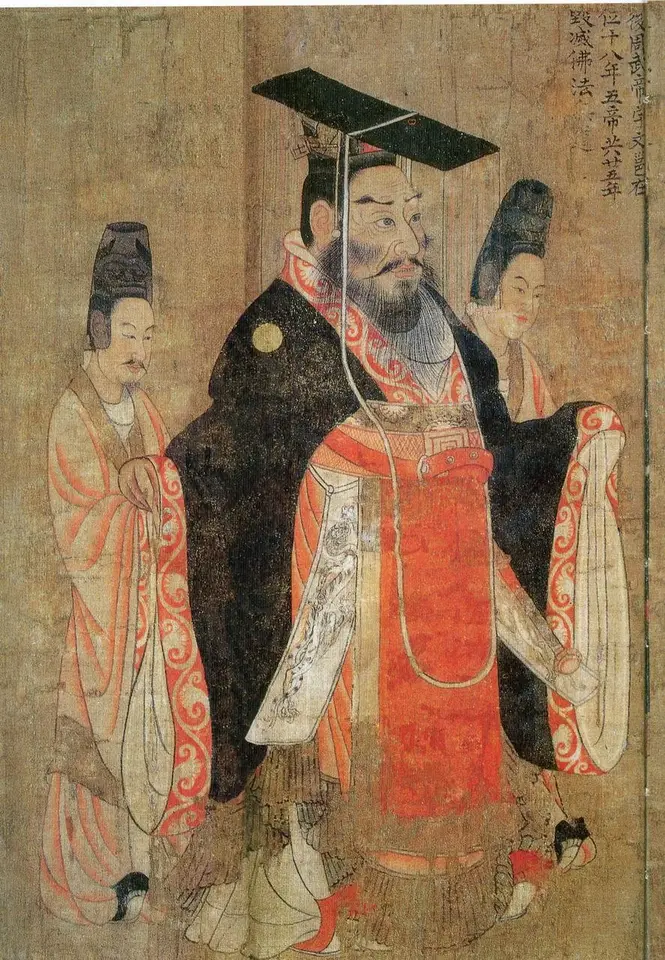
560 CE–578 CE
宇文邕
Emperor Wu of Northern Zhou (北周武帝, 543 – June 21, 578), personal name Yuwen Yong (宇文邕) and childhood sobriquet Milotu, was the third sovereign of the Northern Zhou dynasty during the Northern and Southern Dynasties period, reigning from 560 to 578. He was the fourth son of Yuwen Tai, the paramount architect of Western Wei, and a younger brother to Emperor Xiaomin and Emperor Ming. Endowed with exceptional strategic patience,…
Emperor Wu of Northern Zhou (北周武帝, 543 – June 21, 578), personal name Yuwen Yong (宇文邕) and childhood sobriquet Milotu, was the third sovereign of the Northern Zhou dynasty during the Northern and Southern Dynasties period, reigning from 560 to 578. He was the fourth son of Yuwen Tai, the paramount architect of Western Wei, and a younger brother to Emperor Xiaomin and Emperor Ming. Endowed with exceptional strategic patience, intellectual depth, and martial discipline, Yuwen Yong was enthroned at age seventeen following the assassination of Emperor Ming by their overmighty cousin, the Grand Regent Yuwen Hu. For twelve years, Yuwen Yong practiced profound dissimulation, outwardly deferring to Yuwen Hu while quietly assembling loyalist cadres within the inner court. In 572, he struck decisively in Hanren Hall, personally executing Yuwen Hu with a jade scepter and reclaiming undisputed sovereign authority. Upon assuming personal rule, Emperor Wu instituted radical institutional and military overhauls. He revolutionized the Fubing militia system, dismantling ethnic barriers to incorporate Han peasant landholders into regular military units and creating a multi-ethnic agrarian army. He enforced extreme personal frugality, demolished ostentatious palaces, and enacted the proscription of Buddhism and Daoism between 574 and 577, returning over three million monks, nuns, and temple serfs to productive farming and taxable registries. In 577, Emperor Wu personally commanded the northern armies to capture Jinyang and Yecheng, obliterating the rival Northern Qi dynasty and ending forty years of division between the eastern and western northern realms. Passing away from sudden illness in 578 at age thirty-six while on campaign against the Gokturks, he was buried at Xiaoling. His military reunification and institutional reforms laid the direct structural foundation for the Sui and Tang reunification of China.
Born in Tongzhou to Yuwen Tai and Consort Chinu; exhibits quiet reserve and intellectual focus in childhood.
Enfeoffed as Duke of Fucheng Commandery under Western Wei; trains in military archery and governance.
Appointed Grand General and garrisoned at Tongzhou following the establishment of the Northern Zhou dynasty.
Promoted to Minister of Works and elevated to Duke of Lu; earns deep administrative trust within the bureaucracy.
Enthroned on May 31 after Yuwen Hu poisons Emperor Ming; adopts absolute political deference toward the regent.
Proclaims the Baoding era; invests Yuwen Hu with supreme military command over domestic and foreign forces.
Receives Princess Ashina of the Gokturks as his consecrated empress to cement northern steppe alliances.
Personally executes Yuwen Hu in Hanren Hall on March 14, terminating twelve years of dictatorial regency.
Decrees the abolition of Buddhist and Daoist establishments in Guanzhong, reallocating monastic serfs to agriculture.
Personally commands sixty thousand troops to assault Jinyang, routing Northern Qi armies and compelling Gao Wei to flee.
Storms Yecheng, captures Gao Wei and Gao Heng, annexing Northern Qi and achieving the reunification of northern China.
Succumbs to sudden critical illness on June 21 at age thirty-six while advancing against the Turks; buried at Xiaoling.
Emperor Wu was born in 543 in Tongzhou (modern Dali, Shaanxi) during the reign of Emperor Wen of Western Wei. He was the fourth son of Yuwen Tai, the de facto ruler and pillar of the state who established the Western Wei and laid the structural foundations of the Northern Zhou. His mother was Lady Chinu, an imperial consort. From his earliest youth, Yuwen Yong demonstrated an unusually serious, contemplative, and disciplined demeanor, speaking only when necessary and dedicating his leisure hours to classical literature and military treatises. Yuwen Tai recognized his son's extraordinary latent potential, frequently remarking to his intimates that while his other sons were talented, Yong was the one who possessed the rare depth of vision required to achieve grand dynastic destinies.
In 555, during the reign of Emperor Gong of Western Wei, Yuwen Yong was enfeoffed as the Duke of Fucheng Commandery. When his elder brother Yuwen Jue accepted the abdication of the Wei monarch to inaugurate the Northern Zhou dynasty in 557, Yuwen Yong was appointed Grand General and dispatched to govern the strategic forward garrison of Tongzhou. In 559, under the reign of Emperor Ming (Yuwen Yu), he was recalled to the capital and appointed Minister of Works, subsequently advancing to the noble title of Duke of Lu. Throughout his early administrative tenure, Yuwen Yong conducted himself with meticulous integrity and self-effacing modesty, avoiding political factions and earning widespread respect across the civil and military apparatus.
The founding era of Northern Zhou was characterized by profound sovereign instability under the shadow of Yuwen Hu, Yuwen Tai's nephew who commanded the imperial military forces. In 557, Yuwen Hu deposed and murdered the first sovereign, Emperor Xiaomin (Yuwen Jue). In May 560, sensing that the capable and intelligent second sovereign, Emperor Ming, was working to assert independent royal prerogatives, Yuwen Hu ordered an imperial chef to poison Emperor Ming's meals. On his deathbed, Emperor Ming designated his younger brother Yuwen Yong as his successor. On May 31, 560, the seventeen-year-old Yuwen Yong ascended the throne in the imperial palace of Chang'an as Emperor Wu.
Confronting a ruthless dictator who had assassinated two consecutive monarchs, Emperor Wu recognized that any overt sign of resistance would invite immediate assassination. He adopted a masterclass in long-term political dissimulation and strategic patience. For twelve years, Emperor Wu treated Yuwen Hu with the ceremonial deference accorded to an elder father, greeting him with humble bows, consulting him on all promotions and executions, and granting him the supreme office of Grand Preceptor. When courtiers approached the throne regarding administrative matters, Emperor Wu consistently redirected them to Yuwen Hu's ministerial residence. Meanwhile, Emperor Wu lived an ascetic personal life, wearing coarse garments, eating simple rations, and dedicating himself to military logistics, all while quietly identifying dependable allies such as his younger brother Yuwen Zhi and military commanders who resented Yuwen Hu's monopolistic corruption.
By 572, Yuwen Hu's prestige had been severely degraded following repeated military defeats against Northern Qi, while Emperor Wu's quiet moral authority had matured. On March 14, 572, Yuwen Hu returned to Chang'an from an inspection tour of Tongzhou. Emperor Wu received his cousin with warm family affection, inviting him to Hanren Hall to pay respects to the Empress Dowager Chinu. As they walked toward the inner chambers, Emperor Wu confided with apparent sorrow that the Empress Dowager had developed a dangerous fondness for wine, urging Yuwen Hu as clan elder to read the ancient admonition Announcement on Alcohol (Jiu Gao) to her to persuade her to abstain.
Suspecting nothing, Yuwen Hu entered the hall, took his seat before the Empress Dowager, and unfurled the scroll to read. As Yuwen Hu's gaze was fixed upon the text, Emperor Wu stepped quietly behind him, raised a heavy jade scepter, and struck Yuwen Hu across the back of the neck with all his strength. Yuwen Hu collapsed to the floor stunned; Yuwen Zhi dashed from behind a screen and severed the dictator's head with a single stroke. Emperor Wu immediately issued imperial decrees mobilizing the palace guards, systematically executing Yuwen Hu's sons, generals, and political partisans. The twelve-year regency was extinguished in an afternoon, returning absolute executive authority to the throne.
Assuming full personal governance, Emperor Wu enacted sweeping domestic transformations aimed at revitalizing state power. He demolished opulent pavilions constructed during the regency, liberated thousands of palace retainers, and instituted strict meritocratic performance audits for provincial administrators. Crucially, Emperor Wu restructured the Fubing militia system. Originally established by Yuwen Tai as a purely Xianbei tribal elite, the Fubing faced chronic manpower shortages due to unending warfare. Emperor Wu issued landmark decrees opening the ranks to robust Han peasant landholders, granting their households full exemptions from taxes and corvee duties. By restoring Han surnames to soldiers and integrating militia commands with local county administrations, he created a massive, multi-ethnic peasant-warrior army that transformed Northern Zhou into an irresistible military juggernaut.
In the ideological and economic spheres, Emperor Wu observed with mounting concern the immense expansion of Buddhist monastic institutions, which occupied vast fertile tracts of agricultural land and sheltered millions of able-bodied laborers from taxation and military conscription. After convening extensive court debates between Buddhist masters, Daoist adepts, and Confucian scholars, Emperor Wu enacted the proscription of Buddhism in 574, expanding it to proscribe Daoism. He ordered the confiscation of temple properties, the melting down of bronze statues for currency, and the forced secularization of nearly three million monks, nuns, and temple retainers, returning them to productive agrarian labor and tax registers across northern China.
With his economic and military mobilization complete, Emperor Wu launched his grand strategic campaign to conquer the rival Northern Qi dynasty. In October 576, he personally took the field at the head of sixty thousand elite infantry and cavalry, advancing directly upon Jinyang, the military fortress and secondary capital of Northern Qi. Gao Wei, the dissolute and incompetent ruler of Northern Qi, rushed forward with over one hundred thousand troops to relieve the city. In the climactic battle outside the walls of Jinyang, when the Zhou vanguard hesitated under fierce resistance, Emperor Wu rode into the thick of arrow fire with drawn sword, inspiring his divisions to smash the enemy line and slaughter over ten thousand warriors. Gao Wei fled in panic toward Yecheng.
Emperor Wu pursued the retreating enemy relentlessly through winter blizzards, investing the imperial capital of Yecheng. Northern Qi forces arrayed war elephants and armored cavalry outside the city gates; Emperor Wu directed archers to shoot the elephants' eyes, sending the panicked beasts trampling through their own infantry. Zhou divisions stormed the battlements and captured Yecheng in January 577. Gao Wei and his son were captured while attempting to flee south. Northern Qi's fifty provinces, one hundred and sixty-two commanderies, and over three million households were annexed into Northern Zhou. Through this campaign, Emperor Wu terminated forty years of bloody division between eastern and western regimes, achieving the total military reunification of northern China.
Following the conquest of Northern Qi, Emperor Wu turned his strategic attention toward southern and northern threats. In 577 and 578, Northern Zhou forces under Wang Gui successfully repelled the Taijian northern offensive launched by the Chen dynasty, routing the southern commander Wu Mingche at the Battle of Luliang and capturing over thirty thousand prisoners. Simultaneously, Emperor Wu planned an unprecedented grand offensive against the Gokturk Khaganate, aiming to eliminate nomadic incursions along the northern steppe border.
In June 578, Emperor Wu mobilized five separate expeditionary armies and personally departed Chang'an to direct operations on the steppe. However, during the march toward Yunyang, the emperor fell critically ill due to prolonged physical exhaustion and overwork. Recognizing that his condition was terminal, he ordered the imperial column to halt and returned toward the capital. On June 21, 578, Emperor Wu passed away in his carriage at the age of thirty-six. He was interred with unadorned, frugal rites at Xiaoling on Mount Liang, leaving the throne to his son Yuwen Yun (Emperor Xuan). His early death prevented the immediate conquest of southern China, yet the military, demographic, and legal foundations he created directly enabled his successor Yang Jian to establish the Sui dynasty and achieve the final reunification of China in 589.
Emperor Wu's liquidation of Yuwen Hu stands as one of the most brilliant and dangerous sovereign coups in Chinese court history. Having witnessed the regicide of two imperial brothers, Emperor Wu maintained absolute tactical discipline and feigned submission for over a decade. His meticulously planned palace strike in Hanren Hall eradicated the entrenched military regency without precipitating civil war or provincial rebellions, restoring undisputed monarchical supremacy and clearing the path for sweeping structural state reforms.
The anti-clerical movement enacted between 574 and 577, known historically as the Second of the Three Disasters of Wu, was primarily an economic and demographic reform. By shutting down tens of thousands of monasteries, confiscating colossal temple treasures, and compelling nearly three million monastics and temple serfs to return to civilian life, Emperor Wu eradicated the parasitic clerical economy of northern China. This massive reallocation of human labor directly enriched the state treasury, expanded the pool of taxable agricultural households, and provided hundreds of thousands of healthy recruits for imperial armies.
The military destruction of Northern Qi in 577 was Emperor Wu's crowning strategic masterpiece. Mobilizing an army transformed by discipline and multi-ethnic integration, he personally directed the decisive engagements at Jinyang and Yecheng, outmaneuvering Northern Qi's larger but demoralized forces. The campaign annexed over three million households, ending four decades of ruinous civil war across northern China and establishing a unified geopolitical and economic bloc that made the ultimate grand reunification under Sui and Tang inevitable.
Emperor Wu's structural reformation of the Fubing militia system transformed early medieval Chinese military history. Overturning the ancestral Xianbei monopoly on military service, he opened enlistment to Han peasant freeholders, granting them hereditary status and complete tax exemptions in exchange for disciplined military service. By restoring ancestral Chinese surnames to troops and integrating garrison units into local administrative registers, he laid the organizational foundation for the peasant-soldier militia that served as the primary military pillar of the early Tang Empire.
In the aftermath of the northern conquest, Emperor Wu demonstrated formidable strategic balance by neutralizing southern expansionism. When the southern Chen dynasty mounted the ambitious Taijian northern expedition under General Wu Mingche to seize the Huai River valley, Emperor Wu dispatched General Wang Gui to execute an aggressive counter-encirclement. At the Battle of Luliang in 578, Northern Zhou forces severed the southern army's water escape routes and completely annihilated Wu Mingche's veteran divisions, capturing thirty thousand troops and consolidating Northern Zhou's undisputed mastery along the Huai River barrier.
| Relationship Type | Name | Title / Role | Historical Interactions and Key Facts |
|---|---|---|---|
| Third Elder Brother | Yuwen Yu | Emperor Ming | Second sovereign of Northern Zhou; poisoned by Yuwen Hu in 560; designated Yuwen Yong on his deathbed. |
| Cousin / Dictator | Yuwen Hu | Grand Preceptor / Duke of Jin | Assassinated two emperors and ruled for twelve years; executed by Emperor Wu in Hanren Hall in 572. |
| Younger Brother | Yuwen Zhi | Prince of Wei | Secret ally who sprang from behind the curtain to strike down Yuwen Hu; later revolted and was executed. |
| Primary Empress | Princess Ashina | Empress Ashina | Daughter of Muqan Khagan of the Gokturks; married Emperor Wu in 568 to secure northern steppe peace. |
| Master General | Yang Jian | Duke of Sui | Prominent commander under Emperor Wu; married his daughter to Yuwen Yun, later founding the Sui dynasty. |
| Master Commander | Wang Gui | Senior General | Directed the defeat of Chen forces at Luliang; frequently advised Emperor Wu regarding the crown prince's flaws. |
| Eastern Adversary | Gao Wei | Later Ruler of Northern Qi | Decadent sovereign of Northern Qi; routed by Emperor Wu at Jinyang and captured at Yecheng in 577. |
Linghu Defen and Tang chroniclers wrote in the Book of Zhou: "Emperor Gaozu was naturally serious, dignified, and unfathomably deep. Endowed with profound insight, he governed through strict self-discipline and unyielding purpose. For over a decade under the shadow of the dictator, he maintained extraordinary concealment, never letting slip his inner resolve. When he struck down Yuwen Hu, the altars of state were secured in a single day. He reformed laws, eliminated opulent luxuries, unified northern China, and pacified the four quarters. He lived on coarse grains and unadorned robes, sleeping on hard couches during campaigns, marching on foot alongside common soldiers. Had heaven granted him a decade more of life, the grand reunification of the universe would have been accomplished by his own hand!"
Emperor Wen of Sui (Yang Jian), who had served under Emperor Wu, remarked to his ministers: "Emperor Wu of Northern Zhou was truly an extraordinary sovereign. He eliminated powerful tyrants, broke through difficult obstacles, and unified northern territories within a few short years. His frugal governance and military discipline served as models for my own administration."
Li Yanshou observed in the History of the Northern Dynasties: "Emperor Wu combined the martial prowess of Emperor Taiwu of Northern Wei with the profound administrative depth of Han sovereigns. He lived without luxury, shared hardship with his troops, and dismantled the religious stranglehold over the economy. His subjugation of Northern Qi demonstrated operational perfection. Though he passed away before traversing the Yangtze, the reunification achieved by Sui was merely the execution of Emperor Wu's grand design."
Sima Guang wrote in the Zizhi Tongjian: "Emperor Wu of Northern Zhou was endowed with extraordinary fortitude and martial genius. In his personal conduct, he was frugal and austere, rejecting lavish ornament. In administering his armies, he maintained absolute impartiality in rewards and punishments, sharing cold and hunger with common warriors. His destruction of Northern Qi liberated the Central Plains from chronic bloodshed. His sole tragic failing lay in his inability to educate his heir, leaving his vast empire to collapse under an unworthy successor."
Wang Fuzhi, the early Qing philosopher, analyzed Emperor Wu in On the Comprehensive Mirror for Aid in Government: "Among the monarchs of the Northern and Southern Dynasties, Emperor Wu of Zhou was the most admirable in personal fortitude and structural innovation. His reform of the Fubing system by integrating Han freeholders was the stroke of administrative genius that broke the racial segregation of the Northern Dynasties, forging the multi-ethnic state machinery that powered Sui and Tang. While his anti-Buddhist proscriptions were severe, his objective was the restoration of agrarian productivity and fiscal solvency. He was a sovereign of heroic stature whose untimely demise alone prevented him from wearing the crown of a unified China."
Modern historians emphasize that Emperor Wu was the pivotal architect of China's medieval transition. By eradicating the Xianbei monopoly on military command and secularizing the Buddhist temple economy, he liberated millions of agricultural workers and created the integrated bicultural military apparatus that ended the prolonged fragmentation following the fall of Han. His brief but explosive reign was the crucible from which the Golden Age of Sui and Tang emerged.
Yuwen Tai, Yang Jian, Yuwen Hu, Northern Zhou Conquest of Northern Qi, Proscription of Buddhism by Emperor Wu
FIGURES ASSOCIATED WITH THIS DYNASTY