Birth | Born at Jinyang, a son of Gao Huan and Lou Zhaojun.
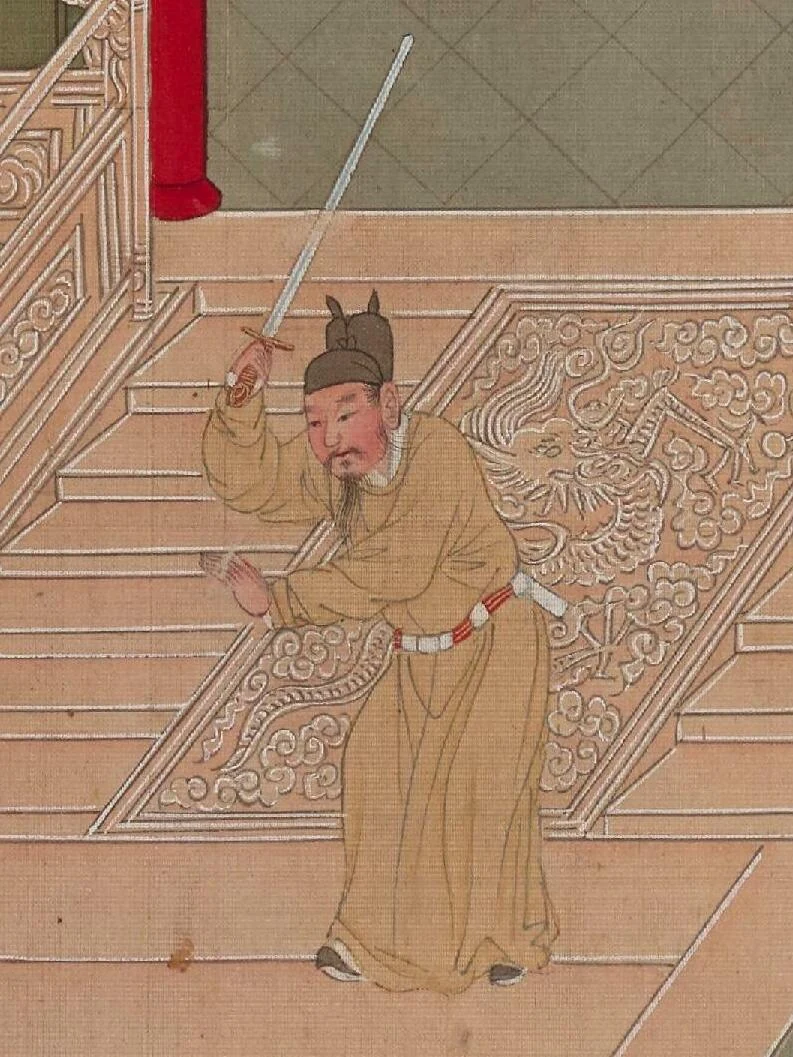
526 CE
Emperor
Gao Yang
高洋
Gao Yang (born 526, died 25 November 559), courtesy name Zijin and Xianbei name Hounigan, was a native of Tiao County in Bohai Commandery, born at Jinyang, and the founding emperor of Northern Qi. He was a son of Gao Huan and Lou Zhaojun. After his elder brother Gao Cheng was assassinated in 549(Wuding 7, Eastern Wei), Gao Yang took control of the Eastern Wei court. In 550(Wuding 8, Eastern Wei; Tianbao 1, Northern Qi), he…
526 CENorthern Qi
PROFILE
Gao Yang (born 526, died 25 November 559), courtesy name Zijin and Xianbei name Hounigan, was a native of Tiao County in Bohai Commandery, born at Jinyang, and the founding emperor of Northern Qi. He was a son of Gao Huan and Lou Zhaojun. After his elder brother Gao Cheng was assassinated in 549(Wuding 7, Eastern Wei), Gao Yang took control of the Eastern Wei court. In 550(Wuding 8, Eastern Wei; Tianbao 1, Northern Qi), he forced Emperor Xiaojing, Yuan Shanjian, to abdicate and founded Northern Qi. Early in his reign, he reorganized prefectures and commanderies and official administration, adjusted the palace guard and frontier defenses, and launched military campaigns against the Rouran, Khitan, Kumo Xi, and other groups. Sources record that from around 555(Tianbao 6, Northern Qi), his attention to government declined and his drinking and violent behavior intensified. His reign is therefore characterized in the sources both by the founding of Northern Qi and early administrative measures, and by misgovernment in his later years.
- Other name
- Emperor Wenxuan
- Courtesy name
- Zijin
- Period
- Northern Qi
- Date of Birth
- 526 CE(2nd year of the Xiaochang era, Northern Wei)
- Date of Death
- November 25, 559 CE(10th year of the Beiqitianbao era, 10th month)
- Dynasty / polity
- Northern Qi
- Identity
- Emperor
- Ethnicity / group
- Not reliably established in existing sources
- Ancestral home
- Tiao County, Bohai Commandery (present-day Jing County, Hengshui, Hebei)
- Place of birth
- Yingkou, Liaoning
- Reign
- Not reliably established in historical sources
- Successor
- Emperor Fei of Northern Qi, Gao Yin (son)
- Era name
- Not reliably established in historical sources
- Temple name
- Gaozu
- Posthumous name
- Emperor Wenxuan
- Major achievements
- Founding emperor of Northern Qi; repelled Yuwen Zhou and other powers, but became violently abusive and lost control of government in his later years.
- Native place
- Tiao County, Bohai Commandery (present-day Jing County, Hengshui, Hebei);526(Xiaochang 2, Northern Wei)
- Place of death
- Deyang Hall, Jinyang Palace;550-25 November 559(Tianbao 1-10, Northern Qi)
- Predecessor
- Emperor Xiaojing of Eastern Wei, Yuan Shanjian;Gao Yin, the deposed emperor of Northern Qi
LIFE TIMELINE
Entry into office | Appointed Regular Mounted Attendant, Grand General of Agile Cavalry, with the rank recorded in Chinese as Bearer of the Privilege of Opening a Bureau with the Ceremonial of the Three Excellencies, and other offices.
Promotion | Appointed Palace Attendant; the following year became Left Vice Director of the Department of State Affairs and General of the Guards.
Transfer of family power | His father Gao Huan died and his elder brother Gao Cheng took control of Eastern Wei government; Gao Yang held offices including Prefect of the Masters of Writing.
Taking control of government | Gao Cheng was assassinated by Lan Jing. Gao Yang concealed the death temporarily, captured and killed the assassin, stabilized the situation, and was subsequently enfeoffed as Prince of Qi.
Founding Northern Qi | Forced Emperor Xiaojing, Yuan Shanjian, to abdicate, ascended the throne, established the state of Qi, and adopted the era name Tianbao.
CE(8th year of the Wuding era, Eastern Wei, 5th month; 1st year of
550 CE(8th year of the Wuding era, Eastern Wei, 5th month; 1st year of the Tianbao era, Bei Qi) | Response to Western Wei attack | Personally organized the army to confront Yuwen Tai; Western Wei withdrew after seeing the disciplined Northern Qi formation.
Northern campaign and diplomacy | Campaigned against the Kumo Xi; sent Cui Liu to Goguryeo to negotiate the return of people displaced there at the end of Northern Wei.
Campaign against the Khitan | Personally participated in a northern campaign in which Northern Qi forces defeated the Khitan and took many captives.
Northern warfare | Campaigned against the Shanhu, suppressed a Rouran rebellion, and met Rouran forces entering Northern Qi's northern frontier.
Military activity and turning point in rule | Continued campaigns against the Rouran; historical sources also record that from this period he gradually shifted from diligent government toward neglect and heavy drinking.
Frontier defense | The court linked existing Great Wall defenses and repaired frontier walls and garrisons from the Xihe area toward Bohai.
Frontier defense | Constructed a new defensive line inside the Great Wall to strengthen the northern frontier.
Killing of Northern Wei imperial clansmen | Ordered the execution of large numbers of members of the Yuan imperial clan; the histories record 721 people killed in the successive actions.
Death | Died in Deyang Hall of Jinyang Palace. Some sources give his age as 34 by traditional reckoning, while the Book of Northern Qi gives 31; the recorded age is disputed.
In 559(Tianbao 10) | In 559(Tianbao 10), Gao Yang ordered action against members of the former Northern Wei imperial clan after Yuan Shao answered a question about the restoration of the Han by Emperor Guangwu of Han.
Death | The introductions of both give the corresponding date as 25 November 559.
The full another account text instead records the initial posthumous name Wenxuan and temp | The full another account text instead records the initial posthumous name Wenxuan and temple name Gaozu, followed around the beginning of Tiantong in 565 by a change to the posthumous name Jinglie and temple name Weizong.
Posthumous name restored | The posthumous name Wenxuan and the temple name Xianzu were restored to him.
BIOGRAPHY
Biography
Family Background and Early Years Gao Yang was the second son of Gao Huan and Lou Zhaojun and the full younger brother of Gao Cheng. As Gao Huan gained control of Eastern Wei military and political affairs, the status of the Gao family rose rapidly. Gao Yang was born in Jinyang and was registered as a native of Tiao County in Bohai Commandery. the Xianbei name as Hou Niyu Existing sources give different descriptions of the Gao family's ethnic background, and this article does not impose a modern ethnic classification on them. The histories record that Gao Yang was not valued for his childhood appearance by Gao Cheng, while Gao Huan regarded him as calm and capable of judgment. Other historical stories are treated as anecdotes below rather than as verified biographical facts. In 535(Tianping 2, Eastern Wei), Gao Yang was appointed Regular Mounted Attendant, Grand General of Agile Cavalry, with the rank recorded in Chinese as Bearer of the Privilege of Opening a Bureau with the Ceremonial of the Three Excellencies, Grand Master of Splendid Happiness of the Left, and Founding Duke of Taiyuan Commandery. In 543(Wuding 1, Eastern Wei), he was appointed Palace Attendant; the next year he became Left Vice Director of the Department of State Affairs and General of the Guards. During Gao Cheng's control of the court, Gao Yang continued to serve in the Eastern Wei central government. In 547(Wuding 5, Eastern Wei), Gao Huan died and Gao Cheng took over political power, while Gao Yang received offices including Prefect of the Masters of Writing, Director of the Secretariat, and Metropolitan Area Grand Commander. ### Taking Control of Eastern Wei and Founding Northern Qi In 549(Wuding 7, Eastern Wei), Gao Cheng was assassinated at Ye by the kitchen servant Lan Jing. After receiving the news, Gao Yang first controlled disclosure of the death, mobilized his followers to capture and kill the assassin, and then went to Jinyang to handle military and political affairs. The sudden assassination briefly destabilized the court. Once Gao Yang had brought the situation under control, Emperor Xiaojing of Eastern Wei, Yuan Shanjian, appointed him Grand Councilor and Prince of Qi, among other offices. Gao Yang thereby took control of the Eastern Wei court. In the fifth month of 550(Wuding 8, Eastern Wei), Gao Yang forced Yuan Shanjian to abdicate at Ye and founded Northern Qi, adopting the era name Tianbao. This ended the Eastern Wei polity. In the eleventh month of the same year, Yuwen Tai of Western Wei advanced east with an army. Gao Yang personally left the palace to organize his troops. The histories state that Western Wei withdrew after seeing the disciplined Northern Qi army and record Yuwen Tai as remarking, “Gao Huan is not dead.” The account reflects the new regime's military response in its first year and also shows that Western Wei remained one of Northern Qi's principal opponents. ### Governance in the Early Reign In the early years after taking the throne, Gao Yang personally attended to government. His policies focused on reducing redundant administrative layers, reorganizing officials, stabilizing finances, and strengthening frontier forces. The court addressed the proliferation of prefectures and commanderies and the burden of excessive official posts by accepting proposals to reduce local administrative units and personnel. The full one account text also records the restoration or regulation of officials' salaries, strict treatment of corruption, and legal restraints on favored nobles. The Book of Northern Qi summarizes his early government as attentive to state affairs, governed through law, and clear in rewards and punishments. These are historical evaluations of the results and should not be simplified into a claim that corruption was completely eliminated. Northern Qi began revising the Northern Qi Code during Gao Yang's reign and continued the compilation of Northern Wei history. Gao Yang ordered Wei Shou to direct the compilation of the Book of Wei. When members of established families challenged the completed work, Gao Yang did not accept demands that the historians be punished and instead dealt with some people who used accusations of “slandering history” against one another. The court also recruited Confucian scholars to lecture on the classics to the crown prince and other princes and ordered the collation of books. These measures show attention to law, education, and historical compilation in his early rule, but the available evidence is insufficient to attribute all later legal influence to Gao Yang personally. ### Military Organization, Frontier Defense, and External Wars Northern Qi relied heavily on Xianbei soldiers and their military organization. The full one account text, citing the Book of Northern Qi, states that Gao Yang reorganized the palace guard, established the troops known as the Baibao guards, and continually repaired equipment and trained soldiers. The same materials show that the Northern Qi military included the Gao family's old forces, palace guards, and frontier troops from different regions; one guard formation should not be treated as representing the whole military system. In 550(Tianbao 1, Northern Qi), Gao Yang responded to the eastward advance of Western Wei. Northern Qi then continued campaigning against surrounding powers. In 552(Tianbao 3), Gao Yang personally led troops against the Kumo Xi. He also sent Cui Liu to Goguryeo to demand the return of people displaced there at the end of Northern Wei; after negotiations, five thousand households were brought back. In 553(Tianbao 4), Northern Qi campaigned north against the Khitan, and the histories record Gao Yang's presence with the army and the defeat of Khitan forces. Northern Qi later also undertook military action against the Göktürks. In 554(Tianbao 5), Gao Yang campaigned north against the Shanhu and dealt with a Rouran rebellion and incursions into Northern Qi territory. In 555(Tianbao 6), Northern Qi again campaigned against the Rouran and won engagements around Qilian Pond and other places. one account summarizes these wars as a succession of campaigns expanding Northern Qi influence and states that its sphere extended toward Huainan and the Yangzi region. Specific battlefield results and figures for captives come largely from one-sided historical accounts and should be distinguished from the basic fact that the campaigns occurred. Frontier construction proceeded alongside the northern campaigns. The full one account text records that from 551(Tianbao 2), Northern Qi built and connected sections of the northern frontier wall and established garrisons and frontier posts. Further repairs or extensions followed in 555, 556, and 557. Existing sources do not entirely agree on the segments, total lengths, or mileage. This article therefore retains only the commonly supported point that the fortifications were constructed in stages rather than adopting a single total-length figure. ### Misgovernment and Violence in the Later Reign Around 555(Tianbao 6), Gao Yang's style of rule changed. Both the full one account text and the Book of Northern Qi state that he increasingly indulged in alcohol and that his government shifted from earlier diligence toward neglect. Accounts of harm to consorts, members of the imperial clan, and officials while intoxicated are limited here to incidents recorded in the histories, without treating later embellished details as certain fact. Gao Yang's late construction of palaces and other projects was also criticized by historical writers. In 559(Tianbao 10), Gao Yang ordered action against members of the former Northern Wei imperial clan after Yuan Shao answered a question about the restoration of the Han by Emperor Guangwu of Han. one account, citing the Book of Northern Qi, records that 721 members of the Yuan clan were killed in successive actions that year. The event illustrates the extreme measures taken by Northern Qi imperial power against the former dynasty's clan and heightened fear within the ruling elite. Gao Yang died on the jiawu day of the tenth month that same year. The introductions of both give the corresponding date as 25 November 559. the full text gives his age as 34, while the Book of Northern Qi gives 31, so this article does not treat his age at death as certain. ### Posthumous Honors Gao Yang was buried at Wuning Mausoleum. His posthumous and temple names underwent several changes. The full one account text, citing the Book of Northern Qi, states that in Qianming 1 (560) he received the posthumous name Emperor Wenxuan and the temple name Weizong, and that in the early Wuping period around 570 the Wenxuan posthumous name was restored and the temple name changed to Xianzu. The full another account text instead records the initial posthumous name Wenxuan and temple name Gaozu, followed around the beginning of Tiantong in 565 by a change to the posthumous name Jinglie and temple name Weizong. These divergent accounts show that Northern Qi changed his temple and posthumous names in its later years. This article follows the final forms, Xianzu and Emperor Wenxuan, while preserving the sequence reported by another account as a source difference.
His Lineage, the Portents at His Birth, and the Strange Tales of His Youth
According to the genealogical table of chancellors in the New Tang History, the Gao were of the Jiang surname: the sixth-generation descendant of the grand duke of Qi, Duke Wen's son Chi, begot Prince Gao, whose grandson Xi was chief minister of Qi and, having joined Guan Zhong in assembling the princes, was commanded by Duke Huan to take his grandfather's name as his surname with his fief at Lu and the posthumous name Jingzhong, holding the chief ministry for generations; and ten generations later Gao Hong was governor of Bohai under the Later Han and settled at Xiu county in Bohai, whence the Bohai Gao, a line that passed through Wei, Jin and the Sixteen States to the generation of Gao Huan's father. When Gao Yang's mother, Lou Zhaojun, was with child, a red light covered the chamber every night, and she wondered at it privately, so that after his birth he was given the Xianbei name Houmiyu, which in Xianbei means "child of good looks." The History of the Northern Qi also records that when Gao Huan first went over to Erzhu Rong, in a time of danger and disorder with the house bare to the walls, Lou Zhaojun and her kinsfolk lamented their cold and hunger together; and Gao Yang, who could not yet speak, suddenly answered "we shall live," so that the empress dowager and those about him were too astonished to speak. Grown up he was "black, with great cheeks and a narrow chin, scaly body and double ankles," not given to play, deep and of large measure. In Jinyang there had been a monk sometimes foolish and sometimes wise whom men could not fathom, called Master Bald, and Gao Yang once went with other boys to see him, and when he asked each boy's rank and fortune, and came to Gao Yang, he only raised his hand and pointed to heaven three times without a word, which those who saw it found strange. Gao Huan once tested his sons' understanding, having each sort out a tangle of silk, and Gao Yang alone drew a knife and cut it, saying that what is tangled must be cut; and again having them each take troops out in four directions while armoured horse feigned attack, Gao Cheng and the others were frightened and confused, while Gao Yang marshalled his men against Peng Le, who took off his helmet and spoke to him, and still took him and presented him. Afterwards, riding with Gao Cheng past Liaoyang mountain, he alone saw the gate of heaven open, which no one else saw. Inwardly clear though outwardly wanting, he was often mocked by Gao Cheng with the words that this man too should get wealth and honour, and how should the physiognomists explain it; but Gao Huan thought otherwise of him and told Xue Chu that this boy's understanding surpassed his own. As a boy he studied under Lu Jingyu of Fanyang, and his silent memory was such that Lu Jingyu could not fathom him. This hiding of his light both dissolved Gao Cheng's suspicion and protected him, and deceived almost all the officers.
His Assumption of the Government and the Founding of Northern Qi
In 549, when Gao Cheng was murdered at Ye by his cook Lan Jing and the court was in confusion at the suddenness of it, Gao Yang, then only twenty-three, came forward. Most of the Gao officers looked down on him, but the calm and composure he showed in putting down the affair, and the political measures that followed, astonished them: on the one hand he directed the guards himself in hunting the assassins, "cutting up the ruffians with his own hand and lacquering their heads," and on the other he attended to the government in person, so that great and small military matters were in order and the confusion was at once controlled. The Wei emperor Xiaojing thereupon decreed him commissioner with the staff of authority, chancellor, commander of military affairs at home and abroad, director of the Secretariat, grand headquarters and prince of Qi commandery, with ten thousand households; and in the fifth month of the following year he entered Ye, was advanced to chancellor of state with the general control of the hundred departments, and was enfeoffed with the ten commanderies of Bohai, Changle, Ande, Wuyi, Hejian, Gaoyang, Zhangwu, Zhongshan, Changshan and Boling, with two hundred thousand households, the nine bestowals and special honours, retaining the title of prince of Qi. In the fifth month of 550 Yuan Shanjian, with tears, signed the patent, took leave of his consorts and was driven from the palace, whereupon Gao Yang took the throne and changed the era to Tianbao, and the Eastern Wei came to an end. In the tenth month of that year he went in the imperial carriage to the Jinyang palace and greeted the empress dowager in the inner hall; on the xin-si day he proclaimed a partial amnesty for the four prisons of Bingzhou, Taiyuan commandery and Jinyang county and of the chancellery of state, making Yuan Shao president of the left of the Secretariat and Duan Shao president of the right; and on the ren-chen day he abolished the chancellery of state, keeping only the cavalry and foreign troops bureaux, each made a separate secretariat with charge of secret business, so dividing the authority. In the eleventh month of the same year, when Yuwen Tai of Western Wei brought his host to Shancheng and sent cavalry north across the river to Jianzhou, Gao Yang went out in person to the east of the city and formed his troops, and Yuwen Tai, hearing of the sternness and fullness of his array, sighed that Gao Huan was not dead, and withdrew; and Xiao Yi, prince of Xiangdong of Liang, sent envoys with tribute, while Li Jingsheng, governor of Jiaozhou, Ma Songren of Liangzhou, Xiahou Zhenqia of Yizhou and Li Han of Xinzhou all brought their provinces over to Northern Qi.
His Early Measures and the Three Northern Campaigns
In his first years Gao Yang attended to business himself, his policy turning on cutting down redundant levels of administration, reforming the officials, steadying the finances and strengthening the frontier. To the problem of too many commanderies and counties with officials overburdened, the court took advice to abolish some, reducing the surplus; officials' stipends were restored or regulated, corruption was dealt with strictly, and the favoured nobles were bound by law. In 552 he went to Yingzhou and sent Cui Liu of Boling on a mission to Koguryo to demand the people who had scattered there at the end of Northern Wei, instructing him that if they would not agree he might act as he saw fit; and Cui Liu, refused, glared and shouted at them and struck Gao Pingcheng from his couch with his fist, so that those about him held their breath and dared not move and Gao Pingcheng apologized and yielded, and Cui Liu brought back five thousand households. In the ninth month of 553 the Khitan raided the frontier, and Gao Yang made a northern progress through Ji, Ding, You and An and campaigned against them: in the tenth month he reached Pingzhou and went by the western road to the long trench, ordering the minister of education Pan Xiangle with five thousand picked cavalry by the eastern road to Qingshan, while he himself came to Bailang city and passed Changli city; and he ordered the prince of Ande, Han Gui, with four thousand picked cavalry eastward to cut the Khitan retreat, and reaching the Yangshi water marched by double stages to surprise them, then himself crossed the mountains before his men and directed the attack, breaking them utterly with more than a hundred thousand prisoners and several hundred thousand head of stock, Pan Xiangle breaking their detached force at Qingshan as well. The histories say that in this campaign he "crossed the hills before his soldiers," "bare-headed and bare-armed, resting neither day nor night, marching more than a thousand li on meat and water alone, his fierce spirit growing the keener." In 554 he campaigned north against the Shanhu, who broke at the first battle with more than ten thousand beheaded, so that the Shanhu far and near were overawed; and in the same year, when the Anluochen division of the Rouran rebelled, he led the army against them and broke them heavily, the Rouran advancing from Sizhou toward Datong and being cut down for twenty li at the Huanggua mound with the ground strewn with corpses and thirty thousand prisoners taken, Anluochen's wife and children not escaping. In the third month of 555 Northern Qi campaigned again against the Rouran, who had been beaten and beaten again, winning at the Qilian pool. Alongside these campaigns went frontier works: from 551 Northern Qi built and joined the northern wall in sections with garrison posts and frontier towns, and in 555, 556 and 557 continued to repair or extend the line. These operations carried Northern Qi's influence toward Huainan and the line of the Yangtze, its power reaching its height.
The Concrete Record of His Later Violence and the Question of His Dates
About 555, with the neighbours at peace and all power in his hands, Gao Yang's will began to slacken and he passed from diligence to licence and violence. He once climbed alone to the highest point of a building he was raising, so that the people who saw it trembled with fear; he would expose himself in the streets although it was the depth of winter; and he would powder and paint his face and go about the streets in women's clothes, or gather great numbers of women into the palace for himself and his favourites to revel with day and night. The most dreadful thing the histories record concerns Consort Xue: Gao Yang had a consort Xue of beauty that could overthrow a city, greatly favoured, with whom he lived day and night; and one day, drunk, he suddenly recalled that she had once had an affair with Gao Yue, prince of Zhaowu, and in a fit of jealousy drew a dagger and killed her, then put the body in his bosom and went drunkenly off to drink with others; and after three rounds he suddenly drew the body out and, as if it were nothing, cut it limb from limb, made a lute of her thigh-bone and played and sang on it himself, while all present were frozen with horror — after which he gathered up the remains and wept over them, saying that a beauty was hard to come by again and it was a great pity. In 559, on account of Yuan Shao's answer about the restoration under Emperor Guangwu of the Han, he ordered the liquidation of the Yuan imperial clan, and the History of the Northern Qi records that seven hundred and twenty-one of the Yuan clan were killed in that year, which shows both the extremity of Northern Qi's measures against the former dynasty's kin and the fear it spread among the ruling group. He died on the jia-wu day of the tenth month of that year. As to his dates, the History of the Northern Qi and the History of the Northern Dynasties both give his age at death as thirty-one, yet the latter also says he was born in a wu year, and the former's story of the house bare to the walls cannot belong to 529, when Gao Huan was already governor of Jinzhou and could not have been reduced to cold and hunger; and so some scholars hold that he was born in 526 and died at thirty-four. He was buried at Wuning mausoleum, and his posthumous honours were adjusted several times: in 560, the first year of Qianming, he was given the posthumous name emperor Wenxuan with the temple name Weizong, and in the early Wuping years, about 570, the name Wenxuan was retained while the temple name was changed to Xianzu.
Major Activities
Administrative Reorganization After founding Northern Qi, Gao Yang's court reduced some prefectural and commandery units in response to complex local administrative layers and excessive official staffing. the changes reduced the number of local administrators and were combined with arrangements for official salaries, performance review, and punishment of corruption. The Book of Northern Qi describes his early government as attentive to administration and as governing subordinates through law. Statements such as “officials all obeyed the law” are historical judgments in the sources rather than quantitative conclusions about the entire Northern Qi bureaucracy. ### Law, Education, and Historical Compilation Revision of the Northern Qi Code began during Gao Yang's reign, and the court also continued the compilation of the Book of Wei. He had Confucian scholars teach the classics to the crown prince and princes, ordered the collation of books, and protected Wei Shou while the historical work was completed. These measures incorporated law, education, and historiography into the administration of the new dynasty and formed part of his early political activity. ### Palace Guard Reorganization and Northern Frontier Gao Yang emphasized the training of palace and frontier forces. The full one account text, citing the Book of Northern Qi, records his establishment of the Baibao guards and describes Northern Qi's staged construction of frontier walls and garrisons during his reign. These works were coordinated with military action against the Rouran, Göktürks, Khitan, and other northern groups. Because the sources use different measures for the length of the fortifications, this article does not adopt a single mileage figure. ### External Wars and Frontier Diplomacy During Gao Yang's rule, Northern Qi campaigned between 552 and 555 against the Kumo Xi, Khitan, Göktürks, Shanhu, and Rouran. More specifically recorded actions include the 552(Tianbao 3) campaign against the Kumo Xi and Cui Liu's mission to Goguryeo, the 553(Tianbao 4) northern campaign against the Khitan, the 554(Tianbao 5) suppression of a Rouran rebellion and counterattack against forces entering Northern Qi territory, and the continuation of campaigns against the Rouran in 555(Tianbao 6). Northern Qi influence later extended into the Huainan region. Figures for troop strengths and captives are not extrapolated beyond what is recorded in the historical and encyclopedic sources. ### Northern Frontier Wall Construction Northern Qi built northern frontier walls in stages during Gao Yang's reign and established defenses at strategic points. The works began in the early Tianbao period and were then extended and connected with older wall sections. In 557(Tianbao 8), a further inner defensive line was built. The different project lengths and cumulative mileage given Baike do not fully agree, so this article retains only the verifiable main line of staged construction to strengthen frontier defense.
The Changes in the Equal-Field System, the State's Wealth, and Law and Letters
In institutions and resources, Northern Qi under Gao Yang continued the equal-field system, broadly as under Northern Wei but with changes: the provision of double fields was abolished, though the land actually received by a man and wife was still equivalent to a double holding; where Northern Wei set no limit on land granted for slaves, Northern Qi limited it by official rank to between three hundred and sixty persons; and taxes were further regulated. Northern Qi's farming, salt and iron working and porcelain manufacture were all fairly developed, and it was the richest of the three states standing with Chen and Northern Zhou, which was the financial base of its frequent campaigns. In law and letters, the Northern Qi Code was taken in hand in Gao Yang's time and the compilation of the history of Northern Wei continued: he had Wei Shou direct the writing of the Wei history, and when the draft was questioned by old families he did not adopt the proposal to punish the historian but dealt instead with some of those who attacked it as a "slanderous history"; and the court gathered Confucians to lecture on the classics to the heir apparent and the princes and had the books collated. These measures brought law, education and historiography into the framework of the new dynasty's government, alongside the reduction of commanderies and counties, the regulation of stipends and the punishment of corruption. It should be noted, however, that Northern Qi rested on Xianbei soldiers and their military organization, and that its armies were made up of Gao family veterans, palace guards and frontier troops in the several regions, so that a unit such as the "hundred-guard soldiers" cannot be taken for the whole of its strength; and the influence of the Northern Qi Code on later law should not be ascribed to Gao Yang alone. As to the two halves of his reign, the earlier was marked by attention to government, rule by law and clear rewards and punishments, the later by drink, neglect of business and the raising of palaces — a turn that is itself one thread in the passage of Northern Qi from strength to decline.
Personal Relations
- Gao Huan: father; Eastern Wei strongman and founder of the political foundation of Northern Qi.
- Lou Zhaojun: mother; principal wife of Gao Huan.
- Gao Cheng: full elder brother; succeeded Gao Huan in controlling Eastern Wei government and was assassinated by Lan Jing in 549(Wuding 7, Eastern Wei).
- Gao Yan: younger brother; later Emperor Xiaozhao of Northern Qi.
- Gao Zhan: younger brother; later Emperor Wucheng of Northern Qi.
- Li Zu'e: empress; mother of Gao Yin and Gao Shaode.
- Gao Yin: eldest son; succeeded as emperor of Northern Qi and was later deposed.
- Gao Shaode: son; enfeoffed as Prince of Taiyuan.
- Gao Shaoyi: son; enfeoffed as Prince of Fanyang. - Yuan Shanjian: Emperor Xiaojing of Eastern Wei; abdicated in favor of Gao Yang in 550(Wuding 8, Eastern Wei), ending Eastern Wei.
- Yang Yin: senior Northern Qi official who participated in government and arrangements surrounding the founding of the dynasty under Gao Yang.
- Wei Shou: historian ordered to direct compilation of the Book of Wei.
- Cui Liu: envoy sent by Gao Yang to Goguryeo to negotiate the return of people displaced there at the end of Northern Wei.
- Yuwen Tai: effective ruler of Western Wei; led an army east in 550(Tianbao 1, Northern Qi) and confronted Gao Yang. - Lan Jing: Eastern Wei kitchen servant who assassinated Gao Cheng, indirectly bringing Gao Yang to control of the government.
- Members of the former Northern Wei imperial clan: subjected to large-scale executions ordered by Gao Yang in 559(Tianbao 10, Northern Qi); the histories record several hundred deaths.
Anecdotes
Tangled Silk and Birth Portents The Book of Northern Qi records that Gao Huan tested his sons by giving each tangled silk to handle. Gao Yang alone drew his knife and cut it, answering that what was tangled had to be cut. The biography uses this episode to portray decisiveness; it is presented here as a story recorded in the history, not as independent proof of innate ability. The Book of Northern Qi and the History of the Northern Dynasties also report that a red light illuminated the room every night during the pregnancy and interpret the Xianbei name Hou Niyu as referring to a child with an auspicious appearance. These are dynastic portent stories, not verifiable facts about the circumstances of his birth. The sources preserve the variant Hou Nigan as well; English-language reference works render that variant as Hounigan.
Historical Assessment
Assessments in the Histories The Book of Northern Qi first describes Gao Yang as having “great bearing from youth” and as calm and perceptive, and records his attentiveness to government and military administration soon after taking the throne. The same biography later criticizes him for “abandoning himself to drink and desire” and links his violence in later years and the political situation after his death with the fortunes of Northern Qi. These assessments correspond to differences between the earlier and later parts of his reign and should not be reduced to either praise or condemnation alone. The History of the Northern Dynasties records that Gao Yang initially inherited the political foundations laid by Gao Huan and Gao Cheng and received support at court and beyond; for his later period it emphasizes drinking, executions, and sexual excess. The Tang work Essentials of Government in the Zhenguan Reign, when discussing Northern Qi politics, connected the state's temporary stability with the employment of Yang Yin and other officials. This indicates that later historians also distinguished Gao Yang's personal style of rule from the role of his governing team. ### Overall Assessment On the basis of the surviving histories, Gao Yang's historical role centers on inheriting the Gao family's control of Eastern Wei, founding Northern Qi, and pursuing administrative reorganization, frontier construction, and campaigns on multiple fronts in the early part of his reign. His later indulgence in alcohol and sex and harsh treatment of members of the imperial clan and officials contrast sharply with his earlier governance. The available materials do not justify modern medical diagnoses of his psychology or treatment of legendary prophecies as established fact.
FIGURES ASSOCIATED WITH THIS DYNASTY
Bibliography
- Li Baiyao, Book of Northern Qi, vol. 4, Annals of Emperor Wenxuan.
- Li Yanshou, History of the Northern Dynasties, vol. 7, Central Annals of Qi, and vol. 94, Biographies 82.