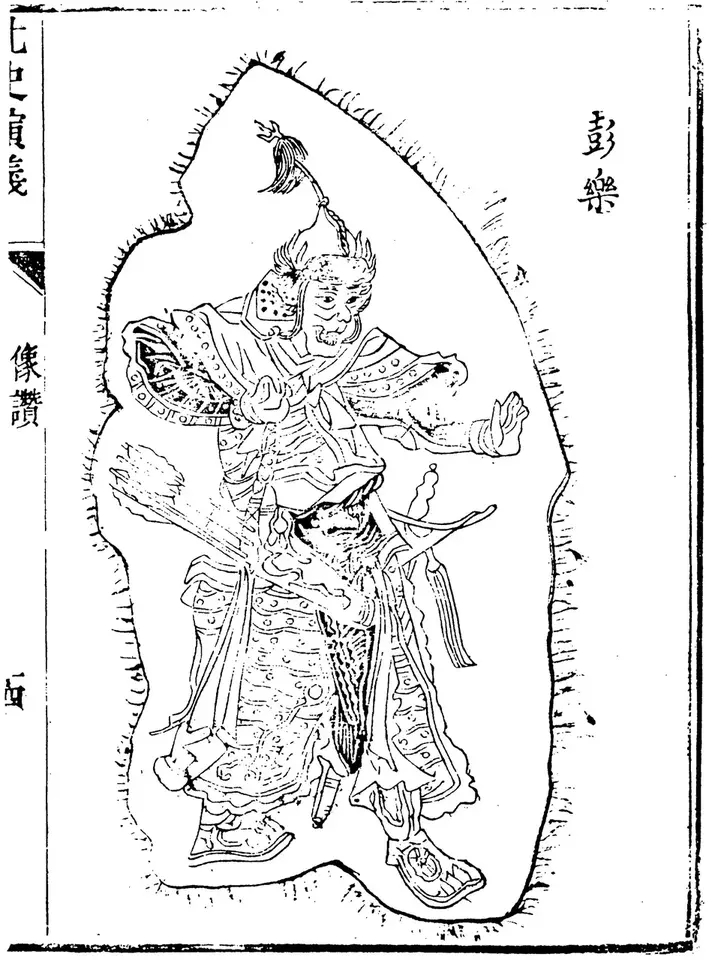
Life Story
Early Rebellions and Fluctuating Loyalties
Peng Le was born in Gaoping within Anding Commandery during the late Northern Wei dynasty. Growing up in the harsh environment of the northern frontier garrisons, he developed an imposing and muscular frame, extraordinary physical stamina, and mastery of equestrian combat and archery, demonstrating fearless resolve in battle.
When the Six Garrisons Rebellion erupted, throwing northern China into turmoil, Peng Le joined the rebel host of Du Luozhou in the eighth month of 525. However, observing that Du Luozhou lacked strategic discipline, Peng Le led his followers to surrender to Erzhu Rong, the ascendant warlord of Xiurong. Serving under Erzhu Rong, Peng Le participated in the Battle of Fukou, helping imperial armies destroy the massive peasant insurrection led by Ge Rong.
Recognized for his valor, Peng Le was appointed Area Commander. In the tenth month of 528, he marched under Gao Huan and Executive Yu Hui to suppress Yang Kan, the rebel administrator of Taishan, routing insurgent forces at Xiaqiu.
In the first month of 529, amid shifting factional alignments within the imperial court, Peng Le led two thousand elite horsemen to defect to Han Lou, who held Youzhou in rebellion. Han Lou warmly welcomed him, conferring upon him the title Prince of Beiping. When Erzhu Rong dispatched Grand Commander Hou Yuan to extinguish the rebellion in Youzhou, Peng Le recognized that Han Lou could not prevail, defecting back to imperial forces and aiding Hou Yuan in the capture of the city.
Adherence to Gao Huan and the Hanling Triumph
Recognizing that enduring security required alignment with an enlightened leader, Peng Le threw his full support behind Gao Huan when the latter initiated his uprising against the tyrannical Erzhu clan in Jinzhou in the second month of 531.
In the sixth month of that year, Erzhu Yusheng, the governor of Yinzhou, exited his stronghold with an escort to inspect the surrounding territory. Peng Le led a detachment of elite cavalry in a swift flanking maneuver, cutting off the governor's retreat and capturing Erzhu Yusheng alive, thereby securing the vital strategic city of Yinzhou for Gao Huan.
In the intercalary third month of 532, Erzhu Zhao, Erzhu Tianguang, Erzhu Dulu, and Erzhu Zhongyuan assembled a colossal coalition army of two hundred thousand soldiers to encircle Gao Huan at Hanling Mountain. Confronting an overwhelming enemy force, Peng Le volunteered to lead the frontal assault.
Donning double suits of heavy iron armor and wielding a heavy battle lance, Peng Le spearheaded the charge directly into Erzhu Zhao's central division. He slashed through enemy ranks dozens of times, personally eliminating dozens of hostile officers and carving a path through the defensive line. His breakthrough shattered the coalition's formations, allowing Gao Huan's main body to roll up the enemy lines and permanently crush the hegemony of the Erzhu clan. In recognition of his valor, Peng Le was created Duke of Lecheng County, later advancing to Governor of Sizhou and Duke of Miyang Commandery.
The Epic Feat of Severing Intestines at Shayuan
In 534, the Northern Wei empire fractured into Eastern Wei, dominated by Gao Huan, and Western Wei, ruled by Yuwen Tai. In the tenth month of 537, Gao Huan mounted a massive western expedition, confronting Western Wei forces across the marshy terrain of Shayuan.
Observing that Western Wei armies were concealed within the dense reed marshes, Gao Huan advocated a cautious defensive posture. Eager for combat, Peng Le passionately urged an immediate strike, asserting that Eastern Wei possessed numerical superiority of a hundred to one. Gao Huan yielded to his enthusiasm and ordered an all-out advance.
At dawn, Peng Le imbibed several flagons of wine and charged ahead into the opposing center, colliding directly with the elite vanguard led by Yuwen Hu, the nephew of Yuwen Tai. During the ferocious melee, a Western Wei lance impaled Peng Le's abdomen, causing his intestines to spill outward. Enduring excruciating agony, Peng Le attempted to push the protruding organs back into the wound, but finding the puncture too narrow, he unsheathed his combat dagger and severed the exposed intestines before wrapping his battle tunic tightly around his torso.
Continuing his assault with undiminished fury, Peng Le inspired awe and terror among enemy ranks, killing over ten thousand soldiers under Yuwen Hu. However, the Eastern Wei main army fell into a catastrophic ambush within the marshes and was routed, forcing a general withdrawal. Following the campaign, Gao Huan frequently cited Peng Le's reckless advance as an enduring tactical warning to his commanders.
The Breakthrough at Mount Mang and the Sparing of Yuwen Tai
In the first month of 543, Gao Shen, the Eastern Wei governor of Beiyuzhou, defected to Western Wei, prompting Yuwen Tai to mobilize his entire military host to march east. Gao Huan concentrated his armies at Mount Mang, initiating the decisive clash that would determine northern supremacy.
At dawn, Peng Le took command of several thousand heavy shock cavalry on the right wing, launching an unstoppable charge against the northern flank of the Western Wei lines. His cavalry swept through the forward ranks like a whirlwind, routing the defending infantry. Charging deep into enemy territory without awaiting supporting columns, Peng Le rode directly into the headquarters of Yuwen Tai.
Because Peng Le had penetrated so deeply into hostile territory, rumors spread through the Eastern Wei ranks that he had once again defected. Gao Huan remarked with resignation that Peng Le had historically switched allegiances between Han Lou, Erzhu Rong, and himself, noting that the outcome of the campaign did not hinge upon a single unreliable soldier.
Moments later, dust clouds billowed from the northwest as Peng Le sent galloping couriers reporting total victory. Returning to the imperial presence, Peng Le presented an astounding array of captives: five Western Wei imperial princes, including Prince of Lintao Yuan Jian, Prince of Shujun Yuan Rongzong, Prince of Jiangxia Yuan Sheng, Prince of Julu Yuan Chan, and Prince of Qiaojun Yuan Liang, alongside Chief Supervisor Zhao Shan and forty-eight senior officers. Peng Le bound their necks with cords, tied their hands behind their backs, and placed sharp blades at their throats, calling out their names before the assembled armies. Eastern Wei troops surged forward with triumphant roars, slaying over thirty thousand Western Wei soldiers.
As the Western Wei forces disintegrated, Gao Huan ordered Peng Le to lead a mounted pursuit to capture Yuwen Tai. Galloping in close pursuit, Peng Le shouted after the fleeing commander. Hard-pressed and facing capture, Yuwen Tai turned in his saddle and shouted back, mocking Peng Le as a fool and warning him that without Yuwen Tai, Peng Le would have no future value to Gao Huan.
Characteristically naive and covetous, Peng Le absorbed the words, accepting a bag of gold belts that Yuwen Tai discarded before allowing the enemy generalissimo to escape. Returning to camp, Peng Le reported that Yuwen Tai had barely slipped away from his blade. When Gao Huan cross-examined him, Peng Le confessed Yuwen Tai's exact words. Enraged yet overjoyed by the overall triumph, Gao Huan forced Peng Le to kneel, repeatedly pushed his head into the dirt, and drew his blade several times as if to execute him. When Peng Le pleaded to take five thousand cavalry to recapture Yuwen Tai, Gao Huan roared in frustration at his foolishness, ultimately ordering three thousand bolts of fine silk to be piled upon Peng Le's body as a paradoxical mixture of punishment and bounty.
Grand Offices and Tragic Execution
Following the triumph at Mount Mang, Peng Le's military prestige reached its zenith. He was appointed Governor of Bingzhou and subsequently promoted to Minister over the Masses, joining the Three Excellencies. Despite his unmatched battlefield feats, Peng Le remained politically unsophisticated.
In the twelfth month of 546, while on his deathbed, Gao Huan specifically warned his heir Gao Cheng that Peng Le's loyalty was difficult to secure and that he must be closely monitored and restrained.
In the fifth month of 550, Gao Huan's second son Gao Yang usurped the Eastern Wei throne and established the Northern Qi dynasty as Emperor Wenxuan. Acknowledging Peng Le's preeminent standing within the military, Gao Yang ennobled him as Prince of Chenliu Commandery and elevated him to Grand Commandant.
However, Peng Le maintained an arrogant and straightforward demeanor, frequently ridiculing court civil officials during imperial banquets. In 551, Liu Zhang, an administrator of Xiangzhou, falsely accused Peng Le of conspiring in an armed insurrection. Paralyzed by suspicion and cruelty, Emperor Wenxuan ordered the imperial guards to arrest and execute Peng Le without formal trial. The foremost warrior of Eastern Wei perished tragically, leaving the armies of northern China in profound sorrow.
Major Achievements
Vanguard Breakthrough at the Battle of Hanling
During the historic Battle of Hanling in 532, which pitted Gao Huan against the coalition armies of the Erzhu clan, Peng Le served as the spearhead of the Eastern Wei offensive.
Clad in dual iron armor and wielding a heavy lance, he braved dense volleys of arrows to strike the heart of Erzhu Zhao's central division.
His unstoppable penetration threw the coalition host into confusion, allowing Gao Huan's main divisions to secure a total victory that dismantled the military dominance of the Erzhu house.
The Legend of Severing Intestines at Shayuan
During the Battle of Shayuan in 537, Peng Le demonstrated extraordinary physical resilience and combat willpower.
Surrounded by enemy columns and impaled through the abdomen, he severed his own protruding intestines with his dagger and bound the wound to continue fighting.
Leading his squadrons against the elite divisions of Yuwen Hu, he decapitated thousands of hostile warriors, establishing one of the most astonishing individual feats of endurance in Chinese military history.
Capturing Five Imperial Princes at Mount Mang
At the Battle of Mount Mang in 543, Peng Le executed a daring cavalry raid that decided the engagement.
Striking the northern flank of the Western Wei lines, he fought his way into the enemy headquarters, capturing five imperial princes including Prince of Lintao Yuan Jian and forty-eight senior officers.
By displaying the chained captives before both armies, he shattered Western Wei morale and enabled Eastern Wei to destroy over thirty thousand enemy troops.
Pursuing Yuwen Tai and the Golden Belt Episode
During the collapse of the Western Wei armies at Mount Mang, Peng Le pursued supreme commander Yuwen Tai across the battlefield.
Sparing the Western Wei leader after receiving his gold belt and considering his political warnings, Peng Le returned with the prize to camp.
While this decision reflected a fateful lack of strategic discipline, it altered the balance of power between the northern dynasties and highlighted Peng Le's complex character.
Supreme Martial Prowess and the Giant Lance
Throughout his career, Peng Le was celebrated as the foremost warrior of Eastern Wei, standing alongside Han Gui, Xue Guyan, and Pan Le.
When former officer Lu Cao presented a colossal sixteen-chi lance crafted from ancient giant bones, none of Gao Huan's commanders possessed the physical strength to brandish it except Peng Le, who swung it effortlessly with a single hand.
His reputation for peerless strength and battlefield bravery established him as an enduring legend in the martial chronicles of the Northern and Southern Dynasties.