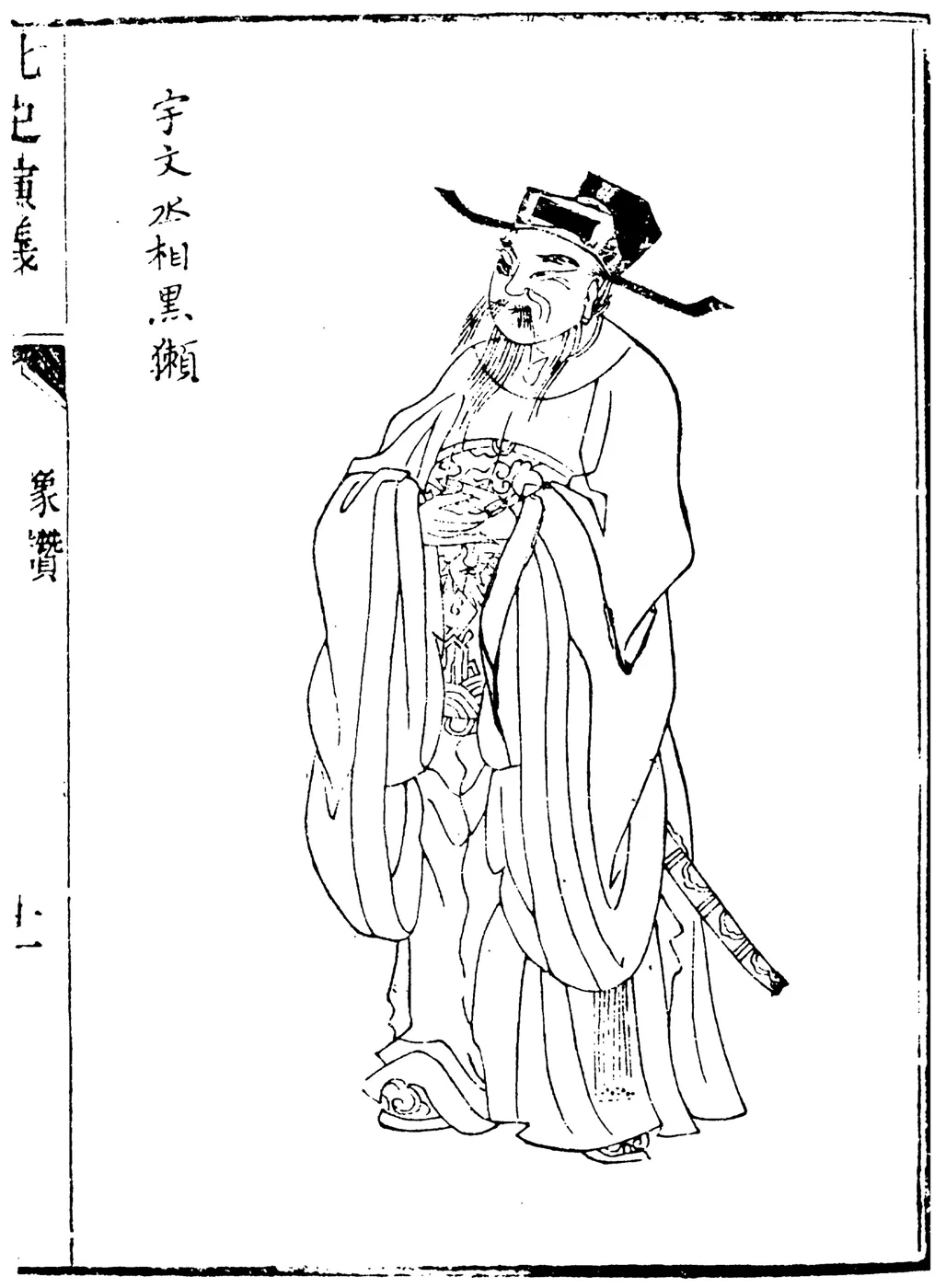
Biography
Family Background and Early Years
According to the source, Yuwen Tai's ancestors traced their origin to the Yan Emperor Shennong and later became incorporated into the Xianbei, forming the Yuwen branch. The Yuwen group was later destroyed by the Xianbei ruler Murong Huang, and the surviving members served the various Yan regimes of the Murong clan. After Later Yan was defeated by Northern Wei, the family submitted to Northern Wei and was soon resettled at Wuchuan, present-day Wuchuan County in Inner Mongolia, where it remained for generations. His ninth-generation ancestor Houdougui was defeated by Murong Huang; Houdougui's son Ling served Yan as Commandant of the Imperial Son-in-Law and was enfeoffed as Duke of Xuantu. When Emperor Daowu of Northern Wei attacked Zhongshan, Ling led five hundred armored cavalrymen in submitting to Wei, was appointed supervisor of imperial pastures, and received the title Marquis of Anding. In the early Tianxing era, Northern Wei relocated prominent families to the metropolitan region, and Ling moved to Wuchuan as part of this policy.
Yuwen Tai's father, Yuwen Gong, was military commander of Wuchuan Garrison and was known for determination and courage. At the end of the Zhengguang era in 524, the Rebellion of the Six Garrisons broke out, and the rebel forces of Wei Kegu captured Wuchuan and Huaishuo. Heba Duba, commander of Wuchuan Garrison and father of Heba Yue, was captured by the rebels but remained loyal to the Northern Wei court. Together with his close friend Yuwen Gong, he gathered local notables including Yu Zhen, Nian Xian, Yifu Kugen, and Yuchi Zhentan, raised local volunteers, and killed Wei Kegu in a surprise attack. Yuwen Tai's eldest brother Yuwen Hao died in the fighting. Shortly after Wuchuan expelled Wei Kegu's forces, it suffered an incursion by the Tiele. Heba Duba was killed fighting them, and Yuwen Gong led his family to take refuge in Zhongshan.
In the first lunar month of 526, the second year of Xiaochang, Xianyu Xiuli, a soldier from Huaishuo Garrison, led northern-garrison refugees in rebellion at Zuoren City in Dingzhou, identified here as present-day Tang County in Hebei. Yuwen Tai's family joined the rebel force. On the way to Zuoren City they were defeated by Northern Wei troops; Yuwen Gong and Yuwen Tai's second elder brother Yuwen Lian were killed. Yuwen Tai and his third elder brother Yuwen Luosheng survived and entered Xianyu Xiuli's army. After Xianyu Xiuli's death, Yuwen Tai joined Ge Rong's forces and was appointed a military commander.
Following Heba Yue
After Ge Rong's rebellion was defeated, Yuwen Tai and Yuwen Luosheng surrendered to Erzhu Rong. Yuwen Luosheng was respected for his upright character, concern for soldiers, and high reputation. Erzhu Rong became jealous and suspicious after hearing of this reputation and fabricated charges to have him killed. Yuwen Tai escaped the same fate only after speaking forcefully in his own defense and dispelling Erzhu Rong's suspicions. Because Yuwen Tai already knew Erzhu Rong's subordinate Heba Yue, who also came from a military family and had close ties with Yuwen Tai's father, Yuwen Tai was incorporated into Heba Yue's command.
In the spring of 530, the third year of Yongan, Erzhu Rong sent Erzhu Tianguang as commander-in-chief, with Heba Yue and Houmochen Yue as deputies, to suppress uprisings in the Guanlong region. Yuwen Tai entered the passes under Heba Yue as an infantry commandant. For his role in suppressing the rebellions he was successively promoted to General Who Pacifies the West and Grand Master of Splendid Happiness, received an additional three hundred households in his fief, was appointed General of the Direct Guard, and placed in charge of Yuanzhou affairs. During these campaigns Yuwen Tai used opportunities to expand his influence, showing favor to officials and commoners and winning considerable local support.
In 532, the first year of Taichang, Gao Huan destroyed the Erzhu clan, enthroned Emperor Xiaowu of Wei, Yuan Xiu, and took overall control of government. Heba Yue appointed Yuwen Tai Left Assistant Director of his Branch Department and military administrative officer, and additionally made him Cavalier Attendant-in-Ordinary, entrusting him with affairs great and small. Yuwen Tai asked to be sent to Jinyang, present-day Taiyuan in Shanxi, to observe Gao Huan. At Jinyang, Yuwen Tai responded to Gao Huan with quickness and eloquence. Gao Huan wished to retain him in his own service, but Yuwen Tai firmly declined and returned. Back in Chang'an, he analyzed the political situation for Heba Yue and argued that Gao Huan would never be content to remain a subject. He advised Heba Yue to take troops into the Long region, occupy strategic points, collect local forces, and then return to Chang'an to support the Wei house. Impressed, Heba Yue sent Yuwen Tai to Luoyang to present this plan secretly to Emperor Xiaowu, who was delighted and additionally appointed him General of the Martial Guard.
In the eighth lunar month of 533, the second year of Yongxi, Emperor Xiaowu appointed Heba Yue commander of military affairs for Yongzhou, Huazhou, and twenty other prefectures and Inspector of Yongzhou. On the pretext of pasturing horses, Heba Yue led troops west to Pingliang, present-day Huating in Gansu. That year, regarding Xiazhou, with its seat at Yanlü, identified here as Baichengzi south of present-day Uxin Banner in Inner Mongolia, as an important frontier position, Heba Yue sought a capable inspector. On the strong recommendation of those around him, Yuwen Tai was appointed Commissioner Bearing the Tally, General of the Martial Guard, and Inspector of Xiazhou. After reaching Xiazhou, Yuwen Tai pacified displaced people, cultivated good relations with non-Han communities, and quickly brought the situation under control.
Rise in the Guanlong Region
In 534, the third year of Yongxi, Heba Yue joined Houmochen Yue in attacking Cao Ni but fell into Houmochen Yue's trap and was murdered. Heba Yue's army was left without a commander and became deeply unsettled. Zhao Gui and others proposed that Yuwen Tai take command and sent men to find him. Friends advised Yuwen Tai to wait because the situation was unclear and dangerous. He replied, “What is difficult to obtain and easy to lose is opportunity; what cannot wait even to the end of the day is the decisive moment. If I do not go at once, I fear the men's loyalties will disperse.” He immediately went to Pingliang, took command of Heba Yue's troops, gathered the generals to explain the situation, toured the camps, and restored order.
Gao Huan also sent his chief secretary Hou Jing to win over Heba Yue's former troops. When Yuwen Tai reached Anding he encountered Hou Jing at a relay station. Yuwen Tai spat out the food he was chewing, mounted his horse, and said: “Though Duke Heba is dead, Yuwen Tai is still here. What are you trying to do?” Hou Jing reportedly turned pale and answered, “I am like an arrow shot by another hand toward some other place; how could I decide my own direction?” He then withdrew.
Having taken control of Heba Yue's army, Yuwen Tai ordered the forces onto a war footing in preparation for attacking Houmochen Yue. At the same time he submitted a memorial to Emperor Xiaowu, and with Yuan Pi and the generals sacrificed an animal and swore an oath to support the imperial house. Emperor Xiaowu formally appointed Yuwen Tai Grand Commander and placed Heba Yue's former troops under him. With imperial recognition, Yuwen Tai immediately led these forces against the defectors Shi Gui and Houmochen Yue, defeated Houmochen Yue, and moved east to occupy Chang'an, establishing his political base in Guanlong. After pacifying Qin and Long his power increased. Emperor Xiaowu appointed him Palace Attendant, General-in-Chief of Agile Cavalry, Commander Unequalled in Honor, Grand Commander of the region west of the passes, and Duke of Lüeyang County, with authority to make appointments by imperial delegation. He became the most powerful figure in the empire after Gao Huan.
Domination of Western Wei
In the seventh lunar month of 534, the third year of Yongxi, Emperor Xiaowu could no longer withstand Gao Huan and rode west from Luoyang into the passes, moving the court to Chang'an. He additionally appointed Yuwen Tai General-in-Chief and Inspector of Yongzhou, concurrently Director of the Department of State Affairs. In the tenth lunar month, Gao Huan installed Emperor Xiaojing of Wei, Yuan Shanjian, at Ye, present-day Yezhen in Linzhang County, Hebei, creating the regime known as Eastern Wei. Northern Wei thus split into Eastern and Western Wei.
After Emperor Xiaowu reached Chang'an, government orders came to depend entirely on Yuwen Tai. The emperor remained constrained and grew dissatisfied, and tension developed between the two. In the twelfth lunar month of the same year, Yuwen Tai poisoned Emperor Xiaowu and installed Yuan Baoju, establishing what became known as Western Wei. In the first lunar month of the following year, Yuan Baoju formally ascended the throne west of Chang'an, adopted the era name Datong, and became Emperor Wen of Western Wei. Yuwen Tai retained real control of government as chancellor, Commander of All Military Affairs at Home and Abroad, and chief of the Branch Department, and held the title Duke of Anding Commandery.
Eastern Wei was then stronger, and Gao Huan intended to pacify Guanlong. In the first lunar month of 535, the first year of Datong, Gao Huan led a large army to construct three floating bridges at Puban, present-day Yongji in Shanxi, in preparation to cross the Yellow River, opening prolonged warfare between the two Wei regimes. In the spring of 537 Eastern Wei attacked Tong Pass and Yuwen Tai defeated it. In the autumn of the same year, an Eastern Wei army of 100,000 reached Shayuan, present-day Dali in Shaanxi. With fewer than 10,000 troops, Yuwen Tai exploited the enemy's overconfidence, personally beat the drum to rally his men, and won a major victory, taking 70,000 prisoners in the Battle of Shayuan. Western Wei thereafter shifted from defense to attack and successively seized Eastern Wei territories including Hedong.
In 538, at the Battle of Mount Mang, Yuwen Tai won initially but then suffered a serious defeat; Eastern Wei, however, remained unable to penetrate deeply into Guanzhong. In 546, Gao Huan led an Eastern Wei army of 100,000 against Yubi. The Western Wei commander Wei Xiaokuan held the fortress with 7,000 men for more than fifty days. Gao Huan lost 70,000 men according to the source, fell ill from distress, and died soon afterward.
Yuwen Tai pursued a policy of making peace in the north while attacking southward. He maintained friendly relations with the Turks and Rouran. In 538 he arranged for Emperor Wen of Western Wei, Yuan Baoju, to marry Lady Yujiulü, a daughter of the Rouran qaghan Anagui, as empress, forcing his original empress, Lady Yifu, to become a Buddhist nun; in 540 he further compelled Lady Yifu to commit suicide. Against Xiao Liang in the south, Yuwen Tai followed an offensive strategy and successively seized Yizhou and territories around Jingzhou and Yongzhou in southwestern China.
In 551, Emperor Wen of Western Wei died and Yuwen Tai installed his son Yuan Qin as emperor. Yuan Qin was unwilling to remain a puppet and plotted to kill Yuwen Tai. The plot was exposed, Yuan Qin was deposed, and Yuwen Tai installed Yuan Kuo, later known as Emperor Gong of Western Wei.
Reforms and Death
While dominating Western Wei, Yuwen Tai carried out a series of major political, military, and economic reforms. Economically, he encouraged agriculture and sericulture, restored the equal-field system, and promoted military farming to support the army. He adopted Su Chuo's reform proposals, including the documentary practice described as “black enters, vermilion exits,” in which subordinates wrote memorials in black ink and superiors answered in red; the source connects this use of red and black to distinguishing fiscal expenditures and revenues and to the later Chinese expression for a deficit. He also established household registers and accounting procedures for listing the expected labor and tax obligations of the following year. Later he issued the Edict of Six Articles for local officials: first, regulate one's mind; promote moral education; fully exploit the land; elevate worthy men; show compassion in judicial matters; and equalize taxes and labor service.
Militarily, Yuwen Tai reformed the command structure and established the fubing system to broaden the recruitment base. Formally drawing on the old Xianbei system of eight divisions, he established Eight Pillars of State, though in practice there were six armies. Under each Pillar-of-State General-in-Chief were two generals-in-chief, making twelve in all. Under each general-in-chief were two Commanders Unequalled in Honor, making twenty-four. Under each such commander were two yitong commanders, making forty-eight; each yitong commanded one thousand soldiers. The six Pillars thus collectively controlled about 48,000 troops. This became the famous fubing system, later continued by the Sui and Tang.
Politically, Yuwen Tai emphasized moral education as the primary principle and law as a supplement. In legal affairs he opposed excessive severity and argued that “the law does not bend to the noble.” In thought and culture he promoted Confucian learning and established a school within the Branch Department. Captives such as Wang Bao and Zong Lin were treated courteously. He later ordered Lu Bian to reform the bureaucracy on the model of the *Rites of Zhou*, creating the Six Ministries system later associated with Northern Zhou, and even required government proclamations to imitate pre-Qin styles. Yuwen Tai also restored old Xianbei surnames: for example, the imperial Yuan clan was restored to the Tuoba surname, Han officials were granted Xianbei surnames, and soldiers adopted the non-Han surnames of their commanders. The source describes this as a formal “Hu-ization” of a group of Han Chinese, noting that Yang Zhong received the surname Puliuru and Li Hu the surname Daye.
In the ninth lunar month of 556, the third year of Emperor Gong of Western Wei, Yuwen Tai fell ill while returning from a northern inspection at Qiantun Mountain. He died at Yunyang Palace on the yihai day of the tenth lunar month, November 21, 556, aged fifty by traditional reckoning. His body was carried back to Chang'an before his death was publicly announced. After his son Yuwen Jue replaced Wei with Zhou, Yuwen Tai was posthumously honored as King Wen and given the temple name Taizu. In 559, the first year of the Wucheng era, he was further honored as Emperor Wen.
His Family and Wuchuan
Yuwen Tai, courtesy name Heita, was a man of Wuchuan county in Dai commandery, of Xianbei stock. His forebears of the Yuwen tribe came down nine generations to Hou Dougui, who was destroyed by Murong Chao; and Hou Dougui's son Yuwen Ling served Yan, was made commandant of the imperial son-in-law and enfeoffed as duke of Xuantu. When the Daowu emperor of Wei was about to attack Zhongshan, Yuwen Ling followed Murong Bao against him; and Murong Bao being beaten, Yuwen Ling came over to Wei with five hundred armoured riders, was made chief of the pastures and given the rank of marquis of Anding; and in the early Tianxing period, when the great men were moved to the capital of Dai, Yuwen Ling was moved with them to Wuchuan. In the last years of Zhengguang of the Northern Wei the rising of the Six Garrisons broke out, and the rebel Wei Keggu, whose party was especially strong, took Wuchuan and Huaishuo; and the commander of Wuchuan, Heba Doba, father of Heba Yue, though seized by the rebels, still in his heart upheld the Northern Wei government, and so plotted with his close friend Yuwen Gong, father of Yuwen Tai, and with the local worthies Yu Zhen, Nian Xian, Yifu Kugen and Yuchi Zhentan, gathering loyal men and killing Wei Keggu by surprise. After this Wuchuan, worn by war, had scarce driven out Wei Keggu's rebels when fresh risings came, and Yuwen Tai's family took part in them; but on the way to Zuoren city they were beaten by the Northern Wei government troops, and Yuwen Tai's father narrowly escaped and fled into the army of Xianyu Xiuli. After Xianyu Xiuli's death Yuwen Tai joined Ge Rong's force; and his elder brother Yuwen Luosheng, upright of character, kind to the soldiers and of high repute, was heard of by Erzhu Rong, who was jealous and suspicious of him and therefore framed a charge and killed him. When Ge Rong killed Xianyu Xiuli, Yuwen Tai being then eighteen, Ge Rong made him a commander; and Yuwen Tai, knowing that he would not succeed, plotted with his brothers to flee, but before the plan was carried out Erzhu Rong took Ge Rong and settled Hebei, and Yuwen Tai was moved with the rest to Jinyang. Erzhu Rong, thinking the Yuwen brothers heroes and fearing they might oppose him, killed Yuwen Tai's third brother Yuwen Luosheng on a trumped-up charge and meant to kill Yuwen Tai too; but Yuwen Tai vindicated his family's wrong with generous words, and Erzhu Rong was moved and spared him and treated him the more respectfully.
His Entry into the Passes under Heba Yue and His Mission to Bingzhou
In the second year of Xiaochang there was trouble in Yanzhou, and Yuwen Tai first went against it with Erzhu Rong as a commander. Earlier the prince of Beihai, Yuan Hao, had fled to Liang, and the men of Liang set him up as lord of Wei and had him lead troops into Luoyang, and Emperor Xiaozhuang of Wei withdrew to Henei to avoid him; and Erzhu Rong sent Heba Yue against Yuan Hao and to bring back the emperor. Yuwen Tai being an old friend of Heba Yue, he went with him as a detached commander. When Wanqi Chounu rebelled in the passes, Emperor Xiaozhuang sent Erzhu Tianguang and Heba Yue against him, and Yuwen Tai went with Heba Yue into the passes and as van broke the false travelling office Yuchi Pusa and others; and when Chounu was pacified and Longyou settled, Yuwen Tai had the greatest share of merit, and was made general of the western expedition and grandee of brilliant emolument of the purple, with three hundred more households, and made general of the palace gate and administrator of Yuanzhou. In putting down the risings of the passes Yuwen Tai took the chance to extend his influence, showing kindness to officers and people and winning much goodwill. In the first year of Taichang Heba Yue made him left assistant and master of horse of the travelling office, taking part in all decisions however great or small, and afterwards he went out as inspector of Xiazhou; and Heba Yue, under the pretext of pasturing horses, led troops west to camp in a vital frontier place and wished to appoint a capable man as its inspector, and at the urging of all Yuwen Tai was made inspector of Xiazhou, and on coming to Xiazhou he soothed the refugees and made friends of the peoples and soon had the commandery in hand. At that time Gao Huan was great chancellor in the court and held power, and Emperor Xiaowu, Yuan Xiu, secretly leagued with Heba Yue to check him, and Yuwen Tai, then master of horse of the office, asked of himself to go on a mission to Bingzhou to observe Gao Huan's character; and coming to Jinyang he answered Gao Huan readily and argued with vigour, and Gao Huan wished to keep him for his own use, but Yuwen Tai feigned loyalty and firmly declined and returned, and Gao Huan indeed sent men after him who came to the pass too late. Yuwen Tai also set out the situation to Heba Yue, saying that Gao Huan was no subject of a lord, and that the reason his treason was not yet manifest was his fear of the two brothers; but that no one who wished to do a great work and restore the altars of state had ever succeeded without taking advantage of the ground and gathering heroes; that Houmo Chen Yue was in truth a common man who by a lucky chance had got his post, and having no thought of the state's welfare was not feared by Gao Huan either, and that with preparation he could be taken easily; that the chief Fei Yetou had no fewer than ten thousand archers, that the inspector of Xiazhou, Hubasheng Mie'otu, had more than three thousand veteran troops, and that the inspector of Lingzhou, Cao Ni, trusting in his remoteness, harboured hopes of his own; that the refugees of Hexi under Gedouling Yili and the rest were rich in households and had not submitted to the court's influence; and that if they moved their army near Long and held the vital places, showing their might and winning them by virtue, they could gather their troops and horses to fill their own army, soothe the Di and Qiang in the west, hold the desert garrisons in the north, and return to Chang'an to support the Wei house, which was the deed of Huan and Wen. Heba Yue was much pleased, and memorialised to make Yuwen Tai holder of the tally, general of the martial guards and inspector of Xiazhou.
His Taking over Heba Yue's Army, His Welcoming of Emperor Xiaowu, and the Emperor's Killing
Heba Yue went against Cao Ni and, falling into Houmo Chen Yue's trap, was murdered, and his army of three hundred thousand was without a master and in fear. Zhao Gui and the others proposed that Yuwen Tai should command Heba Yue's troops and sent men to him; and Yuwen Tai's friends advised that the situation was unclear and the position dangerous and that he should watch and decide later, but Yuwen Tai held that the hour was hard to gain and easy to lose and that the moment would not wait the day, and that if he did not go at once the men's hearts would scatter. He went at once to Liangzhou and took over the command, gathered the generals and set out the case, and went about the camps to steady the army. Having taken over Heba Yue's troops, Yuwen Tai on the one hand put the armies under strict order to prepare against Houmo Chen Yue, and on the other memorialised Emperor Xiaowu, Yuan Xiu, and with Yuan Pi and the generals slaughtered victims and swore to support the royal house together; and Emperor Xiaowu thereupon decreed that Yuwen Tai be travelling office of the passes, commanding Heba Yue's troops. Having the emperor's formal recognition, Yuwen Tai at once led Heba Yue's remaining troops against the rebels Shi Gui and Houmo Chen Yue; and afterwards he went against Cao Ni, and the next year Cao Ni surrendered and Lingzhou was pacified, and Yuwen Tai moved its strongmen to Xianyang to hold them in hand. His strength growing after the pacification of Qin and Long, Emperor Xiaowu made him palace attendant, grand commander of the passes and duke of Lueyang, with power to appoint, becoming a powerful man second only to Gao Huan. In the seventh month of the third year of Yongxi Emperor Xiaowu, unable to withstand Gao Huan, came with light horse from Luoyang into the passes and moved the capital to Chang'an; and in the eighth month Gao Huan raided and took the Tong pass and raided Huayin, and Yuwen Tai led the armies to camp at Bashang to await him, and Gao Huan left his general Xue Jin to hold the pass and withdrew, and Yuwen Tai then marched against Xue Jin and took seven thousand of his men and returned to Chang'an, advancing to chancellor. In the tenth month of winter Gao Huan set up Yuan Shanjian, son of Yuan Dan prince of Qinghe, as lord and moved the capital to Ye, which was the Eastern Wei. After Emperor Xiaowu moved to Chang'an all decrees came from Yuwen Tai, and the emperor, still ruled by another, was displeased and grew estranged from him; and in the intercalary twelfth month of that year Yuwen Tai and the ministers settled the succession and set up Yuan Baoju, prince of Nanyang of Wei, as heir, who in the first month of the next year took the throne at the west of Chang'an city and changed the era to Datong, being Emperor Wen of the Western Wei. Yuwen Tai still held the real government of the Western Wei as chancellor, commander of all military affairs within and without and travelling office of the passes, with the rank of duke of Anding.
The Battle of Xiaoguan
In the first month of the third year of Datong Gao Huan camped at Puban and built three floating bridges on the Yellow River meaning to cross, and sent his general Dou Tai toward the Tong pass and Gao Aocao to invest Luozhou. Yuwen Tai held that the Eastern Wei, sending out columns and showing a crossing by bridges, were in truth holding his army while Dou Tai came in from the west; and that Dou Tai, a bold general of Gao Huan's made proud by many victories, should be attacked first, for if his army were beaten Gao Huan would retire without a battle. He told his generals that Gao Huan had twice raided the Tong pass, and that their army had never gone beyond Bashang; that this time he came in force but their troops had not gone out of the suburbs, so that the rebels thought they meant only to hold, with no will to fight afar, and being puffed up with success despised them; that taking this chance they could not fail; that though the rebels built bridges they could not cross at once, and that within five days he would take Dou Tai, and they should not doubt it. But the generals held that Gao Huan was near and Dou Tai far, and that to leave the near for the far was wrong, and advised dividing the army to meet them; while Yuwen Shen held that if they struck Gao Huan first Dou Tai would come to the rescue and they would be attacked front and rear, but that if they sent picked light troops out secretly to strike Dou Tai first, Gao Huan, being careful, could not come in time to the rescue, and Dou Tai being beaten Gao Huan's military power would be broken and they could turn back on him and win completely. Yuwen Tai took his advice, and proclaiming abroad that they were abandoning a certain place to mislead the Eastern Wei, secretly moved the army east from Chang'an and reached Xiaoguan on the morning of the seventeenth day of the first month; and Dou Tai, hearing suddenly that the Western Wei army had come, was panic-stricken and hurried south from Fengling to meet them, and Yuwen Tai came out at Mamuze and sent troops to attack Dou Tai, whose army broke; Dou Tai killed himself and more than ten thousand of his men were taken. Gao Huan, the ice on the Yellow River being thin and relief impossible, drew off his bridges; and Gao Aocao too was ordered to withdraw from Shangluo. In this battle Yuwen Tai judged the situation, used the weakness of the Eastern Wei army, concentrated his forces and struck one column where they did not look for it, and won at a blow.
The Battle of Shayuan
The second great war of East and West Wei now began. That year Guanzhong suffered famine, and Yuwen Tai, having pacified Hongnong, lodged and fed his army there more than fifty days; his fighting men were fewer than ten thousand, and hearing that Gao Huan was about to cross he led the army into the passes and held south of the Wei, and the troops of the several provinces he summoned did not come. Gao Huan's adviser told him that the Western Wei had suffered famine for years and that Yuwen Tai's army had risked coming to seize the grain of the granaries, and that they should divide their troops among the roads and not engage, so that by wheat harvest Yuwen Tai's soldiers and people would mostly starve and he would have to surrender; and the great general Hou Jing advised that with several hundred thousand men coming at once, if they were beaten they could not be gathered again, and that they should divide the great army in two and advance in succession, so that if the van won the rear could press on and if the van lost the rear could meet it. Gao Huan, eager for revenge, took neither advice and crossed the Yellow River at Pujin. Yuwen Tai summoned his generals, and Li Bi said that the enemy being many and they few, they could not array on the plain, but that ten li east there was the Wei bend where they might first take post and await them; so they advanced to the Wei bend and formed with their backs to the water, Li Bi as the right wing and Zhao Gui as the left, and ordered the officers and men to lay down their spears in the reeds and rise at the sound of the drum. At the hour of the monkey Gao Huan's army came, and seeing the smallness of Yuwen Tai's force they raced forward in no order and massed against the left; and as they joined battle Yuwen Tai beat the drum and the men all rose, and Yu Jin and five other armies fought with them while Li Bi and the rest with armoured horse struck across and cut their army in two and broke it utterly, beheading more than six thousand and taking more than twenty thousand who surrendered. Yuwen Tai pursued to the Yellow River, taking seventy thousand in all, keeping twenty thousand armoured men and letting the rest go home, and gathered their baggage and weapons and presented captives at Chang'an; and returning to the south of the Wei he found that the troops of the provinces he had summoned had only then arrived. After this victory his troops were fine and his grain sufficient, and he had each soldier plant a willow on the field of battle to mark the feat, and was advanced to pillar of state and grand general, with his fief increased to five thousand households.
The Battle of Heqiao and the Battle of Mangshan
Soon after Shayuan Yuwen Tai sent troops east: Yuan Jihai, prince of Fengyi, and the prefect of the armies Dugu Xin with twenty thousand foot and horse toward Luoyang, the inspector of Luozhou Li Xian toward Jingzhou, and Heba Sheng and Li Bi east across the Yellow River to invest Puban; and the Eastern Wei gate commander Gao Zixin opened the gate to Heba Sheng's army, and the Eastern Wei general Xue Chongli abandoned the city and fled, and Heba Sheng and the others pursued and took him. In the seventh month the Eastern Wei sent Hou Jing, Kudi Gan, Gao Aocao, Han Gui, Kezhu Hunyuan and Modoulou Daiwen to invest Dugu Xin at Luoyang, with Gao Huan following; and in the eighth month Yuwen Tai came to Gucheng, and Modoulou Daiwen and Kezhu Hunyuan came against him, and he killed Daiwen in the field and took all his men and sent them to Hongnong. Hou Jing raised the siege by night and went north, and Yuwen Tai pursued him; and Hou Jing drew up a long line, holding the river bridge in the north and Mount Mang in the south, and fought Yuwen Tai's great army. In the mêlée Yuwen Tai's horse was struck by a stray arrow and bolted and threw him to the ground, and the Eastern Wei host came up and his attendants scattered; and the commander Li Mu dismounted and beat the sprawling Yuwen Tai with his whip, pretending to curse a common soldier, and the Eastern Wei troops pursuing, hearing Li Mu's tone, took the man on the ground for no commander of the Western Wei and turned to chase others; and Li Mu helped Yuwen Tai onto a horse and both fled. The Western Wei rear coming up in force, their spirit revived and they turned on Hou Jing's army and broke it heavily, more than ten thousand drowning in the river as they fled. They killed Gao Aocao with his guardsman Li Meng and the inspector of Yanzhou Song Xian, and took fifteen thousand armoured men and as many tens of thousands drowned in the river; and Gao Huan, hearing of Gao Aocao's death, was as one whose liver and gall were torn out, and had Gao Yongle beaten two hundred strokes of the army staff. That day the array being great and its ends far apart, they fought from dawn to the hour of the goat some tens of engagements in a fog so thick that none could know the other; and Dugu Xin and Li Yuan held the right and Zhao Gui and Yi Feng the left, and both being worsted and not knowing where the emperor and Yuwen Tai were, they abandoned their men and went home first, and the generals Li Hu and Nian Xian of the rear, meeting Dugu Xin's retreat, went back with them, and so the army was withdrawn and Luoyang was lost. That night Gao Huan with seven thousand horse hurried to the front, but the Western Wei had gone; and though in this campaign the Eastern Wei recovered the central strongpoint of Luoyang and the Western Wei lost some troops, no vital harm was done, so that in the twelfth month of that year Luoyang fell again in a local counter-attack of the Western Wei. In the ninth year of Datong the fourth great war, the battle of Mangshan, opened, its occasion being the surrender to the Western Wei of the Eastern Wei inspector of Beiyuzhou, Gao Zhongmi; and Yuwen Tai led the armies to receive him, and coming to the north bank of the Yellow River where Gao Huan had crossed, he held Mount Mang and did not fight for days; and Yuwen Tai left all his baggage and climbed Mount Mang by night meaning to surprise Gao Huan. The Eastern Wei with several thousand horse charged straight into the northern army of the Western Wei and broke all before them, and Peng Le sent word of the victory, having taken the Western Wei prince of Lintao, Yuan Jian, with four other princes and forty-eight commanders and staff; and Gao Huan sent Peng Le after Yuwen Tai, and Yuwen Tai, in sorry case, begged him from horseback to take his gold and jewels and spare him, and Peng Le, being a rough man, thought it reasonable, left Yuwen Tai and went back to the camp to take the bags of gold and report to Gao Huan. Gao Huan, glad of the victory and furious that Peng Le had let Yuwen Tai go, made him prostrate himself and seizing his great head dashed it against the ground again and again, grinding his teeth, and several times raised his sword to cut it off but could not bring himself to do it. The next day the two armies fought again and Yuwen Tai's three armies struck together and Gao Huan was heavily beaten, with sixty thousand killed or taken, Gao Huan himself losing his horse to an arrow. Afterwards, because the troops under Zhao Gui and four other Western Wei generals fell back, the field changed again and the Eastern Wei, gathering, came on; and Yuwen Tai, attacking, could not hold and fled with his army, and only because Dugu Xin and the others gathered the scattered troops of the Western Wei and harassed the pursuers from behind did he escape, and camped on the upper Wei. Gao Huan entered Shanzhou, and his officer Feng Zihui urged him to follow up the victory and unite the two Weis; but the other generals had no spirit and dared not fight again, and Gao Huan, seeing them disheartened, ordered the army home; and Wang Sizheng, who had held the Hongnong granary for Yuwen Tai, hearing of the great defeat did not flee but had the gates opened wide and lay down with his clothes loosened on the city tower to encourage the officers and men, and some days later the Eastern Wei troops came to the wall, saw the gates open, and dared not enter.
The Turning after Yubi, the Rebellion of Hou Jing, and the Taking of Shu
In the ninth month of the twelfth year of Datong Gao Huan in person led more than a hundred thousand men to invest Yubi, held by the Western Wei, and Wei Xiaokuan defended it stubbornly; and Gao Huan cut the water, used fire and dug tunnels, and besieged the city more than fifty days, losing more than seventy thousand men, and could not take it, and at last fell ill and raised the siege. In that battle Gao Huan put out all his strength and could not take one isolated city in fifty days, so that his wit failed him and he fell into a fury and sickened, and in the first month of the next year he died; and from then Yuwen Tai turned his former inferiority about. Gao Cheng and Hou Jing, who held strong troops, were at odds, and Gao Cheng, fearing Hou Jing's weight, wished to take his troops; and Hou Jing held himself fast with his army, and Yuwen Tai accepted his surrender while being very cautious with the cunning and changeable Hou Jing, sending great armies in succession to take over the land Hou Jing held and hinting that he should give up his troops and come to court at Chang'an; and Gao Cheng in the meantime also sent a great army to press him, so that Hou Jing turned and went over to the Liang. In the putting down of Hou Jing's rebellion the Xiao brothers contended for the throne and killed one another, and Yuwen Tai took the chance to seize the Liang's land, taking Handong and the rest; and Xiao Yi, before Hou Jing was put down, had acknowledged himself a vassal of the Western Wei and made a league with them, with a border at a certain place, asking to be a dependent and sending a hostage, but once emperor he no longer acknowledged vassalage; and Yuwen Tai sent the envoy Yuwen Renshu to Jiangling to inquire, and the Liang emperor told him that Liang was now united and that the Western Wei should return to Liang the Yi and Xiangyang they had taken. Yuwen Tai held that having taken Liang and Yi they should go further and take the Jiang and Han; and it happened that Xiao Yi's nephew came to the Western Wei court asking for troops against Xiao Yi. So in the ninth month of the first year of Gongdi of the Western Wei Yuwen Tai ordered Yu Jin and Yuwen Hu against Jiangling, and Yuwen Hu with light horse as van went day and night and sent officers to take the Liang's frontier towns, took their scouts, and came straight under the walls of Jiangling; and the city, not expecting the army, was in confusion, and Yuwen Hu sent two thousand horse to cut the river crossing and collect the ships to await the great army, and invested and took it. In the eleventh month the city fell and the Liang emperor was put to death, and the Wei army chose more than a hundred thousand men and women of the people of Jiangling and drove them into the passes, leaving only an empty city to Xiao Cha, and bringing the lands the Liang had held within the Western Wei. These victories made the Western Wei the power best able to unite the realm.
The Deposing and Killing of the Western Wei Emperors, the Six Ministries, and His Death
In the third month of the seventeenth year of Datong Emperor Wen of the Western Wei died, and his son succeeded as the deposed emperor; the era was changed but no more era names were used, and from then the Western Wei emperors had no era names. Some of the Yuan imperial clan, unwilling that the government should come from the chancellor, wished to take power back from Yuwen Tai: the master of the secretariat Yuan Lie plotted a coup to kill him, and the matter leaked and he was killed by Yuwen Tai; and the deposed emperor, pitying Yuan Lie and much displeased with Yuwen Tai, plotted to kill him, and the plot leaked again, so that in the ninth month of the third year of the deposed emperor Yuwen Tai deposed and killed Yuan Qin and set up his younger brother, the prince of Qi. From then the Western Wei emperor had but the empty name of emperor, and the change of house was only a matter of time. In the first month of spring of the third year of Gongdi Yuwen Tai first carried out the rites of Zhou and established the six ministries, taking himself as grand tutor and grand steward, the pillar of state Li Bi as grand tutor and grand minister over the masses, Zhao Gui as grand guardian and grand master of rites, Dugu Xin as grand master of horse, Yu Jin as grand master of works and Houmo Chen Chong as grand master of works. In the fourth month of the third year of Gongdi of the Western Wei Yuwen Tai made a northern tour; in the eighth month he crossed the northern river; and in the ninth month, returning to Mount Qiandun, he fell ill, and knowing himself gravely ill he sent in haste for his nephew Yuwen Hu at Jingzhou and entrusted his orphan to him, saying that his sons were all young and that with strong enemies without and many rivals within the affairs of the state must all be decided by him, and that he must strive to accomplish his purpose. On the day yihai of the tenth month he died at the Yunyang palace and his death was announced at Chang'an at fifty-two, by another account fifty, and he was buried in the Cheng tomb with the posthumous name duke Wen. The next year Yuwen Hu forced the abdication of the Western Wei emperor and the Northern Zhou was founded; and Yuwen Tai was posthumously honoured in turn as king Wen and emperor Wen with the temple name Taizu. His Cheng tomb lies in the primary school of Gongli township, Fuping county, Shaanxi, eleven kilometres south of the county town at five hundred and thirty metres; the mound is twelve metres high and a hundred and forty-two point eight metres round, planted with pines and cypresses, and before it stands a stone set up by Bi Yuan, governor of Shaanxi, in the forty-first year of Qianlong, and another set up in the sixth year of Kaibao of the Northern Song.